9709 P13 - Nov 2013 - Q4
2243
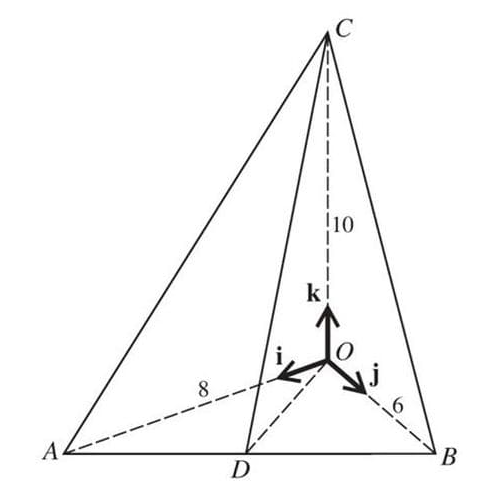
The diagram shows a pyramid OABC in which the edge OC is vertical. The horizontal base OAB is a triangle, right-angled at O, and D is the mid-point of AB. The edges OA, OB and OC have lengths of 8 units, 6 units and 10 units respectively. The unit vectors i, j and k are parallel to \(\overrightarrow{OA}\), \(\overrightarrow{OB}\) and \(\overrightarrow{OC}\) respectively.
(i) Express each of the vectors \(\overrightarrow{OD}\) and \(\overrightarrow{CD}\) in terms of i, j and k.
(ii) Use a scalar product to find angle ODC.
Solutions locked. Please sign in with access to view them.