Past Exam Questions
← Back9709 P33 - Jun 2019 - Q10I - 5 marks
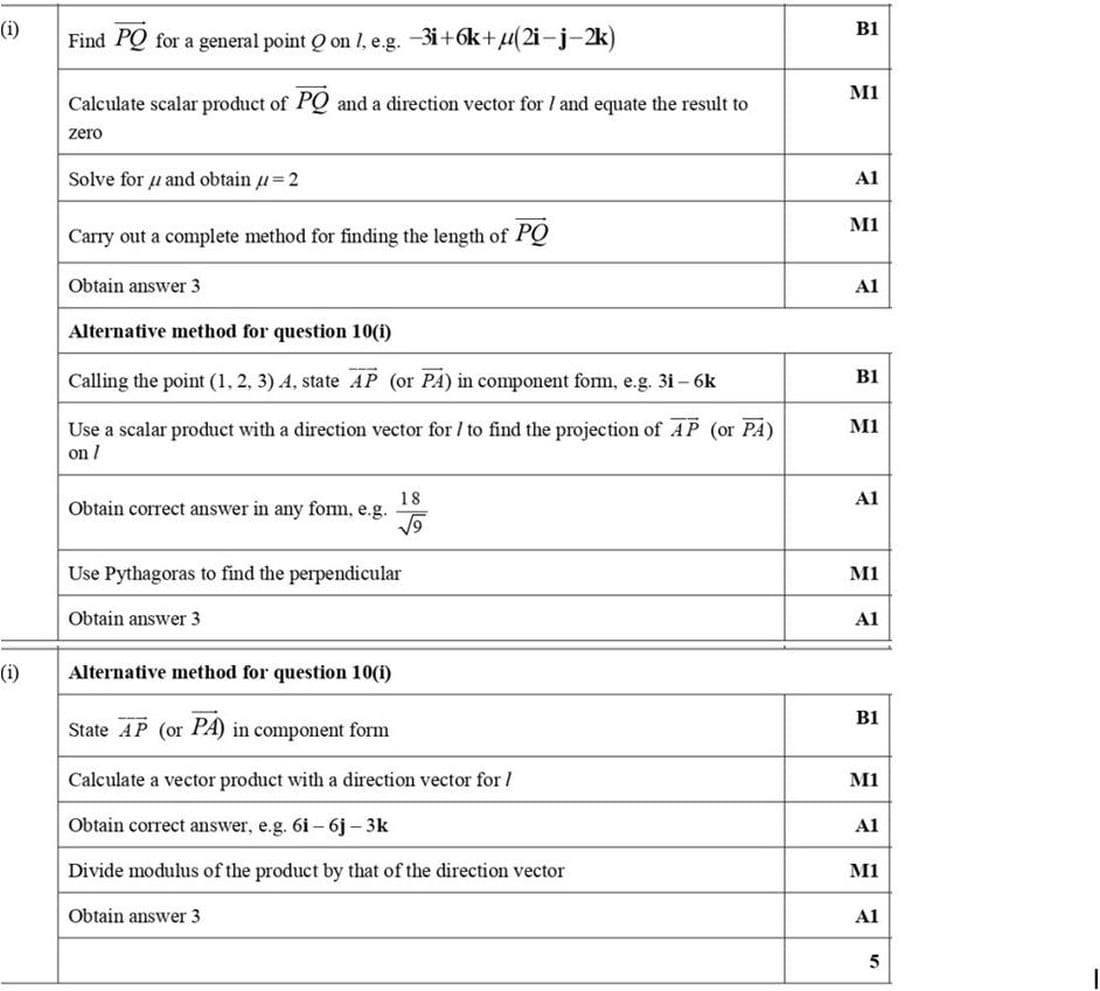
\(The line l has equation r = i + 2j + 3k + μ(2i - j - 2k).\)
The point P has position vector 4i + 2j - 3k. Find the length of the perpendicular from P to l.
9709 P32 - Jun 2019 - Q9I - 5 marks
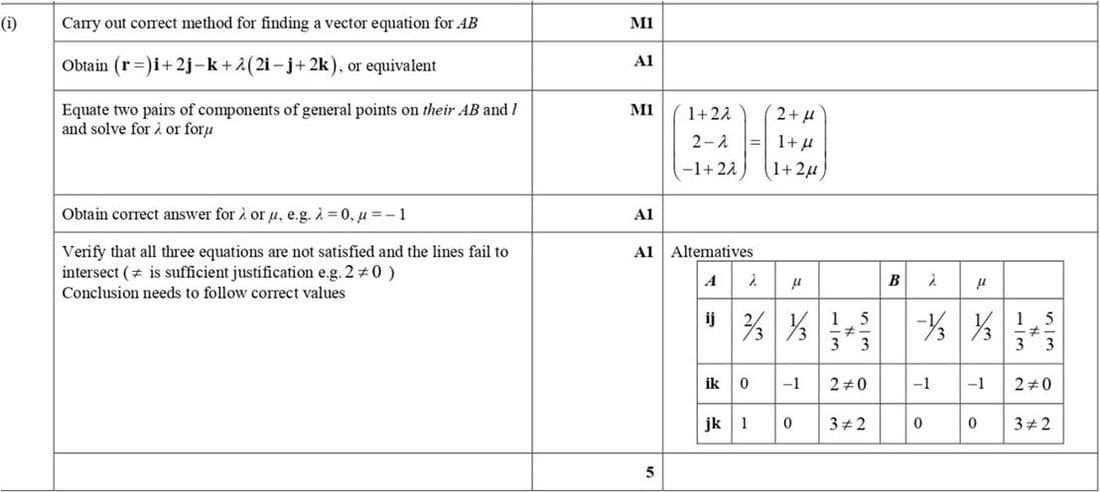
The points A and B have position vectors i + 2j - k and 3i + j + k respectively. The line l has equation r = 2i + j + k + μ(i + j + 2k).
Show that l does not intersect the line passing through A and B.
9709 P33 - Jun 2018 - Q10 - 11 marks
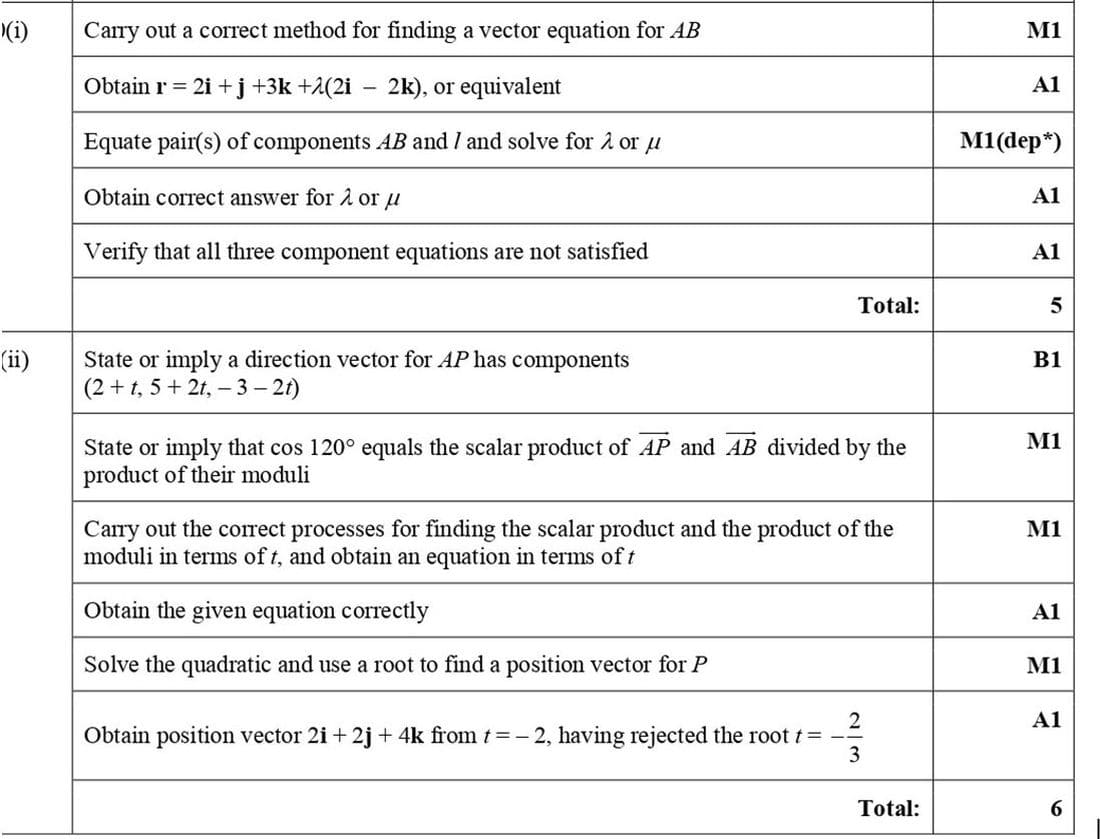
The points A and B have position vectors \(2\mathbf{i} + \mathbf{j} + 3\mathbf{k}\) and \(4\mathbf{i} + \mathbf{j} + \mathbf{k}\) respectively. The line l has equation \(\mathbf{r} = 4\mathbf{i} + 6\mathbf{j} + \mu(\mathbf{i} + 2\mathbf{j} - 2\mathbf{k})\).
(i) Show that l does not intersect the line passing through A and B.
The point P, with parameter t, lies on l and is such that angle PAB is equal to 120°.
(ii) Show that \(3t^2 + 8t + 4 = 0\). Hence find the position vector of P.
9709 P32 - Jun 2018 - Q10I - 4 marks
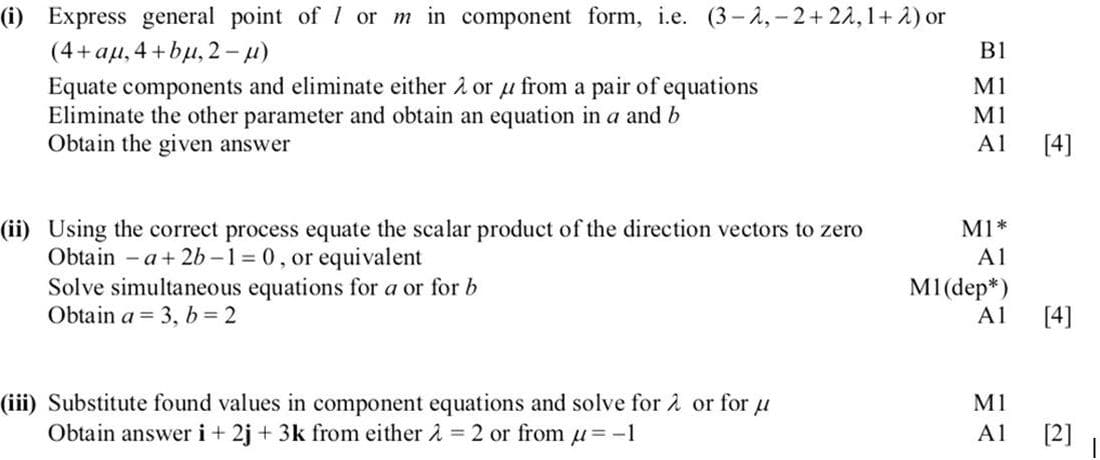
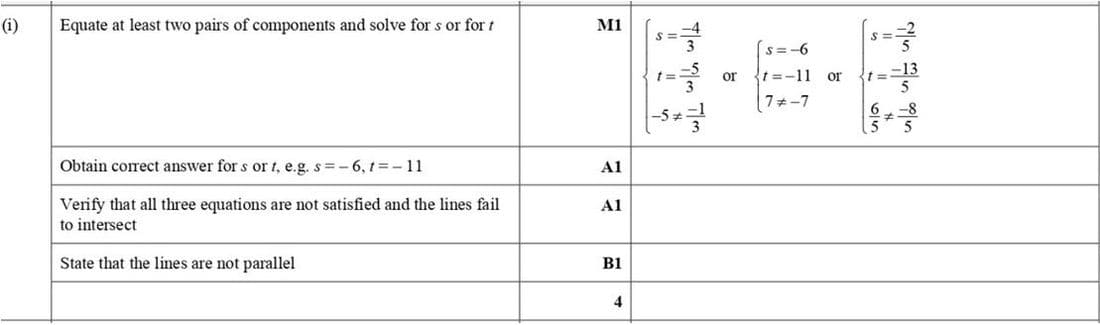
Two lines l and m have equations r = 2i - j + k + s(2i + 3j - k) and r = i + 3j + 4k + t(i + 2j + k) respectively.
Show that the lines are skew.
9709 P31 - Jun 2018 - Q10I - 5 marks
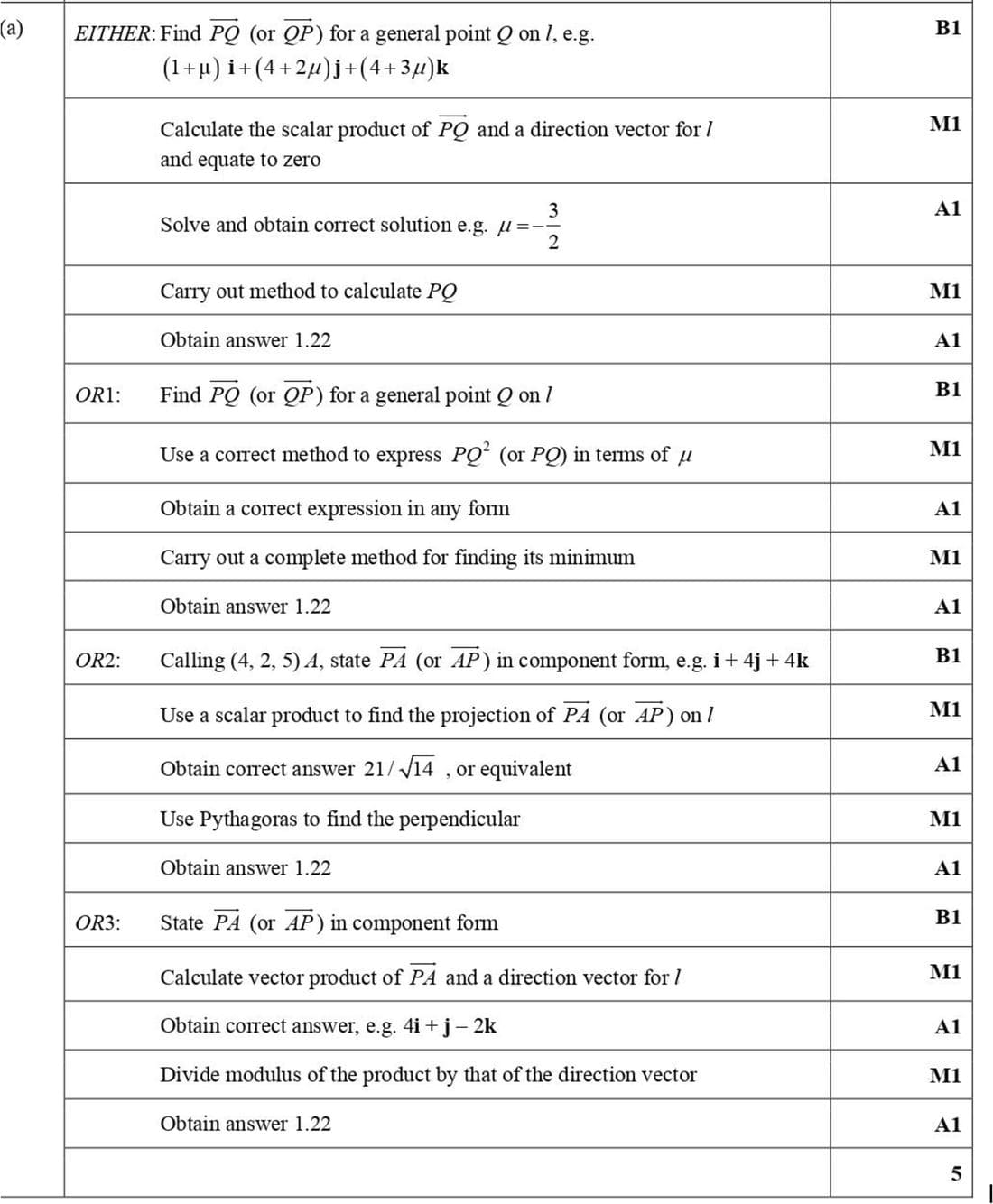
The point P has position vector \(3\mathbf{i} - 2\mathbf{j} + \mathbf{k}\). The line \(l\) has equation \(\mathbf{r} = 4\mathbf{i} + 2\mathbf{j} + 5\mathbf{k} + \mu(\mathbf{i} + 2\mathbf{j} + 3\mathbf{k})\).
Find the length of the perpendicular from P to l, giving your answer correct to 3 significant figures.
9709 P31 - Nov 2017 - Q10 - 6 marks
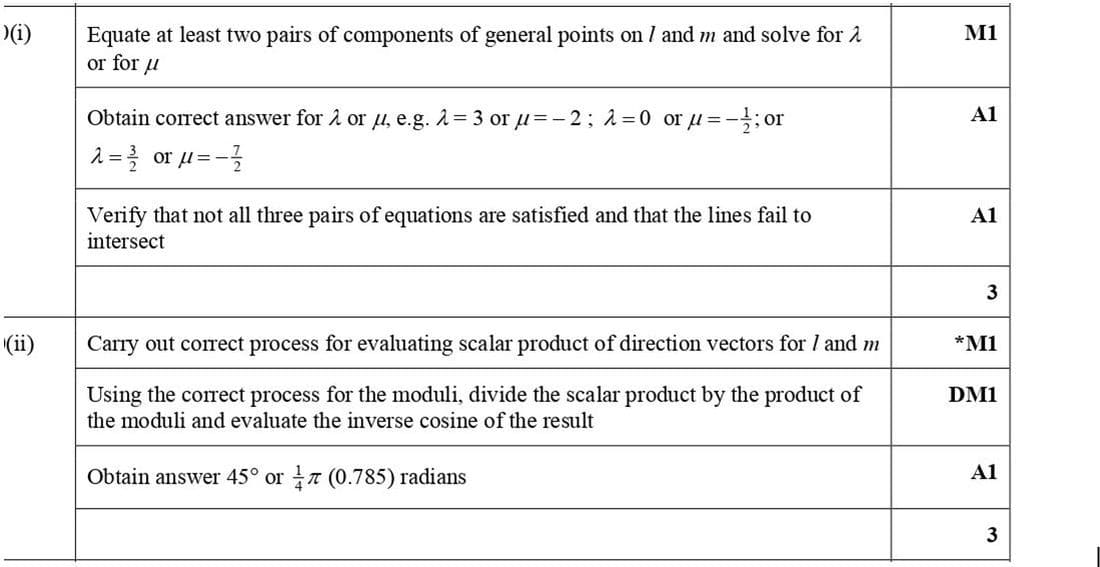
The equations of two lines l and m are r = 3i − j − 2k + λ(−i + j + 4k) and r = 4i + 4j − 3k + μ(2i + j − 2k) respectively.
- Show that the lines do not intersect.
- Calculate the acute angle between the directions of the lines.
9709 P33 - Jun 2017 - Q10I - 5 marks
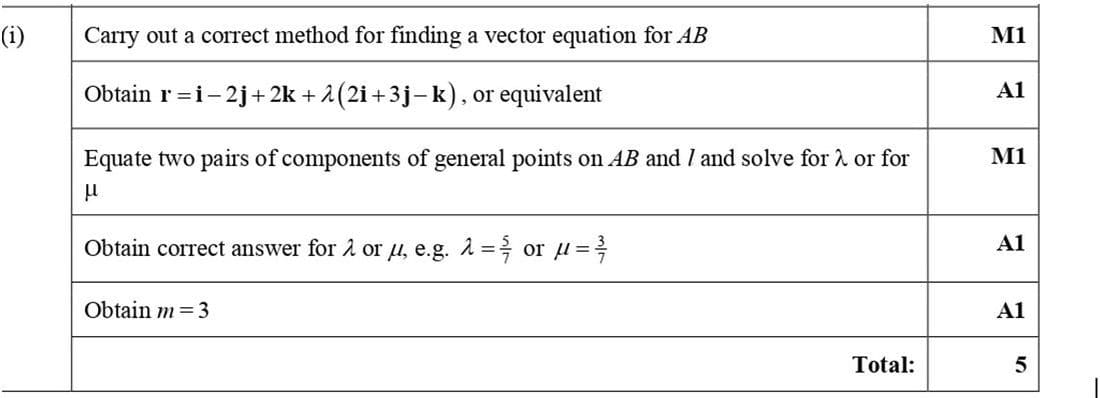
The points A and B have position vectors given by \(\overrightarrow{OA} = \mathbf{i} - 2\mathbf{j} + 2\mathbf{k}\) and \(\overrightarrow{OB} = 3\mathbf{i} + \mathbf{j} + \mathbf{k}\). The line \(l\) has equation \(\mathbf{r} = 2\mathbf{i} + \mathbf{j} + m\mathbf{k} + \mu(\mathbf{i} - 2\mathbf{j} - 4\mathbf{k})\), where \(m\) is a constant.
Given that the line \(l\) intersects the line passing through A and B, find the value of \(m\).
9709 P33 - Jun 2023 - Q9 - 10 marks
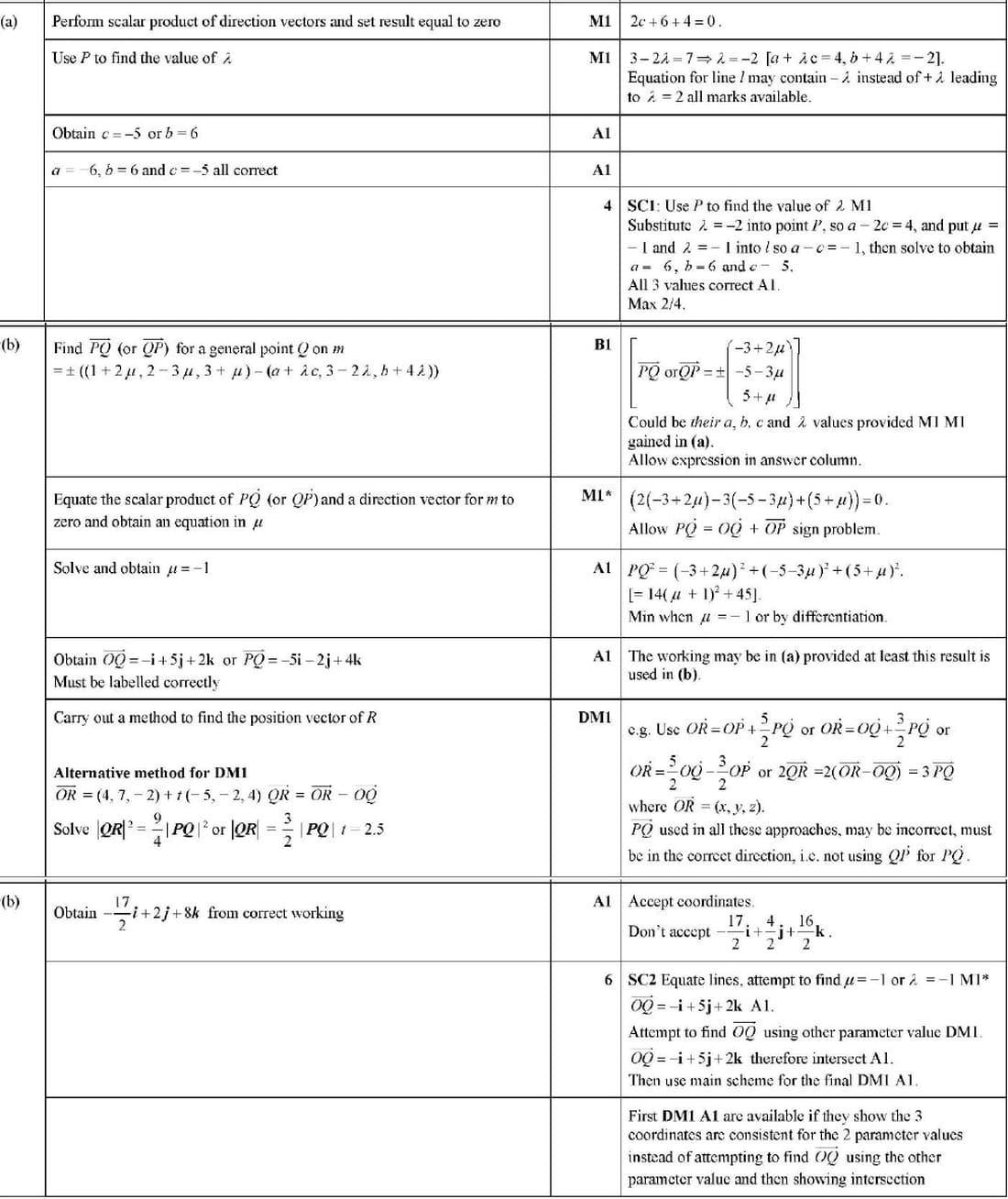
The lines l and m have equations
l: \(\mathbf{r} = a\mathbf{i} + 3\mathbf{j} + b\mathbf{k} + \lambda (c\mathbf{i} - 2\mathbf{j} + 4\mathbf{k})\),
m: \(\mathbf{r} = \mathbf{i} + 2\mathbf{j} + 3\mathbf{k} + \mu (2\mathbf{i} - 3\mathbf{j} + \mathbf{k})\).
Relative to the origin O, the position vector of the point P is \(4\mathbf{i} + 7\mathbf{j} - 2\mathbf{k}\).
(a) Given that l is perpendicular to m and that P lies on l, find the values of the constants a, b and c.
(b) The perpendicular from P meets line m at Q. The point R lies on PQ extended, with \(PQ : QR = 2 : 3\).
Find the position vector of R.
9709 P32 - Jun 2017 - Q9I - 5 marks
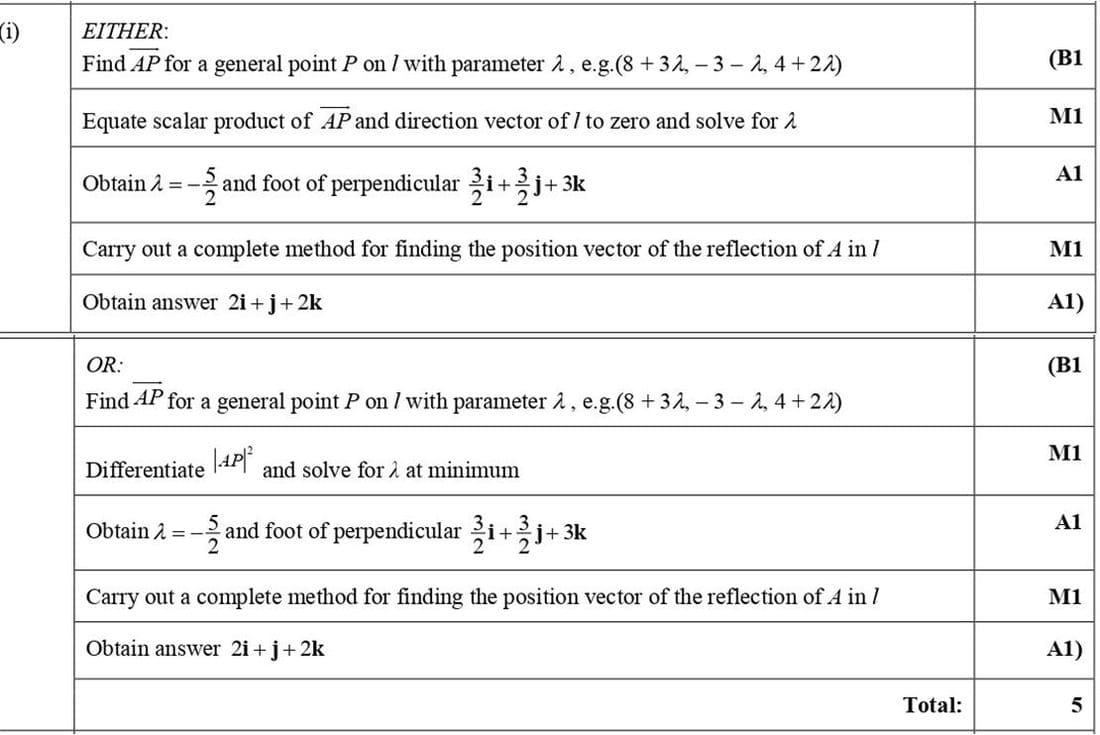
Relative to the origin O, the point A has position vector given by \(\overrightarrow{OA} = \mathbf{i} + 2\mathbf{j} + 4\mathbf{k}\). The line l has equation \(\mathbf{r} = 9\mathbf{i} - \mathbf{j} + 8\mathbf{k} + \mu(3\mathbf{i} - \mathbf{j} + 2\mathbf{k})\).
Find the position vector of the foot of the perpendicular from A to l. Hence find the position vector of the reflection of A in l.
9709 P33 - Nov 2016 - Q10I - 5 marks
The line l has vector equation r = i + 2j + k + \(\lambda (2i - j + k)\).
Find the position vectors of the two points on the line whose distance from the origin is \(\sqrt{10}\).

9709 P33 - Jun 2016 - Q8 - 9 marks
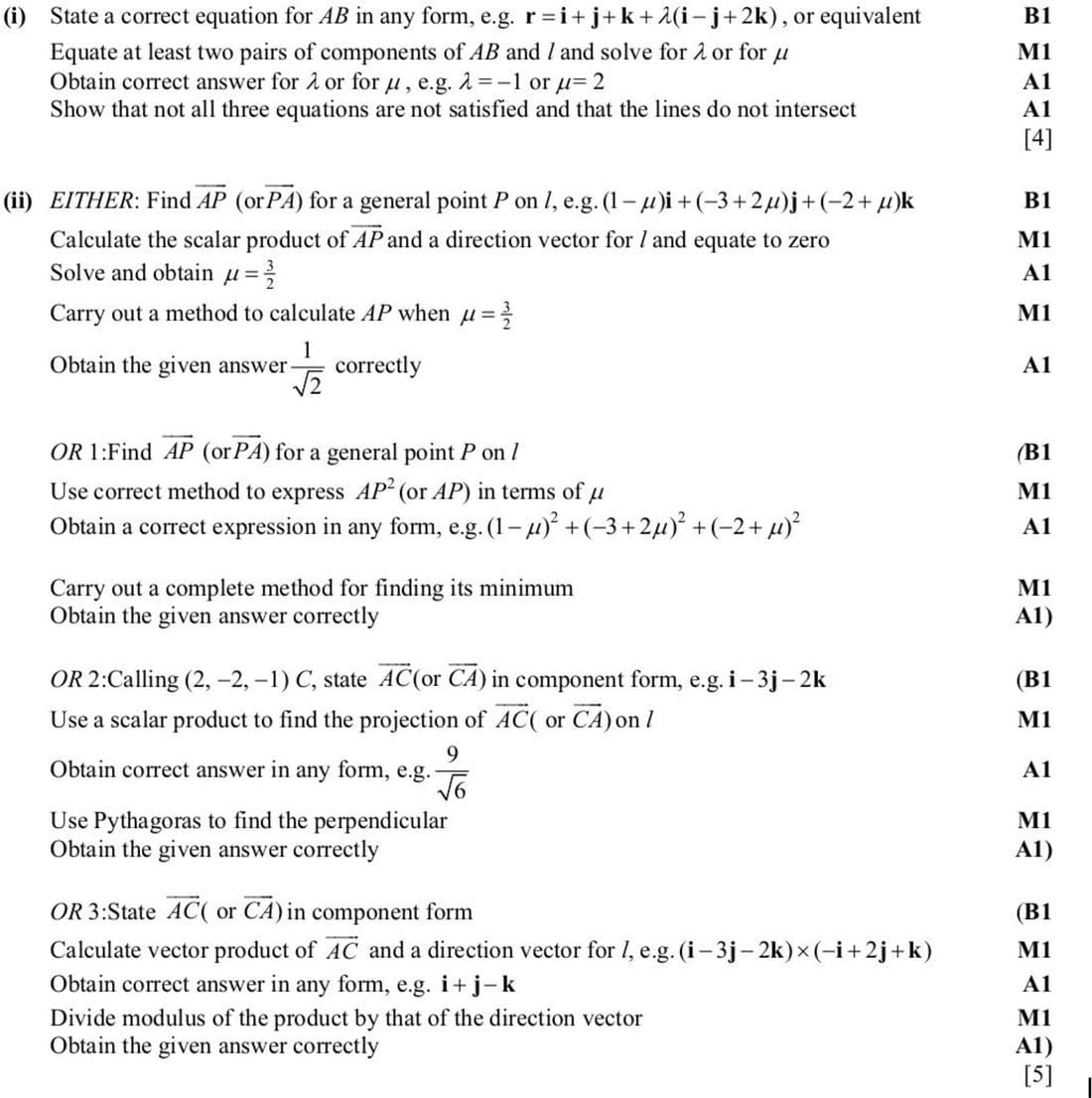
The points A and B have position vectors, relative to the origin O, given by \(\overrightarrow{OA} = \mathbf{i} + \mathbf{j} + \mathbf{k}\) and \(\overrightarrow{OB} = 2\mathbf{i} + 3\mathbf{k}\). The line \(l\) has vector equation \(\mathbf{r} = 2\mathbf{i} - 2\mathbf{j} - \mathbf{k} + \mu(-\mathbf{i} + 2\mathbf{j} + \mathbf{k})\).
(i) Show that the line passing through A and B does not intersect \(l\).
(ii) Show that the length of the perpendicular from A to \(l\) is \(\frac{1}{\sqrt{2}}\).
9709 P32 - Jun 2016 - Q9I - 5 marks
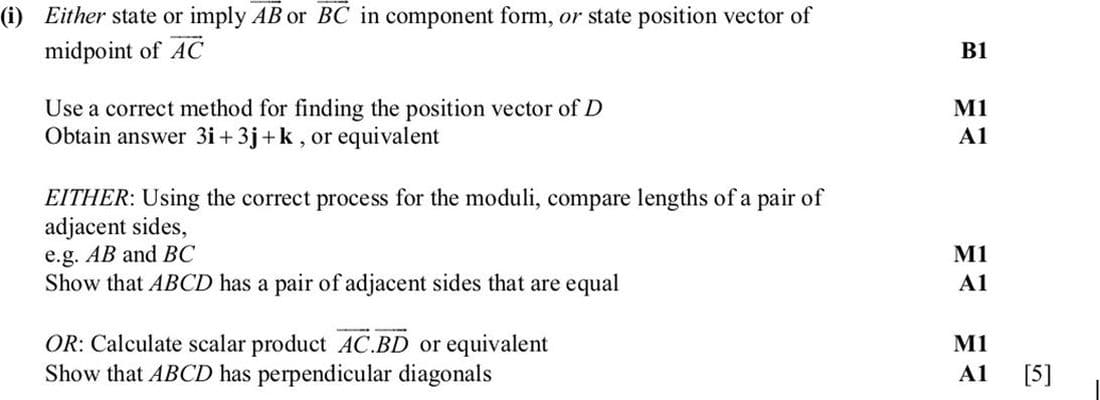
The points A, B and C have position vectors, relative to the origin O, given by \(\overrightarrow{OA} = \mathbf{i} + 2\mathbf{j} + 3\mathbf{k}\), \(\overrightarrow{OB} = 4\mathbf{j} + \mathbf{k}\) and \(\overrightarrow{OC} = 2\mathbf{i} + 5\mathbf{j} - \mathbf{k}\). A fourth point D is such that the quadrilateral ABCD is a parallelogram.
Find the position vector of D and verify that the parallelogram is a rhombus.
9709 P32 - Jun 2015 - Q10I - 5 marks
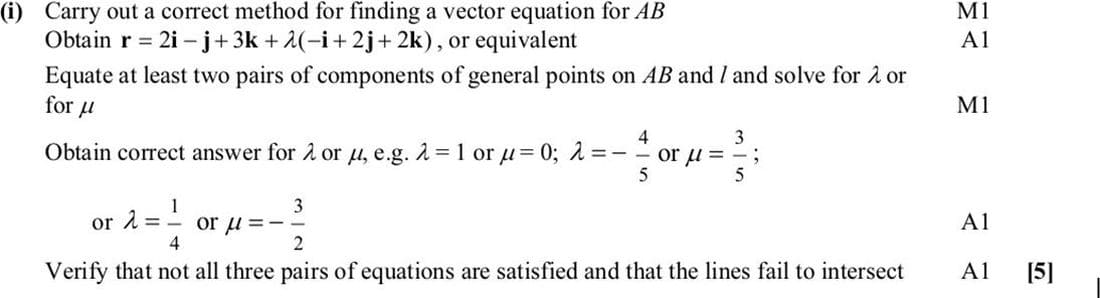
The points A and B have position vectors given by \(\overrightarrow{OA} = 2\mathbf{i} - \mathbf{j} + 3\mathbf{k}\) and \(\overrightarrow{OB} = \mathbf{i} + \mathbf{j} + 5\mathbf{k}\). The line l has equation \(\mathbf{r} = \mathbf{i} + \mathbf{j} + 2\mathbf{k} + \mu(3\mathbf{i} + \mathbf{j} - \mathbf{k})\).
Show that l does not intersect the line passing through A and B.
9709 P31 - Jun 2015 - Q6 - 9 marks
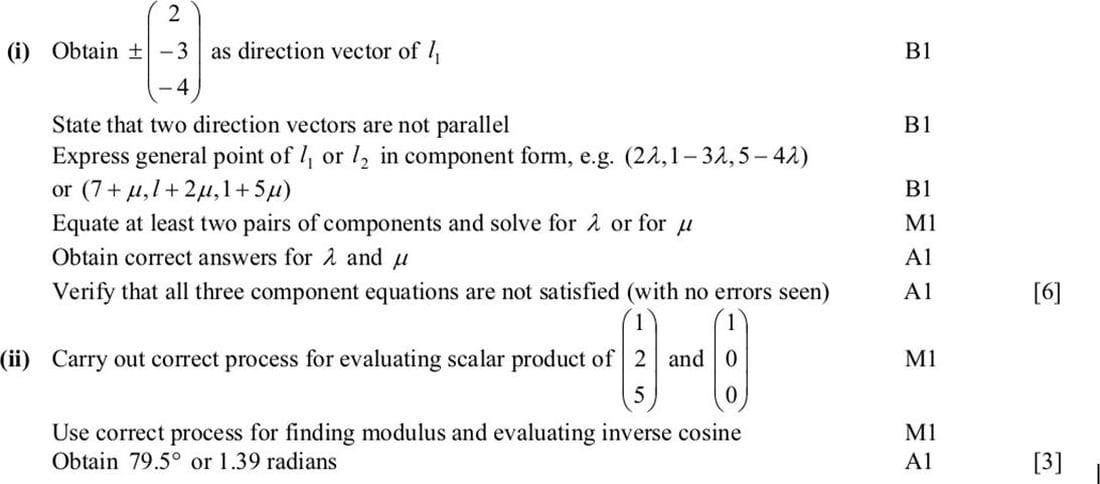
The straight line \(l_1\) passes through the points \((0, 1, 5)\) and \((2, -2, 1)\). The straight line \(l_2\) has equation \(\mathbf{r} = 7\mathbf{i} + \mathbf{j} + \mathbf{k} + \mu(\mathbf{i} + 2\mathbf{j} + 5\mathbf{k})\).
(i) Show that the lines \(l_1\) and \(l_2\) are skew.
(ii) Find the acute angle between the direction of the line \(l_2\) and the direction of the \(x\)-axis.
9709 P33 - Nov 2014 - Q7 - 8 marks
The equations of two straight lines are
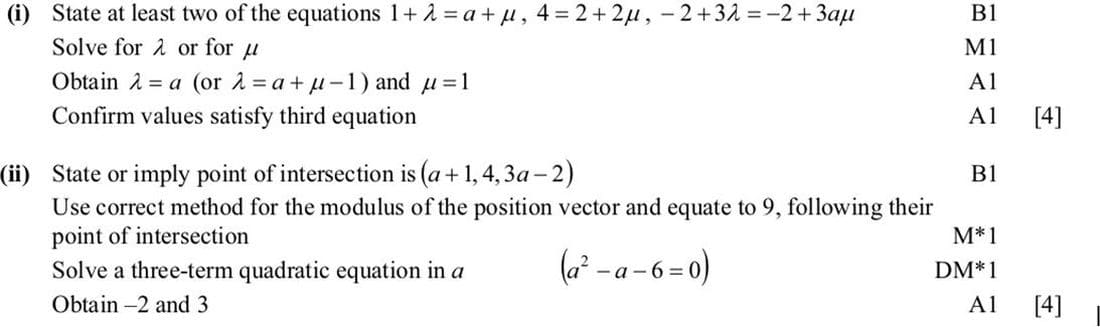
\(\mathbf{r} = \mathbf{i} + 4\mathbf{j} - 2\mathbf{k} + \lambda(\mathbf{i} + 3\mathbf{k})\) and \(\mathbf{r} = a\mathbf{i} + 2\mathbf{j} - 2\mathbf{k} + \mu(\mathbf{i} + 2\mathbf{j} + 3a\mathbf{k})\),
where \(a\) is a constant.
- Show that the lines intersect for all values of \(a\).
- Given that the point of intersection is at a distance of 9 units from the origin, find the possible values of \(a\).
9709 P31 - Nov 2014 - Q10I - 5 marks
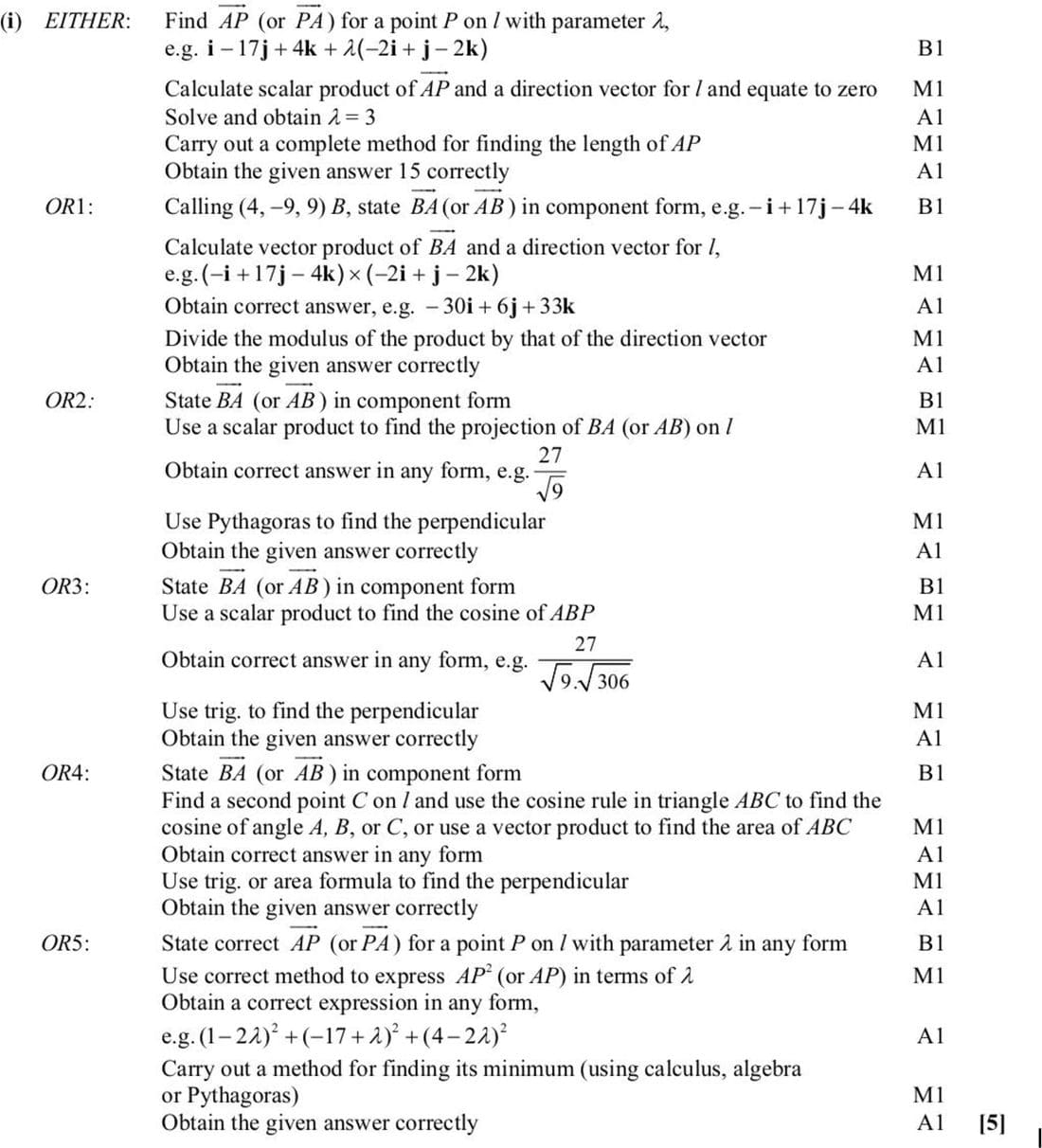
The line l has equation r = 4i - 9j + 9k + \(\lambda (-2i + j - 2k)\). The point A has position vector 3i + 8j + 5k.
Show that the length of the perpendicular from A to l is 15.
9709 P32 - Jun 2014 - Q10 - 7 marks
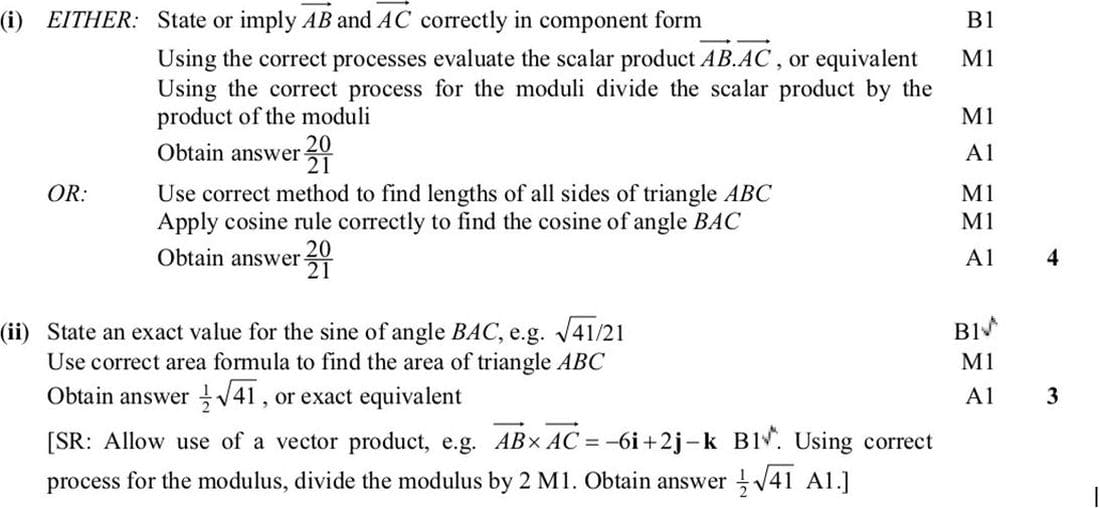
Referred to the origin O, the points A, B and C have position vectors given by
\(\overrightarrow{OA} = \mathbf{i} + 2\mathbf{j} + 3\mathbf{k}, \quad \overrightarrow{OB} = 2\mathbf{i} + 4\mathbf{j} + \mathbf{k}, \quad \text{and} \quad \overrightarrow{OC} = 3\mathbf{i} + 5\mathbf{j} - 3\mathbf{k}.\)
- Find the exact value of the cosine of angle BAC.
- Hence find the exact value of the area of triangle ABC.
9709 P33 - Nov 2012 - Q8I - 5 marks
Two lines have equations
\(\mathbf{r} = \begin{pmatrix} 5 \\ 1 \\ -4 \end{pmatrix} + s \begin{pmatrix} 1 \\ -1 \\ 3 \end{pmatrix}\) and \(\mathbf{r} = \begin{pmatrix} p \\ 4 \\ -2 \end{pmatrix} + t \begin{pmatrix} 2 \\ 5 \\ -4 \end{pmatrix}\),
where \(p\) is a constant. It is given that the lines intersect.
Find the value of \(p\) and determine the coordinates of the point of intersection.

9709 P32 - Jun 2023 - Q11 - 9 marks
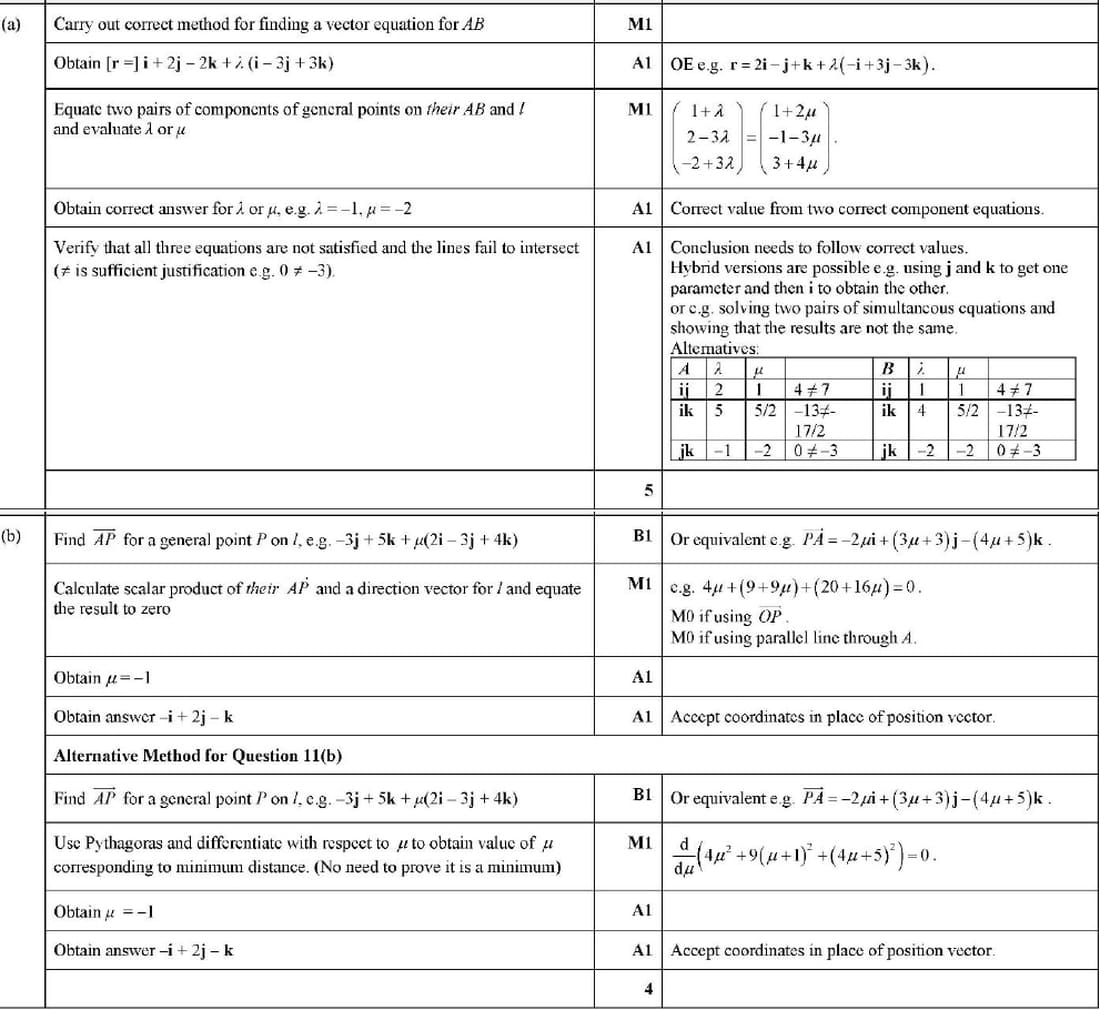
The points A and B have position vectors \(\mathbf{i} + 2\mathbf{j} - 2\mathbf{k}\) and \(2\mathbf{i} - \mathbf{j} + \mathbf{k}\) respectively. The line \(l\) has equation \(\mathbf{r} = \mathbf{i} - \mathbf{j} + 3\mathbf{k} + \mu(2\mathbf{i} - 3\mathbf{j} + 4\mathbf{k})\).
(a) Show that \(l\) does not intersect the line passing through A and B.
(b) Find the position vector of the foot of the perpendicular from A to \(l\).
9709 P33 - Jun 2012 - Q9 - 10 marks
The lines l and m have equations r = 3i - 2j + k + λ(-i + 2j + k) and r = 4i + 4j + 2k + μ(ai + bj - k), respectively, where a and b are constants.
- Given that l and m intersect, show that 2a - b = 4.
- Given also that l and m are perpendicular, find the values of a and b.
- When a and b have these values, find the position vector of the point of intersection of l and m.