Browsing as Guest. Progress, bookmarks and attempts are disabled.
Log in to track your work.
9709 P13 - Nov 2012 - Q9
2202
The position vectors of points A and B relative to an origin O are given by
\(\overrightarrow{OA} = \begin{pmatrix} p \\ 1 \\ 1 \end{pmatrix}\) and \(\overrightarrow{OB} = \begin{pmatrix} 4 \\ 2 \\ p \end{pmatrix}\),
where \(p\) is a constant.
In the case where OAB is a straight line, state the value of \(p\) and find the unit vector in the direction of \(\overrightarrow{OA}\). [3]
In the case where OA is perpendicular to AB, find the possible values of \(p\). [5]
In the case where \(p = 3\), the point C is such that OABC is a parallelogram. Find the position vector of C. [2]
Solution
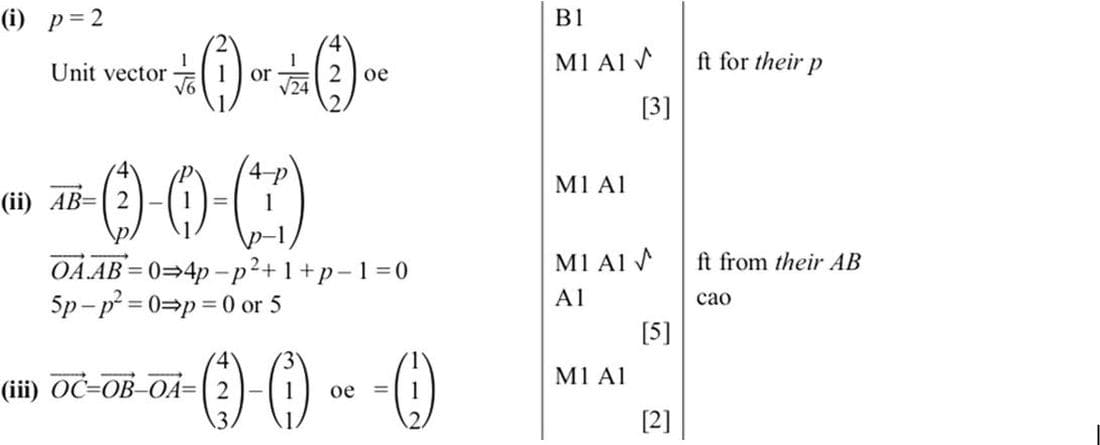
(i) For OAB to be a straight line, \(\overrightarrow{OA}\) and \(\overrightarrow{OB}\) must be parallel. Thus, \(\begin{pmatrix} 4 \\ 2 \\ p \end{pmatrix} = k \begin{pmatrix} p \\ 1 \\ 1 \end{pmatrix}\) for some scalar \(k\). Solving, we find \(p = 2\). The unit vector in the direction of \(\overrightarrow{OA}\) is \(\frac{1}{\sqrt{6}} \begin{pmatrix} 2 \\ 1 \\ 1 \end{pmatrix}\).
(ii) For OA to be perpendicular to AB, \(\overrightarrow{OA} \cdot \overrightarrow{AB} = 0\). First, find \(\overrightarrow{AB} = \begin{pmatrix} 4-p \\ 1 \\ p-1 \end{pmatrix}\). Then, \(\overrightarrow{OA} \cdot \overrightarrow{AB} = (p)(4-p) + 1 + (p-1) = 0\). Simplifying gives \(5p - p^2 = 0\), so \(p = 0\) or \(p = 5\).
(iii) For OABC to be a parallelogram, \(\overrightarrow{OC} = \overrightarrow{OB} - \overrightarrow{OA}\). With \(p = 3\), \(\overrightarrow{OB} = \begin{pmatrix} 4 \\ 2 \\ 3 \end{pmatrix}\) and \(\overrightarrow{OA} = \begin{pmatrix} 3 \\ 1 \\ 1 \end{pmatrix}\). Thus, \(\overrightarrow{OC} = \begin{pmatrix} 1 \\ 1 \\ 2 \end{pmatrix}\).