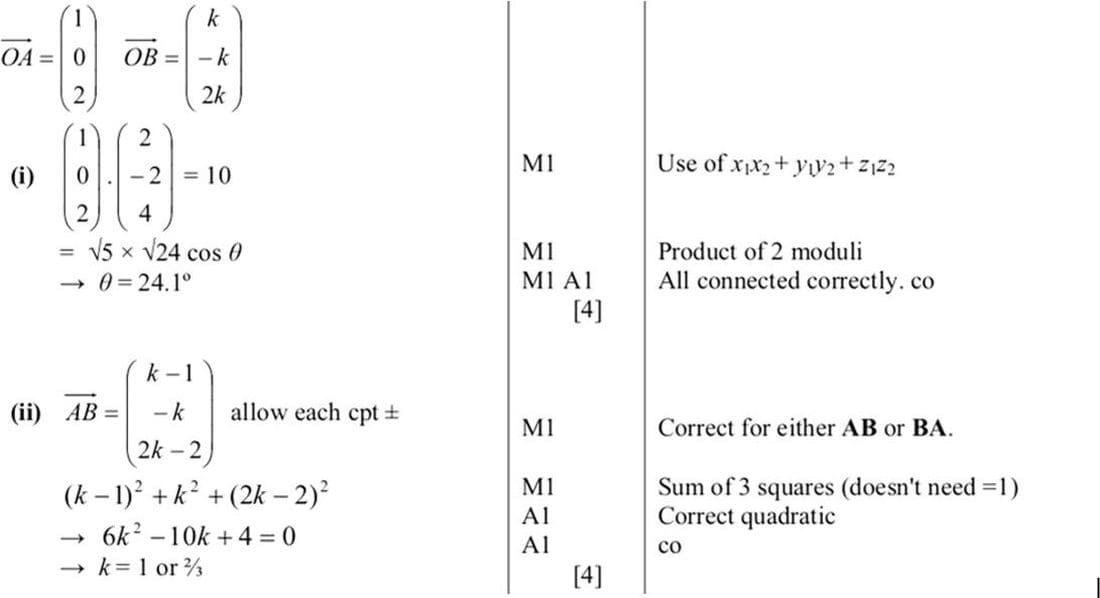
(i) To find the angle \(AOB\), use the dot product formula:
\(\overrightarrow{OA} \cdot \overrightarrow{OB} = 1 \cdot k + 0 \cdot (-k) + 2 \cdot 2k = k + 4k = 5k\).
For \(k = 2\), \(\overrightarrow{OA} \cdot \overrightarrow{OB} = 10\).
The magnitudes are \(|\overrightarrow{OA}| = \sqrt{1^2 + 0^2 + 2^2} = \sqrt{5}\) and \(|\overrightarrow{OB}| = \sqrt{k^2 + (-k)^2 + (2k)^2} = \sqrt{6k^2} = \sqrt{24}\).
Using the dot product formula, \(\overrightarrow{OA} \cdot \overrightarrow{OB} = |\overrightarrow{OA}| \cdot |\overrightarrow{OB}| \cdot \cos \theta\).
\(10 = \sqrt{5} \cdot \sqrt{24} \cdot \cos \theta\).
\(\cos \theta = \frac{10}{\sqrt{5} \cdot \sqrt{24}}\).
\(\theta = \cos^{-1}\left(\frac{10}{\sqrt{5} \cdot \sqrt{24}}\right) \approx 24.1^\circ\).
(ii) For \(\overrightarrow{AB}\) to be a unit vector, its magnitude must be 1.
\(\overrightarrow{AB} = \begin{pmatrix} k-1 \\ -k \\ 2k-2 \end{pmatrix}\).
Magnitude: \(\sqrt{(k-1)^2 + (-k)^2 + (2k-2)^2} = 1\).
\((k-1)^2 + k^2 + (2k-2)^2 = 1\).
\((k-1)^2 = k^2 - 2k + 1\), \((2k-2)^2 = 4k^2 - 8k + 4\).
\(k^2 - 2k + 1 + k^2 + 4k^2 - 8k + 4 = 1\).
\(6k^2 - 10k + 5 = 1\).
\(6k^2 - 10k + 4 = 0\).
Solving the quadratic equation: \(k = 1\) or \(k = \frac{2}{3}\).