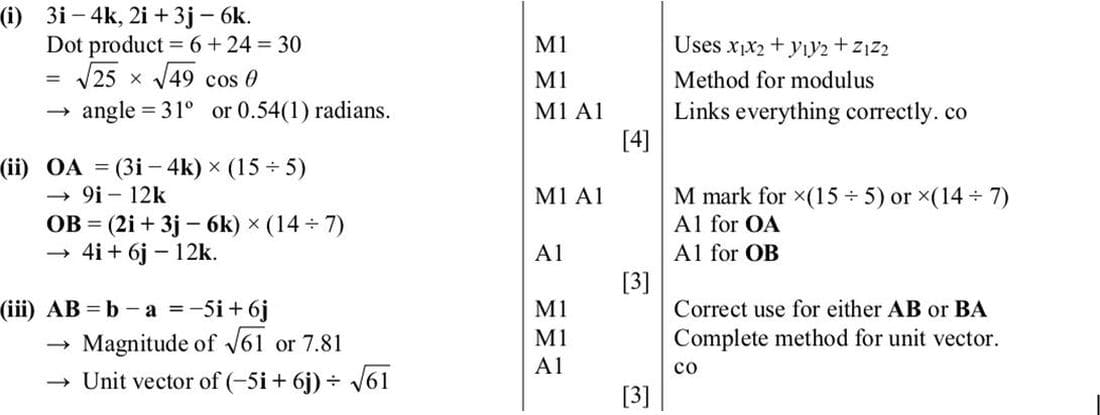
(i) To find the angle between the vectors \(3\mathbf{i} - 4\mathbf{k}\) and \(2\mathbf{i} + 3\mathbf{j} - 6\mathbf{k}\), we use the dot product formula:
\(\mathbf{a} \cdot \mathbf{b} = |\mathbf{a}| |\mathbf{b}| \cos \theta\).
The dot product is \((3)(2) + (0)(3) + (-4)(-6) = 6 + 24 = 30\).
The magnitudes are \(|3\mathbf{i} - 4\mathbf{k}| = \sqrt{3^2 + 0^2 + (-4)^2} = \sqrt{25}\) and \(|2\mathbf{i} + 3\mathbf{j} - 6\mathbf{k}| = \sqrt{2^2 + 3^2 + (-6)^2} = \sqrt{49}\).
Thus, \(30 = \sqrt{25} \times \sqrt{49} \cos \theta\).
Solving for \(\theta\), we get \(\theta = \cos^{-1}\left(\frac{30}{35}\right)\), which is approximately 31° or 0.54 radians.
(ii) \(\overrightarrow{OA}\) is in the same direction as \(3\mathbf{i} - 4\mathbf{k}\) with magnitude 15:
\(\overrightarrow{OA} = (3\mathbf{i} - 4\mathbf{k}) \times \frac{15}{5} = 9\mathbf{i} - 12\mathbf{k}\).
\(\overrightarrow{OB}\) is in the same direction as \(2\mathbf{i} + 3\mathbf{j} - 6\mathbf{k}\) with magnitude 14:
\(\overrightarrow{OB} = (2\mathbf{i} + 3\mathbf{j} - 6\mathbf{k}) \times \frac{14}{7} = 4\mathbf{i} + 6\mathbf{j} - 12\mathbf{k}\).
(iii) To find the unit vector in the direction of \(\overrightarrow{AB}\), first find \(\overrightarrow{AB} = \overrightarrow{OB} - \overrightarrow{OA} = (4\mathbf{i} + 6\mathbf{j} - 12\mathbf{k}) - (9\mathbf{i} - 12\mathbf{k}) = -5\mathbf{i} + 6\mathbf{j}\).
The magnitude of \(\overrightarrow{AB}\) is \(\sqrt{(-5)^2 + 6^2} = \sqrt{61}\).
Thus, the unit vector is \(\frac{-5\mathbf{i} + 6\mathbf{j}}{\sqrt{61}}\).