Past Exam Questions
← Back9709 P12 - Nov 2019 - Q3
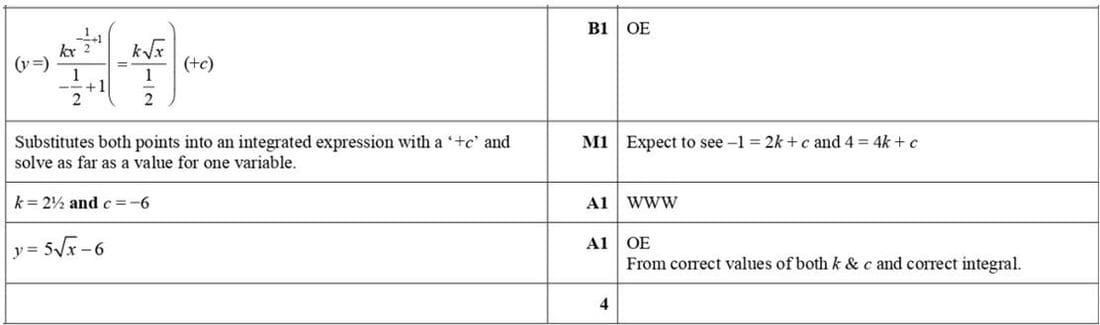
A curve is such that \(\frac{dy}{dx} = \frac{k}{\sqrt{x}}\), where \(k\) is a constant. The points \(P(1, -1)\) and \(Q(4, 4)\) lie on the curve. Find the equation of the curve.
9709 P11 - Nov 2019 - Q9
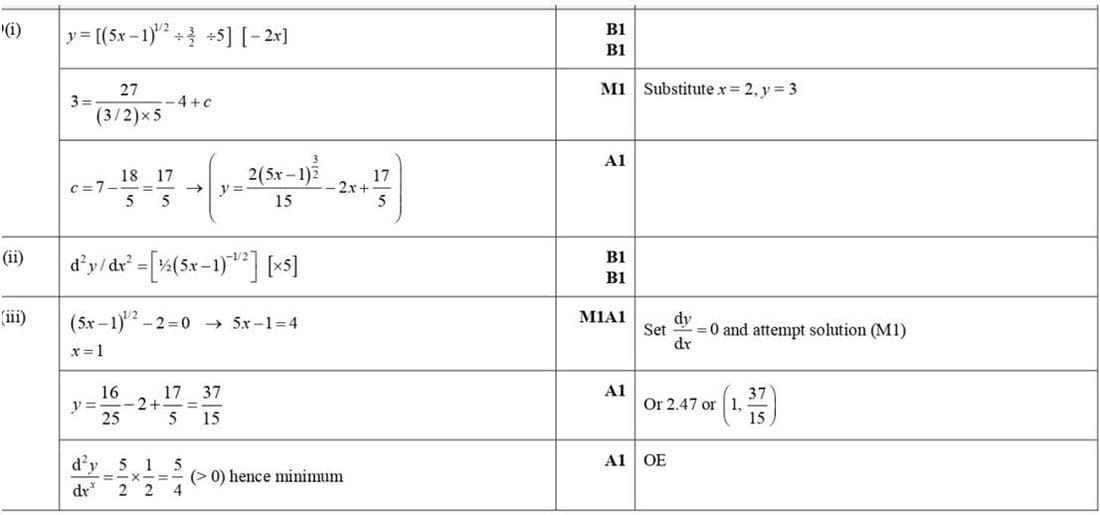
A curve for which \(\frac{dy}{dx} = (5x - 1)^{\frac{1}{2}} - 2\) passes through the point (2, 3).
(i) Find the equation of the curve. [4]
(ii) Find \(\frac{d^2y}{dx^2}\). [2]
(iii) Find the coordinates of the stationary point on the curve and, showing all necessary working, determine the nature of this stationary point. [4]
9709 P13 - Jun 2019 - Q8
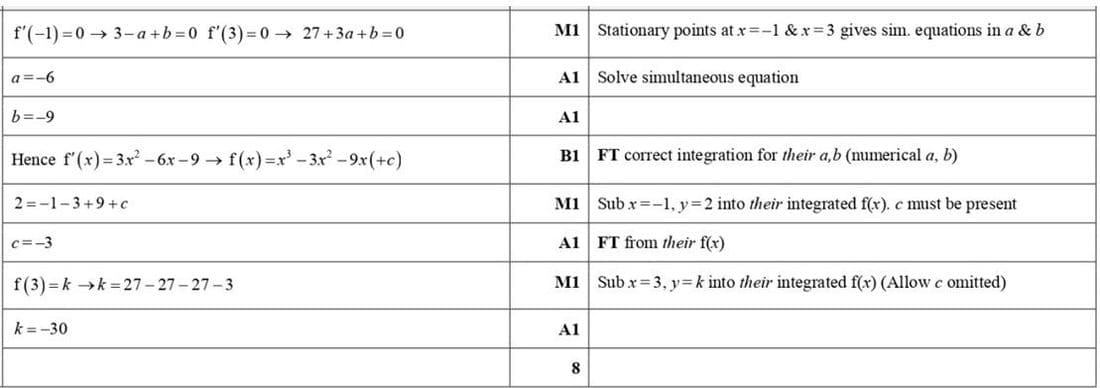
A curve is such that \(\frac{dy}{dx} = 3x^2 + ax + b\). The curve has stationary points at \((-1, 2)\) and \((3, k)\). Find the values of the constants \(a, b\) and \(k\).
9709 P11 - Jun 2019 - Q10
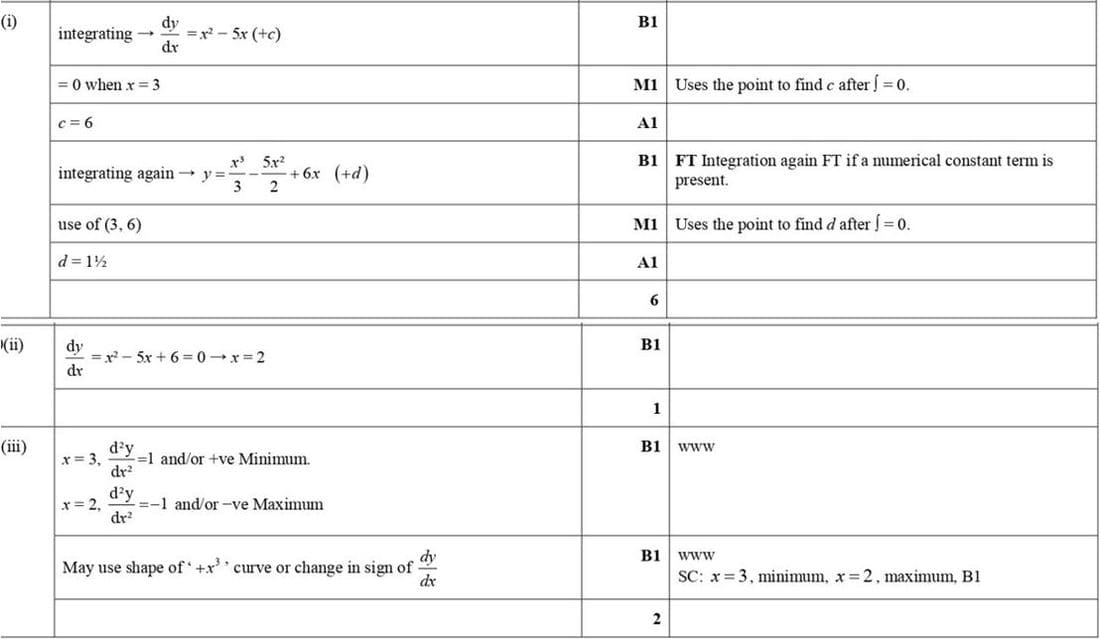
A curve for which \(\frac{d^2y}{dx^2} = 2x - 5\) has a stationary point at (3, 6).
- Find the equation of the curve.
- Find the x-coordinate of the other stationary point on the curve.
- Determine the nature of each of the stationary points.
9709 P12 - Mar 2019 - Q2
A curve with equation \(y = f(x)\) passes through the points \((0, 2)\) and \((3, -1)\). It is given that \(f'(x) = kx^2 - 2x\), where \(k\) is a constant. Find the value of \(k\).

9709 P33 - Nov 2023 - Q11 - 9 marks
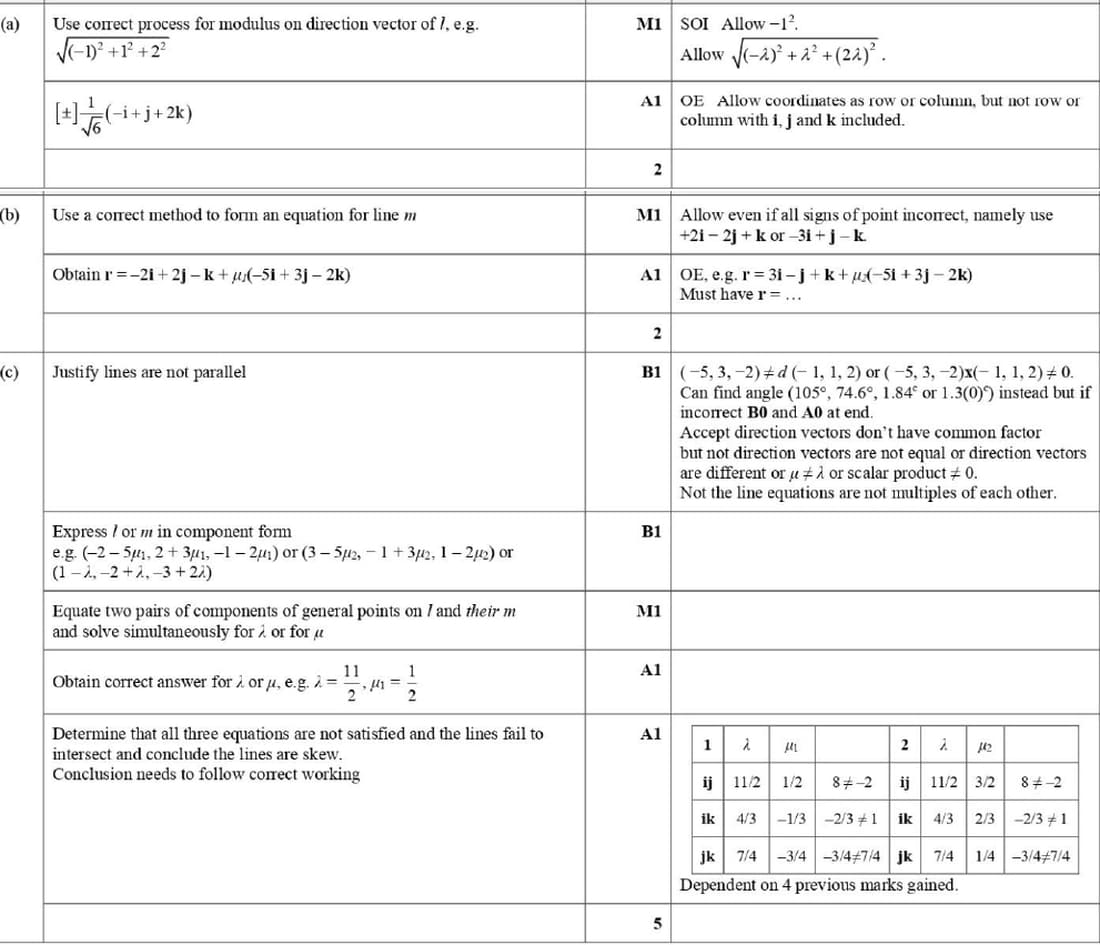
The line l has equation \(\mathbf{r} = \mathbf{i} - 2\mathbf{j} - 3\mathbf{k} + \lambda\bigl(-\mathbf{i} + \mathbf{j} + 2\mathbf{k}\bigr)\). The points A and B have position vectors \(-2\mathbf{i} + 2\mathbf{j} - \mathbf{k}\) and \(3\mathbf{i} - \mathbf{j} + \mathbf{k}\) respectively.
(a) Find a unit vector in the direction of l.
The line m passes through the points A and B.
(b) Find a vector equation for m.
(c) Determine whether lines l and m are parallel, intersect or are skew.
9709 P32 - Mar 2022 - Q10 - 10 marks
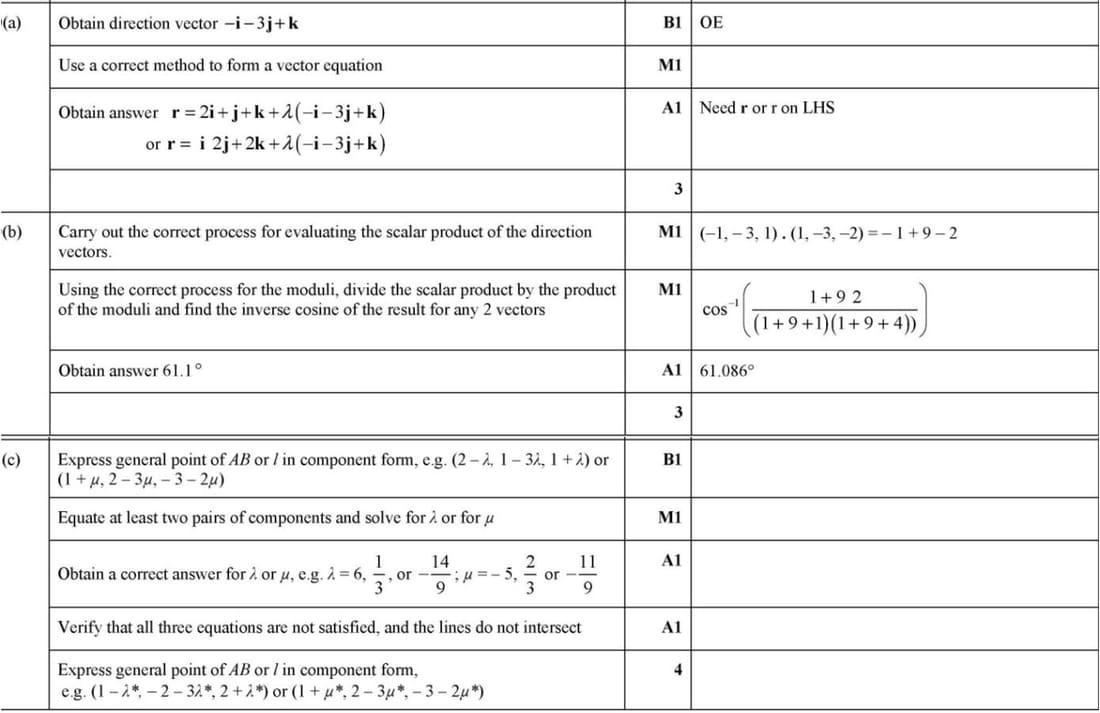
The points A and B have position vectors \(2\mathbf{i} + \mathbf{j} + \mathbf{k}\) and \(\mathbf{i} - 2\mathbf{j} + 2\mathbf{k}\) respectively. The line \(l\) has vector equation \(\mathbf{r} = \mathbf{i} + 2\mathbf{j} - 3\mathbf{k} + \mu(\mathbf{i} - 3\mathbf{j} - 2\mathbf{k})\).
(a) Find a vector equation for the line through A and B.
(b) Find the acute angle between the directions of \(AB\) and \(l\), giving your answer in degrees.
(c) Show that the line through A and B does not intersect the line \(l\).
9709 P32 - Nov 2021 - Q10 - 10 marks
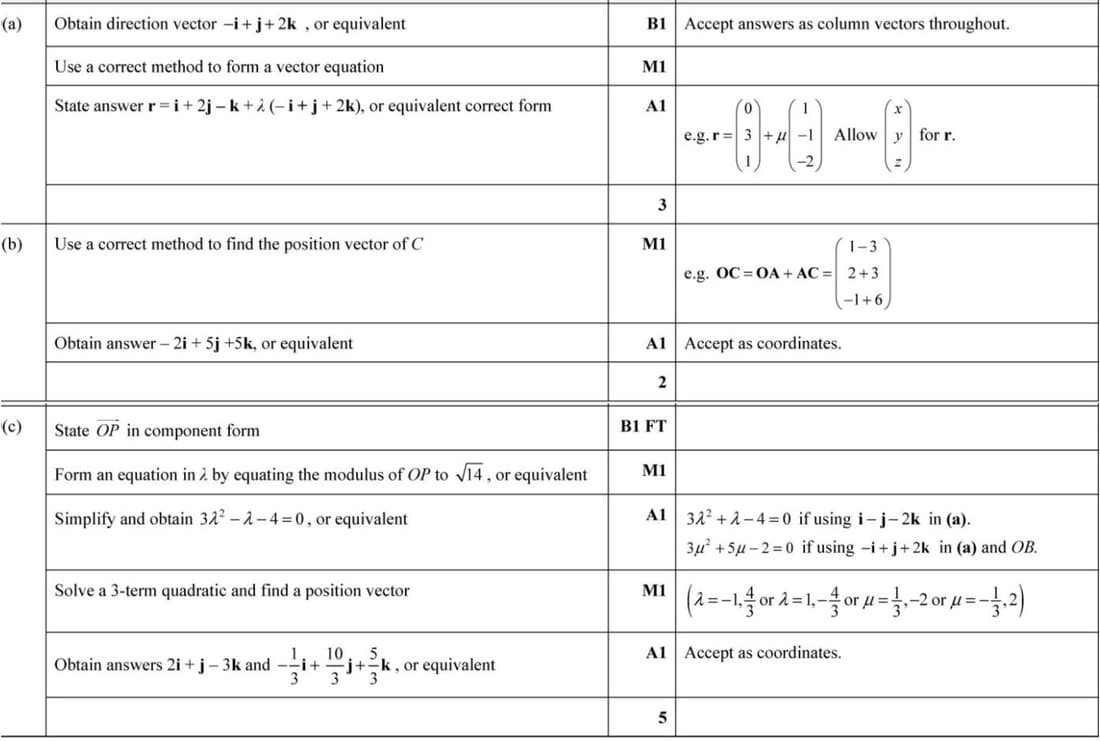
With respect to the origin O, the position vectors of the points A and B are given by \(\overrightarrow{OA} = \begin{pmatrix} 1 \\ 2 \\ -1 \end{pmatrix}\) and \(\overrightarrow{OB} = \begin{pmatrix} 0 \\ 3 \\ 1 \end{pmatrix}\).
(a) Find a vector equation for the line l through A and B.
(b) The point C lies on l and is such that \(\overrightarrow{AC} = 3\overrightarrow{AB}\). Find the position vector of C.
(c) Find the possible position vectors of the point P on l such that \(OP = \sqrt{14}\).
9709 P31 - Nov 2021 - Q9 - 11 marks
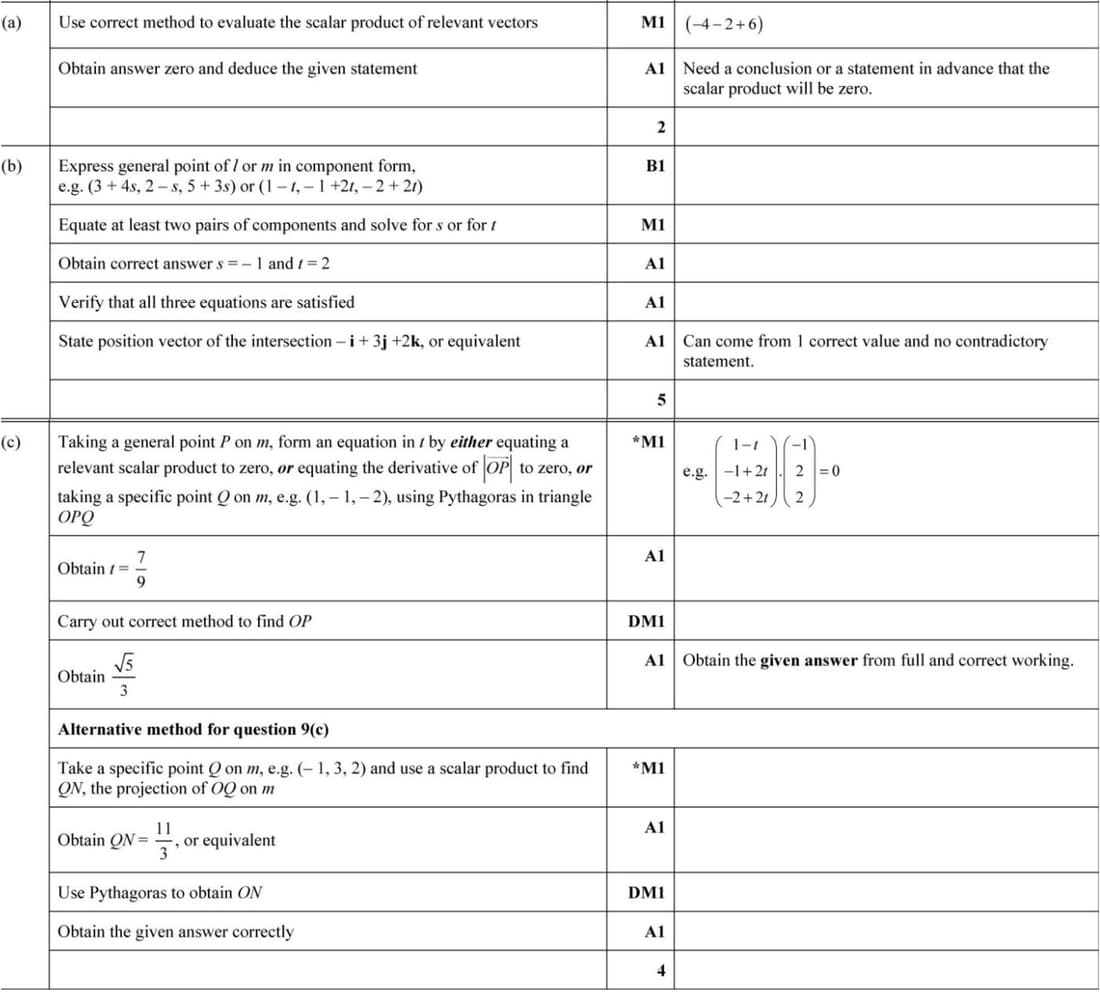
Two lines l and m have equations r = 3i + 2j + 5k + s(4i - j + 3k) and r = i - j - 2k + t(-i + 2j + 2k) respectively.
(a) Show that l and m are perpendicular.
(b) Show that l and m intersect and state the position vector of the point of intersection.
(c) Show that the length of the perpendicular from the origin to the line m is \(\frac{1}{3}\sqrt{5}\).
9709 P33 - Jun 2021 - Q9 - 9 marks
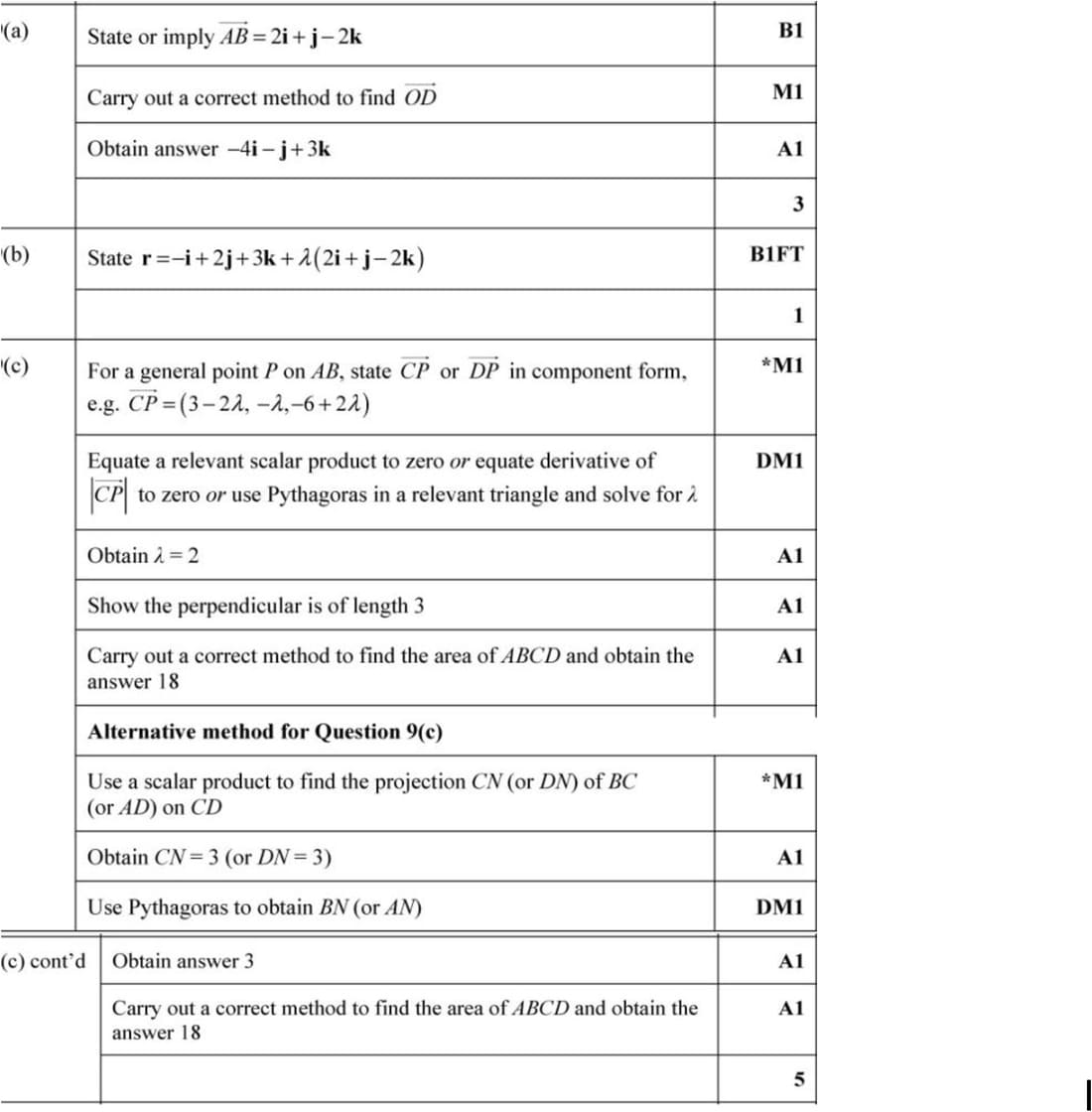
The quadrilateral ABCD is a trapezium in which AB and DC are parallel. With respect to the origin O, the position vectors of A, B, and C are given by \(\overrightarrow{OA} = -\mathbf{i} + 2\mathbf{j} + 3\mathbf{k}\), \(\overrightarrow{OB} = \mathbf{i} + 3\mathbf{j} + \mathbf{k}\), and \(\overrightarrow{OC} = 2\mathbf{i} + 2\mathbf{j} - 3\mathbf{k}\).
(a) Given that \(\overrightarrow{DC} = 3\overrightarrow{AB}\), find the position vector of D.
(b) State a vector equation for the line through A and B.
(c) Find the distance between the parallel sides and hence find the area of the trapezium.
9709 P31 - Jun 2021 - Q8 - 9 marks
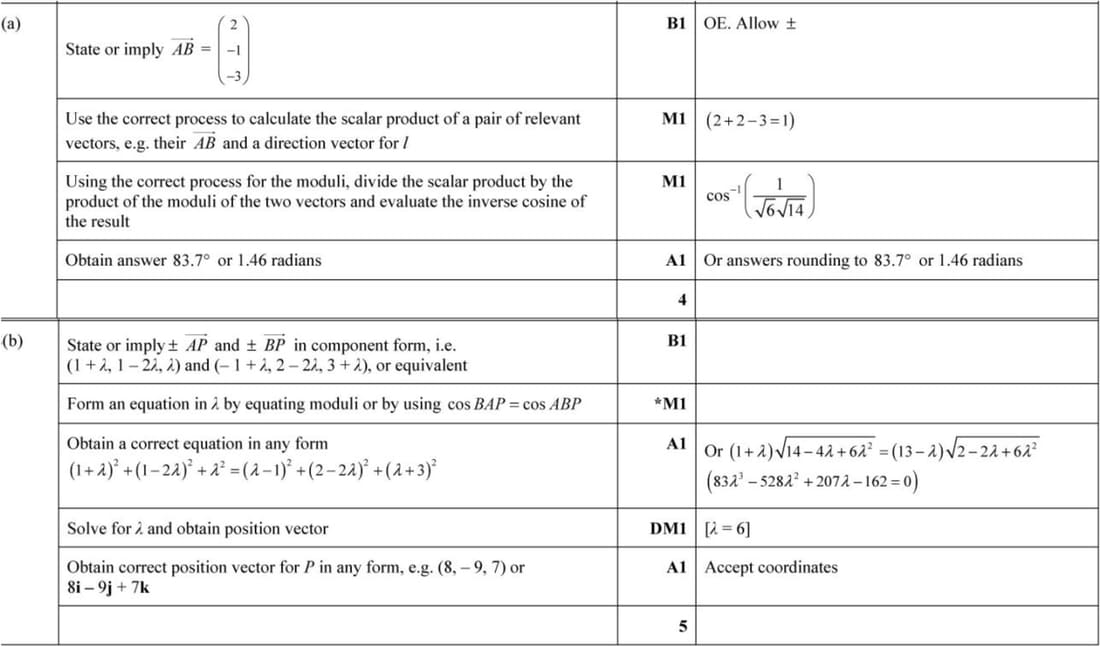
With respect to the origin \(O\), the points \(A\) and \(B\) have position vectors given by \(\overrightarrow{OA} = \begin{pmatrix} 1 \\ 2 \\ 1 \end{pmatrix}\) and \(\overrightarrow{OB} = \begin{pmatrix} 3 \\ 1 \\ -2 \end{pmatrix}\). The line \(l\) has equation \(\mathbf{r} = \begin{pmatrix} 2 \\ 3 \\ 1 \end{pmatrix} + \lambda \begin{pmatrix} 1 \\ -2 \\ 1 \end{pmatrix}\).
(a) Find the acute angle between the directions of \(AB\) and \(l\).
(b) Find the position vector of the point \(P\) on \(l\) such that \(AP = BP\).
9709 P32 - Mar 2021 - Q7 - 8 marks
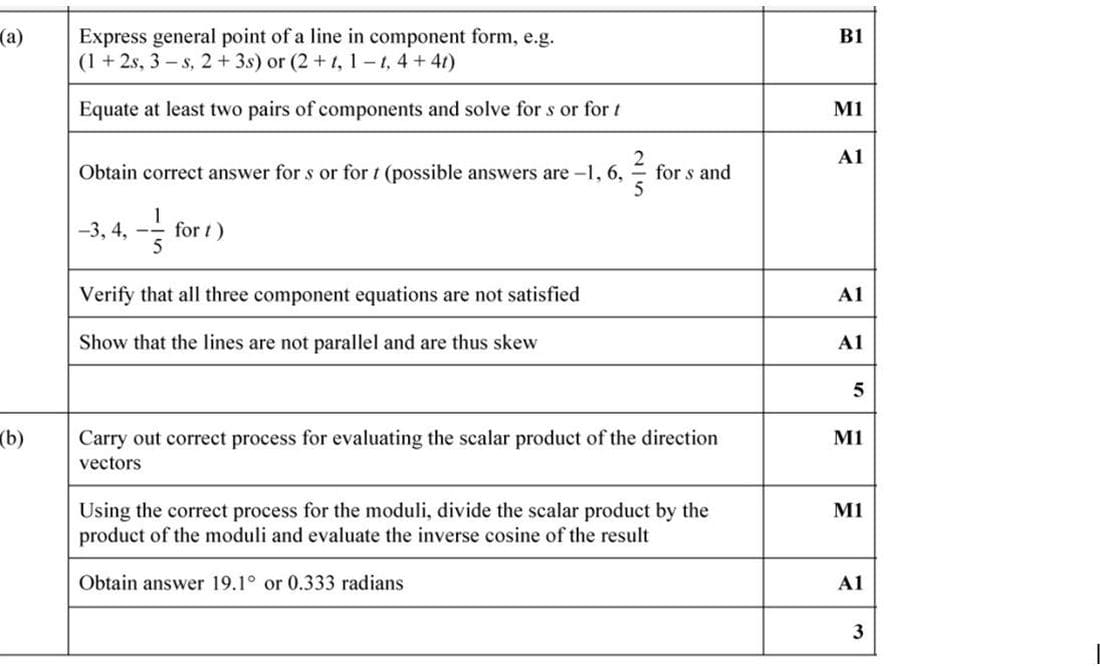
Two lines have equations \(\mathbf{r} = \begin{pmatrix} 1 \\ 3 \\ 2 \end{pmatrix} + s \begin{pmatrix} 2 \\ -1 \\ 3 \end{pmatrix}\) and \(\mathbf{r} = \begin{pmatrix} 2 \\ 1 \\ 4 \end{pmatrix} + t \begin{pmatrix} 1 \\ -1 \\ 4 \end{pmatrix}\).
(a) Show that the lines are skew.
(b) Find the acute angle between the directions of the two lines.
9709 P33 - Nov 2021 - Q8 - 9 marks
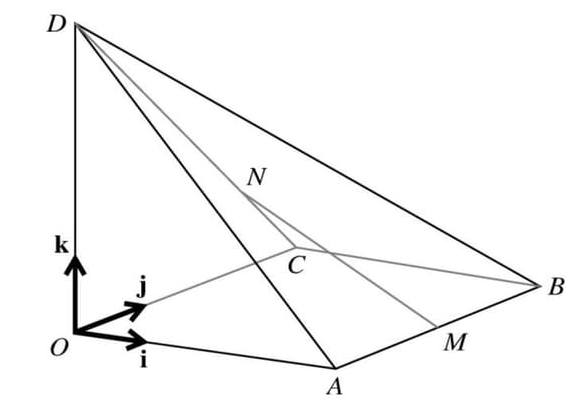
In the diagram, \(OABCD\) is a pyramid with vertex \(D\). The horizontal base \(OABC\) is a square of side 4 units. The edge \(OD\) is vertical and \(OD = 4\) units. The unit vectors \(\mathbf{i}, \mathbf{j}\) and \(\mathbf{k}\) are parallel to \(OA, OC\) and \(OD\) respectively.
The midpoint of \(AB\) is \(M\) and the point \(N\) on \(CD\) is such that \(DN = 3NC\).
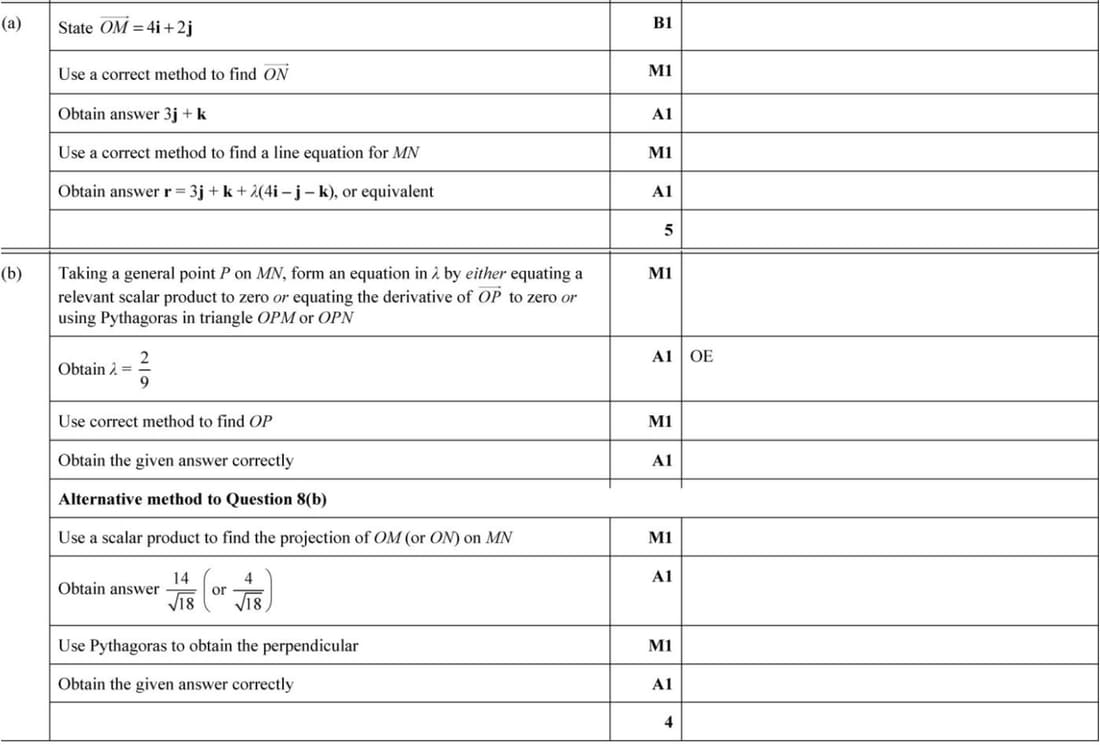
(a) Find a vector equation for the line through \(M\) and \(N\).
(b) Show that the length of the perpendicular from \(O\) to \(MN\) is \(\frac{1}{3}\sqrt{82}\).
9709 P32 - Nov 2020 - Q8 - 10 marks
With respect to the origin O, the position vectors of the points A, B, C and D are given by
\(\overrightarrow{OA} = \begin{pmatrix} 2 \\ 1 \\ 5 \end{pmatrix}, \quad \overrightarrow{OB} = \begin{pmatrix} 4 \\ -1 \\ 1 \end{pmatrix}, \quad \overrightarrow{OC} = \begin{pmatrix} 1 \\ 1 \\ 2 \end{pmatrix} \quad \text{and} \quad \overrightarrow{OD} = \begin{pmatrix} 3 \\ 2 \\ 3 \end{pmatrix}.\)
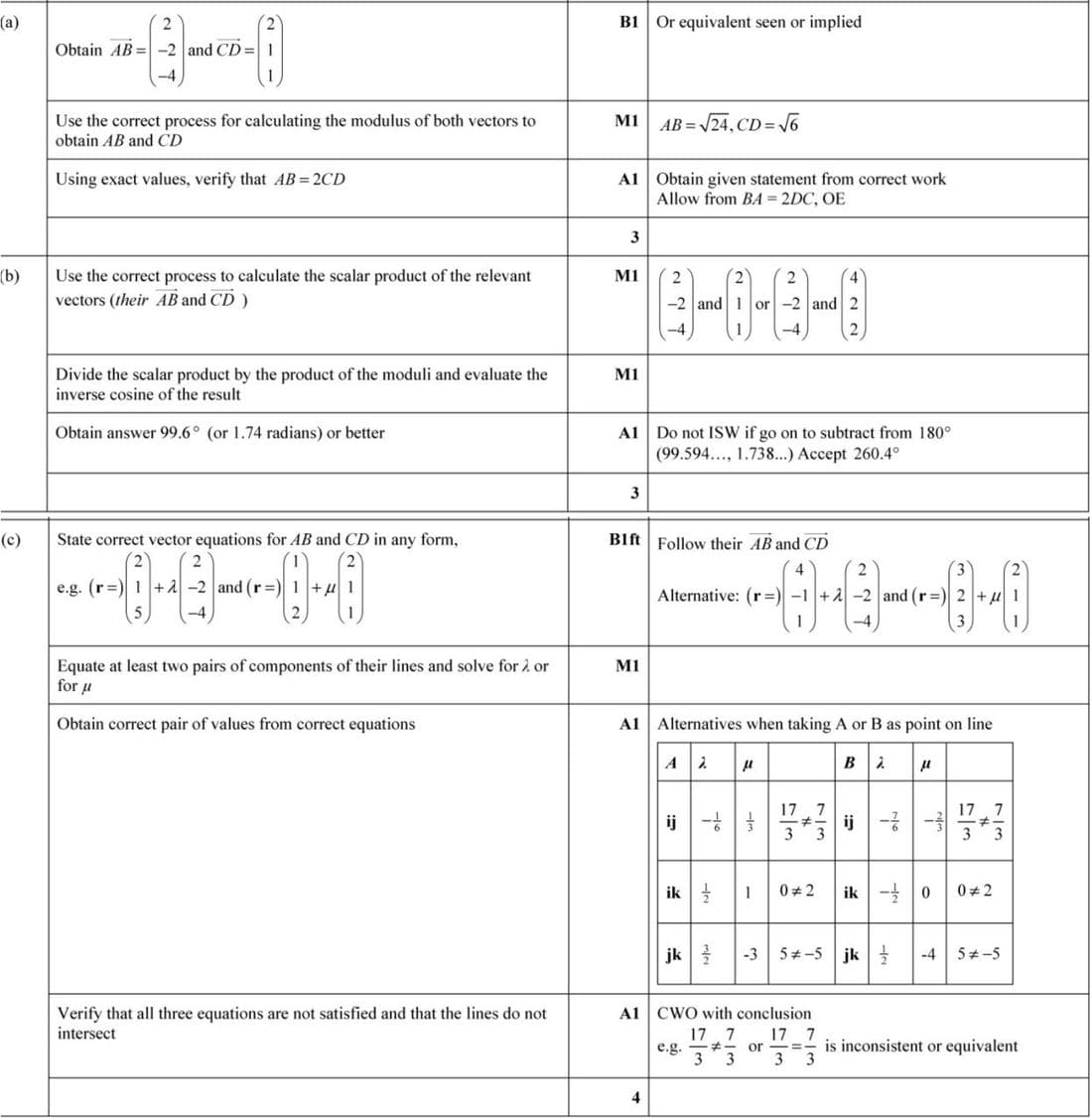
(a) Show that \(AB = 2CD.\)
(b) Find the angle between the directions of \(\overrightarrow{AB}\) and \(\overrightarrow{CD}.\)
(c) Show that the line through A and B does not intersect the line through C and D.
9709 P31 - Nov 2020 - Q11 - 11 marks
Two lines have equations \(\mathbf{r} = \mathbf{i} + 2\mathbf{j} + \mathbf{k} + \lambda(a\mathbf{i} + 2\mathbf{j} - \mathbf{k})\) and \(\mathbf{r} = 2\mathbf{i} + \mathbf{j} - \mathbf{k} + \mu(2\mathbf{i} - \mathbf{j} + \mathbf{k})\), where \(a\) is a constant.
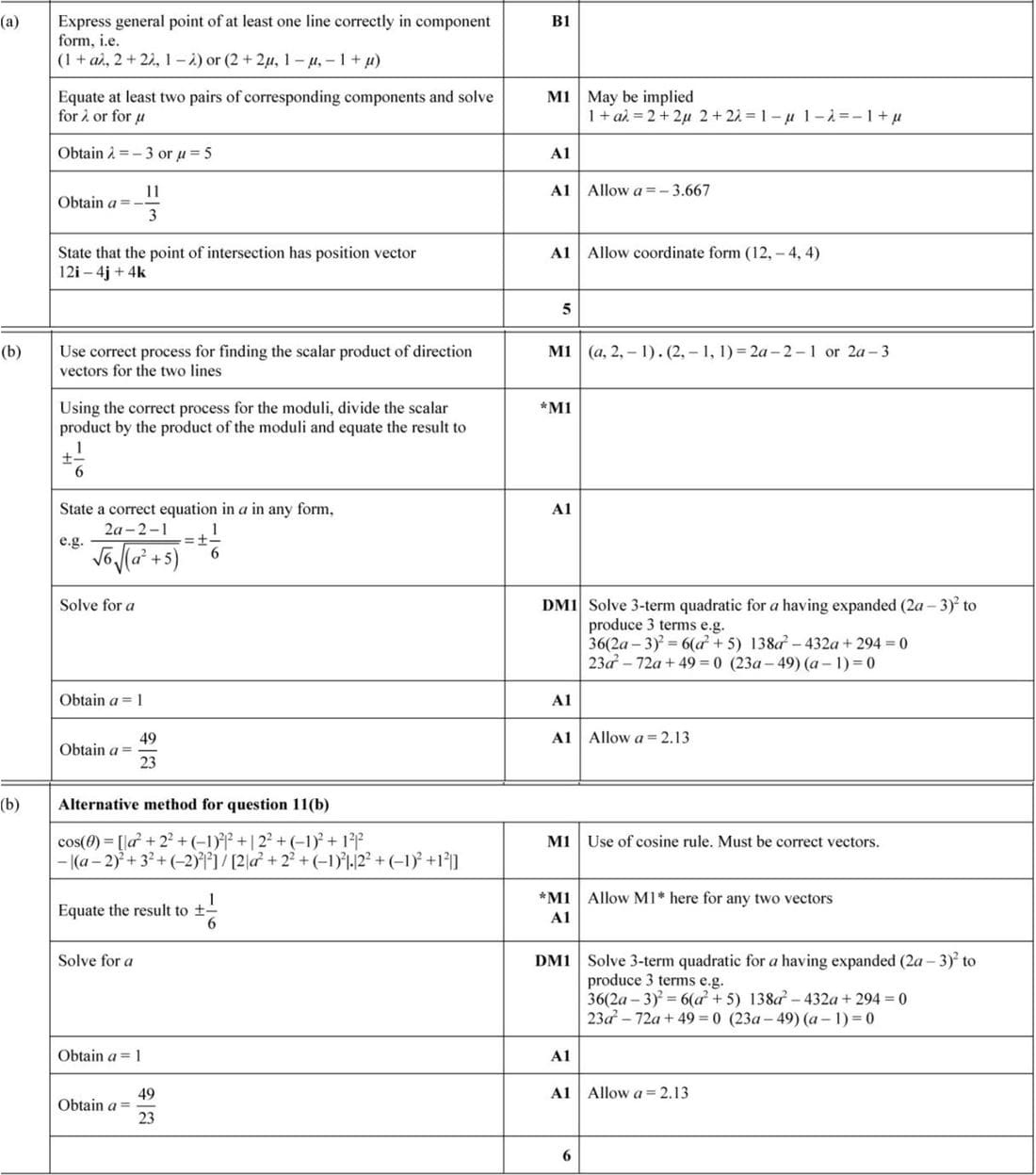
(a) Given that the two lines intersect, find the value of \(a\) and the position vector of the point of intersection.
(b) Given instead that the acute angle between the directions of the two lines is \(\cos^{-1}\left(\frac{1}{6}\right)\), find the two possible values of \(a\).
9709 P32 - Jun 2020 - Q10 - 11 marks
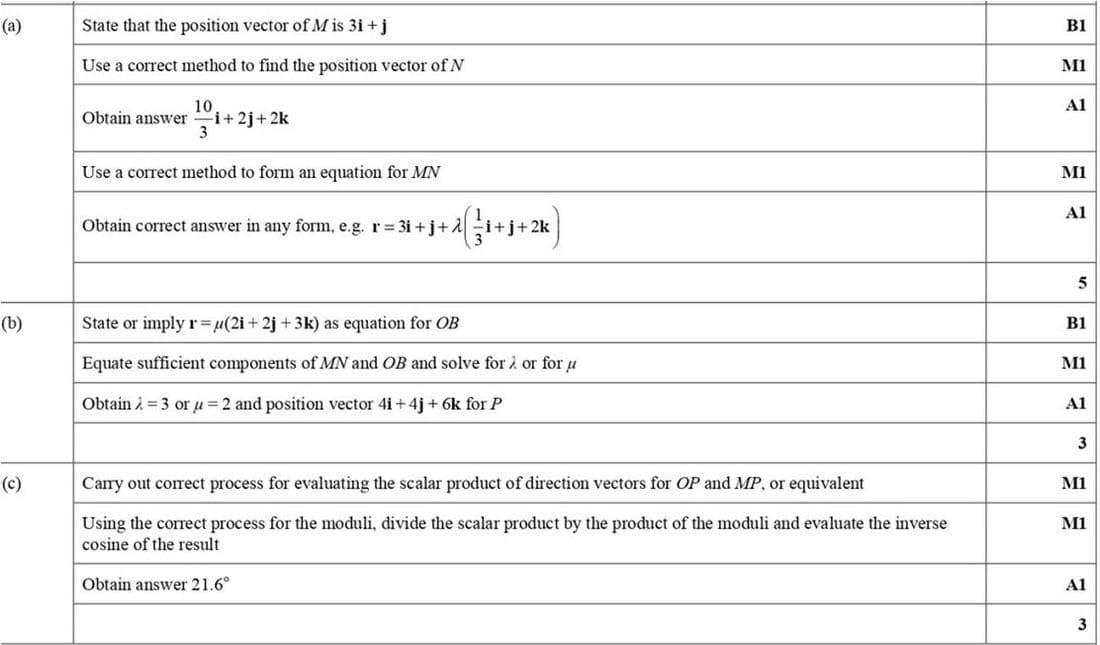
With respect to the origin O, the points A and B have position vectors given by \(\overrightarrow{OA} = 6\mathbf{i} + 2\mathbf{j}\) and \(\overrightarrow{OB} = 2\mathbf{i} + 2\mathbf{j} + 3\mathbf{k}\). The midpoint of OA is M. The point N lying on AB, between A and B, is such that \(AN = 2NB\).
(a) Find a vector equation for the line through M and N.
The line through M and N intersects the line through O and B at the point P.
(b) Find the position vector of P.
(c) Calculate angle OPM, giving your answer in degrees.
9709 P32 - Nov 2023 - Q10 - 9 marks
The equations of the lines l and m are given by
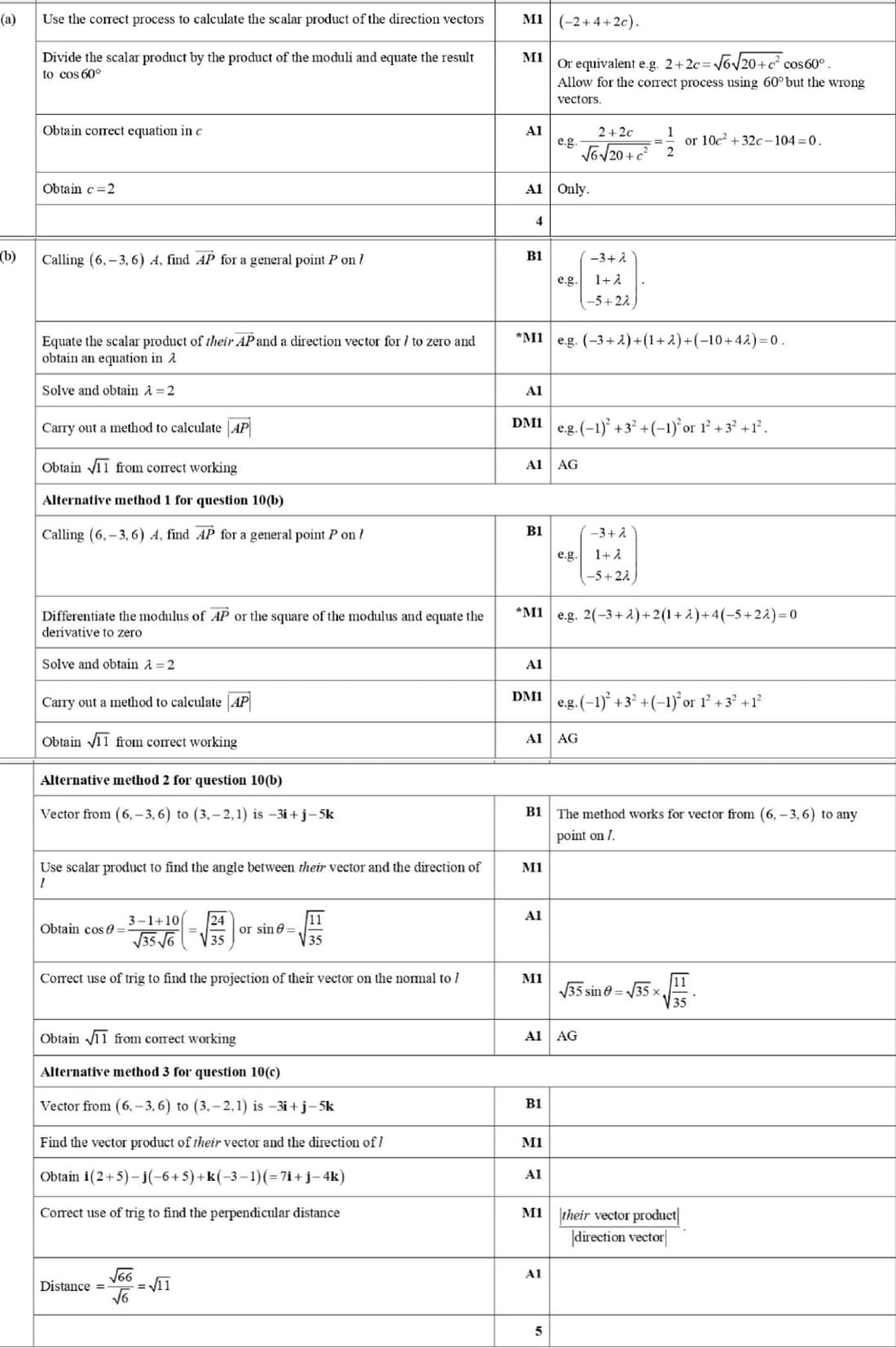
l: \(\mathbf{r} = \begin{pmatrix} 3 \\ -2 \\ 1 \end{pmatrix} + \lambda \begin{pmatrix} 1 \\ 1 \\ 2 \end{pmatrix}\) and m: \(\mathbf{r} = \begin{pmatrix} 6 \\ -3 \\ 6 \end{pmatrix} + \mu \begin{pmatrix} -2 \\ 4 \\ c \end{pmatrix}\),
where c is a positive constant. It is given that the angle between l and m is 60°.
(a) Find the value of c.
(b) Show that the length of the perpendicular from (6, -3, 6) to l is \(\sqrt{11}\).
9709 P31 - Jun 2020 - Q9 - 9 marks
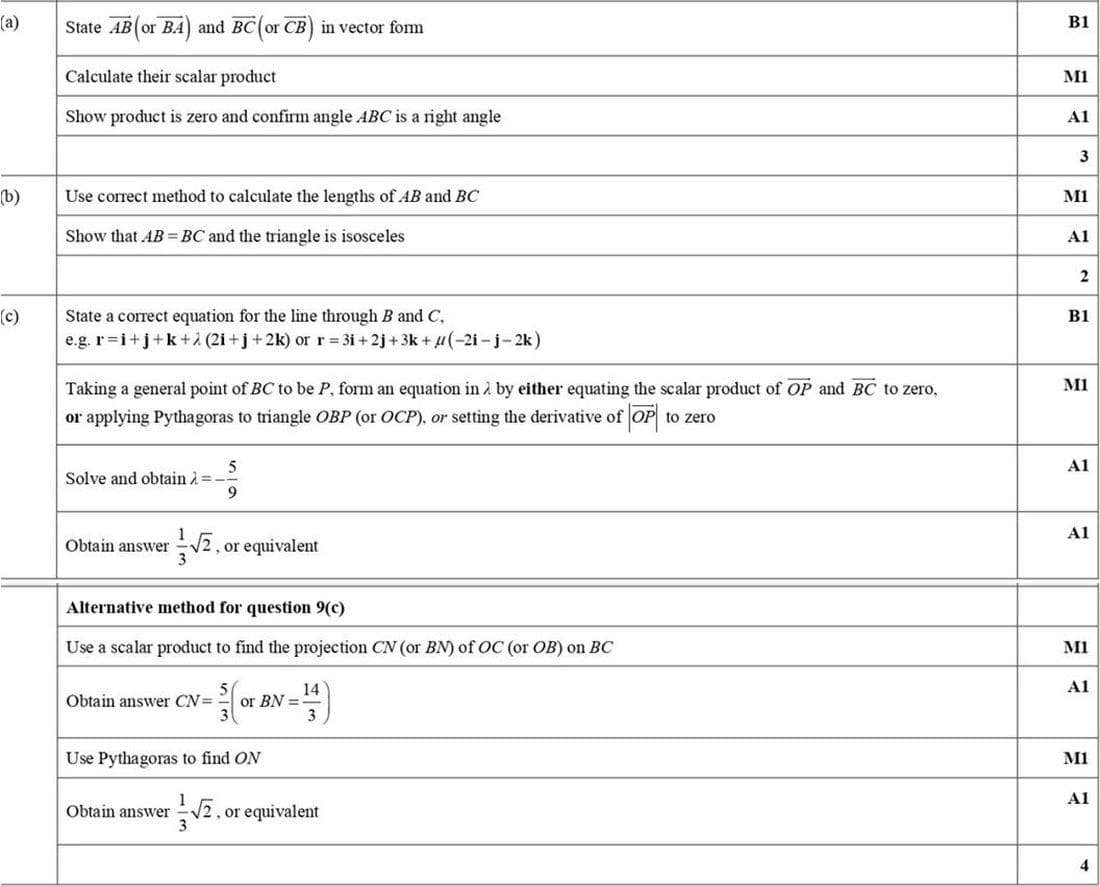
With respect to the origin O, the vertices of a triangle ABC have position vectors \(\overrightarrow{OA} = 2\mathbf{i} + 5\mathbf{k}\), \(\overrightarrow{OB} = 3\mathbf{i} + 2\mathbf{j} + 3\mathbf{k}\) and \(\overrightarrow{OC} = \mathbf{i} + \mathbf{j} + \mathbf{k}\).
(a) Using a scalar product, show that angle ABC is a right angle. [3]
(b) Show that triangle ABC is isosceles. [2]
(c) Find the exact length of the perpendicular from O to the line through B and C. [4]
9709 P32 - Mar 2020 - Q8 - 9 marks
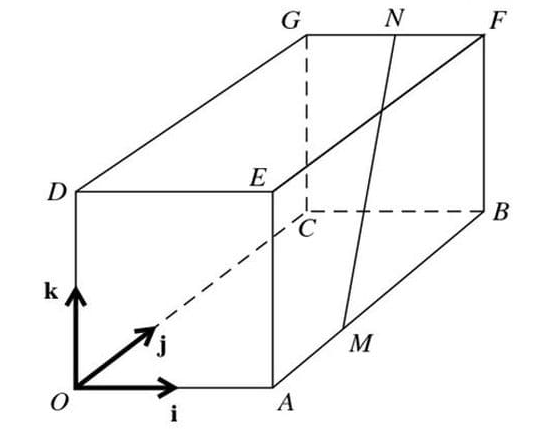
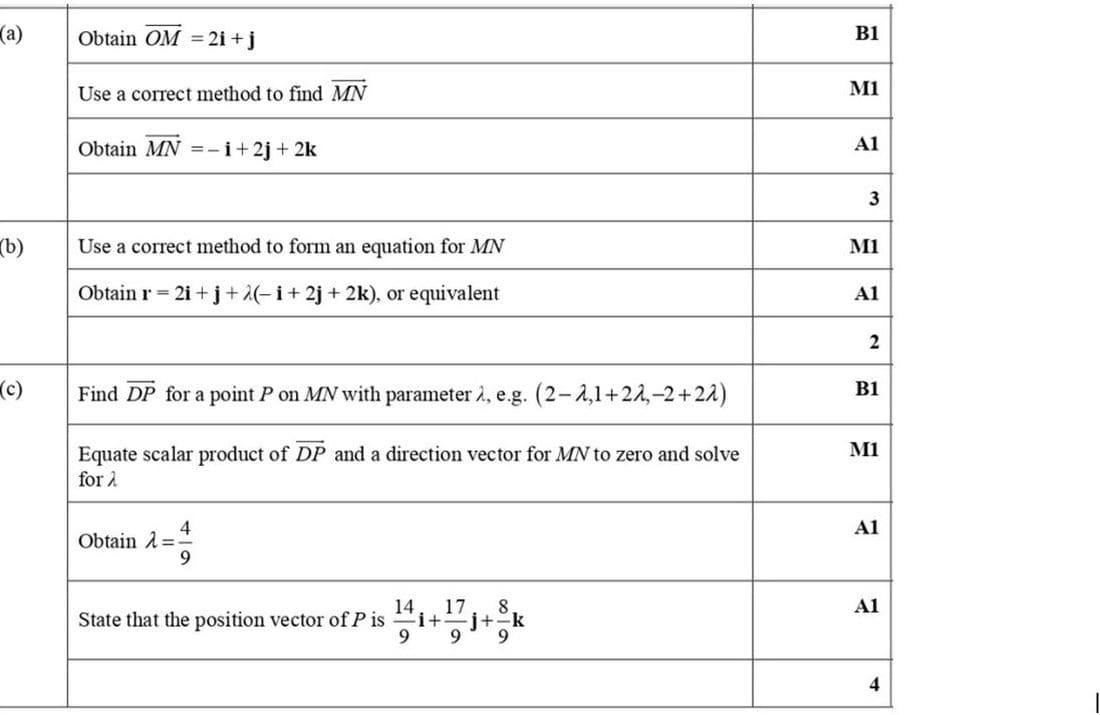
In the diagram, OABCDEFG is a cuboid in which OA = 2 units, OC = 3 units and OD = 2 units. Unit vectors i, j and k are parallel to OA, OC and OD respectively. The point M on AB is such that MB = 2AM. The midpoint of FG is N.
(a) Express the vectors \(\overrightarrow{OM}\) and \(\overrightarrow{MN}\) in terms of i, j and k.
(b) Find a vector equation for the line through M and N.
(c) Find the position vector of P, the foot of the perpendicular from D to the line through M and N.
9709 P31 - Nov 2019 - Q7I - 4 marks
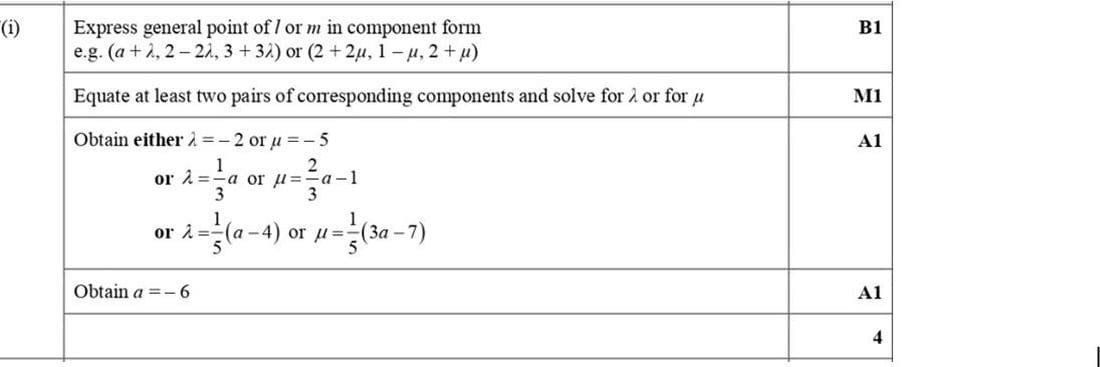
Two lines l and m have equations r = ai + 2j + 3k + λ(i − 2j + 3k) and r = 2i + j + 2k + μ(2i − j + k) respectively, where a is a constant. It is given that the lines intersect.
Find the value of a.