9709 P12 - Jun 2013 - Q6
2199
Relative to an origin O, the position vectors of points A and B are given by
\(\overrightarrow{OA} = \mathbf{i} - 2\mathbf{j} + 2\mathbf{k}\) and \(\overrightarrow{OB} = 3\mathbf{i} + p\mathbf{j} + q\mathbf{k}\),
where \(p\) and \(q\) are constants.
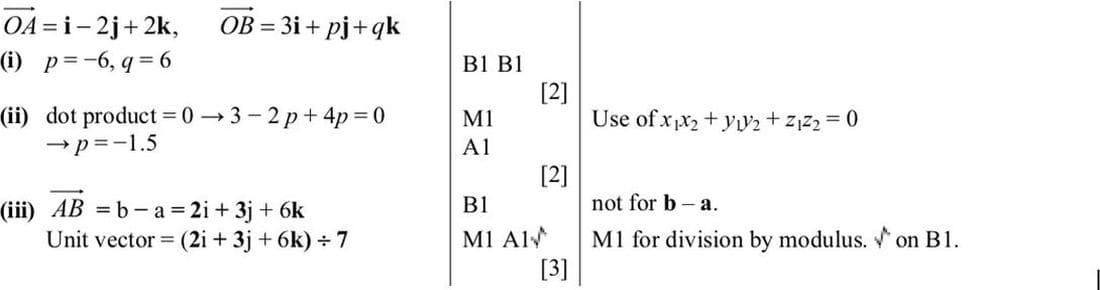
- State the values of \(p\) and \(q\) for which \(\overrightarrow{OA}\) is parallel to \(\overrightarrow{OB}\).
- In the case where \(q = 2p\), find the value of \(p\) for which angle \(BOA\) is \(90^\circ\).
- In the case where \(p = 1\) and \(q = 8\), find the unit vector in the direction of \(\overrightarrow{AB}\).