Browsing as Guest. Progress, bookmarks and attempts are disabled.
Log in to track your work.
June 2011 p11 q4
2247
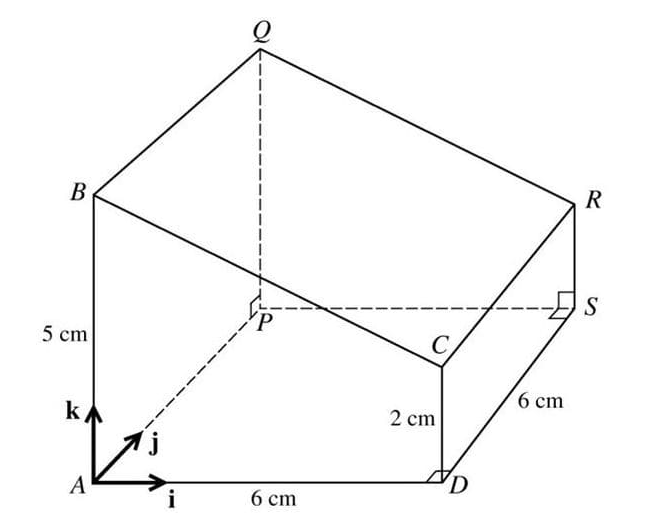
The diagram shows a prism ABCDPQRS with a horizontal square base APSD with sides of length 6 cm. The cross-section ABCD is a trapezium and is such that the vertical edges AB and DC are of lengths 5 cm and 2 cm respectively. Unit vectors i, j and k are parallel to AD, AP and AB respectively.
(i) Express each of the vectors \(\overrightarrow{CP}\) and \(\overrightarrow{CQ}\) in terms of i, j and k.
(ii) Use a scalar product to calculate angle PCQ.
Solution
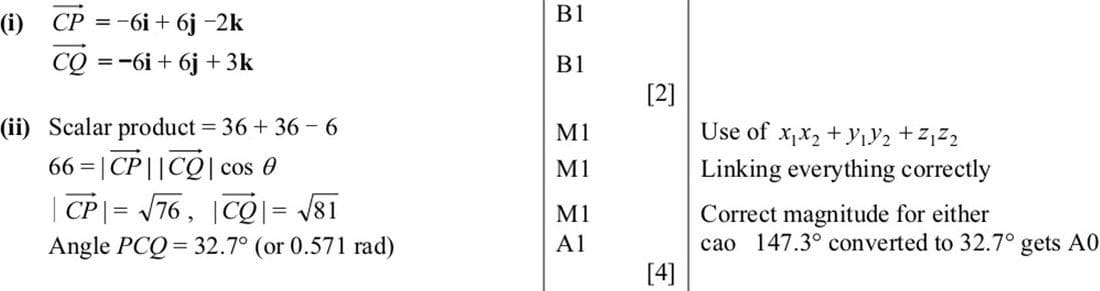
(i) To find \(\overrightarrow{CP}\), note that \(C\) is at \((6, 0, 2)\) and \(P\) is at \((0, 6, 0)\). Thus, \(\overrightarrow{CP} = (0 - 6)\mathbf{i} + (6 - 0)\mathbf{j} + (0 - 2)\mathbf{k} = -6\mathbf{i} + 6\mathbf{j} - 2\mathbf{k}\).
For \(\overrightarrow{CQ}\), \(Q\) is at \((0, 6, 5)\). Thus, \(\overrightarrow{CQ} = (0 - 6)\mathbf{i} + (6 - 0)\mathbf{j} + (5 - 2)\mathbf{k} = -6\mathbf{i} + 6\mathbf{j} + 3\mathbf{k}\).
The magnitudes are \(|\overrightarrow{CP}| = \sqrt{(-6)^2 + 6^2 + (-2)^2} = \sqrt{76}\) and \(|\overrightarrow{CQ}| = \sqrt{(-6)^2 + 6^2 + 3^2} = \sqrt{81}\).
Using the formula for the angle, \(66 = \sqrt{76} \times \sqrt{81} \times \cos \theta\), we find \(\cos \theta = \frac{66}{\sqrt{76} \times \sqrt{81}}\).