9709 P1 - Jun 2006 - Q8
2256
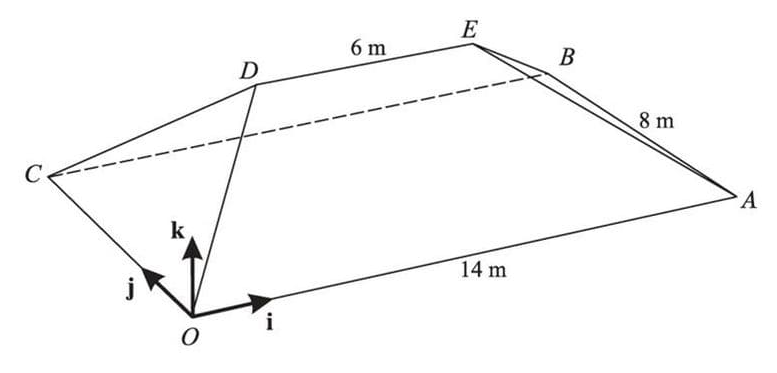
The diagram shows the roof of a house. The base of the roof, \(OABC\), is rectangular and horizontal with \(OA = CB = 14 \, \text{m}\) and \(OC = AB = 8 \, \text{m}\). The top of the roof \(DE\) is 5 m above the base and \(DE = 6 \, \text{m}\). The sloping edges \(OD, CD, AE\) and \(BE\) are all equal in length.
Unit vectors \(\mathbf{i}\) and \(\mathbf{j}\) are parallel to \(OA\) and \(OC\) respectively and the unit vector \(\mathbf{k}\) is vertically upwards.
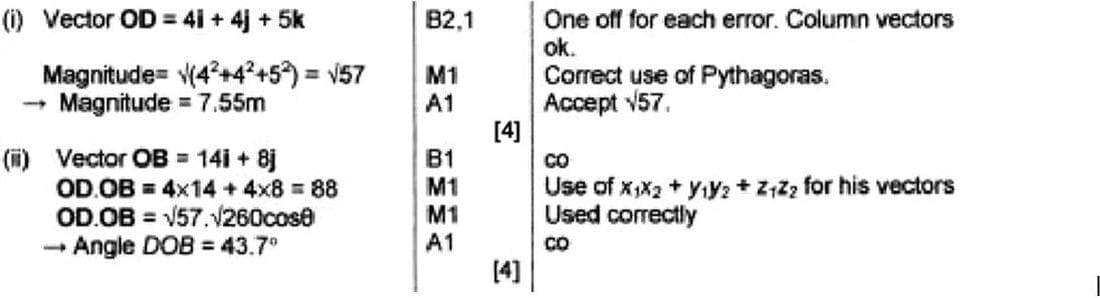
- Express the vector \(\overrightarrow{OD}\) in terms of \(\mathbf{i}, \mathbf{j}\) and \(\mathbf{k}\), and find its magnitude. [4]
- Use a scalar product to find angle \(DOB\). [4]