9709 P12 - Nov 2009 - Q6
2252
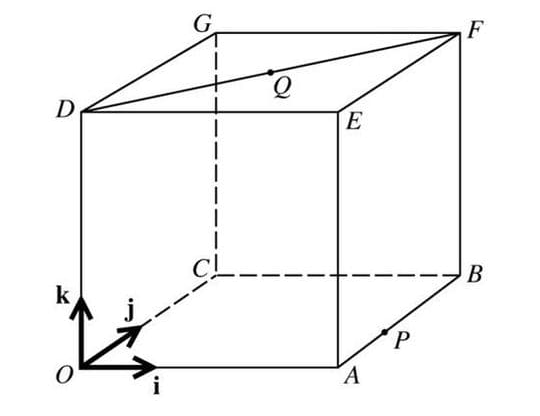
In the diagram, \(OABCDEFG\) is a cube in which each side has length 6. Unit vectors \(\mathbf{i}, \mathbf{j}\) and \(\mathbf{k}\) are parallel to \(\overrightarrow{OA}, \overrightarrow{OC}\) and \(\overrightarrow{OD}\) respectively. The point \(P\) is such that \(\overrightarrow{AP} = \frac{1}{3} \overrightarrow{AB}\) and the point \(Q\) is the mid-point of \(DF\).
(i) Express each of the vectors \(\overrightarrow{OQ}\) and \(\overrightarrow{PQ}\) in terms of \(\mathbf{i}, \mathbf{j}\) and \(\mathbf{k}\).
(ii) Find the angle \(OQP\).
Solutions locked. Please sign in with access to view them.