9709 P1 - Nov 2008 - Q4
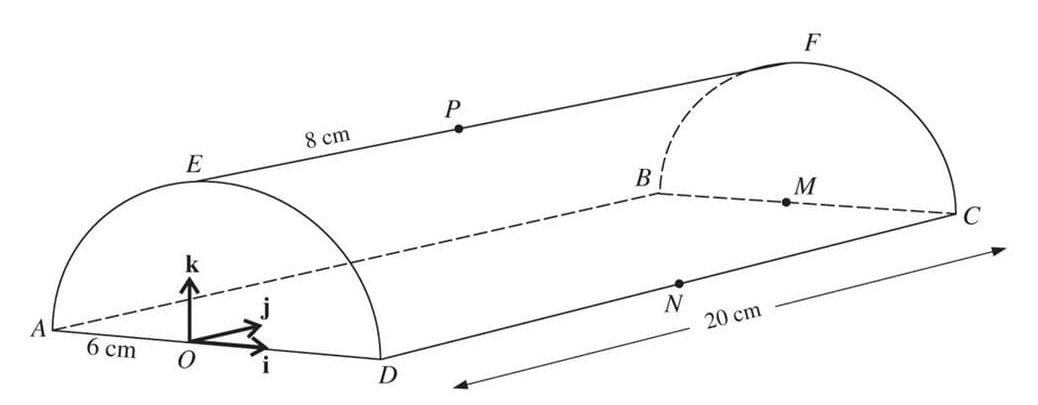
The diagram shows a semicircular prism with a horizontal rectangular base \(ABCD\). The vertical ends \(AED\) and \(BFC\) are semicircles of radius 6 cm. The length of the prism is 20 cm. The mid-point of \(AD\) is the origin \(O\), the mid-point of \(BC\) is \(M\) and the mid-point of \(DC\) is \(N\). The points \(E\) and \(F\) are the highest points of the semicircular ends of the prism. The point \(P\) lies on \(EF\) such that \(EP = 8\) cm.
Unit vectors \(\mathbf{i}, \mathbf{j}\) and \(\mathbf{k}\) are parallel to \(OD, OM\) and \(OE\) respectively.
(i) Express each of the vectors \(\overrightarrow{PA}\) and \(\overrightarrow{PN}\) in terms of \(\mathbf{i}, \mathbf{j}\) and \(\mathbf{k}\).
(ii) Use a scalar product to calculate angle \(APN\).