Past Exam Questions
← Back9709 P61 - Nov 2014 - Q3
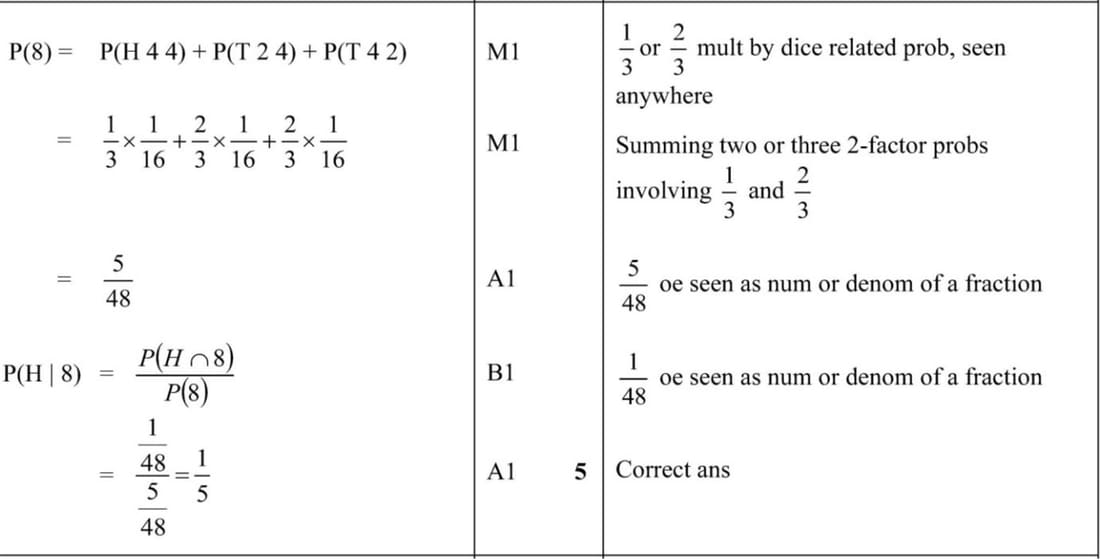
Jodie tosses a biased coin and throws two fair tetrahedral dice. The probability that the coin shows a head is \(\frac{1}{3}\). Each of the dice has four faces, numbered 1, 2, 3, and 4. Jodie’s score is calculated from the numbers on the faces that the dice land on, as follows:
- if the coin shows a head, the two numbers from the dice are added together;
- if the coin shows a tail, the two numbers from the dice are multiplied together.
Find the probability that the coin shows a head given that Jodie’s score is 8.
9709 P63 - Jun 2014 - Q6
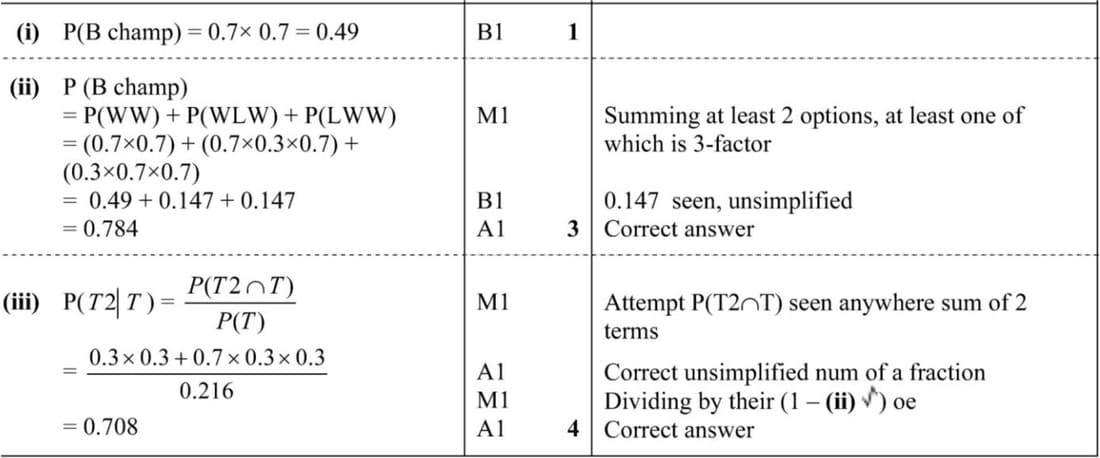
Tom and Ben play a game repeatedly. The probability that Tom wins any game is 0.3. Each game is won by either Tom or Ben. Tom and Ben stop playing when one of them (to be called the champion) has won two games.
- Find the probability that Ben becomes the champion after playing exactly 2 games. [1]
- Find the probability that Ben becomes the champion. [3]
- Given that Tom becomes the champion, find the probability that he won the 2nd game. [4]
9709 P61 - Jun 2014 - Q5
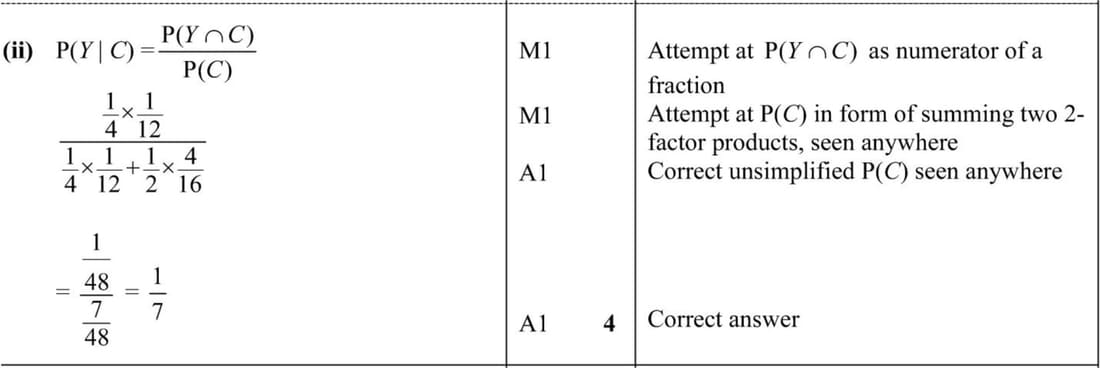
Playground equipment consists of swings (S), roundabouts (R), climbing frames (C) and play-houses (P). The numbers of pieces of equipment in each of 3 playgrounds are as follows.
| Playground X | Playground Y | Playground Z | |
|---|---|---|---|
| 3S, 2R, 4P | 6S, 3R, 1C, 2P | 8S, 3R, 4C, 1P |
Each day Nur takes her child to one of the playgrounds. The probability that she chooses playground X is \(\frac{1}{4}\). The probability that she chooses playground Y is \(\frac{1}{4}\). The probability that she chooses playground Z is \(\frac{1}{2}\). When she arrives at the playground, she chooses one piece of equipment at random.
Given that Nur chooses a climbing frame, find the probability that she chose playground Y. [4]
9709 P63 - Nov 2013 - Q7
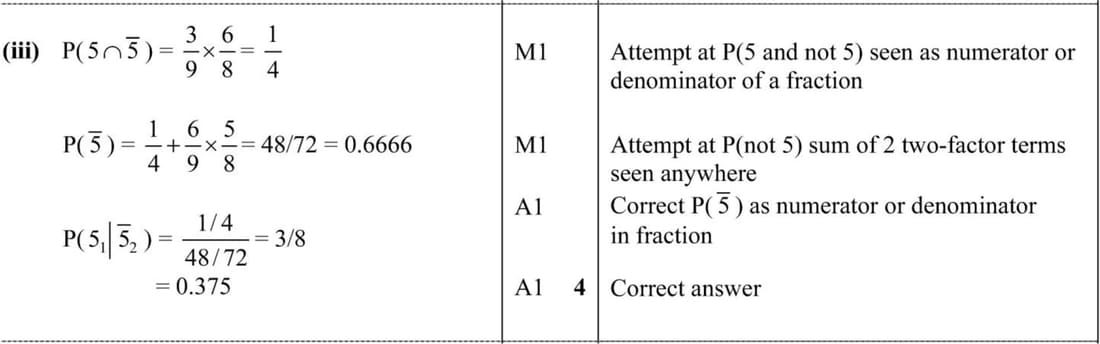
Dayo chooses two digits at random, without replacement, from the 9-digit number 113 333 555.
Find the probability that the first digit Dayo chose was a 5, given that the second digit he chose is not a 5.
9709 P62 - Nov 2013 - Q2
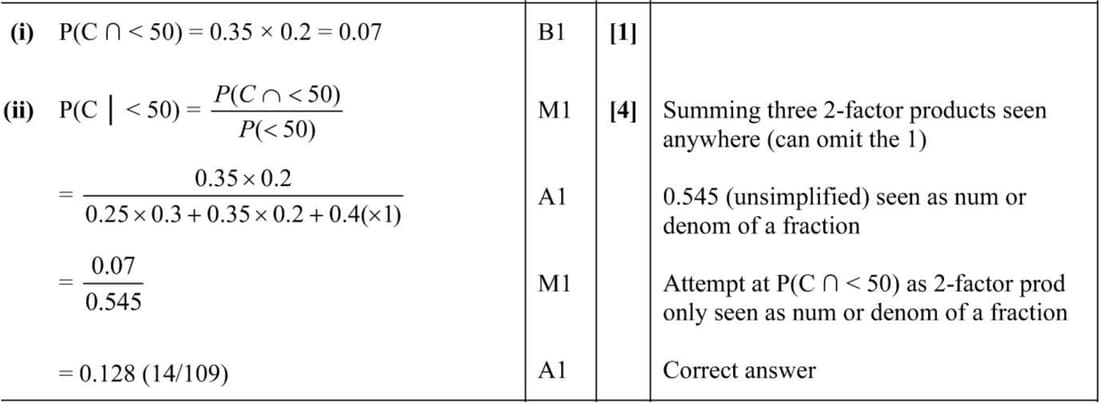
On Saturday afternoons Mohit goes shopping with probability 0.25, or goes to the cinema with probability 0.35 or stays at home. If he goes shopping the probability that he spends more than $50 is 0.7. If he goes to the cinema the probability that he spends more than $50 is 0.8. If he stays at home he spends $10 on a pizza.
(i) Find the probability that Mohit will go to the cinema and spend less than $50.
(ii) Given that he spends less than $50, find the probability that he went to the cinema.
9709 P61 - Nov 2013 - Q2
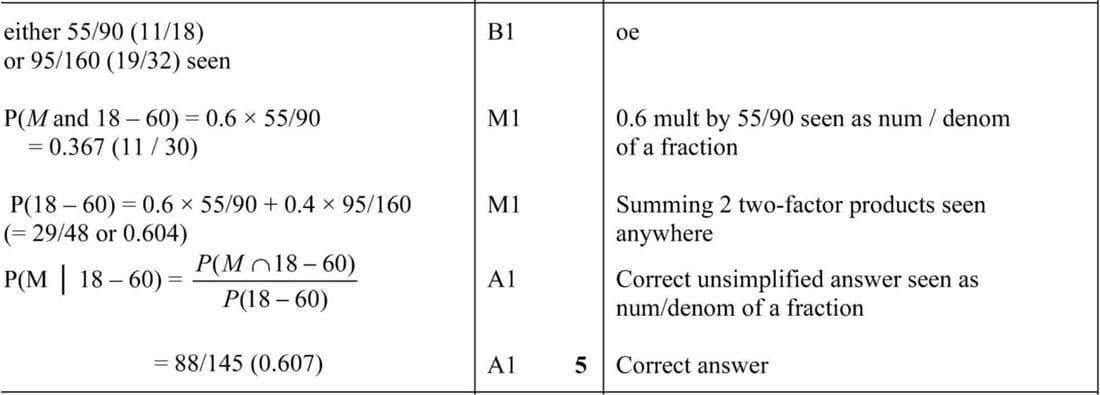
The people living in two towns, Mumbok and Bagville, are classified by age. The numbers in thousands living in each town are shown in the table below.
| Mumbok | Bagville | |
|---|---|---|
| Under 18 years | 15 | 35 |
| 18 to 60 years | 55 | 95 |
| Over 60 years | 20 | 30 |
One of the towns is chosen. The probability of choosing Mumbok is 0.6 and the probability of choosing Bagville is 0.4. Then a person is chosen at random from that town. Given that the person chosen is between 18 and 60 years old, find the probability that the town chosen was Mumbok.
9709 P63 - Jun 2013 - Q5
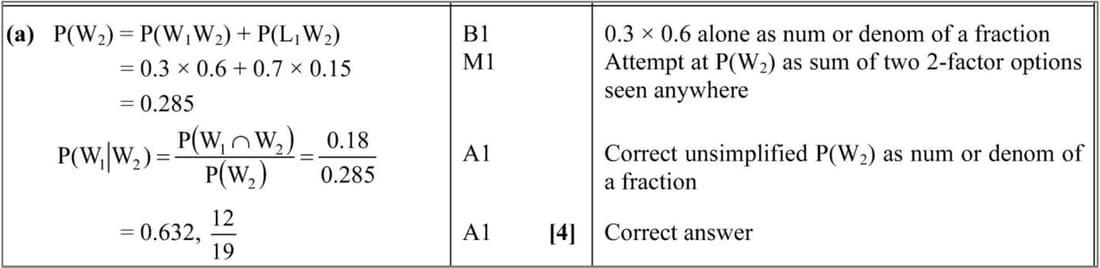
John plays two games of squash. The probability that he wins his first game is 0.3. If he wins his first game, the probability that he wins his second game is 0.6. If he loses his first game, the probability that he wins his second game is 0.15. Given that he wins his second game, find the probability that he won his first game.
9709 P53 - Nov 2022 - Q7
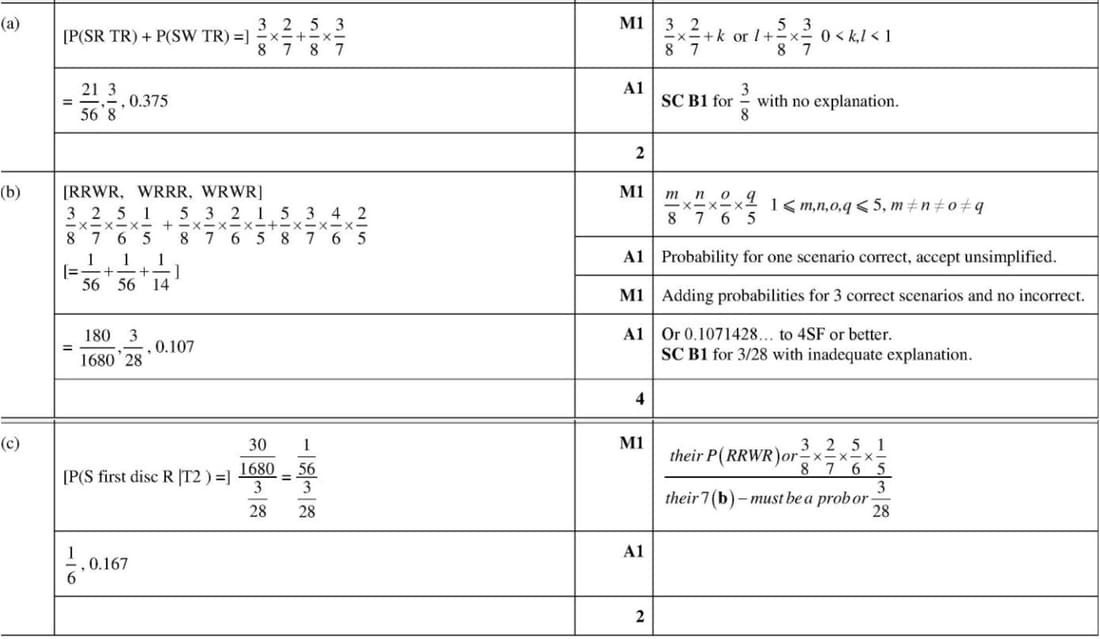
Sam and Tom are playing a game which involves a bag containing 5 white discs and 3 red discs. They take turns to remove one disc from the bag at random. Discs that are removed are not replaced into the bag. The game ends as soon as one player has removed two red discs from the bag. That player wins the game.
Sam removes the first disc.
(a) Find the probability that Tom removes a red disc on his first turn.
(b) Find the probability that Tom wins the game on his second turn.
(c) Find the probability that Sam removes a red disc on his first turn given that Tom wins the game on his second turn.
9709 P62 - Jun 2013 - Q7
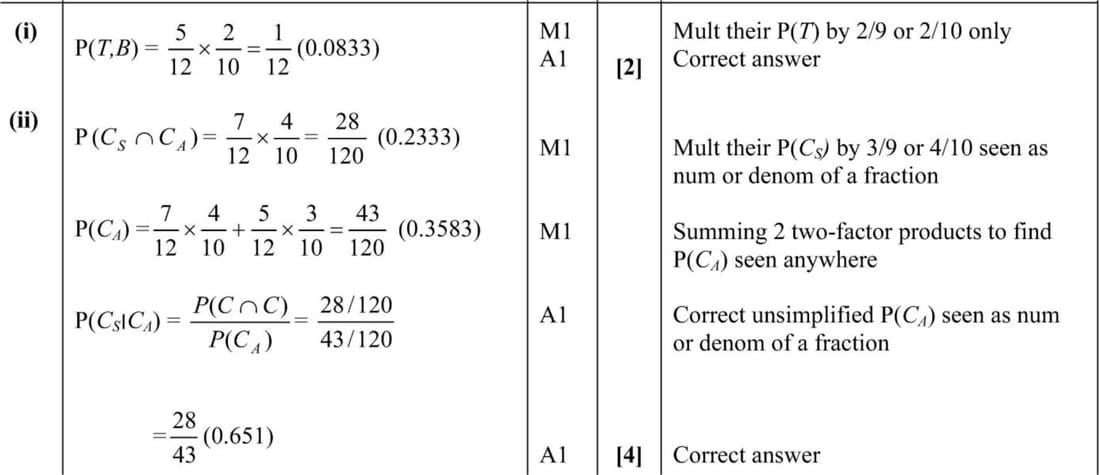
Susan has a bag of sweets containing 7 chocolates and 5 toffees. Ahmad has a bag of sweets containing 3 chocolates, 4 toffees and 2 boiled sweets. A sweet is taken at random from Susan’s bag and put in Ahmad’s bag. A sweet is then taken at random from Ahmad’s bag.
(i) Find the probability that the two sweets taken are a toffee from Susan’s bag and a boiled sweet from Ahmad’s bag.
(ii) Given that the sweet taken from Ahmad’s bag is a chocolate, find the probability that the sweet taken from Susan’s bag was also a chocolate.
9709 P61 - Jun 2013 - Q7
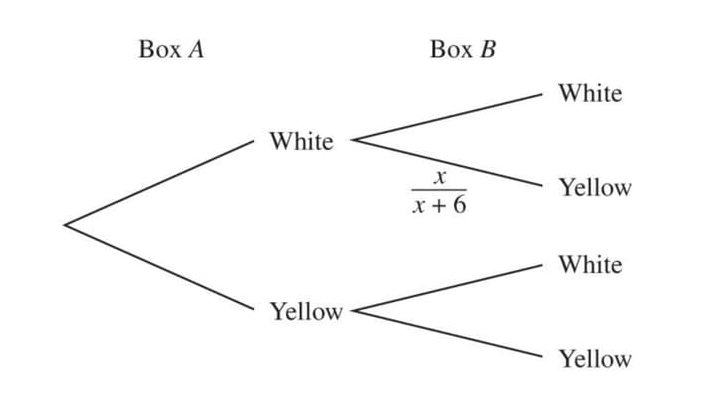
Box A contains 8 white balls and 2 yellow balls. Box B contains 5 white balls and x yellow balls. A ball is chosen at random from box A and placed in box B. A ball is then chosen at random from box B. The tree diagram below shows the possibilities for the colours of the balls chosen.
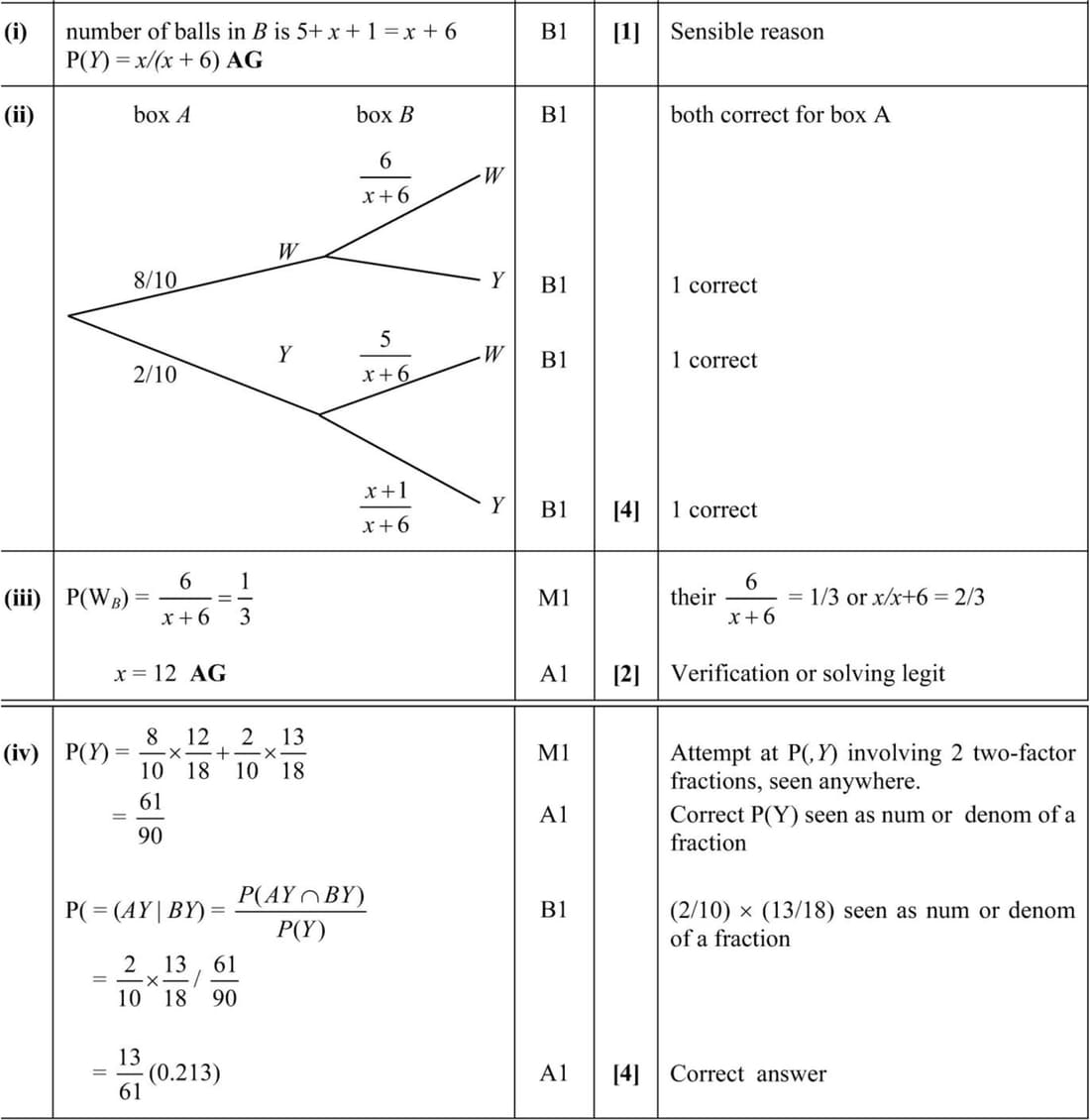
(i) Justify the probability \(\frac{x}{x+6}\) on the tree diagram.
(ii) Copy and complete the tree diagram.
(iii) If the ball chosen from box A is white then the probability that the ball chosen from box B is also white is \(\frac{1}{3}\). Show that the value of \(x\) is 12.
(iv) Given that the ball chosen from box B is yellow, find the conditional probability that the ball chosen from box A was yellow.
9709 P62 - Nov 2012 - Q1
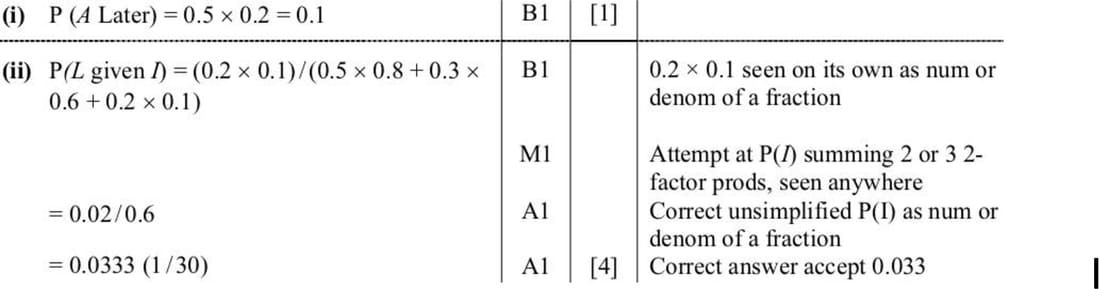
Fabio drinks coffee each morning. He chooses Americano, Cappuccino or Latte with probabilities 0.5, 0.3 and 0.2 respectively. If he chooses Americano he either drinks it immediately with probability 0.8, or leaves it to drink later. If he chooses Cappuccino he either drinks it immediately with probability 0.6, or leaves it to drink later. If he chooses Latte he either drinks it immediately with probability 0.1, or leaves it to drink later.
(i) Find the probability that Fabio chooses Americano and leaves it to drink later.
(ii) Fabio drinks his coffee immediately. Find the probability that he chose Latte.
9709 P61 - Nov 2012 - Q6
Ana meets her friends once every day. For each day the probability that she is early is 0.05 and the probability that she is late is 0.75. Otherwise she is on time.
If she is early there is a probability of 0.7 that she will eat a banana. If she is late she does not eat a banana. If she is on time there is a probability of 0.4 that she will eat a banana. Given that for one particular meeting with friends she does not eat a banana, find the probability that she is on time.

9709 P61 - Jun 2012 - Q2
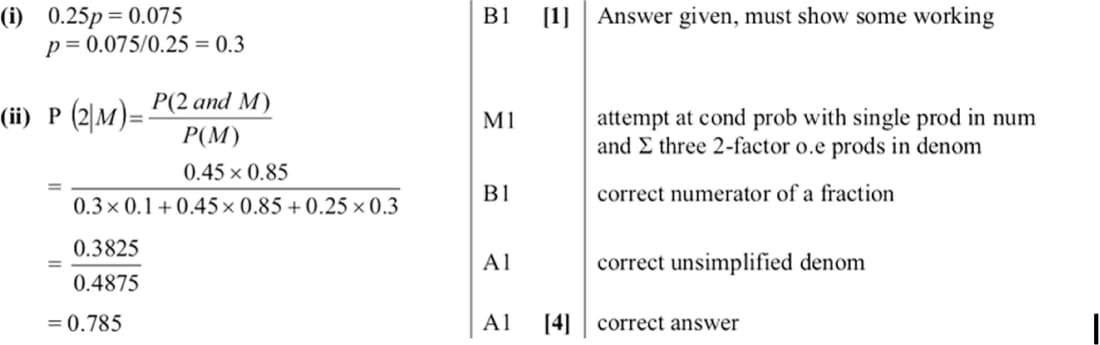
Maria has 3 pre-set stations on her radio. When she switches her radio on, there is a probability of 0.3 that it will be set to station 1, a probability of 0.45 that it will be set to station 2 and a probability of 0.25 that it will be set to station 3. On station 1 the probability that the presenter is male is 0.1, on station 2 the probability that the presenter is male is 0.85 and on station 3 the probability that the presenter is male is \(p\). When Maria switches on the radio, the probability that it is set to station 3 and the presenter is male is 0.075.
- Show that the value of \(p\) is 0.3.
- Given that Maria switches on and hears a male presenter, find the probability that the radio was set to station 2.
9709 P61 - Jun 2011 - Q2
When Ted is looking for his pen, the probability that it is in his pencil case is 0.7. If his pen is in his pencil case he always finds it. If his pen is somewhere else, the probability that he finds it is 0.2. Given that Ted finds his pen when he is looking for it, find the probability that it was in his pencil case.

9709 P63 - Nov 2010 - Q3
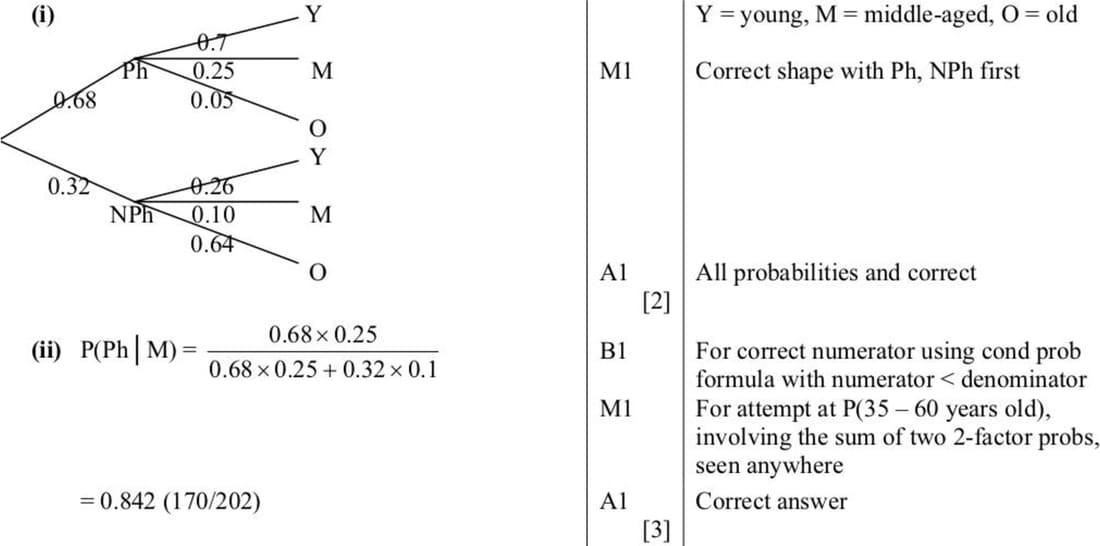
It was found that 68% of the passengers on a train used a cell phone during their train journey. Of those using a cell phone, 70% were under 30 years old, 25% were between 30 and 65 years old and the rest were over 65 years old. Of those not using a cell phone, 26% were under 30 years old and 64% were over 65 years old.
(i) Draw a tree diagram to represent this information, giving all probabilities as decimals.
(ii) Given that one of the passengers is 45 years old, find the probability of this passenger using a cell phone during the journey.
9709 P62 - Nov 2010 - Q3
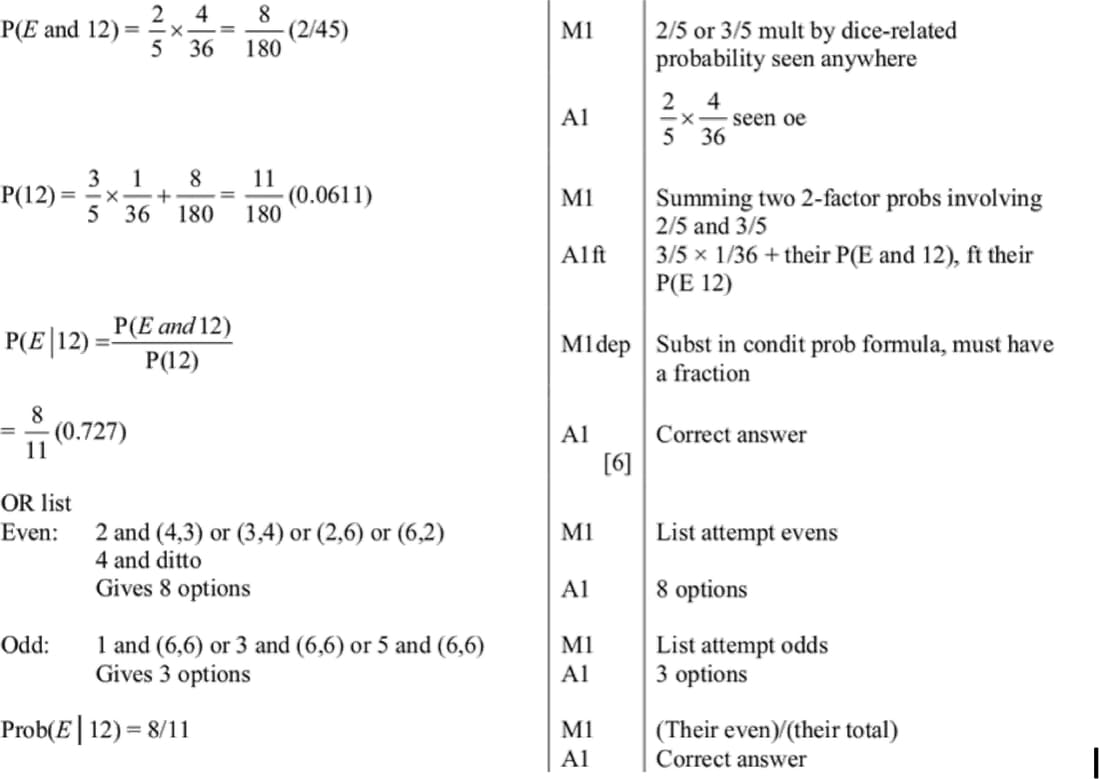
A fair five-sided spinner has sides numbered 1, 2, 3, 4, 5. Raj spins the spinner and throws two fair dice. He calculates his score as follows:
- If the spinner lands on an even-numbered side, Raj multiplies the two numbers showing on the dice to get his score.
- If the spinner lands on an odd-numbered side, Raj adds the numbers showing on the dice to get his score.
Given that Raj’s score is 12, find the probability that the spinner landed on an even-numbered side.
9709 P62 - Jun 2010 - Q6
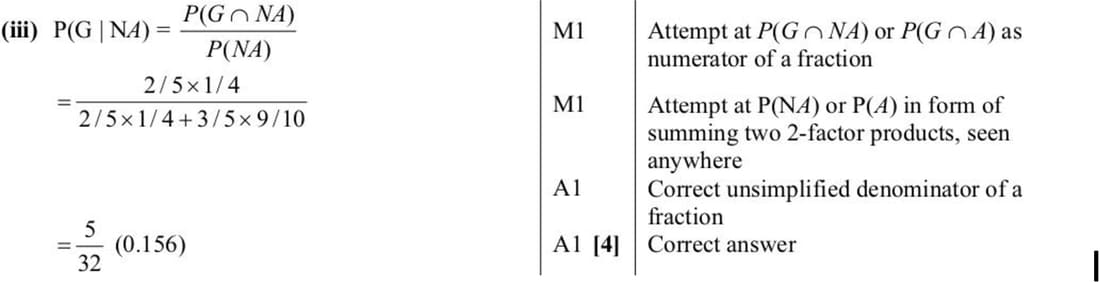
When the farmer’s dog is let loose, it chases either the ducks with probability \(\frac{3}{5}\) or the geese with probability \(\frac{2}{5}\). If the dog chases the ducks there is a probability of \(\frac{1}{10}\) that they will attack the dog. If the dog chases the geese there is a probability of \(\frac{3}{4}\) that they will attack the dog. Given that the dog is not attacked, find the probability that it was chasing the geese.
9709 P61 - Jun 2010 - Q7
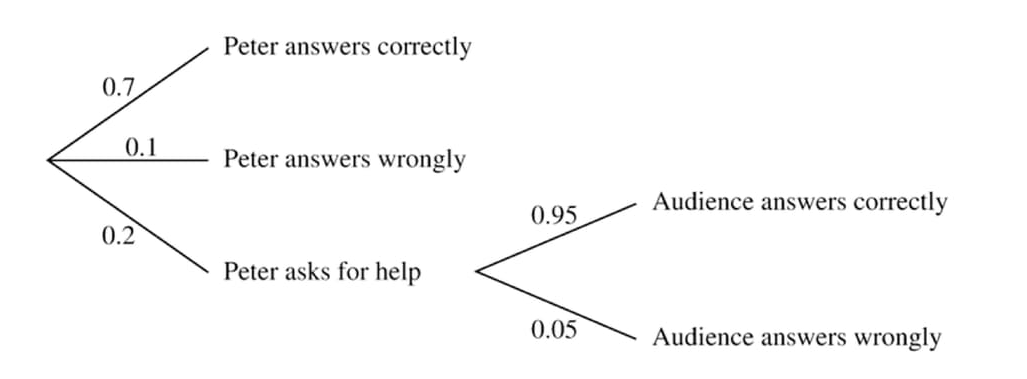
In a television quiz show Peter answers questions one after another, stopping as soon as a question is answered wrongly.
- The probability that Peter gives the correct answer himself to any question is 0.7.
- The probability that Peter gives a wrong answer himself to any question is 0.1.
- The probability that Peter decides to ask for help for any question is 0.2.
On the first occasion that Peter decides to ask for help he asks the audience. The probability that the audience gives the correct answer to any question is 0.95. This information is shown in the tree diagram below.
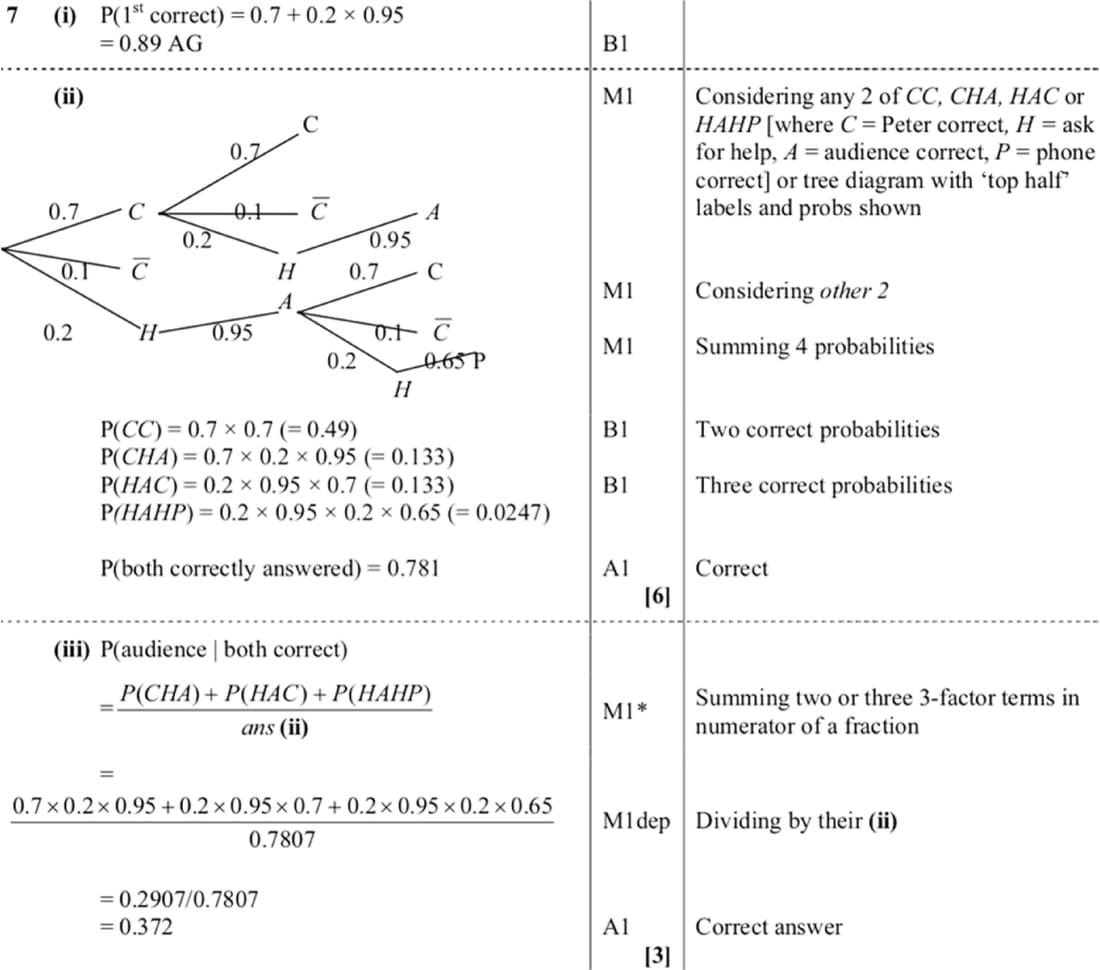
(i) Show that the probability that the first question is answered correctly is 0.89.
On the second occasion that Peter decides to ask for help he phones a friend. The probability that his friend gives the correct answer to any question is 0.65.
(ii) Find the probability that the first two questions are both answered correctly.
(iii) Given that the first two questions were both answered correctly, find the probability that Peter asked the audience.
9709 P52 - Nov 2022 - Q1
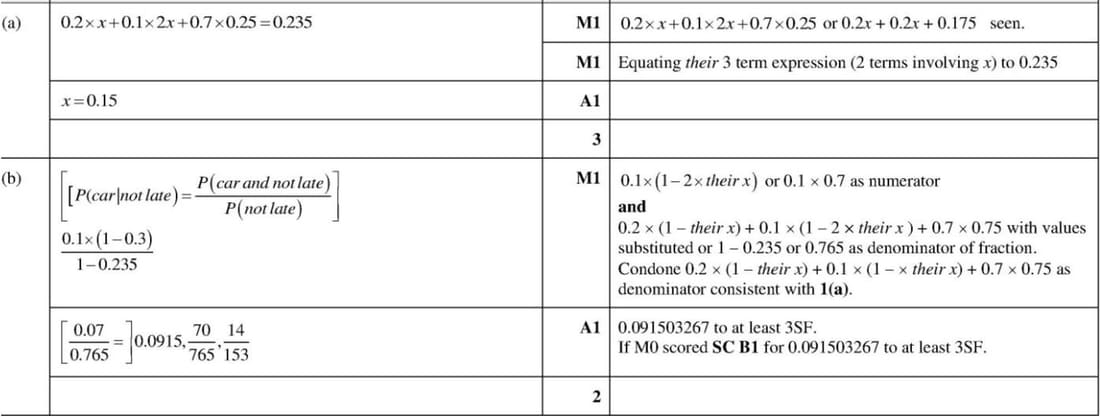
On any day, Kino travels to school by bus, by car or on foot with probabilities 0.2, 0.1 and 0.7 respectively. The probability that he is late when he travels by bus is \(x\). The probability that he is late when he travels by car is \(2x\) and the probability that he is late when he travels on foot is 0.25.
The probability that, on a randomly chosen day, Kino is late is 0.235.
(a) Find the value of \(x\).
(b) Find the probability that, on a randomly chosen day, Kino travels to school by car given that he is not late.
9709 P62 - Nov 2009 - Q3
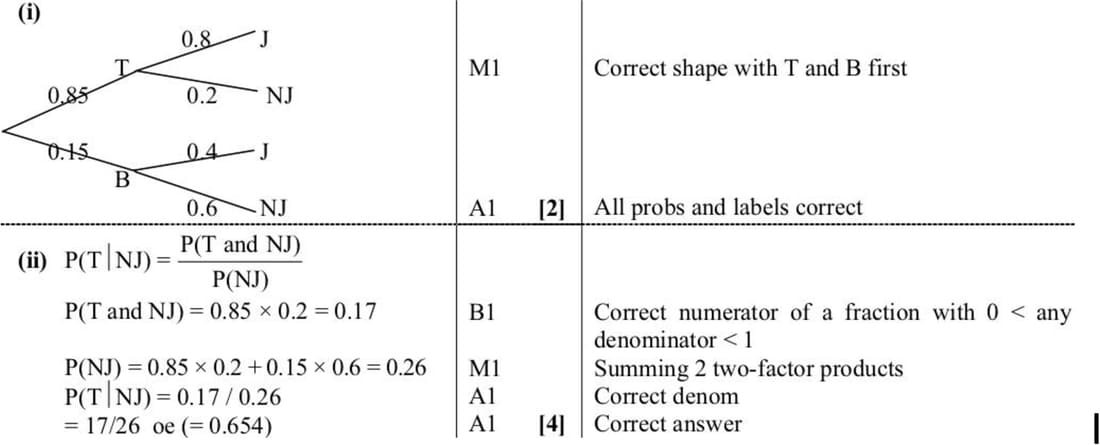
Maria chooses toast for her breakfast with probability 0.85. If she does not choose toast then she has a bread roll. If she chooses toast then the probability that she will have jam on it is 0.8. If she has a bread roll then the probability that she will have jam on it is 0.4.
(i) Draw a fully labelled tree diagram to show this information.
(ii) Given that Maria did not have jam for breakfast, find the probability that she had toast.