Past Exam Questions
← Back9709 P63 - Nov 2016 - Q4
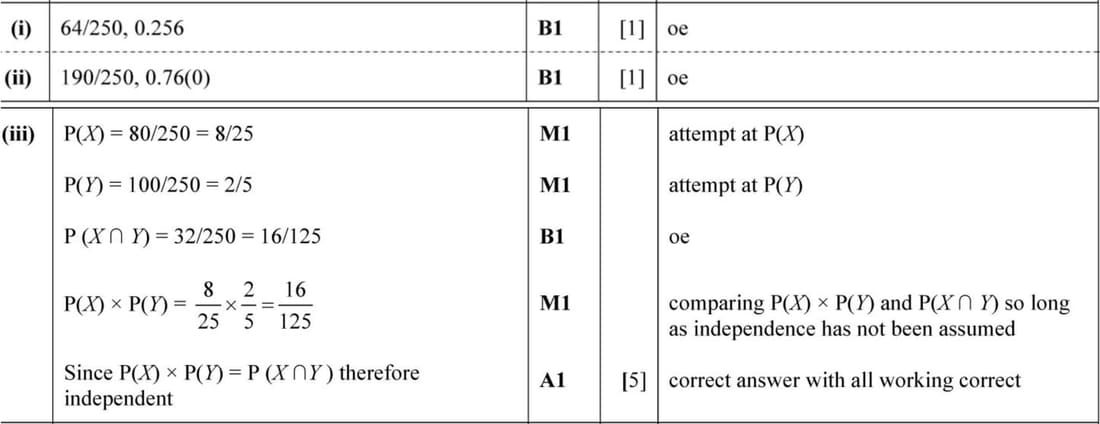
For a group of 250 cars the numbers, classified by colour and country of manufacture, are shown in the table.
| Germany | Japan | Korea | |
|---|---|---|---|
| Silver | 40 | 26 | 34 |
| White | 32 | 22 | 26 |
| Red | 28 | 12 | 30 |
One car is selected at random from this group. Find the probability that the selected car is
- a red or silver car manufactured in Korea,
- not manufactured in Japan.
X is the event that the selected car is white. Y is the event that the selected car is manufactured in Germany.
(iii) By using appropriate probabilities, determine whether events X and Y are independent.
9709 P63 - Jun 2016 - Q1
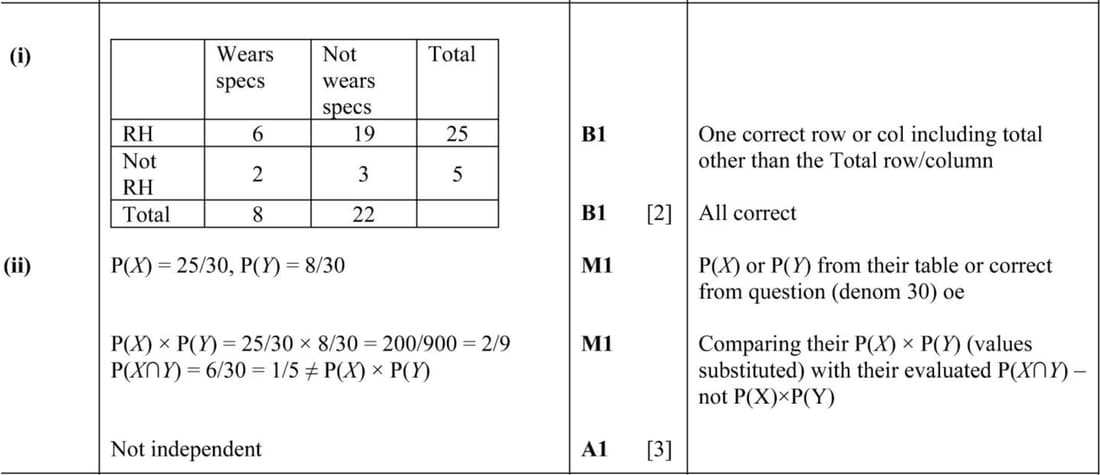
In a group of 30 adults, 25 are right-handed and 8 wear spectacles. The number who are right-handed and do not wear spectacles is 19.
(i) Copy and complete the following table to show the number of adults in each category.
| Wears spectacles | Does not wear spectacles | Total | |
|---|---|---|---|
| Right-handed | |||
| Not right-handed | |||
| Total | 30 |
An adult is chosen at random from the group. Event X is ‘the adult chosen is right-handed’; event Y is ‘the adult chosen wears spectacles’.
(ii) Determine whether X and Y are independent events, justifying your answer.
9709 P62 - Mar 2016 - Q3
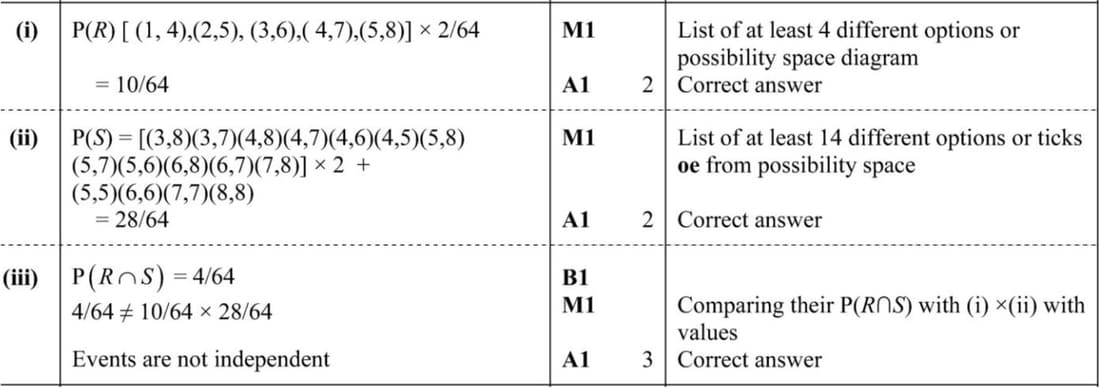
A fair eight-sided die has faces marked 1, 2, 3, 4, 5, 6, 7, 8. The score when the die is thrown is the number on the face the die lands on. The die is thrown twice.
- Event R is ‘one of the scores is exactly 3 greater than the other score’.
- Event S is ‘the product of the scores is more than 19’.
- Find the probability of R. [2]
- Find the probability of S. [2]
- Determine whether events R and S are independent. Justify your answer. [3]
9709 P63 - Nov 2015 - Q3
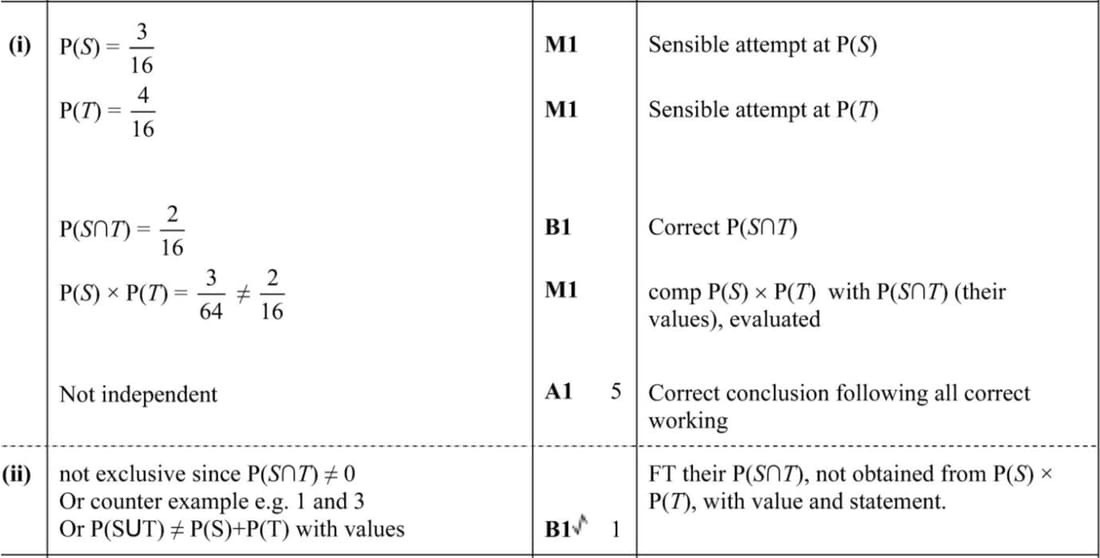
Ellie throws two fair tetrahedral dice, each with faces numbered 1, 2, 3, and 4. She notes the numbers on the faces that the dice land on. Event S is 'the sum of the two numbers is 4'. Event T is 'the product of the two numbers is an odd number'.
- Determine whether events S and T are independent, showing your working.
- Are events S and T exclusive? Justify your answer.
9709 P61 - Jun 2015 - Q3
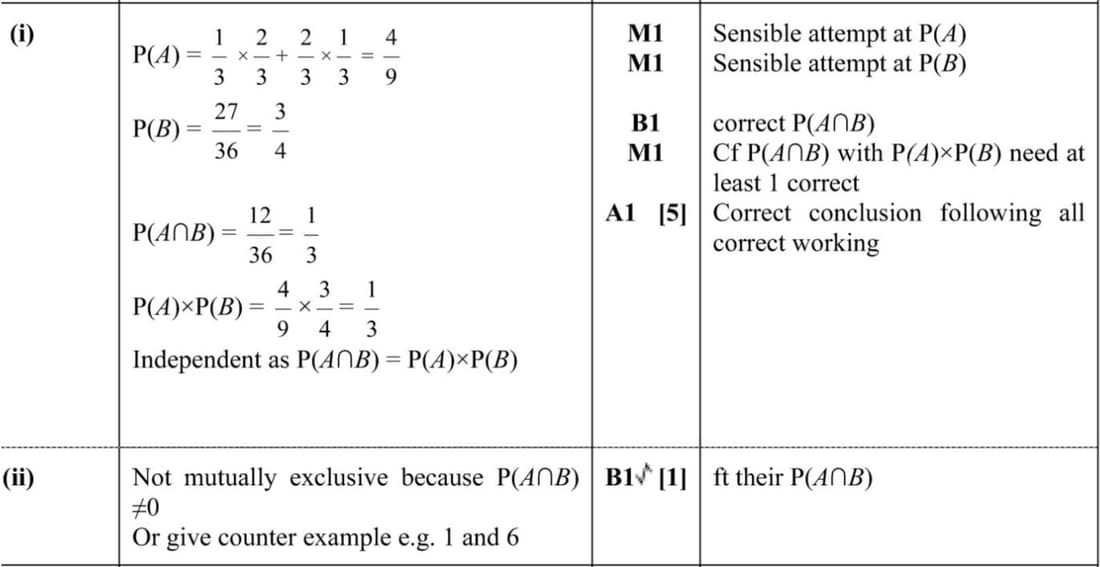
Jason throws two fair dice, each with faces numbered 1 to 6. Event A is ‘one of the numbers obtained is divisible by 3 and the other number is not divisible by 3’. Event B is ‘the product of the two numbers obtained is even’.
- Determine whether events A and B are independent, showing your working. [5]
- Are events A and B mutually exclusive? Justify your answer. [1]
9709 P52 - Mar 2023 - Q5
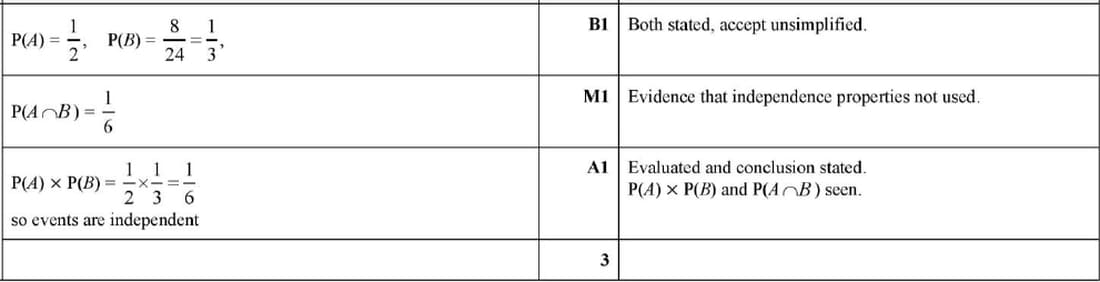
Marco has four boxes labelled K, L, M and N. He places them in a straight line in the order K, L, M, N with K on the left. Marco also has four coloured marbles: one is red, one is green, one is white and one is yellow. He places a single marble in each box, at random. Events A and B are defined as follows.
A: The white marble is in either box L or box M.
B: The red marble is to the left of both the green marble and the yellow marble.
Determine whether or not events A and B are independent.
9709 P62 - Nov 2013 - Q7
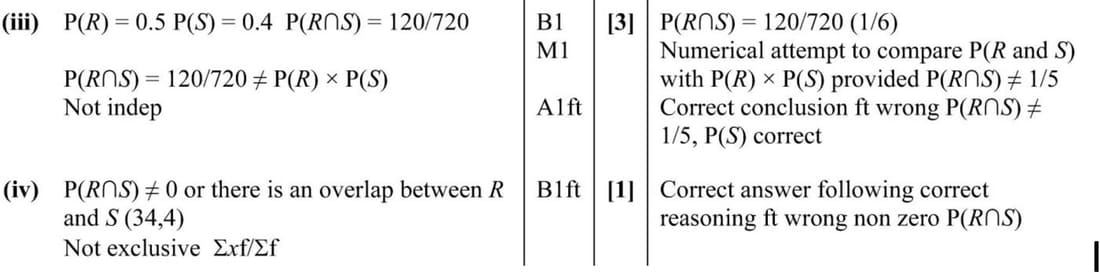
Rory has 10 cards. Four of the cards have a 3 printed on them and six of the cards have a 4 printed on them. He takes three cards at random, without replacement, and adds up the numbers on the cards. Event \(R\) is 'the sum of the numbers on the three cards is 11'. Event \(S\) is 'the number on the first card taken is a 3'.
(iii) Determine whether events \(R\) and \(S\) are independent. Justify your answer.
(iv) Determine whether events \(R\) and \(S\) are exclusive. Justify your answer.
9709 P63 - Jun 2013 - Q1
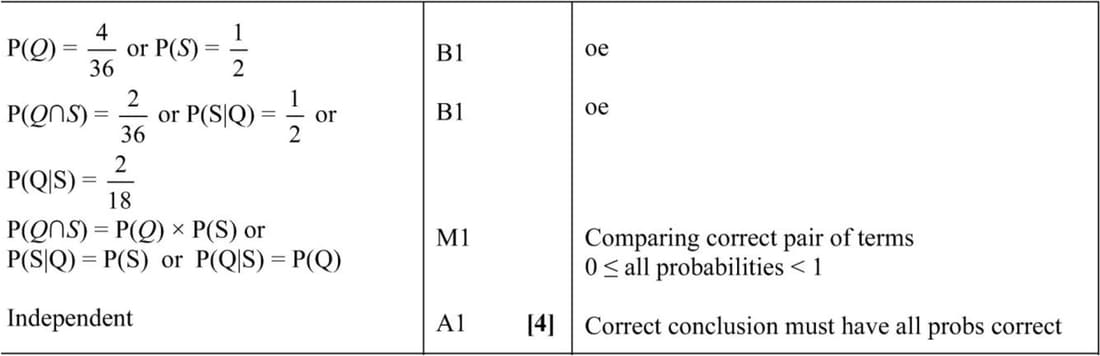
Q is the event ‘Nicola throws two fair dice and gets a total of 5’. S is the event ‘Nicola throws two fair dice and gets one low score (1, 2 or 3) and one high score (4, 5 or 6)’. Are events Q and S independent? Justify your answer.
9709 P63 - Nov 2012 - Q3
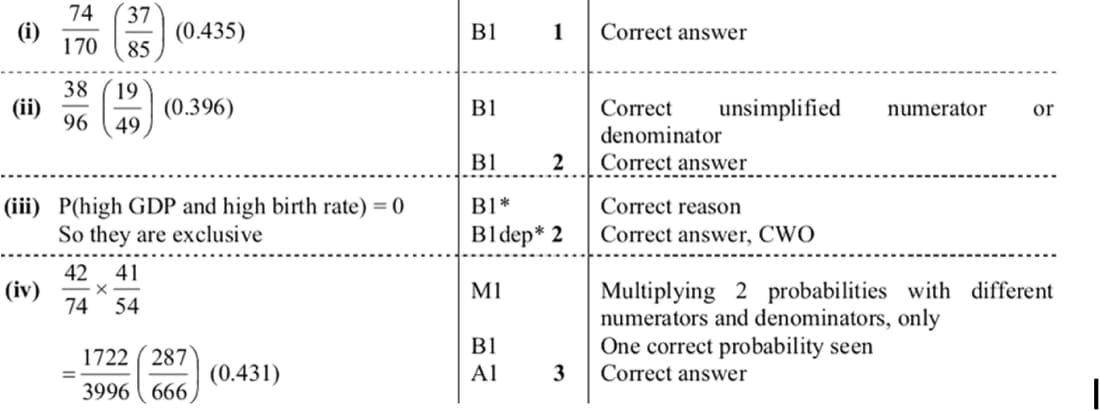
Ronnie obtained data about the gross domestic product (GDP) and the birth rate for 170 countries. He classified each GDP and each birth rate as either ‘low’, ‘medium’ or ‘high’. The table shows the number of countries in each category.
| Birth rate | |||
|---|---|---|---|
| GDP | Low | Medium | High |
| Low | 3 | 5 | 45 |
| Medium | 20 | 42 | 12 |
| High | 35 | 8 | 0 |
One of these countries is chosen at random.
- Find the probability that the country chosen has a medium GDP. [1]
- Find the probability that the country chosen has a low birth rate, given that it does not have a medium GDP. [2]
- State with a reason whether or not the events ‘the country chosen has a high GDP’ and ‘the country chosen has a high birth rate’ are exclusive. [2]
One country is chosen at random from those countries which have a medium GDP and then a different country is chosen at random from those which have a medium birth rate.
- Find the probability that both countries chosen have a medium GDP and a medium birth rate. [3]
9709 P63 - Jun 2012 - Q5
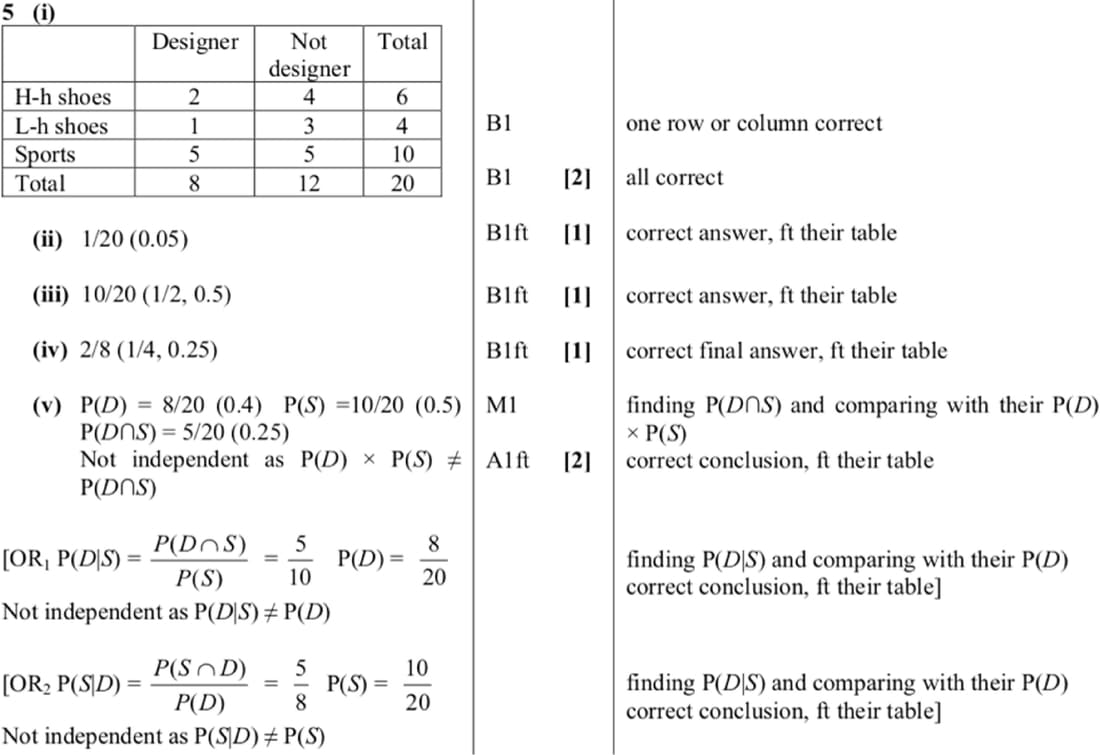
Suzanne has 20 pairs of shoes, some of which have designer labels. She has 6 pairs of high-heeled shoes, of which 2 pairs have designer labels. She has 4 pairs of low-heeled shoes, of which 1 pair has designer labels. The rest of her shoes are pairs of sports shoes. Suzanne has 8 pairs of shoes with designer labels in total.
(i) Copy and complete the table below to show the number of pairs in each category.
| Designer labels | No designer labels | Total |
|---|---|---|
| High-heeled shoes | 6 | |
| Low-heeled shoes | 4 | |
| Sports shoes | ||
| Total | 20 |
Suzanne chooses 1 pair of shoes at random to wear.
(ii) Find the probability that she wears the pair of low-heeled shoes with designer labels.
(iii) Find the probability that she wears a pair of sports shoes.
(iv) Find the probability that she wears a pair of high-heeled shoes, given that she wears a pair of shoes with designer labels.
(v) State with a reason whether the events ‘Suzanne wears a pair of shoes with designer labels’ and ‘Suzanne wears a pair of sports shoes’ are independent.
9709 P63 - Nov 2011 - Q2
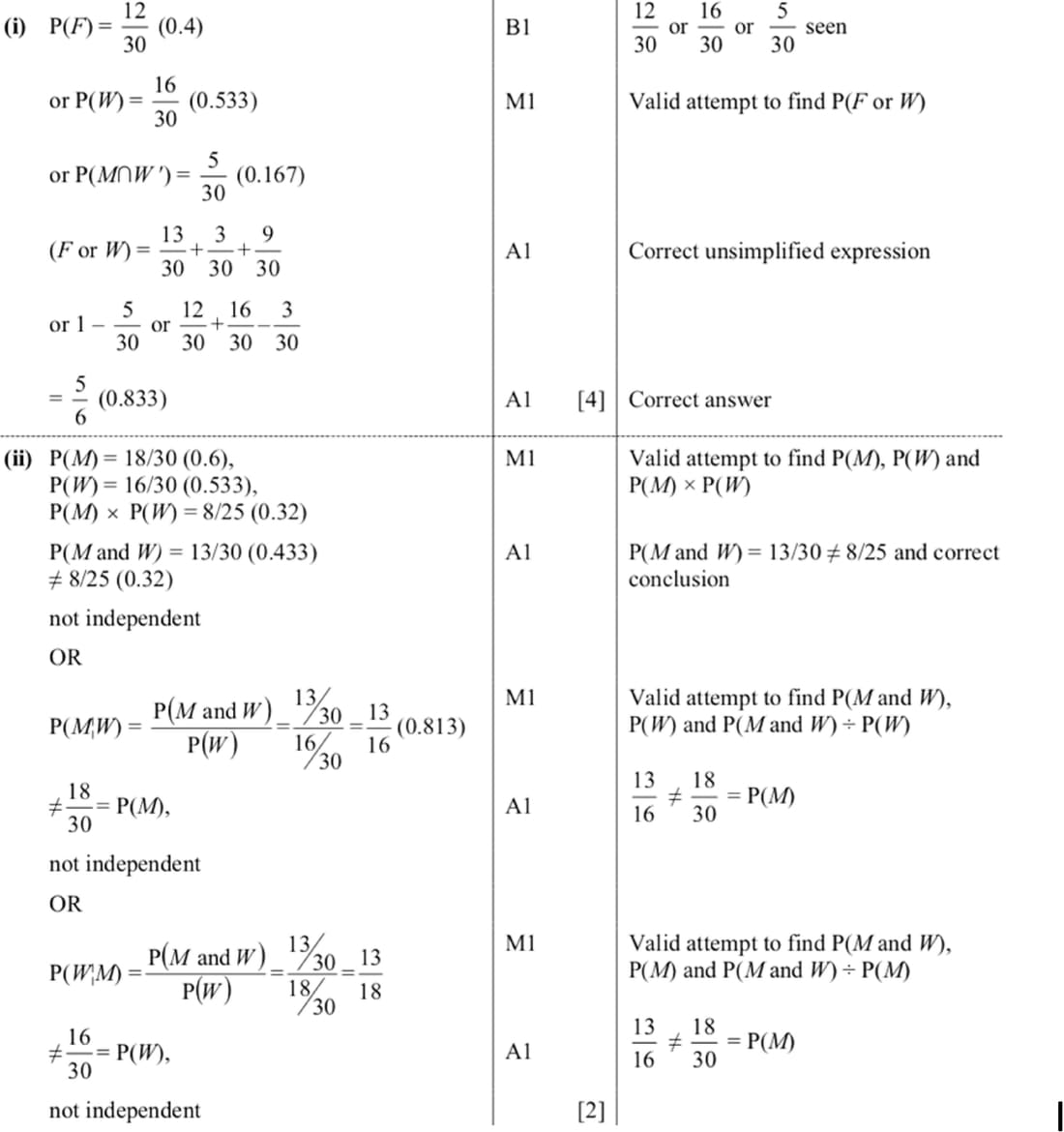
In a group of 30 teenagers, 13 of the 18 males watch 'Kops are Kids' on television and 3 of the 12 females watch 'Kops are Kids'.
(i) Find the probability that a person chosen at random from the group is either female or watches 'Kops are Kids' or both.
(ii) Showing your working, determine whether the events 'the person chosen is male' and 'the person chosen watches Kops are Kids' are independent or not.
9709 P61 - Nov 2011 - Q7
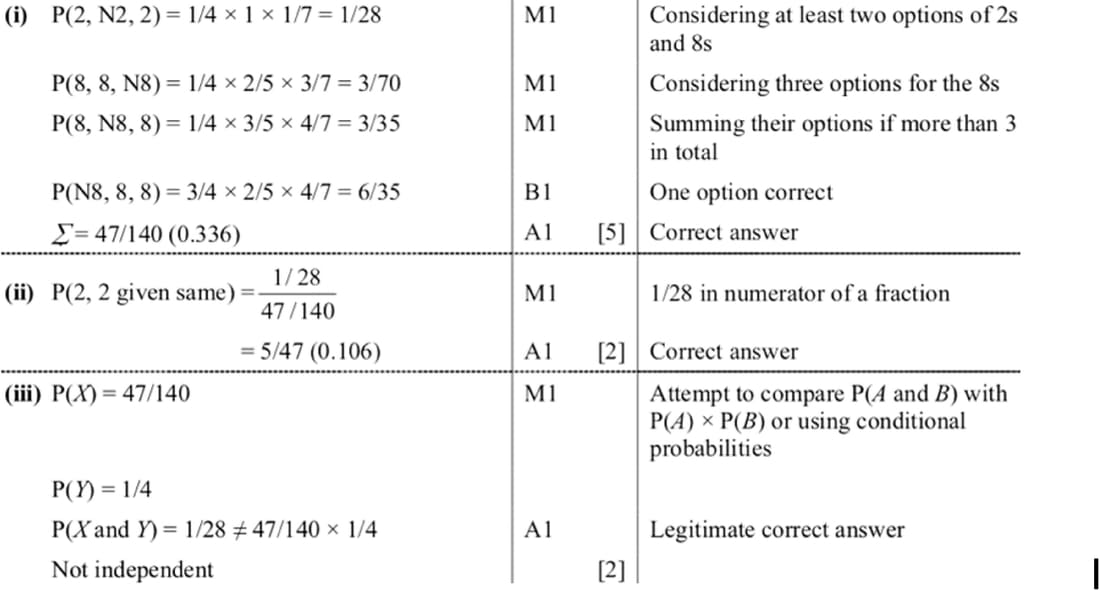
Bag A contains 4 balls numbered 2, 4, 5, 8. Bag B contains 5 balls numbered 1, 3, 6, 8, 8. Bag C contains 7 balls numbered 2, 7, 8, 8, 8, 8, 9. One ball is selected at random from each bag.
- Find the probability that exactly two of the selected balls have the same number.
- Given that exactly two of the selected balls have the same number, find the probability that they are both numbered 2.
- Event X is ‘exactly two of the selected balls have the same number’. Event Y is ‘the ball selected from bag A has number 2’. Showing your working, determine whether events X and Y are independent or not.
9709 P63 - Jun 2011 - Q4
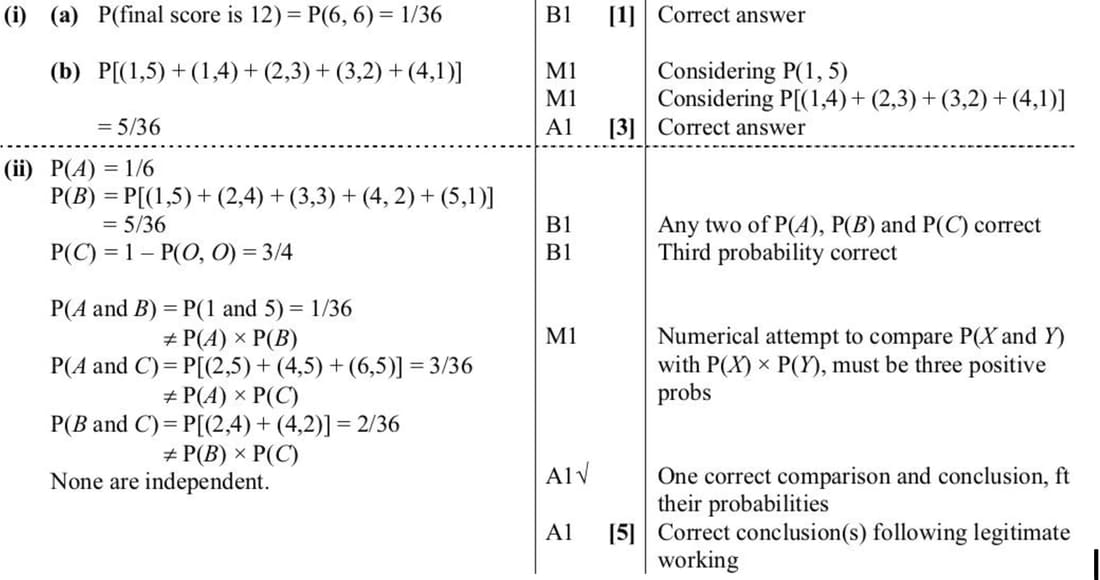
Tim throws a fair die twice and notes the number on each throw.
(i) Tim calculates his final score as follows. If the number on the second throw is a 5 he multiplies the two numbers together, and if the number on the second throw is not a 5 he adds the two numbers together. Find the probability that his final score is
(a) 12,
(b) 5.
(ii) Events A, B, C are defined as follows.
A: the number on the second throw is 5
B: the sum of the numbers is 6
C: the product of the numbers is even
By calculation find which pairs, if any, of the events A, B and C are independent.
9709 P62 - Jun 2010 - Q5
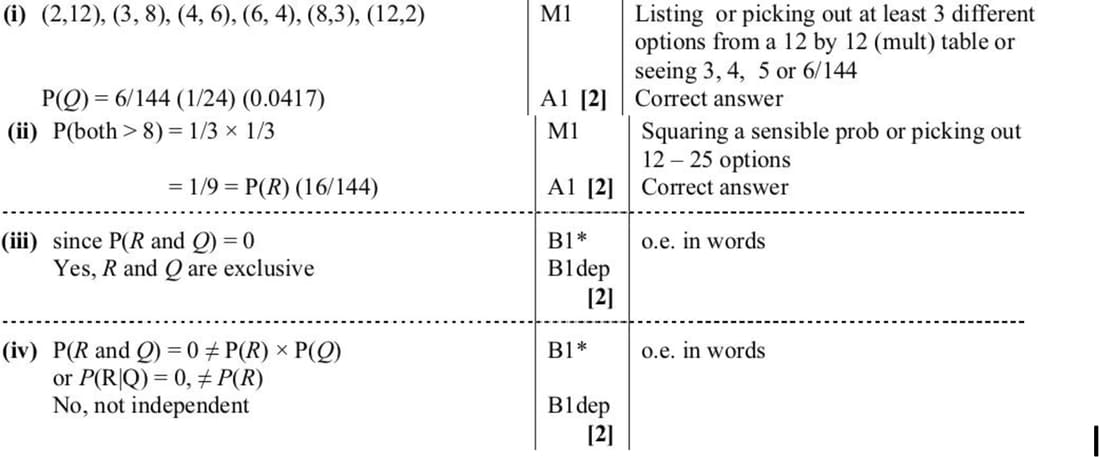
Two fair twelve-sided dice with sides marked 1, 2, 3, 4, 5, 6, 7, 8, 9, 10, 11, 12 are thrown, and the numbers on the sides which land face down are noted. Events \(Q\) and \(R\) are defined as follows.
\(Q\): the product of the two numbers is 24.
\(R\): both of the numbers are greater than 8.
- Find \(P(Q)\). [2]
- Find \(P(R)\). [2]
- Are events \(Q\) and \(R\) exclusive? Justify your answer. [2]
- Are events \(Q\) and \(R\) independent? Justify your answer. [2]
9709 P6 - Nov 2006 - Q4
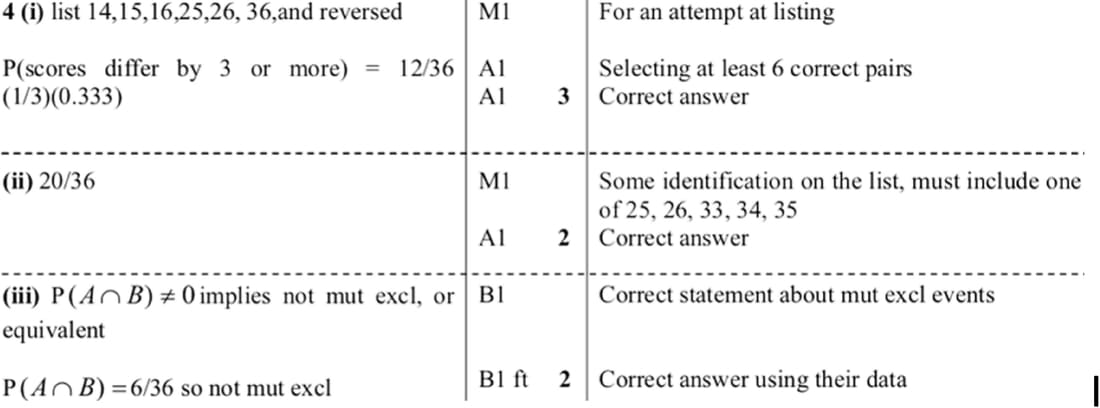
Two fair dice are thrown.
- Event A is ‘the scores differ by 3 or more’. Find the probability of event A.
- Event B is ‘the product of the scores is greater than 8’. Find the probability of event B.
- State with a reason whether events A and B are mutually exclusive.
9709 P6 - Jun 2005 - Q5
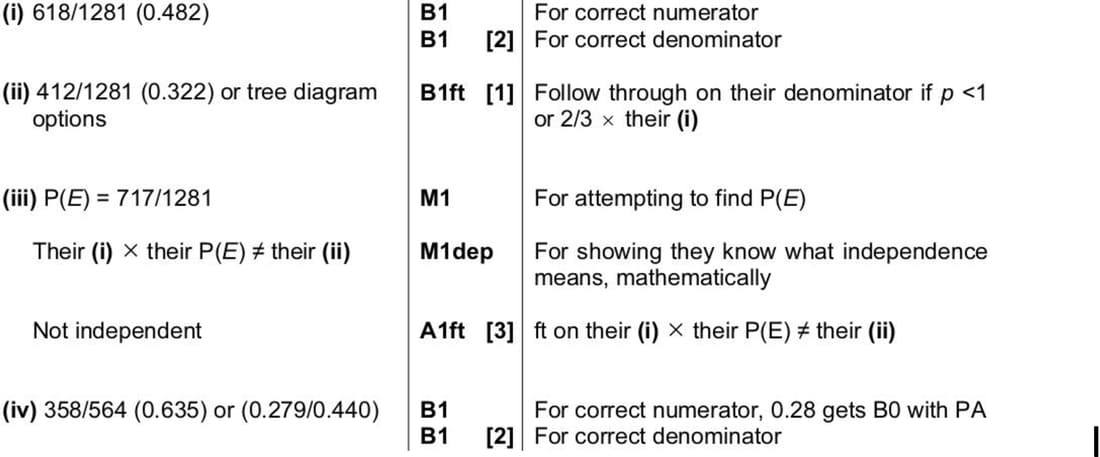
Data about employment for males and females in a small rural area are shown in the table.
| Unemployed | Employed | |
|---|---|---|
| Male | 206 | 412 |
| Female | 358 | 305 |
A person from this area is chosen at random. Let \(M\) be the event that the person is male and let \(E\) be the event that the person is employed.
- Find \(P(M)\).
- Find \(P(M \text{ and } E)\).
- Are \(M\) and \(E\) independent events? Justify your answer.
- Given that the person chosen is unemployed, find the probability that the person is female.
9709 P51 - Nov 2022 - Q5
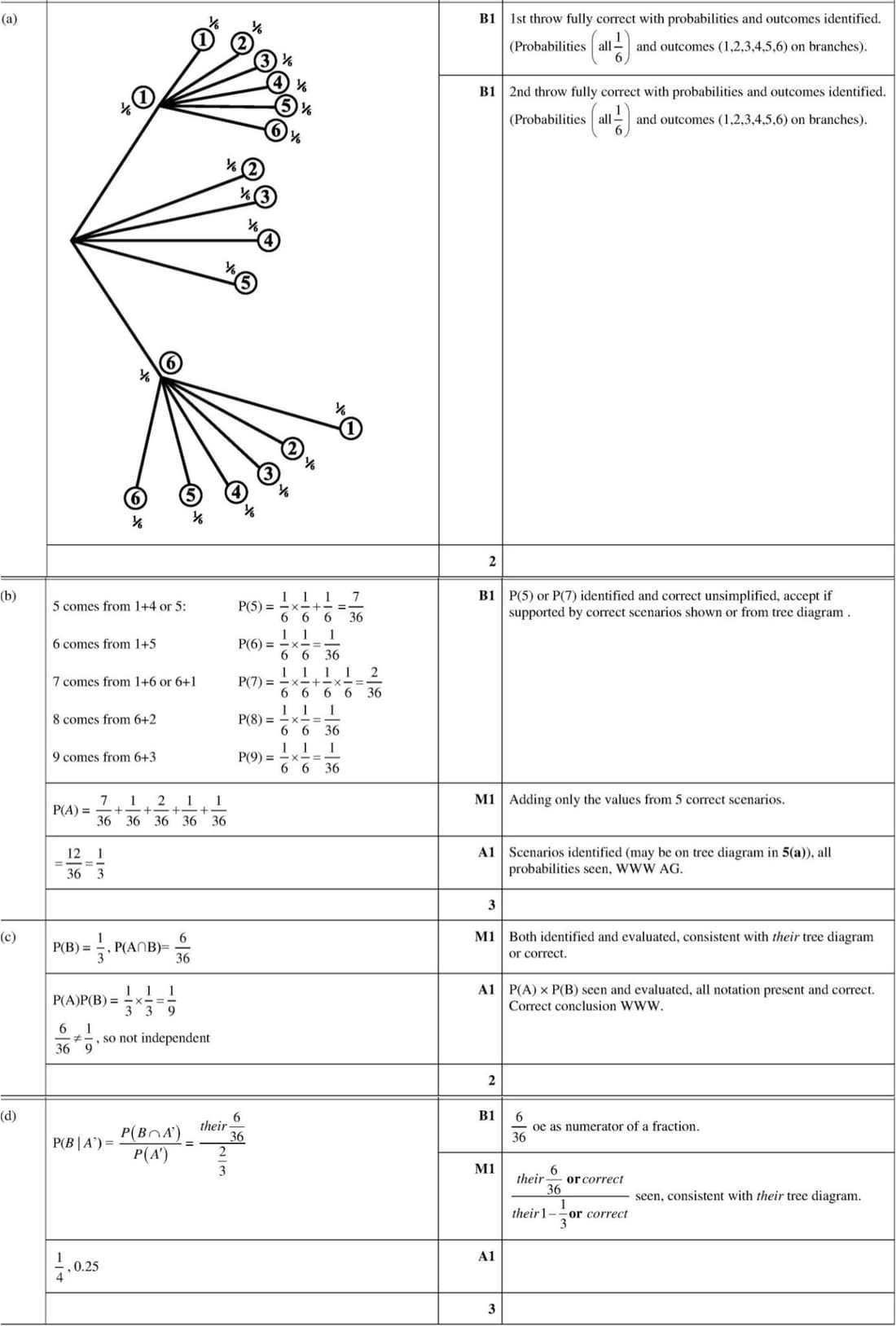
A game is played with an ordinary fair 6-sided die. A player throws the die once. If the result is 2, 3, 4, or 5, that result is the player's score and the player does not throw the die again. If the result is 1 or 6, the player throws the die a second time and the player's score is the sum of the two numbers from the two throws.
(a) Draw a fully labelled tree diagram to represent this information.
Events A and B are defined as follows.
A: the player's score is 5, 6, 7, 8 or 9
B: the player has two throws
(b) Show that P(A) = \(\frac{1}{3}\).
(c) Determine whether or not events A and B are independent.
(d) Find P(B | A').
9709 P6 - Jun 2002 - Q1
Events A and B are such that \(P(A) = 0.3\), \(P(B) = 0.8\) and \(P(A \text{ and } B) = 0.4\). State, giving a reason in each case, whether events A and B are
- independent,
- mutually exclusive.

9709 P52 - Nov 2021 - Q1
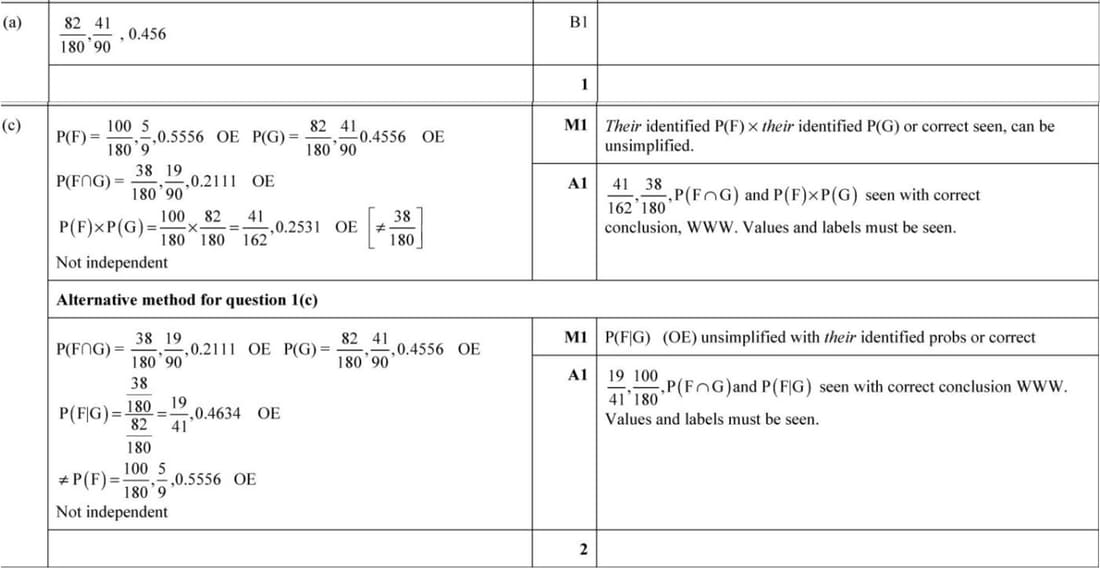
Each of the 180 students at a college plays exactly one of the piano, the guitar, and the drums. The numbers of male and female students who play the piano, the guitar, and the drums are given in the following table.
| Piano | Guitar | Drums | |
|---|---|---|---|
| Male | 25 | 44 | 11 |
| Female | 42 | 38 | 20 |
A student at the college is chosen at random.
- (a) Find the probability that the student plays the guitar.
- (c) Determine whether the events ‘the student plays the guitar’ and ‘the student is female’ are independent, justifying your answer.
9709 P52 - Mar 2021 - Q7
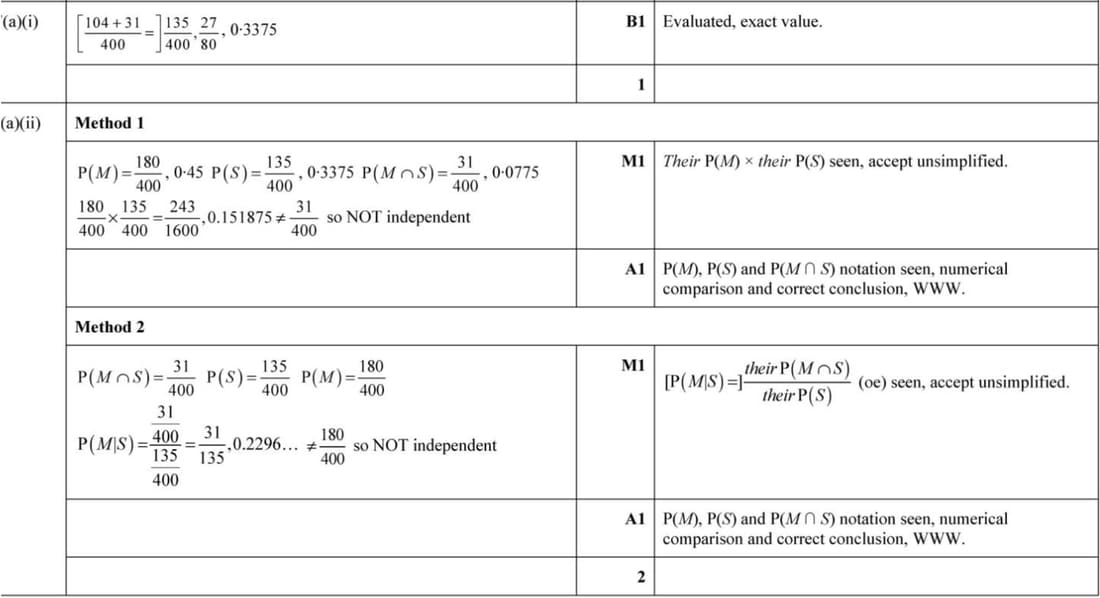
There are 400 students at a school in a certain country. Each student was asked whether they preferred swimming, cycling or running and the results are given in the following table.
| Swimming | Cycling | Running | |
|---|---|---|---|
| Female | 104 | 50 | 66 |
| Male | 31 | 57 | 92 |
A student is chosen at random.
- Find the probability that the student prefers swimming. [1]
- Determine whether the events ‘the student is male’ and ‘the student prefers swimming’ are independent, justifying your answer. [2]