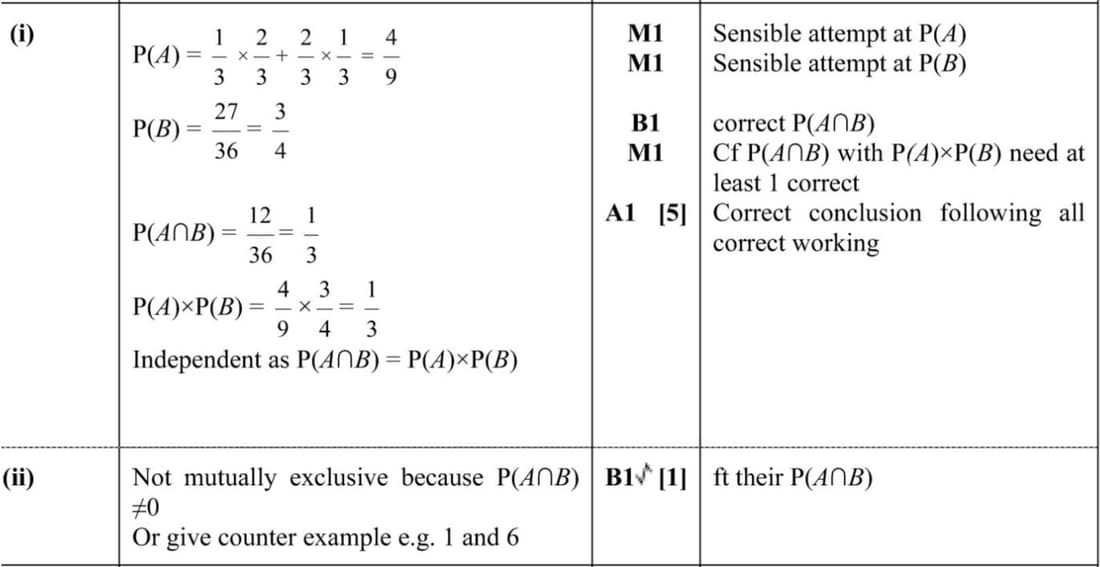
To determine if events A and B are independent, we need to check if \(P(A \cap B) = P(A) \times P(B)\).
First, calculate \(P(A)\):
There are 2 numbers divisible by 3 (3 and 6) and 4 numbers not divisible by 3 (1, 2, 4, 5) on a die. The probability that one die shows a number divisible by 3 and the other does not is:
\(P(A) = \frac{1}{3} \times \frac{2}{3} + \frac{2}{3} \times \frac{1}{3} = \frac{4}{9}\)
Next, calculate \(P(B)\):
The product is even if at least one number is even. There are 3 even numbers (2, 4, 6) on a die. The probability that the product is even is:
\(P(B) = 1 - \left(\frac{1}{2} \times \frac{1}{2}\right) = \frac{3}{4}\)
Now, calculate \(P(A \cap B)\):
\(P(A \cap B) = \frac{12}{36} = \frac{1}{3}\)
Check independence:
\(P(A) \times P(B) = \frac{4}{9} \times \frac{3}{4} = \frac{1}{3}\)
Since \(P(A \cap B) = P(A) \times P(B)\), events A and B are independent.
For mutual exclusivity, events are mutually exclusive if \(P(A \cap B) = 0\). Since \(P(A \cap B) = \frac{1}{3} \neq 0\), events A and B are not mutually exclusive.