9709 P63 - Nov 2012 - Q3
2667
Ronnie obtained data about the gross domestic product (GDP) and the birth rate for 170 countries. He classified each GDP and each birth rate as either ‘low’, ‘medium’ or ‘high’. The table shows the number of countries in each category.
| Birth rate | |||
|---|---|---|---|
| GDP | Low | Medium | High |
| Low | 3 | 5 | 45 |
| Medium | 20 | 42 | 12 |
| High | 35 | 8 | 0 |
One of these countries is chosen at random.
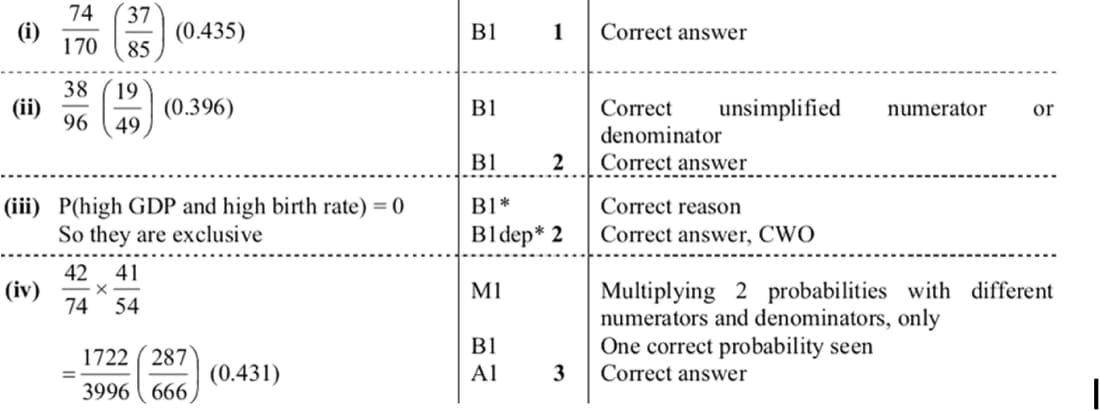
- Find the probability that the country chosen has a medium GDP. [1]
- Find the probability that the country chosen has a low birth rate, given that it does not have a medium GDP. [2]
- State with a reason whether or not the events ‘the country chosen has a high GDP’ and ‘the country chosen has a high birth rate’ are exclusive. [2]
One country is chosen at random from those countries which have a medium GDP and then a different country is chosen at random from those which have a medium birth rate.
- Find the probability that both countries chosen have a medium GDP and a medium birth rate. [3]