Link integration and differentiation while distinguishing an area, a volume and the growth of an accumulated value.
Notes
Before you start: recover a curve from a gradient, find intersections, integrate regions and use derivative signs.
Recover the curve and its constant before using its ordinate in another model. To find a bounded area, identify the intersections and integrate upper minus lower. For a rotation, draw the same region relative to the axis and use squared disk or washer radii instead. These are different quantities with different units.
If \(V(k)=\pi\int_a^k R(x)^2\,dx\), then at interior \(\displaystyle k, V'(k)=\pi R(k)^{2}\). This derivative is cross-sectional area: volume per unit length, not a time rate. Where it is positive, V grows. Its greatest growth need not occur at the largest V. Check endpoints when maximising either quantity.
For a time-rate model, integrate the rate and add the initial amount. A zero rate locates a candidate extremum of the amount; its sign pattern and the allowed time interval establish the global result.
Recall later
Label the target before calculating: curve, gradient, area, volume, amount or rate. Keep units with the final target.
Common mistakes
- Using the gradient instead of the recovered ordinate in an area or volume.
- Squaring a vertical separation instead of subtracting squared washer radii.
- Confusing the maximum accumulated value with its maximum rate or omitting a feasible endpoint.
Example 1
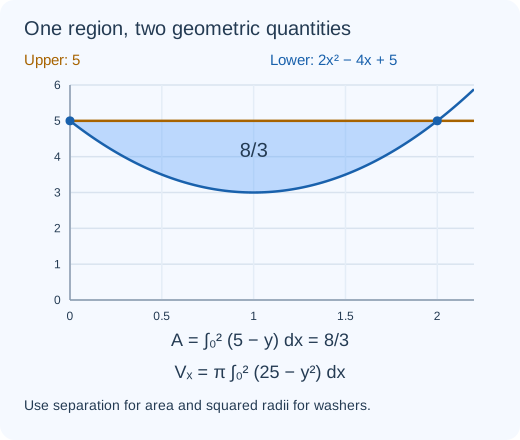
A curve has \(\displaystyle y'=4x-4\) and \(\displaystyle y(0)=5\). Find its stationary point and the area enclosed with \(\displaystyle y=5\).
Show the reasoning
The curve is \(\displaystyle y=2x^{2}-4x+5\), with minimum (1,3). The line meets it at 0 and 2. Its enclosed area is \(\displaystyle \int_{0}^{2} (4x- 2x^{2})dx= \frac{8}{3}\) square units. Rotation about the x-axis would instead use \(\displaystyle \pi \int _{0}^{2}(25-y^{2})dx\).
Example 2
For \(\displaystyle 0\le k\le 1\), let \(V(k)=\pi\int_0^k(1-x)^2\,dx\). Compare where the disk area and total volume are largest.
Show the reasoning
\(\displaystyle V(k)= \pi (k- k^{2}+ \frac{k^{3}}{3})\). Disk area \(\displaystyle \pi (1-k)^{2}\) is largest at \(\displaystyle k=0\), while V increases over the interval and is largest at \(\displaystyle k=1\), with value \(\displaystyle \frac{\pi }{3}\). The largest cross-section and largest accumulated volume answer different questions.
Example 3
An amount has rate 8−4t and initial value 6 on \(\displaystyle 0\le t\le 3\). Find its greatest and final values.
Show the reasoning
\(\displaystyle Q(t)=6+8t-2t^{2}=14-2(t-2)^{2}\). Its greatest value is 14 at \(\displaystyle t=2\), which is feasible. The final value is \(\displaystyle Q(3)=12\); the rate has already become negative, but the net change is still +6.