Past Exam Questions
← Back9231 P11 - Jun 2014 - Q12E - 14 marks
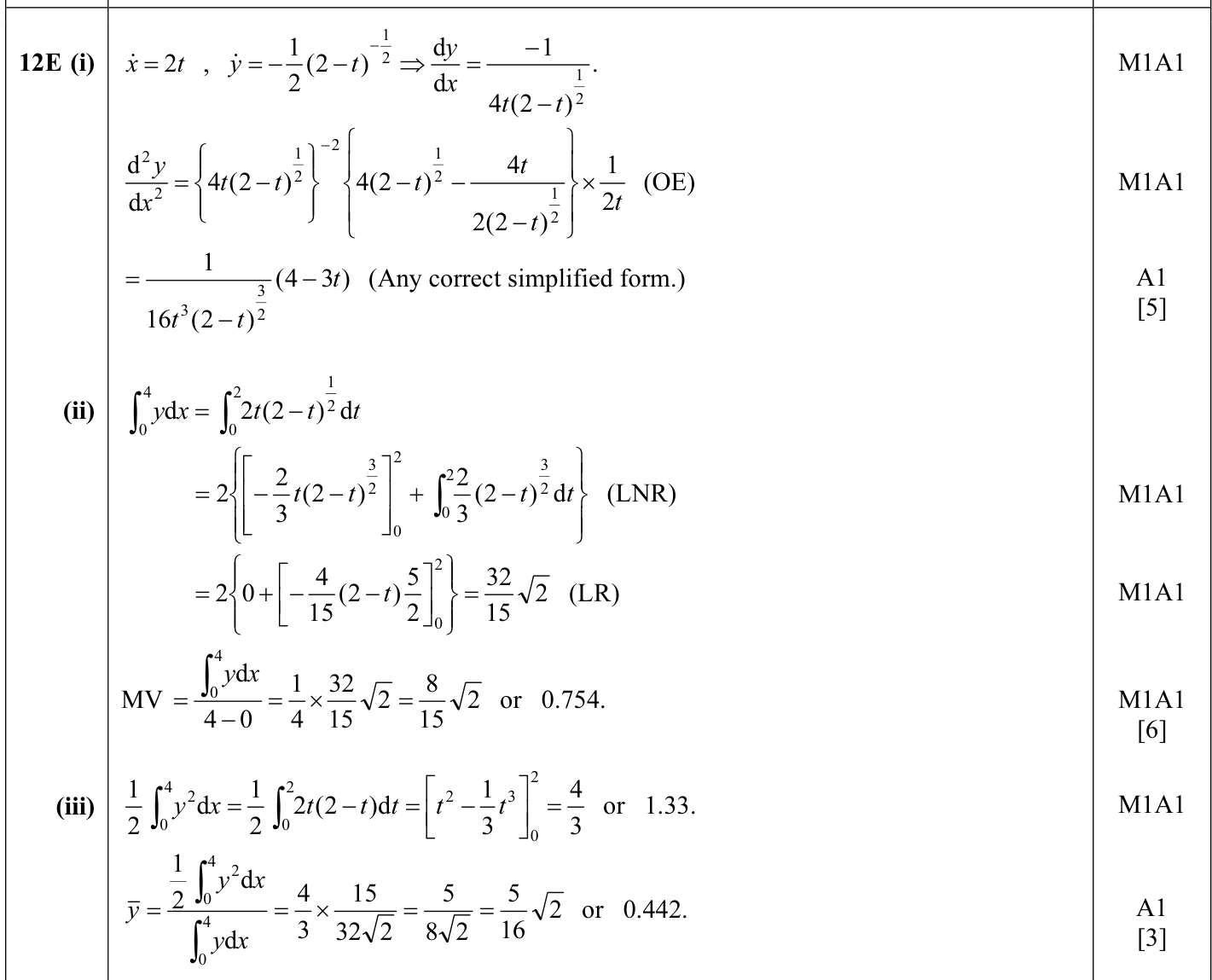
The curve \(C\) has parametric equations
\(x=t^2,\qquad y=(2-t)^{\frac12},\qquad 0\leq t\leq2.\)
Find:
(i) \(\frac{d^2y}{dx^2}\) in terms of \(t\);
(ii) the mean value of \(y\) with respect to \(x\) over \(0\leq x\leq4\);
(iii) the \(y\)-coordinate of the centroid of the region enclosed by \(C\), the \(x\)-axis and the \(y\)-axis.
9231 P11 - Jun 2015 - Q9 - 11 marks
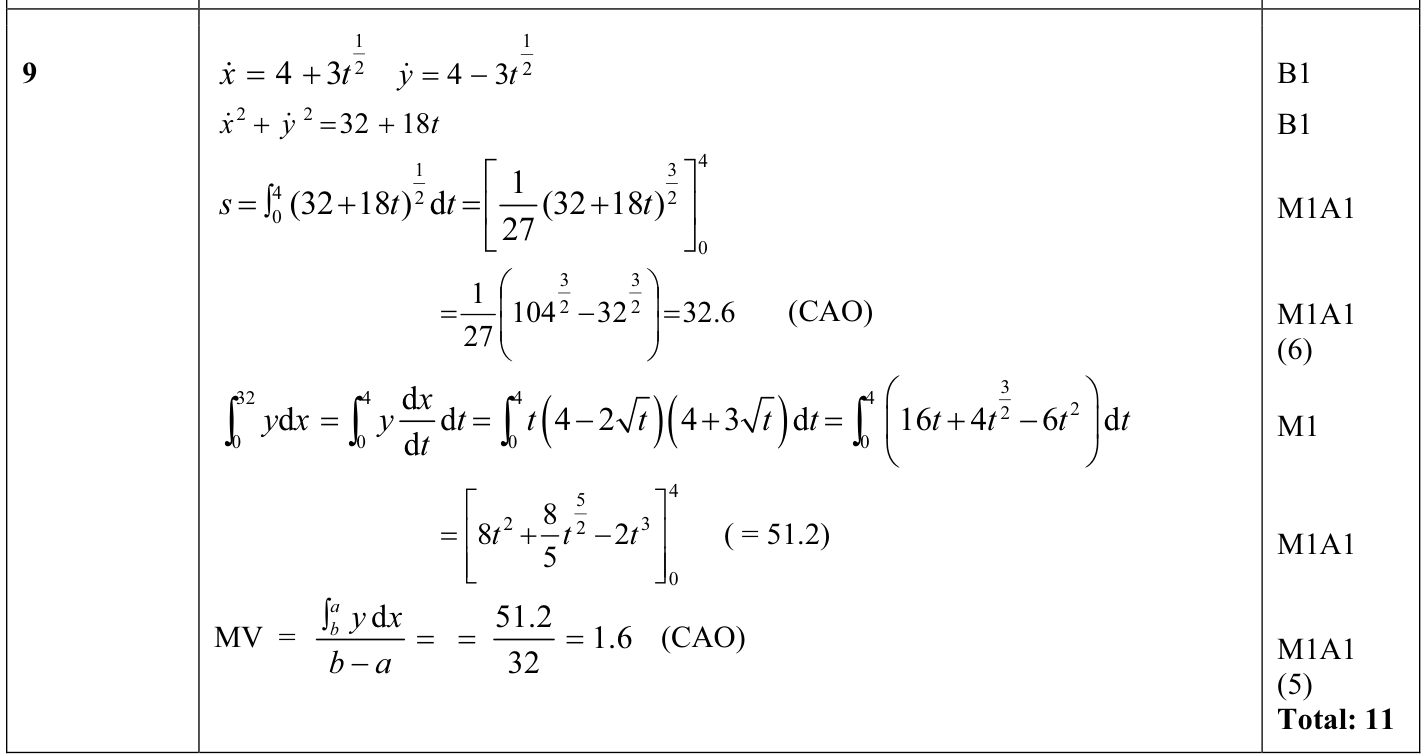
The curve \(C\) has parametric equations
\(x=4 t+2 t^{\frac{3}{2}}, \quad y=4 t-2 t^{\frac{3}{2}}, \quad \text { for } 0 \leqslant t \leqslant 4\)
Find the arc length of \(C\), giving your answer correct to 3 significant figures.
Find the mean value of \(y\) with respect to \(x\) over the interval \(0 \leqslant x \leqslant 32\).
9231 P11 - Nov 2016 - Q11O - 14 marks
OR
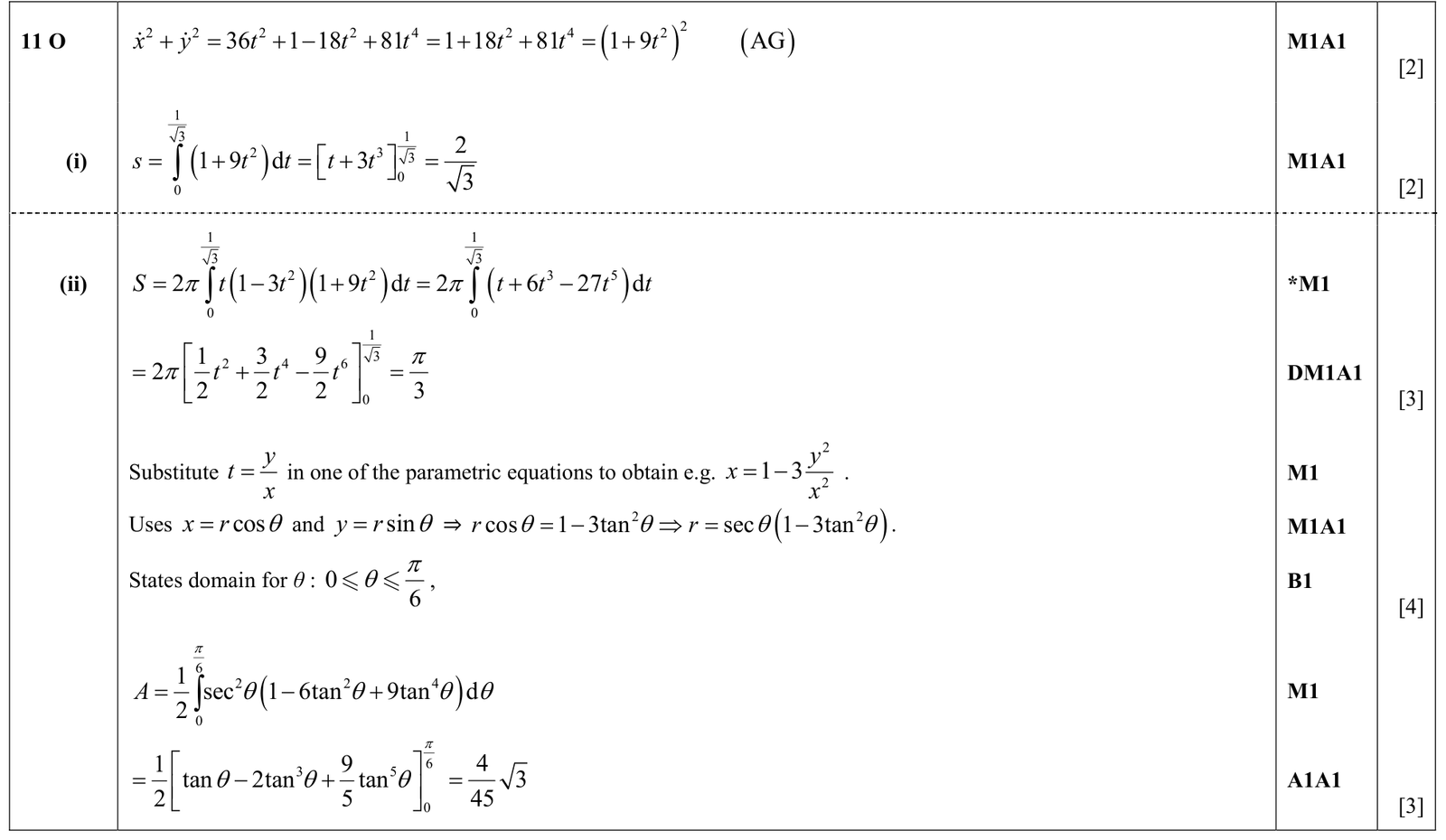
A curve \(C\) has parametric equations
\(x=1-3t^2,\qquad y=t(1-3t^2),\qquad 0\leqslant t\leqslant \frac{1}{\sqrt3}.\)
Show that
\(\left(\frac{dx}{dt}\right)^2+\left(\frac{dy}{dt}\right)^2=(1+9t^2)^2.\)
Hence find (i) the arc length of \(C\), and (ii) the surface area generated when \(C\) is rotated through \(2\pi\) radians about the \(x\)-axis.
Use the fact that \(t=\dfrac{y}{x}\) to find a cartesian equation of \(C\). Hence show that the polar equation of \(C\) is \(r=\sec\theta(1-3\tan^2\theta)\), and state the domain of \(\theta\).
Find the area of the region enclosed between \(C\) and the initial line.
9231 P13 - Jun 2016 - Q4 - 8 marks
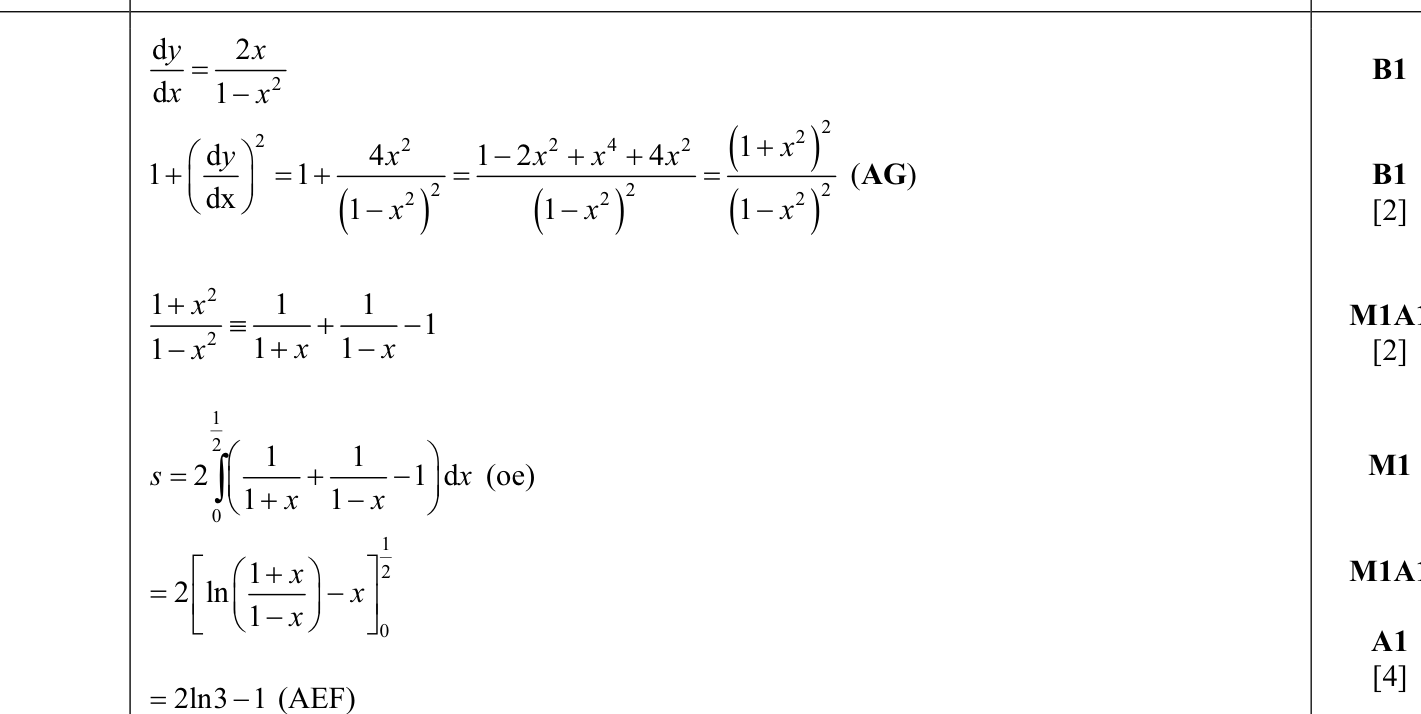
The curve \(C\) has equation \(y=-\ln \left(1-x^{2}\right)\) for \(-\frac{1}{2} \leqslant x \leqslant \frac{1}{2}\). Show that
\(1+\left(\frac{\mathrm{d} y}{\mathrm{~d} x}\right)^{2}=\left(\frac{1+x^{2}}{1-x^{2}}\right)^{2}\)
Show further that \(\frac{1+x^{2}}{1-x^{2}}\) may be expressed in the form \(\frac{P}{1+x}+\frac{Q}{1-x}+R\), where \(P, Q\) and \(R\) are constants to be determined.
Find the exact arc length of \(C\).
9231 P11 - Jun 2016 - Q11E - 14 marks
EITHER
A curve \(C\) has parametric equations
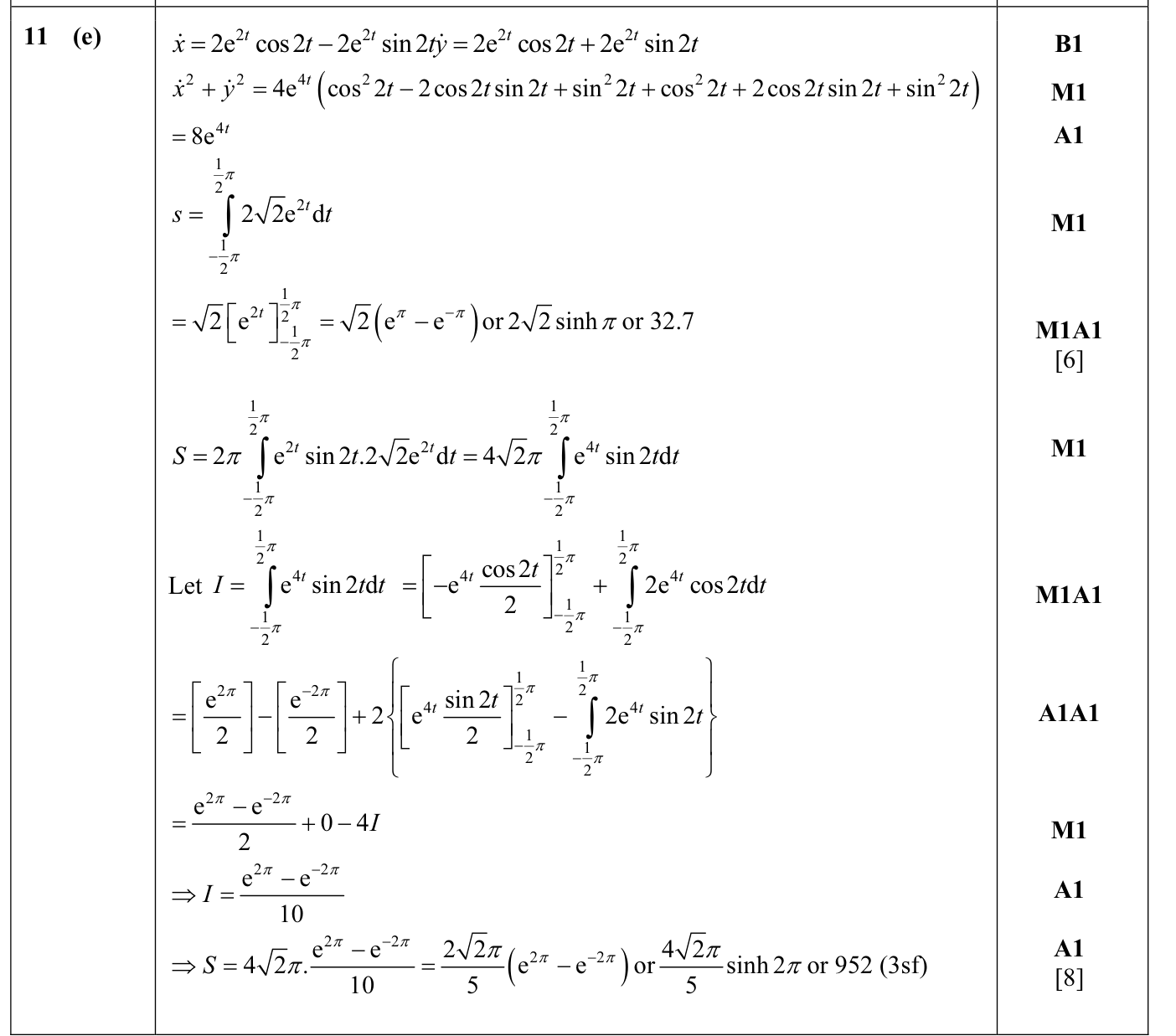
\(x=e^{2t}\cos2t,\qquad y=e^{2t}\sin2t,\qquad -\frac{\pi}{2}\leq t\leq\frac{\pi}{2}.\)
Find the arc length of \(C\).
Find the area of the surface generated when \(C\) is rotated through \(2\pi\) radians about the \(x\)-axis.
9231 P12 - Nov 2014 - Q2 - 6 marks
A curve \(C\) has parametric equations
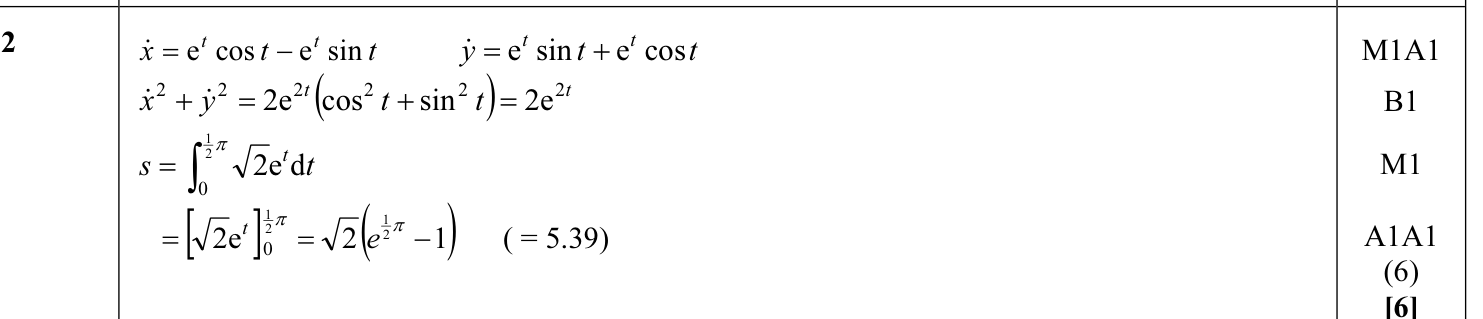
\(x=\mathrm{e}^{t} \cos t, \quad y=\mathrm{e}^{t} \sin t, \quad \text { for } 0 \leqslant t \leqslant \frac{1}{2} \pi\)
Find the arc length of \(C\).
9231 P11 - Nov 2014 - Q2 - 6 marks
A curve \(C\) has parametric equations
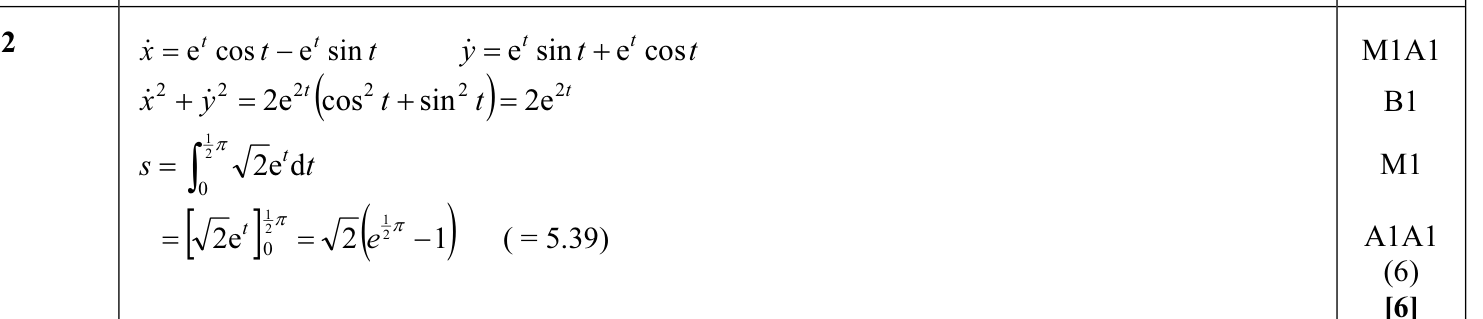
\(x=\mathrm{e}^{t} \cos t, \quad y=\mathrm{e}^{t} \sin t, \quad \text { for } 0 \leqslant t \leqslant \frac{1}{2} \pi\)
Find the arc length of \(C\).
9231 P11 - Jun 2013 - Q11 - 28 marks
Answer only one of the following two alternatives.
EITHER
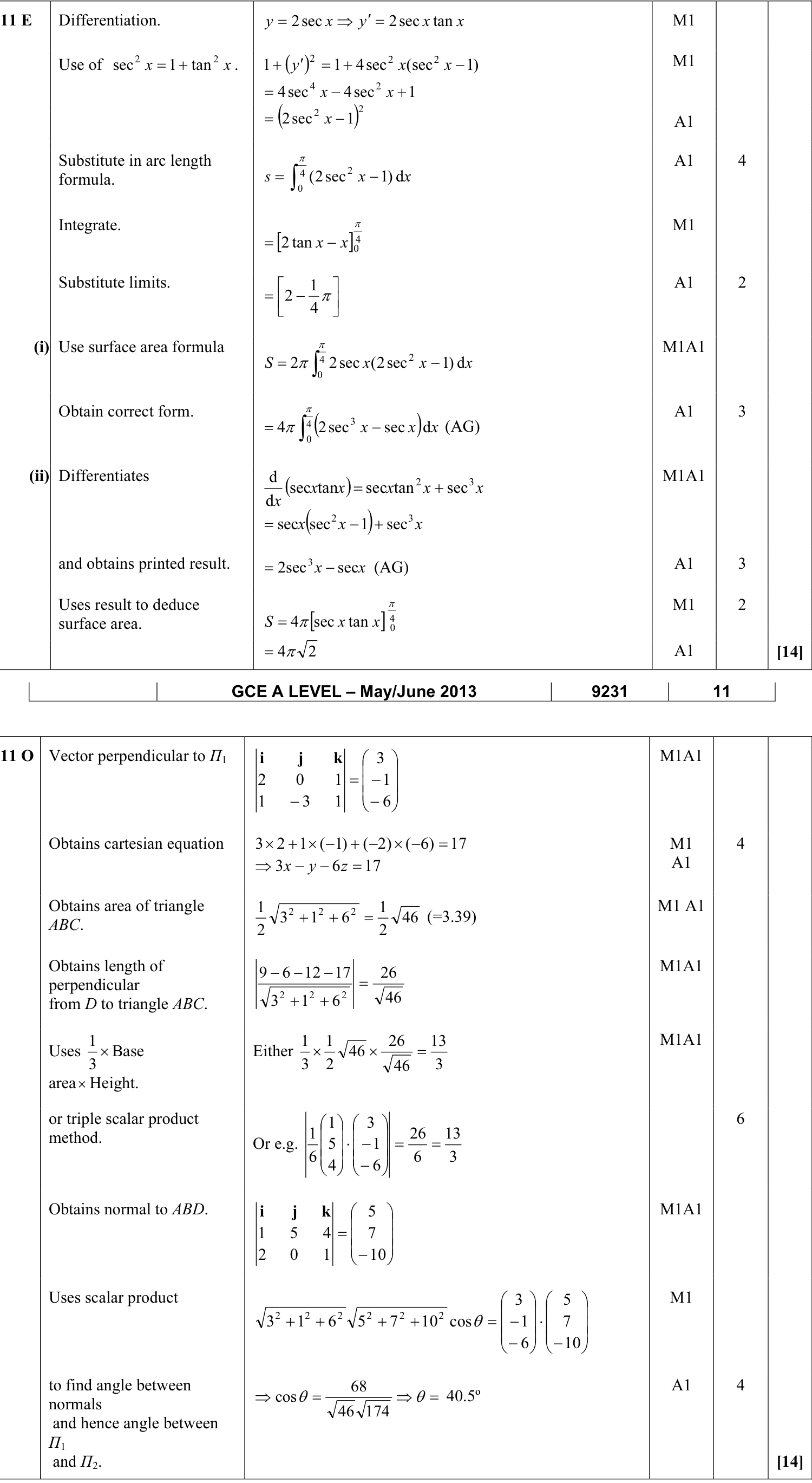
The curve \(C\) has equation \(y=2 \sec x\), for \(0 \leqslant x \leqslant \frac{1}{4} \pi\). Show that the arc length \(s\) of \(C\) is given by
\(s=\int_{0}^{\frac{1}{4} \pi}\left(2 \sec ^{2} x-1\right) \mathrm{d} x\)
Find the exact value of \(s\).
The surface area generated when \(C\) is rotated through \(2 \pi\) radians about the \(x\)-axis is denoted by \(S\). Show that
(i) \(S=4 \pi \int_{0}^{\frac{1}{4} \pi}\left(2 \sec ^{3} x-\sec x\right) \mathrm{d} x\),
(ii) \(\frac{\mathrm{d}}{\mathrm{d} x}(\sec x \tan x)=2 \sec ^{3} x-\sec x\).
Hence find the exact value of \(S\).
OR
The points \(A, B, C\) and \(D\) have coordinates as follows:
\(A(2,1,-2), \quad B(4,1,-1), \quad C(3,-2,-1) \quad \text { and } \quad D(3,6,2) .\)
The plane \(\Pi_{1}\) passes through the points \(A, B\) and \(C\). Find a cartesian equation of \(\Pi_{1}\).
Find the area of triangle \(A B C\) and hence, or otherwise, find the volume of the tetrahedron \(A B C D\).
[The volume of a tetrahedron is \(\frac{1}{3} \times\) area of base × perpendicular height.]
The plane \(\Pi_{2}\) passes through the points \(A, B\) and \(D\). Find the acute angle between \(\Pi_{1}\) and \(\Pi_{2}\).
9231 P13 - Jun 2013 - Q8 - 11 marks
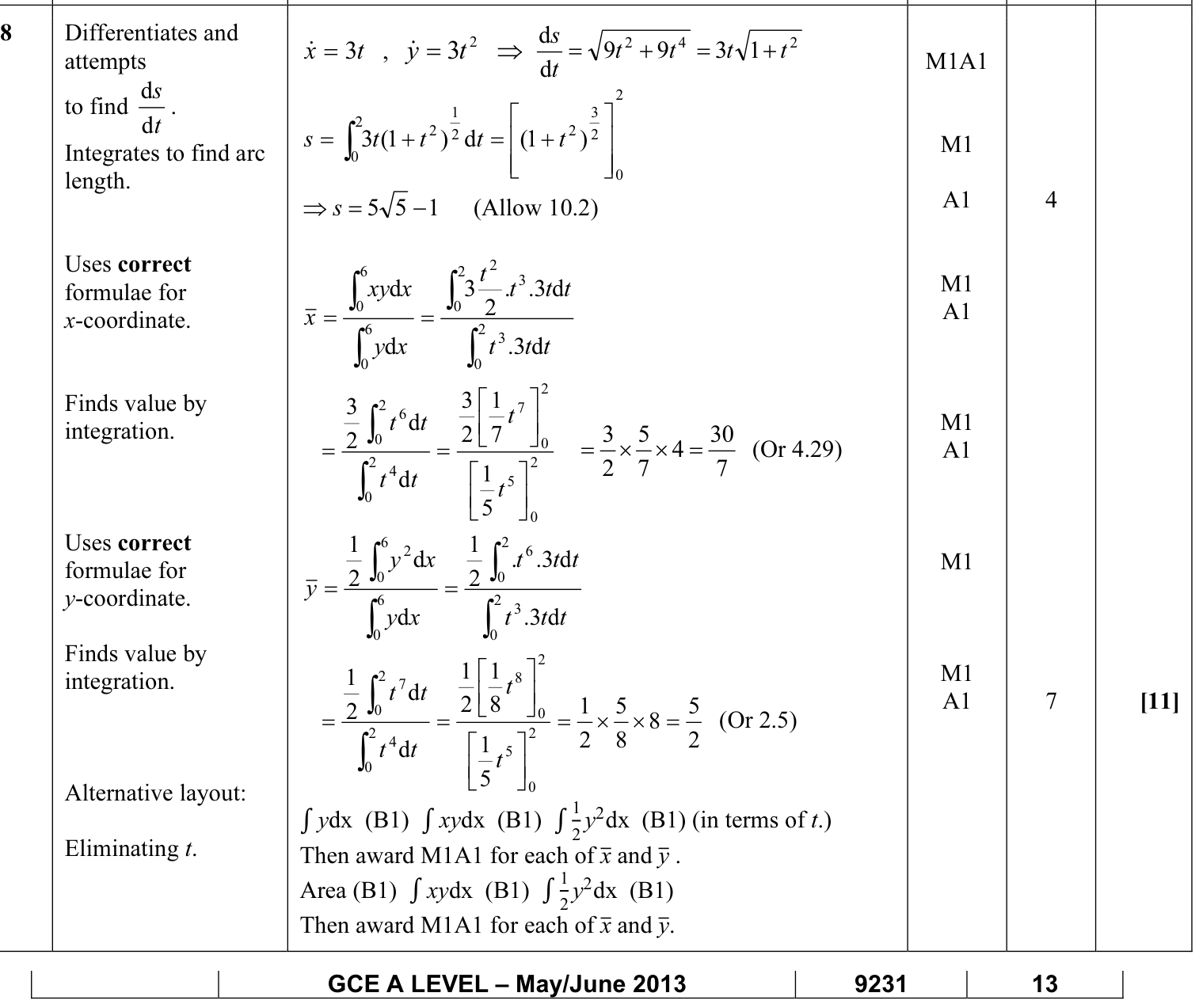
The curve \(C\) has parametric equations \(x=\frac{3}{2} t^{2}, y=t^{3}\), for \(0 \leqslant t \leqslant 2\). Find the arc length of \(C\).
Find the coordinates of the centroid of the region enclosed by \(C\), the \(x\)-axis and the line \(x=6\).
9231 P11 - Nov 2013 - Q9 - 12 marks
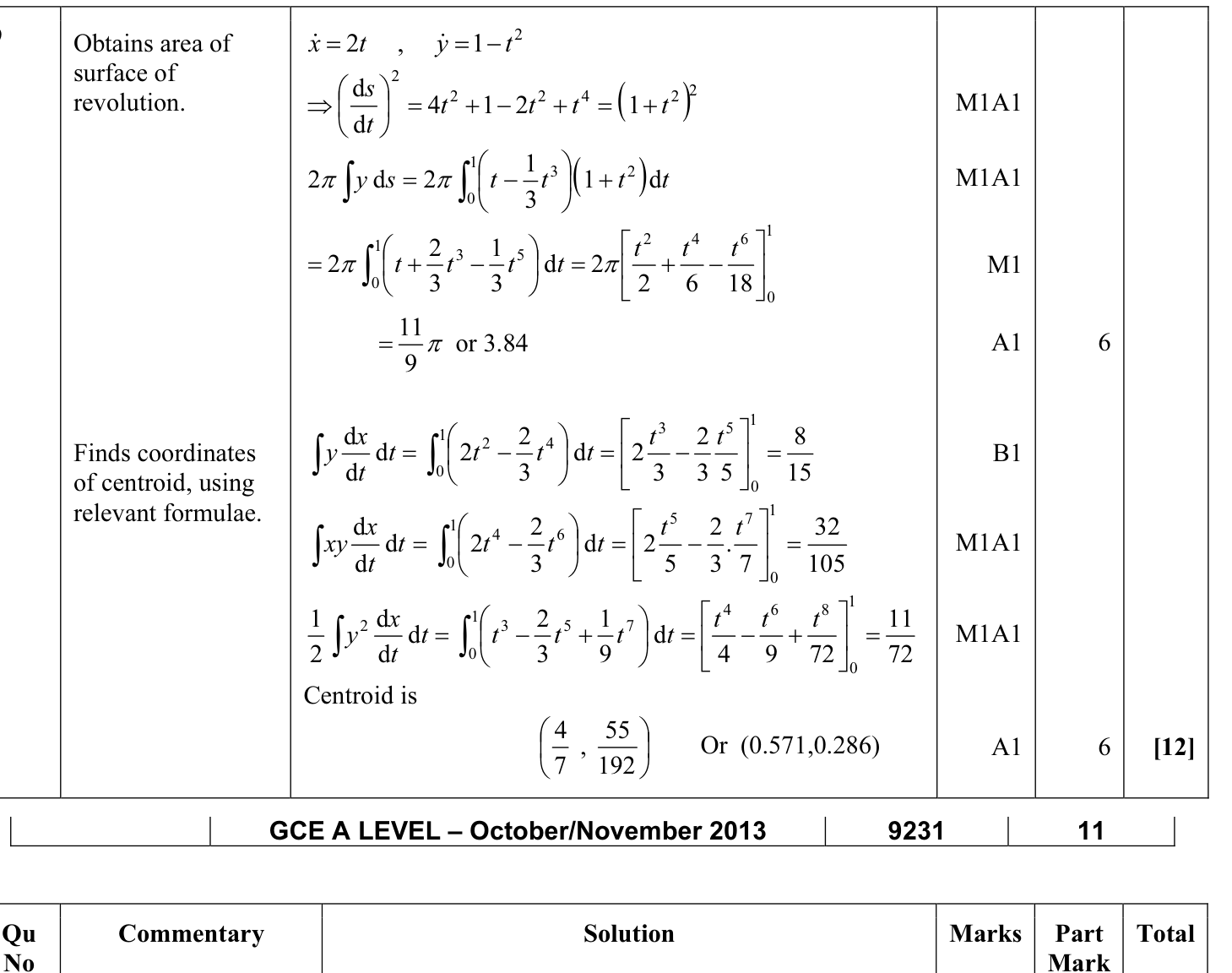
The curve \(C\) has parametric equations
\(x=t^{2}, \quad y=t-\frac{1}{3} t^{3}, \quad \text { for } 0 \leqslant t \leqslant 1\)
Find the surface area generated when \(C\) is rotated through \(2 \pi\) radians about the \(x\)-axis.
Find the coordinates of the centroid of the region bounded by \(C\), the \(x\)-axis and the line \(x=1\).
9231 P12 - Nov 2013 - Q9 - 12 marks
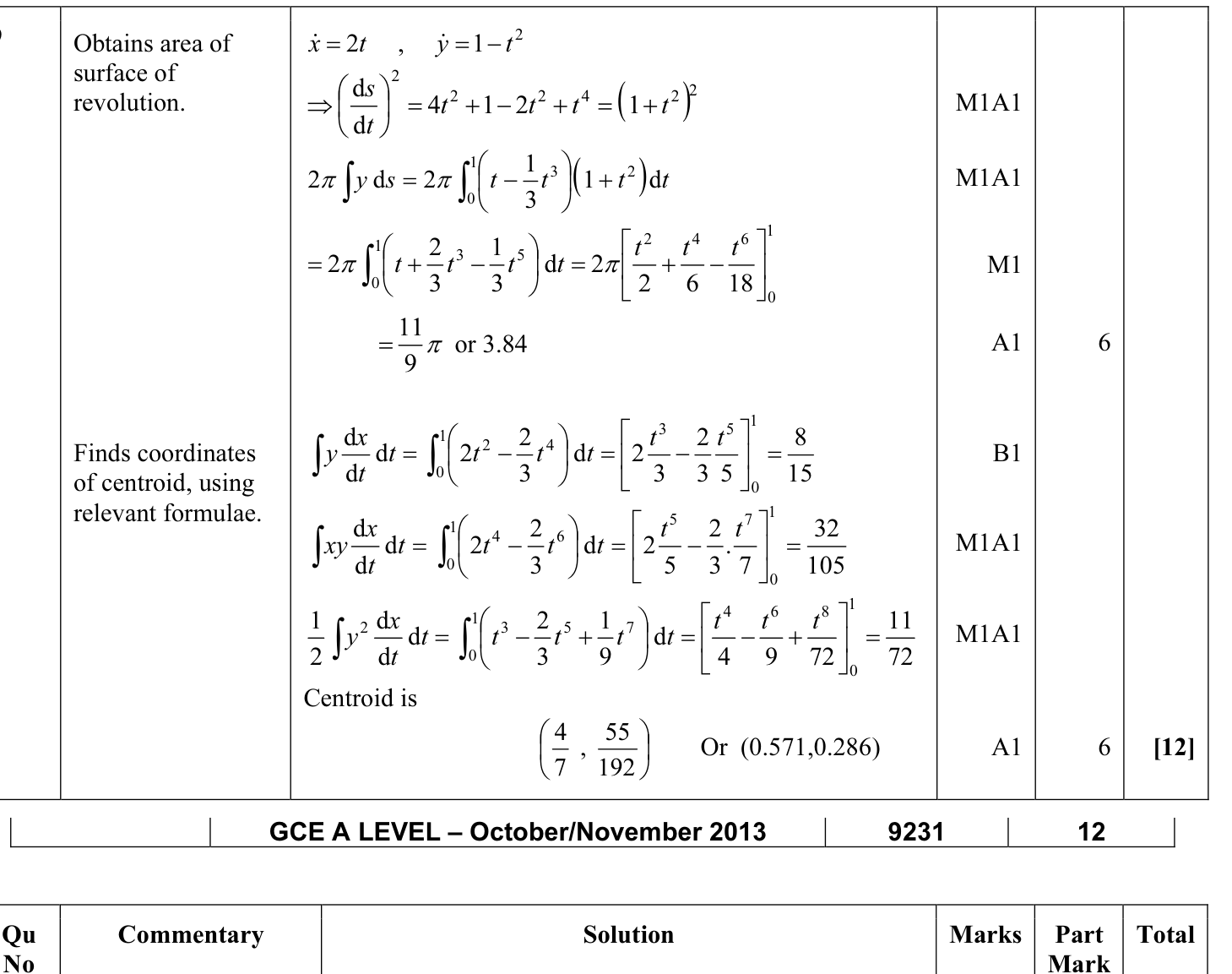
The curve \(C\) has parametric equations
\(x=t^{2}, \quad y=t-\frac{1}{3} t^{3}, \quad \text { for } 0 \leqslant t \leqslant 1\)
Find the surface area generated when \(C\) is rotated through \(2 \pi\) radians about the \(x\)-axis.
Find the coordinates of the centroid of the region bounded by \(C\), the \(x\)-axis and the line \(x=1\).
9231 P13 - Nov 2013 - Q6 - 8 marks
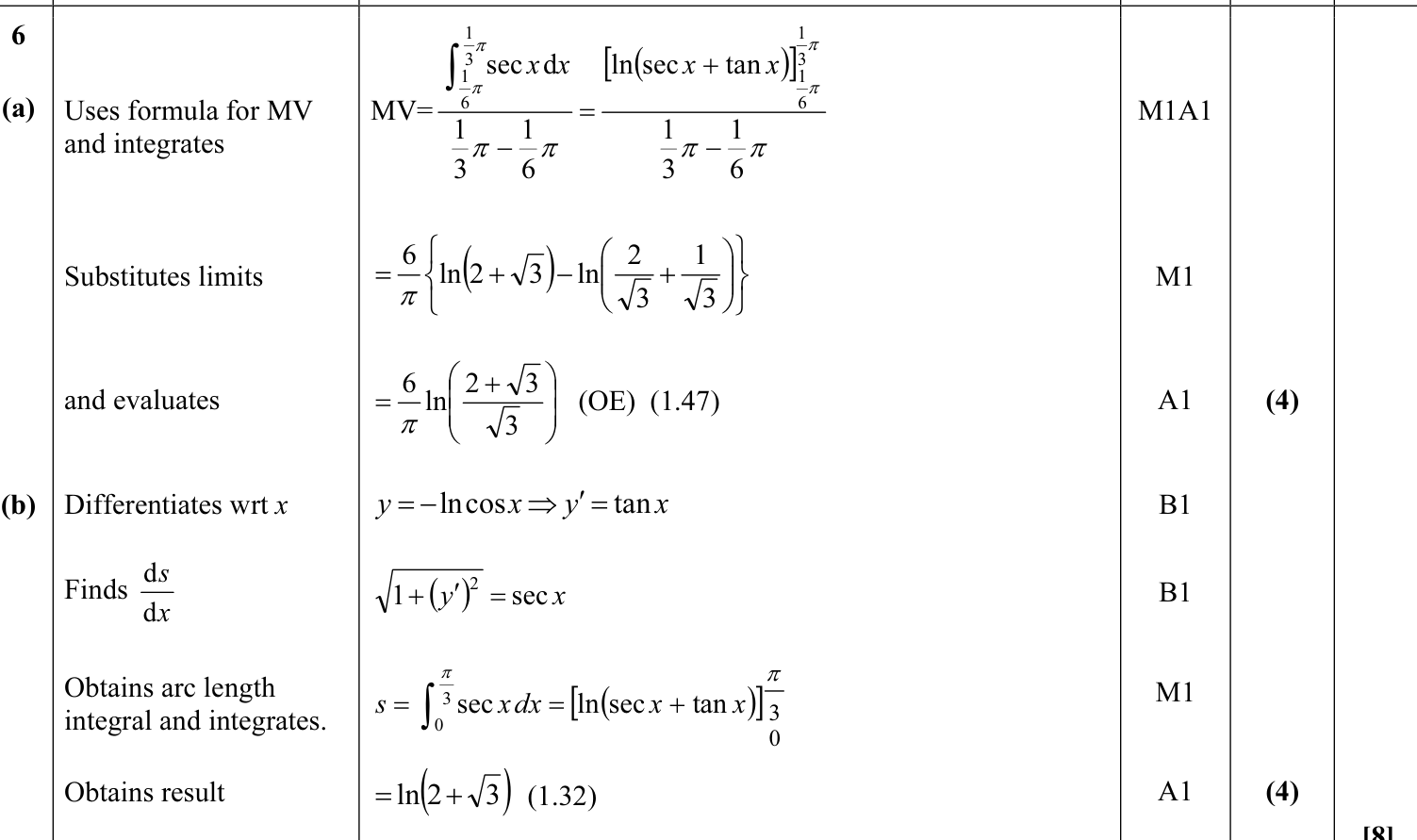
[In this question you may use, without proof, the formula \(\int \sec x \mathrm{~d} x=\ln (\sec x+\tan x)+\operatorname{const}\).]
(a) Let \(y=\sec x\). Find the mean value of \(y\) with respect to \(x\) over the interval \(\frac{1}{6} \pi \leqslant x \leqslant \frac{1}{3} \pi\).
(b) The curve \(C\) has equation \(y=-\ln (\cos x)\), for \(0 \leqslant x \leqslant \frac{1}{3} \pi\). Find the arc length of \(C\).
9231 P1 - Jun 2008 - Q1 - 4 marks
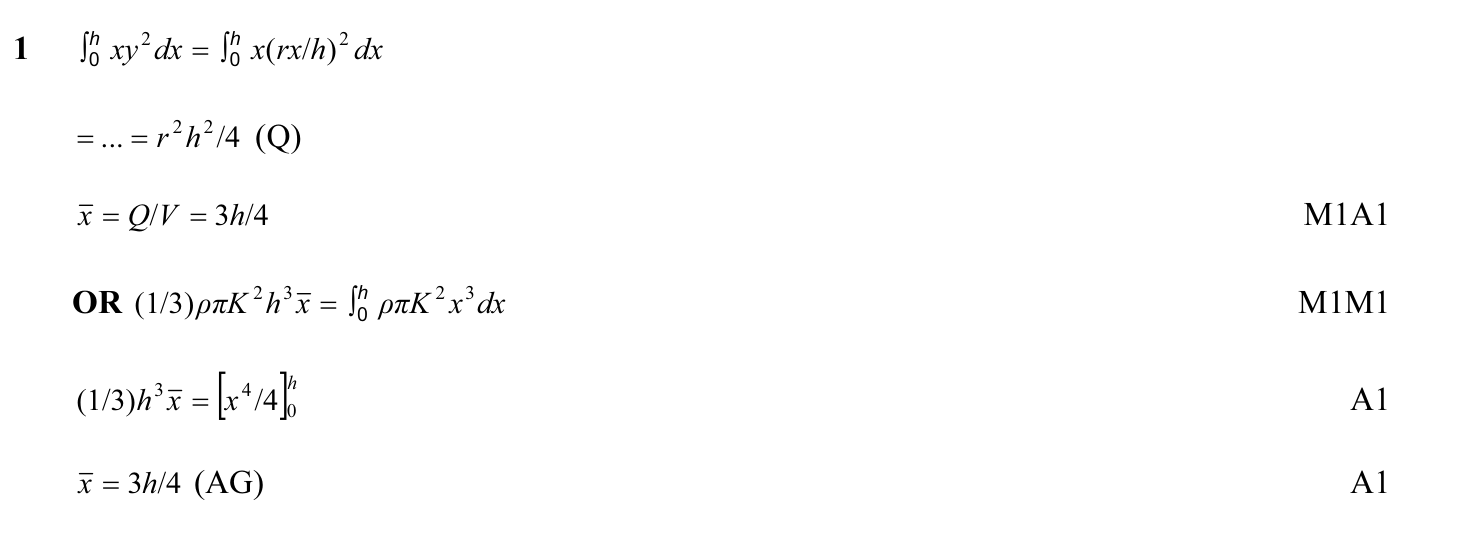
The finite region enclosed by the line \(y=k x\), where \(k\) is a positive constant, the \(x\)-axis is and the line \(x=h\) is rotated through 1 complete revolution about the \(x\)-axis. Prove by integ. the centroid of the resulting cone is at a distance \(\frac{3}{4} h\) from the origin \(O\).
[The volume of a cone of height \(h\) and base radius \(r\) is \(\frac{1}{3} \pi r^{2} h\).]
9231 P1 - Jun 2008 - Q8 - 10 marks
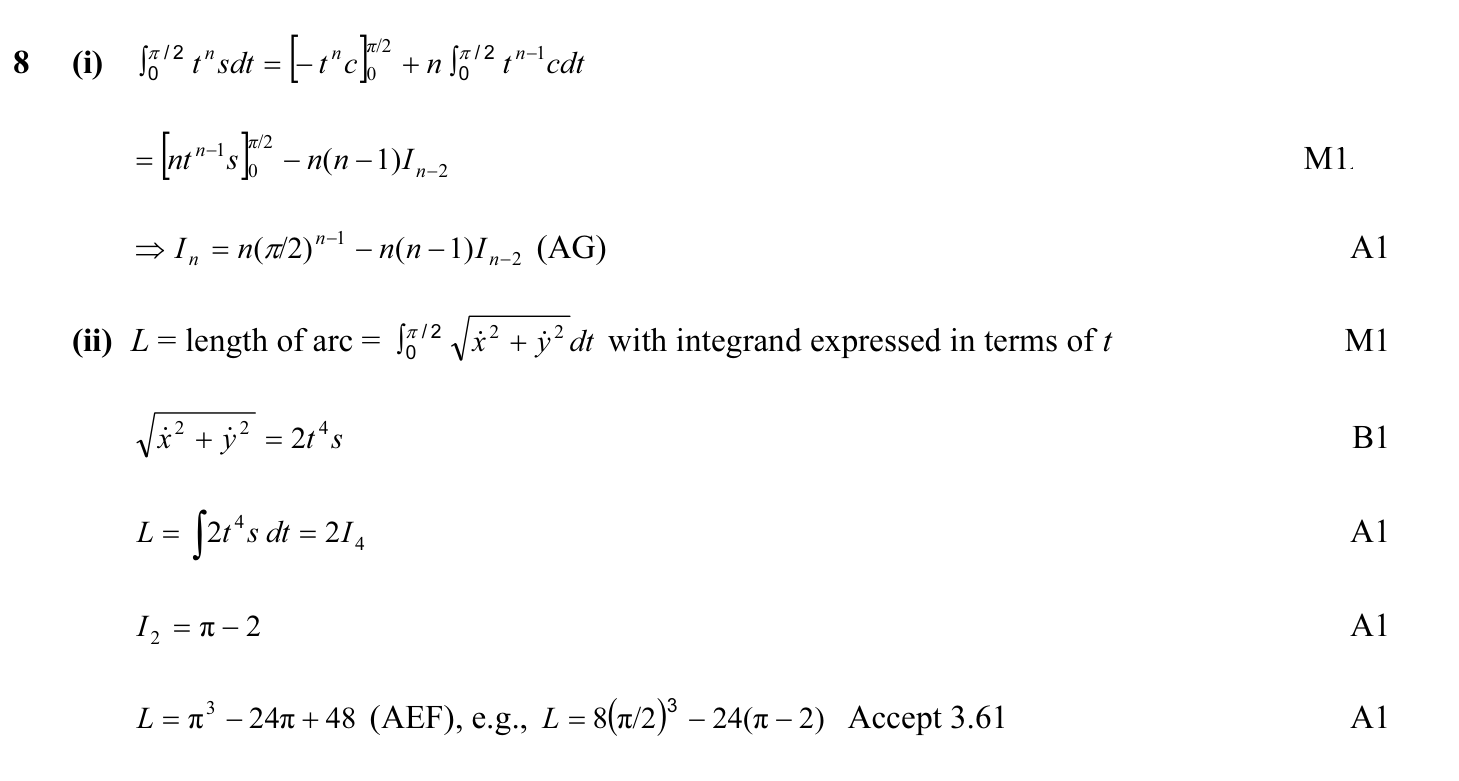
(i) Given that
\(I_{n}=\int_{0}^{\frac{1}{2} \pi} t^{n} \sin t \mathrm{~d} t\)
show that, for \(n \geqslant 2\),
\(I_{n}=n\left(\frac{\pi}{2}\right)^{n-1}-n(n-1) I_{n-2} .\)
(ii) A curve \(C\) in the \(x-y\) plane is defined parametrically in terms of \(t\). It is given that
\(\frac{\mathrm{d} x}{\mathrm{~d} t}=t^{4}(1-\cos 2 t) \quad \text { and } \quad \frac{\mathrm{d} y}{\mathrm{~d} t}=t^{4} \sin 2 t .\)
Find the length of the arc of \(C\) from the point where \(t=0\) to the point where \(t=\frac{1}{2} \pi\).
9231 P1 - Nov 2008 - Q1 - 5 marks
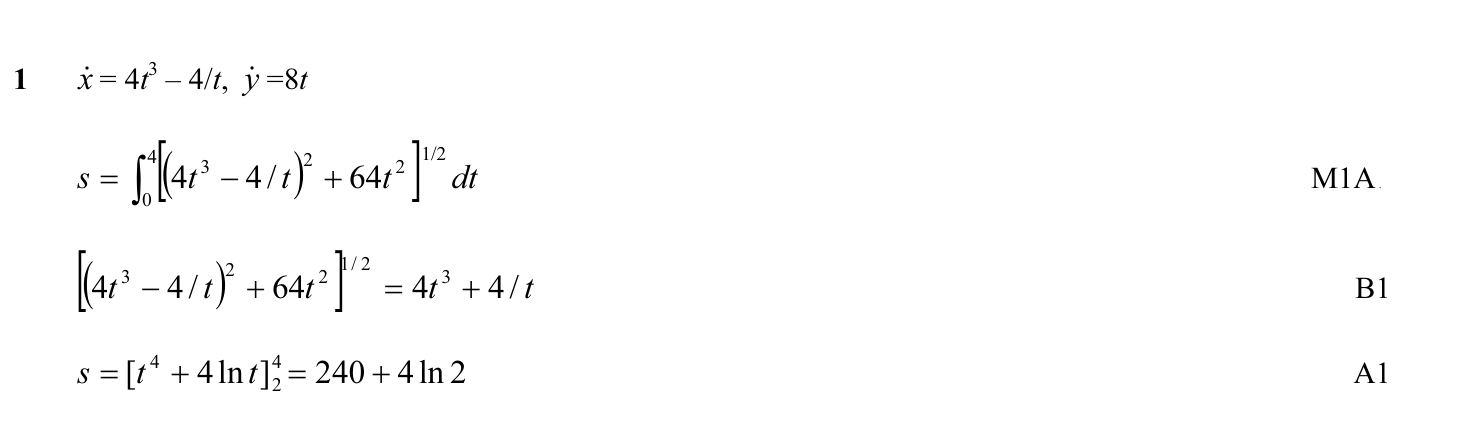
The curve \(C\) is defined parametrically by
\(x=t^{4}-4 \ln t, \quad y=4 t^{2} .\)
Show that the length of the arc of \(C\) from the point where \(t=2\) to the point where \(t=4\) is
\(240+4 \ln 2 .\)
9231 P11 - Jun 2011 - Q9 - 12 marks
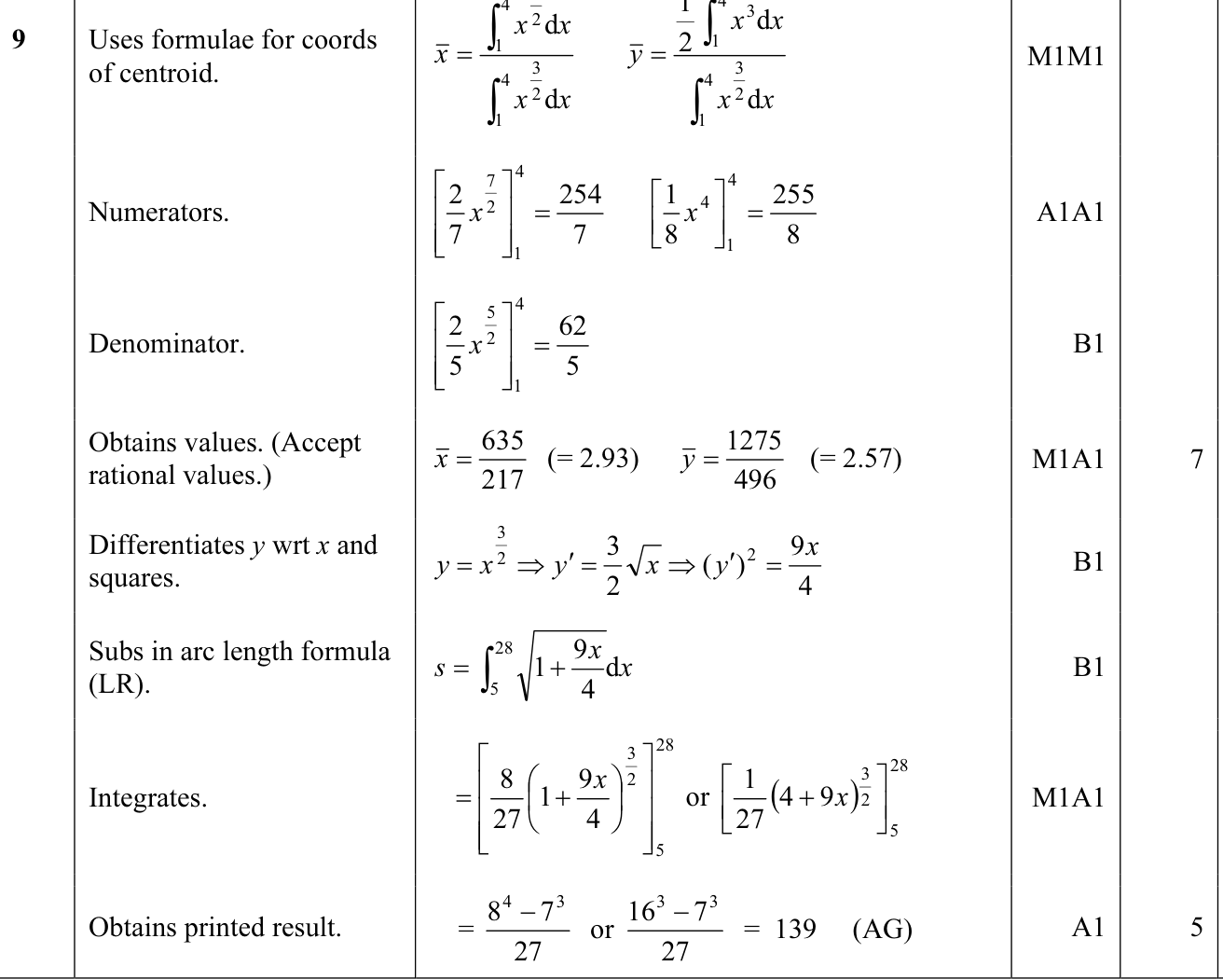
The curve \(C\) has equation \(y=x^{\frac{3}{2}}\). Find the coordinates of the centroid of the region bounded by \(C\), the lines \(x=1, x=4\) and the \(x\)-axis.
Show that the length of the arc of \(C\) from the point where \(x=5\) to the point where \(x=28\) is 139 .
9231 P12 - Jun 2014 - Q8 - 10 marks
The curve \(C\) has parametric equations
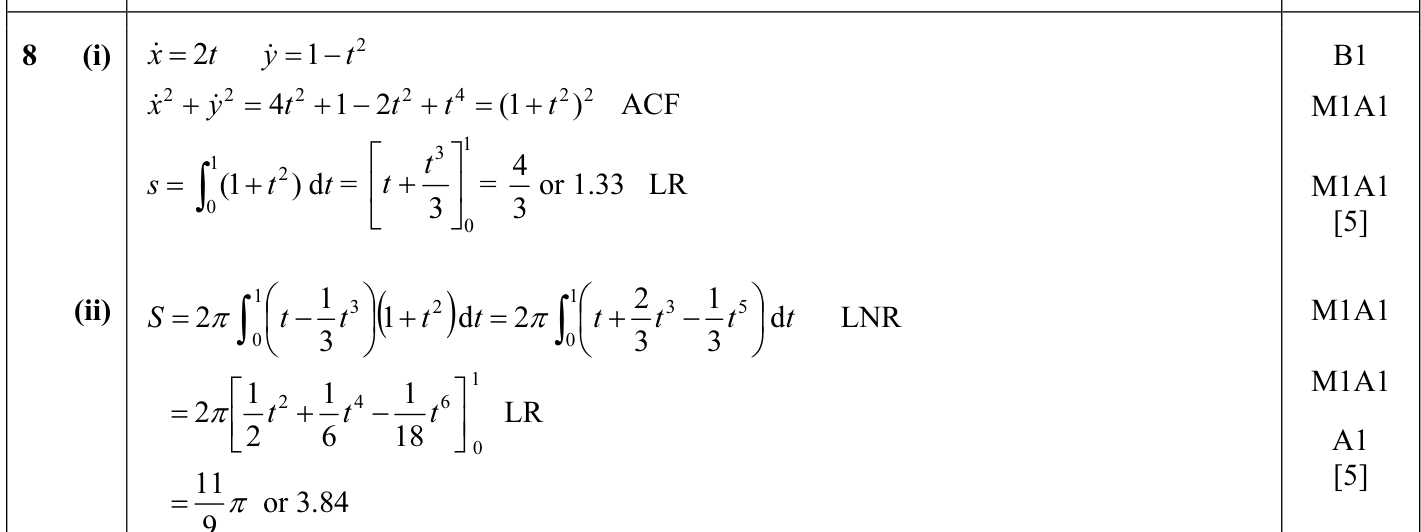
\(x=t^{2}, \quad y=t-\frac{1}{3} t^{3}, \quad \text { for } 0 \leqslant t \leqslant 1 .\)
Find
(i) the arc length of \(C\),
(ii) the surface area generated when \(C\) is rotated through \(2 \pi\) radians about the \(x\)-axis.
9231 P13 - Nov 2012 - Q6 - 7 marks
The curve \(C\) has parametric equations
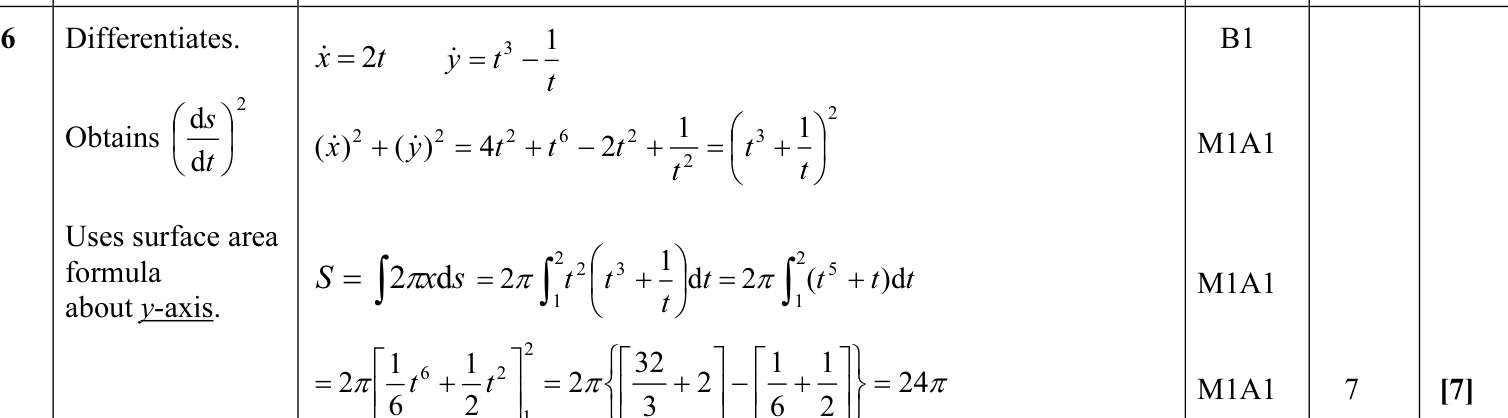
\(x=t^{2}, \quad y=\frac{1}{4} t^{4}-\ln t,\)
for \(1 \leqslant t \leqslant 2\). Find the area of the surface generated when \(C\) is rotated through \(2 \pi\) radians about the \(y\)-axis.
9231 P11 - Jun 2010 - Q3 - 7 marks
At any point \((x, y)\) on the curve \(C\),
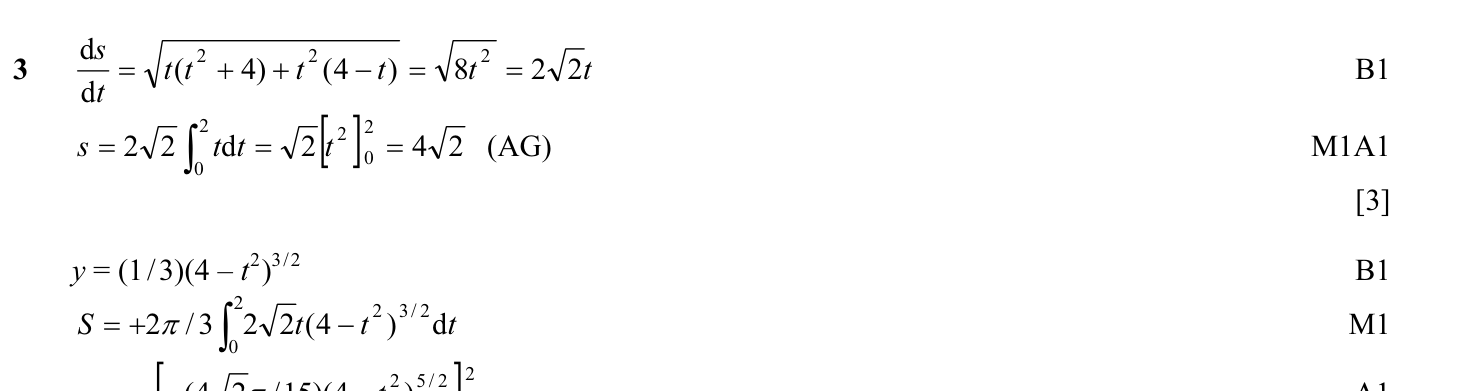
\(\frac{\mathrm{d} x}{\mathrm{~d} t}=t \sqrt{ }\left(t^{2}+4\right) \quad \text { and } \quad \frac{\mathrm{d} y}{\mathrm{~d} t}=-t \sqrt{ }\left(4-t^{2}\right)\)
where the parameter \(t\) is such that \(0 \leqslant t \leqslant 2\). Show that the length of \(C\) is \(4 \sqrt{ } 2\).
Given that \(y=0\) when \(t=2\), determine the area of the surface generated when \(C\) is rotated through one complete revolution about the \(x\)-axis, leaving your answer in an exact form.
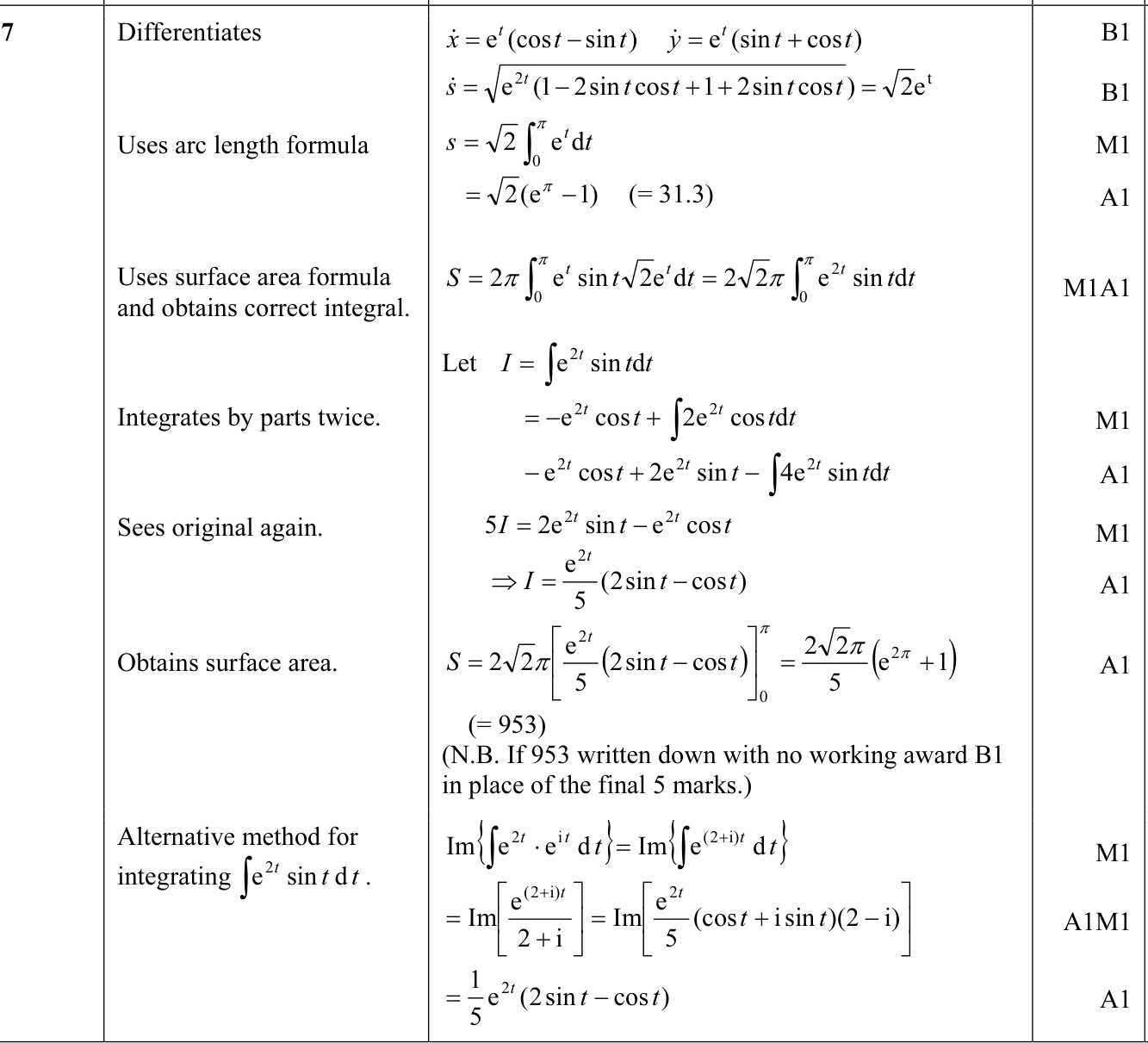
9231 P13 - Jun 2011 - Q7 - 11 marks
A curve \(C\) has parametric equations \(x=\mathrm{e}^{t} \cos t, y=\mathrm{e}^{t} \sin t\), for \(0 \leqslant t \leqslant \pi\). Find the arc \(l=\)
Find the area of the surface generated when \(C\) is rotated through \(2 \pi\) radians about the \(x\)-axis.