Past Exam Questions
← Back9231 P23 - Jun 2020 - Q4 - 8 marks
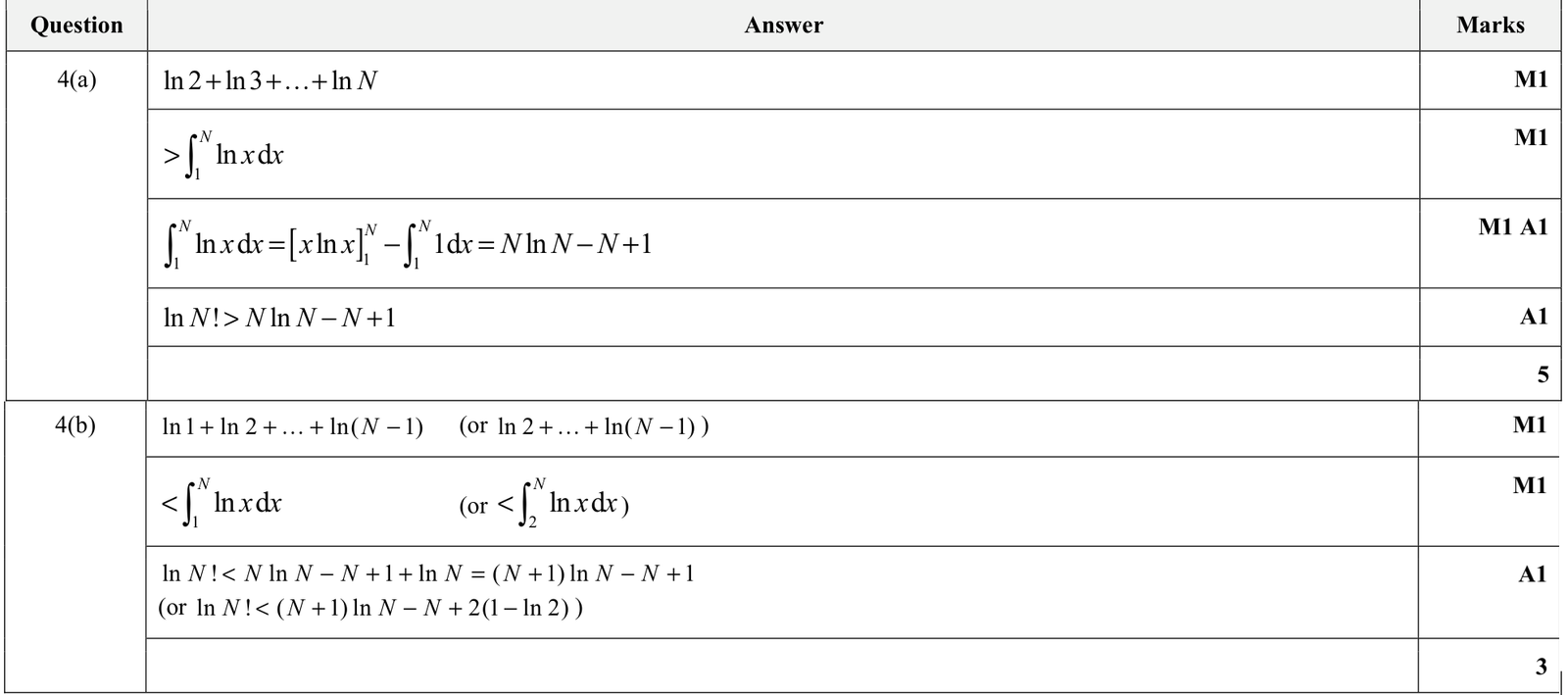
The diagram shows the curve with equation \(y=\ln x\) for \(x \geqslant 1\), together with a set of \((N-1)\) rectangles of unit width.
(a) By considering the sum of the areas of these rectangles, show that
\[\ln N!>N \ln N-N+1 .\]
(b) Use a similar method to find, in terms of \(N\), an upper bound for \(\ln N!\).
9231 P23 - Jun 2021 - Q3 - 10 marks
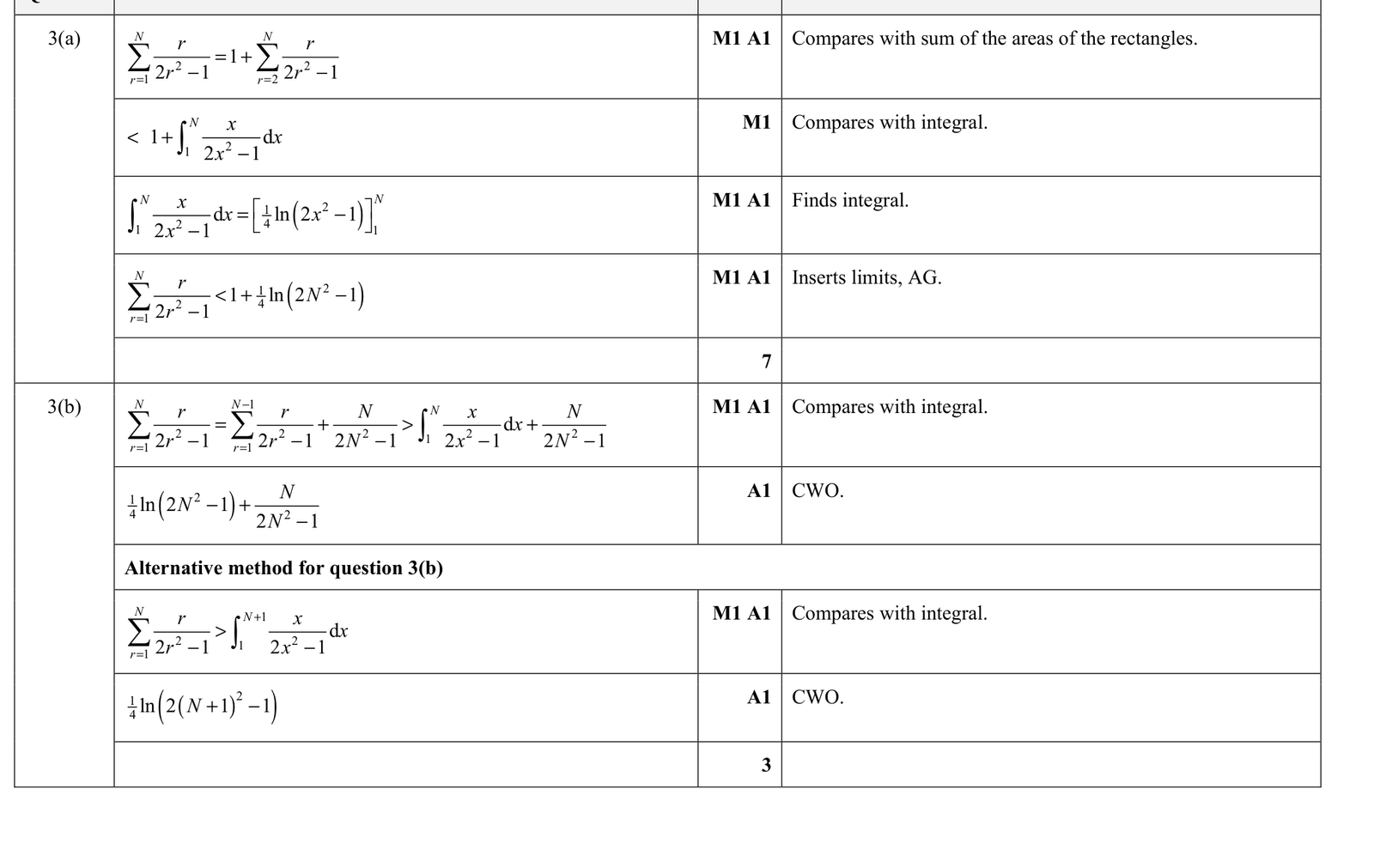
The diagram shows the curve \(y=\frac{x}{2 x^{2}-1}\) for \(x \geqslant 1\), together with a set of \(N-1\) rectangles of unit width.
(a) By considering the sum of the areas of these rectangles, show that
\[\sum_{r=1}^{N} \frac{r}{2 r^{2}-1}<\frac{1}{4} \ln \left(2 N^{2}-1\right)+1\]
(b) Use a similar method to find, in terms of \(N\), a lower bound for \(\sum_{r=1}^{N} \frac{r}{2 r^{2}-1}\).
9231 P22 - Nov 2020 - Q8 - 10 marks
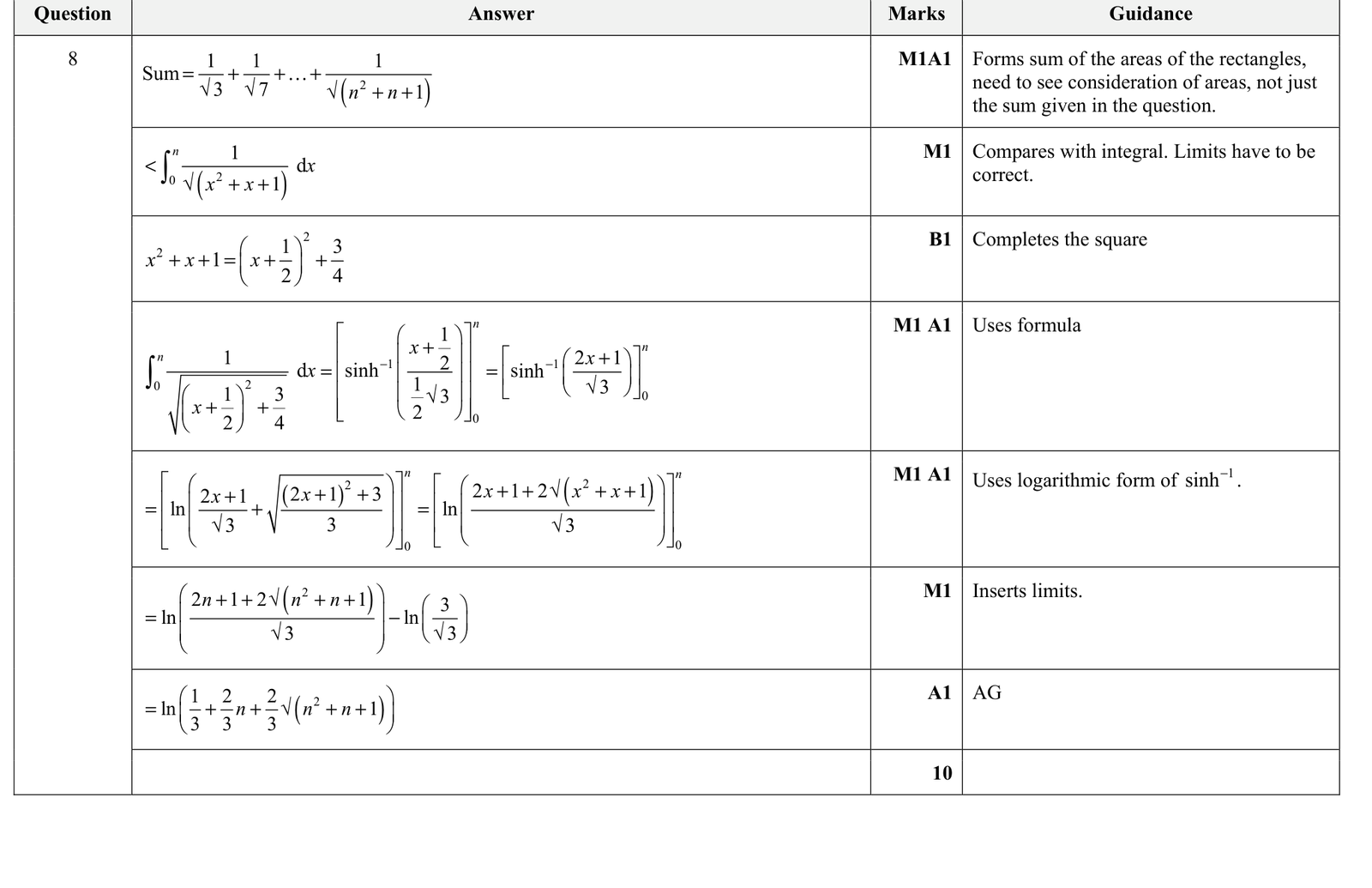
The diagram shows the curve \(y=\frac{1}{\sqrt{x^{2}+x+1}}\) for \(x \geqslant 0\), together with a set of \(n\) rectangles of unit width. By considering the sum of the areas of these rectangles, show that
\[\sum_{r=1}^{n} \frac{1}{\sqrt{r^{2}+r+1}}<\ln \left(\frac{1}{3}+\frac{2}{3} n+\frac{2}{3} \sqrt{n^{2}+n+1}\right) .\]
9231 P22 - Nov 2021 - Q3 - 8 marks
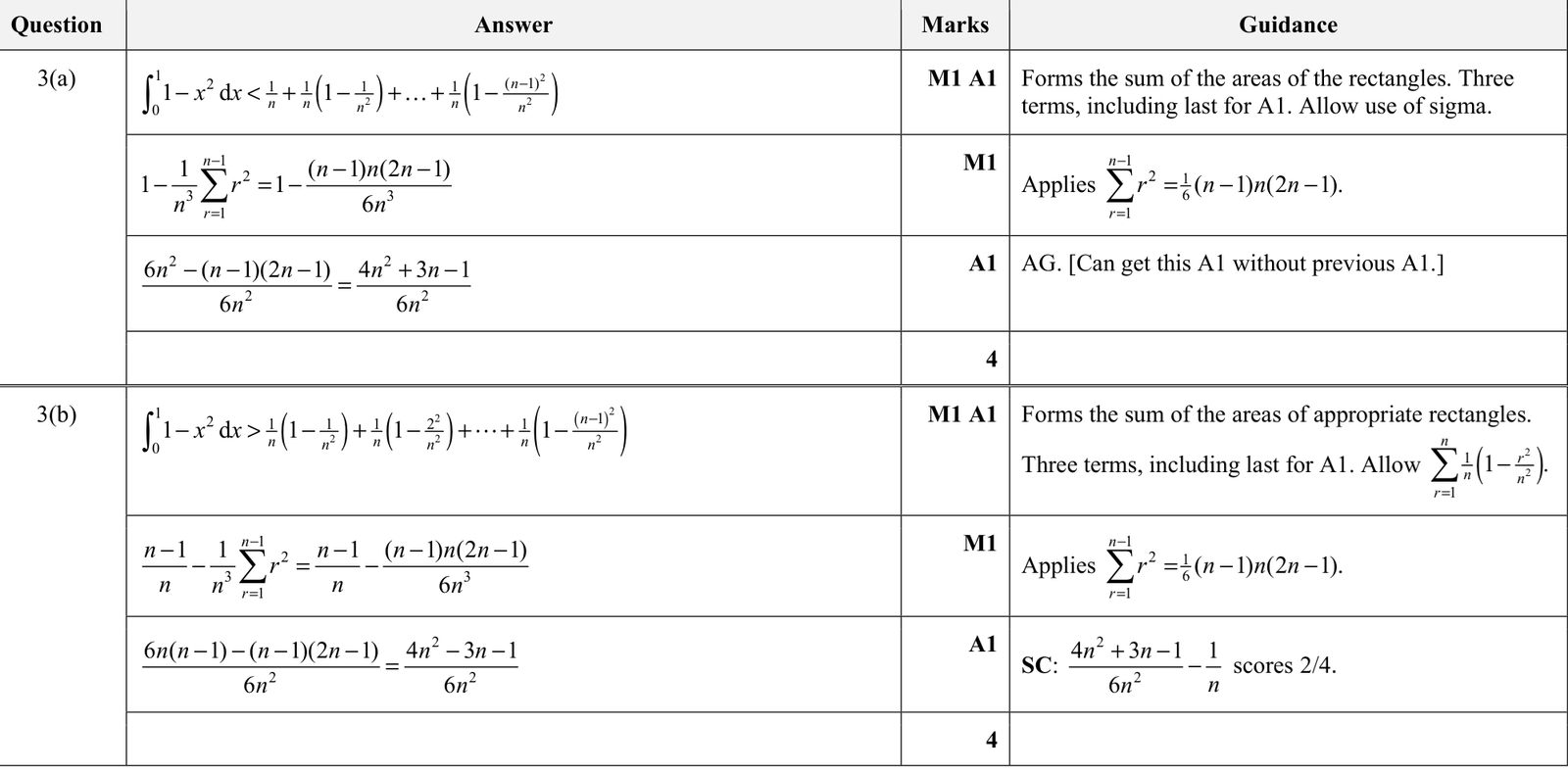
The diagram shows the curve with equation \(y=1-x^{2}\) for \(0 \leqslant x \leqslant 1\), together with a set of \(n\) rectangles of width \(\frac{1}{n}\).
(a) By considering the sum of the areas of the rectangles, show that
\[\int_{0}^{1}\left(1-x^{2}\right) \mathrm{d} x<\frac{4 n^{2}+3 n-1}{6 n^{2}} .\]
(b) Use a similar method to find, in terms of \(n\), a lower bound for \(\int_{0}^{1}\left(1-x^{2}\right) \mathrm{d} x\).
9231 P23 - Jun 2025 - Q5 - 10 marks
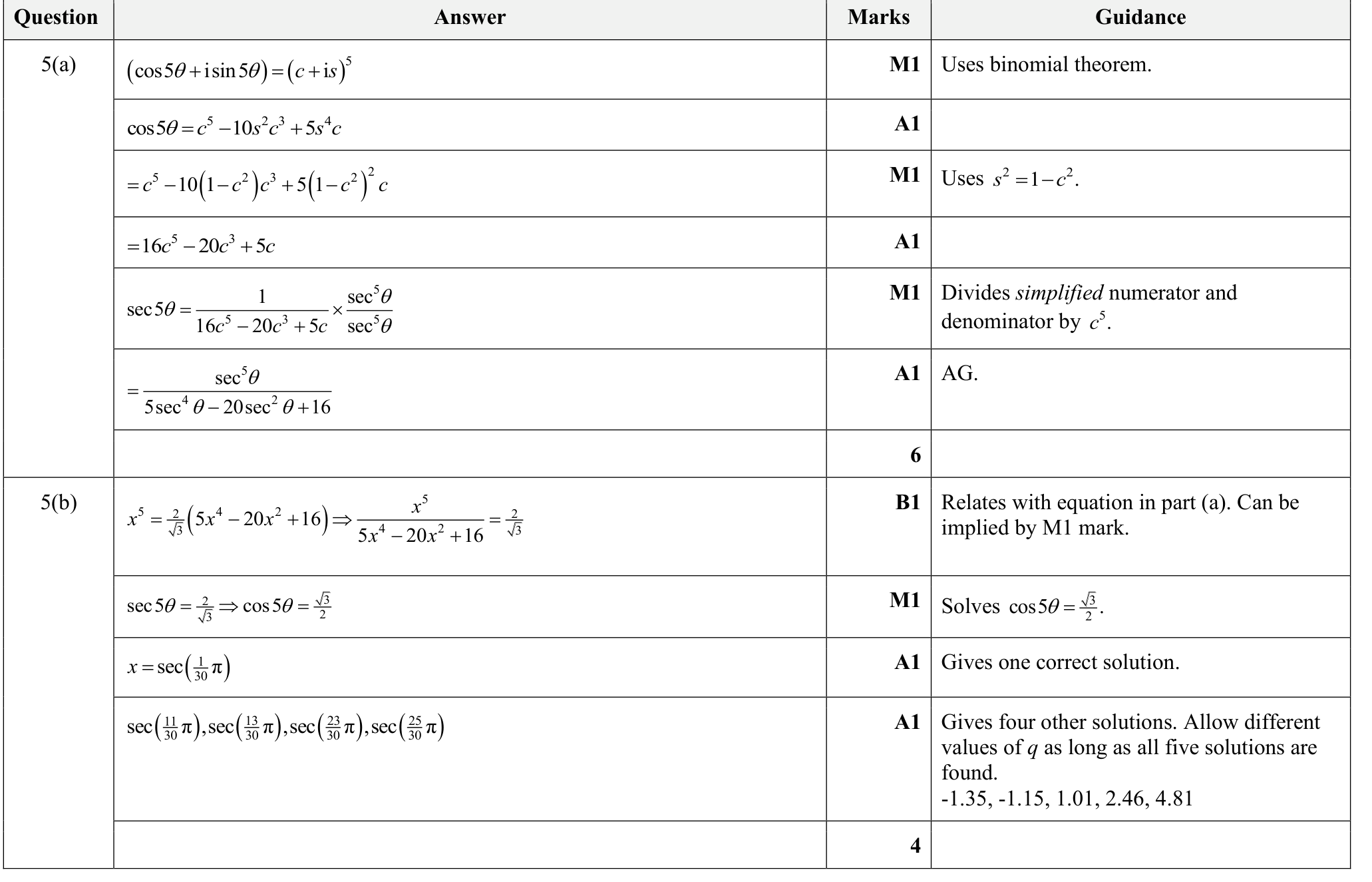
(a) Use de Moivre's theorem to show that
\(\sec 5 \theta=\frac{\sec ^{5} \theta}{5 \sec ^{4} \theta-20 \sec ^{2} \theta+16} .\)
(b) Hence, obtain the roots of the equation
\(\sqrt{3} x^{5}-10 x^{4}+40 x^{2}-32=0\)
in the form \(\sec (q \pi)\), where \(q\) is rational.
9231 P21 - Jun 2025 - Q1 - 5 marks
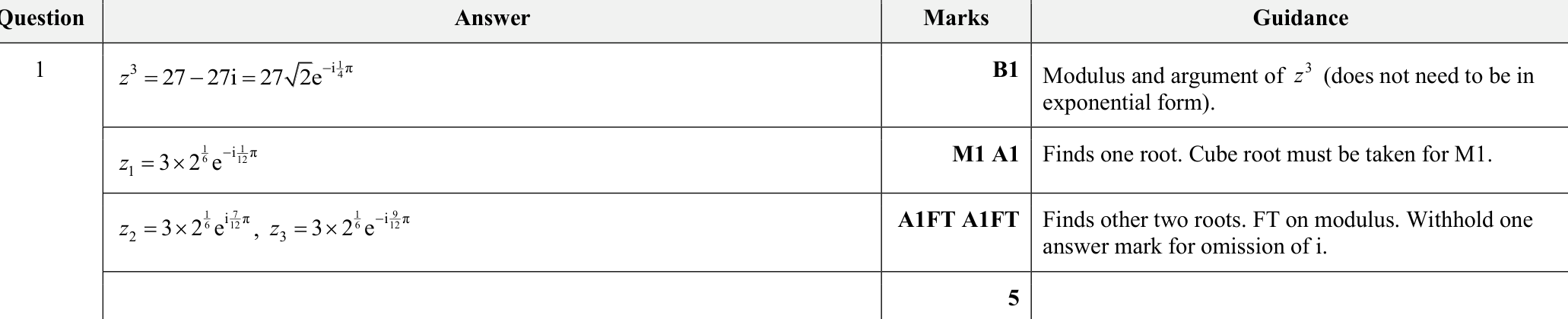
Find the roots of the equation \(z^{3}=27-27 \mathrm{i}\), giving your answers in the form \(r \mathrm{e}^{\mathrm{i} \theta}\), where \(r>0\) and \(-\pi \leqslant \theta<\pi\).
9231 P23 - Jun 2024 - Q6 - 7 marks
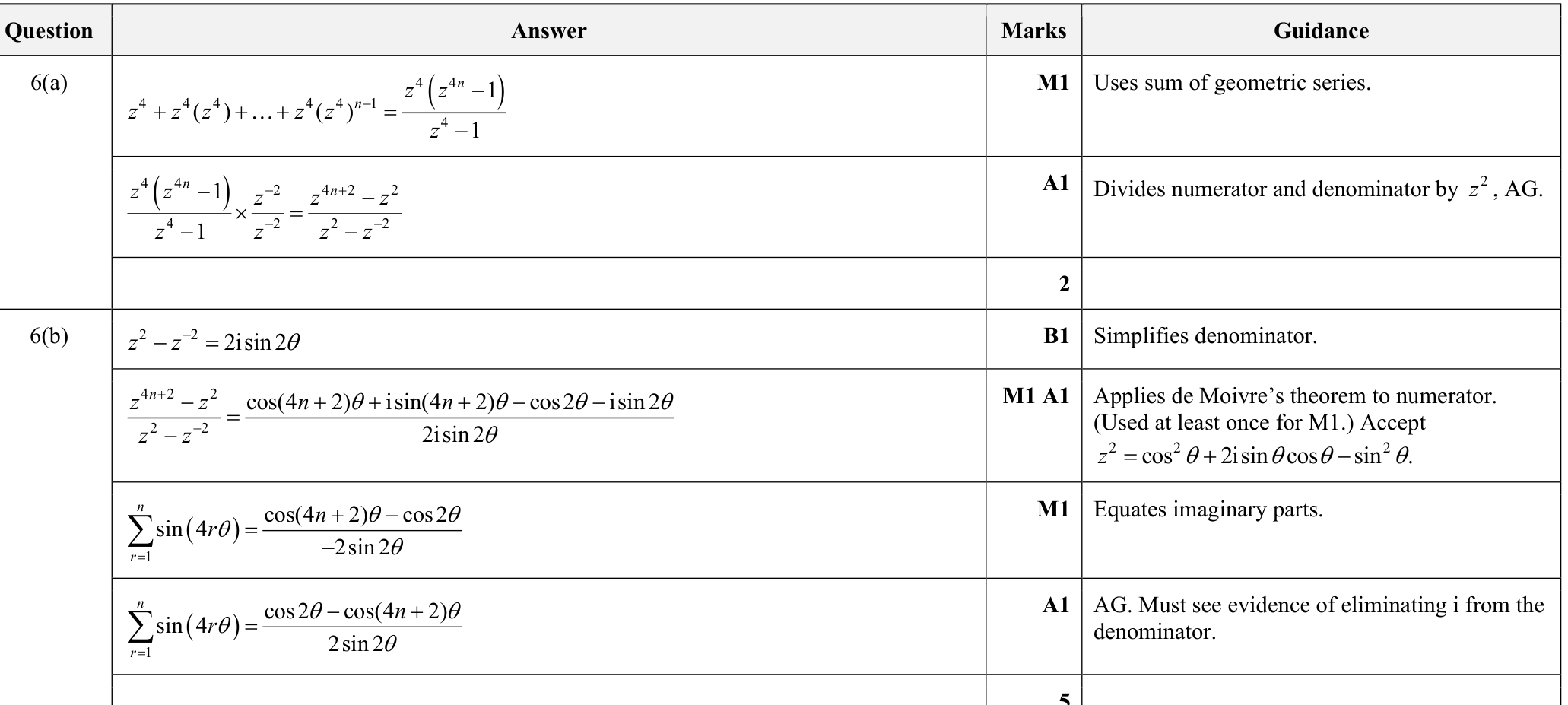
(a) Show that \(\sum_{r=1}^{n} z^{4 r}=\frac{z^{4 n+2}-z^{2}}{z^{2}-z^{-2}}\), for \(z^{2} \neq z^{-2}\).
(b) By letting \(z=\cos \theta+\mathrm{i} \sin \theta\), show that, if \(\sin 2 \theta \neq 0\),
\(\sum_{r=1}^{n} \sin (4 r \theta)=\frac{\cos 2 \theta-\cos (4 n+2) \theta}{2 \sin 2 \theta} .\)
9231 P21 - Jun 2024 - Q1 - 5 marks
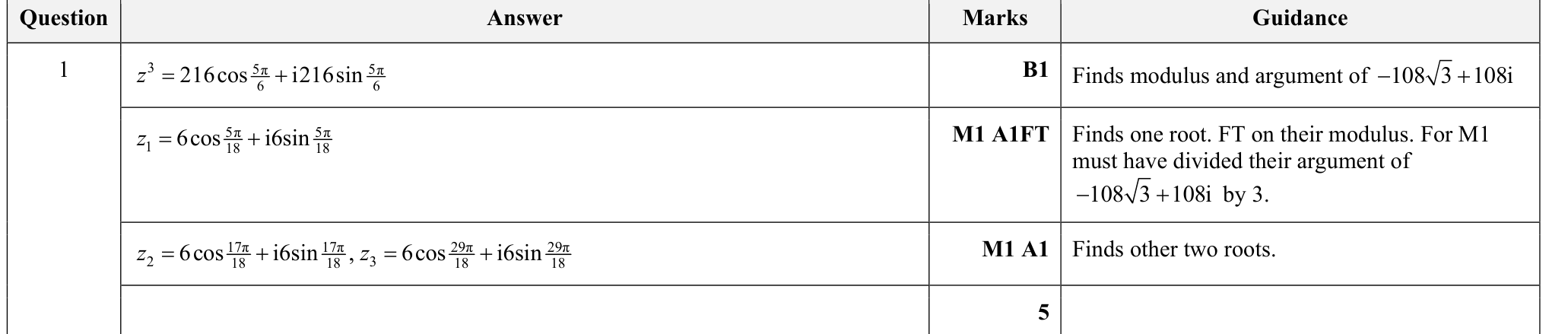
Find the roots of the equation \(z^{3}=-108 \sqrt{3}+108 \mathrm{i}\), giving your answers in the form \(r(\cos \theta+\mathrm{i} \sin \theta)\), where \(r\gt 0\) and \(0\lt \theta\lt 2 \pi\).
9231 P23 - Jun 2023 - Q3 - 7 marks
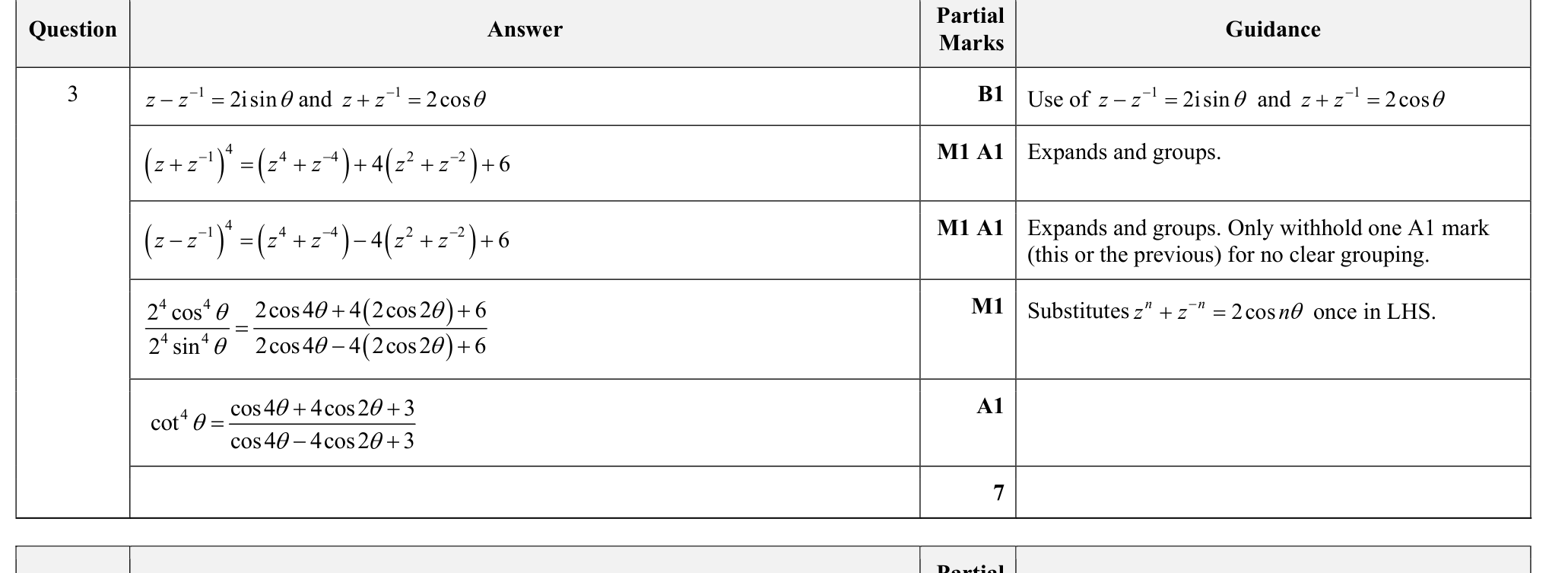
By considering the binomial expansions of \(\left(z+\frac{1}{z}\right)^{4}\) and \(\left(z-\frac{1}{z}\right)^{4}\), where \(z=\cos \theta+\mathrm{i} \sin \theta\), use de Moivre's theorem to show that
\(\cot ^{4} \theta=\frac{\cos 4 \theta+a \cos 2 \theta+b}{\cos 4 \theta-a \cos 2 \theta+b}\)
where \(a\) and \(b\) are integers to be determined.
9231 P21 - Jun 2023 - Q3 - 8 marks
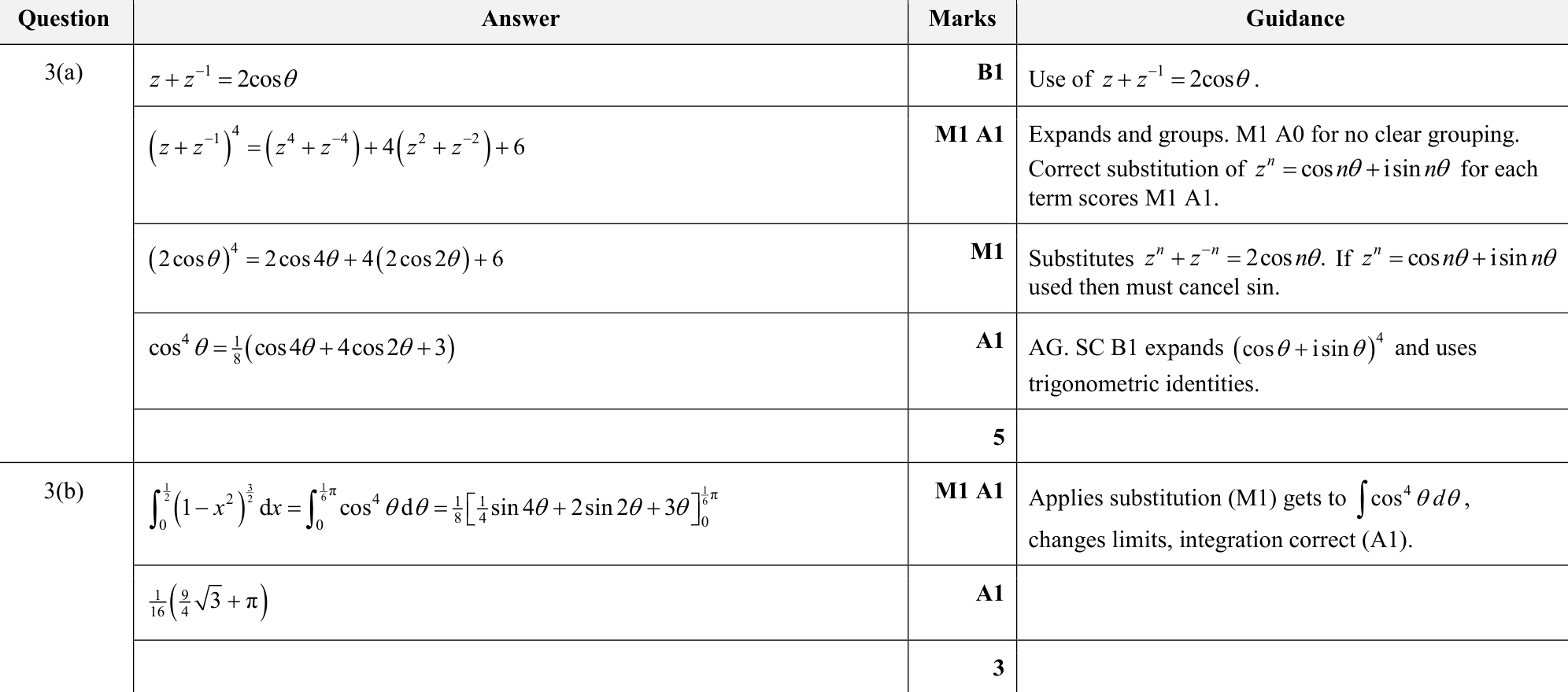
(a) By considering the binomial expansion of \(\left(z+z^{-1}\right)^{4}\), where \(z=\cos \theta+\mathrm{i} \sin \theta\), use de Moivre's theorem to show that \(\cos ^{4} \theta=\frac{1}{8}(\cos 4 \theta+4 \cos 2 \theta+3)\).
(b) Use the substitution \(x=\sin \theta\) to find the exact value of \(\int_{0}^{\frac{1}{2}}\left(1-x^{2}\right)^{\frac{3}{2}} \mathrm{~d} x\).
9231 P22 - Nov 2024 - Q4 - 10 marks
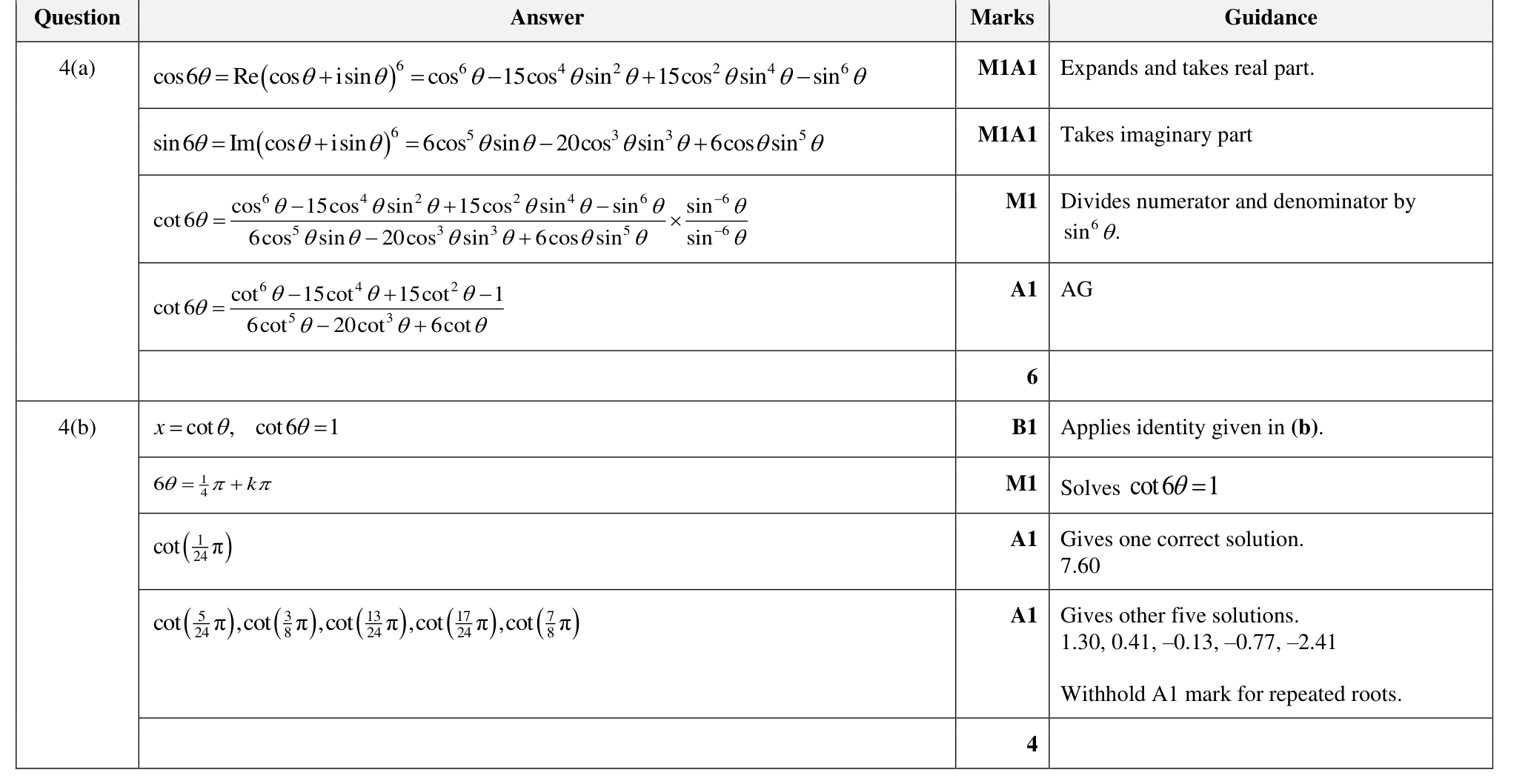
(a) Use de Moivre's theorem to show that
\(\cot 6 \theta=\frac{\cot ^{6} \theta-15 \cot ^{4} \theta+15 \cot ^{2} \theta-1}{6 \cot ^{5} \theta-20 \cot ^{3} \theta+6 \cot \theta} .\)
(b) Hence obtain the roots of the equation
\(x^{6}-6 x^{5}-15 x^{4}+20 x^{3}+15 x^{2}-6 x-1=0\)
in the form \(\cot (q \pi)\), where \(q\) is a rational number.
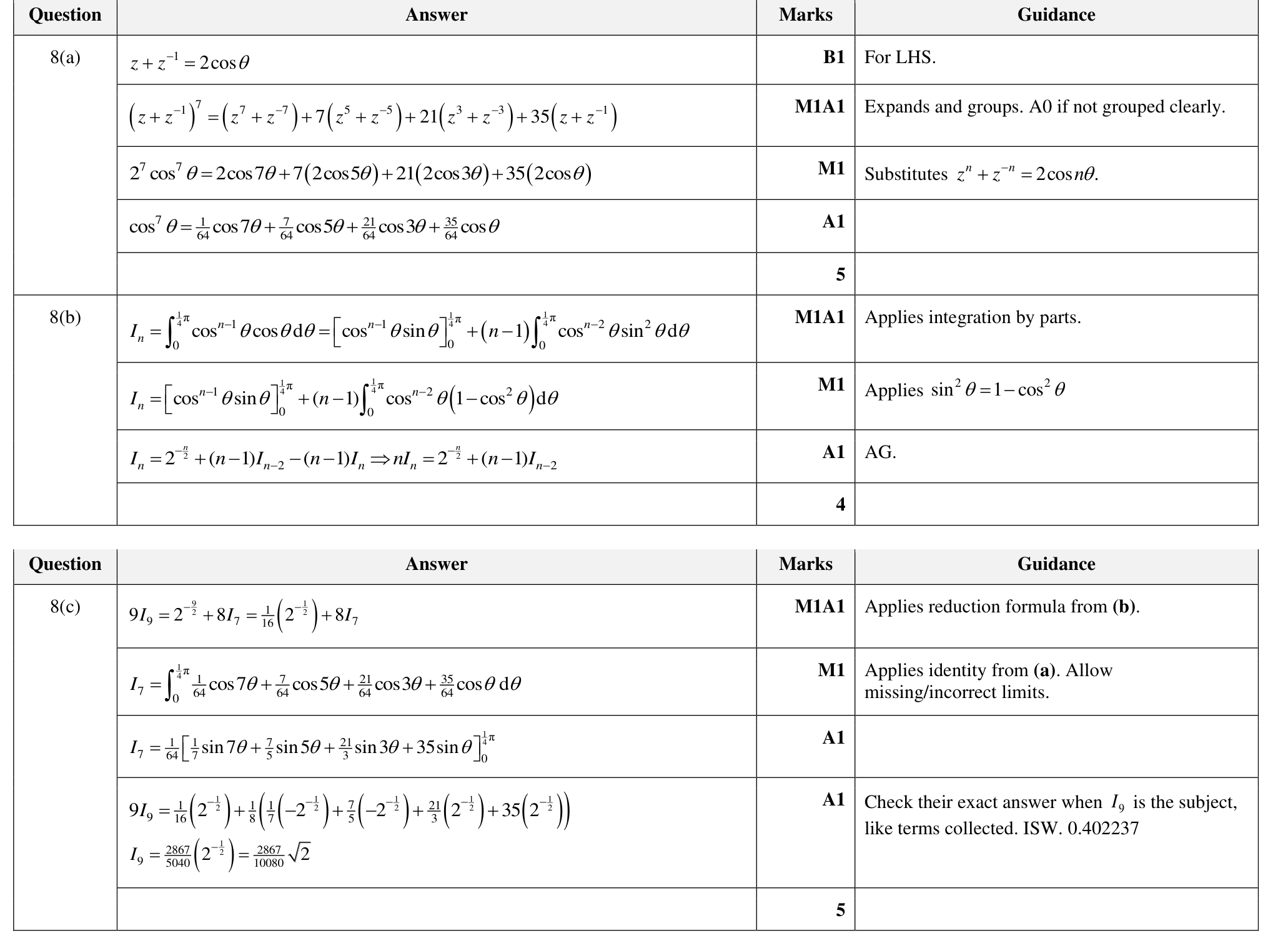
9231 P21 - Nov 2024 - Q8 - 14 marks
(a) By considering the binomial expansion of \(\left(z+\frac{1}{z}\right)^{7}\), where \(z=\cos \theta+\mathrm{i} \sin \theta\), use de Moivre's theorem to show that
\(\cos ^{7} \theta=a \cos 7 \theta+b \cos 5 \theta+c \cos 3 \theta+d \cos \theta\)
where \(a, b, c\) and \(d\) are constants to be determined.
Let \(I_{n}=\int_{0}^{\frac{1}{4} \pi} \cos ^{n} \theta \mathrm{~d} \theta\).
(b) Show that
\(n I_{n}=2^{-\frac{1}{2} n}+(n-1) I_{n-2}\)
(c) Using the results given in parts (a) and (b), find the exact value of \(I_{9}\).
9231 P23 - Jun 2022 - Q1 - 5 marks
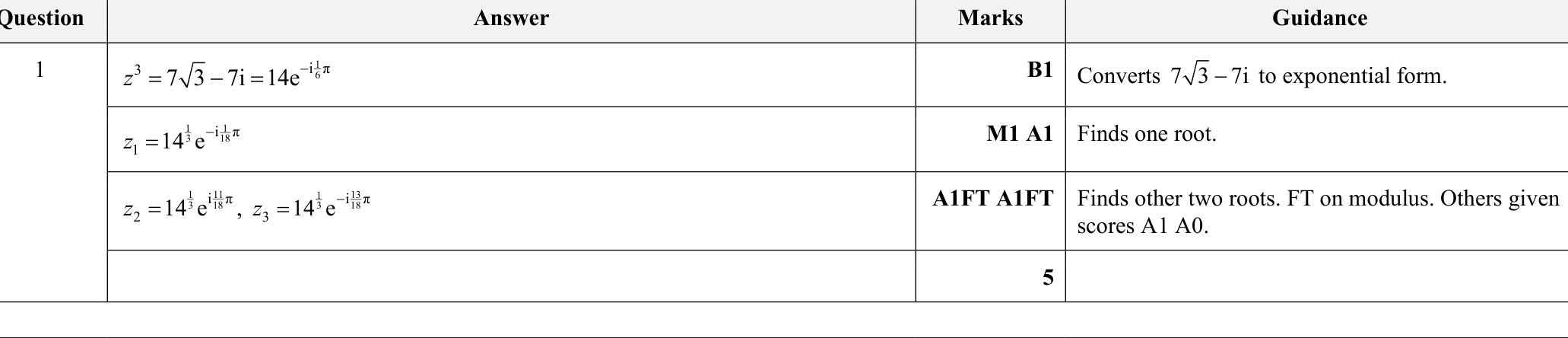
Find the roots of the equation \(z^{3}=7 \sqrt{3}-7 \mathrm{i}\), giving your answers in the form \(r \mathrm{e}^{\mathrm{i} \theta}\), where \(r\gt 0\) and \(-\pi \leqslant \theta\lt \pi\).
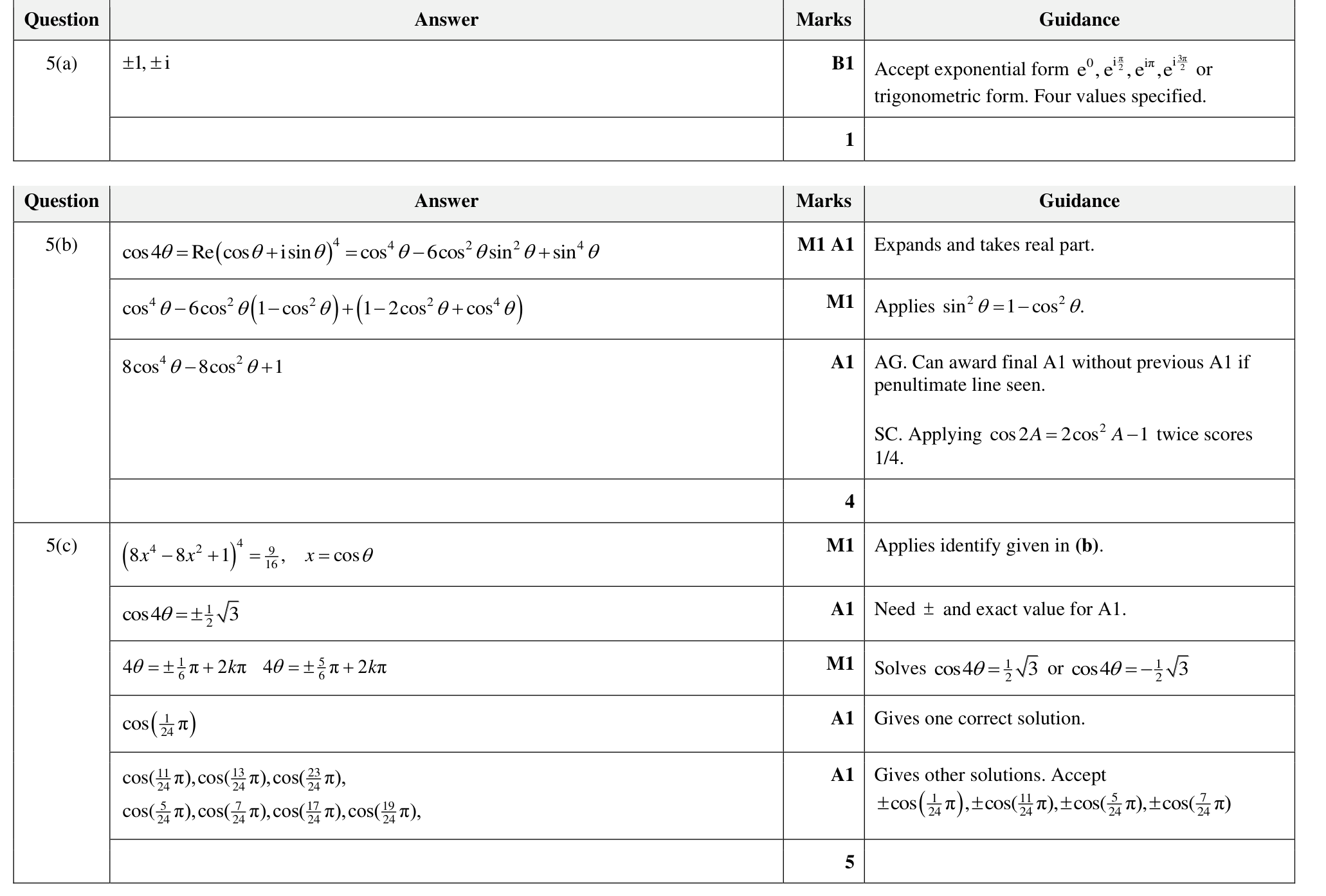
9231 P22 - Nov 2022 - Q5 - 10 marks
(a) Write down the fourth roots of unity.
(b) Use de Moivre's theorem to show that
\(\cos 4 \theta=8 \cos ^{4} \theta-8 \cos ^{2} \theta+1\)
(c) Hence obtain the real roots of the equation
\(16\left(8 x^{4}-8 x^{2}+1\right)^{4}-9=0\)
in the form \(\cos (q \pi)\), where \(q\) is a rational number.
9231 P21 - Jun 2020 - Q3 - 8 marks
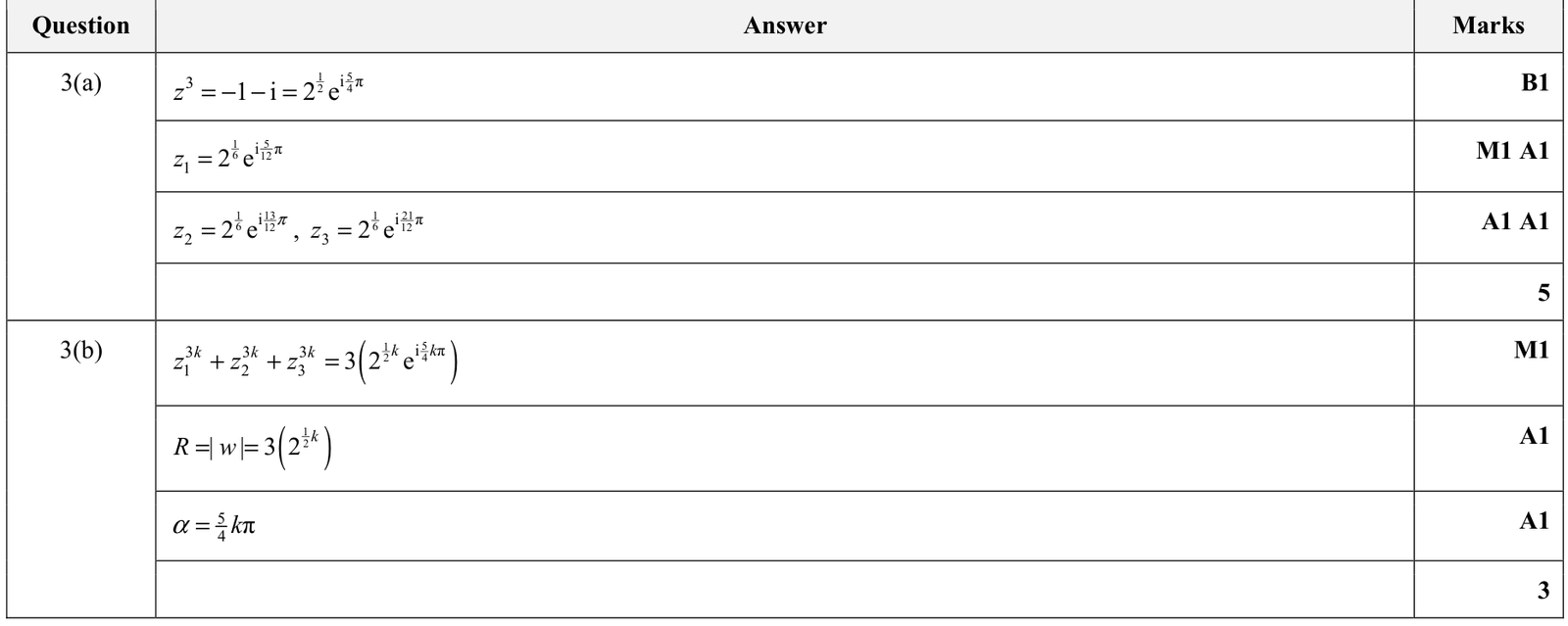
(a) Find the roots of the equation \(z^{3}=-1-\mathrm{i}\), giving your answers in the form \(r \mathrm{e}^{\mathrm{i} \theta}\), where \(r>0\) and \(0 \leqslant \theta<2 \pi\).
Let \(w=z_{1}^{3 k}+z_{2}^{3 k}+z_{3}^{3 k}\), where \(k\) is a positive integer and \(z_{1}, z_{2}, z_{3}\) are the roots of \(z^{3}=-1-\mathrm{i}\).
(b) Express \(w\) in the form \(R \mathrm{e}^{\mathrm{i} \alpha}\), where \(R>0\), giving \(R\) and \(\alpha\) in terms of \(k\).
9231 P12 - Nov 2018 - Q8 - 10 marks
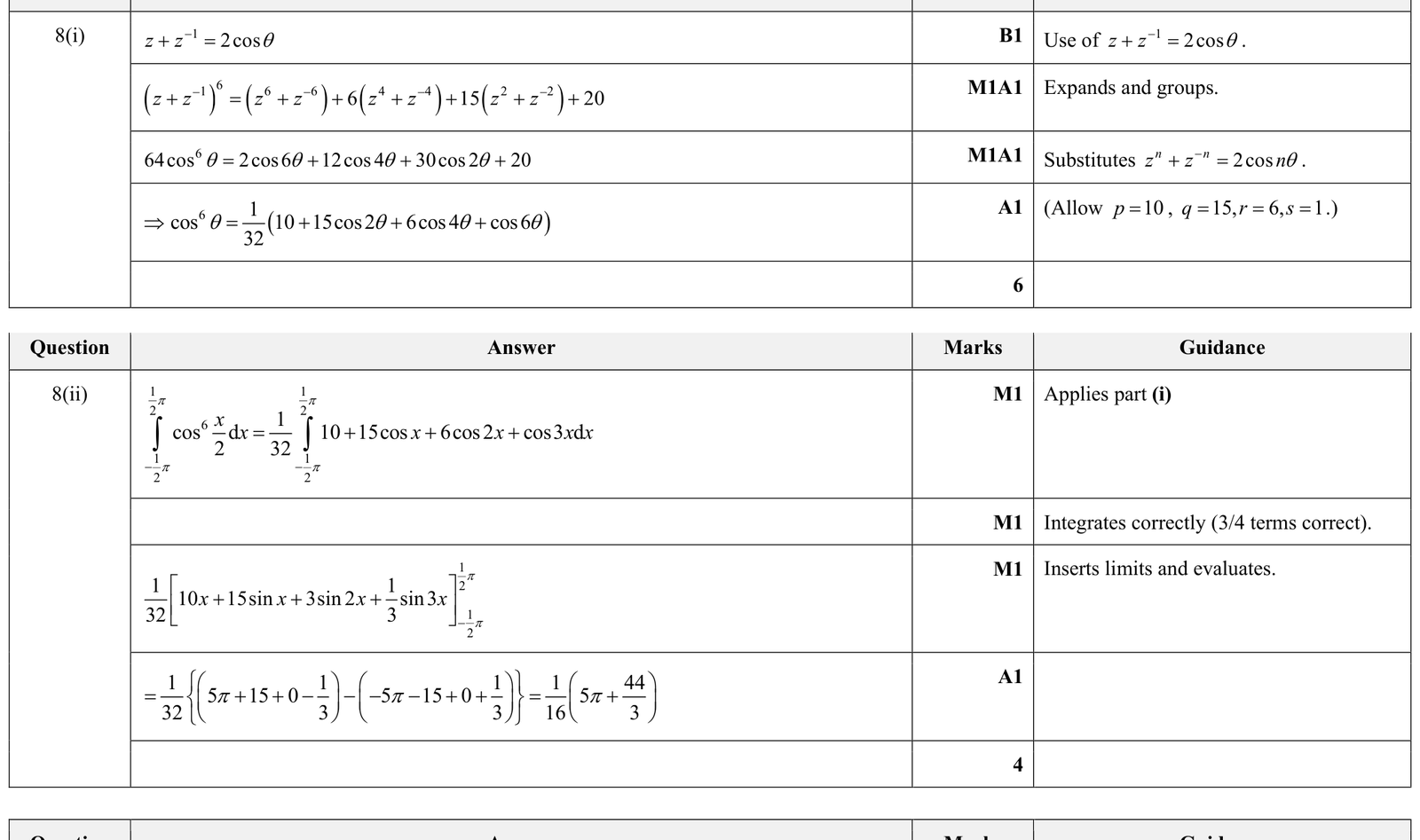
(i) By considering the binomial expansion of \(\left(z+\frac{1}{z}\right)^{6}\), where \(z=\cos \theta+\mathrm{i} \sin \theta\), express \(\cos ^{6} \theta\) in the form
\(\frac{1}{32}(p+q \cos 2 \theta+r \cos 4 \theta+s \cos 6 \theta),\)
where \(p, q, r\) and \(s\) are integers to be determined.
(ii) Hence find the exact value of
\(\int_{-\frac{1}{2} \pi}^{\frac{1}{2} \pi} \cos ^{6}\left(\frac{1}{2} x\right) \mathrm{d} x\)
9231 P11 - Jun 2017 - Q4 - 6 marks
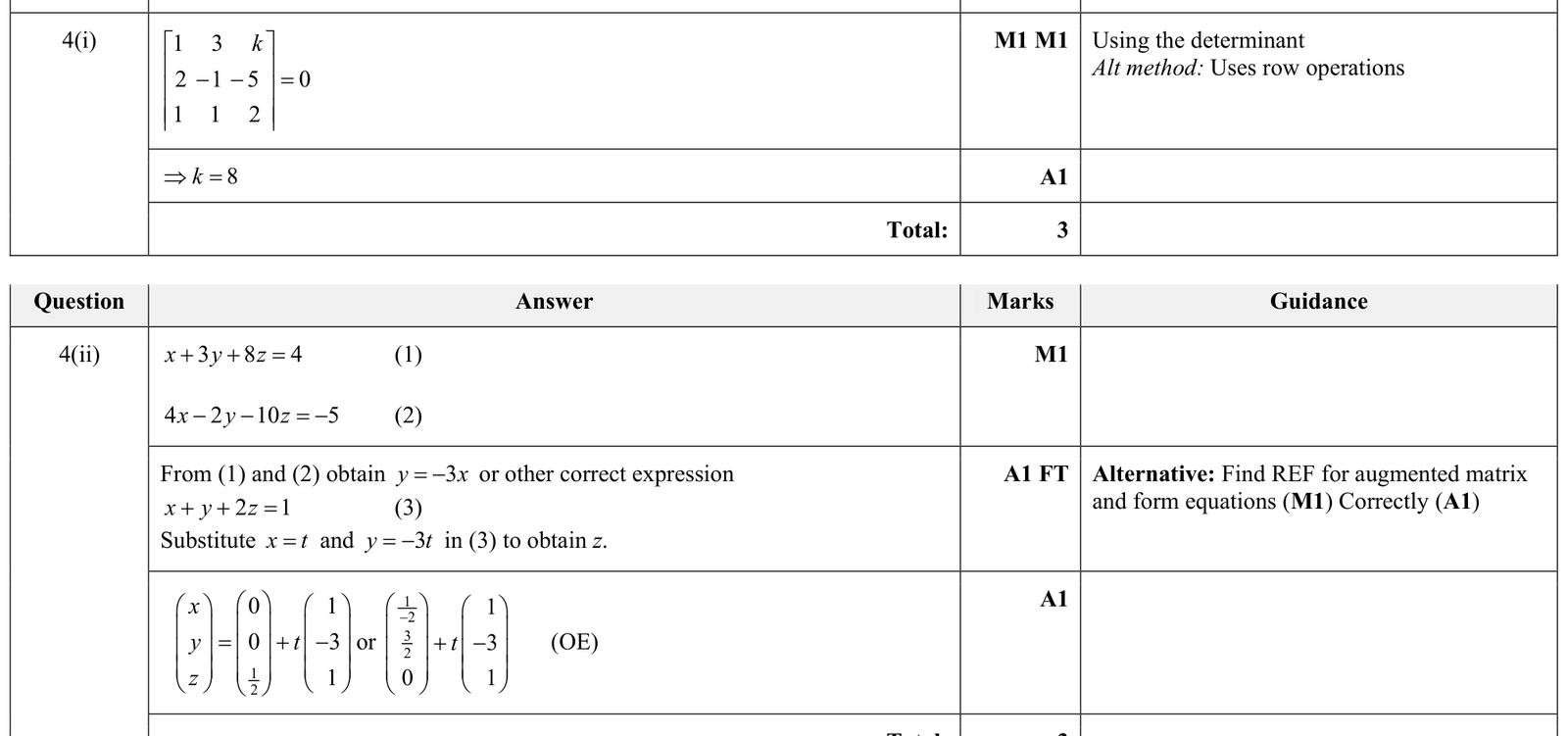
(i) Find the value of \(k\) for which the set of linear equations
\(\begin{aligned} x+3 y+k z & =4 \\ 4 x-2 y-10 z & =-5 \\ x+y+2 z & =1 \end{aligned}\)
has no unique solution.
(ii) For this value of \(k\), find the set of possible solutions, giving your answer in the form
\(\left(\begin{array}{l} x \\ y \\ z \end{array}\right)=\mathbf{a}+t \mathbf{b},\)
where \(\mathbf{a}\) and \(\mathbf{b}\) are vectors and \(t\) is a scalar.
9231 P13 - Jun 2017 - Q7 - 10 marks
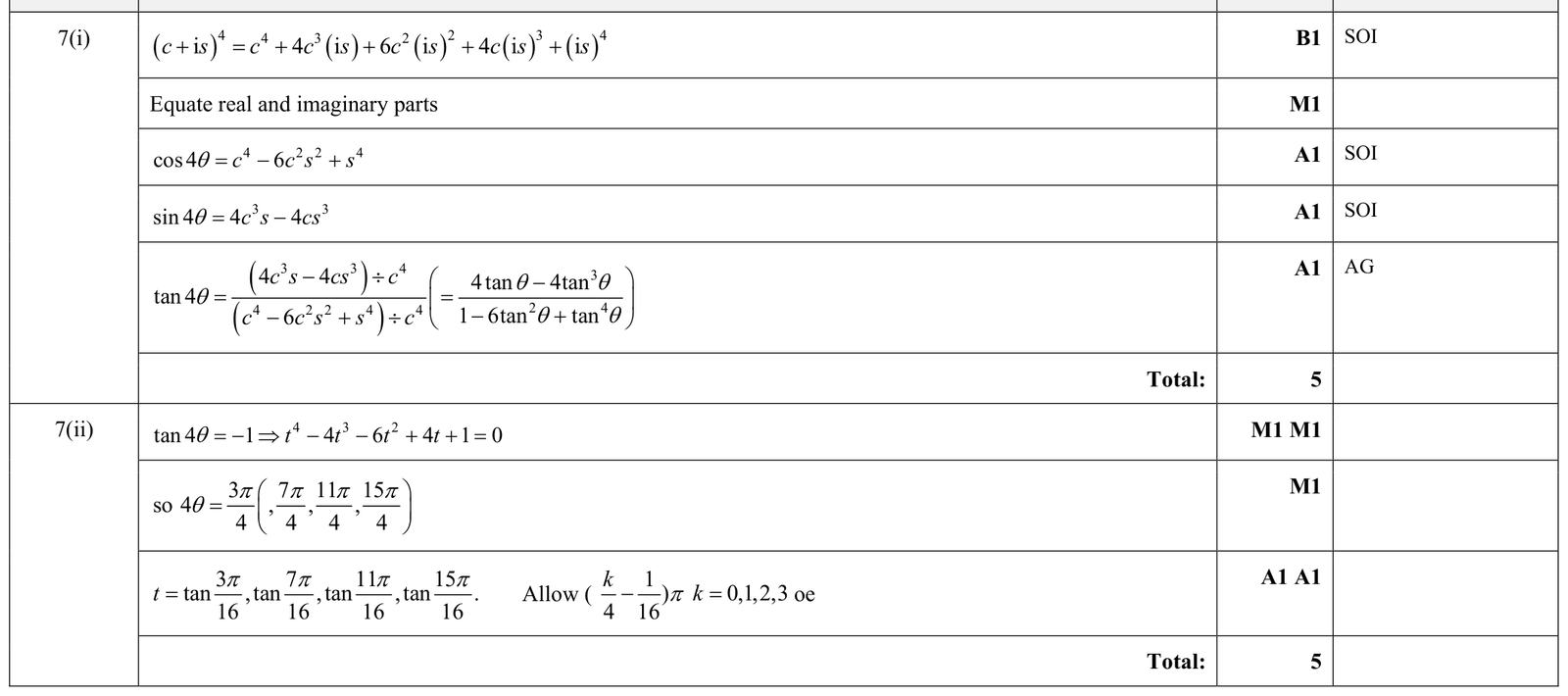
(i) Use de Moivre's theorem to prove that
\(\tan 4 \theta=\frac{4 \tan \theta-4 \tan ^{3} \theta}{1-6 \tan ^{2} \theta+\tan ^{4} \theta}\)
(ii) Hence find the solutions of the equation
\(t^{4}-4 t^{3}-6 t^{2}+4 t+1=0\)
giving your answers in the form \(\tan k \pi\), where \(k\) is a rational number.
9231 P11 - Jun 2014 - Q7 - 9 marks
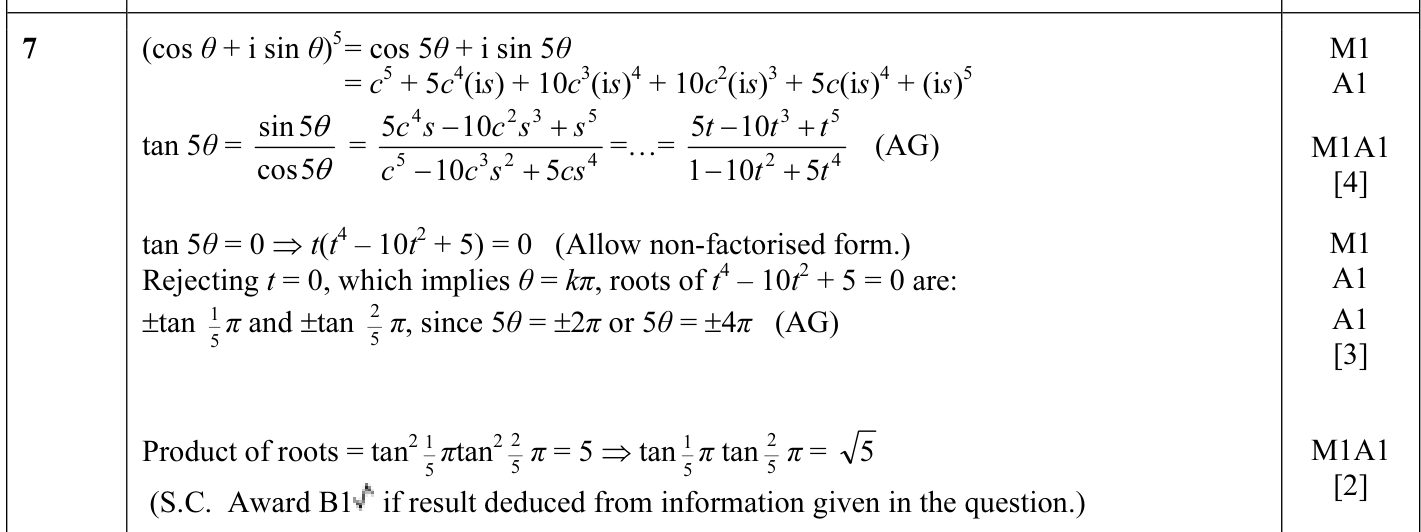
Use de Moivre's theorem to show that
\(\tan 5 \theta=\frac{5 t-10 t^{3}+t^{5}}{1-10 t^{2}+5 t^{4}}\)
where \(t=\tan \theta\).
Deduce that the roots of the equation \(t^{4}-10 t^{2}+5=0\) are \(\pm \tan \frac{1}{5} \pi\) and \(\pm \tan \frac{2}{5} \pi\).
Hence show that \(\tan \frac{1}{5} \pi \tan \frac{2}{5} \pi=\sqrt{ } 5\).
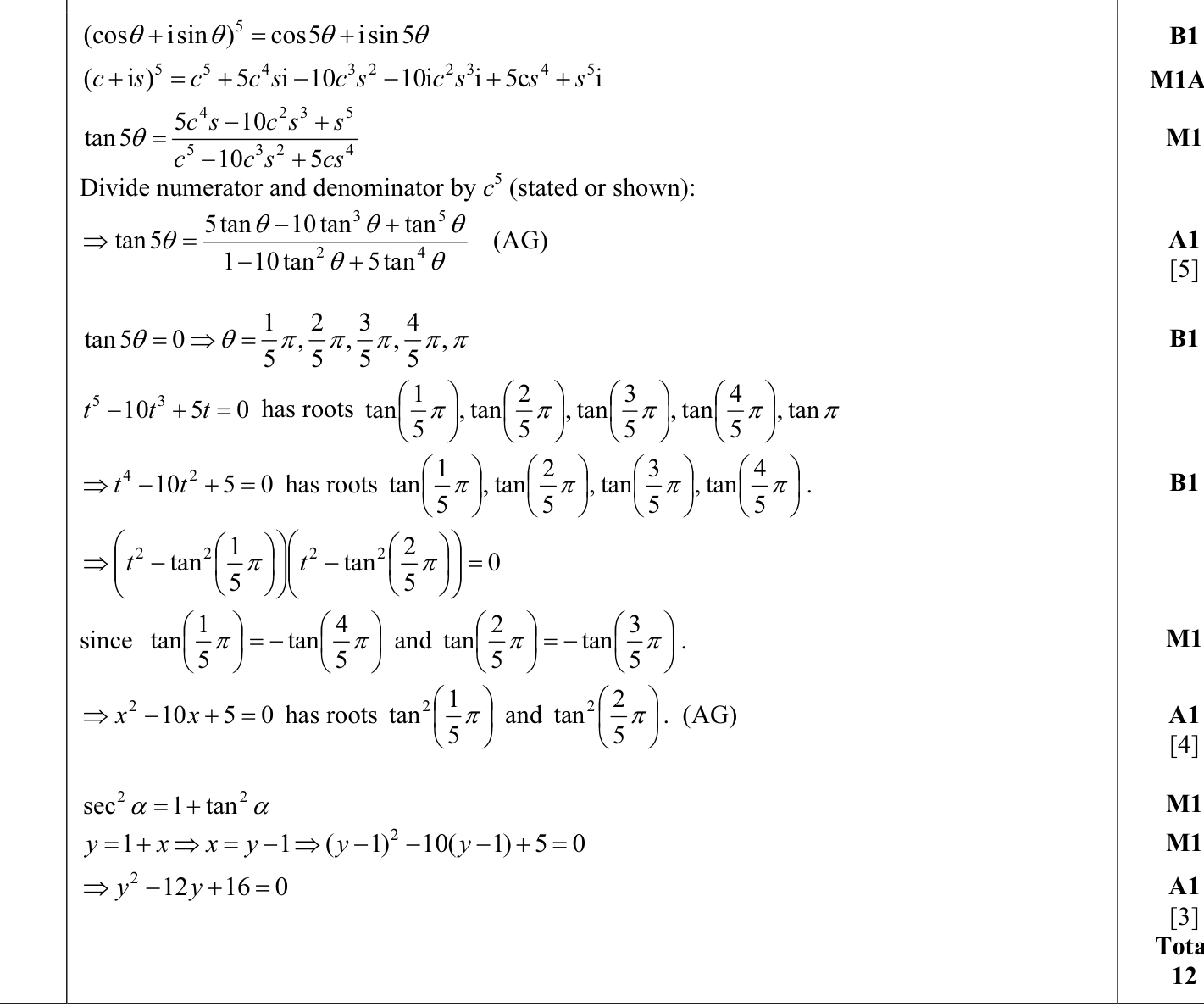
9231 P11 - Nov 2015 - Q10 - 12 marks
Using de Moivre's theorem, show that
\(\tan 5 \theta=\frac{5 \tan \theta-10 \tan ^{3} \theta+\tan ^{5} \theta}{1-10 \tan ^{2} \theta+5 \tan ^{4} \theta} .\)
Hence show that the equation \(x^{2}-10 x+5=0\) has roots \(\tan ^{2}\left(\frac{1}{5} \pi\right)\) and \(\tan ^{2}\left(\frac{2}{5} \pi\right)\).
Deduce a quadratic equation, with integer coefficients, having roots \(\sec ^{2}\left(\frac{1}{5} \pi\right)\) and \(\sec ^{2}\left(\frac{2}{5} \pi\right)\).
[Question 11 is printed on the next page.]