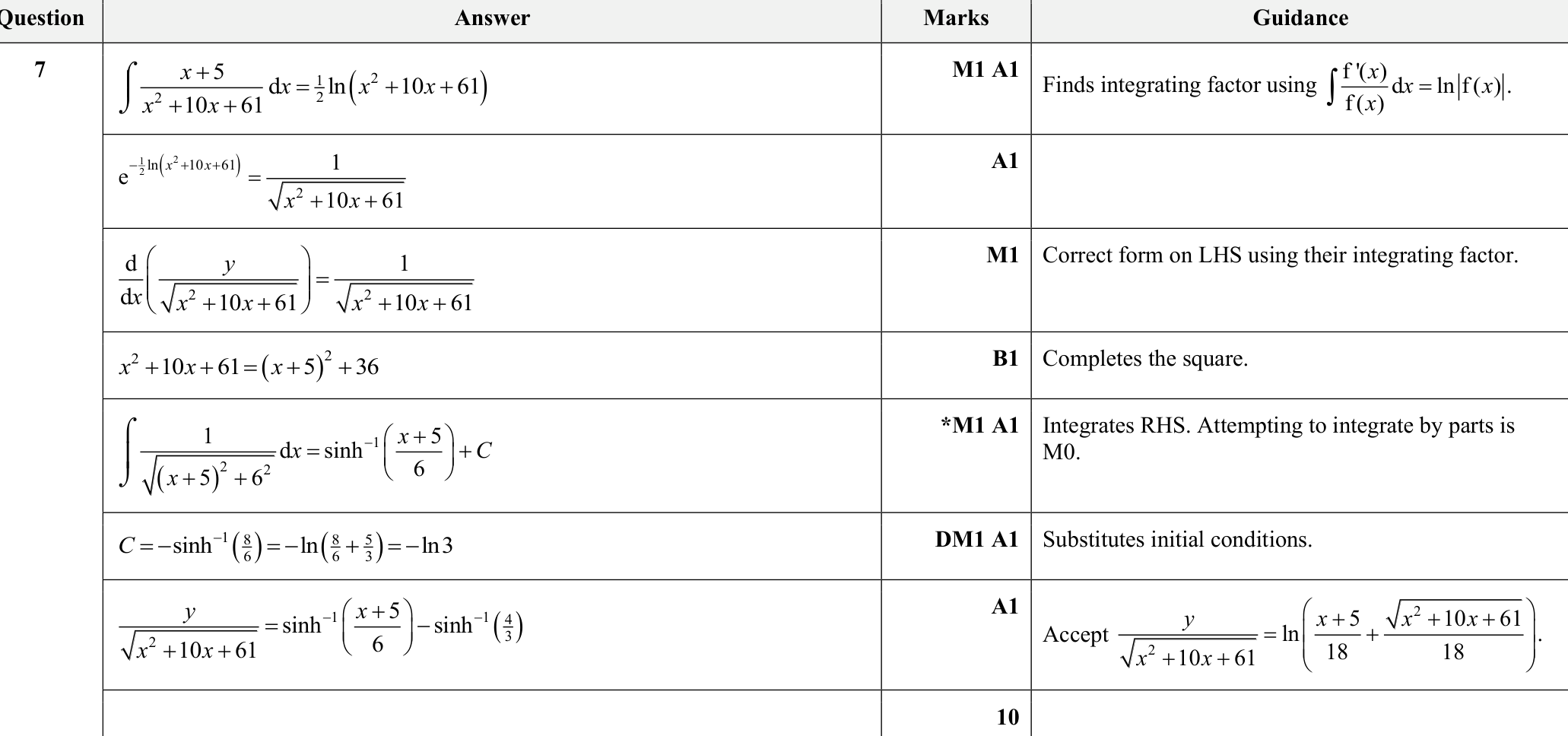
Answer: \(y=\sqrt{x^2+10x+61}\left(\sinh^{-1}\!\left(\frac{x+5}{6}\right)-\sinh^{-1}\!\left(\frac43\right)\right)\).
Equivalently, since \(\sinh^{-1}(4/3)=\ln 3\),
\(y=\sqrt{x^2+10x+61}\,\ln\!\left(\frac{x+5+\sqrt{x^2+10x+61}}{18}\right)\).
The differential equation is linear:
\(\dfrac{dy}{dx}-\dfrac{x+5}{x^2+10x+61}y=1.\)
Use an integrating factor. Here
\(P(x)=-\dfrac{x+5}{x^2+10x+61}\),
so
\(\mu(x)=e^{\int P(x)\,dx}=e^{-\int \frac{x+5}{x^2+10x+61}\,dx}.\)
Now
\(\dfrac{d}{dx}(x^2+10x+61)=2x+10=2(x+5),\)
so
\(\int \frac{x+5}{x^2+10x+61}\,dx=\frac12\ln(x^2+10x+61).\)
Hence
\(\mu(x)=e^{-\frac12\ln(x^2+10x+61)}=\dfrac{1}{\sqrt{x^2+10x+61}}.\)
Multiplying the equation by this gives
\(\frac{d}{dx}\left(\frac{y}{\sqrt{x^2+10x+61}}\right)=\frac{1}{\sqrt{x^2+10x+61}}.\)
Integrating,
\(\frac{y}{\sqrt{x^2+10x+61}}=\int \frac{1}{\sqrt{x^2+10x+61}}\,dx+C.\)
Complete the square:
\(x^2+10x+61=(x+5)^2+36=(x+5)^2+6^2.\)
So
\(\int \frac{1}{\sqrt{x^2+10x+61}}\,dx=\int \frac{1}{\sqrt{(x+5)^2+6^2}}\,dx=\sinh^{-1}\left(\frac{x+5}{6}\right)+C.\)
Therefore
\(\frac{y}{\sqrt{x^2+10x+61}}=\sinh^{-1}\left(\frac{x+5}{6}\right)+C.\)
Use \(y=0\) when \(x=3\):
\(0=\sinh^{-1}\left(\frac{8}{6}\right)+C=\sinh^{-1}\left(\frac43\right)+C,\)
so
\(C=-\sinh^{-1}\left(\frac43\right)=-\ln 3.\)
Hence
\(\frac{y}{\sqrt{x^2+10x+61}}=\sinh^{-1}\left(\frac{x+5}{6}\right)-\sinh^{-1}\left(\frac43\right),\)
and so
\(y=\sqrt{x^2+10x+61}\left(\sinh^{-1}\left(\frac{x+5}{6}\right)-\sinh^{-1}\left(\frac43\right)\right).\)
Using \(\sinh^{-1}u=\ln(u+\sqrt{u^2+1})\), an equivalent exact form is
\(y=\sqrt{x^2+10x+61}\,\ln\left(\frac{x+5+\sqrt{x^2+10x+61}}{18}\right).\)