Past Exam Questions
← Back9231 P13 - Jun 2015 - Q6 - 9 marks
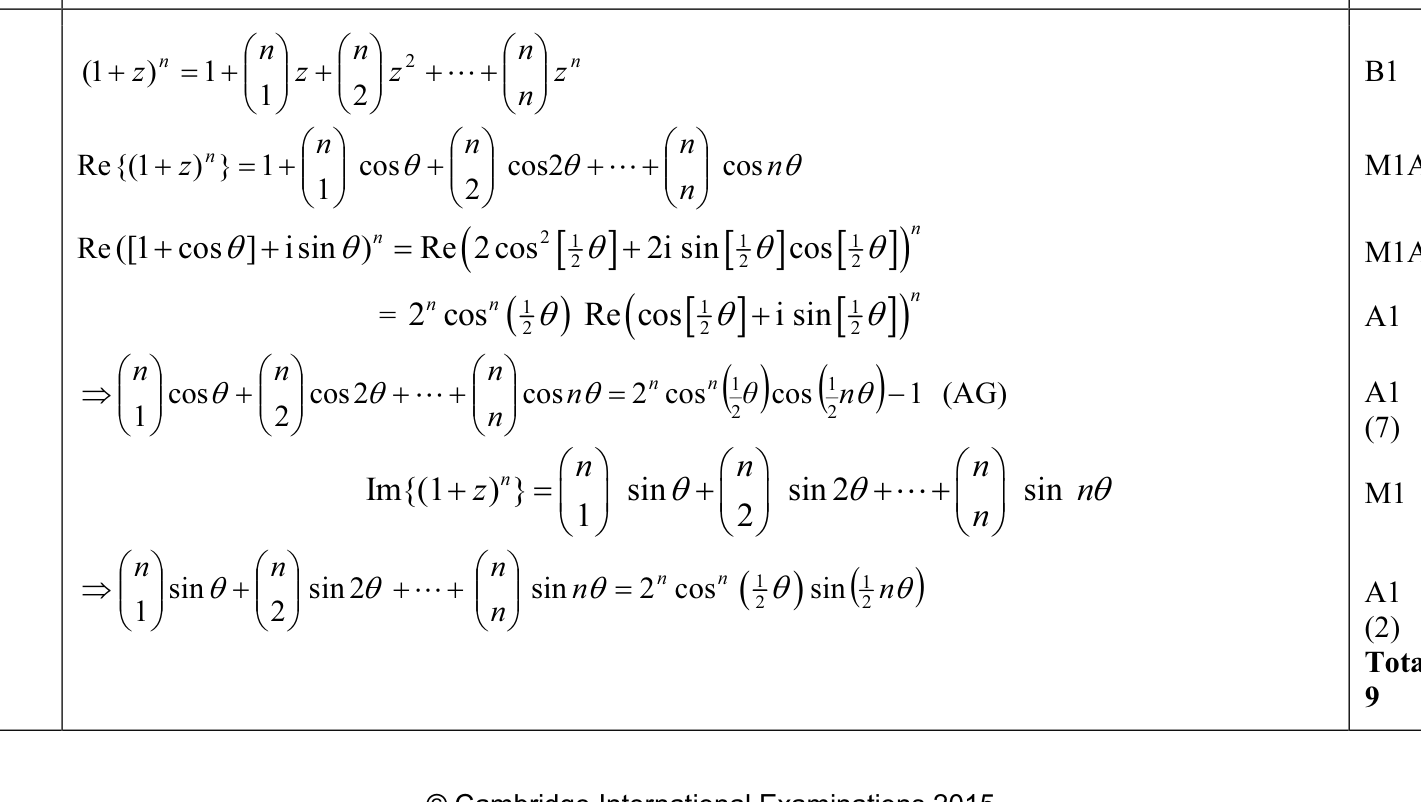
Let \(z=\cos \theta+\mathrm{i} \sin \theta\). Use the binomial expansion of \((1+z)^{n}\), where \(n\) is a positive integer, to show that
\(\binom{n}{1} \cos \theta+\binom{n}{2} \cos 2 \theta+\ldots+\binom{n}{n} \cos n \theta=2^{n} \cos ^{n}\left(\frac{1}{2} \theta\right) \cos \left(\frac{1}{2} n \theta\right)-1 .\)
Find
\(\binom{n}{1} \sin \theta+\binom{n}{2} \sin 2 \theta+\ldots+\binom{n}{n} \sin n \theta .\)
9231 P11 - Nov 2016 - Q10 - 12 marks
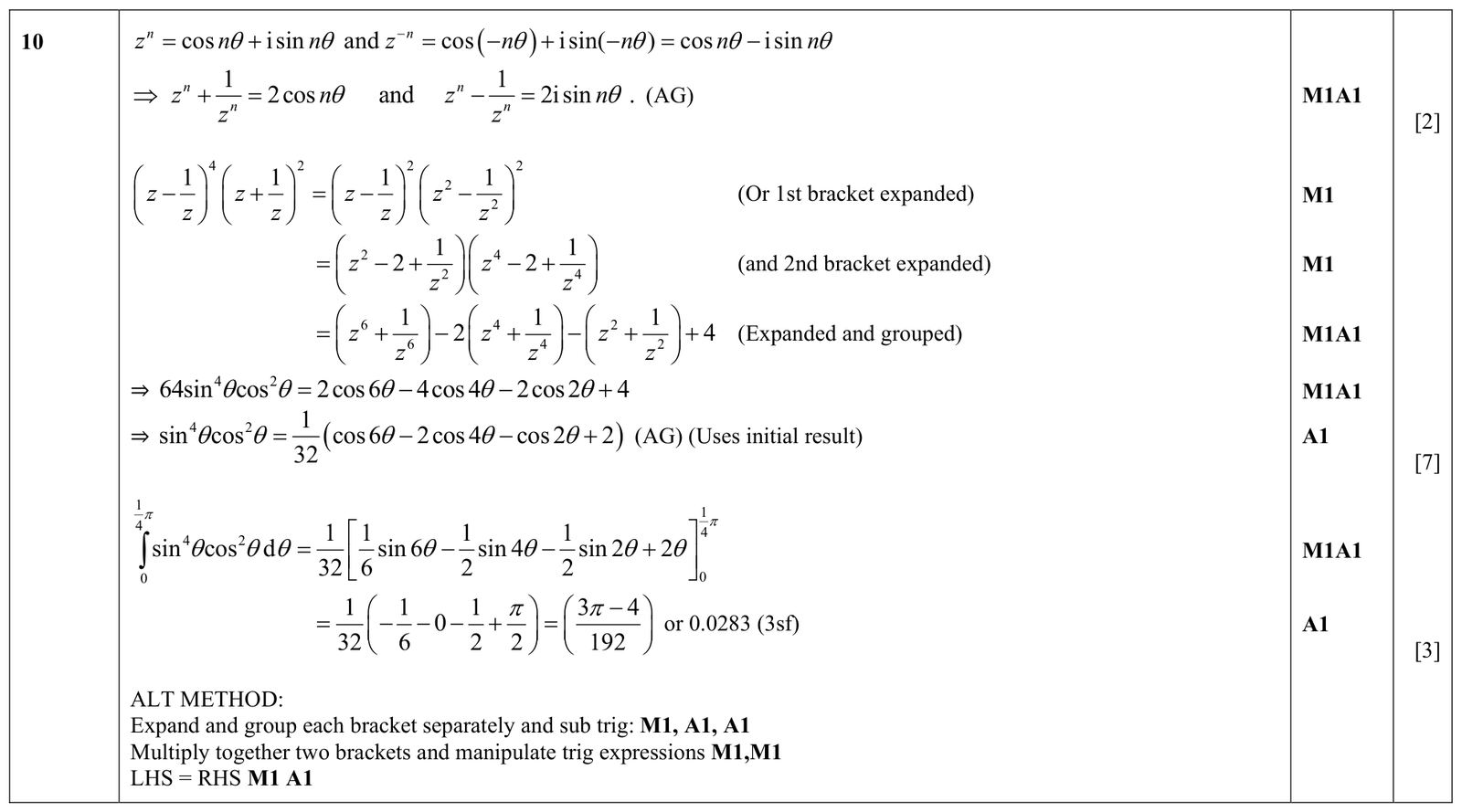
Let \(z=\cos \theta+\mathrm{i} \sin \theta\). Show that
\(z^{n}+\frac{1}{z^{n}}=2 \cos n \theta \quad \text { and } \quad z^{n}-\frac{1}{z^{n}}=2 \mathrm{i} \sin n \theta .\)
By considering \(\left(z-\frac{1}{z}\right)^{4}\left(z+\frac{1}{z}\right)^{2}\), show that
\(\sin ^{4} \theta \cos ^{2} \theta=\frac{1}{32}(\cos 6 \theta-2 \cos 4 \theta-\cos 2 \theta+2) .\)
Hence find the exact value of \(\int_{0}^{\frac{1}{4} \pi} \sin ^{4} \theta \cos ^{2} \theta d \theta\).
[Question 11 is printed on the next page.]
9231 P13 - Jun 2016 - Q9 - 11 marks
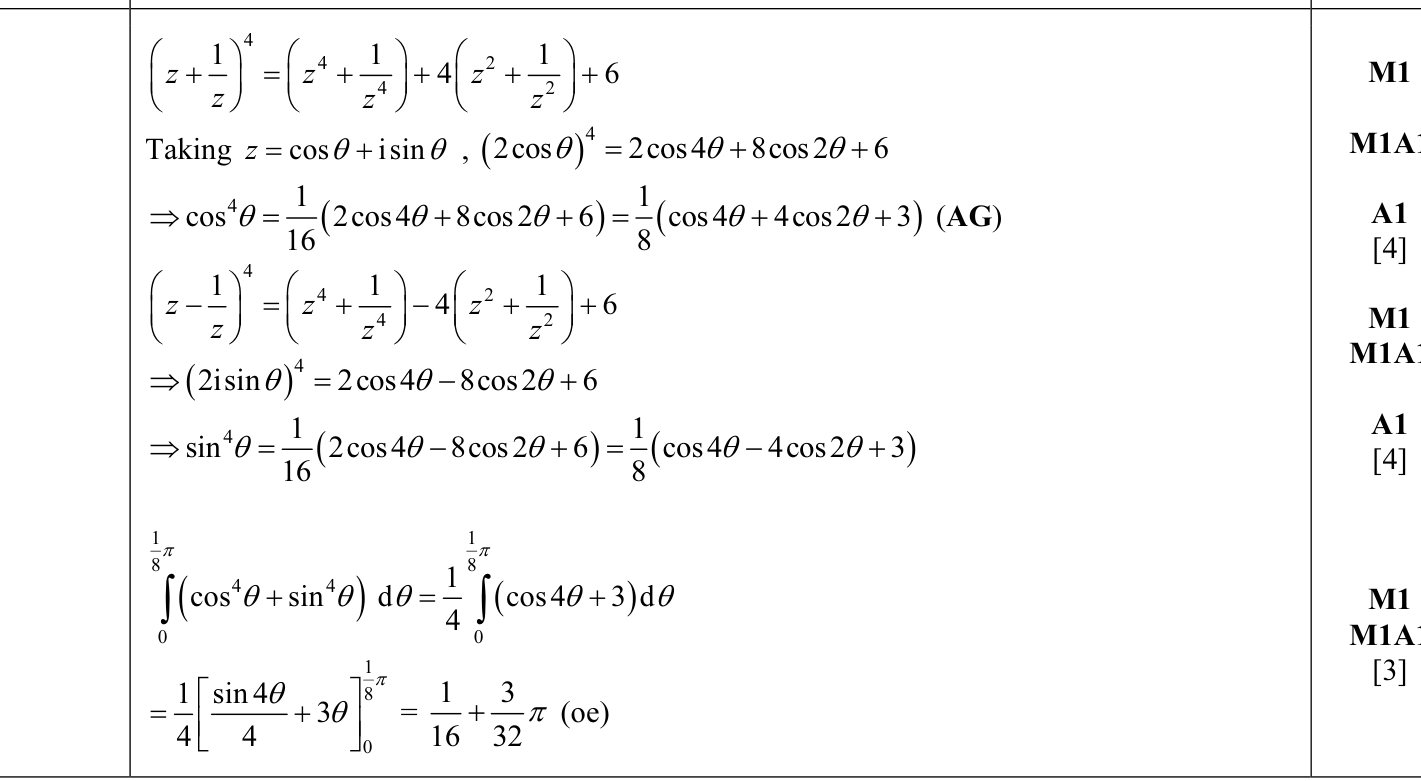
Use de Moivre's theorem to show that \(\cos ^{4} \theta=\frac{1}{8}(\cos 4 \theta+4 \cos 2 \theta+3)\).
Find the corresponding expression for \(\sin ^{4} \theta\) in terms of \(\cos 4 \theta\) and \(\cos 2 \theta\).
Hence find the exact value of \(\int_{0}^{\frac{1}{8} \pi}\left(\cos ^{4} \theta+\sin ^{4} \theta\right) \mathrm{d} \theta\).
9231 P11 - Jun 2016 - Q6 - 9 marks
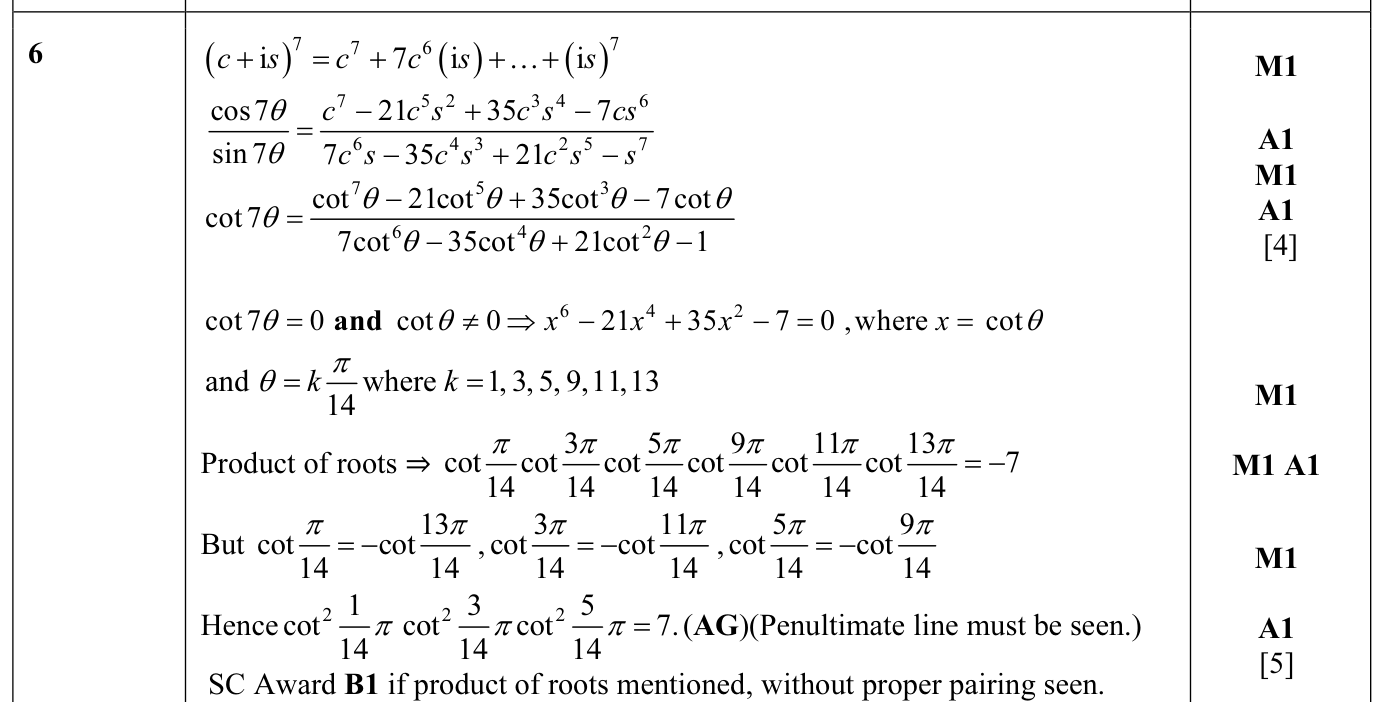
Use de Moivre's theorem to express \(\cot 7 \theta\) in terms of \(\cot \theta\).
Use the equation \(\cot 7 \theta=0\) to show that the roots of the equation
\(x^{6}-21 x^{4}+35 x^{2}-7=0\)
are \(\cot \left(\frac{1}{14} k \pi\right)\) for \(k=1,3,5,9,11,13\), and deduce that
\(\cot ^{2}\left(\frac{1}{14} \pi\right) \cot ^{2}\left(\frac{3}{14} \pi\right) \cot ^{2}\left(\frac{5}{14} \pi\right)=7\)
9231 P11 - Jun 2013 - Q7 - 10 marks
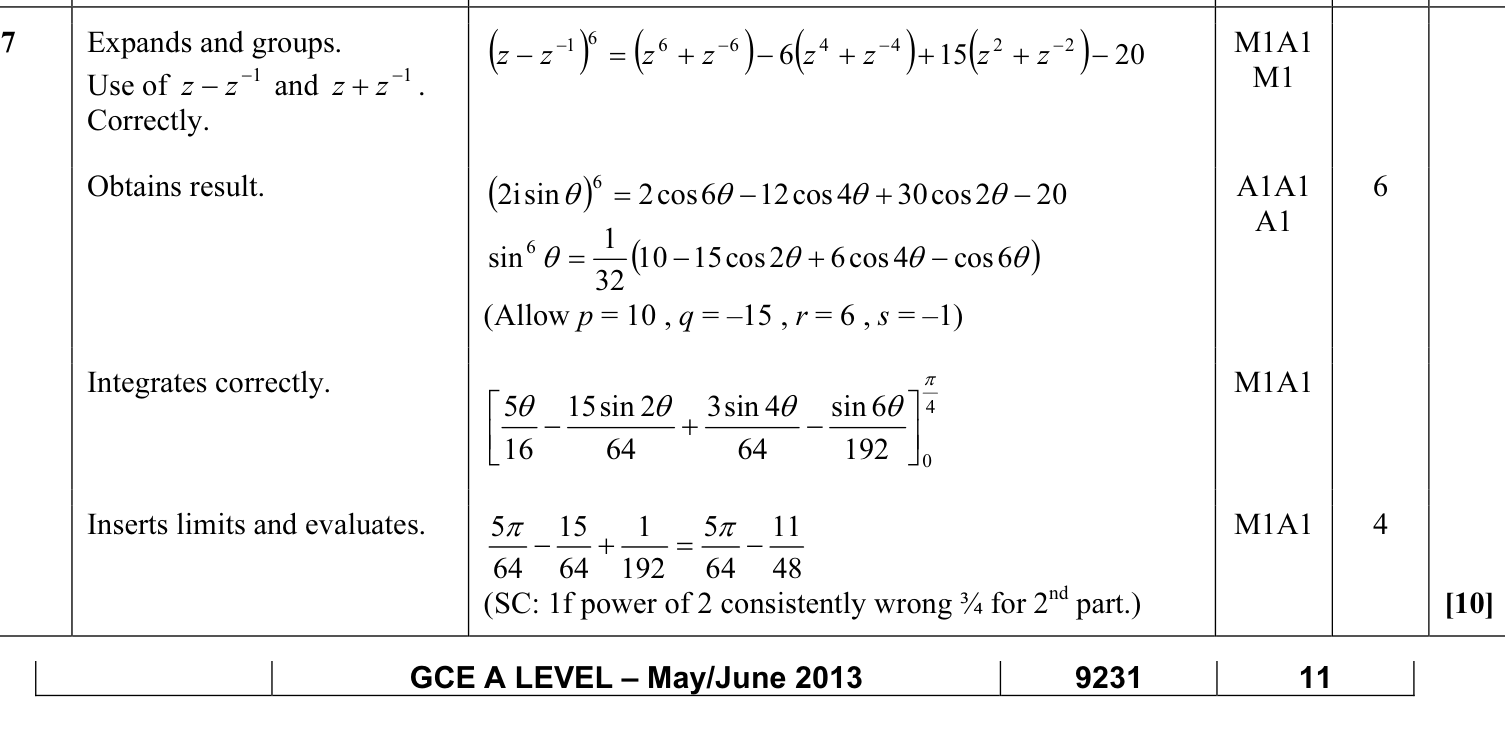
By considering the binomial expansion of \(\left(z-\frac{1}{z}\right)^{6}\), where \(z=\cos \theta+\mathrm{i} \sin \theta\), express \(\sin ^{6} \theta\) in the form
\(\frac{1}{32}(p+q \cos 2 \theta+r \cos 4 \theta+s \cos 6 \theta),\)
where \(p, q, r\) and \(s\) are integers to be determined.
Hence find the exact value of \(\int_{0}^{\frac{1}{4} \pi} \sin ^{6} \theta \mathrm{~d} \theta\).
9231 P13 - Jun 2013 - Q11 - 28 marks
Answer only one of the following two alternatives.
EITHER
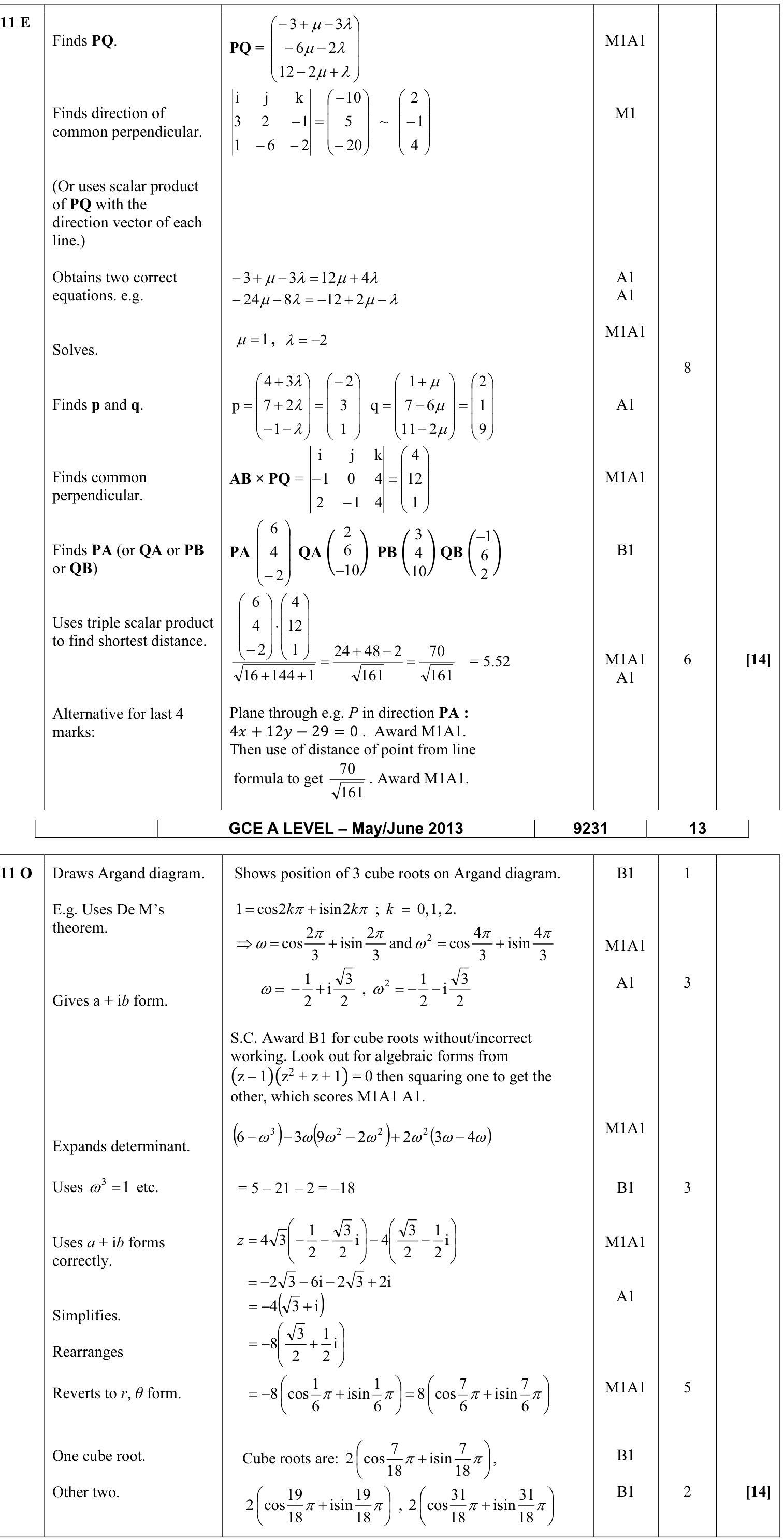
The line \(l_{1}\) passes through the point \(A\) whose position vector is \(4 \mathbf{i}+7 \mathbf{j}-\mathbf{k}\) and is parallel to the vector \(3 \mathbf{i}+2 \mathbf{j}-\mathbf{k}\). The line \(l_{2}\) passes through the point \(B\) whose position vector is \(\mathbf{i}+7 \mathbf{j}+11 \mathbf{k}\) and is parallel to the vector \(\mathbf{i}-6 \mathbf{j}-2 \mathbf{k}\). The points \(P\) on \(l_{1}\) and \(Q\) on \(l_{2}\) are such that \(P Q\) is perpendicular to both \(l_{1}\) and \(l_{2}\). Find the position vectors of \(P\) and \(Q\).
Find the shortest distance between the line through \(A\) and \(B\) and the line through \(P\) and \(Q\), giving your answer correct to 3 significant figures.
OR
Show the cube roots of 1 on an Argand diagram.
Show that the two non-real cube roots can be expressed in the form \(\omega\) and \(\omega^{2}\), and find these cube roots in exact cartesian form \(x+\mathrm{i} y\).
Evaluate the determinant
\(\left|\begin{array}{ccc} 1 & 3 \omega & 2 \omega^{2} \\ 3 \omega^{2} & 2 & \omega \\ 2 \omega & \omega^{2} & 3 \end{array}\right| .\)
It is given that \(z=(4\sqrt{3})\left(\cos \frac{4}{3} \pi+i \sin \frac{4}{3} \pi\right)-4\left(\cos \frac{11}{6} \pi+i \sin \frac{11}{6} \pi\right)\). Express \(z\) in the form \(r(\cos \theta+\mathrm{i} \sin \theta)\), giving exact values for \(r\) and \(\theta\).
Hence find the cube roots of \(z\) in the form \(r(\cos \theta+\mathrm{i} \sin \theta)\).
9231 P1 - Jun 2008 - Q12 - 28 marks
Answer only one of the following two alternatives.
EITHER
The position vectors of the points \(A, B, C, D\) are
\(7 \mathbf{i}+4 \mathbf{j}-\mathbf{k}, \quad 3 \mathbf{i}+5 \mathbf{j}-2 \mathbf{k}, \quad 2 \mathbf{i}+6 \mathbf{j}+3 \mathbf{k}, \quad 2 \mathbf{i}+7 \mathbf{j}+\lambda \mathbf{k}\)
respectively. It is given that the shortest distance between the line \(A B\) and the line \(C D\) is 3 .
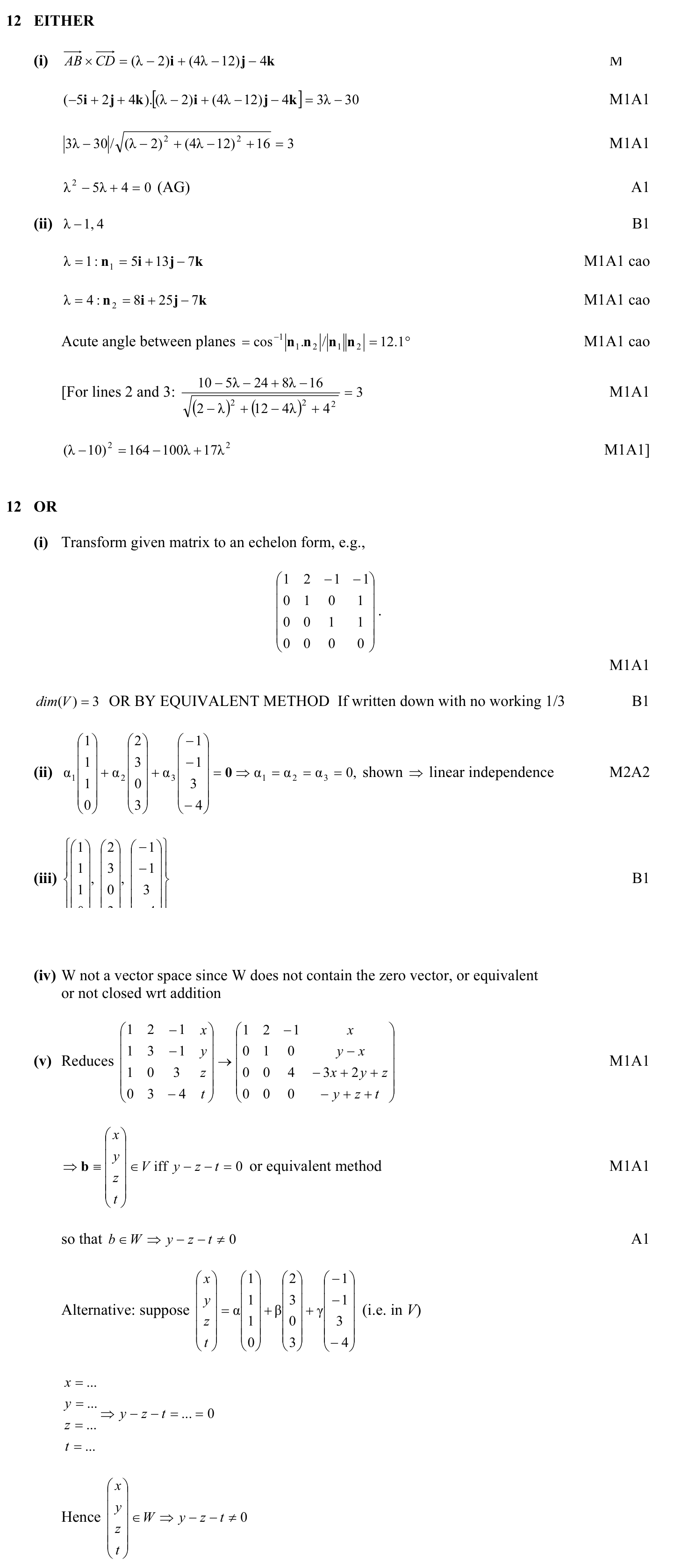
(i) Show that \(\lambda^{2}-5 \lambda+4=0\).
(ii) Find the acute angle between the planes through \(A, B, D\) corresponding to the values of \(\lambda\) satisfying the equation in part (i).
OR
The linear transformation \(\mathrm{T}: \mathbb{R}^{4} \rightarrow \mathbb{R}^{4}\) is represented by the matrix
\(\left(\begin{array}{rrrr} 1 & 2 & -1 & -1 \\ 1 & 3 & -1 & 0 \\ 1 & 0 & 3 & 1 \\ 0 & 3 & -4 & -1 \end{array}\right) .\)
The range space of T is denoted by \(V\).
(i) Determine the dimension of \(V\).
(ii) Show that the vectors \(\left(\begin{array}{l}1 \\ 1 \\ 1 \\ 0\end{array}\right),\left(\begin{array}{l}2 \\ 3 \\ 0 \\ 3\end{array}\right),\left(\begin{array}{r}-1 \\ -1 \\ 3 \\ -4\end{array}\right)\) are linearly independent.
(iii) Write down a basis of \(V\).
The set of elements of \(\mathbb{R}^{4}\) which do not belong to \(V\) is denoted by \(W\).
(iv) State, with a reason, whether \(W\) is a vector space.
(v) Show that if the vector \(\left(\begin{array}{l}x \\ y \\ z \\ t\end{array}\right)\) belongs to \(W\) then \(y-z-t \neq 0\).
9231 P1 - Nov 2008 - Q10 - 10 marks
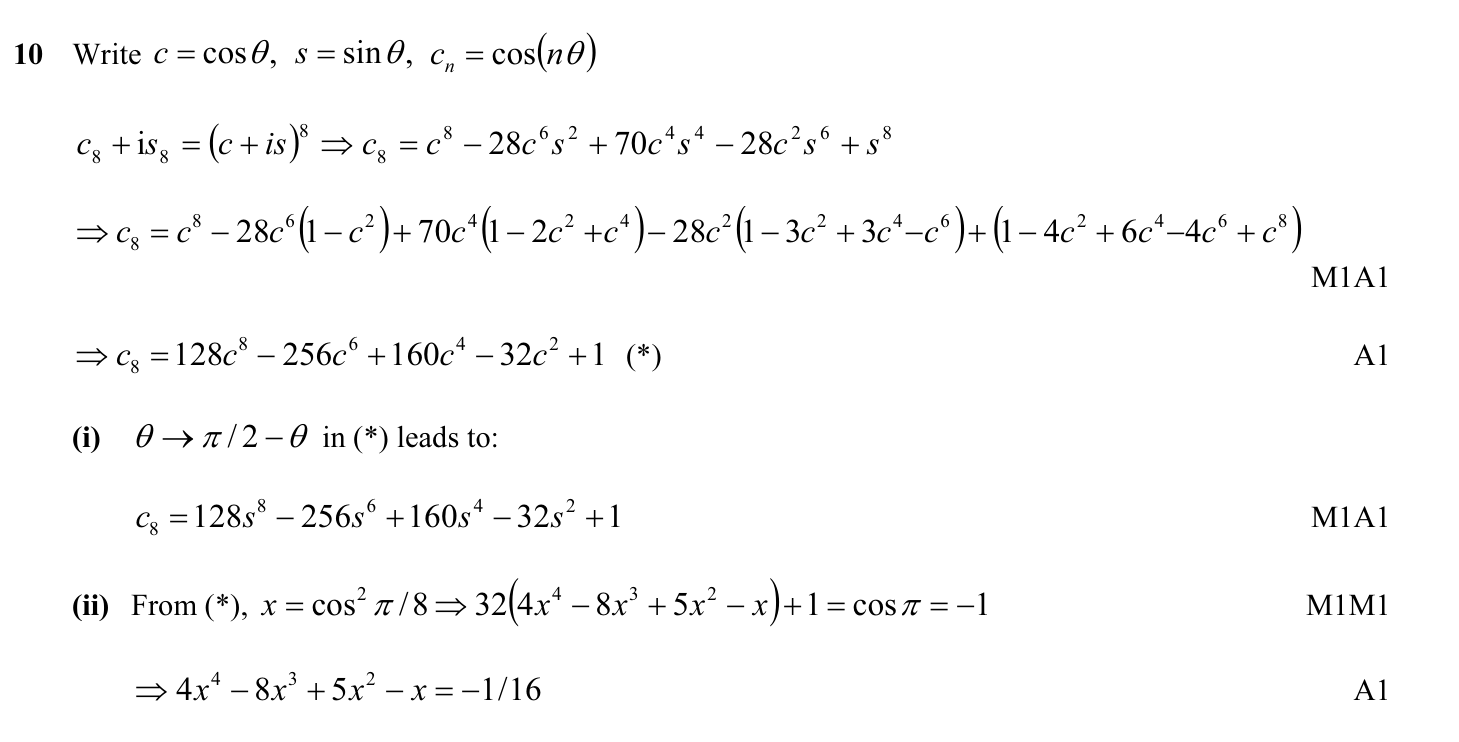
Use de Moivre's theorem to express \(\cos 8 \theta\) as a polynomial in \(\cos \theta\).
Hence
(i) express \(\cos 8 \theta\) as a polynomial in \(\sin \theta\),
(ii) find the exact value of
\(4 x^{4}-8 x^{3}+5 x^{2}-x\)
where \(x=\cos ^{2}\left(\frac{1}{8} \pi\right)\).
9231 P11 - Jun 2011 - Q11 - 28 marks
Answer only one of the following two alternatives.
EITHER
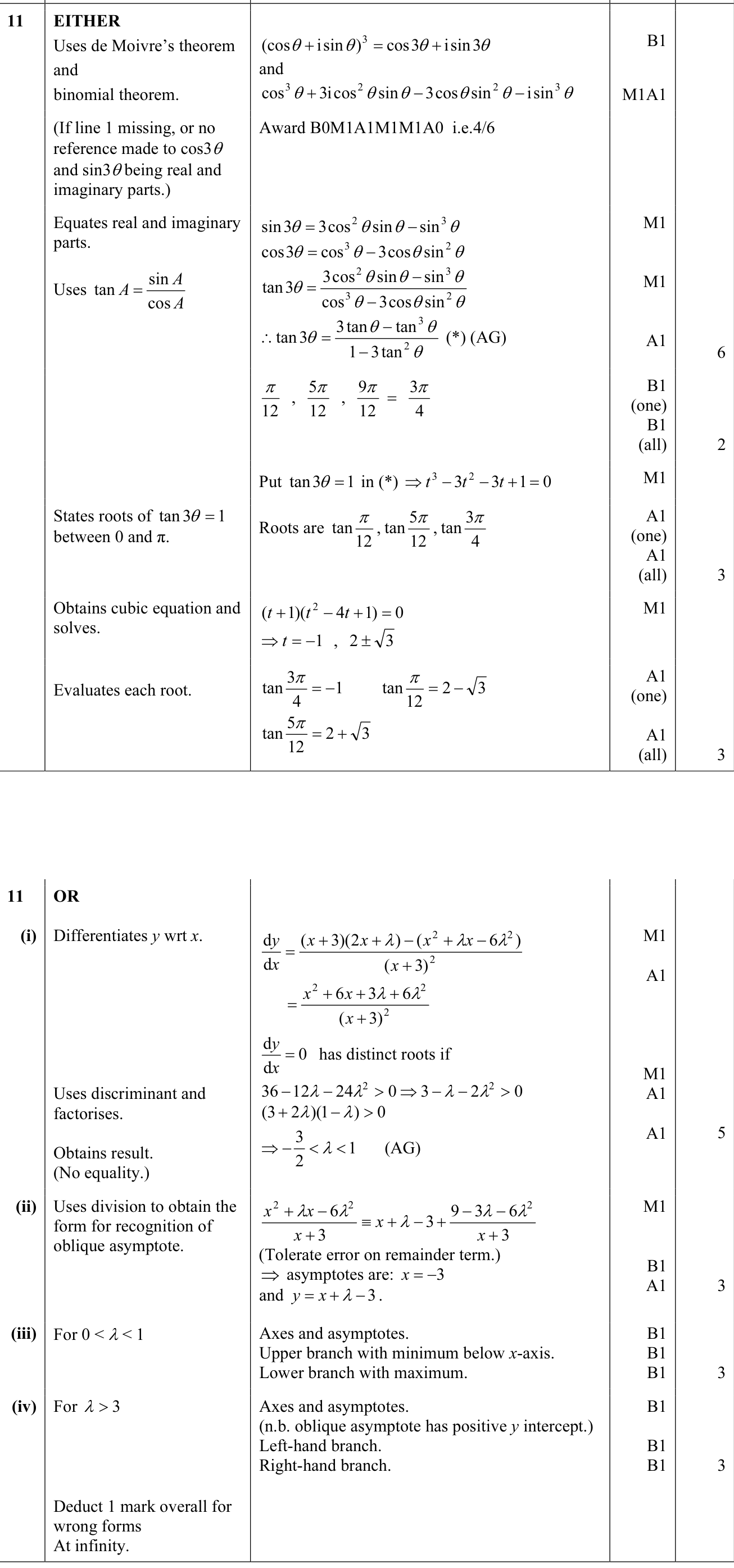
Use de Moivre's theorem to prove that
\(\tan 3 \theta=\frac{3 \tan \theta-\tan ^{3} \theta}{1-3 \tan ^{2} \theta} .\)
State the exact values of \(\theta\), between 0 and \(\pi\), that satisfy \(\tan 3 \theta=1\).
Express each root of the equation \(t^{3}-3 t^{2}-3 t+1=0\) in the form \(\tan (k \pi)\), where \(k\) is a positive rational number.
For each of these values of \(k\), find the exact value of \(\tan (k \pi)\).
OR
The curve \(C\) has equation
\(y=\frac{x^{2}+\lambda x-6 \lambda^{2}}{x+3},\)
where \(\lambda\) is a constant such that \(\lambda \neq 1\) and \(\lambda \neq-\frac{3}{2}\).
(i) Find \(\frac{\mathrm{d} y}{\mathrm{~d} x}\) and deduce that if \(C\) has two stationary points then \(-\frac{3}{2}\lt \lambda\lt 1\).
(ii) Find the equations of the asymptotes of \(C\).
(iii) Draw a sketch of \(C\) for the case \(0\lt \lambda\lt 1\).
(iv) Draw a sketch of \(C\) for the case \(\lambda\gt 3\).
9231 P13 - Jun 2012 - Q7 - 10 marks
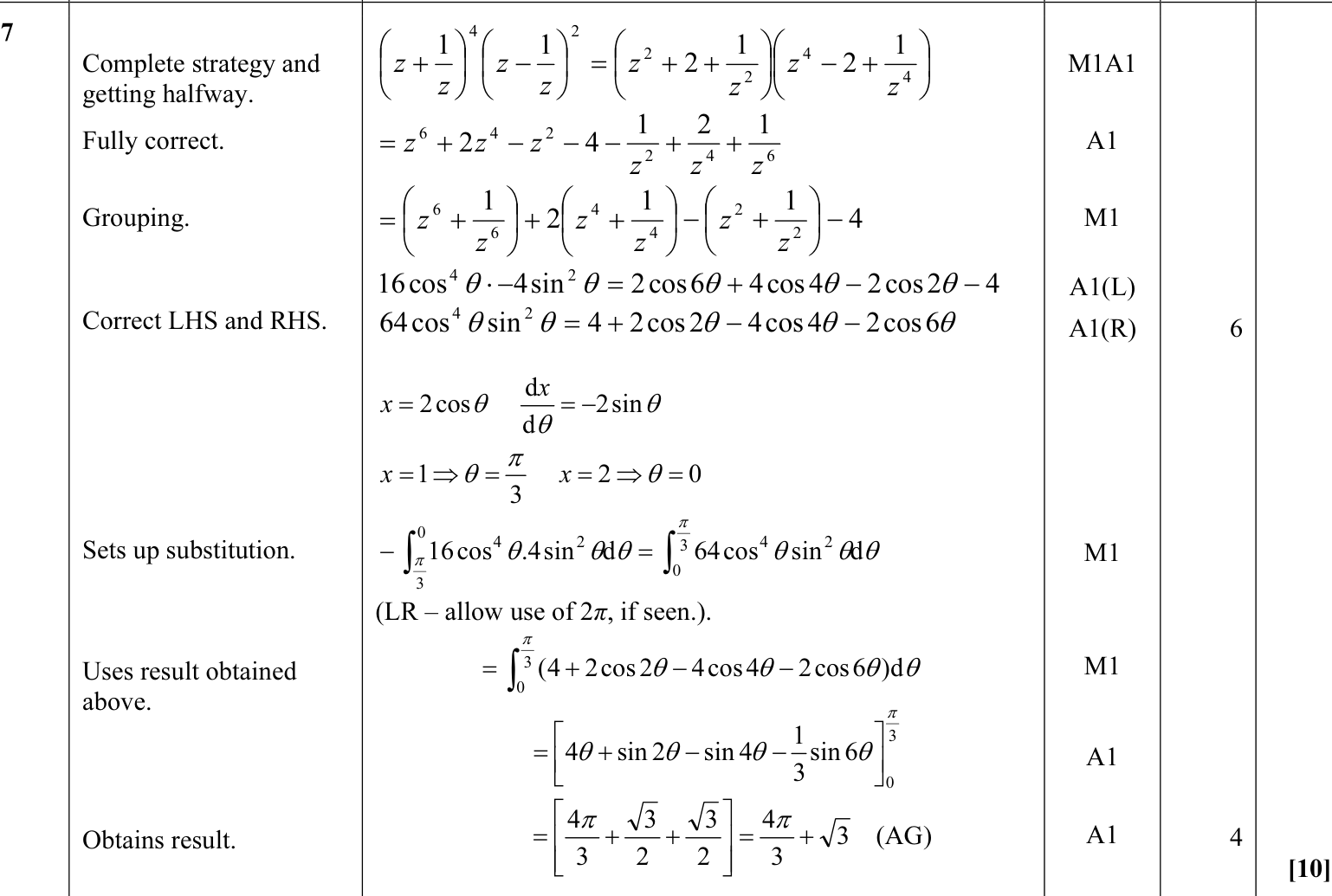
Expand \(\left(z+\frac{1}{z}\right)^{4}\left(z-\frac{1}{z}\right)^{2}\) and, by substituting \(z=\cos \theta+\mathrm{i} \sin \theta\), find integers \(p, q, r, s\) such that
\(64 \sin ^{2} \theta \cos ^{4} \theta=p+q \cos 2 \theta+r \cos 4 \theta+s \cos 6 \theta\)
Using the substitution \(x=2 \cos \theta\), show that
\(\int_{1}^{2} x^{4} \sqrt{ }\left(4-x^{2}\right) \mathrm{d} x=\frac{4}{3} \pi+\sqrt{ } 3\)
9231 P13 - Jun 2012 - Q10 - 11 marks
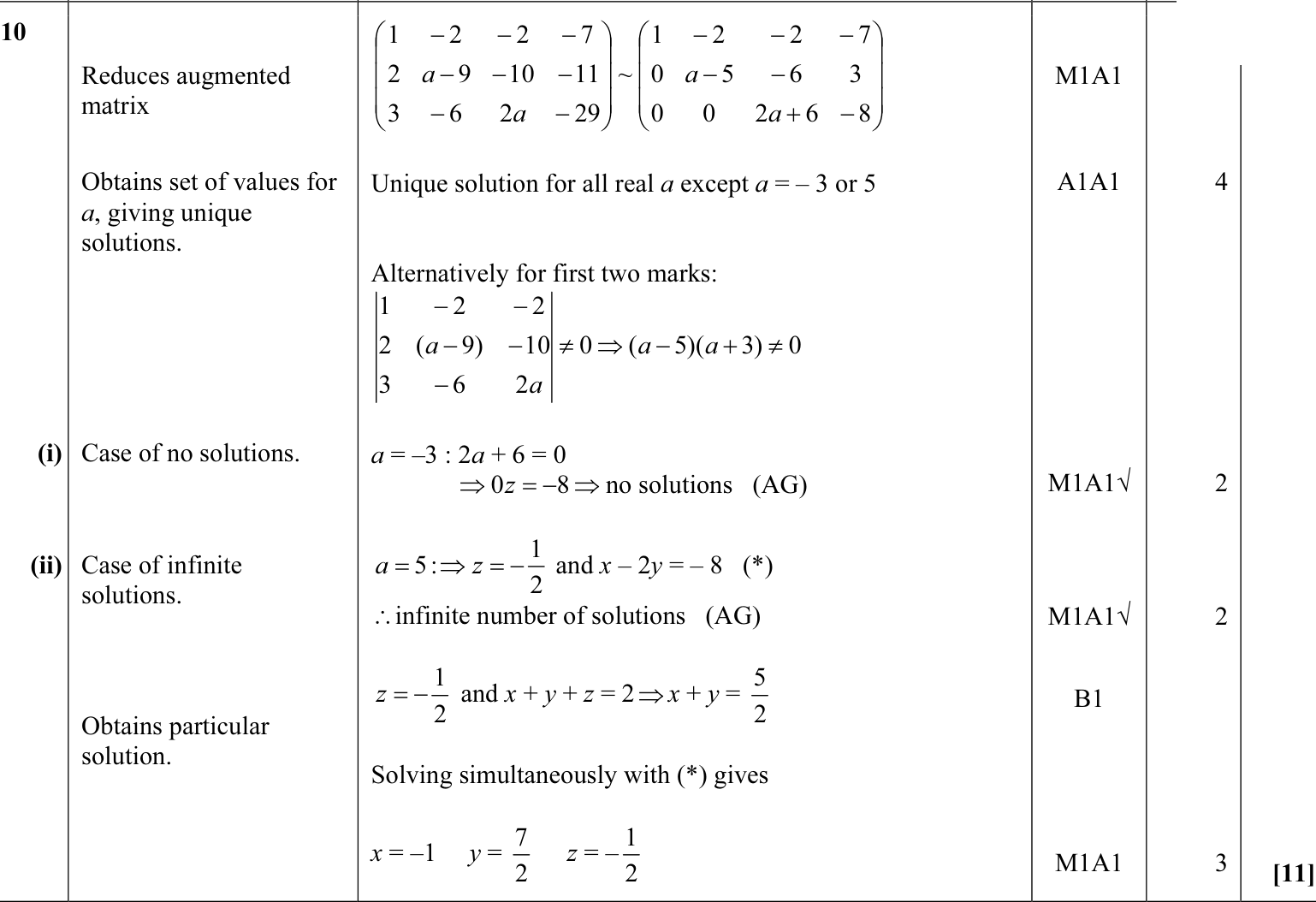
Find the set of values of \(a\) for which the system of equations
\(\begin{aligned} x-2 y-2 z & =-7 \\ 2 x+(a-9) y-10 z & =-11 \\ 3 x-6 y+2 a z & =-29 \end{aligned}\)
has a unique solution.
Show that the system has no solution in the case \(a=-3\).
Given that \(a=5\),
(i) show that the number of solutions is infinite,
(ii) find the solution for which \(x+y+z=2\).
9231 P12 - Jun 2014 - Q7 - 9 marks
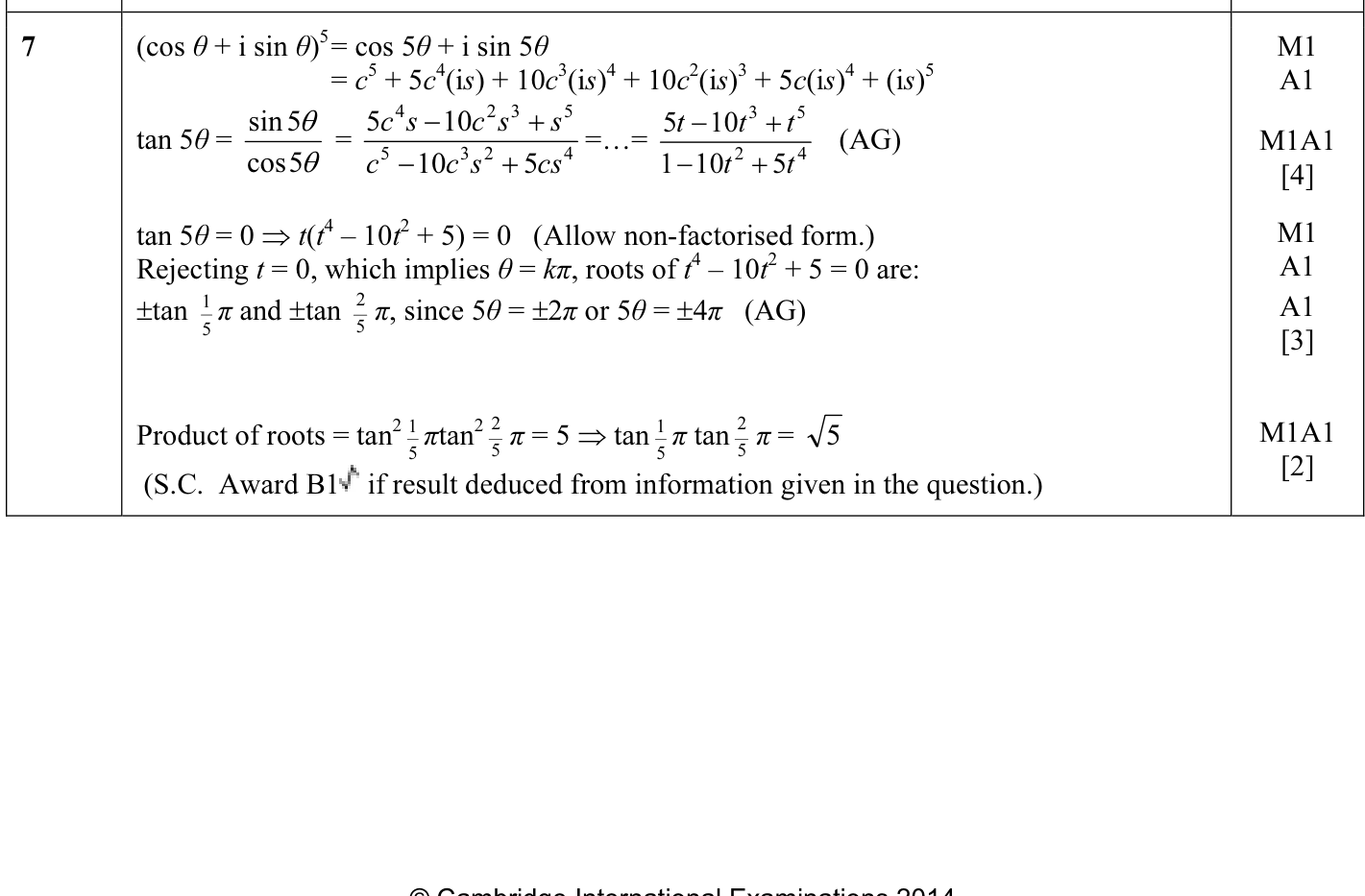
Use de Moivre's theorem to show that
\(\tan 5 \theta=\frac{5 t-10 t^{3}+t^{5}}{1-10 t^{2}+5 t^{4}}\)
where \(t=\tan \theta\).
Deduce that the roots of the equation \(t^{4}-10 t^{2}+5=0\) are \(\pm \tan \frac{1}{5} \pi\) and \(\pm \tan \frac{2}{5} \pi\).
Hence show that \(\tan \frac{1}{5} \pi \tan \frac{2}{5} \pi=\sqrt{ } 5\).
9231 P13 - Nov 2012 - Q2 - 4 marks
Find the set of values of \(a\) for which the system of equations
\(\begin{aligned} a x+y+2 z & =0 \\ 3 x-2 y & =4 \\ 3 x-4 y-6 a z & =14 \end{aligned}\)
has a unique solution.

9231 P11 - Jun 2010 - Q10 - 11 marks
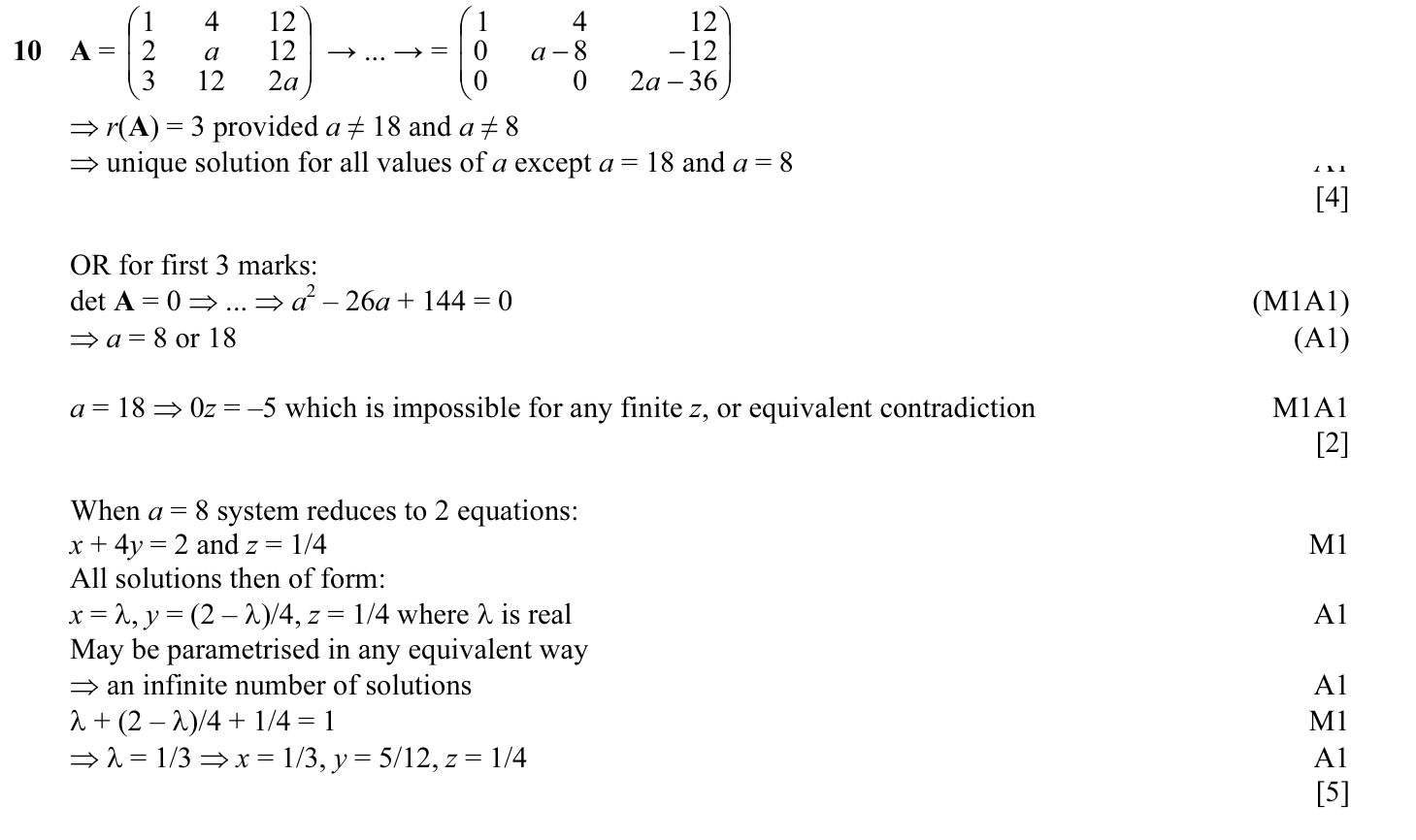
Find the set of values of \(a\) for which the system of equations
\(\begin{aligned} x+4 y+12 z & =5 \\ 2 x+a y+12 z & =a-1, \\ 3 x+12 y+2 a z & =10, \end{aligned}\)
has a unique solution.
Show that the system does not have any solution in the case \(a=18\).
Given that \(a=8\), show that the number of solutions is infinite and find the solution for which \(x+y+z=1\).
9231 P13 - Nov 2011 - Q5 - 7 marks
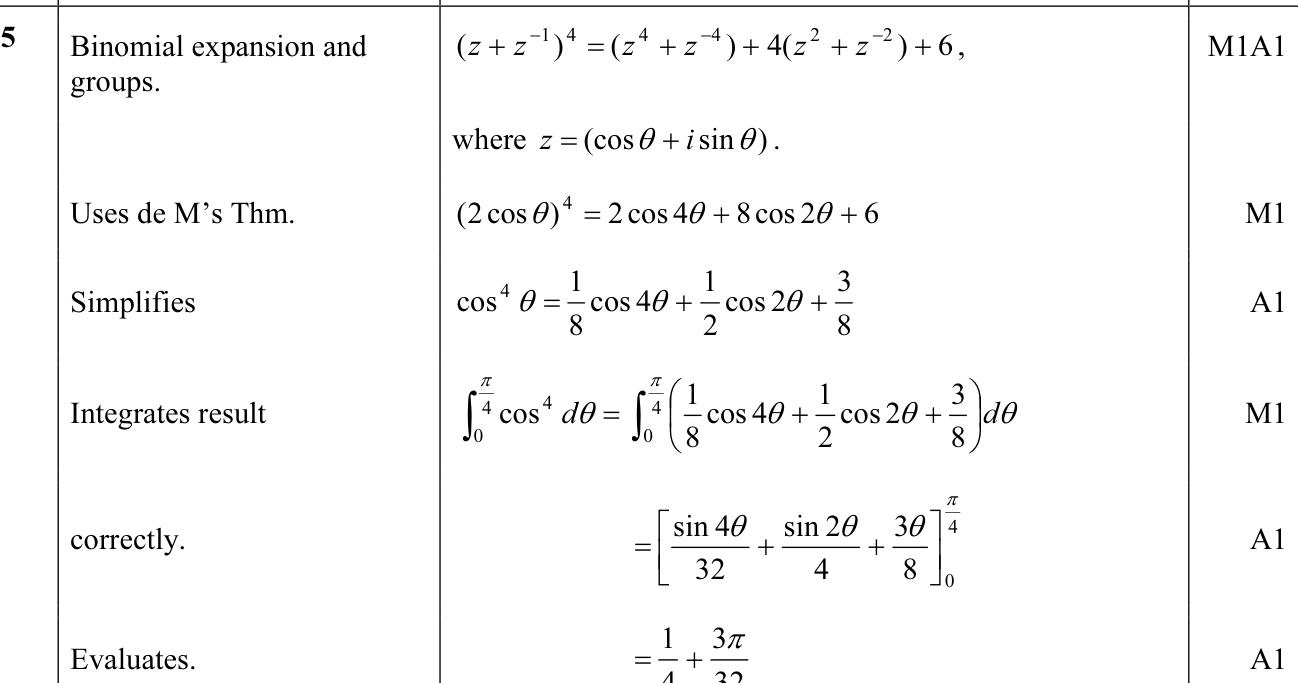
Use de Moivre's theorem to express \(\cos ^{4} \theta\) in the form
\(a \cos 4 \theta+b \cos 2 \theta+c\)
where \(a, b, c\) are constants to be found.
Hence evaluate
\(\int_{0}^{\frac{1}{4} \pi} \cos ^{4} \theta \mathrm{~d} \theta\)
leaving your answer in terms of \(\pi\).
9231 P1 - Nov 2009 - Q7 - 9 marks
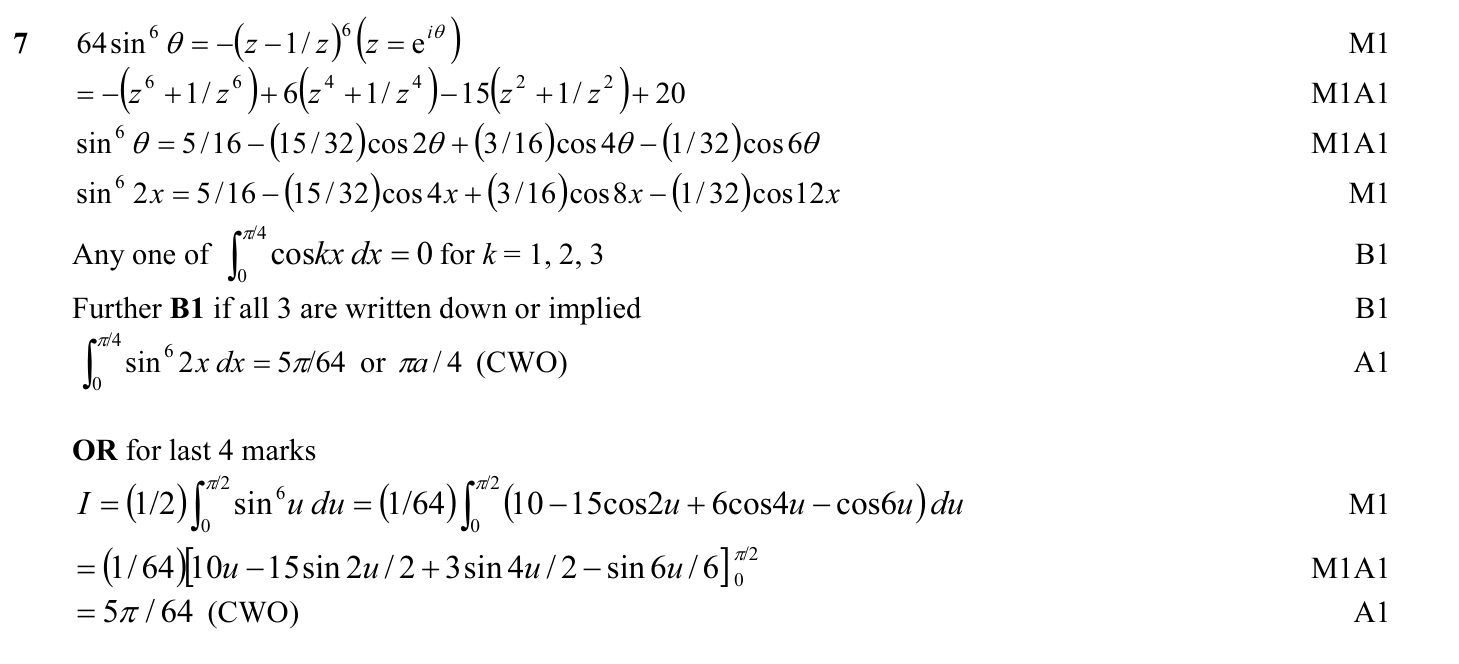
Use de Moivre's theorem to express \(\sin ^{6} \theta\) in the form
\(a+b \cos 2 \theta+c \cos 4 \theta+d \cos 6 \theta,\)
where \(a, b, c, d\) are constants to be found.
Hence evaluate
\(\int_{0}^{\frac{1}{4} \pi} \sin ^{6} 2 x \mathrm{~d} x\)
leaving your answer in terms of \(\pi\).
9231 P11 - Nov 2019 - Q9 - 11 marks
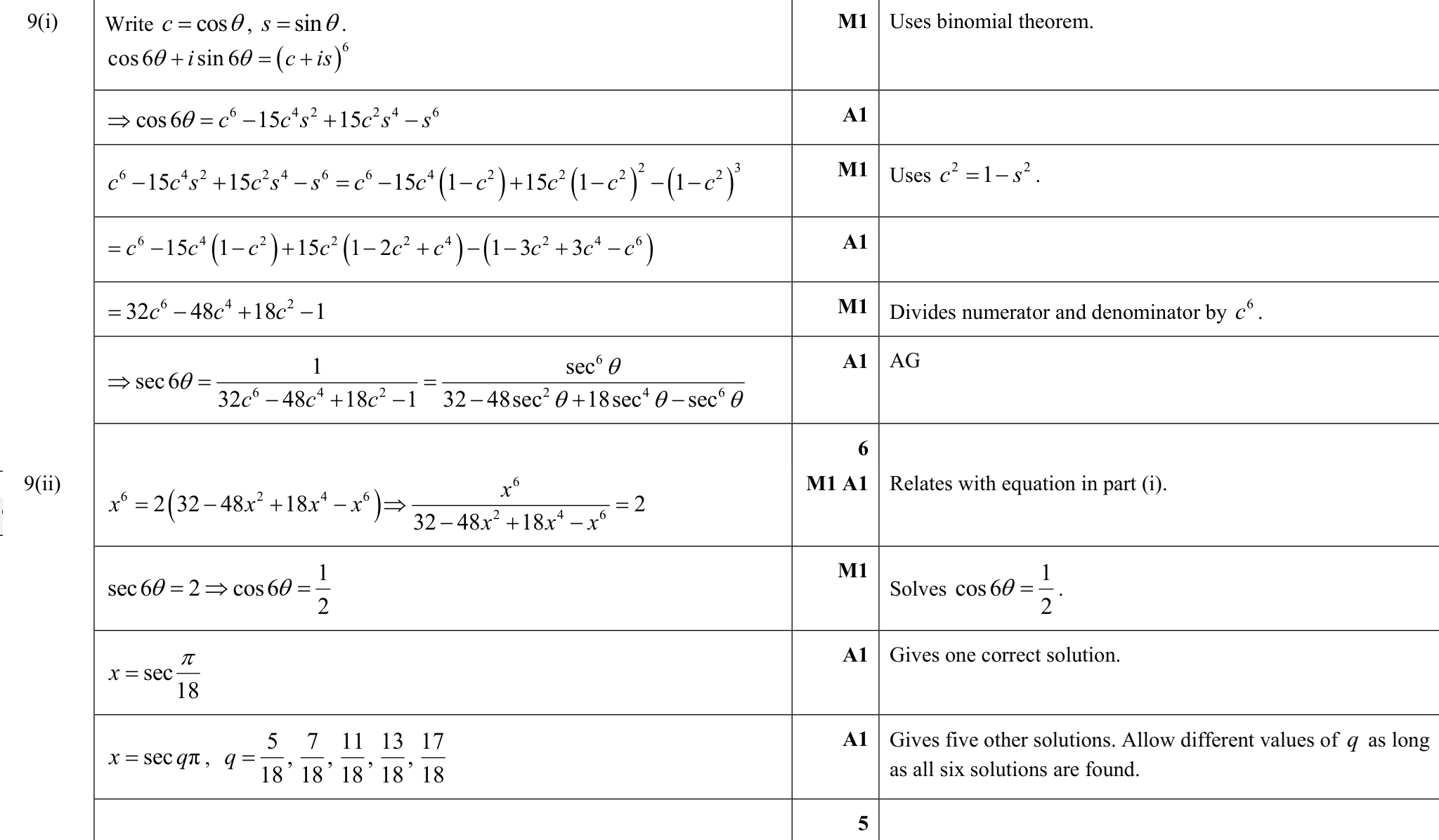
(i) Use de Moivre's theorem to show that
\(\sec 6 \theta=\frac{\sec ^{6} \theta}{32-48 \sec ^{2} \theta+18 \sec ^{4} \theta-\sec ^{6} \theta}\)
(ii) Hence obtain the roots of the equation
\(3 x^{6}-36 x^{4}+96 x^{2}-64=0\)
in the form sec \(q \pi\), where \(q\) is rational.
9231 P13 - Jun 2018 - Q3 - 8 marks
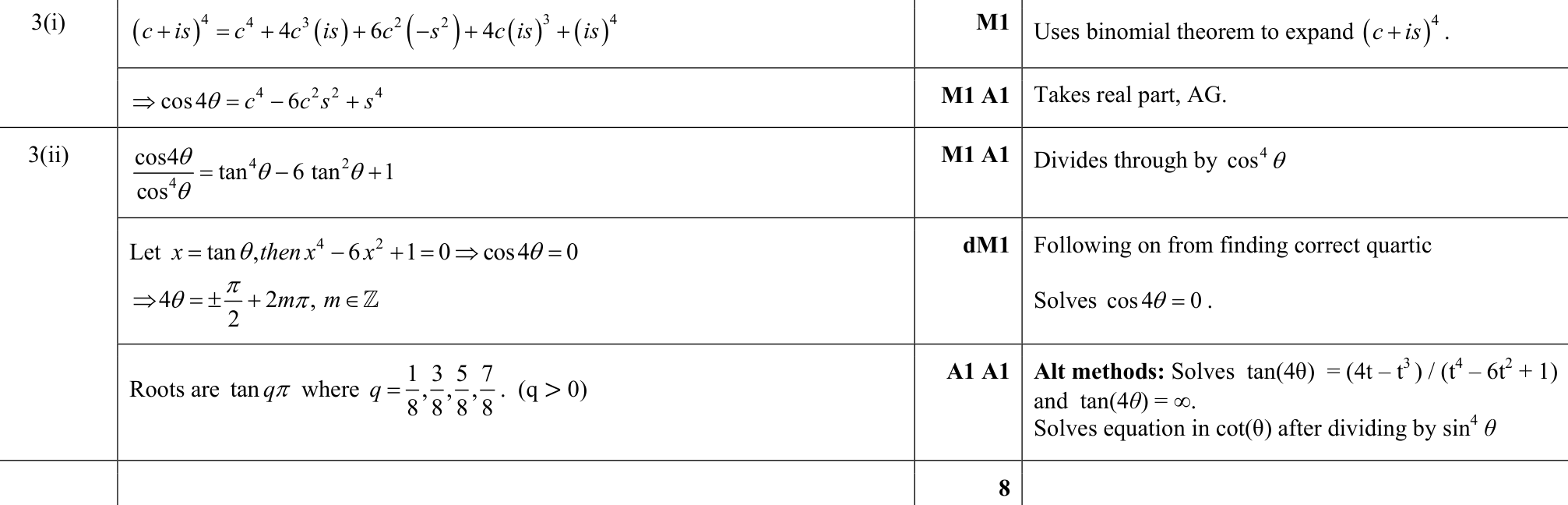
(i) Use de Moivre's theorem to show that
\(\cos 4 \theta=\cos ^{4} \theta-6 \cos ^{2} \theta \sin ^{2} \theta+\sin ^{4} \theta\)
(ii) Hence find all the roots of the equation
\(x^{4}-6 x^{2}+1=0\)
in the form \(\tan q \pi\), where \(q\) is a positive rational number.
9231 P11 - Nov 2018 - Q7 - 10 marks
(i) Use de Moivre's theorem to show that
\(\sin 8 \theta=8 \sin \theta \cos \theta\left(1-10 \sin ^{2} \theta+24 \sin ^{4} \theta-16 \sin ^{6} \theta\right)\).
moniainatian
(ii) Use the equation \(\frac{\sin 8 \theta}{\sin 2 \theta}=0\) to find the roots of
\(16 x^{6}-24 x^{4}+10 x^{2}-1=0\)
in the form \(\sin k \pi\), where \(k\) is rational.

9231 P21 - Jun 2025 - Q3 - 6 marks
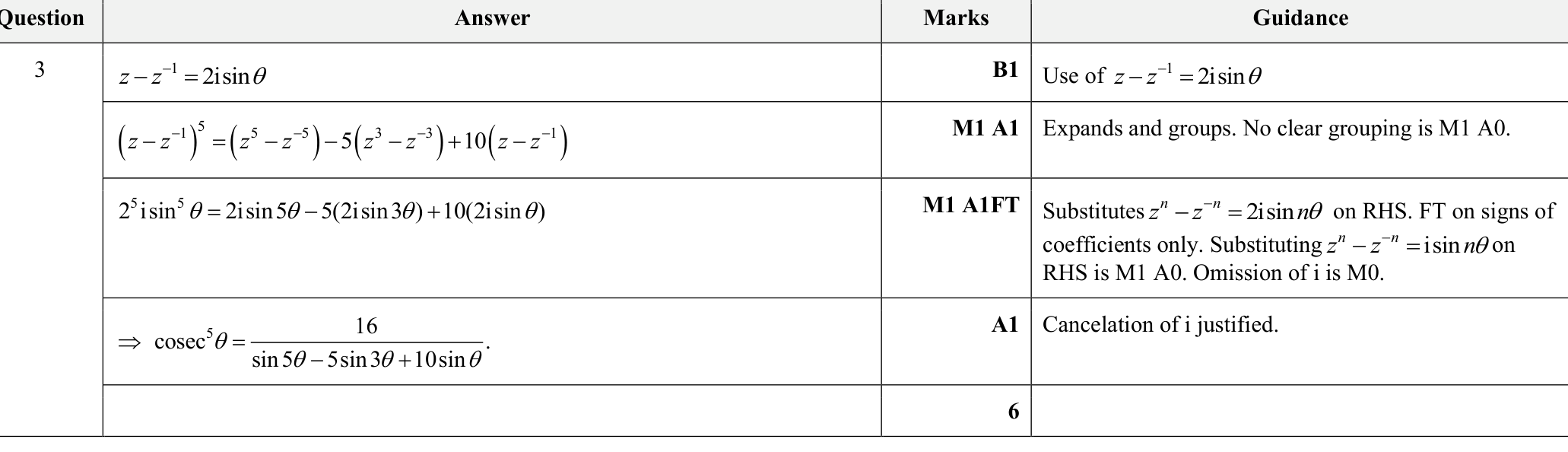
By considering the binomial expansion of \(\left(z-\frac{1}{z}\right)^{5}\), where \(z=\cos \theta+\mathrm{i} \sin \theta\), use de Moivre's theorem to show that
\(\operatorname{cosec}^{5} \theta=\frac{a}{\sin 5 \theta+b \sin 3 \theta+c \sin \theta},\)
where \(a, b\) and \(c\) are integers to be determined.