Past Exam Questions
← Back9231 P11 - Jun 2015 - Q8 - 11 marks
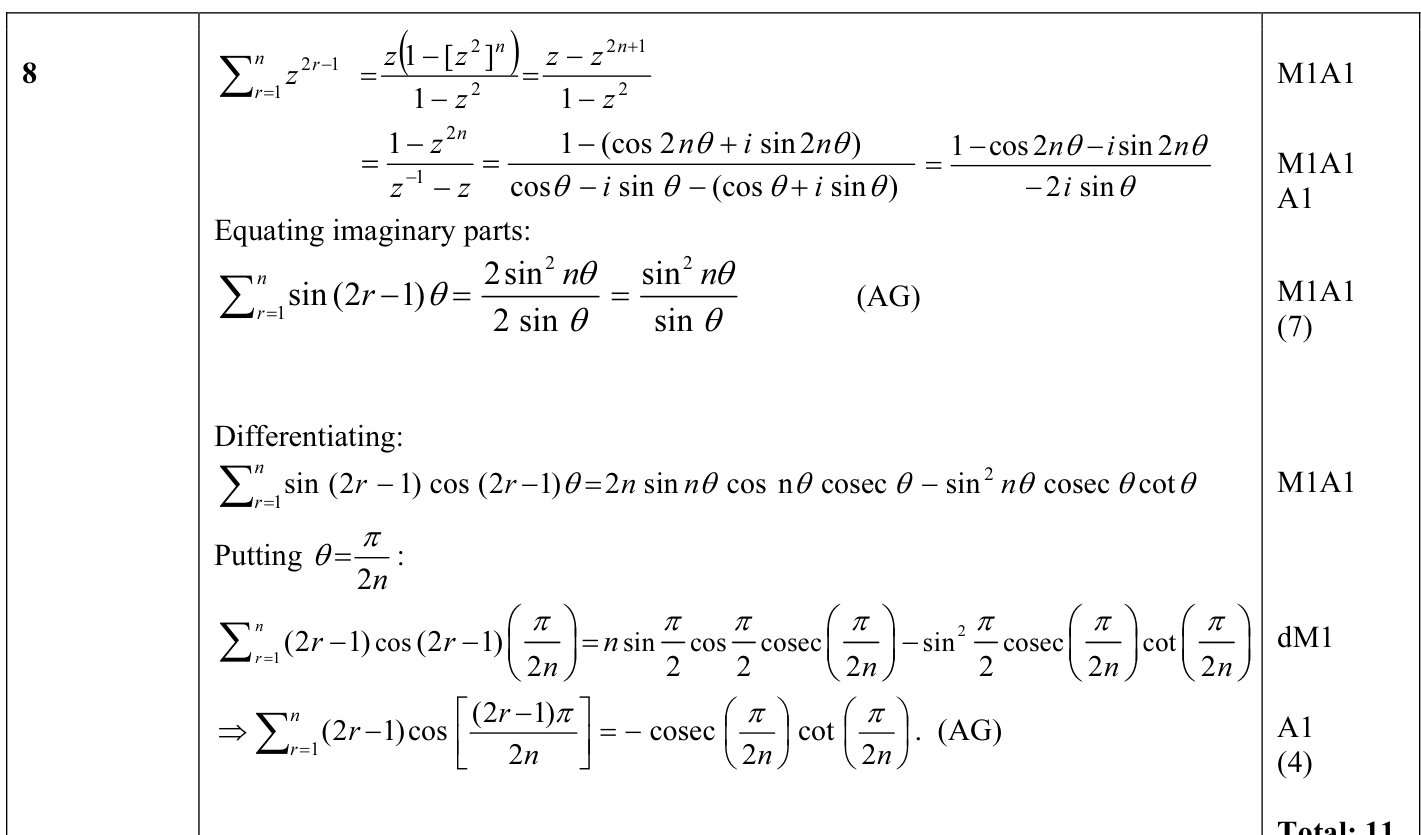
By considering \(\sum_{r=1}^{n} z^{2 r-1}\), where \(z=\cos \theta+\mathrm{i} \sin \theta\), show that, if \(\sin \theta \neq 0\),
\(\sum_{r=1}^{n} \sin (2 r-1) \theta=\frac{\sin ^{2} n \theta}{\sin \theta}\)
Deduce that
\(\sum_{r=1}^{n}(2 r-1) \cos \left[\frac{(2 r-1) \pi}{2 n}\right]=-\operatorname{cosec}\left(\frac{\pi}{2 n}\right) \cot \left(\frac{\pi}{2 n}\right)\)
9231 P1 - Jun 2008 - Q10 - 10 marks
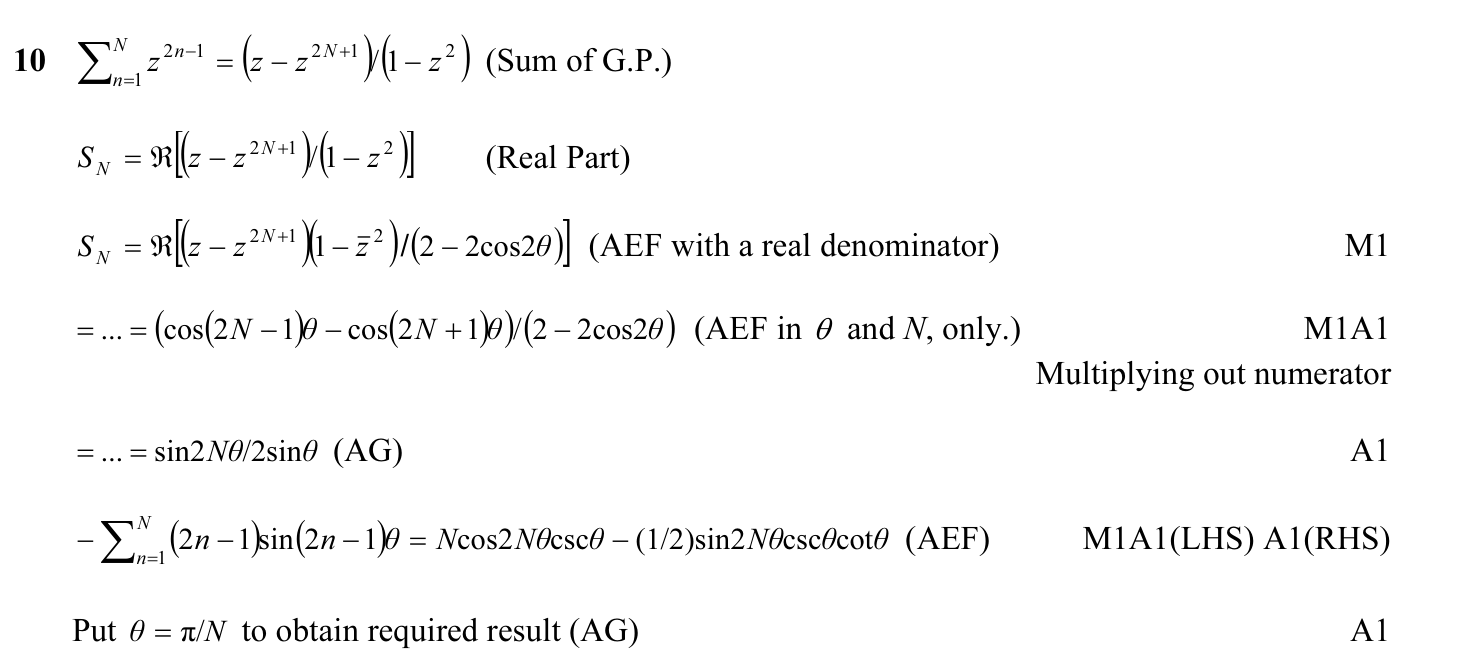
By considering \(\sum_{n=1}^{N} z^{2 n-1}\), where \(z=\mathrm{e}^{\mathrm{i} \theta}\), show that
\(\sum_{n=1}^{N} \cos (2 n-1) \theta=\frac{\sin (2 N \theta)}{2 \sin \theta},\)
where \(\sin \theta \neq 0\).
Deduce that
\(\sum_{n=1}^{N}(2 n-1) \sin \left[\frac{(2 n-1) \pi}{N}\right]=-N \operatorname{cosec} \frac{\pi}{N} .\)
9231 P13 - Nov 2012 - Q8 - 9 marks
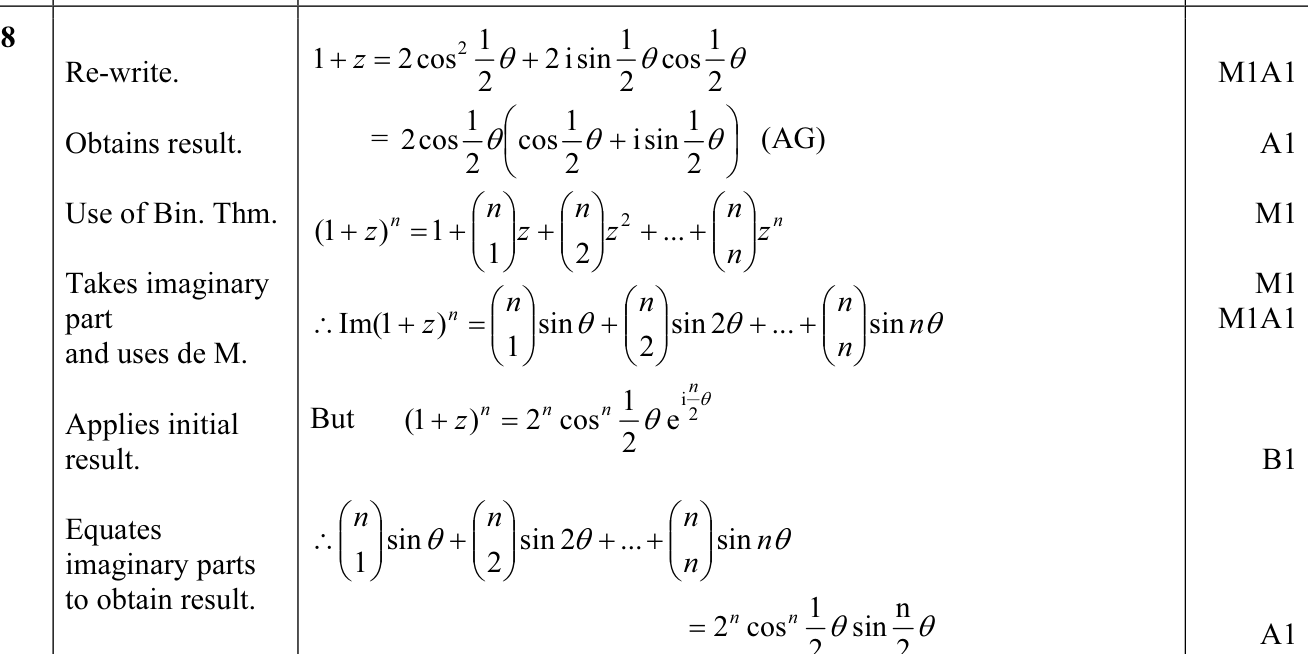
Let \(z=\cos \theta+\mathrm{i} \sin \theta\). Show that
\(1+z=2 \cos \frac{1}{2} \theta\left(\cos \frac{1}{2} \theta+i \sin \frac{1}{2} \theta\right)\)
By considering \((1+z)^{n}\), where \(n\) is a positive integer, deduce the sum of the series
\(\binom{n}{1} \sin \theta+\binom{n}{2} \sin 2 \theta+\ldots+\binom{n}{n} \sin n \theta\)
9231 P23 - Jun 2025 - Q7 - 9 marks
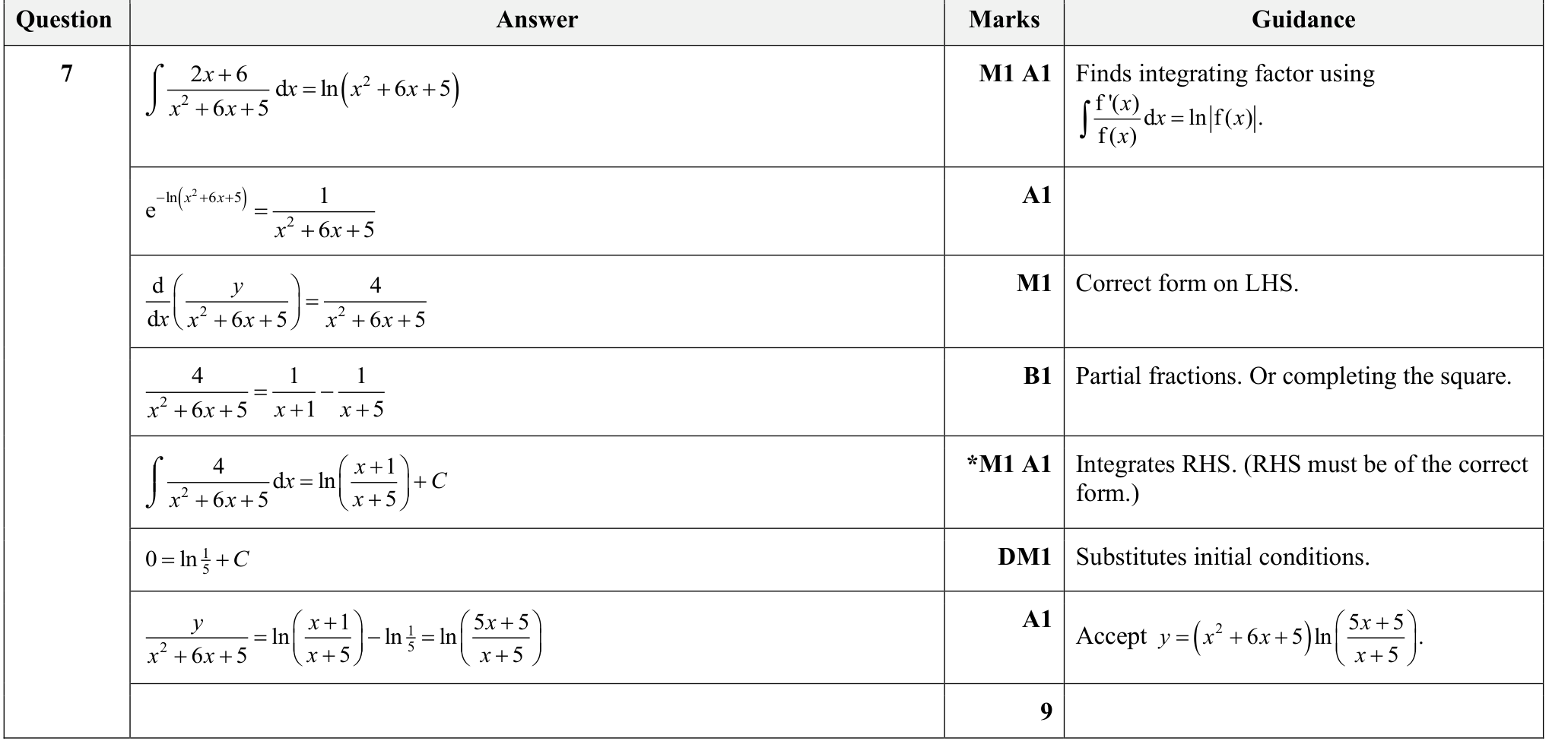
Find the solution of the differential equation
\(\frac{d y}{d x}-\frac{2 x+6}{x^{2}+6 x+5} y=4,\)
given that \(y=0\) when \(x=0\). Give your answer in an exact form.
9231 P21 - Jun 2025 - Q7 - 10 marks
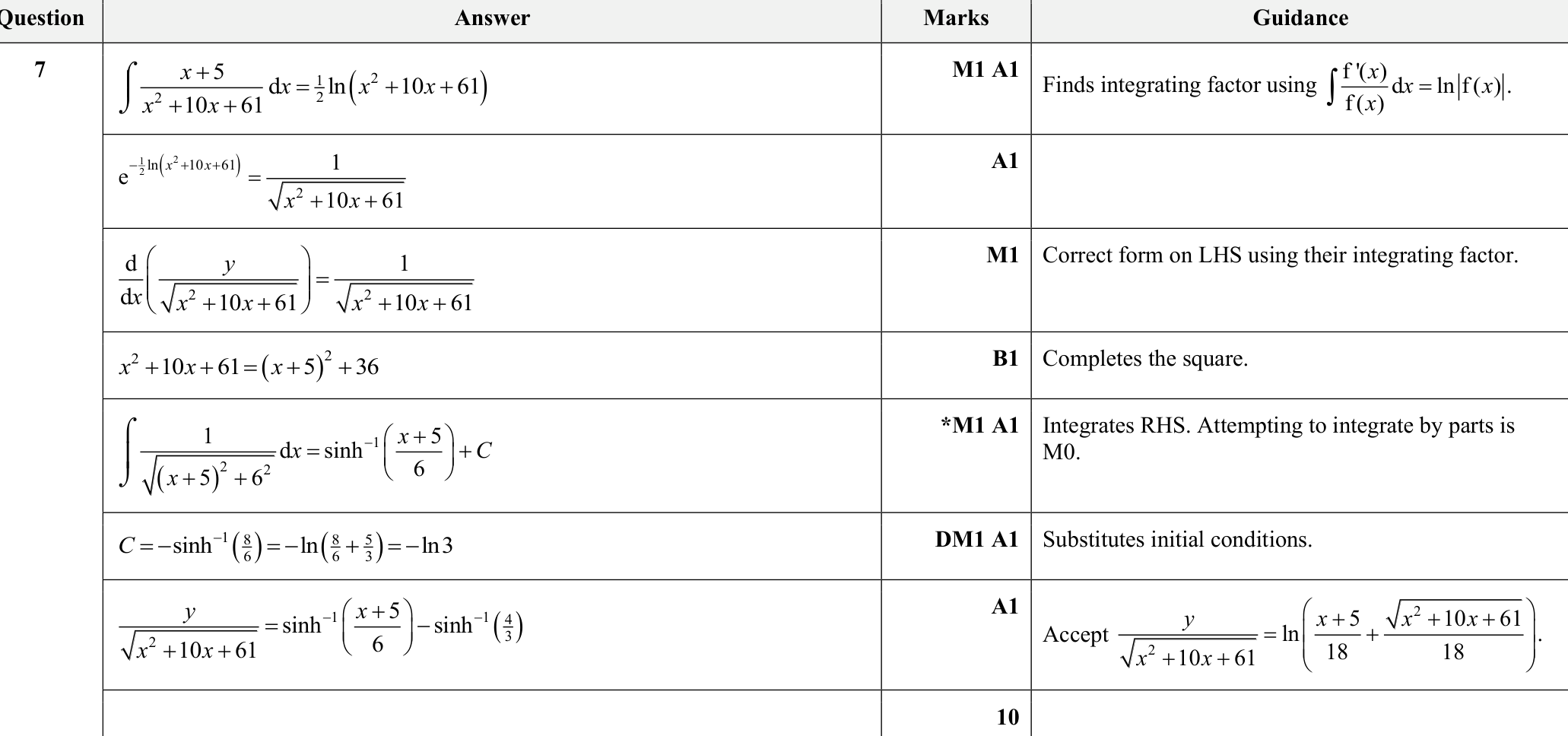
Find the solution of the differential equation
\(\frac{\mathrm{d} y}{\mathrm{~d} x}-\frac{x+5}{x^{2}+10 x+61} y=1,\)
given that \(y=0\) when \(x=3\). Give your answer in an exact form.
9231 P21 - Nov 2024 - Q7 - 10 marks
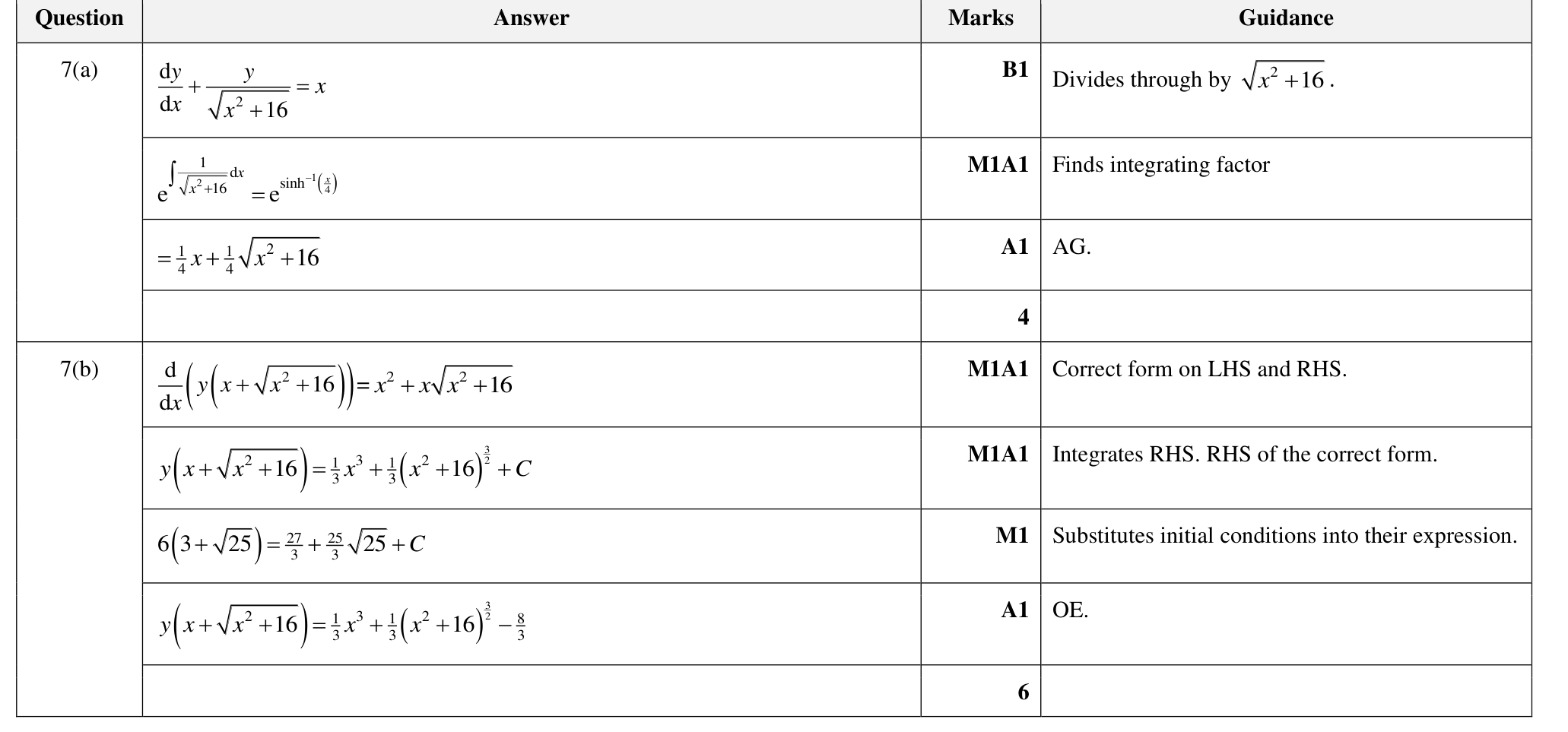
(a) Show that an appropriate integrating factor for
\(\sqrt{x^{2}+16} \frac{\mathrm{~d} y}{\mathrm{~d} x}+y=x \sqrt{x^{2}+16}\)
is \(\frac{1}{4} x+\frac{1}{4} \sqrt{x^{2}+16}\).
(b) Hence find the solution of the differential equation
\(\sqrt{x^{2}+16} \frac{\mathrm{~d} y}{\mathrm{~d} x}+y=x \sqrt{x^{2}+16}\)
for which \(y=6\) when \(x=3\).
9231 P22 - Nov 2023 - Q4 - 9 marks
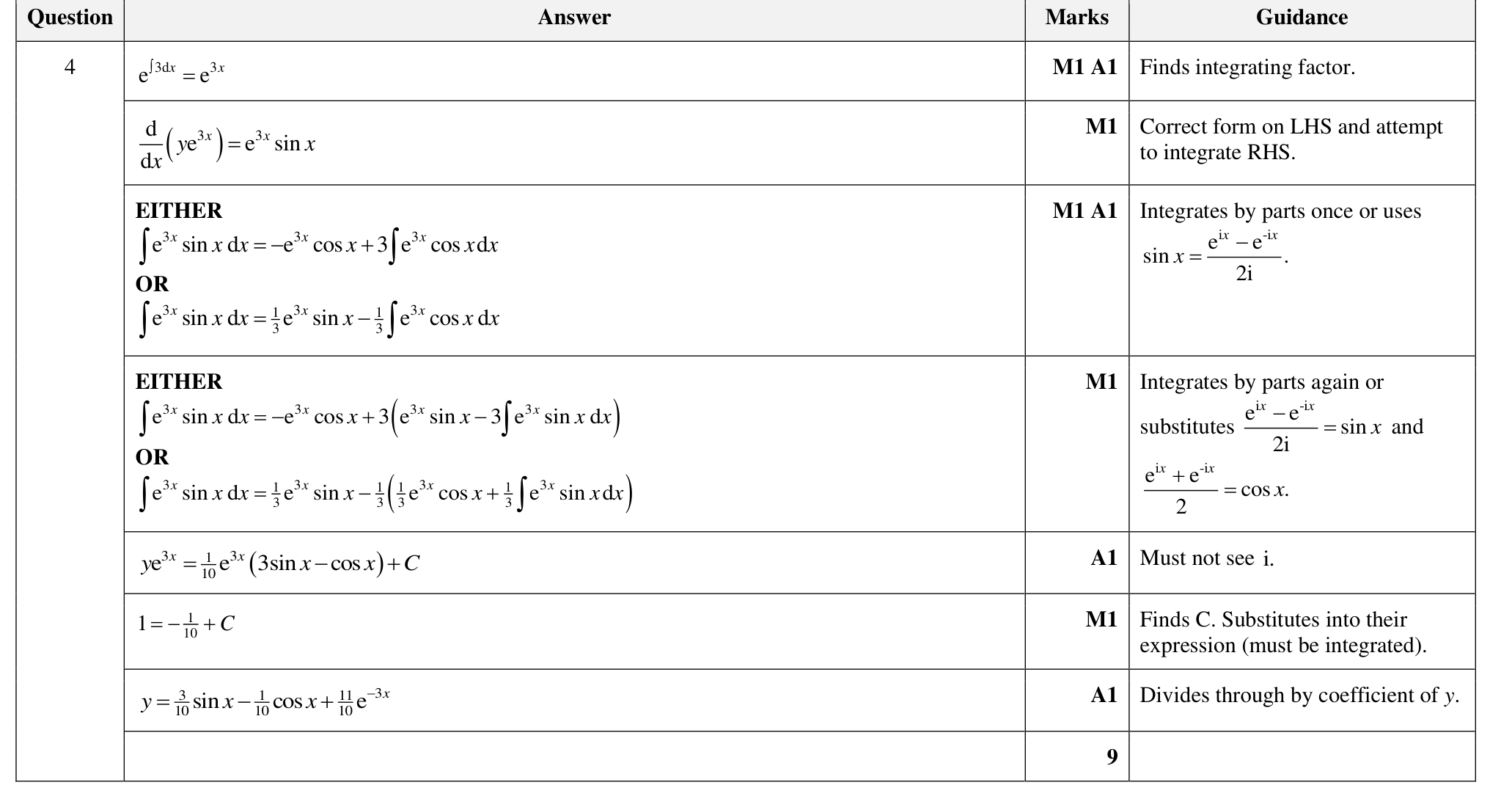
Find the solution of the differential equation
\(\frac{\mathrm{d} y}{\mathrm{~d} x}+3 y=\sin x\)
for which \(y=1\) when \(x=0\). Give your answer in the form \(y=\mathrm{f}(x)\).
9231 P23 - Jun 2022 - Q5 - 9 marks
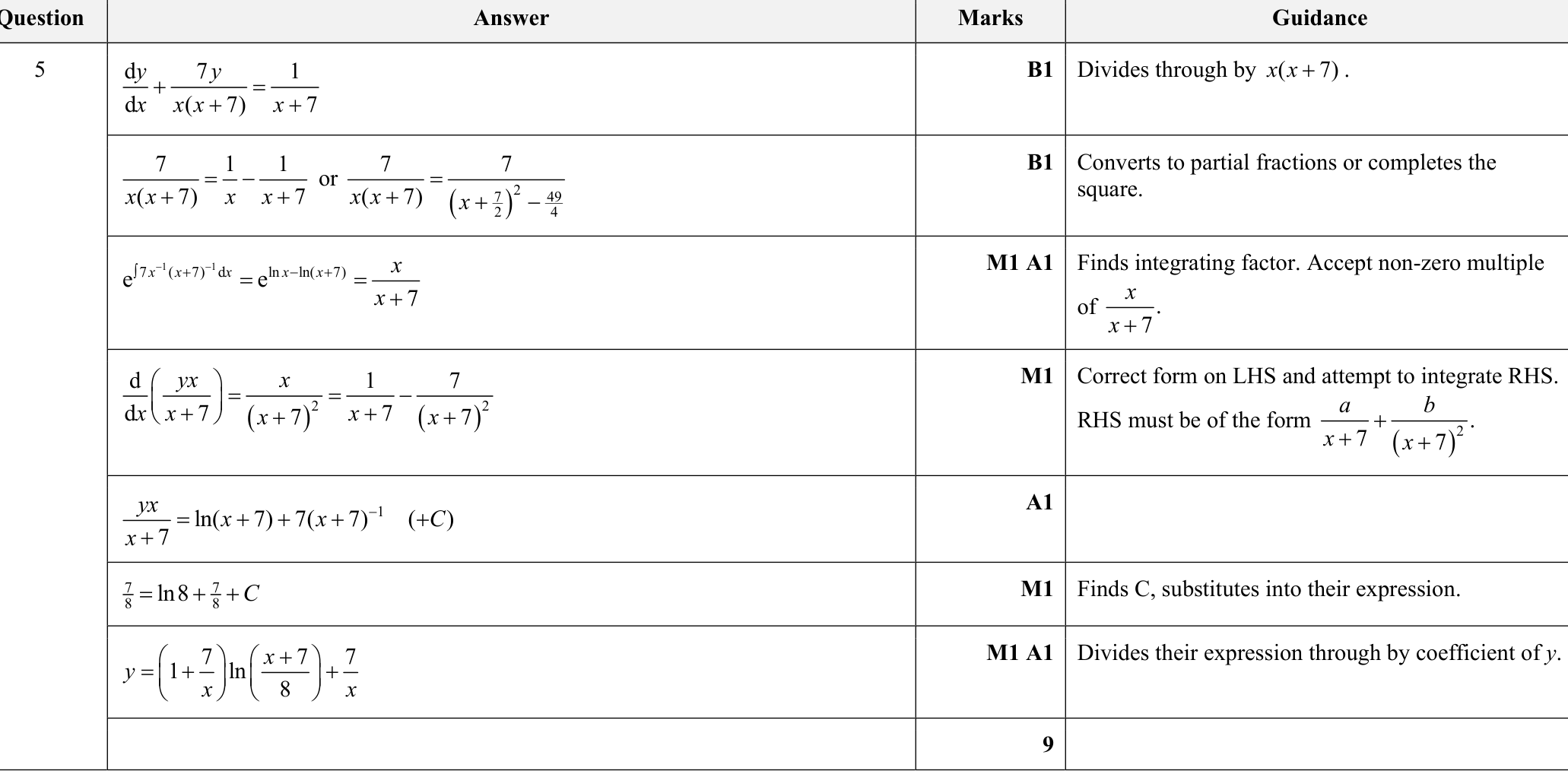
Find the solution of the differential equation
\(x(x+7) \frac{\mathrm{d} y}{\mathrm{~d} x}+7 y=x\)
for which \(y=7\) when \(x=1\). Give your answer in the form \(y=\mathrm{f}(x)\).
9231 P22 - Nov 2022 - Q4 - 9 marks
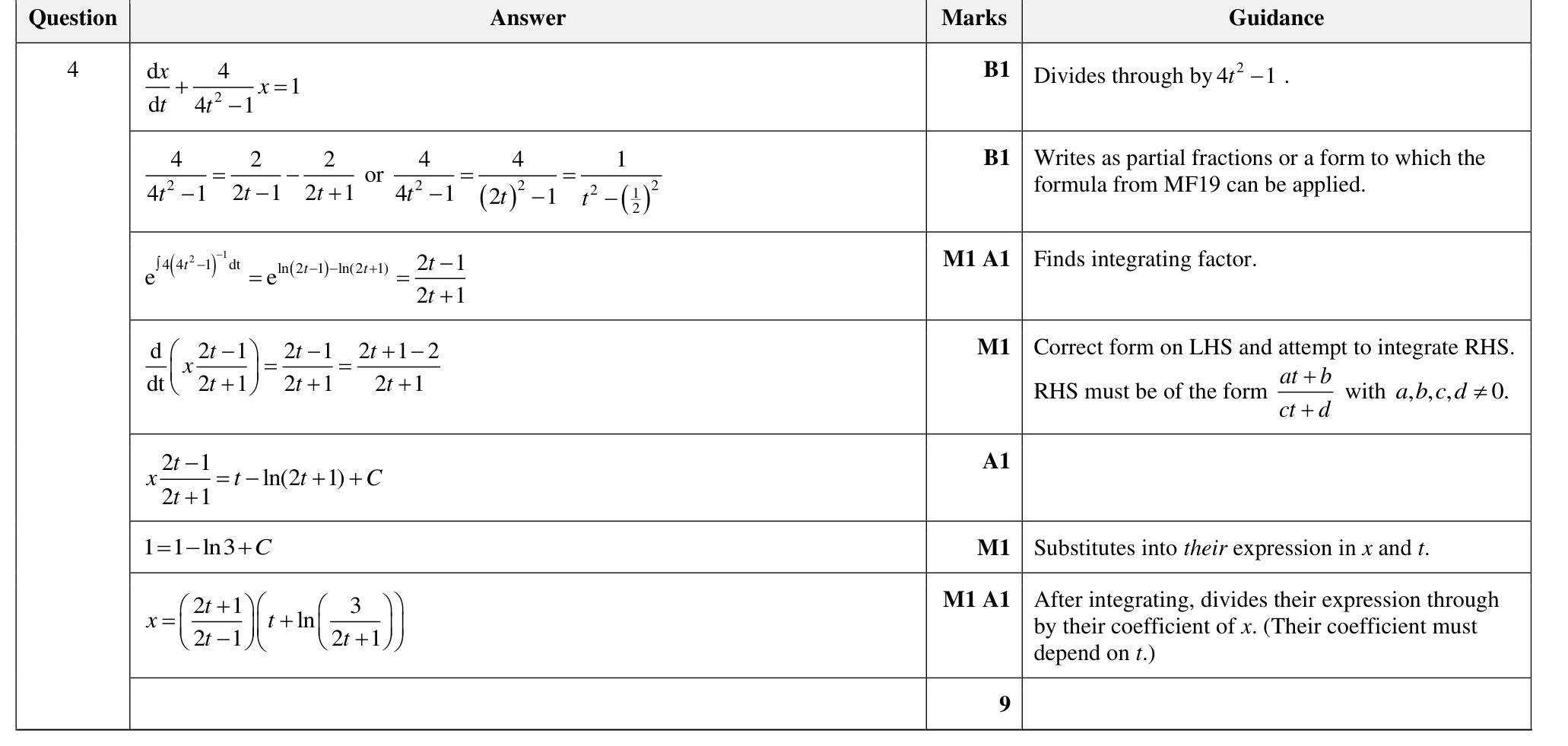
Find the solution of the differential equation
\(\left(4t^2-1\right)\frac{\mathrm{d}x}{\mathrm{d}t}+4x=4t^2-1\)
for which \(x=3\) when \(t=1\). Give your answer in the form \(x=f(t)\).
9231 P21 - Jun 2021 - Q4 - 9 marks
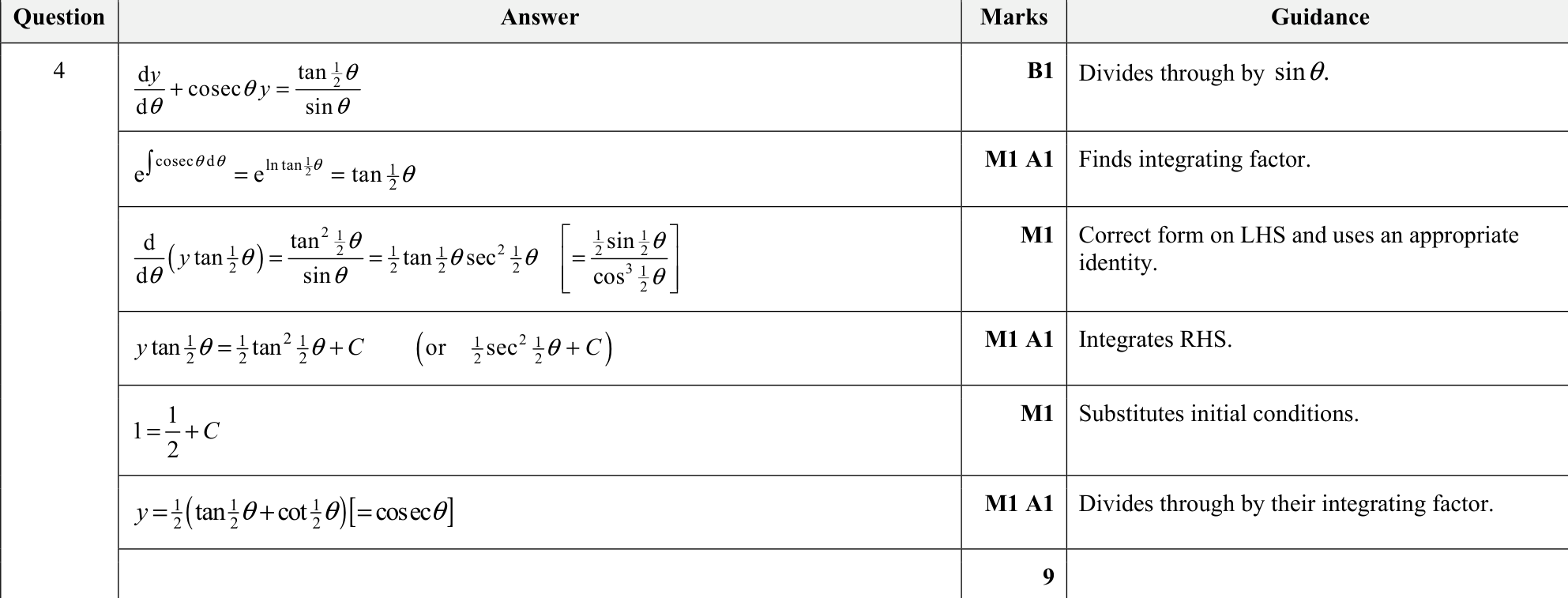
Find the solution of the differential equation
\(\sin \theta \frac{\mathrm{d} y}{\mathrm{~d} \theta}+y=\tan \frac{1}{2} \theta,\)
where \(0\lt \theta\lt \pi\), given that \(y=1\) when \(\theta=\frac{1}{2} \pi\). Give your answer in the form \(y=\mathrm{f}(\theta)\).
9231 P21 - Nov 2021 - Q7 - 11 marks
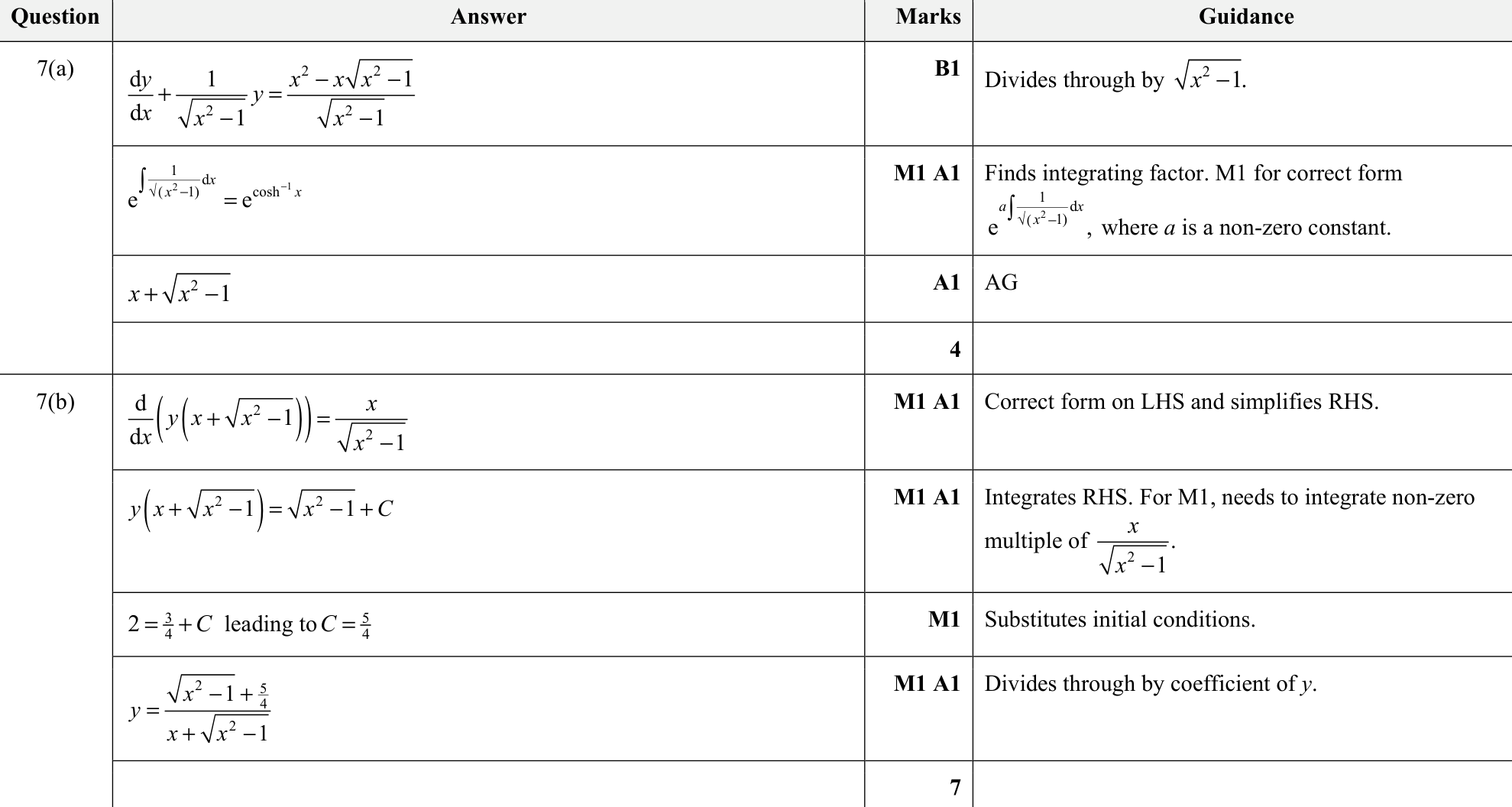
(a) Show that an appropriate integrating factor for
\(\sqrt{x^{2}-1} \frac{\mathrm{~d} y}{\mathrm{~d} x}+y=x^{2}-x \sqrt{x^{2}-1}\)
is \(x+\sqrt{x^{2}-1}\).
(b) Hence find the solution of the differential equation
\(\sqrt{x^{2}-1} \frac{\mathrm{~d} y}{\mathrm{~d} x}+y=x^{2}-x \sqrt{x^{2}-1}\)
for which \(y=1\) when \(x=\frac{5}{4}\). Give your answer in the form \(y=\mathrm{f}(x)\).
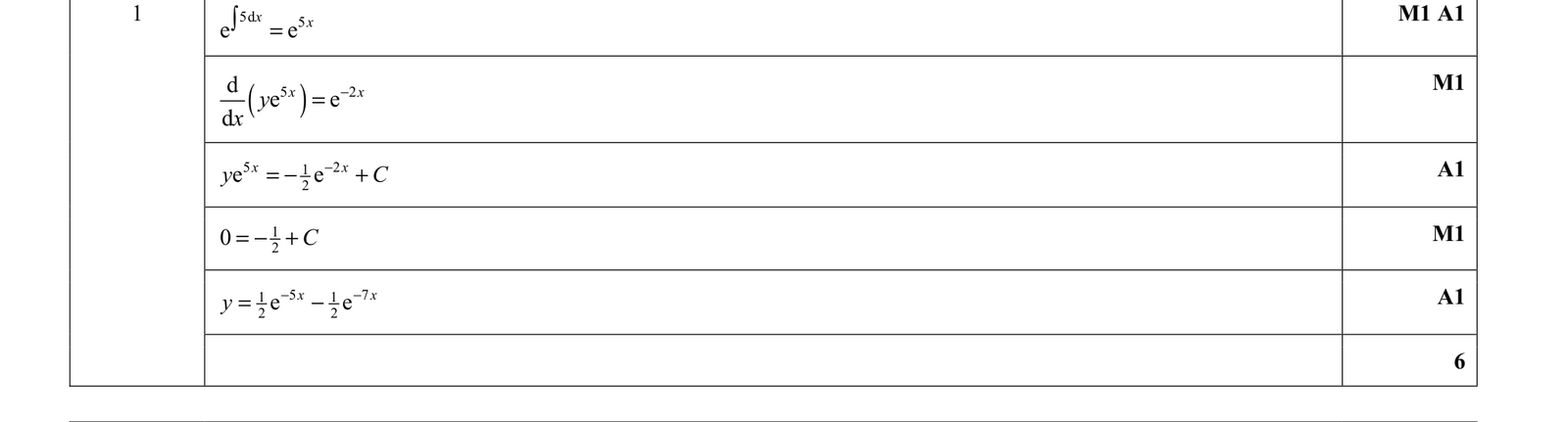
9231 P21 - Jun 2020 - Q1 - 6 marks
Find the solution of the differential equation
\[\frac{\mathrm{d} y}{\mathrm{~d} x}+5 y=\mathrm{e}^{-7 x}\]
for which \(y=0\) when \(x=0\). Give your answer in the form \(y=\mathrm{f}(x)\).
9231 P23 - Jun 2020 - Q7 - 11 marks
(a) Show that an appropriate integrating factor for
\[\left(x^{2}+1\right) \frac{\mathrm{d} y}{\mathrm{~d} x}+y \sqrt{x^{2}+1}=x^{2}-x \sqrt{x^{2}+1}\]
is \(x+\sqrt{x^{2}+1}\).
(b) Hence find the solution of the differential equation
\[\left(x^{2}+1\right) \frac{\mathrm{d} y}{\mathrm{~d} x}+y \sqrt{x^{2}+1}=x^{2}-x \sqrt{x^{2}+1}\]
for which \(y=\ln 2\) when \(x=0\). Give your answer in the form \(y=\mathrm{f}(x)\).

9231 P23 - Jun 2021 - Q6 - 10 marks
(a) Starting from the definitions of sinh and cosh in terms of exponentials, prove that
\[2 \sinh ^{2} x=\cosh 2 x-1\]
(b) Find the solution to the differential equation
\[\frac{\mathrm{d} y}{\mathrm{~d} x}+y \operatorname{coth} x=4 \sinh x\]
for which \(y=1\) when \(x=\ln 3\).

9231 P22 - Nov 2020 - Q4 - 8 marks
Find the solution of the differential equation
\[x \frac{\mathrm{~d} y}{\mathrm{~d} x}+2 y=\mathrm{e}^{x}\]
for which \(y=3\) when \(x=1\). Give your answer in the form \(y=\mathrm{f}(x)\).

9231 P22 - Nov 2021 - Q2 - 7 marks
Find the solution of the differential equation
\[\frac{d y}{d x}+\frac{4 x^{3} y}{x^{4}+5}=6 x\]
for which \(y=1\) when \(x=1\). Give your answer in the form \(y=\mathrm{f}(x)\).

9231 P12 - Nov 2018 - Q5 - 9 marks
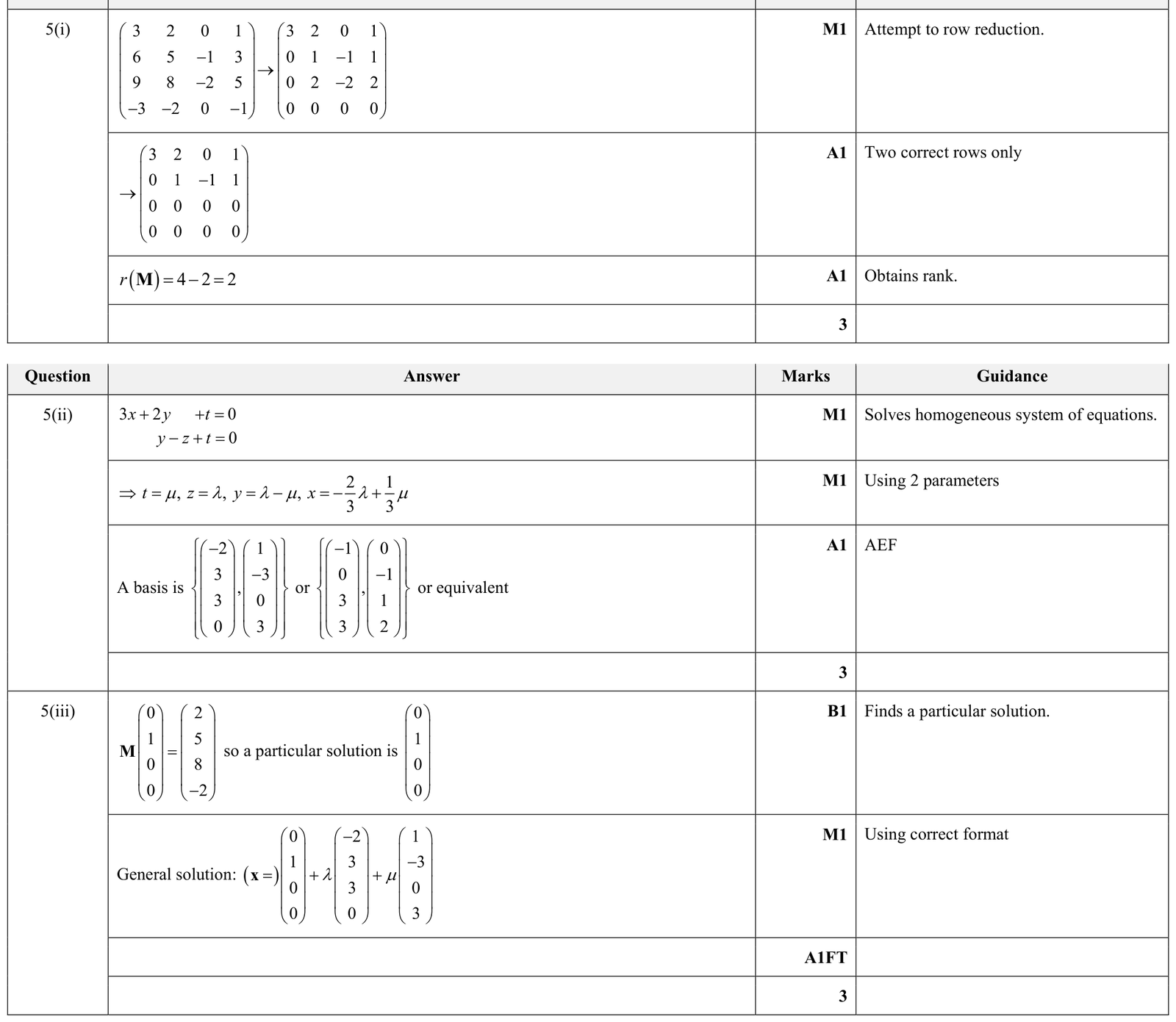
The linear transformation \(\mathrm{T}: \mathbb{R}^{4} \rightarrow \mathbb{R}^{4}\) is represented by the matrix \(\mathbf{M}\), where
\(\mathbf{M}=\left(\begin{array}{rrrr} 3 & 2 & 0 & 1 \\ 6 & 5 & -1 & 3 \\ 9 & 8 & -2 & 5 \\ -3 & -2 & 0 & -1 \end{array}\right) .\)
(i) Find the rank of \(\mathbf{M}\).
Let \(K\) be the null space of T .
(ii) Find a basis for \(K\).
(iii) Find the general solution of
\(\mathbf{M} \mathbf{x}=\left(\begin{array}{r} 2 \\ 5 \\ 8 \\ -2 \end{array}\right) .\)
9231 P12 - Nov 2014 - Q5 - 8 marks
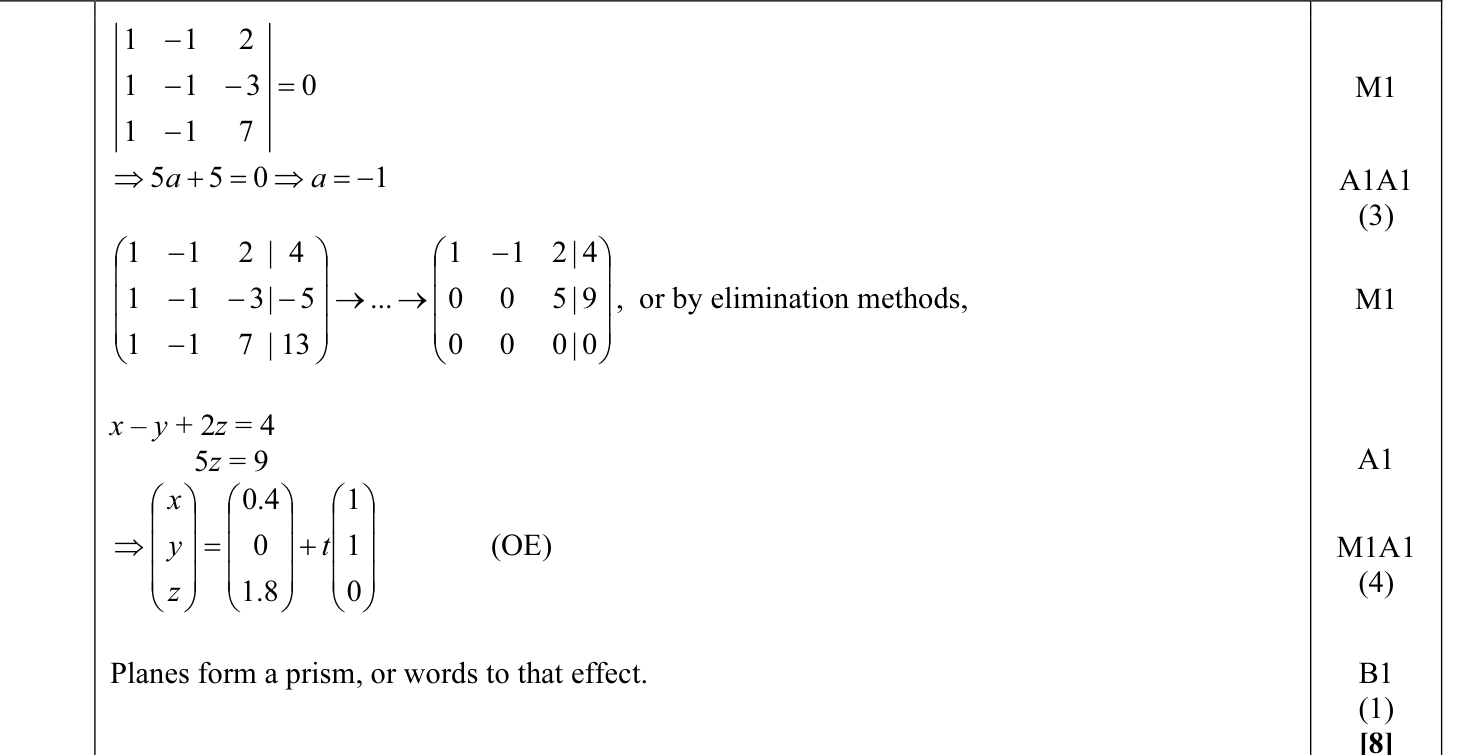
Find the value of \(a\) for which the system of equations
\(\begin{array}{l} x-y+2 z=4 \\ x+a y-3 z=b \\ x-y+7 z=13 \end{array}\)
where \(a\) and \(b\) are constants, has no unique solution.
Taking \(a\) as the value just found,
(i) find the general solution in the case \(b=-5\),
(ii) interpret the situation geometrically in the case \(b \neq-5\).
9231 P11 - Nov 2014 - Q5 - 8 marks
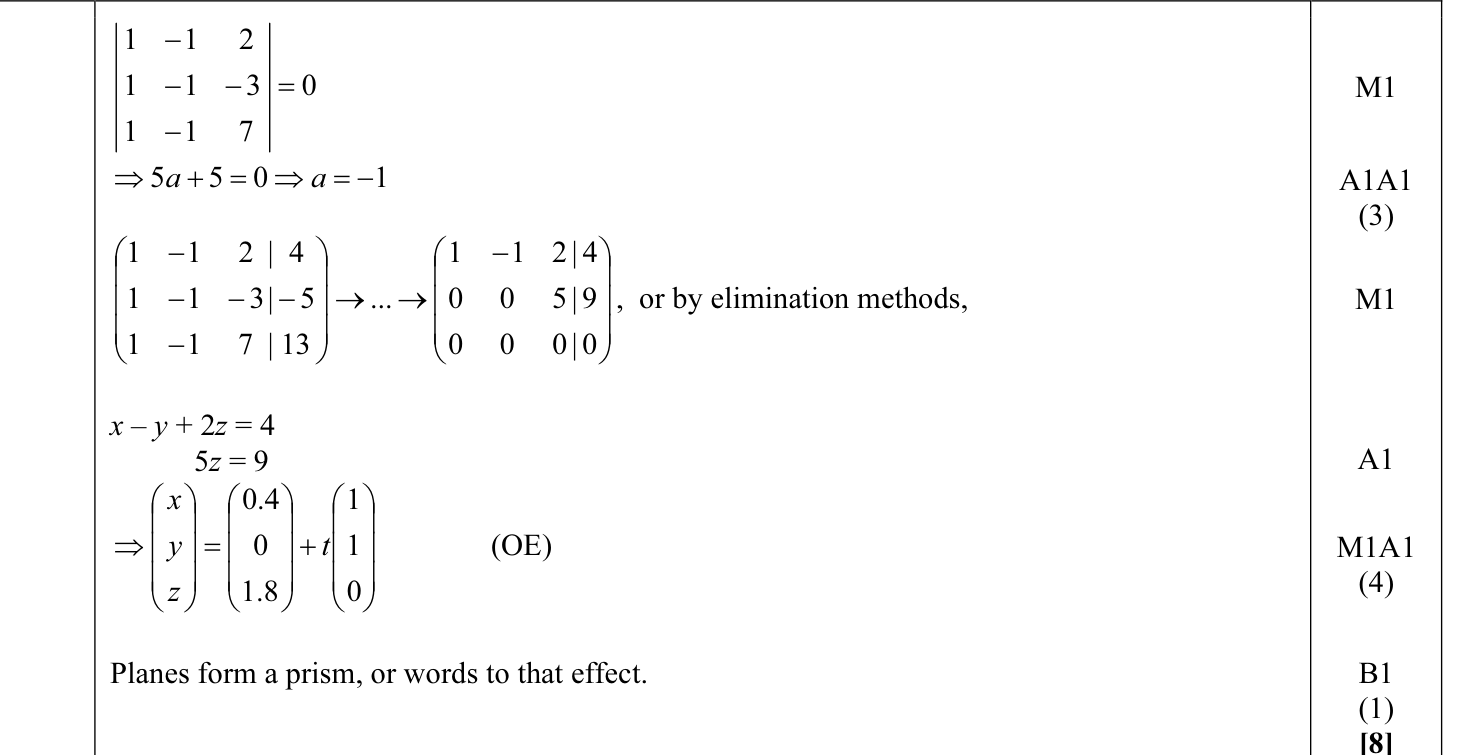
Find the value of \(a\) for which the system of equations
\(\begin{array}{l} x-y+2 z=4 \\ x+a y-3 z=b \\ x-y+7 z=13 \end{array}\)
where \(a\) and \(b\) are constants, has no unique solution.
Taking \(a\) as the value just found,
(i) find the general solution in the case \(b=-5\),
(ii) interpret the situation geometrically in the case \(b \neq-5\).
9231 P11 - Jun 2019 - Q7 - 10 marks
7 Find the particular solution of the differential equation
\(10 \frac{\mathrm{~d}^{2} x}{\mathrm{~d} t^{2}}+3 \frac{\mathrm{~d} x}{\mathrm{~d} t}-x=t+2\)
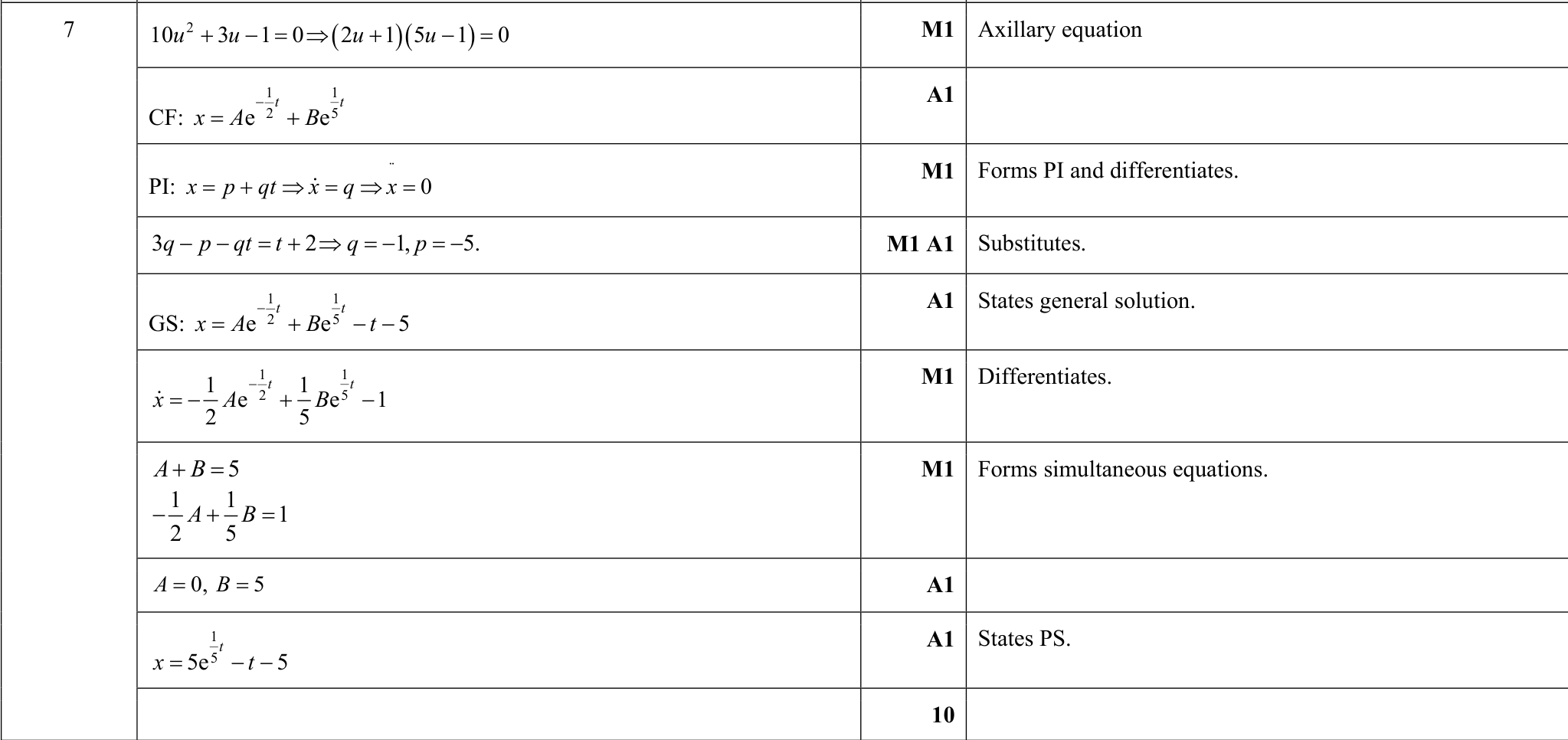
given that when \(t=0, x=0\) and \(\frac{\mathrm{d} x}{\mathrm{~d} t}=0\).