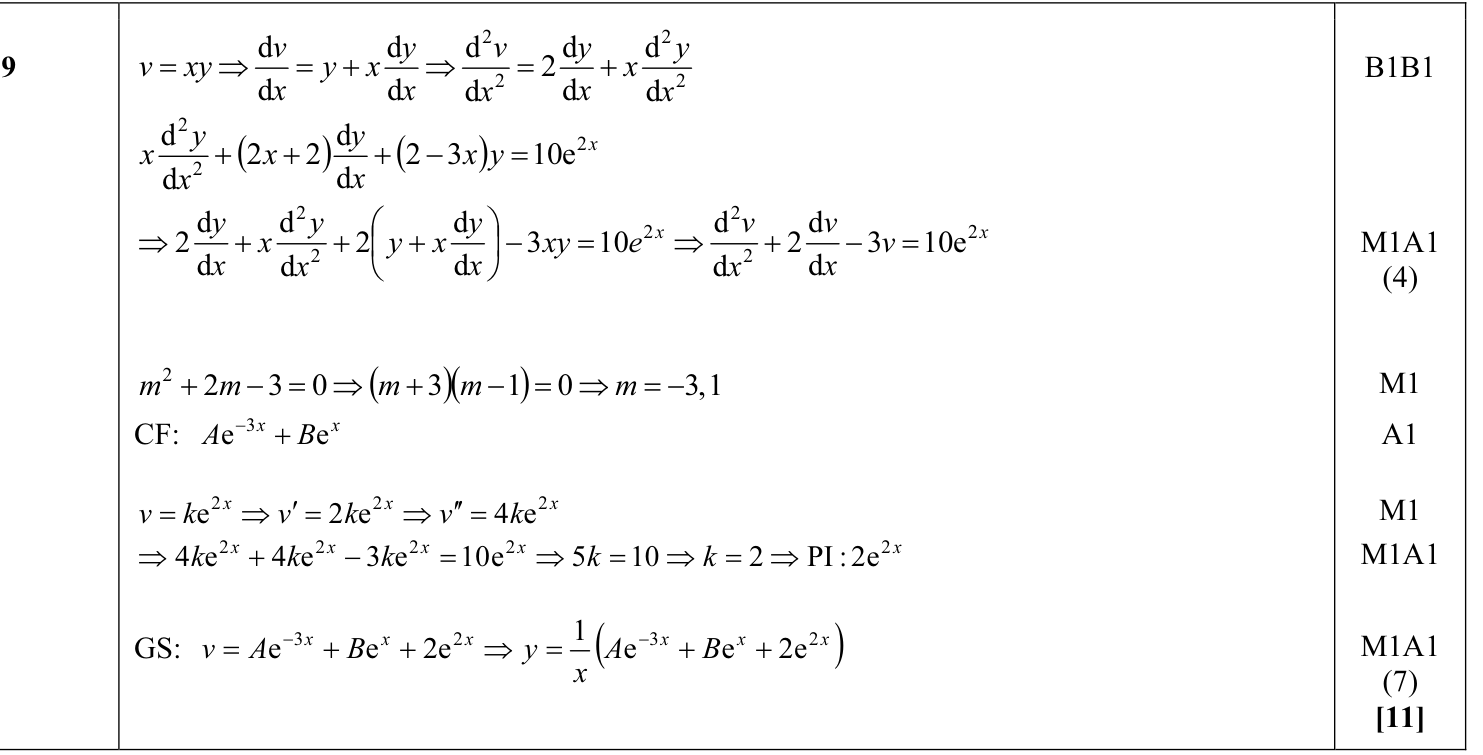
Answer: The general solution is
\(y=\dfrac{1}{x}\left(Ae^{-3x}+Be^x+2e^{2x}\right),\)
where \(A\) and \(B\) are arbitrary constants.
Let \(v=xy\). Then
\(\dfrac{dv}{dx}=y+x\dfrac{dy}{dx}\)
and differentiating again,
\(\dfrac{d^2v}{dx^2}=2\dfrac{dy}{dx}+x\dfrac{d^2y}{dx^2}.\)
Using the given equation
\(x\dfrac{d^2y}{dx^2}+(2x+2)\dfrac{dy}{dx}+(2-3x)y=10e^{2x},\)
rewrite the left-hand side as
\(\left(x\dfrac{d^2y}{dx^2}+2\dfrac{dy}{dx}\right)+2\left(y+x\dfrac{dy}{dx}\right)-3xy.\)
Since
\(x\dfrac{d^2y}{dx^2}+2\dfrac{dy}{dx}=\dfrac{d^2v}{dx^2}, \qquad y+x\dfrac{dy}{dx}=\dfrac{dv}{dx}, \qquad xy=v,\)
this becomes
\(\dfrac{d^2v}{dx^2}+2\dfrac{dv}{dx}-3v=10e^{2x},\)
as required.
Now solve
\(v''+2v'-3v=10e^{2x}.\)
For the complementary function, the auxiliary equation is
\(m^2+2m-3=0,\)
so
\((m+3)(m-1)=0,\)
giving \(m=-3\) and \(m=1\). Hence
\(v_c=Ae^{-3x}+Be^x.\)
For a particular integral, try \(v_p=ke^{2x}\). Then
\(v_p'=2ke^{2x}, \qquad v_p''=4ke^{2x}.\)
Substituting gives
\(4ke^{2x}+2(2ke^{2x})-3(ke^{2x})=10e^{2x},\)
so
\((4k+4k-3k)e^{2x}=10e^{2x}\Rightarrow 5k=10\Rightarrow k=2.\)
Therefore
\(v=Ae^{-3x}+Be^x+2e^{2x}.\)
Since \(v=xy\),
\(y=\dfrac{v}{x}=\dfrac{1}{x}\left(Ae^{-3x}+Be^x+2e^{2x}\right).\)