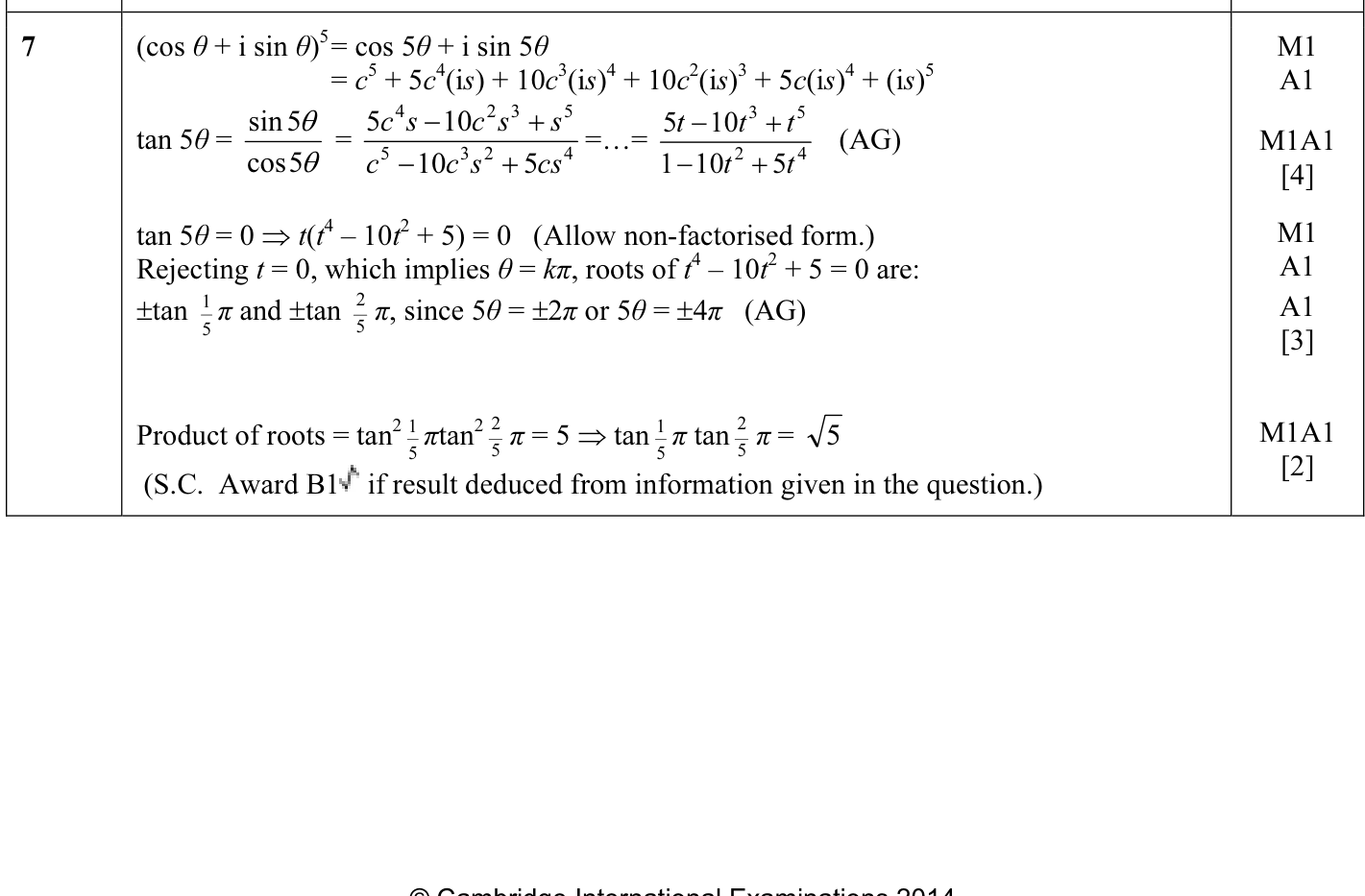
Answer: Let \(t=\tan\theta\). Using de Moivre’s theorem,
\((\cos\theta+i\sin\theta)^5=\cos 5\theta+i\sin 5\theta\).
Expand the left-hand side:
\(\cos^5\theta+5i\cos^4\theta\sin\theta-10\cos^3\theta\sin^2\theta-10i\cos^2\theta\sin^3\theta+5\cos\theta\sin^4\theta+i\sin^5\theta\).
So
\(\cos 5\theta=\cos^5\theta-10\cos^3\theta\sin^2\theta+5\cos\theta\sin^4\theta\),
\(\sin 5\theta=5\cos^4\theta\sin\theta-10\cos^2\theta\sin^3\theta+\sin^5\theta\).
Divide numerator and denominator of \(\tan 5\theta=\frac{\sin 5\theta}{\cos 5\theta}\) by \(\cos^5\theta\):
\(\tan 5\theta=\frac{5\tan\theta-10\tan^3\theta+\tan^5\theta}{1-10\tan^2\theta+5\tan^4\theta}\).
Hence, with \(t=\tan\theta\),
\(\tan 5\theta=\frac{5t-10t^3+t^5}{1-10t^2+5t^4}\).
Now take \(\theta=\frac{\pi}{5}\). Then \(5\theta=\pi\), so \(\tan 5\theta=0\). Therefore the numerator must be zero:
\(5t-10t^3+t^5=0\).
Factor out \(t\):
\(t(t^4-10t^2+5)=0\).
So one root is \(t=0\), and the remaining roots satisfy
\(t^4-10t^2+5=0\).
Now let \(x=t^2\). Then
\(x^2-10x+5=0\),
so
\(x=5\pm 2\sqrt5\).
Thus
\(t^2=5+2\sqrt5\) or \(t^2=5-2\sqrt5\).
These are exactly the squared values of \(\tan\frac{\pi}{5}\) and \(\tan\frac{2\pi}{5}\), since \(\tan\frac{\pi}{5}\) and \(\tan\frac{2\pi}{5}\) are the positive roots corresponding to the two angles in \((0,\pi/2)\). Hence the roots of \(t^4-10t^2+5=0\) are
\(\pm\tan\frac{\pi}{5}\) and \(\pm\tan\frac{2\pi}{5}\).
Finally, the product of the two positive roots is
\(\tan\frac{\pi}{5}\tan\frac{2\pi}{5}=\sqrt{(5+2\sqrt5)(5-2\sqrt5)}=\sqrt{25-20}=\sqrt5\).
Let \(t=\tan\theta\). From de Moivre’s theorem,
\((\cos\theta+i\sin\theta)^5=\cos 5\theta+i\sin 5\theta\).
Expanding the left-hand side and separating real and imaginary parts gives
\(\cos 5\theta=\cos^5\theta-10\cos^3\theta\sin^2\theta+5\cos\theta\sin^4\theta\),
\(\sin 5\theta=5\cos^4\theta\sin\theta-10\cos^2\theta\sin^3\theta+\sin^5\theta\).
Now divide both by \(\cos^5\theta\):
\(\cos 5\theta=\cos^5\theta\bigl(1-10\tan^2\theta+5\tan^4\theta\bigr)\),
\(\sin 5\theta=\cos^5\theta\bigl(5\tan\theta-10\tan^3\theta+\tan^5\theta\bigr)\).
Therefore
\(\tan 5\theta=\frac{\sin 5\theta}{\cos 5\theta}=\frac{5\tan\theta-10\tan^3\theta+\tan^5\theta}{1-10\tan^2\theta+5\tan^4\theta}\).
With \(t=\tan\theta\), this is
\(\tan 5\theta=\frac{5t-10t^3+t^5}{1-10t^2+5t^4}\).
To deduce the quartic, take \(\theta=\frac{\pi}{5}\). Then \(5\theta=\pi\), so \(\tan 5\theta=0\). Hence
\(5t-10t^3+t^5=0\).
Factorising:
\(t(t^4-10t^2+5)=0\).
So the nonzero roots of \(t^4-10t^2+5=0\) are the values of \(t=\tan\theta\) for which \(\tan 5\theta=0\) and \(t\neq 0\). These correspond to \(\theta=\frac{\pi}{5},\frac{2\pi}{5},\frac{3\pi}{5},\frac{4\pi}{5}\) modulo \(\pi\), giving the roots
\(\pm\tan\frac{\pi}{5}\) and \(\pm\tan\frac{2\pi}{5}\).
Now let the two positive roots be \(\tan\frac{\pi}{5}\) and \(\tan\frac{2\pi}{5}\). Since they satisfy \(x^2-10x+5=0\) when \(x=t^2\), their squared values are the roots \(5\pm 2\sqrt5\). Thus
\(\tan\frac{\pi}{5}\tan\frac{2\pi}{5}=\sqrt{(5+2\sqrt5)(5-2\sqrt5)}=\sqrt{25-20}=\sqrt5\).