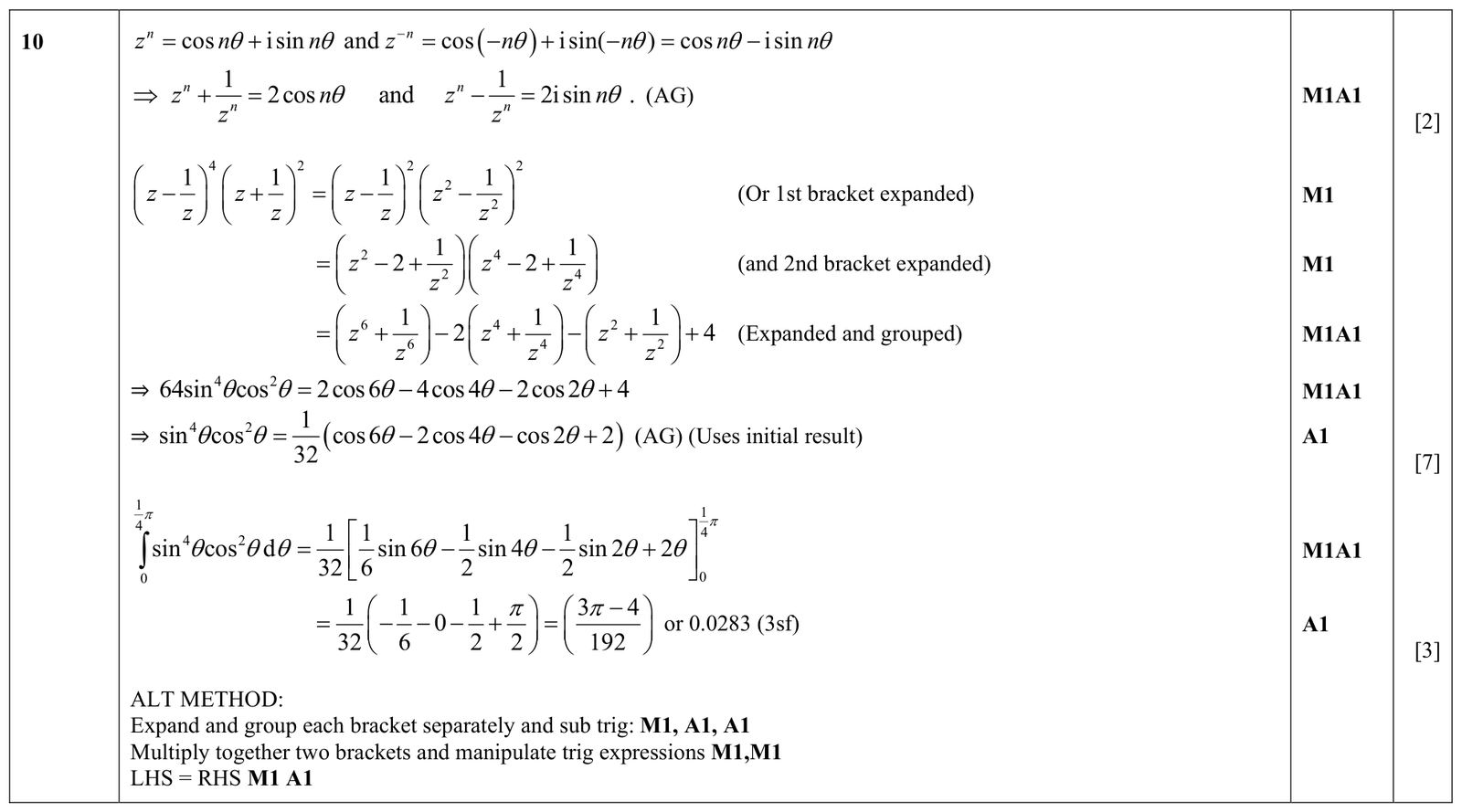
Answer: \(z^n+z^{-n}=2\cos n\theta\) and \(z^n-z^{-n}=2i\sin n\theta\).
\(\displaystyle \sin^4\theta\cos^2\theta=\frac{1}{32}(\cos6\theta-2\cos4\theta-\cos2\theta+2)\).
\(\displaystyle \int_0^{\pi/4}\sin^4\theta\cos^2\theta\,d\theta=\frac{3\pi-4}{192}\).
Let \(z=\cos\theta+i\sin\theta\). Then by De Moivre’s theorem, \(z^n=\cos n\theta+i\sin n\theta\), and since \(z^{-1}=\cos\theta-i\sin\theta\), we also have \(z^{-n}=\cos n\theta-i\sin n\theta\). Hence
\(z^n+\frac{1}{z^n}=z^n+z^{-n}=2\cos n\theta\), and \(z^n-\frac{1}{z^n}=z^n-z^{-n}=2i\sin n\theta\).
Now consider \(\left(z-\frac{1}{z}\right)^4\left(z+\frac{1}{z}\right)^2\). First rewrite the factors:
\(\left(z-\frac{1}{z}\right)^2=z^2-2+\frac{1}{z^2}\),
\(\left(z+\frac{1}{z}\right)^2=z^2+2+\frac{1}{z^2}\),
so
\(\left(z-\frac{1}{z}\right)^4\left(z+\frac{1}{z}\right)^2=\left(z^2-2+\frac{1}{z^2}\right)^2\left(z^2+2+\frac{1}{z^2}\right).\)
A neater route is to use
\(\left(z-\frac{1}{z}\right)^2=z^2-2+\frac{1}{z^2}\)
and
\(\left(z-\frac{1}{z}\right)^4\left(z+\frac{1}{z}\right)^2=\left(z-\frac{1}{z}\right)^2\left(z^2-\frac{1}{z^2}\right)^2.\)
Now expand each square:
\(\left(z-\frac{1}{z}\right)^2=z^2-2+\frac{1}{z^2},\)
\(\left(z^2-\frac{1}{z^2}\right)^2=z^4-2+\frac{1}{z^4}.\)
Therefore
\(\left(z-\frac{1}{z}\right)^4\left(z+\frac{1}{z}\right)^2=\left(z^2-2+\frac{1}{z^2}\right)\left(z^4-2+\frac{1}{z^4}\right).\)
Multiplying out and collecting symmetric terms gives
\(=\left(z^6+\frac{1}{z^6}\right)-2\left(z^4+\frac{1}{z^4}\right)-\left(z^2+\frac{1}{z^2}\right)+4.\)
Using the identities from the first part, this becomes
\(=2\cos 6\theta-4\cos 4\theta-2\cos 2\theta+4.\)
On the other hand,
\(z-\frac{1}{z}=2i\sin\theta,\qquad z+\frac{1}{z}=2\cos\theta,\)
so the left-hand side is
\((2i\sin\theta)^4(2\cos\theta)^2=64\sin^4\theta\cos^2\theta.\)
Hence
\(64\sin^4\theta\cos^2\theta=2\cos 6\theta-4\cos 4\theta-2\cos 2\theta+4,\)
and dividing by 64 gives
\(\sin^4\theta\cos^2\theta=\frac{1}{32}(\cos 6\theta-2\cos 4\theta-\cos 2\theta+2).\)
Now integrate:
\(\int_0^{\pi/4}\sin^4\theta\cos^2\theta\,d\theta=\frac{1}{32}\int_0^{\pi/4}(\cos 6\theta-2\cos 4\theta-\cos 2\theta+2)\,d\theta.\)
So
\(=\frac{1}{32}\left[\frac{1}{6}\sin 6\theta-\frac{1}{2}\sin 4\theta-\frac{1}{2}\sin 2\theta+2\theta\right]_0^{\pi/4}.\)
At \(\theta=\pi/4\), \(\sin(6\theta)=\sin(3\pi/2)=-1\), \(\sin(4\theta)=\sin\pi=0\), and \(\sin(2\theta)=\sin(\pi/2)=1\). Therefore
\(=\frac{1}{32}\left(-\frac{1}{6}-0-\frac{1}{2}+\frac{\pi}{2}\right)=\frac{3\pi-4}{192}.\)