9231 P13 - Jun 2013 - Q11 - 28 marks
Answer only one of the following two alternatives.
EITHER
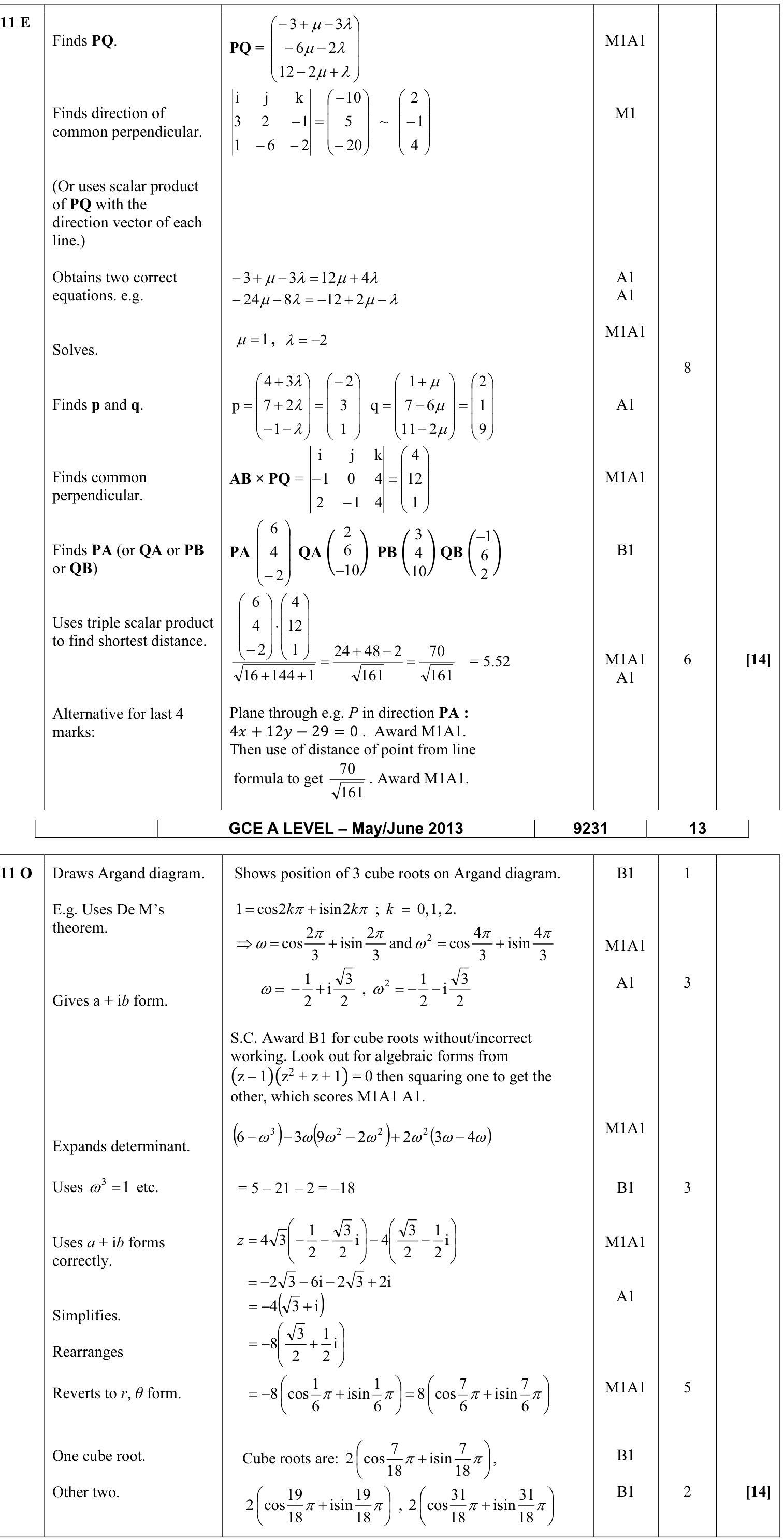
The line \(l_{1}\) passes through the point \(A\) whose position vector is \(4 \mathbf{i}+7 \mathbf{j}-\mathbf{k}\) and is parallel to the vector \(3 \mathbf{i}+2 \mathbf{j}-\mathbf{k}\). The line \(l_{2}\) passes through the point \(B\) whose position vector is \(\mathbf{i}+7 \mathbf{j}+11 \mathbf{k}\) and is parallel to the vector \(\mathbf{i}-6 \mathbf{j}-2 \mathbf{k}\). The points \(P\) on \(l_{1}\) and \(Q\) on \(l_{2}\) are such that \(P Q\) is perpendicular to both \(l_{1}\) and \(l_{2}\). Find the position vectors of \(P\) and \(Q\).
Find the shortest distance between the line through \(A\) and \(B\) and the line through \(P\) and \(Q\), giving your answer correct to 3 significant figures.
OR
Show the cube roots of 1 on an Argand diagram.
Show that the two non-real cube roots can be expressed in the form \(\omega\) and \(\omega^{2}\), and find these cube roots in exact cartesian form \(x+\mathrm{i} y\).
Evaluate the determinant
\(\left|\begin{array}{ccc} 1 & 3 \omega & 2 \omega^{2} \\ 3 \omega^{2} & 2 & \omega \\ 2 \omega & \omega^{2} & 3 \end{array}\right| .\)
It is given that \(z=(4\sqrt{3})\left(\cos \frac{4}{3} \pi+i \sin \frac{4}{3} \pi\right)-4\left(\cos \frac{11}{6} \pi+i \sin \frac{11}{6} \pi\right)\). Express \(z\) in the form \(r(\cos \theta+\mathrm{i} \sin \theta)\), giving exact values for \(r\) and \(\theta\).
Hence find the cube roots of \(z\) in the form \(r(\cos \theta+\mathrm{i} \sin \theta)\).