9231 P11 - Jun 2011 - Q11 - 22 marks
Answer only one of the following two alternatives.
EITHER
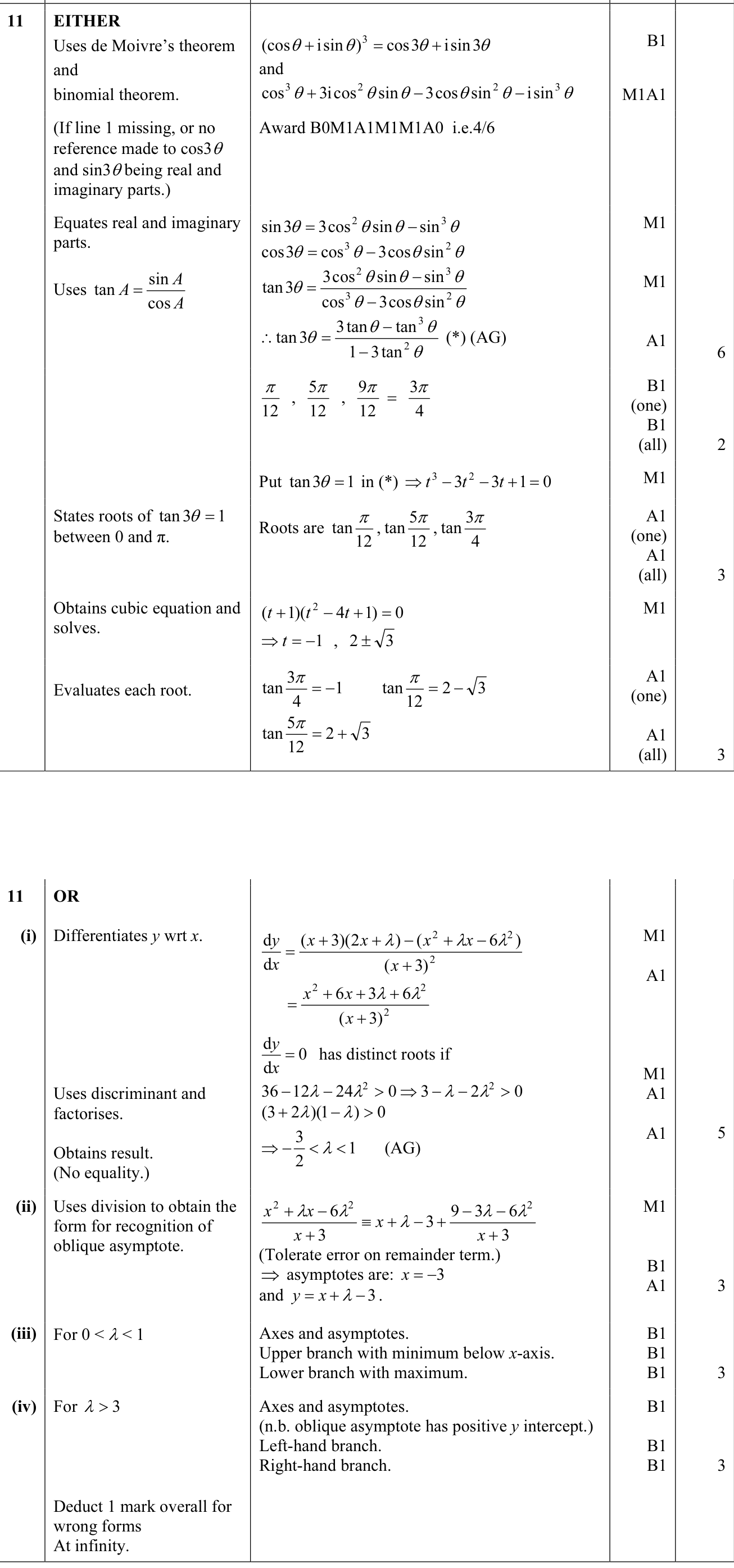
Use de Moivre's theorem to prove that
\(\tan 3 \theta=\frac{3 \tan \theta-\tan ^{3} \theta}{1-3 \tan ^{2} \theta} .\)
State the exact values of \(\theta\), between 0 and \(\pi\), that satisfy \(\tan 3 \theta=1\).
Express each root of the equation \(t^{3}-3 t^{2}-3 t+1=0\) in the form \(\tan (k \pi)\), where \(k\) is a positive rational number.
For each of these values of \(k\), find the exact value of \(\tan (k \pi)\).
OR
The curve \(C\) has equation
\(y=\frac{x^{2}+\lambda x-6 \lambda^{2}}{x+3},\)
where \(\lambda\) is a constant such that \(\lambda \neq 1\) and \(\lambda \neq-\frac{3}{2}\).
(i) Find \(\frac{\mathrm{d} y}{\mathrm{~d} x}\) and deduce that if \(C\) has two stationary points then \(-\frac{3}{2}\lt \lambda\lt 1\).
(ii) Find the equations of the asymptotes of \(C\).
(iii) Draw a sketch of \(C\) for the case \(0\lt \lambda\lt 1\).
(iv) Draw a sketch of \(C\) for the case \(\lambda\gt 3\).