Past Exam Questions
← Back0606 P11 - Nov 2023 - Q9 - 12 marks
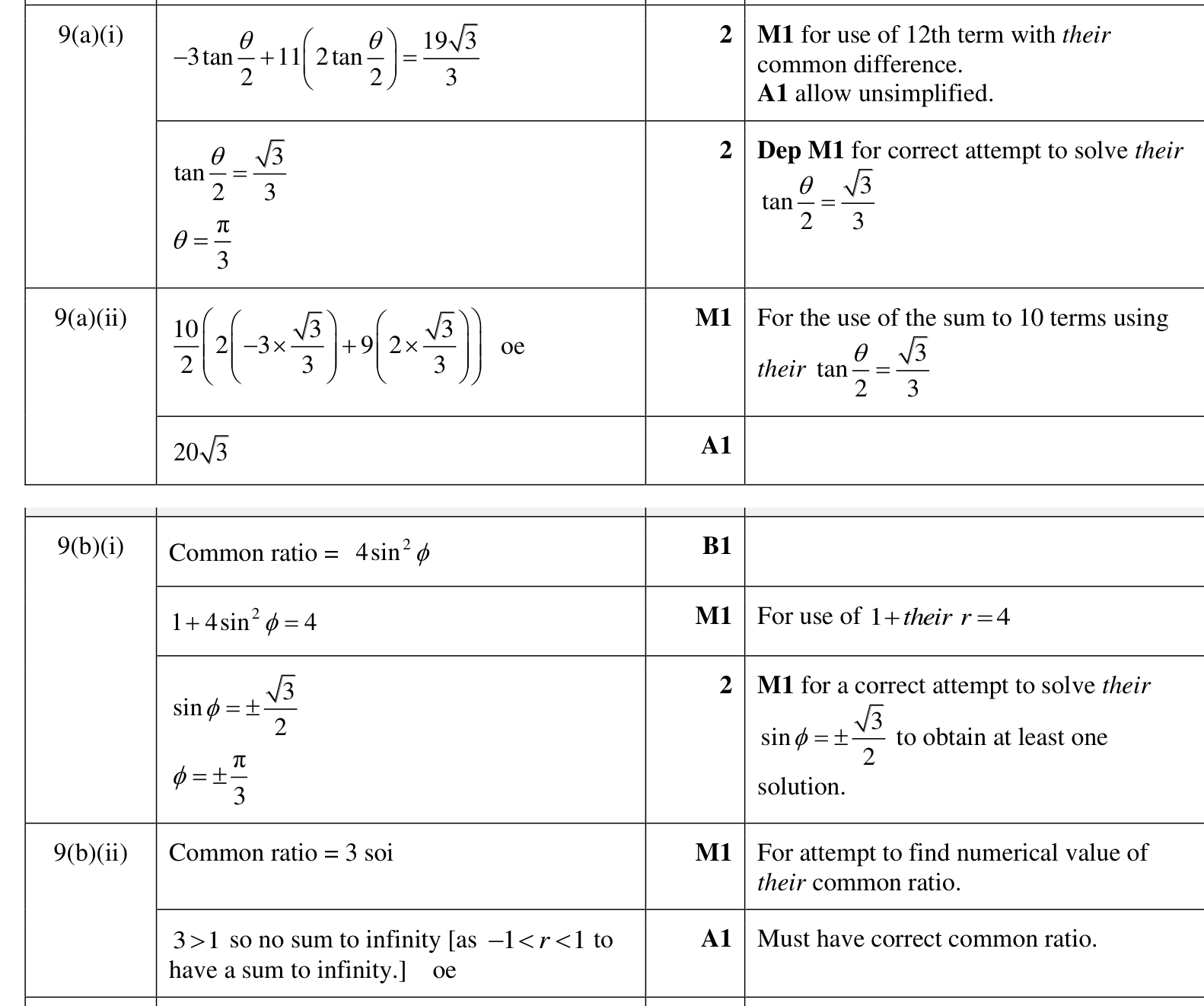
(a) The first three terms of an arithmetic progression are
\(-3\tan\frac{\theta}{2},\quad -\tan\frac{\theta}{2},\quad \tan\frac{\theta}{2},\)
where \(0\lt \theta\lt \frac12\pi\).
Given that the 12th term is \(\frac{19\sqrt3}{3}\), find
(i) the value of \(\theta\),
(ii) the sum of the first 10 terms.
(b) The first three terms of a geometric progression are
\(\frac{1}{16}\operatorname{cosec}^4\phi,\quad \frac14\operatorname{cosec}^2\phi,\quad 1,\)
where \(-\frac12\pi\lt \phi\lt \frac12\pi\).
(i) Given that the sum of the 3rd and 4th terms is 4, find the possible values of \(\phi\).
(ii) Determine whether this geometric progression has a sum to infinity.
0606 P12 - Mar 2022 - Q10 - 12 marks
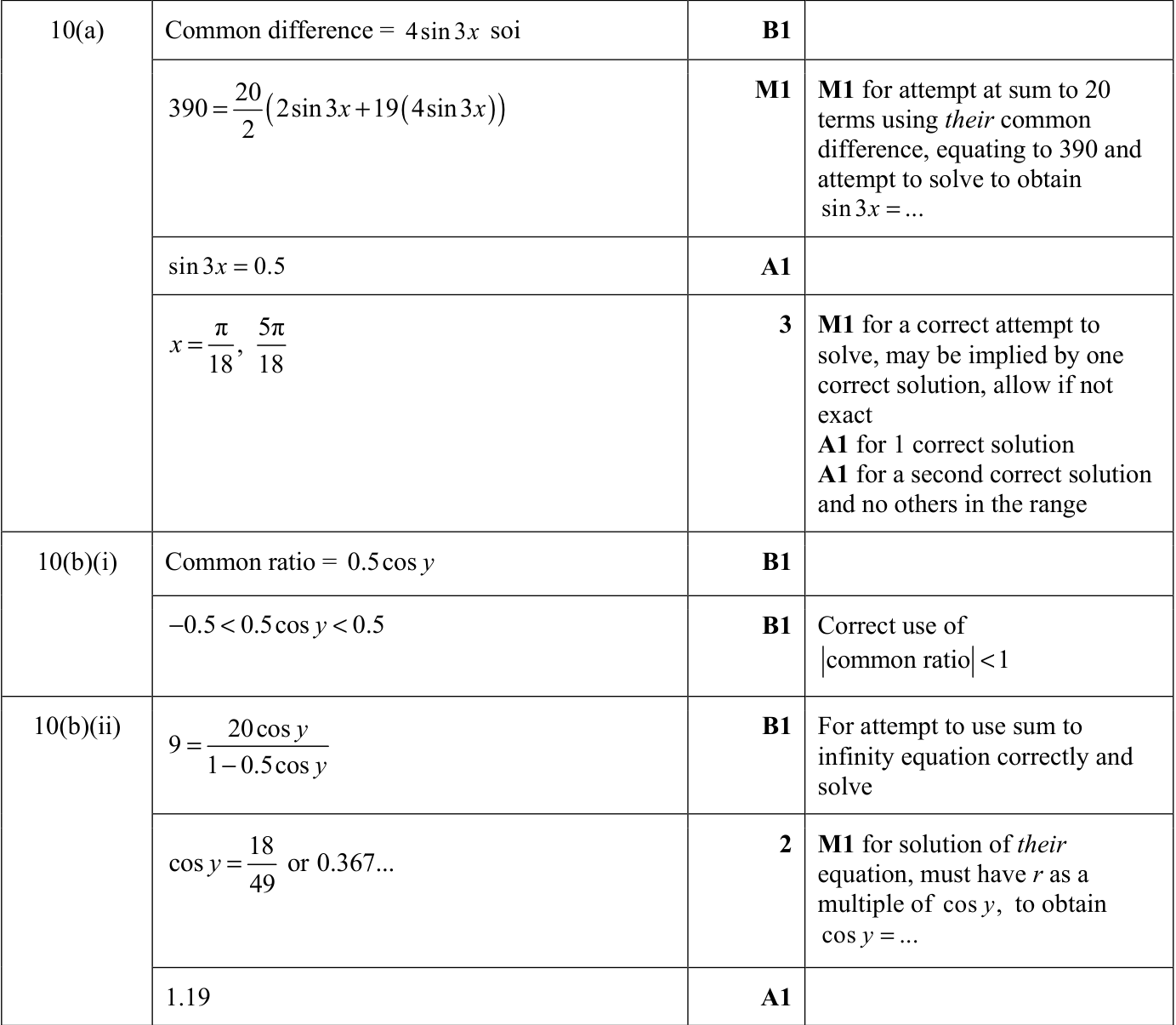
(a) The first three terms of an arithmetic progression are \(\sin3x\), \(5\sin3x\), \(9\sin3x\). Find the exact values of \(x\), where \(0\le x\le\frac{\pi}{2}\), for which the sum to twenty terms is equal to 390.
(b) The first three terms of a geometric progression are \(20\cos y\), \(10\cos^2y\), \(5\cos^3y\).
(i) Explain why this progression has a sum to infinity.
(ii) Find the value of \(y\), where \(y\) is in radians and \(0\lt y\lt 2\), for which the sum to infinity is 9. Give your answer correct to 2 decimal places.
0606 P22 - Mar 2023 - Q6 - 11 marks
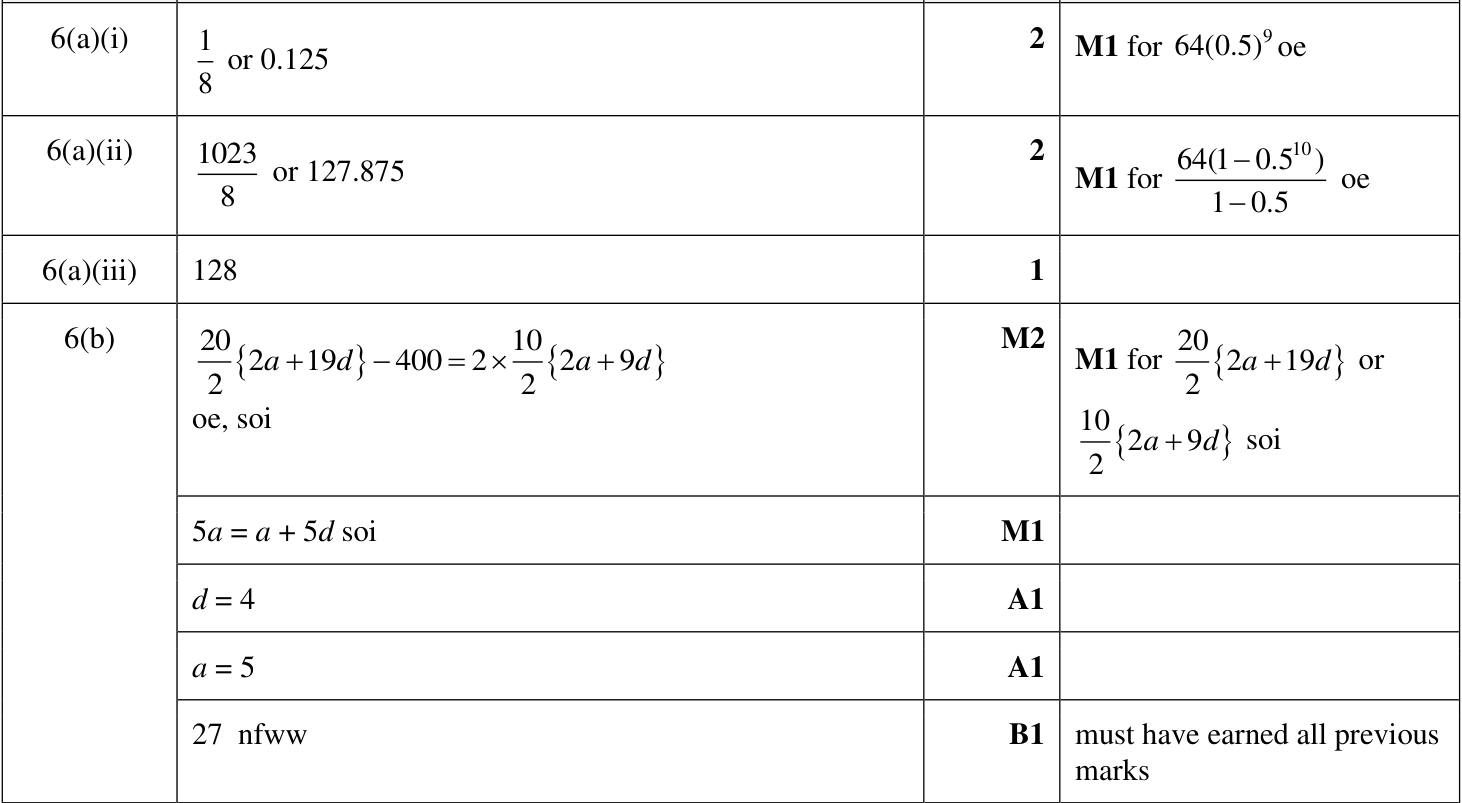
(a) A geometric progression has first term \(64\) and common ratio \(0.5\).
(i) Find the 10th term.
(ii) Find the sum of the first 10 terms.
(iii) Find the sum to infinity.
(b) An arithmetic progression has first term \(a\), common difference \(d\), and sum of the first \(n\) terms \(S_n\). It is given that
\(S_{20}-400=2S_{10}\)
and
\(u_1:u_6=1:5.\)
Find the sum of the first 3 terms of this arithmetic progression.
0606 P11 - Jun 2022 - Q7 - 9 marks
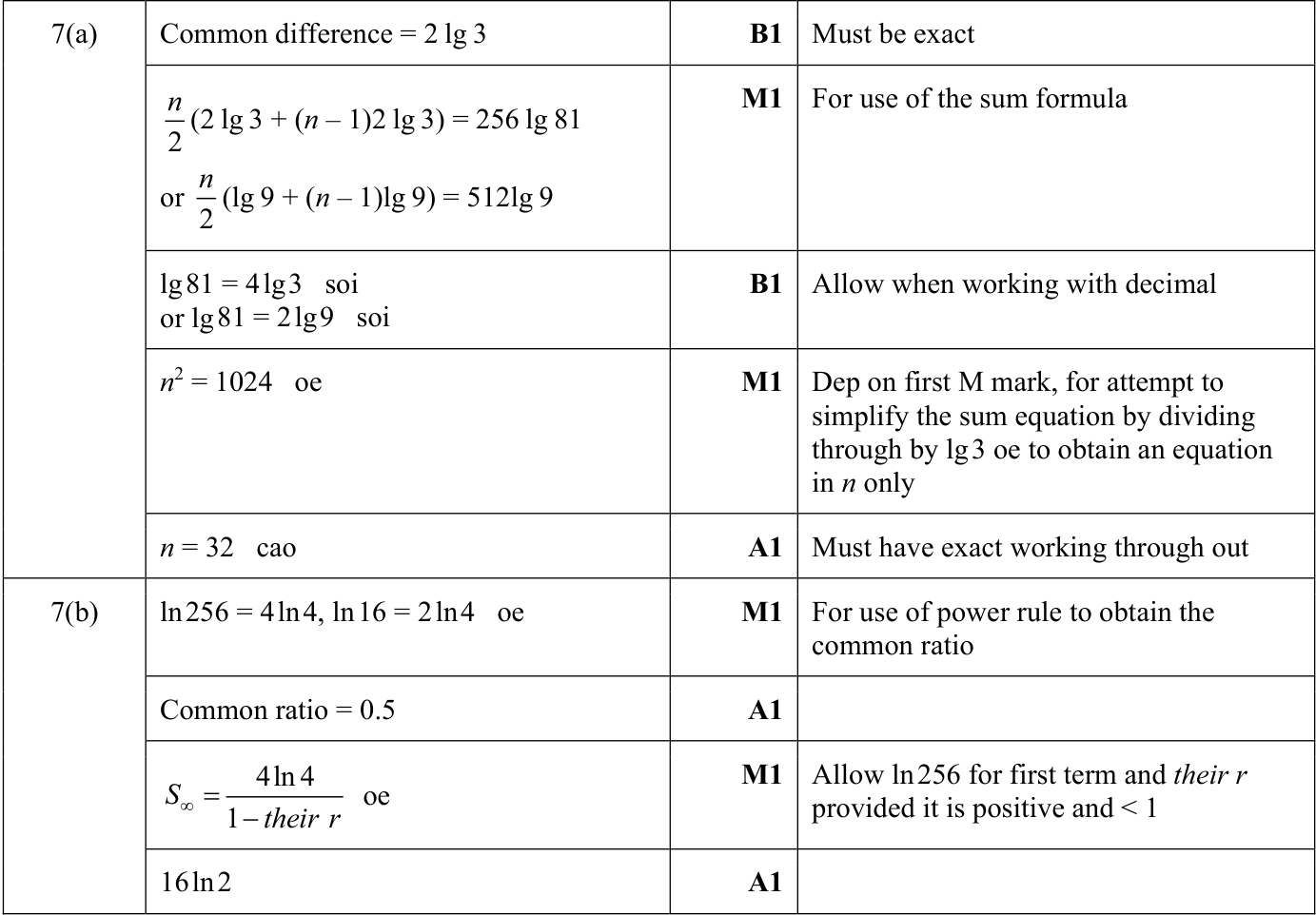
(a) The first three terms of an arithmetic progression are \(\lg3\), \(3\lg3\), \(5\lg3\). Given that the sum to \(n\) terms is \(256\lg81\), find \(n\).
(b) The first three terms of a geometric progression are \(\ln256\), \(\ln16\), \(\ln4\). Find the sum to infinity in the form \(p\ln2\).
0606 P22 - Jun 2022 - Q10 - 13 marks
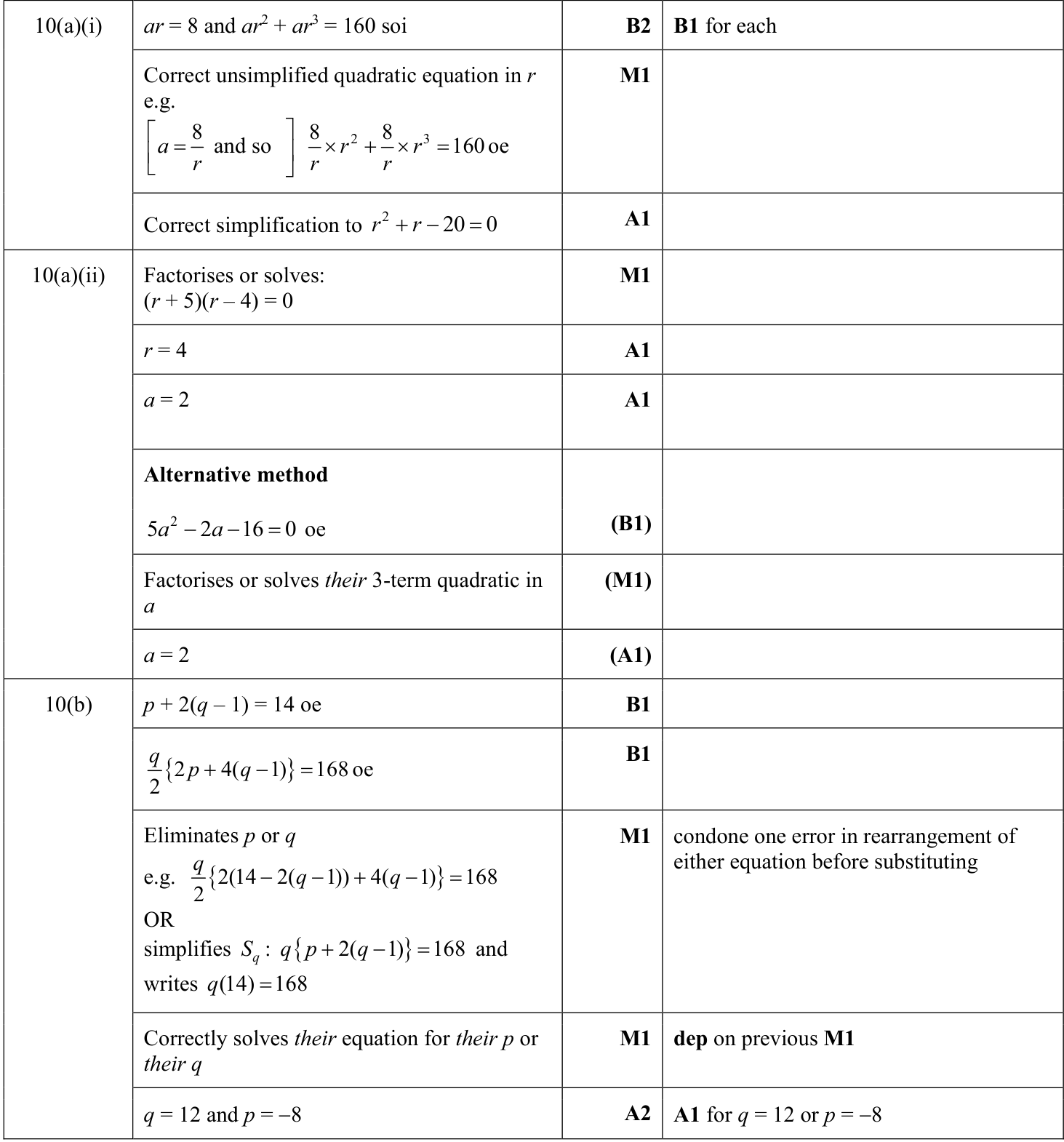
(a) A geometric progression has first term \(a\) and common ratio \(r\), where \(r\gt 0\). The second term of this progression is 8. The sum of the third and fourth terms is 160.
(i) Show that \(r\) satisfies the equation \(r^2+r-20=0\).
(ii) Find the value of \(a\).
(b) An arithmetic progression has first term \(p\) and common difference 2. The \(q\)th term of this progression is 14. A different arithmetic progression has first term \(p\) and common difference 4. The sum of the first \(q\) terms of this progression is 168. Find the values of \(p\) and \(q\).
0606 P23 - Jun 2022 - Q11 - 13 marks
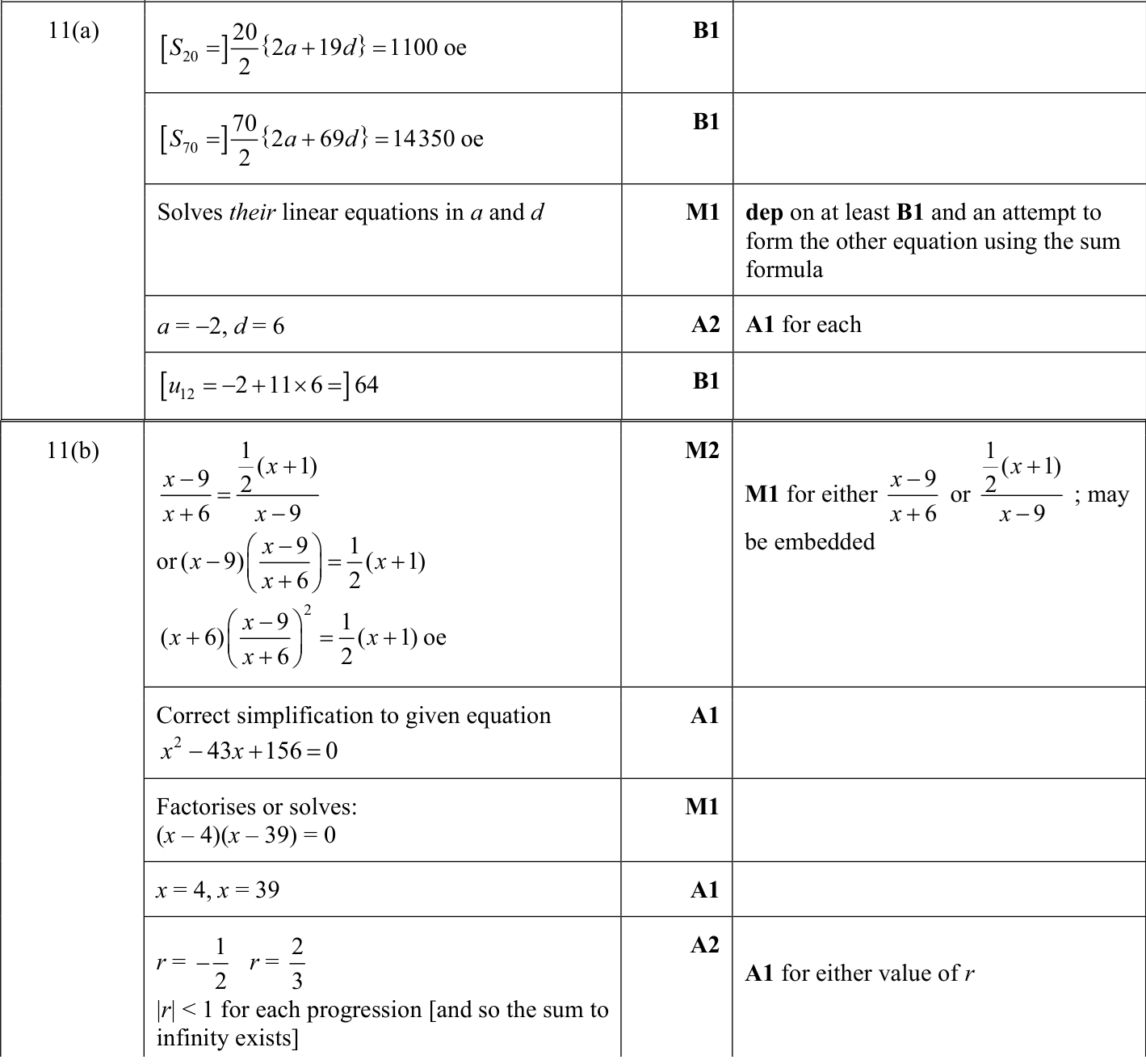
(a) An arithmetic progression has first term \(a\) and common difference \(d\). The sum of the first 20 terms is 1100 and the sum of the first 70 terms is 14350. Find the 12th term.
(b) The first three terms of a geometric progression are \(x+6\), \(x-9\) and \(\frac12(x+1)\).
Show that \(x^2-43x+156=0\), and hence show that the sum to infinity exists for each possible value of \(x\).
0606 P12 - Mar 2021 - Q6 - 11 marks
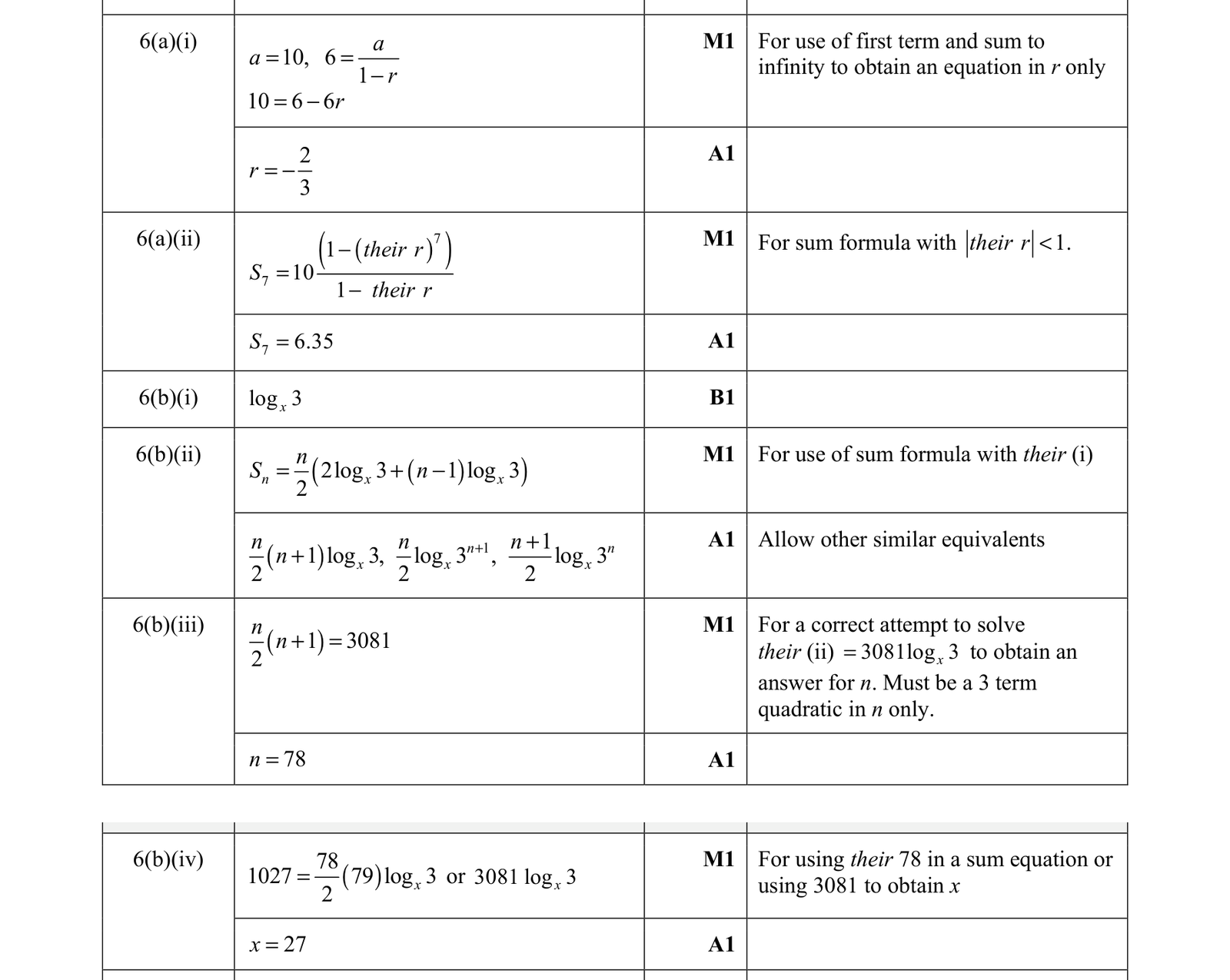
(a) A geometric progression has first term \(10\) and sum to infinity \(6\).
(i) Find the common ratio of this progression.
(ii) Hence find the sum of the first 7 terms, giving your answer correct to 2 decimal places.
(b) The first three terms of an arithmetic progression are \(\log_x3\), \(\log_x(3^2)\), \(\log_x(3^3)\).
(i) Find the common difference of this progression.
(ii) Find, in terms of \(n\) and \(\log_x3\), the sum to \(n\) terms of this progression. Simplify your answer.
(iii) Given that the sum to \(n\) terms is \(3081\log_x3\), find the value of \(n\).
(iv) Hence, given that the sum to \(n\) terms is also equal to \(1027\), find the value of \(x\).
0606 P12 - Jun 2021 - Q9 - 10 marks
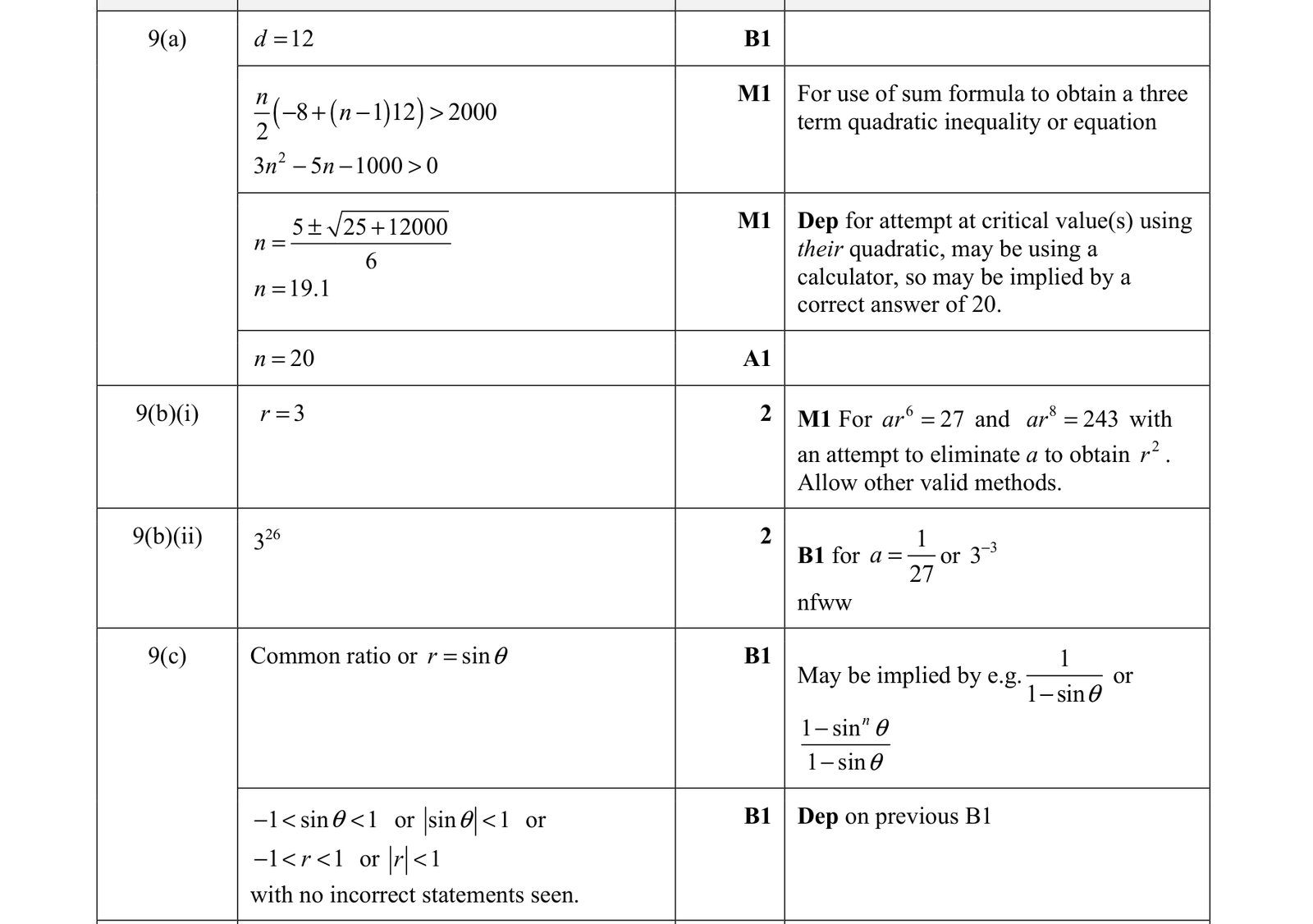
(a) The first three terms of an arithmetic progression are \(-4\), \(8\) and \(20\).
Find the smallest number of terms of this progression which have a sum greater than \(2000\).
(b) The \(7\)th term of a geometric progression is \(27\), and the \(9\)th term is \(243\). The common ratio is positive.
(i) Find the first term and the common ratio.
(ii) Find the \(30\)th term, giving your answer as a power of \(3\).
(c) Explain why the geometric progression
\(1,\ \sin\theta,\ \sin^2\theta,\ \sin^3\theta,\ldots\)
has a sum to infinity for \(-\frac{\pi}{2}\lt \theta\lt \frac{\pi}{2}\).
0606 P21 - Jun 2021 - Q11 - 10 marks
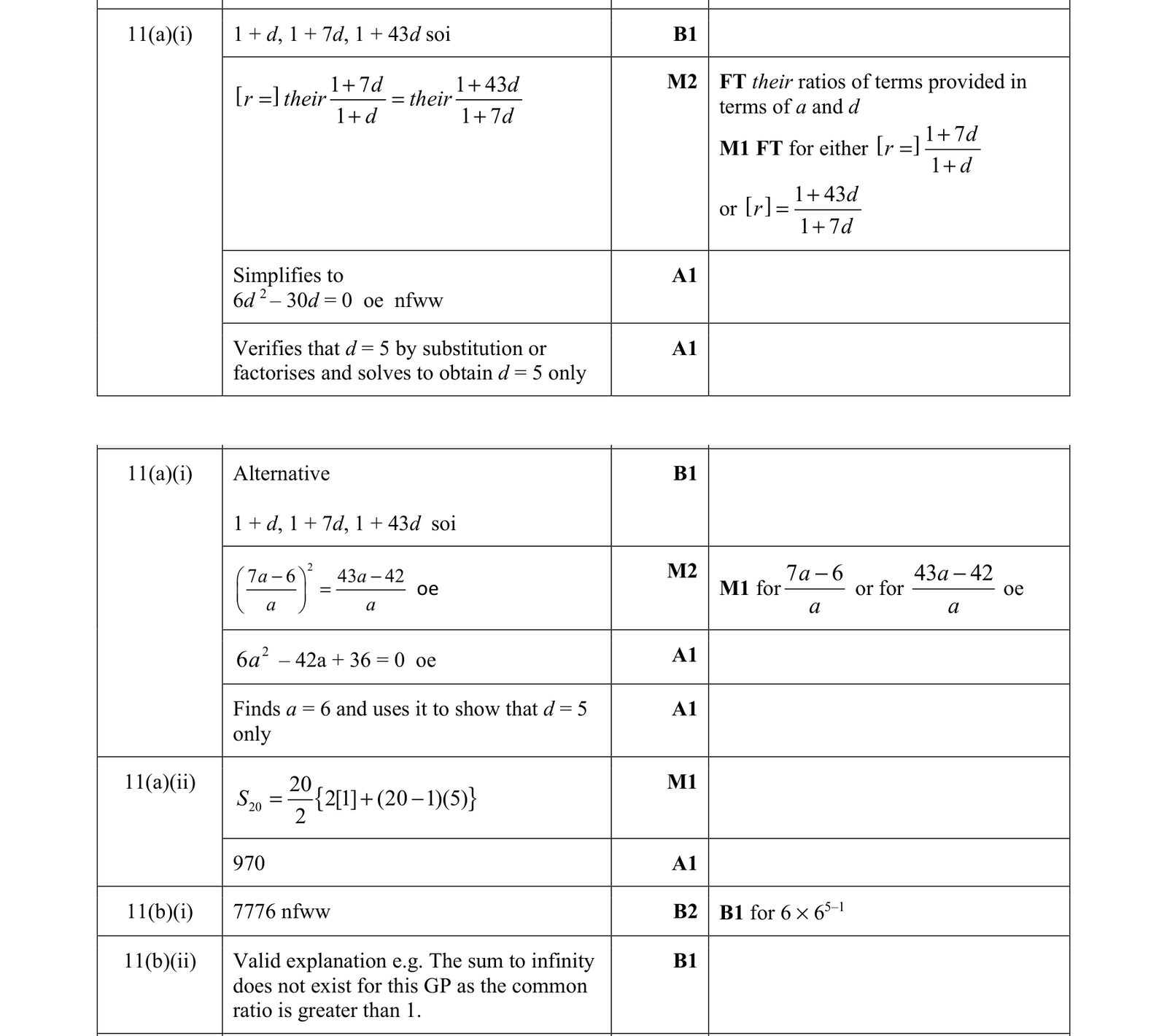
The \(2\)nd, \(8\)th and \(44\)th terms of an arithmetic progression form the first three terms of a geometric progression. In the arithmetic progression, the first term is \(1\) and the common difference is positive.
(a)
(i) Show that the common difference of the arithmetic progression is \(5\).
(ii) Find the sum of the first \(20\) terms of the arithmetic progression.
(b)
(i) Find the \(5\)th term of the geometric progression.
(ii) Explain whether or not the sum to infinity of this geometric progression exists.
0606 P23 - Jun 2021 - Q11 - 10 marks
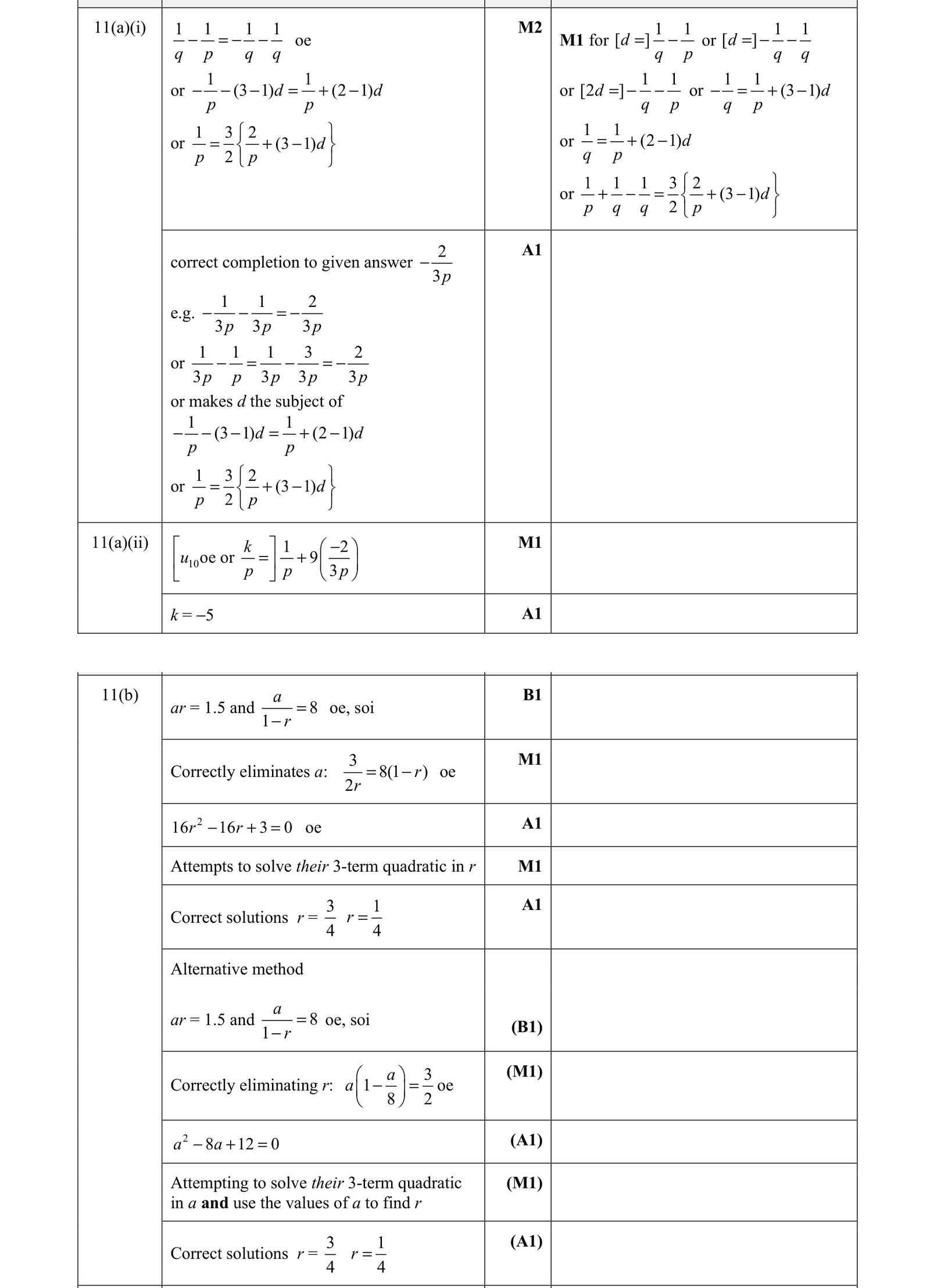
(a) The first three terms of an arithmetic progression are
\(\frac1p,\quad \frac1q,\quad -\frac1q.\)
(i) Show that the common difference can be written as
\(-\frac2{3p}.\)
(ii) The \(10\)th term of the progression is \(\frac{k}{p}\), where \(k\) is a constant. Find \(k\).
(b) The sum to infinity of a geometric progression is \(8\). The second term of the progression is \(\frac32\). Find the two possible values of the common ratio.
0606 P11 - Nov 2021 - Q10 - 12 marks
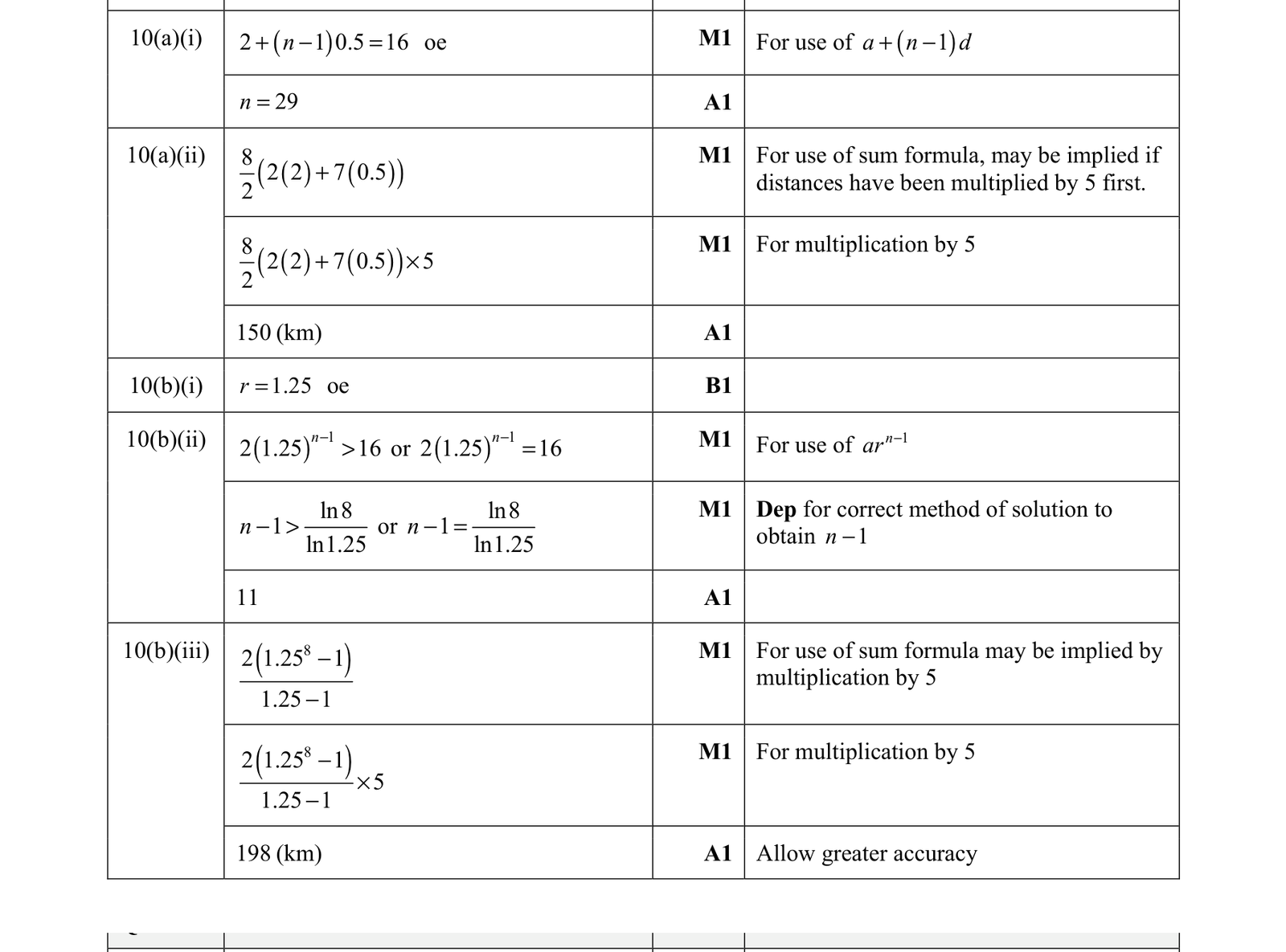
(a) Jess runs on 5 days each week to prepare for a race. In week 1, every run is \(2\text{ km}\). In week 2, every run is \(2.5\text{ km}\). In week 3, every run is \(3\text{ km}\). Jess increases the distance of the run by \(0.5\text{ km}\) every week.
(i) Find the week in which Jess runs \(16\text{ km}\) on each of the 5 days.
(ii) Find the total distance Jess will have run by the end of week 8.
(b) Kyle also runs on 5 days each week to prepare for a race. In week 1, every run is \(2\text{ km}\). In week 2, every run is \(2.5\text{ km}\). In week 3, every run is \(3.125\text{ km}\). The distances he runs each week form a geometric progression.
(i) Find the common ratio of the geometric progression.
(ii) Find the first week in which Kyle will run more than \(16\text{ km}\) on each of the 5 days.
(iii) Find the total distance Kyle will have run by the end of week 8.
0606 P22 - Nov 2021 - Q10 - 10 marks
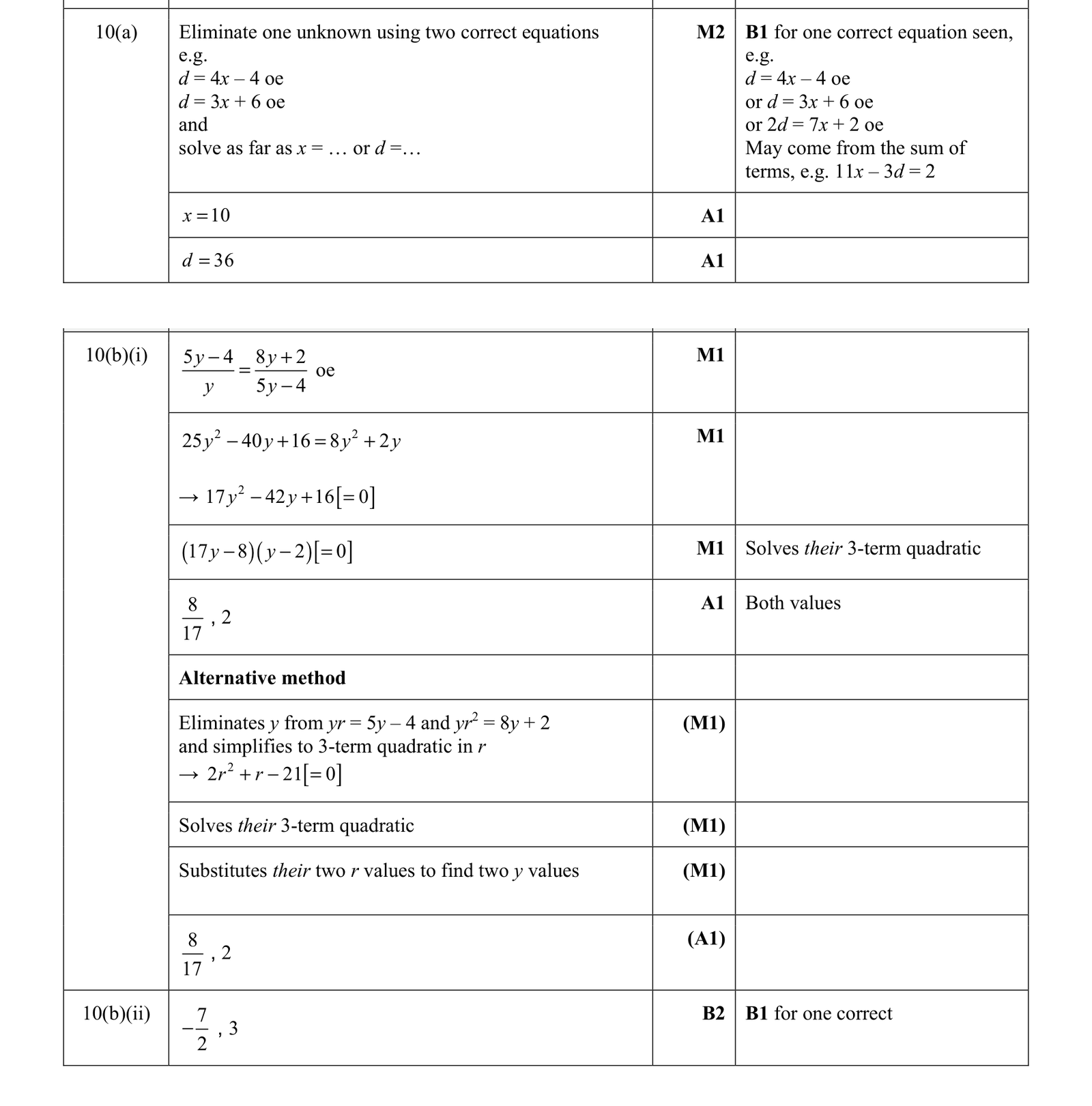
(a) The first three terms of an arithmetic progression are \(x\), \(5x-4\) and \(8x+2\). Find \(x\) and the common difference.
(b) The first three terms of a geometric progression are \(y\), \(5y-4\) and \(8y+2\).
(i) Find the two possible values of \(y\).
(ii) For each of these values of \(y\), find the corresponding value of the common ratio.
0606 P22 - Mar 2020 - Q13 - 10 marks
(a) The sum of the first two terms of a geometric progression is \(10\). The third term is \(9\). Find the possible values of the common ratio and the corresponding first terms. For the convergent progression, find the sum to infinity.
(b) An arithmetic progression has first term \(-10\) and fourth term \(14\). Find the value of
\(u_{100}+u_{101}+\cdots+u_{200}.\)

0606 P11 - Jun 2020 - Q9 - 12 marks
(a) An arithmetic progression has a second term of \(-14\) and a sum to \(21\) terms of \(84\). Find the first term and the \(21\)st term of this progression.
(b) A geometric progression has a second term of \(27p^2\) and a fifth term of \(p^5\). The common ratio, \(r\), is such that \(0\lt r\lt1\).
(i) Find \(r\) in terms of \(p\).
(ii) Hence find, in terms of \(p\), the sum to infinity of the progression.
(iii) Given that the sum to infinity is \(81\), find the value of \(p\).

0606 P13 - Jun 2020 - Q8 - 8 marks
(a) An arithmetic progression has a first term of \(7\) and a common difference of \(0.4\). Find the least number of terms so that the sum of the progression is greater than \(300\).
(b) The sum of the first two terms of a geometric progression is \(9\) and its sum to infinity is \(36\). Given that the terms of the progression are positive, find the common ratio.

0606 P22 - Jun 2020 - Q10 - 11 marks
(a) The first 5 terms of a sequence are
\(4,\quad -2,\quad 1,\quad -0.5,\quad 0.25.\)
(i) Find the 20th term of the sequence.
(ii) Explain why the sum to infinity exists for this sequence and find the value of this sum.
(b) The tenth term of an arithmetic progression is 15 times the second term. The sum of the first 6 terms of the progression is 87.
(i) Find the common difference of the progression.
(ii) For this progression, the \(n\)th term is 6990. Find the value of \(n\).

0606 P11 - Nov 2020 - Q10 - 12 marks
(a) An arithmetic progression has a second term of \(8\) and a fourth term of \(18\). Find the least number of terms for which the sum of this progression is greater than \(1560\).
(b) A geometric progression has a sum to infinity of \(72\). The sum of the first \(3\) terms of this progression is \(\dfrac{333}{8}\).
(i) Find the value of the common ratio.
(ii) Hence find the value of the first term.

0606 P23 - Nov 2020 - Q10 - 11 marks
The sum of the first 4 terms of an arithmetic progression is \(38\). The sum of the next 4 terms is \(86\). Find the first term and common difference of the arithmetic progression.
The third term of a geometric progression is \(12\), and the sixth term is \(-96\). Find the sum of the first 10 terms of the geometric progression.

9709 P32 - Mar 2026 - Q1
Solve the equation \(4\times2^{x+2}-5\times2^{2-x}=3\). Give your answer correct to \(3\) significant figures.
9709 P32 - Mar 2026 - Q2
The complex number \(z\) satisfies \(|z|=9\) and \(\frac12\pi\leq \arg z<\pi\).
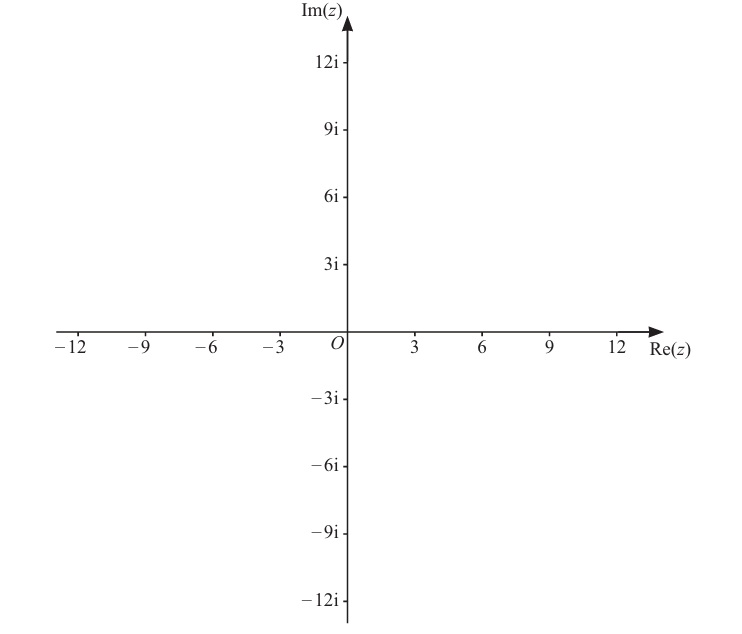
(a) On the Argand diagram, sketch the locus of the points representing \(z\).
(b) On the same diagram, sketch the locus of the points representing \(z^*+3\).