Past Exam Questions
← Back9231 P41 - Nov 2022 - Q4 - 8 marks
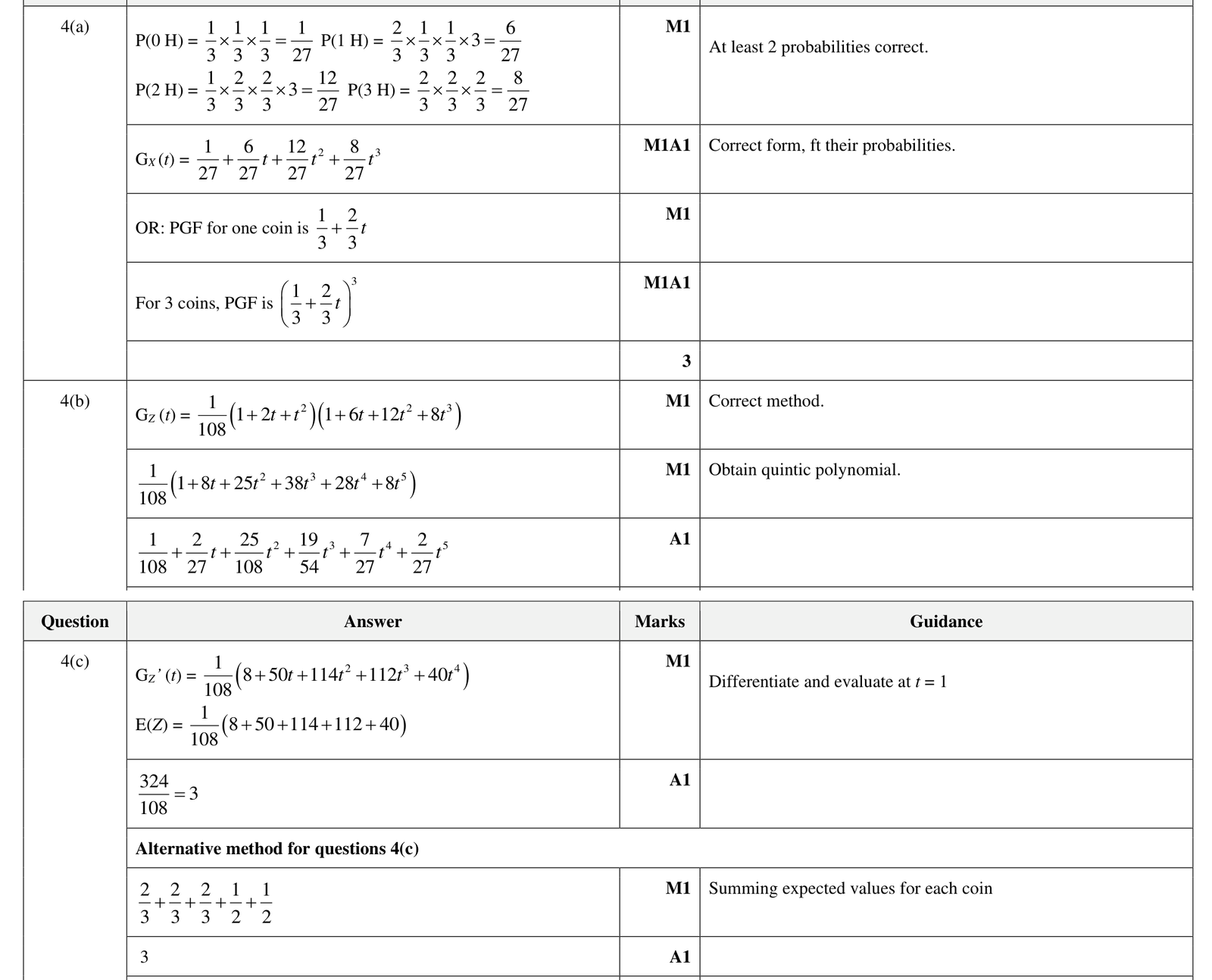
Jason has three biased coins. For each coin the probability of obtaining a head when it is thrown is \(\frac{2}{3}\). Jason throws all three coins. The number of heads obtained is denoted by \(X\).
(a) Find the probability generating function \(G_X(t)\) of \(X\).
Jason also has two unbiased coins. He throws all five coins. The number of heads obtained from the two unbiased coins is denoted by \(Y\). It is given that \(G_Y(t)=\frac14+\frac12t+\frac14t^2\). The random variable \(Z\) is the total number of heads obtained when Jason throws all five coins.
(b) Find the probability generating function of \(Z\), expressing your answer as a polynomial.
(c) Find \(E(Z)\).
9231 P41 - Jun 2021 - Q6 - 12 marks
Tanji has a bag containing 4 red balls and 2 blue balls. He selects 3 balls at random from the bag, without replacement. The number of red balls selected by Tanji is denoted by \(X\).
(a) Find the probability generating function \(\mathrm{G}_{X}(t)\) of \(X\).
Tanji also has two coins, each biased so that the probability of obtaining a head when it is thrown is \(\frac{1}{4}\). He throws the two coins at the same time. The number of heads obtained is denoted by \(Y\).
(b) Find the probability generating function \(\mathrm{G}_{Y}(t)\) of \(Y\).
The random variable \(Z\) is the sum of the number of red balls selected by Tanji and the number of heads obtained.
(c) Find the probability generating function of \(Z\), expressing your answer as a polynomial.
(d) Use the probability generating function of \(Z\) to find \(\mathrm{E}(Z)\) and \(\operatorname{Var}(Z)\).

9231 P43 - Jun 2021 - Q4 - 8 marks
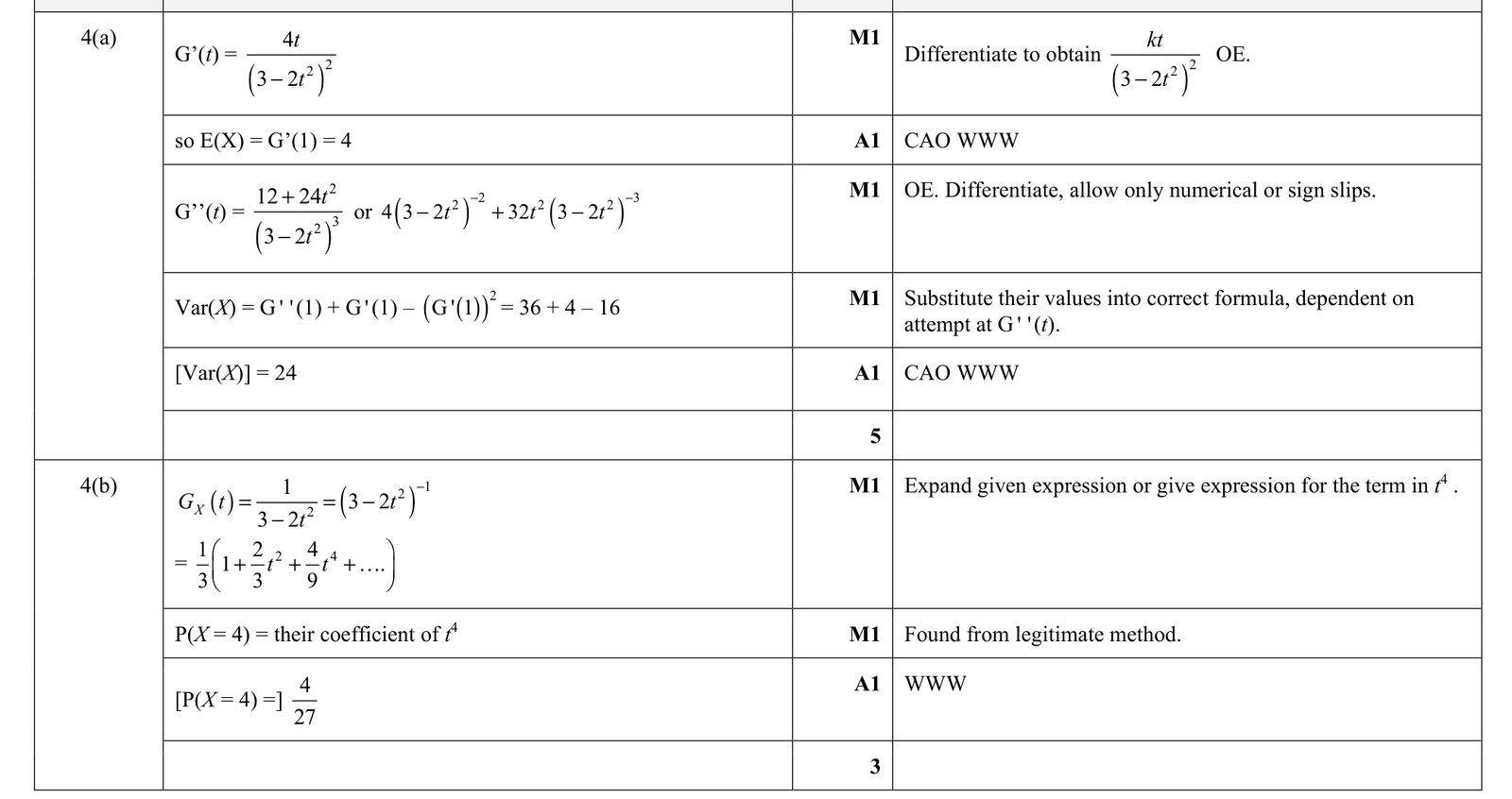
\(X\) is a discrete random variable which takes the values \(0,2,4, \ldots\). The probability generating function of \(X\) is given by
\(\mathrm{G}_{X}(t)=\frac{1}{3-2 t^{2}} .\)
(a) Find \(\mathrm{E}(X)\) and \(\operatorname{Var}(X)\).
(b) Find \(\mathrm{P}(X=4)\).
9231 P41 - Nov 2021 - Q5 - 10 marks
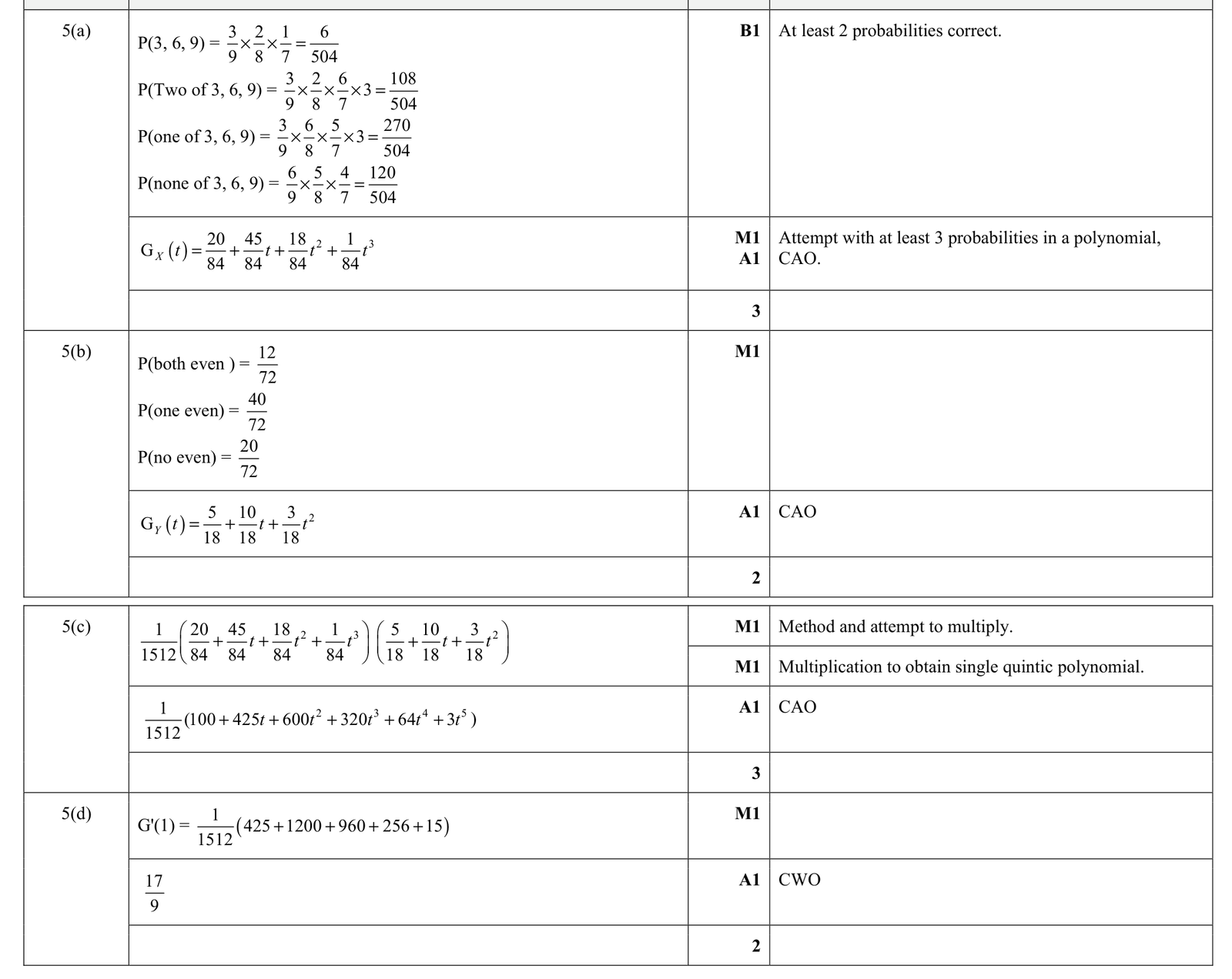
Nine balls labelled \(1,2,3,4,5,6,7,8,9\) are placed in a bag. Kai selects three balls at random from the bag, without replacement. The random variable \(X\) is the number of balls selected by Kai that are labelled with a multiple of 3 .
(a) Find the probability generating function \(\mathrm{G}_{X}(t)\) of \(X\).
The balls are replaced in the bag.
Jacob now selects two balls at random from the bag, without replacement. The random variable \(Y\) is the number of balls selected by Jacob that are labelled with an even number.
(b) Find the probability generating function \(\mathrm{G}_{Y}(t)\) of \(Y\).
The random variable \(Z\) is the sum of the number of balls that are labelled with a multiple of 3 selected by Kai and the number of balls that are labelled with an even number selected by Jacob.
(c) Find the probability generating function of \(Z\), expressing your answer as a polynomial.
(d) Use the probability generating function of \(Z\) to find \(\mathrm{E}(Z)\).
9231 P42 - Nov 2021 - Q5 - 9 marks
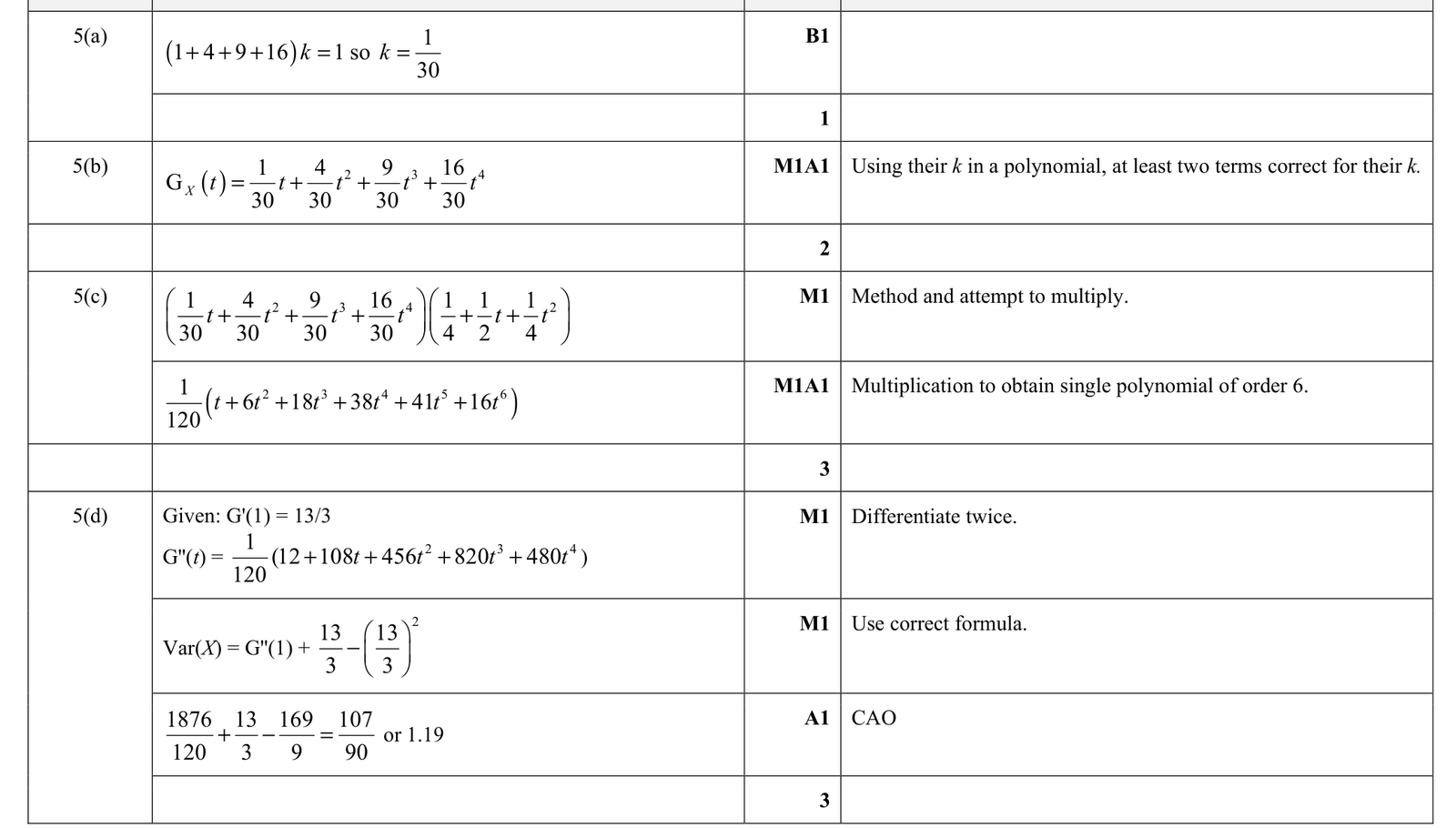
The random variable \(X\) is such that \(\mathrm{P}(X=r)=k r^{2}\) for \(r=1,2,3,4\), where \(k\) is a constant.
(a) Find the value of \(k\).
(b) Find the probability generating function \(\mathrm{G}_{X}(t)\) of \(X\).
The random variable \(Y\) has probability generating function \(\mathrm{G}_{Y}(t)=\frac{1}{4}+\frac{1}{2} t+\frac{1}{4} t^{2}\).
The random variable \(Z\) is the sum of \(X\) and \(Y\).
(c) Assuming that \(X\) and \(Y\) are independent, find the probability generating function \(\mathrm{G}_{Z}(t)\) of \(Z\) as a polynomial in \(t\).
(d) Given that \(\mathrm{E}(Z)=\frac{13}{3}\), use \(\mathrm{G}_{Z}(t)\) to find \(\operatorname{Var}(Z)\).
9231 P41 - Jun 2020 - Q6 - 10 marks
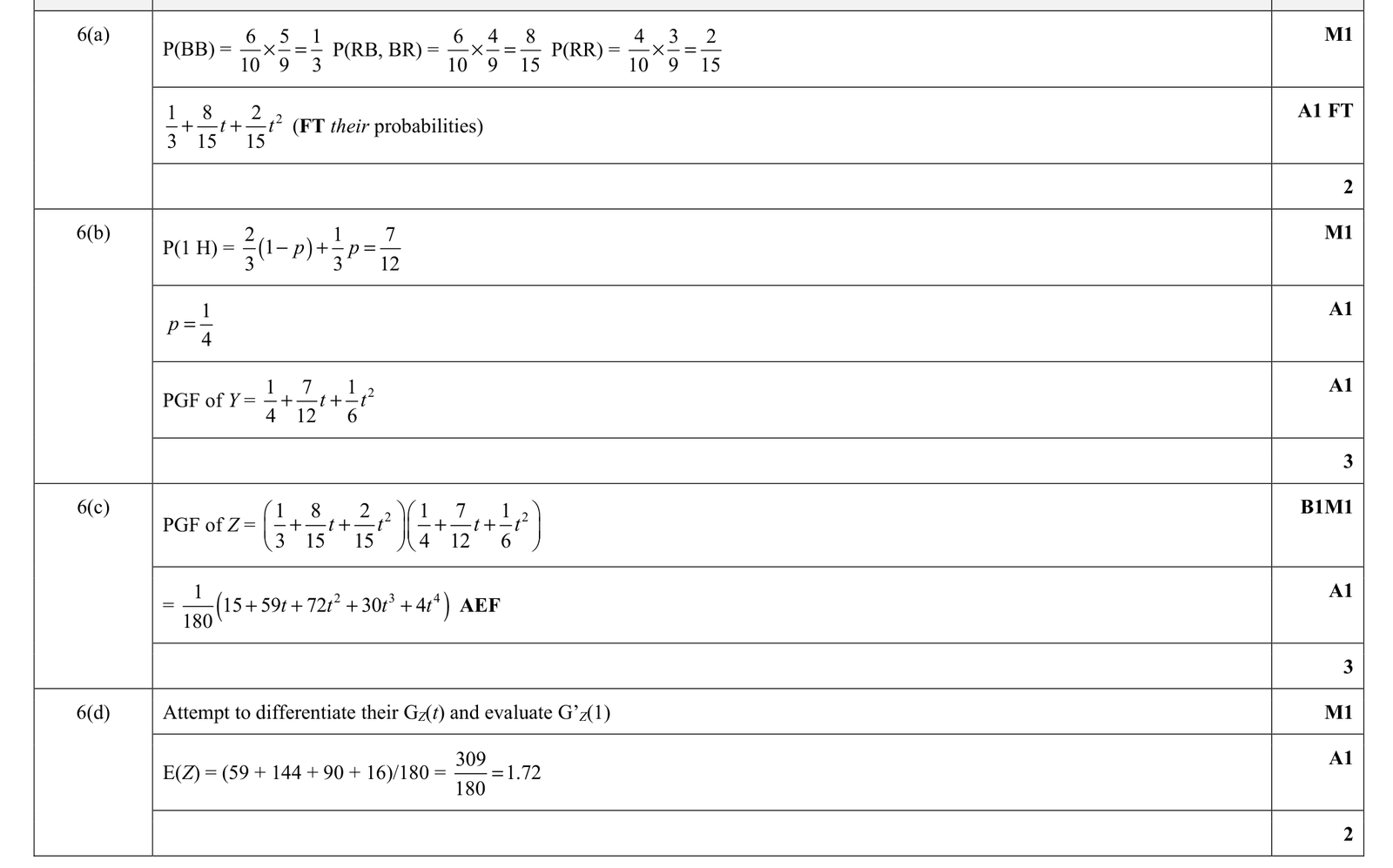
A bag contains 4 red balls and 6 blue balls. Rassa selects two balls at random, without replacement, from the bag. The number of red balls selected by Rassa is denoted by \(X\).
(a) Find the probability generating function, \(\mathrm{G}_{X}(t)\), of \(X\).
Rassa also tosses two coins. One coin is biased so that the probability of a head is \(\frac{2}{3}\). The other coin is biased so that the probability of a head is \(p\). The probability generating function of \(Y\), the number of heads obtained by Rassa, is \(\mathrm{G}_{Y}(t)\). The coefficient of \(t\) in \(\mathrm{G}_{Y}(t)\) is \(\frac{7}{12}\).
(b) Find \(\mathrm{G}_{Y}(t)\).
The random variable \(Z\) is the sum of the number of red balls selected and the number of heads obtained by Rassa.
(c) Find the probability generating function of \(Z\), expressing your answer as a polynomial.
(d) Use the probability generating function of \(Z\) to find \(\mathrm{E}(Z)\).
9231 P41 - Nov 2020 - Q5 - 10 marks
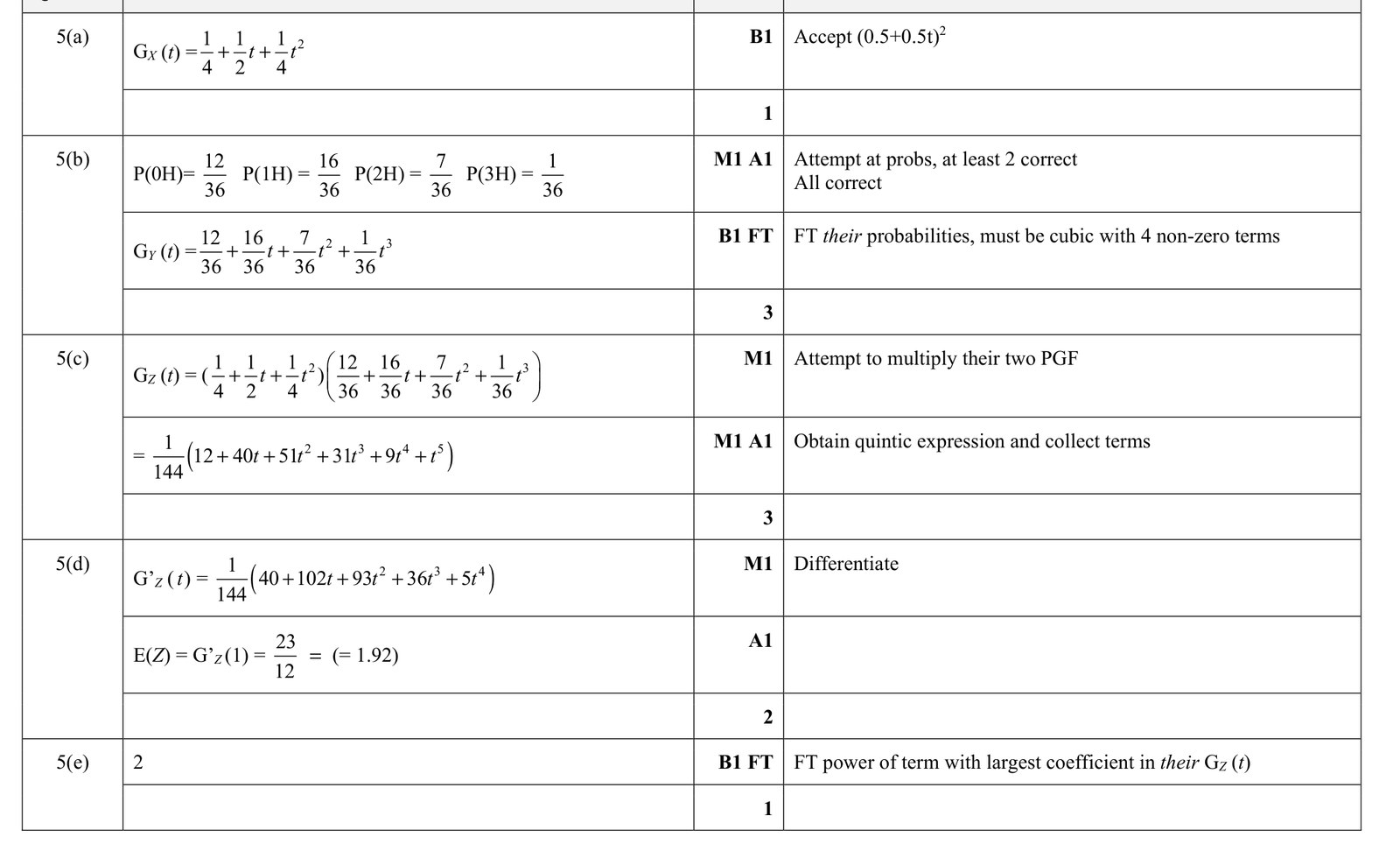
Keira has two unbiased coins. She tosses both coins. The number of heads obtained by Keira is denoted by \(X\).
(a) Find the probability generating function \(\mathrm{G}_{X}(t)\) of \(X\).
Hassan has three coins, two of which are biased so that the probability of obtaining a head when the coin is tossed is \(\frac{1}{3}\). The corresponding probability for the third coin is \(\frac{1}{4}\). The number of heads obtained by Hassan when he tosses these three coins is denoted by \(Y\).
(b) Find the probability generating function \(\mathrm{G}_{Y}(t)\) of \(Y\).
The random variable \(Z\) is the total number of heads obtained by Keira and Hassan.
(c) Find the probability generating function of \(Z\), expressing your answer as a polynomial.
(d) Use the probability generating function of \(Z\) to find \(\mathrm{E}(Z)\).
(e) Use the probability generating function of \(Z\) to find the most probable value of \(Z\).
9231 P42 - Nov 2020 - Q5 - 8 marks
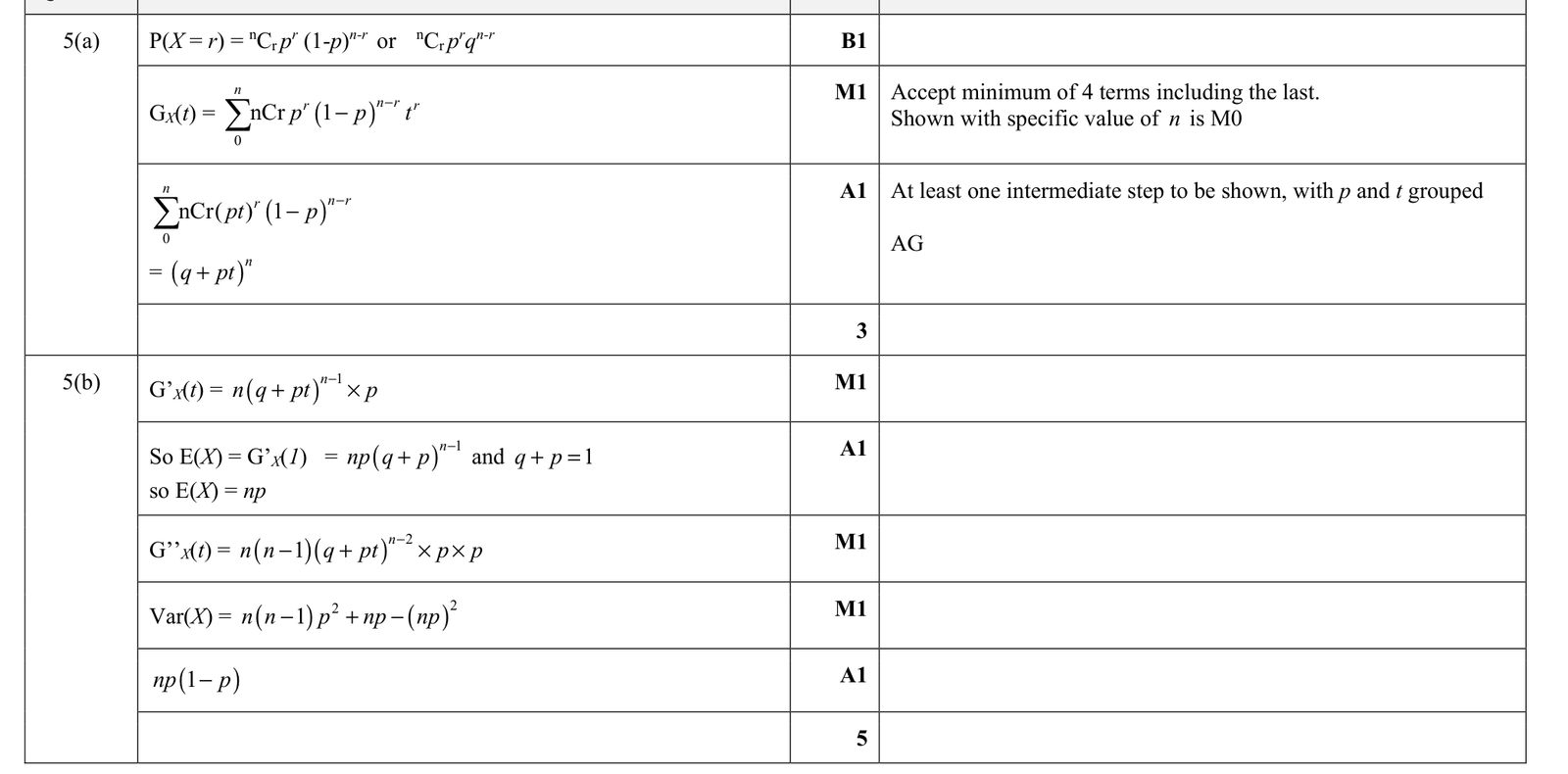
The random variable \(X\) has the binomial distribution \(\mathrm{B}(n, p)\).
(a) Write down an expression for \(\mathrm{P}(X=r)\) and hence show that the probability generating function of \(X\) is \((q+p t)^{n}\), where \(q=1-p\).
(b) Use the probability generating function of \(X\) to prove that \(\mathrm{E}(X)=n p\) and \(\operatorname{Var}(X)=n p(1-p)\).
9231 P41 - Nov 2024 - Q5 - 9 marks
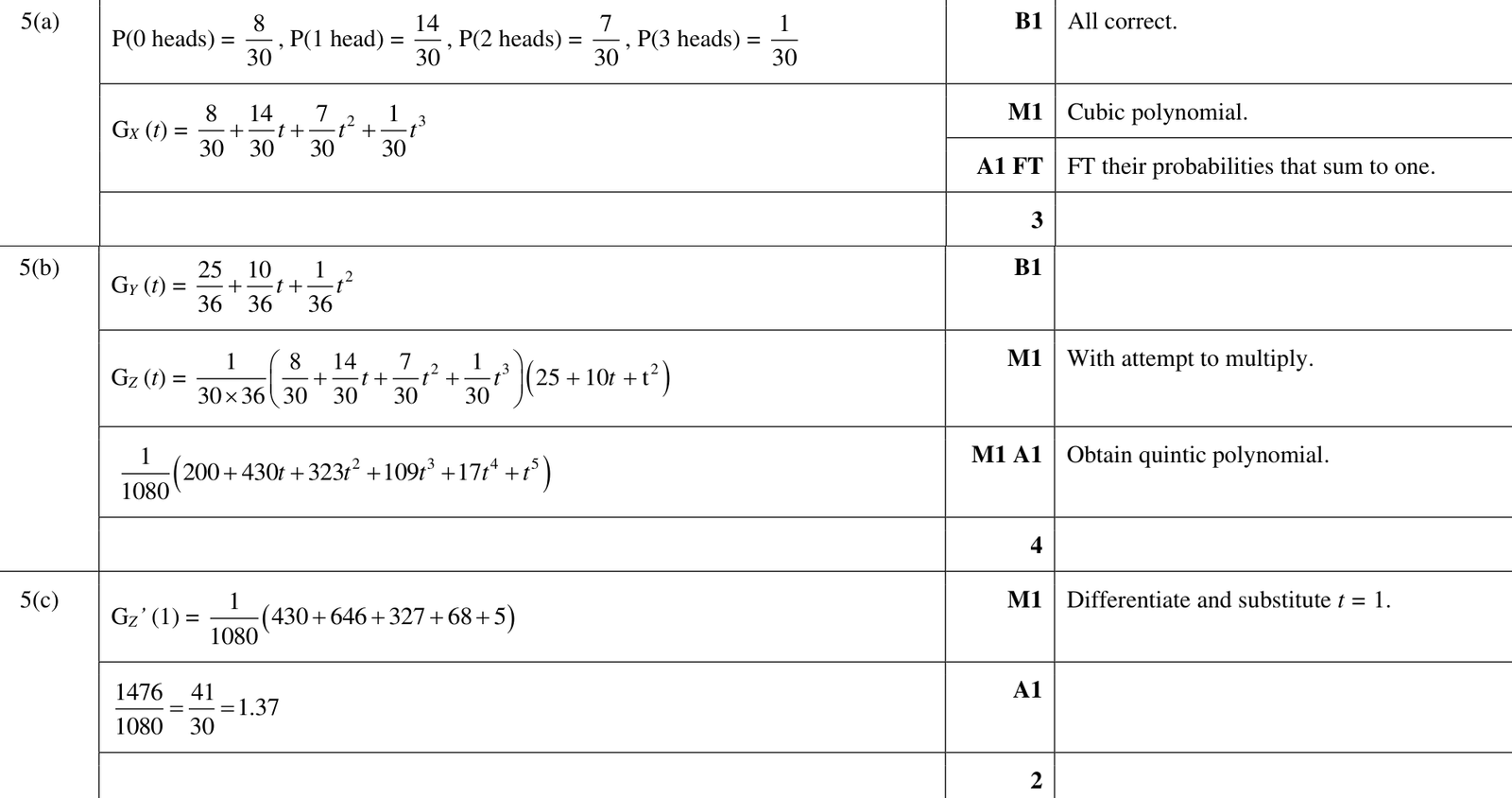
Nikita has three coins. One coin is fair, one coin is biased so that the probability of obtaining a head is \(\frac{1}{3}\) and the third coin is biased so that the probability of obtaining a head is \(\frac{1}{5}\). The random variable \(X\) is the number of heads that Nikita obtains when he throws all three coins at the same time.
(a) Find the probability generating function of \(X\).
Rajesh has two fair six-sided dice with faces labelled 1, 2, 3, 4, 5, 6. The random variable \(Y\) is the number of 4 s that Rajesh obtains when he throws the two dice.
The random variable \(Z\) is the sum of the number of heads obtained by Nikita and the number of 4 s obtained by Rajesh.
(b) Find the probability generating function of \(Z\), expressing your answer as a polynomial.
(c) Use your answer to part (b) to find \(\mathrm{E}(Z)\).
9231 P42 - Nov 2024 - Q2 - 8 marks
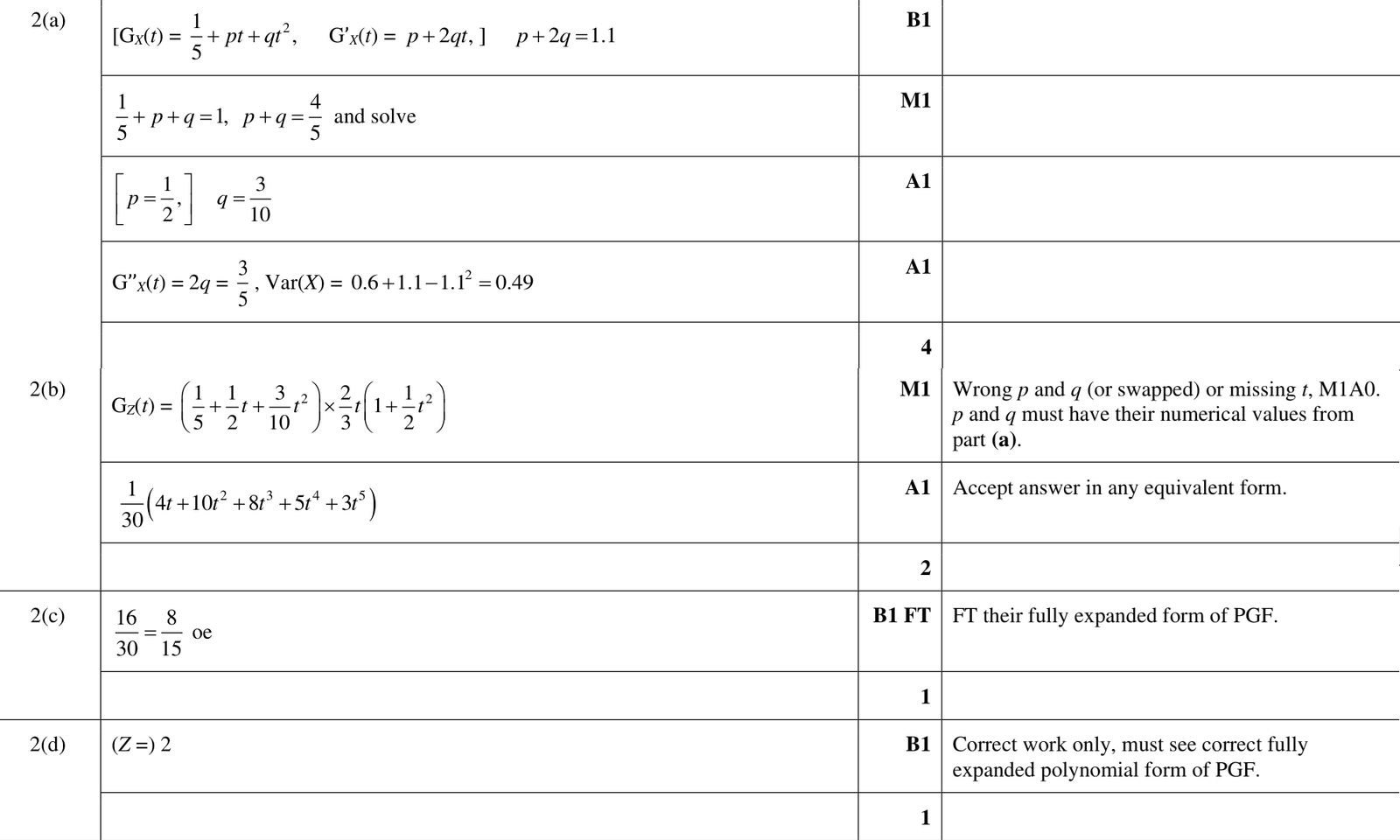
The random variable \(X\) has probability generating function \(\mathrm{G}_{X}(t)\) given by
\(\mathrm{G}_{X}(t)=\frac{1}{5}+p t+q t^{2}\)
where \(p\) and \(q\) are constants.
(a) Given that \(\mathrm{E}(X)=1.1\), find the numerical value of \(\operatorname{Var}(X)\).
The random variable \(Y\) has probability generating function \(\mathrm{G}_{Y}(t)\) given by
\(\mathrm{G}_{Y}(t)=\frac{2}{3} t\left(1+\frac{1}{2} t^{2}\right) .\)
The random variable \(Z\) is the sum of independent observations of \(X\) and \(Y\).
(b) Find the probability generating function of \(Z\).
(c) Find \(\mathrm{P}(Z\gt 2)\).
(d) State the most probable value of \(Z\).
9231 P44 - Jun 2025 - Q5 - 10 marks
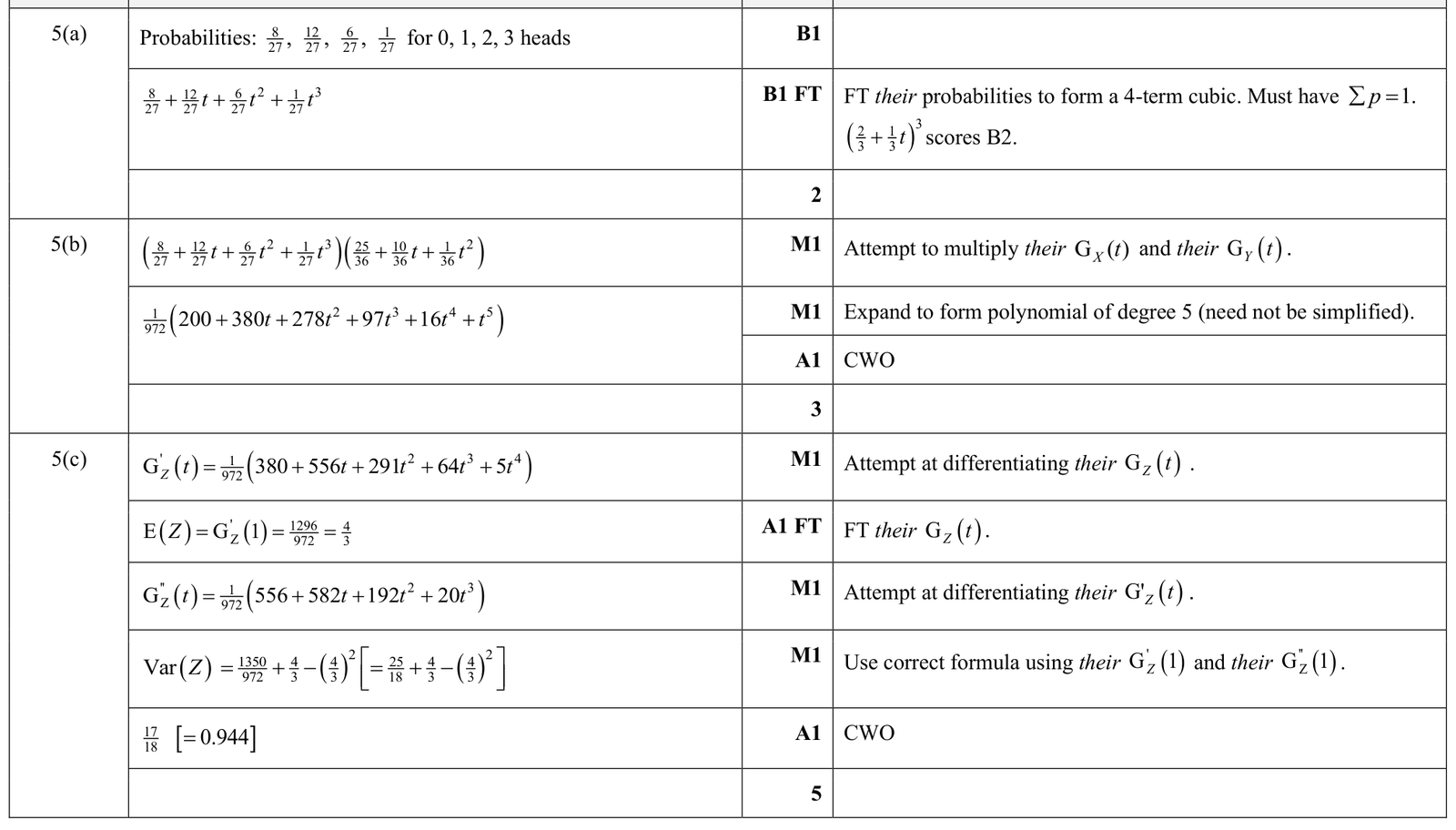
Eric has three identical coins, each of which is biased so that the probability of obtaining a head when it is thrown is \(\frac{1}{3}\). The random variable \(X\) is the number of heads obtained when Eric throws the three coins at the same time.
(a) Find the probability generating function \(\mathrm{G}_{X}(t)\) of \(X\).
Eric also has two fair 6 -sided dice with faces numbered 1 to 6 . The random variable \(Y\) is the number of sixes obtained when Eric throws the two dice at the same time. It is given that the probability generating function of \(Y\) is \(\frac{25}{36}+\frac{10}{36} t+\frac{1}{36} t^{2}\).
Eric throws the three coins and the two dice. The random variable \(Z\) is the sum of the number of heads obtained and the number of sixes obtained.
(b) Find the probability generating function \(\mathrm{G}_{Z}(t)\) of \(Z\), expressing your answer as a polynomial in \(t\).
ს EXWE
(c) Use \(\mathrm{G}_{Z}(t)\) to find \(\mathrm{E}(Z)\) and \(\operatorname{Var}(Z)\).
9231 P42 - Nov 2025 - Q6 - 10 marks
The discrete random variable \(X\) has probability generating function \(G_X(t)\) given by
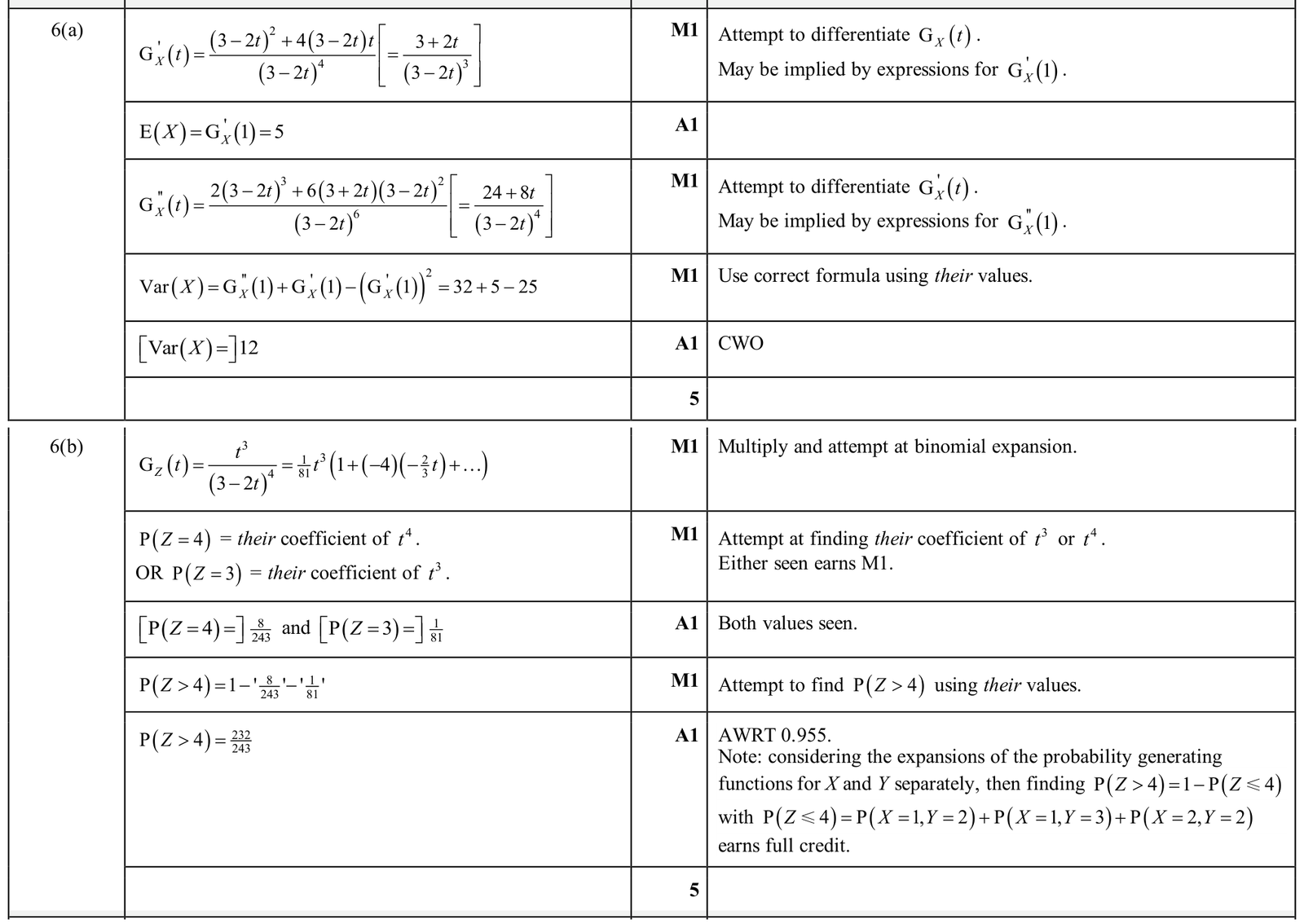
\(G_X(t)=\frac{t}{(3-2t)^2}\).
(a) Find \(\mathrm{E}(X)\) and \(\operatorname{Var}(X)\).
The discrete random variable \(Y\) has probability generating function \(G_Y(t)\) given by
\(G_Y(t)=\frac{t^2}{(3-2t)^2}\).
The random variable \(Z\) is the sum of the random variables \(X\) and \(Y\).
(b) Assuming \(X\) and \(Y\) are independent, find \(\mathrm{P}(Z\gt 4)\).
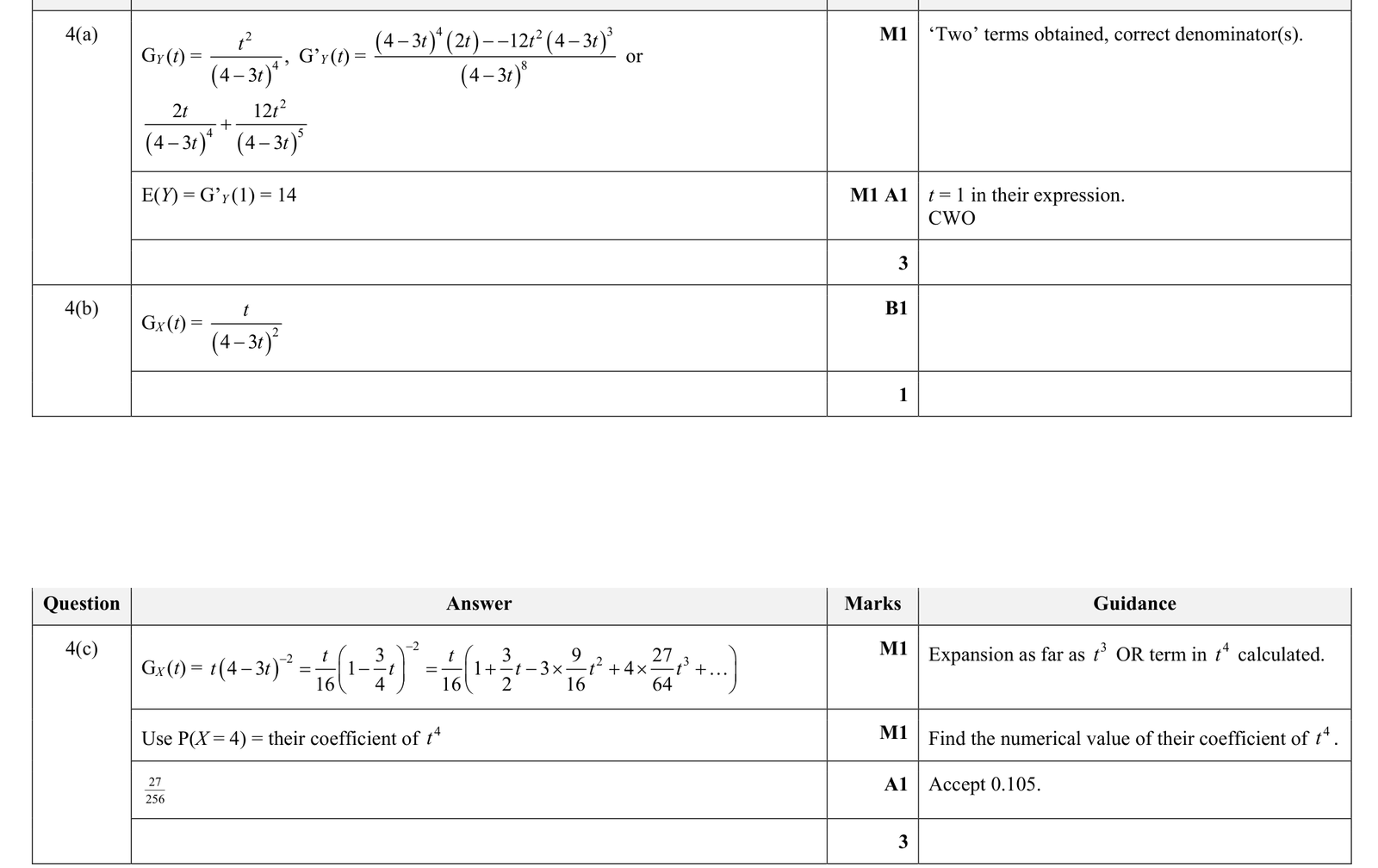
9231 P41 - Jun 2024 - Q4 - 7 marks
The random variable \(Y\) is the sum of two independent observations of the random variable \(X\). The probability generating function \(\mathrm{G}_{Y}(t)\) of \(Y\) is given by
\(\mathrm{G}_{Y}(t)=\frac{t^{2}}{(4-3 t)^{4}}\)
(a) Find \(E(Y)\).
(b) Write down an expression for the probability generating function of \(X\).
(c) Find \(\mathrm{P}(X=4)\).
9231 P43 - Jun 2024 - Q4 - 9 marks
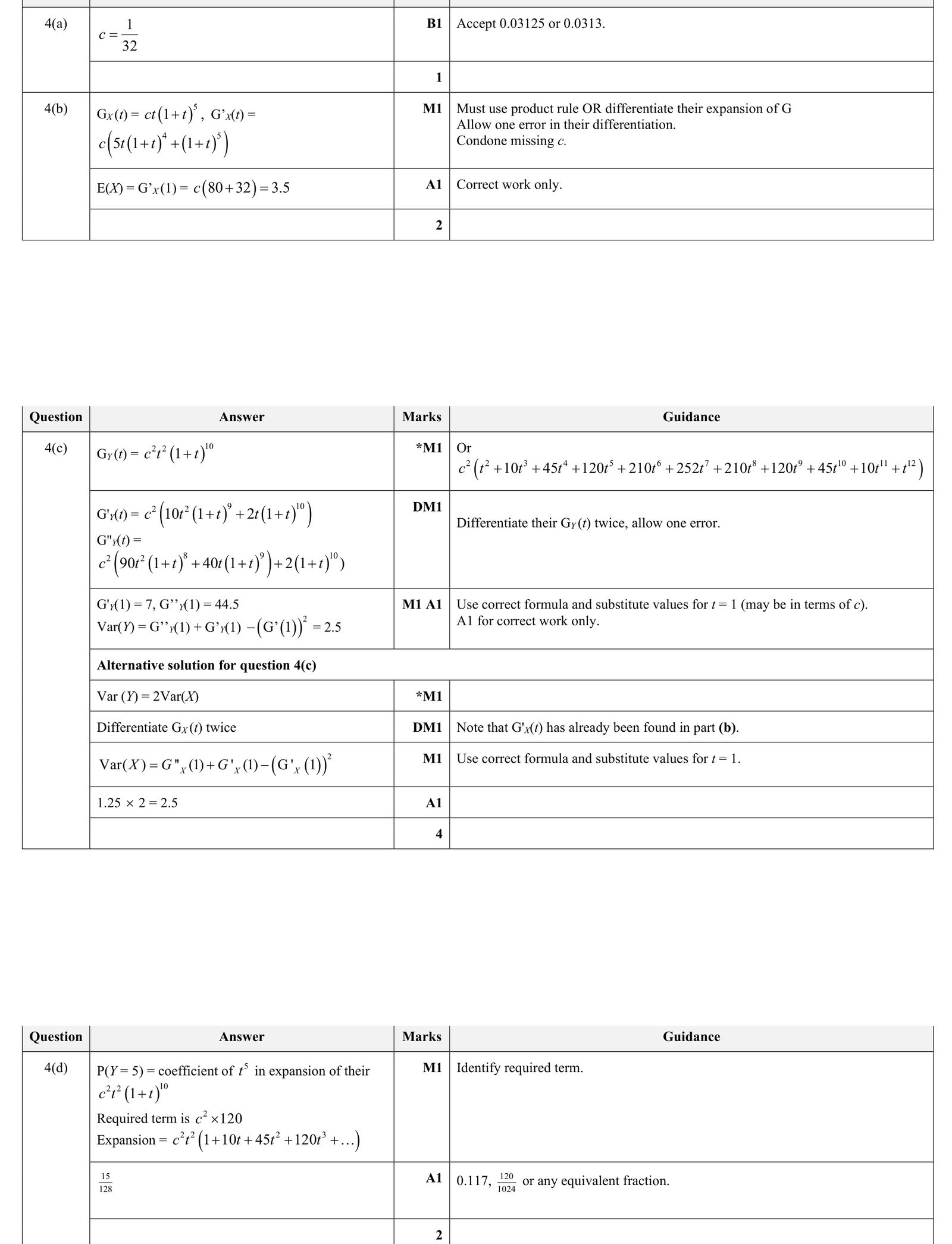
The random variable \(X\) has probability generating function \(\mathrm{G}_{X}(t)\) given by
\(\mathrm{G}_{X}(t)=\operatorname{ct}(1+t)^{5}\)
where \(c\) is a constant.
(a) Find the value of \(c\).
(b) Find the value of \(\mathrm{E}(X)\).
The random variable \(Y\) is the sum of two independent values of \(X\).
(c) Write down the probability generating function of \(Y\) and hence find \(\operatorname{Var}(Y)\).
(d) Find \(\mathrm{P}(Y=5)\).
9231 P41 - Nov 2023 - Q5 - 10 marks
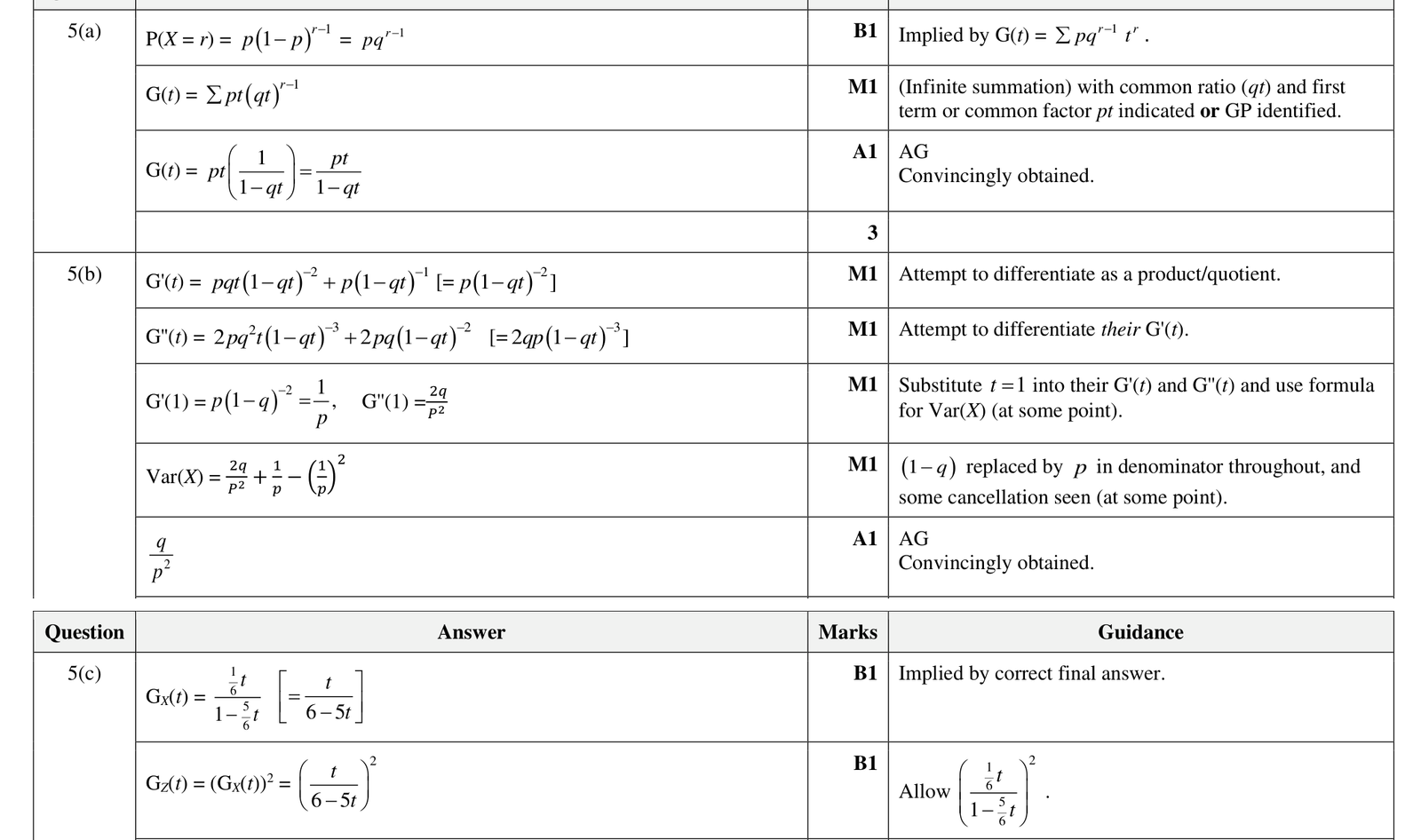
The random variable \(X\) has the geometric distribution \(\operatorname{Geo}(p)\).
(a) Show that the probability generating function of \(X\) is \(\frac{p t}{1-q t}\), where \(q=1-p\).
(b) Use the probability generating function of \(X\) to show that \(\operatorname{Var}(X)=\frac{q}{p^{2}}\).
Kenny throws an ordinary fair 6-sided dice repeatedly. The random variable \(X\) is the number of throws that Kenny takes in order to obtain a 6 . The random variable \(Z\) denotes the sum of two independent values of \(X\).
(c) Find the probability generating function of \(Z\).
9231 P42 - Nov 2023 - Q3 - 10 marks
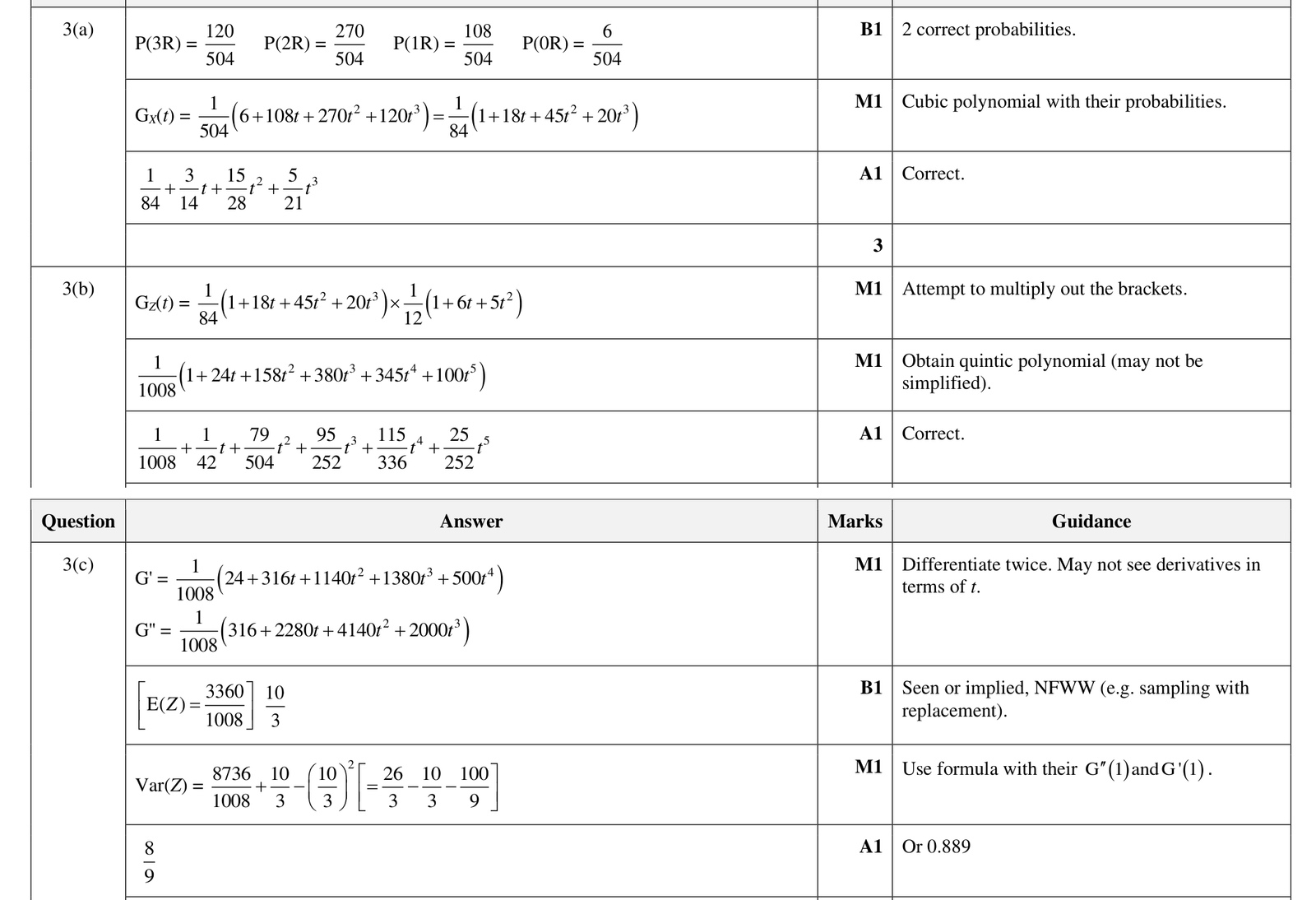
Toby has a bag which contains 6 red marbles and 3 green marbles. He randomly chooses 3 marbles from the bag, without replacement. The random variable \(X\) is the number of red marbles that Toby obtains.
(a) Find the probability generating function of \(X\).
Ling also has a bag which contains 6 red marbles and 3 green marbles. He randomly chooses 2 marbles from his bag, without replacement. The random variable \(Y\) is the number of red marbles that Ling obtains. It is given that the probability generating function of \(Y\) is \(\frac{1}{12}\left(1+6 t+5 t^{2}\right)\).
The random variable \(Z\) is the total number of red marbles that Toby and Ling obtain.
(b) Find the probability generating function of \(Z\), expressing your answer as a polynomial in \(t\).
(c) Use the probability generating function of \(Z\) to find \(\operatorname{Var}(Z)\).
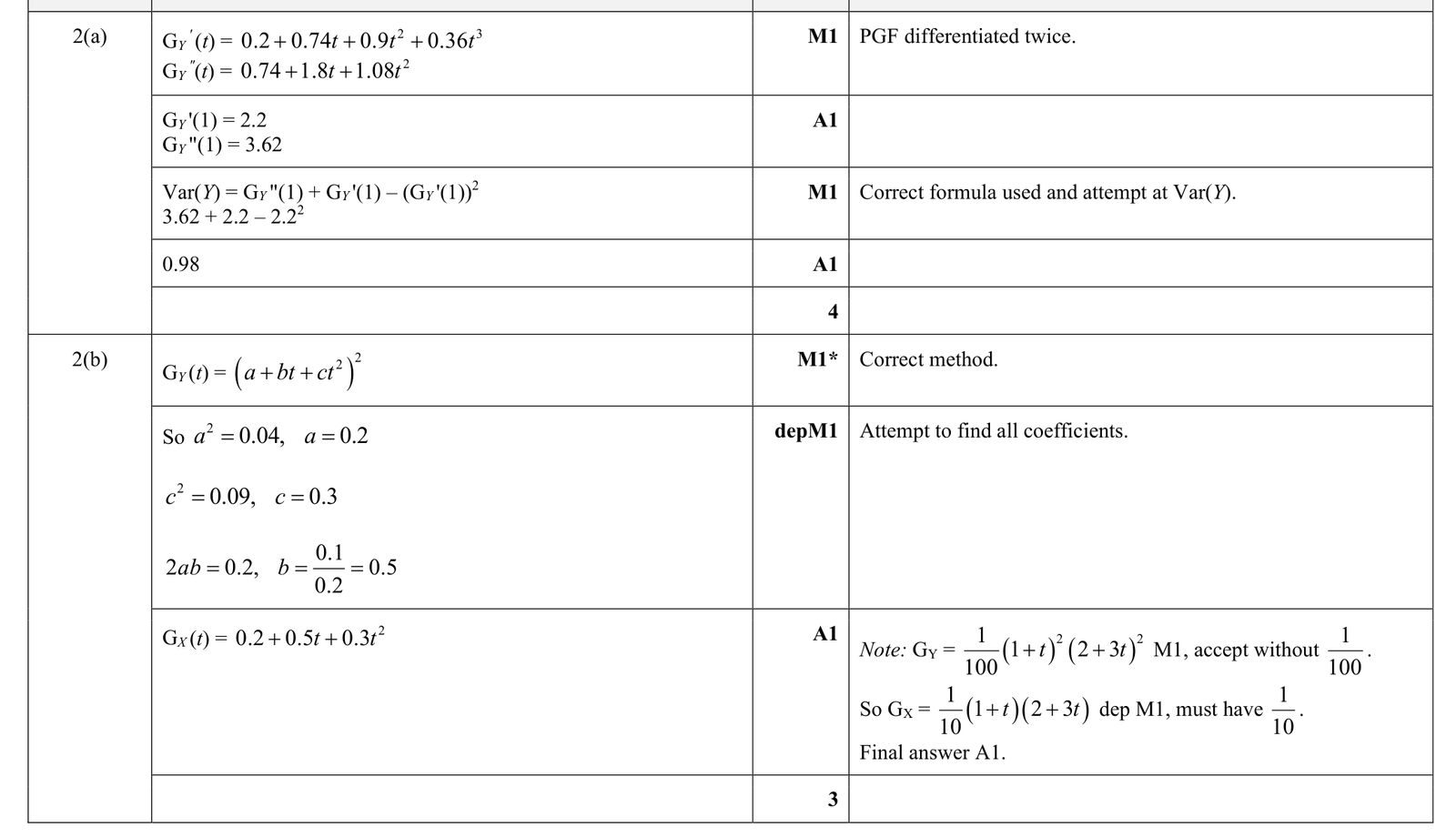
9231 P41 - Jun 2022 - Q2 - 7 marks
The probability generating function, \(\mathrm{G}_{Y}(t)\), of the random variable \(Y\) is given by
\(\mathrm{G}_{Y}(t)=0.04+0.2 t+0.37 t^{2}+0.3 t^{3}+0.09 t^{4}\)
(a) Find \(\operatorname{Var}(Y)\).
The random variable \(Y\) is the sum of two independent observations of the random variable \(X\).
(b) Find the probability generating function of \(X\), giving your answer as a polynomial in \(t\).
9231 P43 - Jun 2022 - Q3 - 8 marks
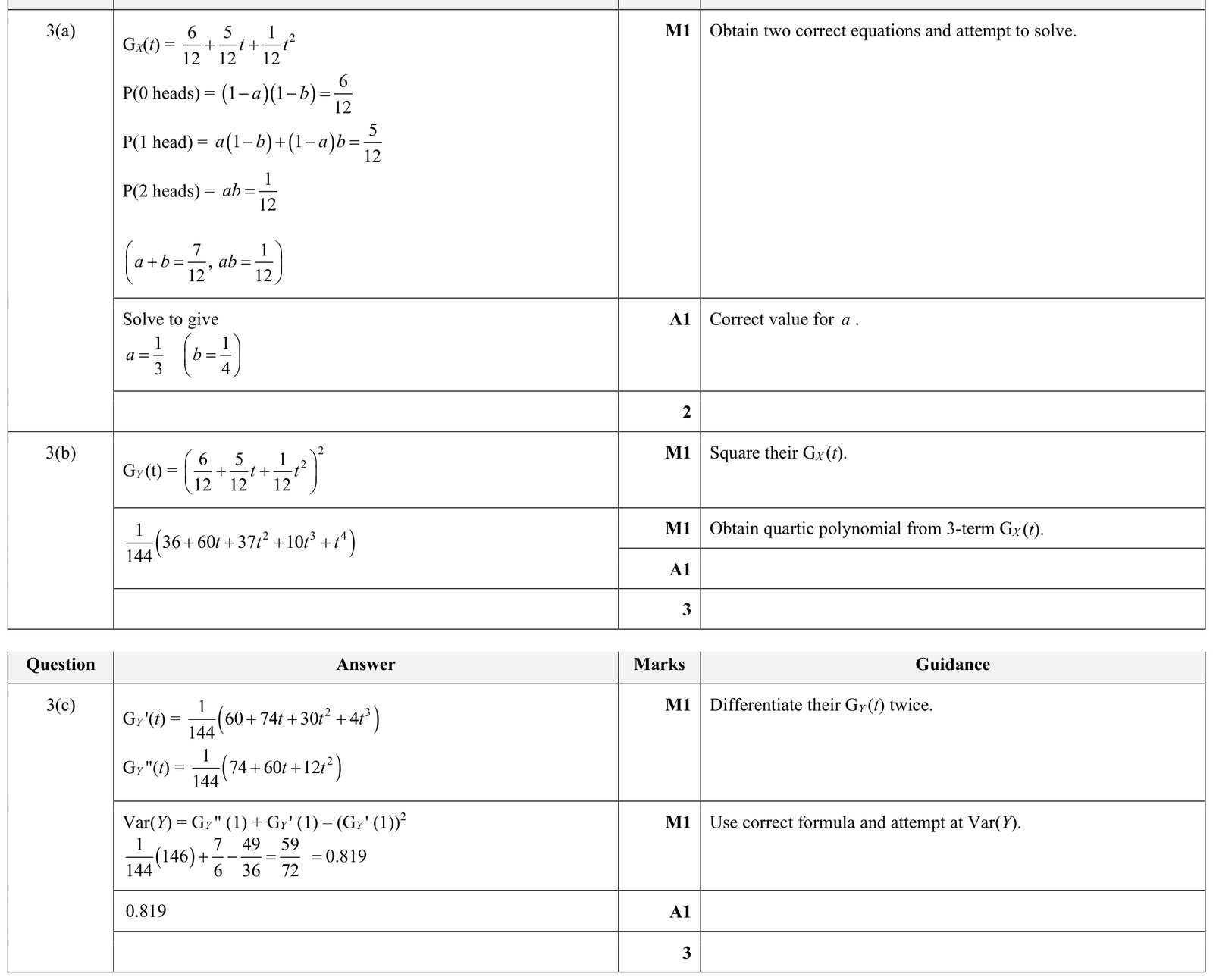
George throws two coins, \(A\) and \(B\), at the same time. Coin \(A\) is biased so that the probability of obtaining a head is \(a\). Coin \(B\) is biased so that the probability of obtaining a head is \(b\), where \(b\lt a\). The probability generating function of \(X\), the number of heads obtained by George, is \(\mathrm{G}_{X}(t)\). The coefficients of \(t\) and \(t^{2}\) in \(\mathrm{G}_{X}(t)\) are \(\frac{5}{12}\) and \(\frac{1}{12}\) respectively.
(a) Find the value of \(a\).
The random variable \(Y\) is the sum of two independent observations of \(X\).
(b) Find the probability generating function of \(Y\), giving your answer as a polynomial in \(t\).
(c) Find \(\operatorname{Var}(Y)\).
9231 P42 - Nov 2022 - Q5 - 9 marks
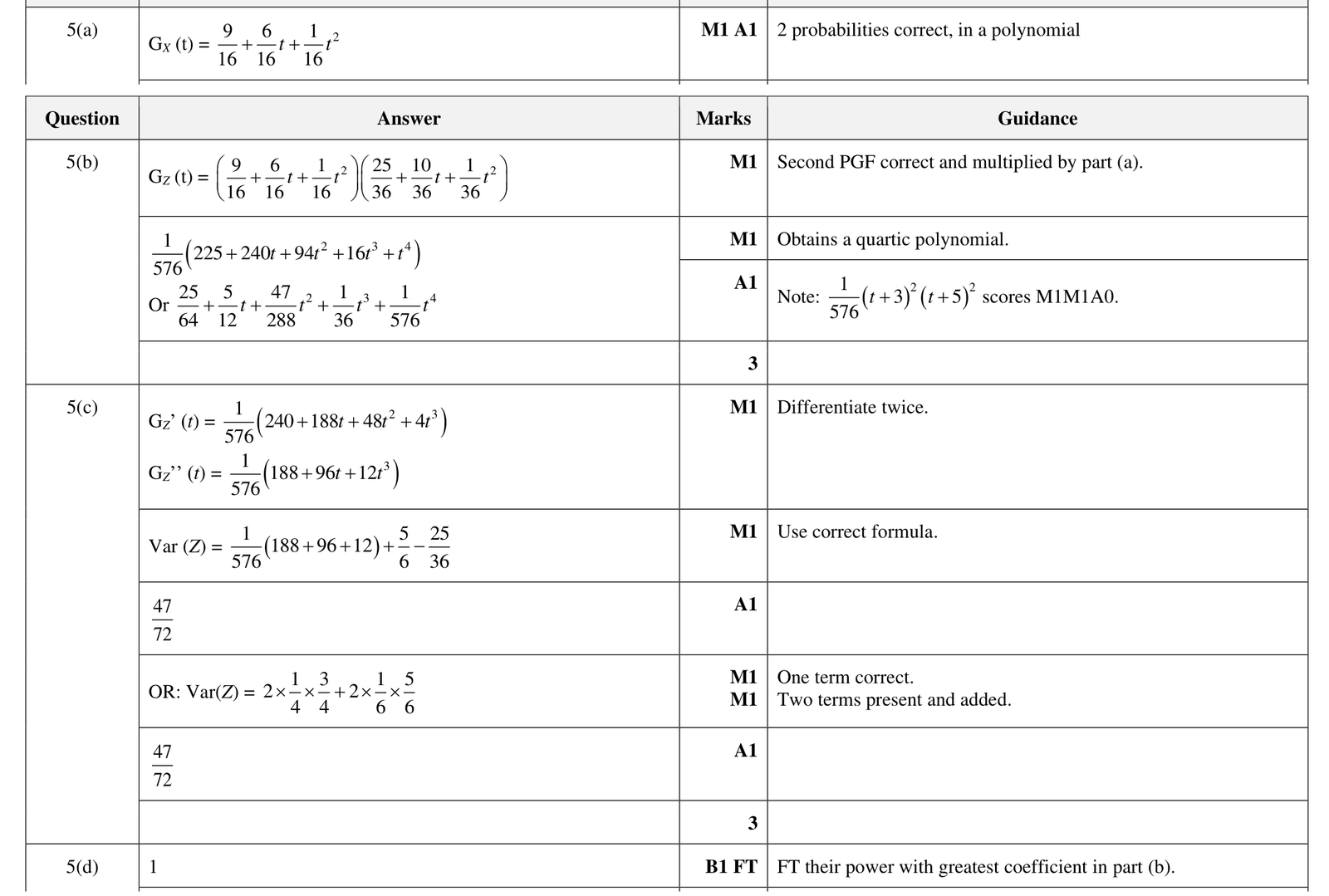
A 6-sided dice, \(A\), with faces numbered 1, 2, 3, 4, 5, 6 is biased so that the probability of throwing a 6 is \(\frac14\). The random variable \(X\) is the number of 6s obtained when dice \(A\) is thrown twice.
(a) Find the probability generating function of \(X\).
A second dice, \(B\), with faces numbered 1, 2, 3, 4, 5, 6 is unbiased. The random variable \(Y\) is the number of 6s obtained when dice \(B\) is thrown twice.
The random variable \(Z\) is the total number of 6s obtained when both dice are thrown twice.
(b) Find the probability generating function of \(Z\), expressing your answer as a polynomial.
(c) Find \(\operatorname{Var}(Z)\).
(d) Use the probability generating function of \(Z\) to find the most probable value of \(Z\).
9231 P43 - Jun 2020 - Q4 - 8 marks
The discrete random variable \(X\) has probability generating function \(\mathrm{G}_{X}(t)\) given by
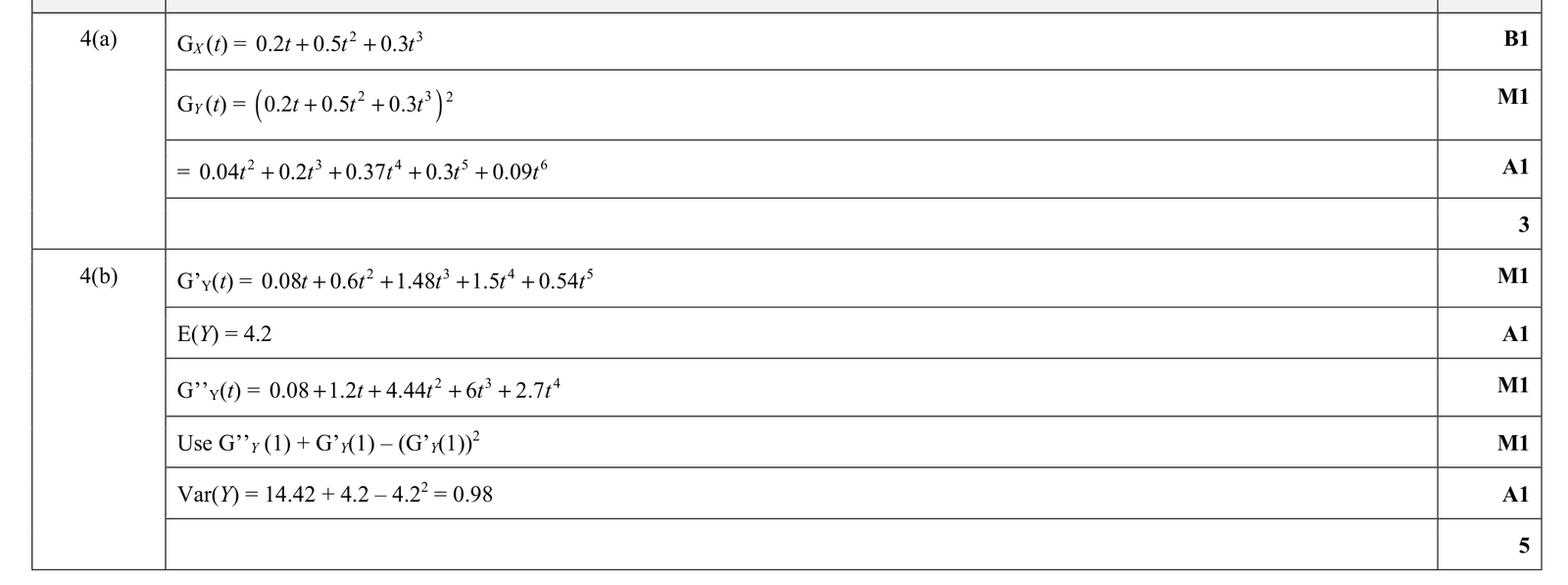
\(\mathrm{G}_{X}(t)=0.2 t+0.5 t^{2}+0.3 t^{3} .\)
The random variable \(Y\) is the sum of two independent observations of \(X\).
(a) Find the probability generating function of \(Y\), giving your answer as an expanded polynomial in \(t\).
(b) Use the probability generating function of \(Y\) to find \(\mathrm{E}(Y)\) and \(\operatorname{Var}(Y)\).