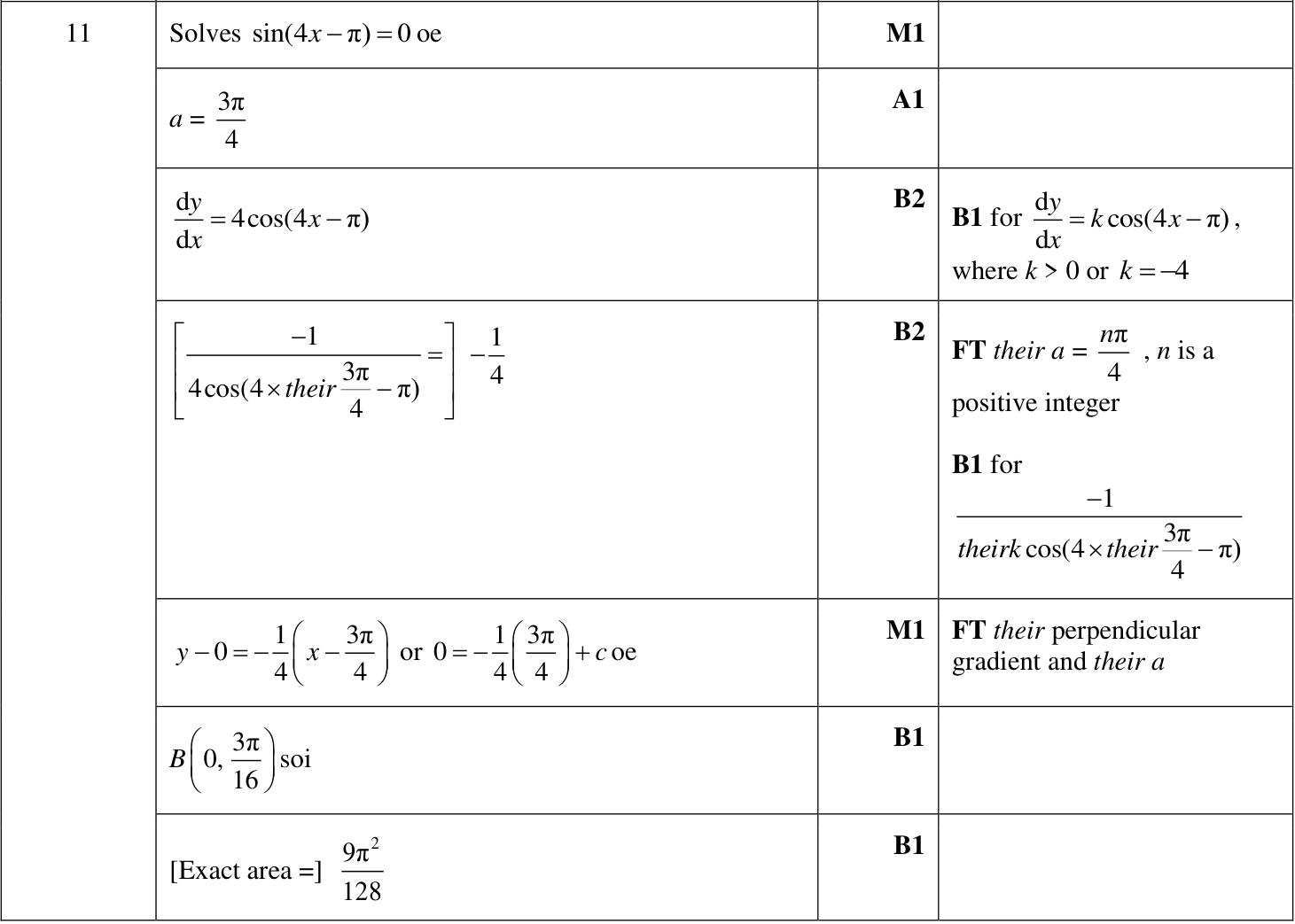
Answer: \(\displaystyle \frac{9\pi^2}{128}\).
Answer: \(\displaystyle \frac{9\pi^2}{128}\).
At \(A(a,0)\), the curve satisfies
\(\sin(4a-\pi)=0.\)
Therefore
\(4a-\pi=n\pi,\)
where \(n\) is an integer. Hence
\(a=\frac{(n+1)\pi}{4}.\)
Since
\(\frac{\pi}{2}\lt a\lt \pi,\)
we get
\(a=\frac{3\pi}{4}.\)
Differentiate the curve:
\(\frac{dy}{dx}=4\cos(4x-\pi).\)
At \(x=\frac{3\pi}{4}\),
\(4x-\pi=2\pi,\)
so
\(\frac{dy}{dx}=4\cos2\pi=4.\)
The tangent gradient is \(4\), so the normal gradient is
\(-\frac14.\)
The normal passes through
\(\left(\frac{3\pi}{4},0\right),\)
so its equation is
\(y=-\frac14\left(x-\frac{3\pi}{4}\right).\)
At the \(y\)-axis, \(x=0\), giving
\(y=-\frac14\left(-\frac{3\pi}{4}\right)=\frac{3\pi}{16}.\)
Thus
\(B=\left(0,\frac{3\pi}{16}\right).\)
The triangle \(OAB\) is right-angled with
\(OA=\frac{3\pi}{4},\qquad OB=\frac{3\pi}{16}.\)
Therefore its area is
\(\frac12\cdot\frac{3\pi}{4}\cdot\frac{3\pi}{16} =\frac{9\pi^2}{128}.\)