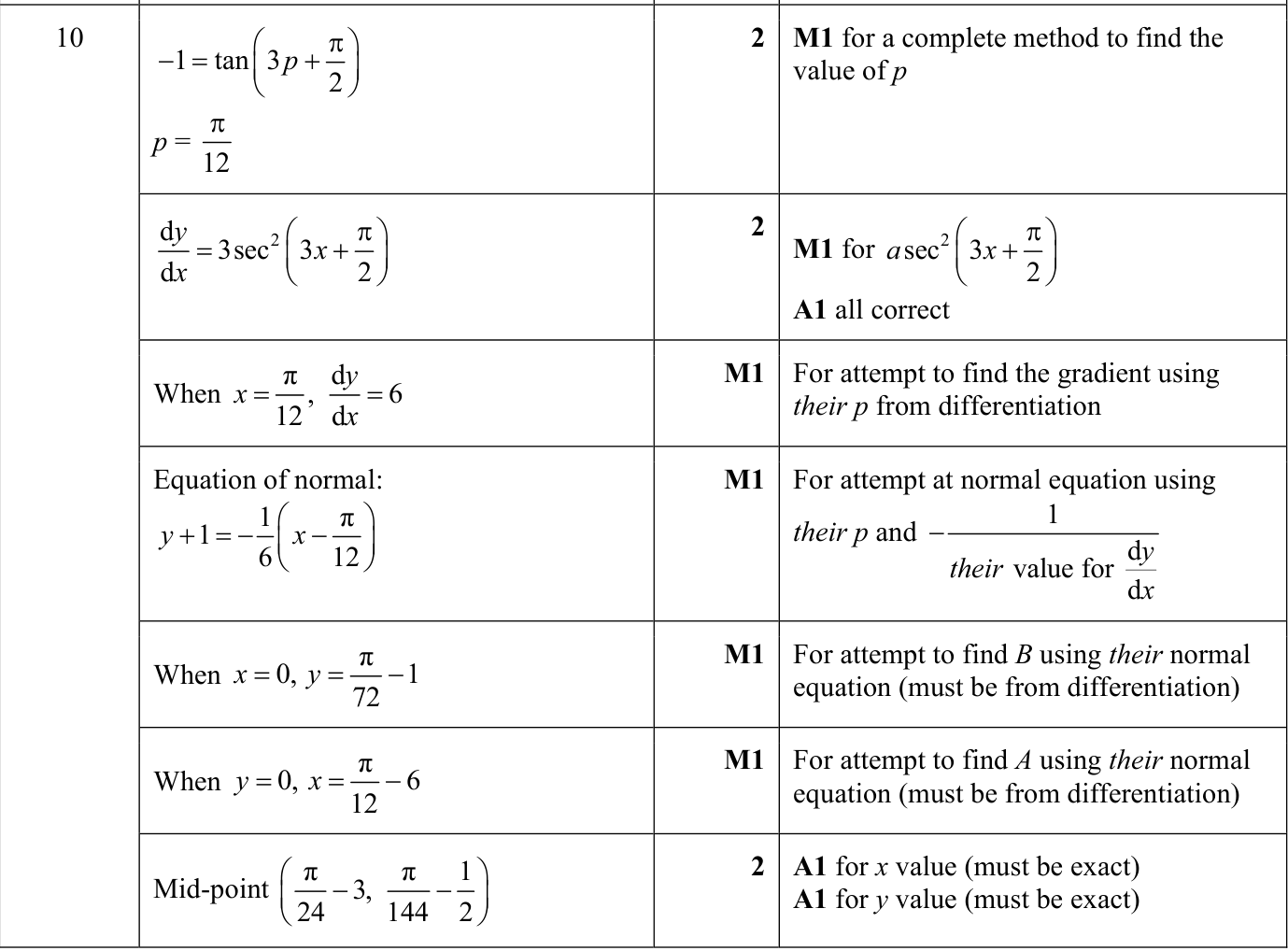
Answer: \(\left(\frac\pi{24}-3,\frac\pi{144}-\frac12\right)\).
Answer: \(\left(\frac\pi{24}-3,\frac\pi{144}-\frac12\right)\).
Since \(P(p,-1)\) lies on the curve,
\(-1=\tan\left(3p+\frac\pi2\right).\)
Given \(0\lt p\le\frac\pi6\), we have
\(\frac\pi2\lt 3p+\frac\pi2\le\pi.\)
In this interval, \(\tan x=-1\) at \(x=\frac{3\pi}{4}\). Therefore
\(3p+\frac\pi2=\frac{3\pi}{4},\)
so
\(p=\frac\pi{12}.\)
Differentiate:
\(\frac{dy}{dx}=3\operatorname{sec}^{2}\left(3x+\frac\pi2\right).\)
At \(x=\frac\pi{12}\), the angle is \(\frac{3\pi}{4}\), so \(\operatorname{sec}^{2}\left(\frac{3\pi}{4}\right)=2\). Hence the tangent gradient is \(6\), and the normal gradient is \(-\frac16\).
The normal through \(\left(\frac\pi{12},-1\right)\) is
\(y+1=-\frac16\left(x-\frac\pi{12}\right).\)
For the \(y\)-intercept, put \(x=0\):
\(y=\frac\pi{72}-1.\)
For the \(x\)-intercept, put \(y=0\):
\(x=\frac\pi{12}-6.\)
Thus
\(A=\left(\frac\pi{12}-6,0\right),\qquad B=\left(0,\frac\pi{72}-1\right).\)
The midpoint is
\(\left(\frac{\frac\pi{12}-6}{2},\frac{\frac\pi{72}-1}{2}\right)=\left(\frac\pi{24}-3,\frac\pi{144}-\frac12\right).\)