Past Exam Questions
← Back9709 P32 - Mar 2026 - Q3
Find the exact value of
\[ \int_{\frac14\pi}^{\frac13\pi} 3\sin x\sin2x\,dx. \]
Give your answer in the form \(p\sqrt3+q\sqrt2\), where \(p\) and \(q\) are rational.
9709 P32 - Mar 2026 - Q4
The coefficient of \(x^3\) in the expansion of \((1-ax)^{\frac25}\) is \(1\).
(a) Find the value of \(a\).
(b) Hence, find the coefficient of \(x^4\) in the expansion of \((2x+1)(1-ax)^{\frac25}\).
(c) State the set of values of \(x\) for which the expansion in 4(b) is valid.
9709 P32 - Mar 2026 - Q5
It is given that \(z=\frac{3+\lambda i}{\lambda+2i}\), where \(\lambda\) is a real constant.
(a) Find the value of \(\lambda\) for which \(\arg z=\frac14\pi\).
(b) When \(\lambda\) has the value found in 5(a), find the exact value of \(|z|\), making your method clear.
9709 P32 - Mar 2026 - Q6
The polynomial \(2x^4+ax^3+4x^2+bx-3\) is denoted by \(p(x)\).
It is given that \((x^2+x+1)\) is a factor of \(p(x)\).
(a) Find the values of \(a\) and \(b\).
(b) Hence, show that \((x+3)\) is a factor of \(p(x)\).
9709 P32 - Mar 2026 - Q7
(a) By sketching a suitable pair of graphs, show that the equation \(\ln x=\operatorname{cosec}\frac12x\) has exactly one root in the interval \(0<x<\pi\).
(b) Verify by calculation that this root lies between \(2.6\) and \(2.9\).
(c) Use the iterative formula \(x_{n+1}=\exp\left(\operatorname{cosec}\frac12x_n\right)\) to determine the root correct to \(3\) decimal places.
Give the result of each iteration to \(5\) decimal places.
\([\exp(x)\text{ is an alternative notation for }e^x.]\)
9709 P32 - Mar 2026 - Q8
The variables \(x\) and \(y\) satisfy the differential equation
\[ ye^{3x}\frac{dy}{dx}=x(y+5). \]
It is given that \(y=0\) when \(x=0\).
Solve the differential equation to obtain an equation in \(x\) and \(y\).
9709 P32 - Mar 2026 - Q9
Let
\[ I=\int_1^3\frac{x^3}{3+x^2}\,dx. \]
(a) Using the substitution \(x=\sqrt3\tan u\), show that \(I=\int_{\frac16\pi}^{\frac13\pi}3\tan^3u\,du\).
(b) Hence, or otherwise, find the exact value of \(I\). Give your answer in the form \(p+q\ln r\), where \(p\), \(q\) and \(r\) are rational.
9709 P32 - Mar 2026 - Q10
The variables \(x\) and \(y\) satisfy the equation \(y^2=k\frac{x-2}{x+2}\), where \(k\) is a constant.
(a) Show that \(\frac{dy}{dx}=\frac{2y}{x^2-4}\).
(b) Given that \(k=5\), find the angle between the tangents to the curve when \(x=3\).
Give your answer in the form \(a\tan^{-1}\left(\frac bc\right)\), where \(a\), \(b\) and \(c\) are integers.
9709 P32 - Mar 2026 - Q11
The points \(A\) and \(B\) have position vectors \(\overrightarrow{OA}=2i+2j-k\) and \(\overrightarrow{OB}=4i+2j+4k\) relative to the origin, \(O\).
(a) Show that the perpendicular distance from \(A\) to the line through \(O\) and \(B\) is \(\frac13\sqrt{65}\).
(b) The point \(C\) has position vector \(\overrightarrow{OC}=3i+pj+qk\), where \(p\) and \(q\) are constants.
Given that
- \(\overrightarrow{OC}\) is perpendicular to \(\overrightarrow{AB}\) and
- angle \(AOC=\) angle \(COB\),
find the values of \(p\) and \(q\).
9231 P23 - Jun 2019 - Q7 - 8 marks
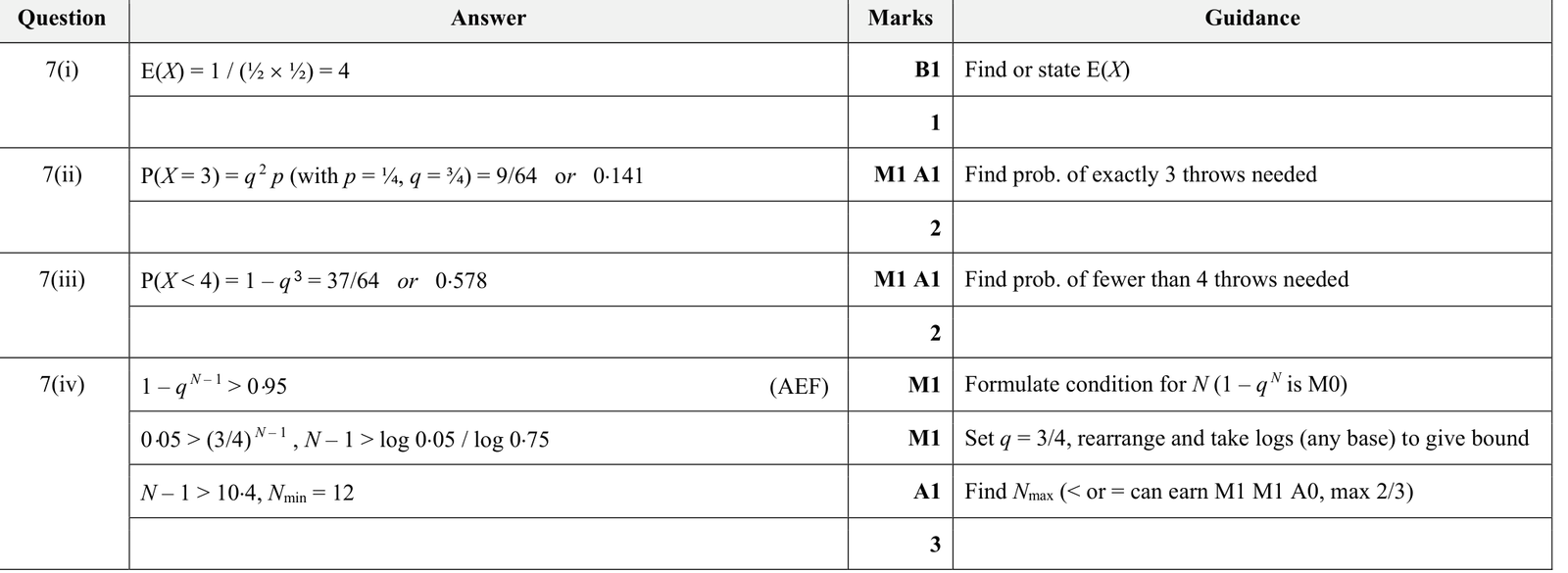
A pair of fair coins is thrown repeatedly until a pair of tails is obtained. The number of throws taken is denoted by the random variable \(X\).
(i) State the expected value of \(X\).
(ii) Find the probability that exactly 3 throws are required to obtain a pair of tails.
(iii) Find the probability that fewer than 4 throws are required to obtain a pair of tails.
(iv) Find the least integer \(N\) such that the probability of obtaining a pair of tails in fewer than \(N\) throws is more than 0.95 .
9231 P21 - Jun 2019 - Q6 - 7 marks
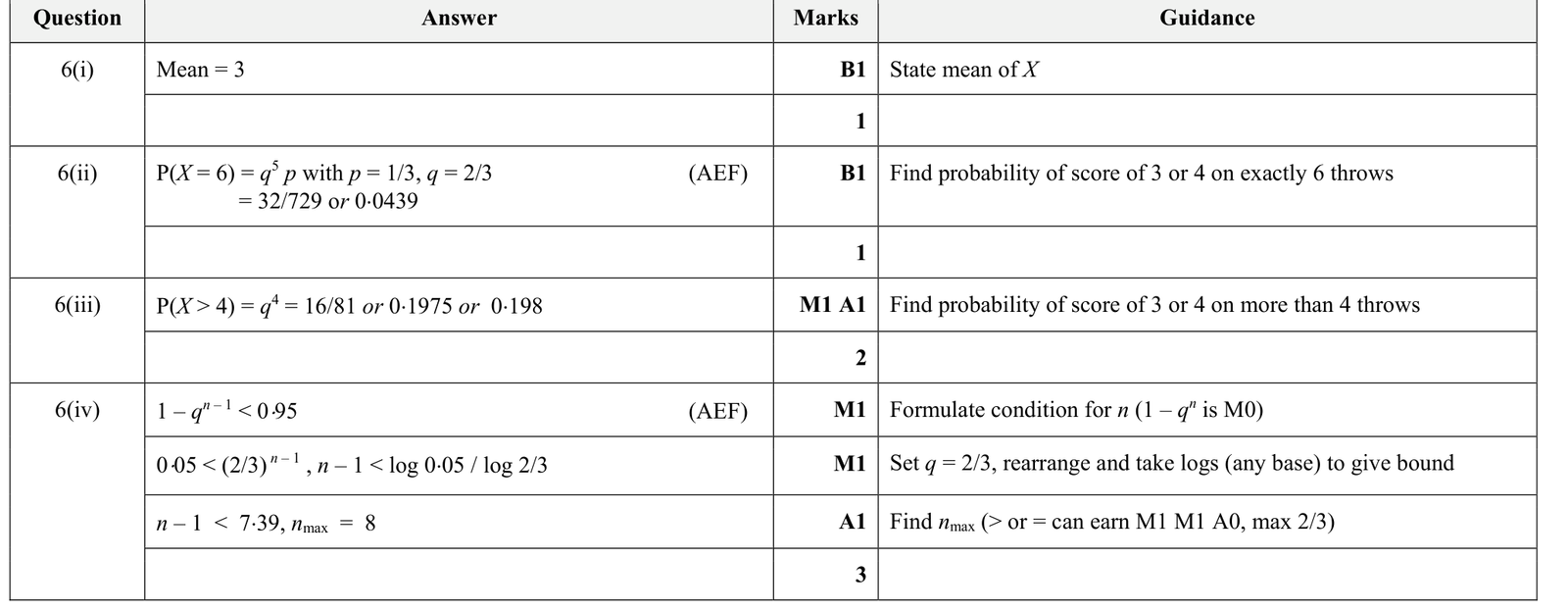
A fair six-sided die is thrown until a 3 or a 4 is obtained. The number of throws taken is denoted by the random variable \(X\).
(i) State the mean value of \(X\).
(ii) Find the probability that obtaining a 3 or a 4 takes exactly 6 throws.
(iii) Find the probability that obtaining a 3 or a 4 takes more than 4 throws.
(iv) Find the greatest integer \(n\) such that the probability of obtaining a 3 or a 4 in fewer than \(n\) throws is less than 0.95.
9231 P22 - Nov 2018 - Q8 - 8 marks
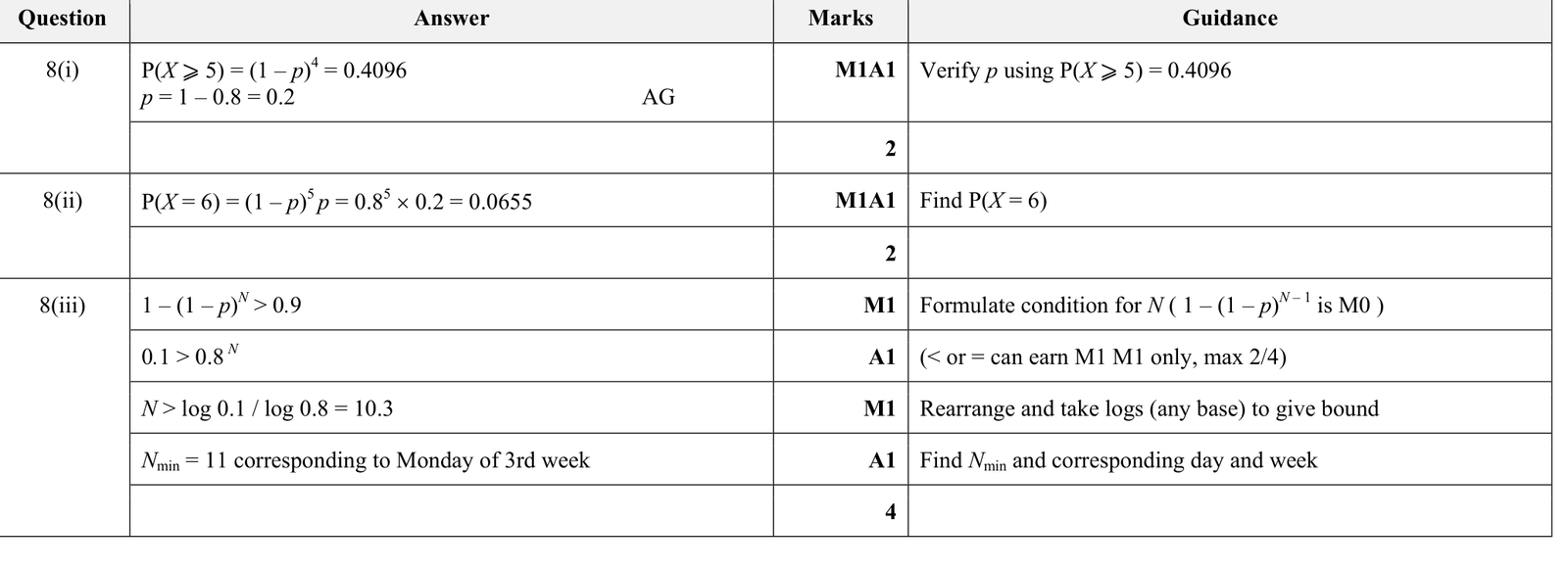
Lan starts a new job on Monday. He will catch the bus to work every day from Monday to Friday inclusive. The probability that he will get a seat on the bus has the constant value \(p\). The random variable \(X\) denotes the number of days that Lan will catch the bus until he is able to get a seat. The probability that Lan will not get a seat on the Monday, Tuesday, Wednesday or Thursday of his first week is 0.4096 .
(i) Show that \(p=0.2\).
(ii) Find the probability that Lan first gets a seat on Monday of the second week in his new job.
(iii) Find the least integer \(N\) such that \(\mathrm{P}(X \leqslant N)>0.9\), and identify the day and the week that corresponds to this value of \(N\).
9231 P21 - Jun 2017 - Q6 - 5 marks
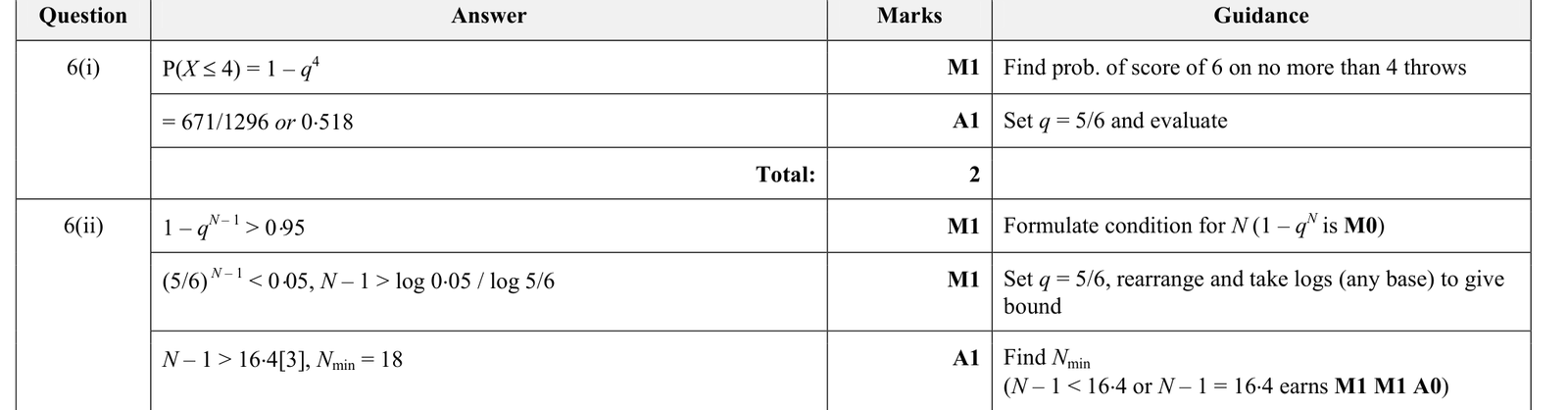
A fair die is thrown repeatedly until a 6 is obtained.
(i) Find the probability that obtaining a 6 takes no more than four throws.
(ii) Find the least integer \(N\) such that the probability of obtaining a 6 before the \(N\) th throw is more than 0.95 .
9231 P21 - Nov 2017 - Q6 - 6 marks
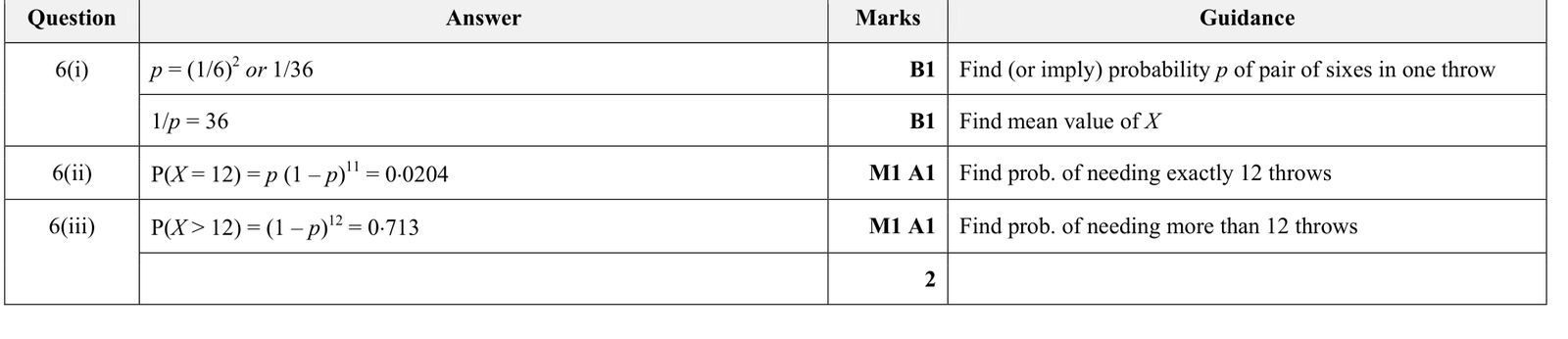
A pair of fair dice is thrown repeatedly until a pair of sixes is obtained. The number of throws taken is denoted by the random variable \(X\).
(i) Find the mean value of \(X\).
(ii) Find the probability that exactly 12 throws are required to obtain a pair of sixes.
(iii) Find the probability that more than 12 throws are required to obtain a pair of sixes.
9231 P21 - Jun 2018 - Q9 - 11 marks
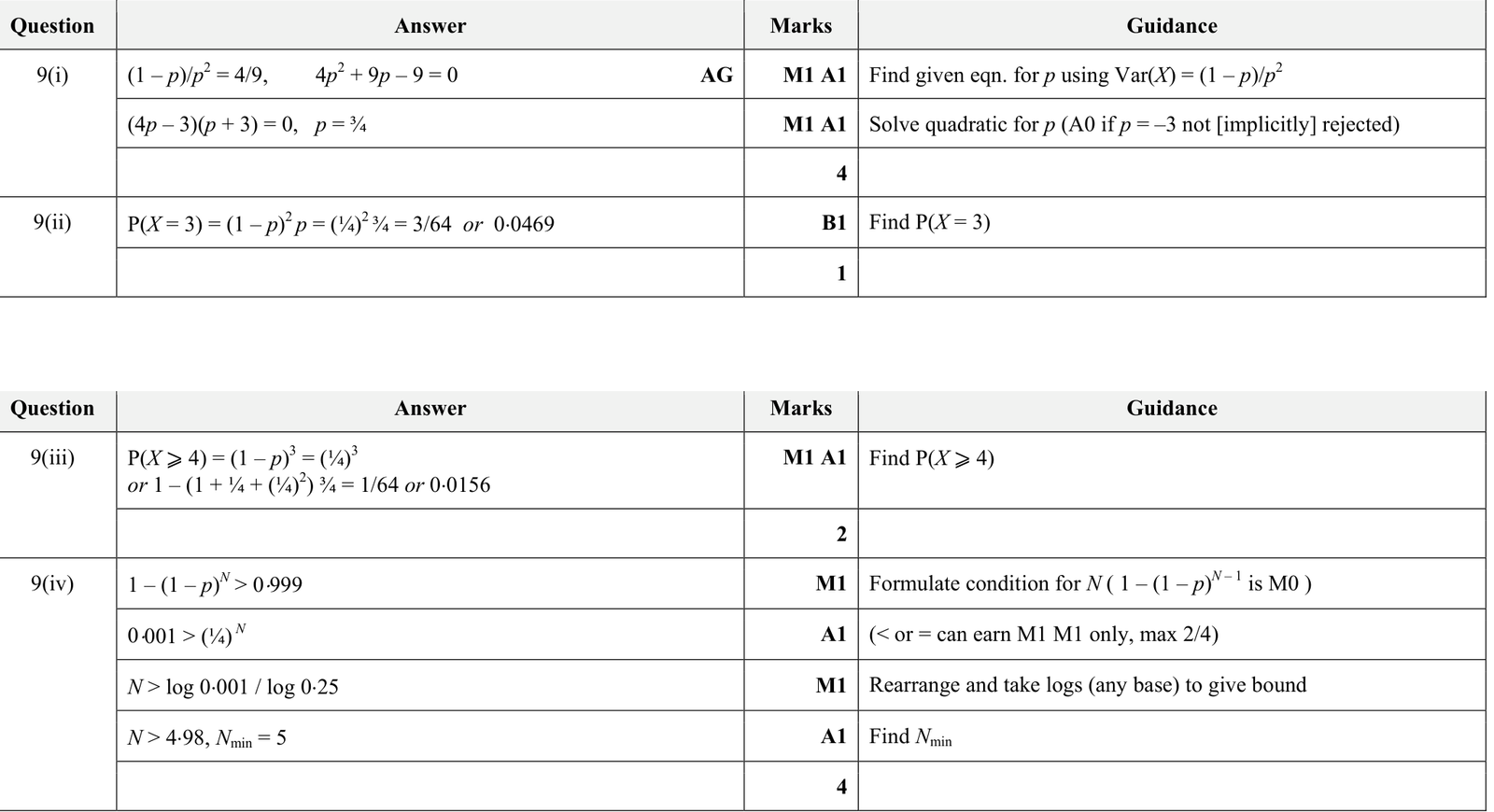
At a ski resort, the probability of snow on any particular day is constant and equal to \(p\). The skiing season begins on 1 November. The random variable \(X\) denotes the day of the skiing season on which the first snowfall occurs. (For example, if the first snowfall is on 5 November, then \(X=5\).) The variance of \(X\) is \(\frac{4}{9}\).
(i) Show that \(4 p^{2}+9 p-9=0\) and hence find the value of \(p\).
(ii) Find the probability that the first snowfall will be on 3 November.
(iii) Find the probability that the first snowfall will not be before 4 November.
(iv) Find the least integer \(N\) so that the probability of the first snowfall being on or before the \(N\) th day of November is more than 0.999 .
9231 P23 - Jun 2018 - Q7 - 7 marks
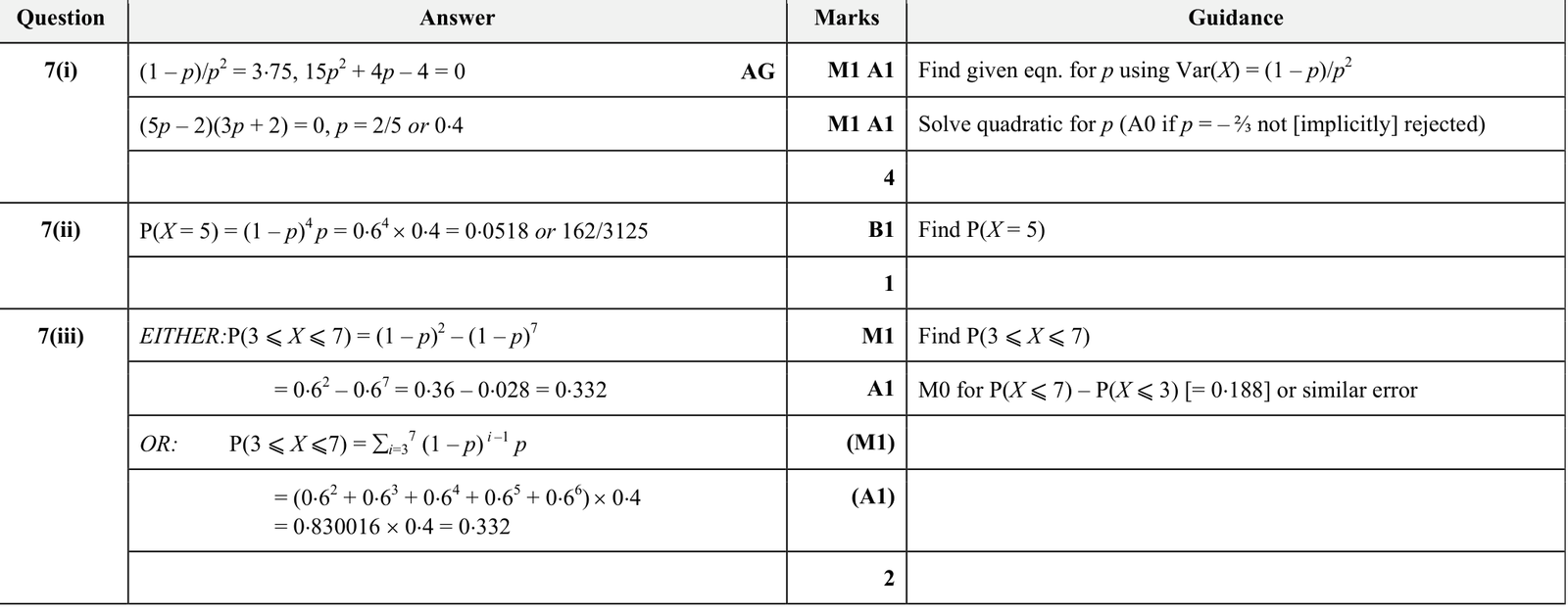
The probability that a driver passes an advanced driving test has a fixed value \(p\) for each attempt. A driver keeps taking the test until he passes. The random variable \(X\) denotes the number of attempts required for the driver to pass. The variance of \(X\) is 3.75 .
(i) Show that \(15 p^{2}+4 p-4=0\) and hence find the value of \(p\).
(ii) Find \(\mathrm{P}(X=5)\).
(iii) Find \(\mathrm{P}(3 \leqslant X \leqslant 7)\).
9231 P41 - Jun 2025 - Q6 - 6 marks
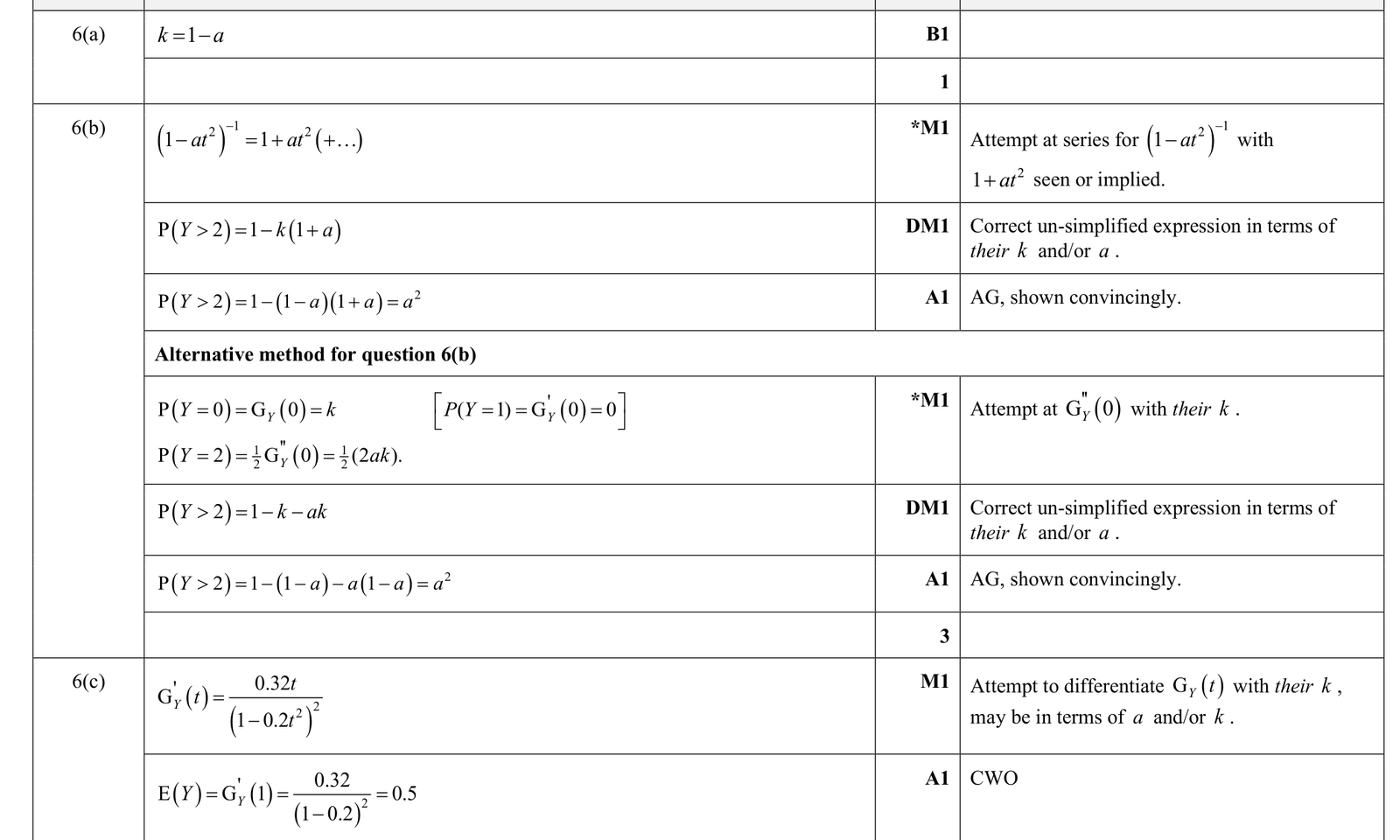
\(6 Y\) is a discrete random variable which takes the values \(0,2,4, \ldots\) The probability generating function of \(Y\) is given by
\(\mathrm{G}_{Y}(t)=\frac{k}{1-a t^{2}}\)
(a) Find \(k\) in terms of \(a\).
(b) Show that \(\mathrm{P}(Y\gt 2)=a^{2}\).
It is now given that \(a=0.2\).
(c) Find the value of \(\mathrm{E}(Y)\).
9231 P43 - Jun 2025 - Q6 - 11 marks
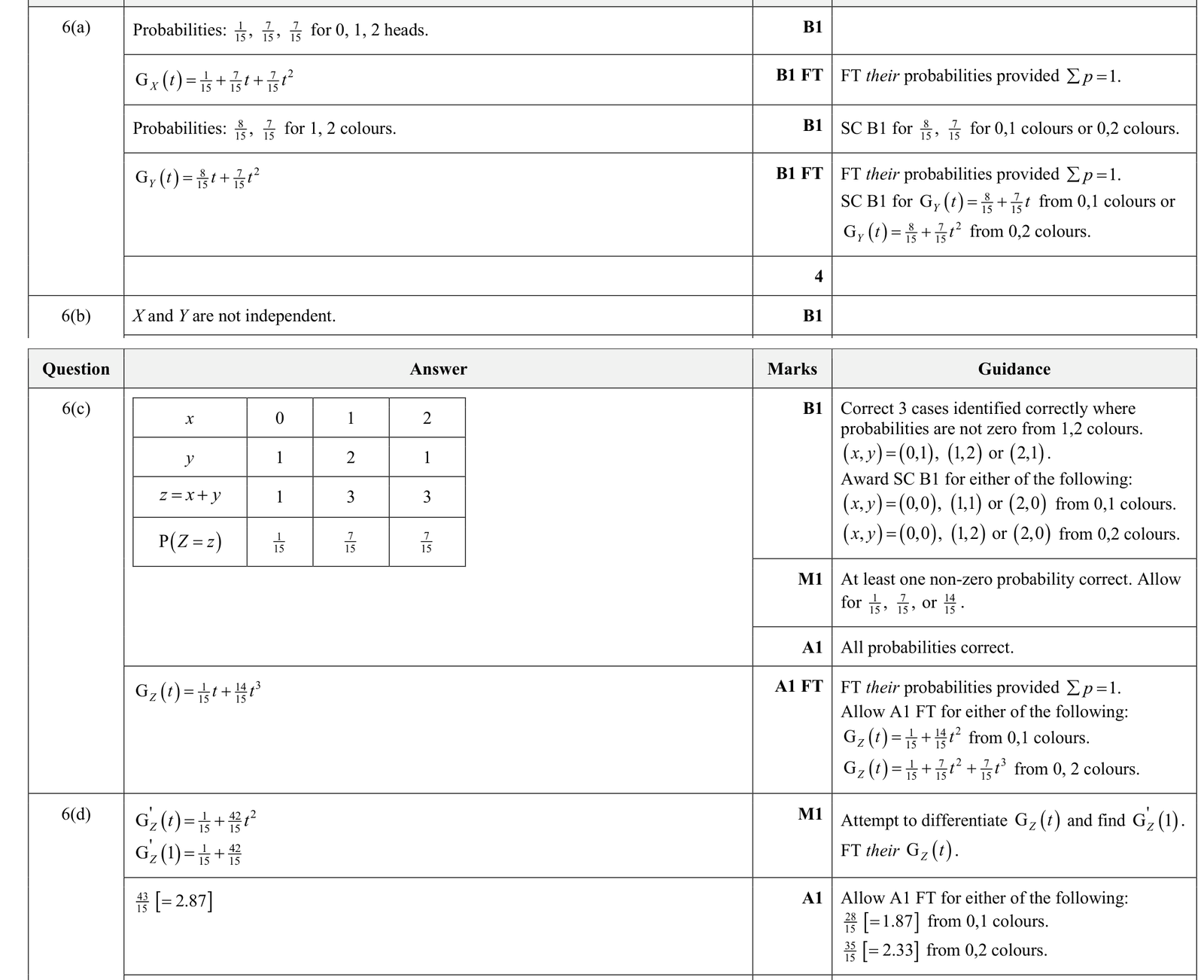
A bag contains 7 red balls and 3 blue balls. Kieran selects 2 balls at random, without replacement. The number of red balls selected by Kieran is denoted by \(X\), and the number of different colours present in Kieran's selection is denoted by \(Y\).
(a) Find the probability generating functions, \(\mathrm{G}_{X}(t)\) of \(X\) and \(\mathrm{G}_{Y}(t)\) of \(Y\).
The random variable \(Z\) is the sum of the number of red balls and the number of different colours present in Kieran's selection. Kieran claims that the probability generating function of \(Z\) is equal to \(\mathrm{G}_{X}(t) \times \mathrm{G}_{Y}(t)\).
(b) Explain why Kieran is incorrect.
(c) Find the probability generating function of \(Z\), expressing your answer as a polynomial in \(t\).
(d) Use the probability generating function of \(Z\) to find \(\mathrm{E}(Z)\).
9231 P41 - Jun 2023 - Q5 - 9 marks
Harry has three coins.
- One coin is biased so that, when it is thrown, the probability of obtaining a head is \(\frac{1}{3}\).
- The second coin is biased so that, when it is thrown, the probability of obtaining a head is \(\frac{1}{4}\).
- The third coin is biased so that, when it is thrown, the probability of obtaining a head is \(\frac{1}{5}\).
The random variable \(X\) is the number of heads that Harry obtains when he throws all three coins together.
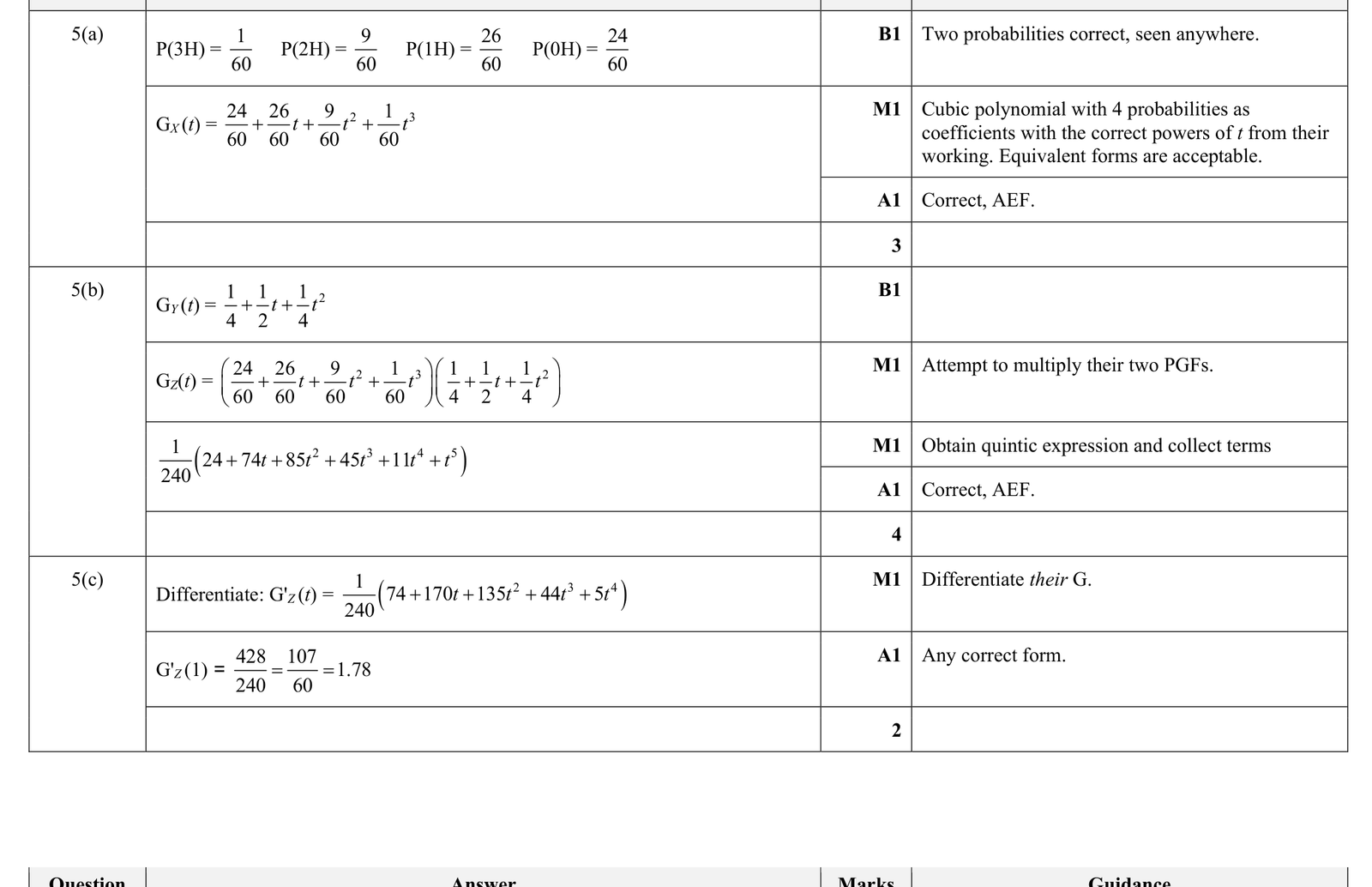
(a) Find the probability generating function of \(X\).
Isaac has two fair coins. The random variable \(Y\) is the number of heads that Isaac obtains when he throws both of his coins together. The random variable \(Z\) is the total number of heads obtained when Harry throws his three coins and Isaac throws his two coins.
(b) Find the probability generating function of \(Z\), expressing your answer as a polynomial in \(t\).
(c) Use the probability generating function of \(Z\) to find \(\mathrm{E}(Z)\).
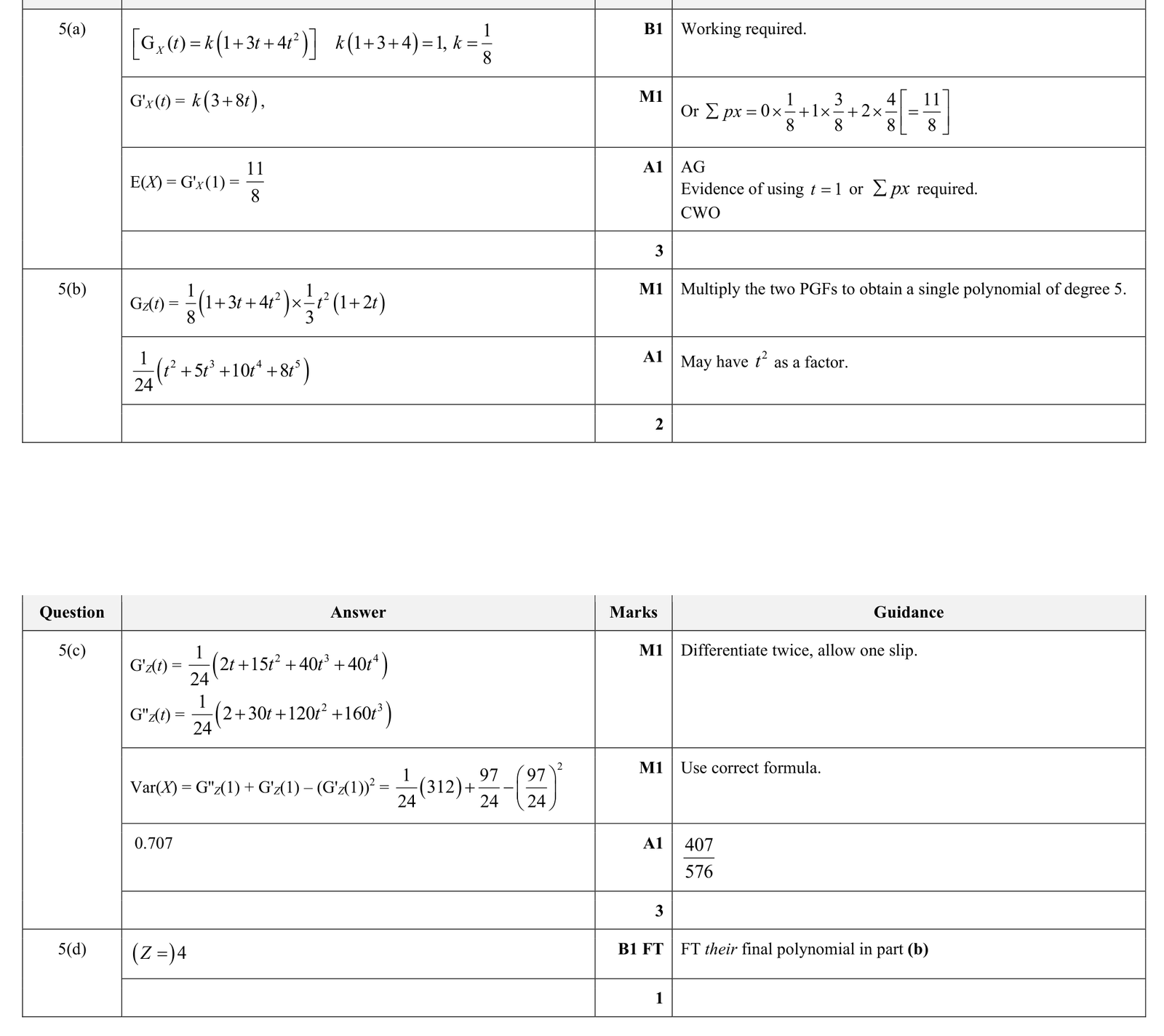
9231 P43 - Jun 2023 - Q5 - 9 marks
The random variable \(X\) has probability generating function \(\mathrm{G}_{X}(t)\) given by
\(\mathrm{G}_{X}(t)=k\left(1+3 t+4 t^{2}\right)\)
where \(k\) is a constant.
(a) Show that \(\mathrm{E}(X)=\frac{11}{8}\).
The random variable \(Y\) has probability generating function \(\mathrm{G}_{Y}(t)\) given by
\(\mathrm{G}_{Y}(t)=\frac{1}{3} t^{2}(1+2 t)\)
The random variables \(X\) and \(Y\) are independent and \(Z=X+Y\).
(b) Find the probability generating function of \(Z\), expressing your answer as a polynomial in \(t\).
(c) Use your answer to part (b) to find the value of \(\operatorname{Var}(Z)\).
(d) Write down the most probable value of \(Z\).