Past Exam Questions
← Back0606 P21 - Jun 2025 - Q11 - 8 marks
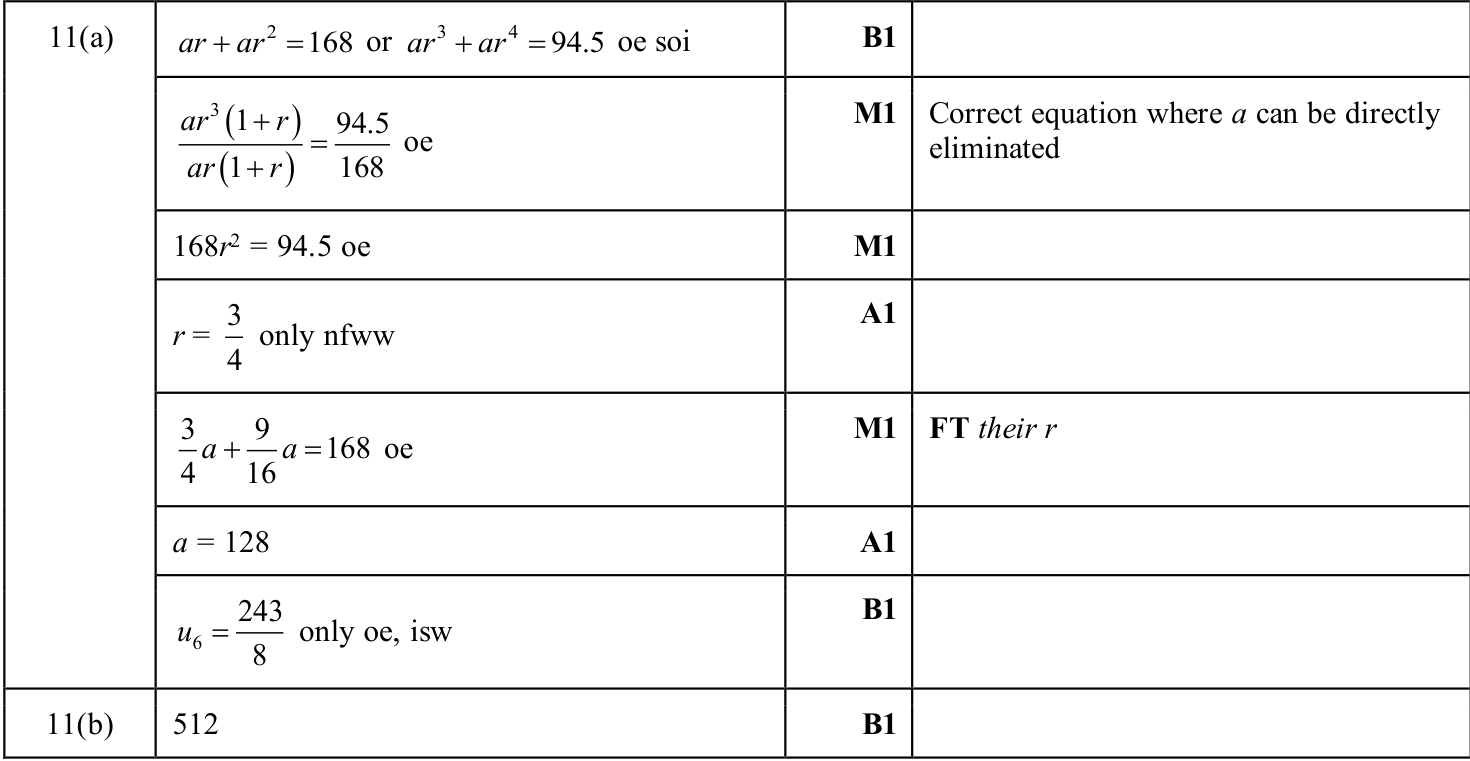
A geometric progression has first term \(a\) and common ratio \(r\), where \(r\gt 0\). The sum of the 2nd and 3rd terms of the progression is 168 . The sum of the 4th and 5th terms of the progression is 94.5. (a) Find the 6th term of the progression. (b) Find the sum to infinity of the progression.
0606 P11 - Nov 2024 - Q10 - 8 marks
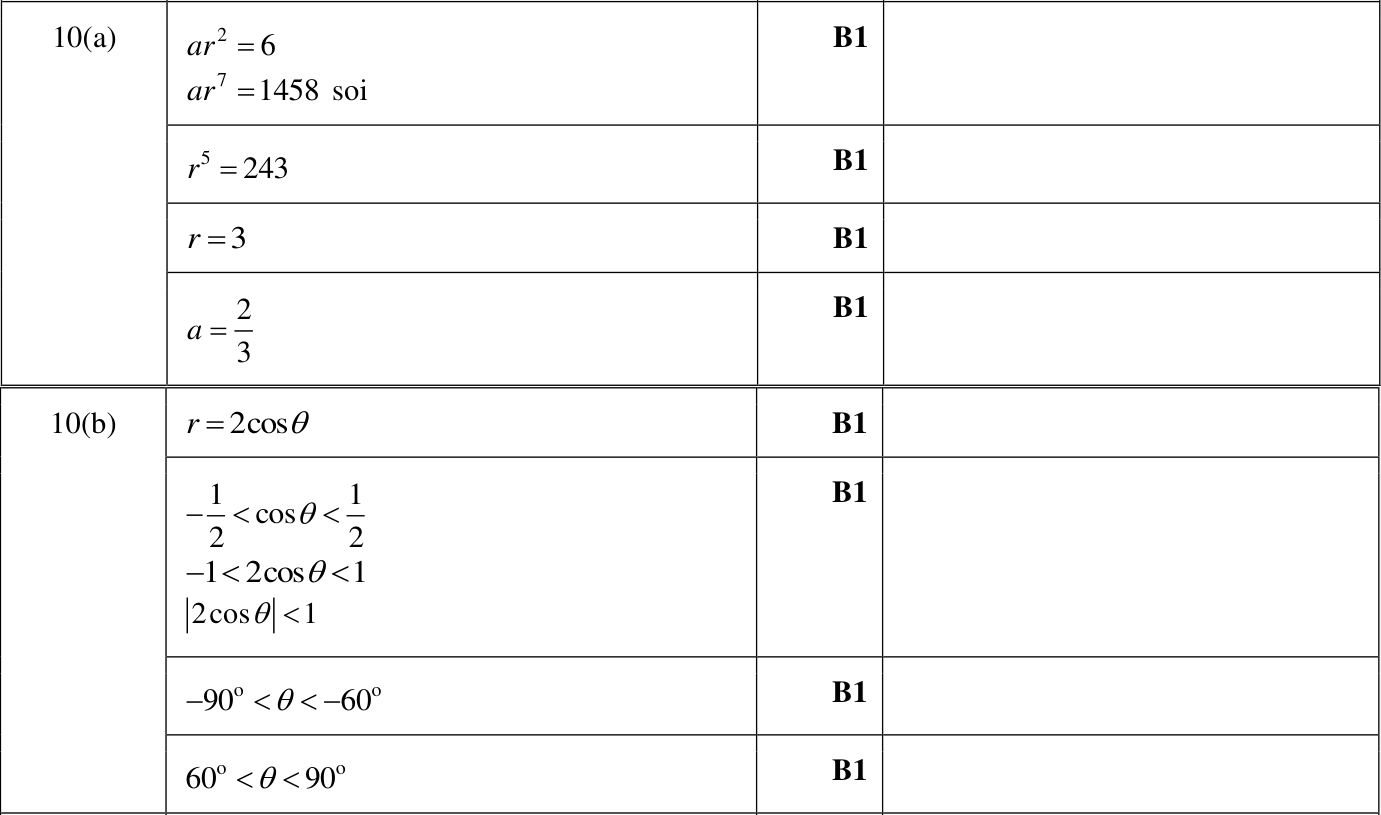
(a) The 3rd and 8th terms of a geometric progression are 6 and 1458 respectively. Find the common ratio and the first term of this progression.
(b) The first 3 terms of a second geometric progression are \(\cos \theta, \quad 2 \cos ^{2} \theta, \quad 4 \cos ^{3} \theta, \quad\) where \(-90^{\circ}\lt \theta\lt 90^{\circ}\). Find the values of \(\theta\) for which this geometric progression has a sum to infinity.
0606 P13 - Nov 2022 - Q5 - 7 marks
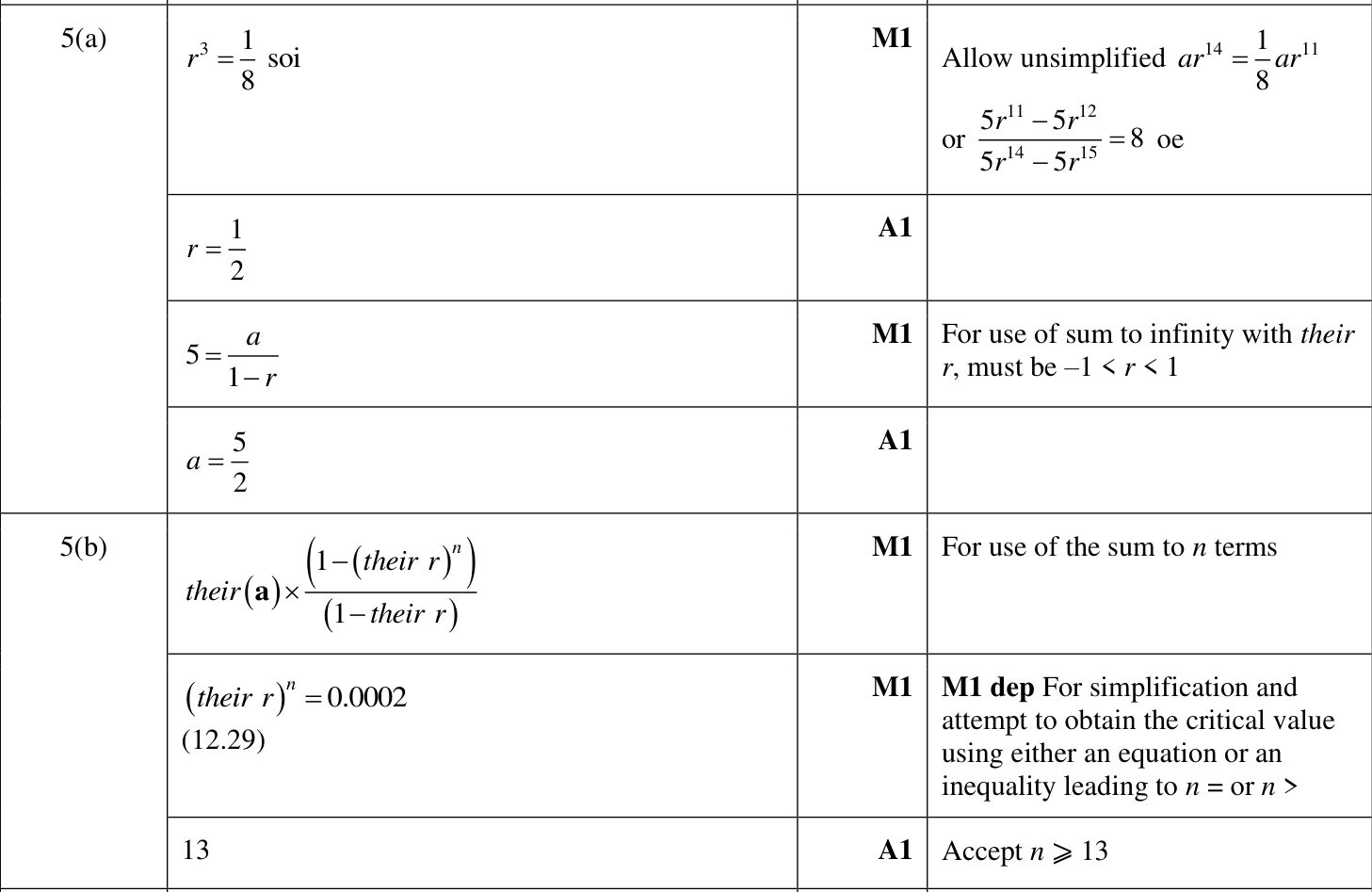
A geometric progression is such that the fifteenth term is equal to \(\frac18\) of the twelfth term. The sum to infinity is \(5\).
(a) Find the first term and the common ratio.
(b) Find the least number of terms needed for the sum of the geometric progression to be greater than \(4.999\).
0606 P21 - Nov 2022 - Q7 - 6 marks
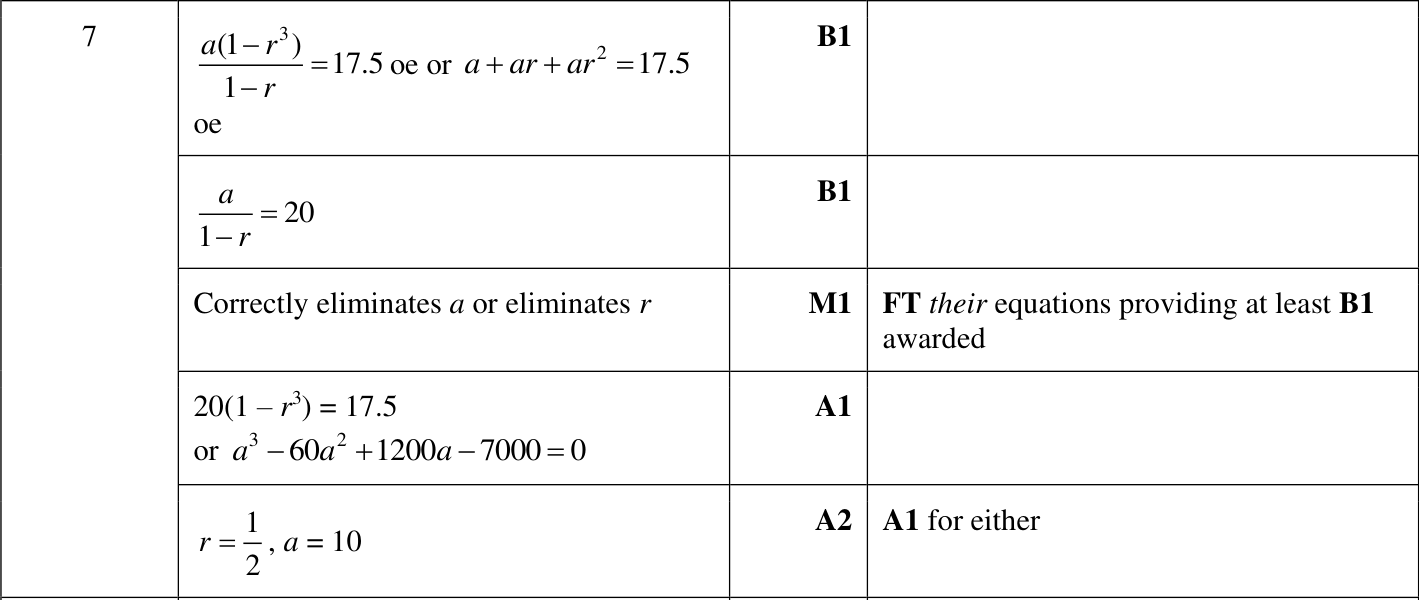
The sum of the first three terms of a geometric progression is \(17.5\) and the sum to infinity is \(20\).
Find the first term and the common ratio.
0606 P22 - Nov 2025 - Q8 - 7 marks
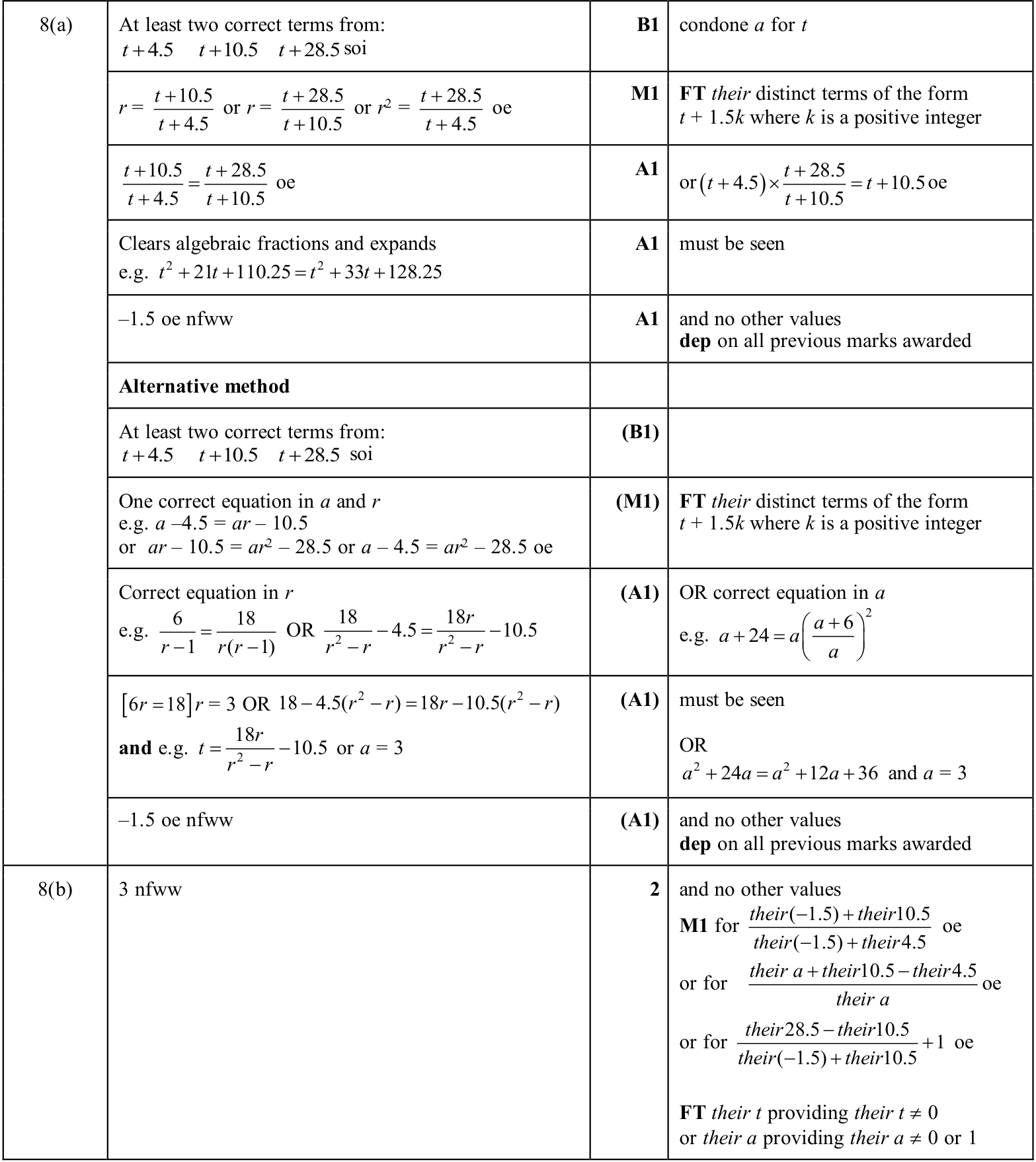
An arithmetic progression has first term \(t\) and common difference \(1.5\). The 4th, 8th and 20th terms of this arithmetic progression form the 1st, 2nd and 3rd terms of a geometric progression.
(a) Find the value of \(t\).
(b) Find the common ratio of the geometric progression.
0606 P13 - Nov 2025 - Q10 - 8 marks
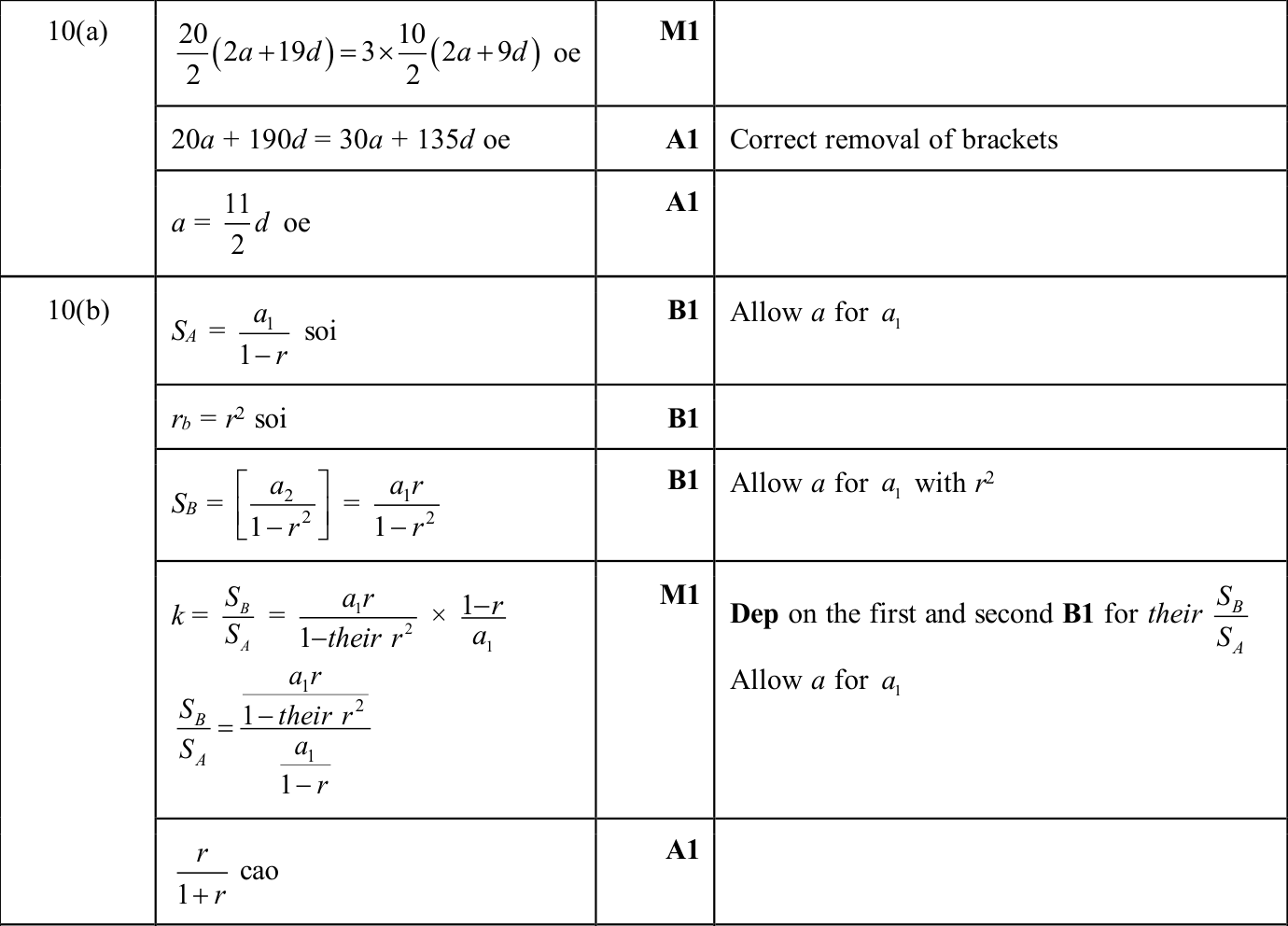
(a) An arithmetic progression has first term \(a\) and common difference \(d\). Given that \(S_{20}=3S_{10}\), find \(a\) in terms of \(d\).
(b) A geometric progression, A, has common ratio \(r\), where \(|r|\lt 1\). The terms of this progression are \(a_1,a_2,a_3,\ldots\).
Another geometric progression, B, has terms \(b_1,b_2,b_3,\ldots\), where \(b_1=a_2\), \(b_2=a_4\), \(b_3=a_6,\ldots\).
The sum to infinity of A is \(S_A\), and the sum to infinity of B is \(S_B\). Find \(\frac{S_B}{S_A}\) in terms of \(r\). Give your answer in its simplest form.
0606 P11 - Nov 2025 - Q5 - 7 marks
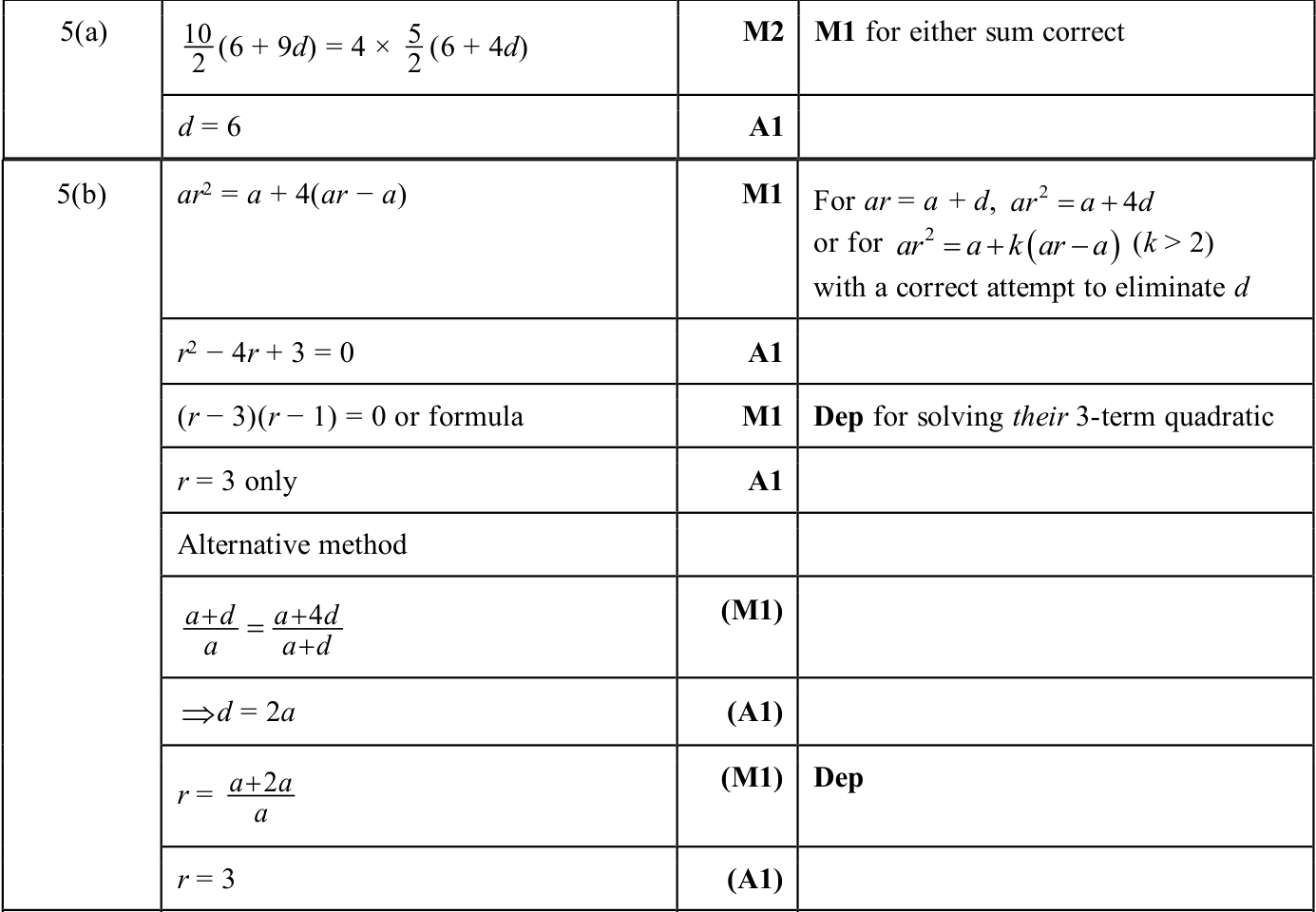
(a) The first term of an arithmetic progression is \(3\). The sum of the first 10 terms is four times the sum of the first 5 terms. Find the common difference.
(b) The first, second and fifth terms of another arithmetic progression are the first, second and third terms of a geometric progression. The first term is non-zero. Find the common ratio of the geometric progression, where the common ratio is not \(1\).
0606 P22 - Jun 2025 - Q7 - 9 marks
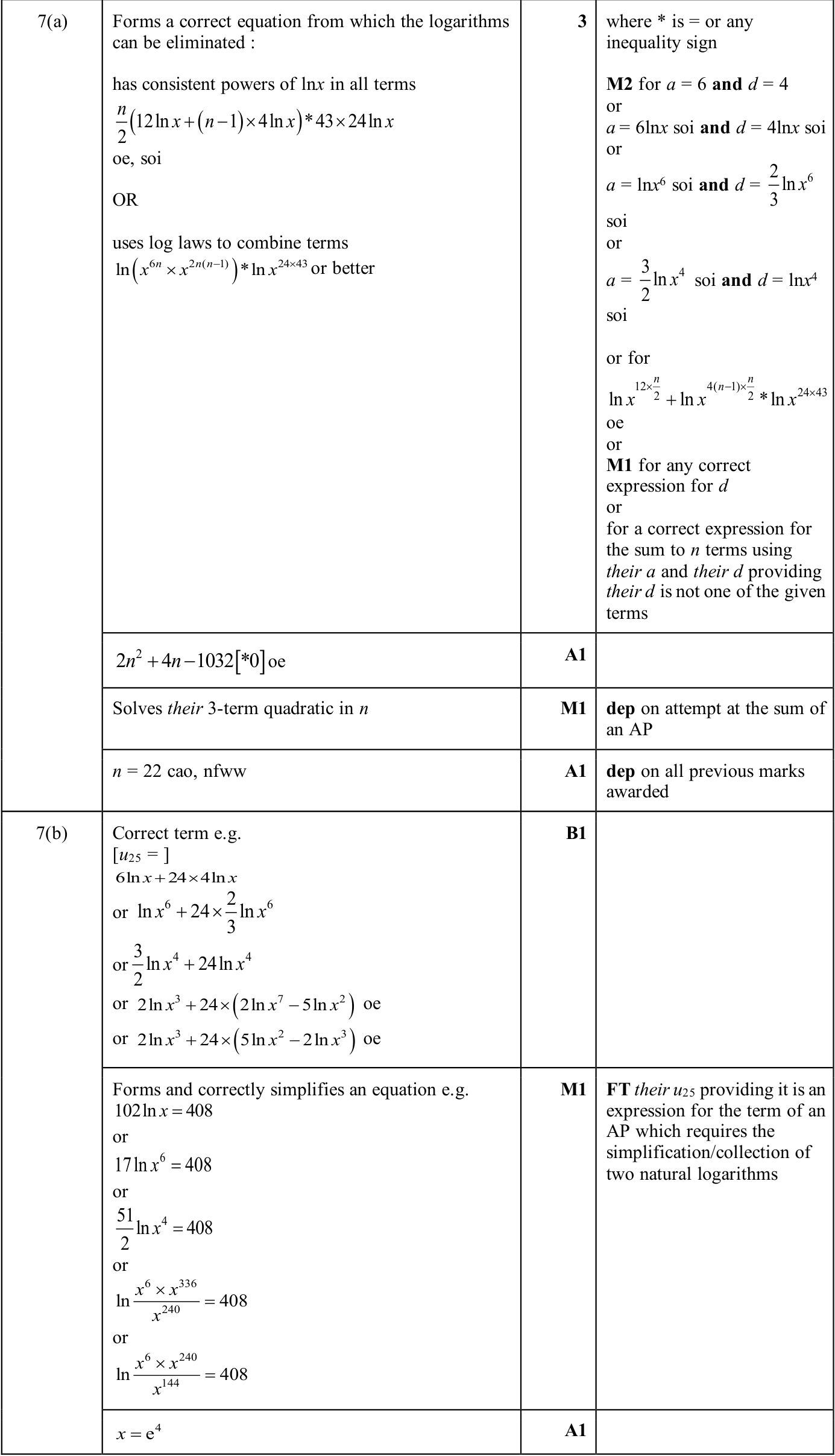
The first three terms of an arithmetic progression can be written as \(2 \ln \left(x^{3}\right), \quad 5 \ln \left(x^{2}\right), \quad 2 \ln \left(x^{7}\right) .\) (a) Given that \(x\gt 1\), find the least number of terms for the sum of this progression to be greater than \(43 \ln \left(x^{24}\right)\) (b) Given that the 25th term of this progression is equal to 408 , find the exact value of \(x\).
0606 P23 - Jun 2025 - Q9 - 12 marks
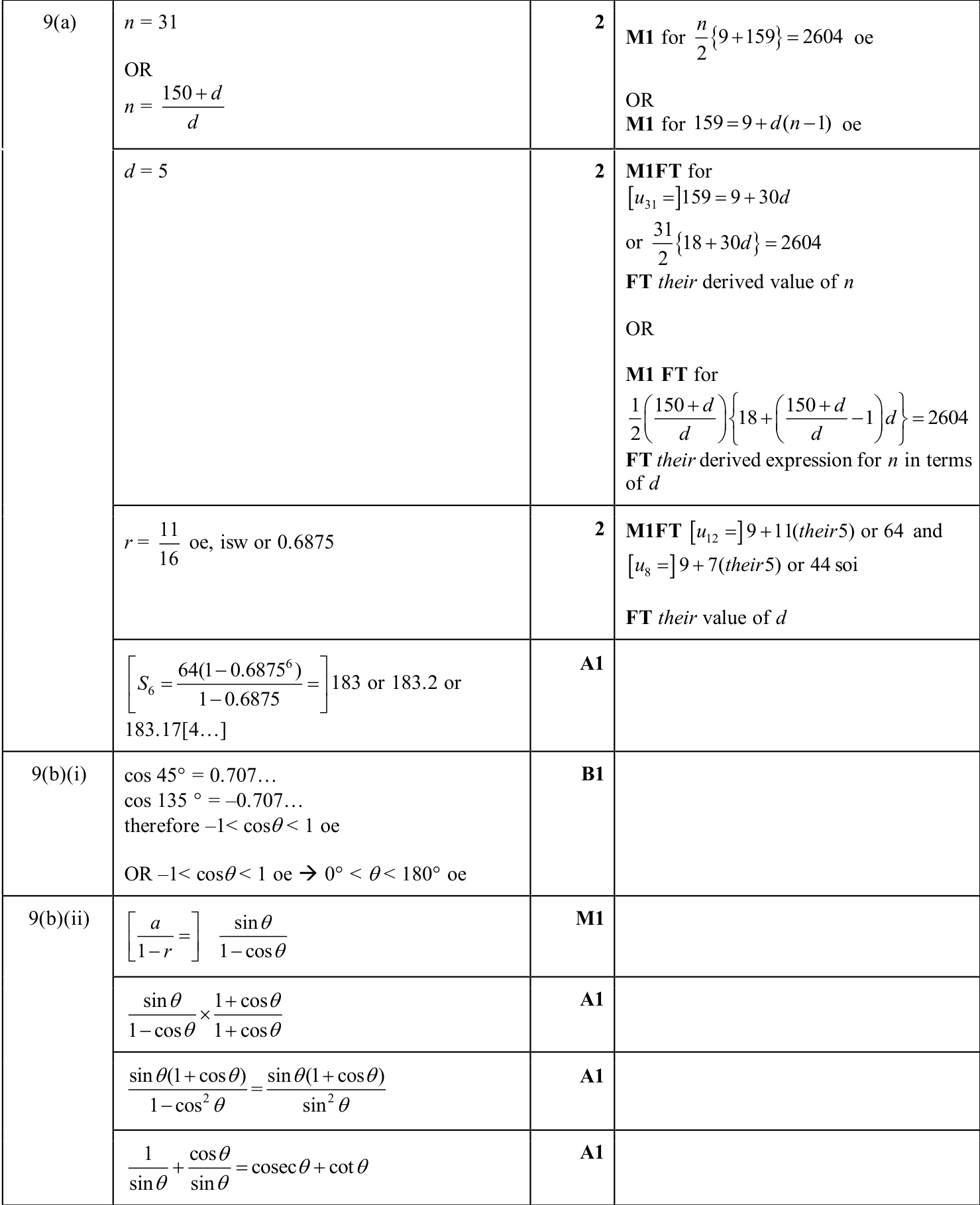
(a) The 1st term of an arithmetic progression is 9 . The last term of this progression is 159 . The sum of all the terms is 2604 .
The 12th term of this arithmetic progression is the 1st term of a geometric progression. The 8th term of this arithmetic progression is the 2nd term of the geometric progression.
Find the sum of the first 6 terms of the geometric progression.
(b) A different geometric progression has 1st term \(\sin \theta\).
The common ratio of this progression is \(\cos \theta\) where \(45^{\circ} \leqslant \theta \leqslant 135^{\circ}\). (i) Show that this progression has a sum to infinity.
(ii) Show that this sum to infinity can be written as \(\operatorname{cosec} \theta+\cot \theta\).
0606 P12 - Nov 2024 - Q10 - 9 marks
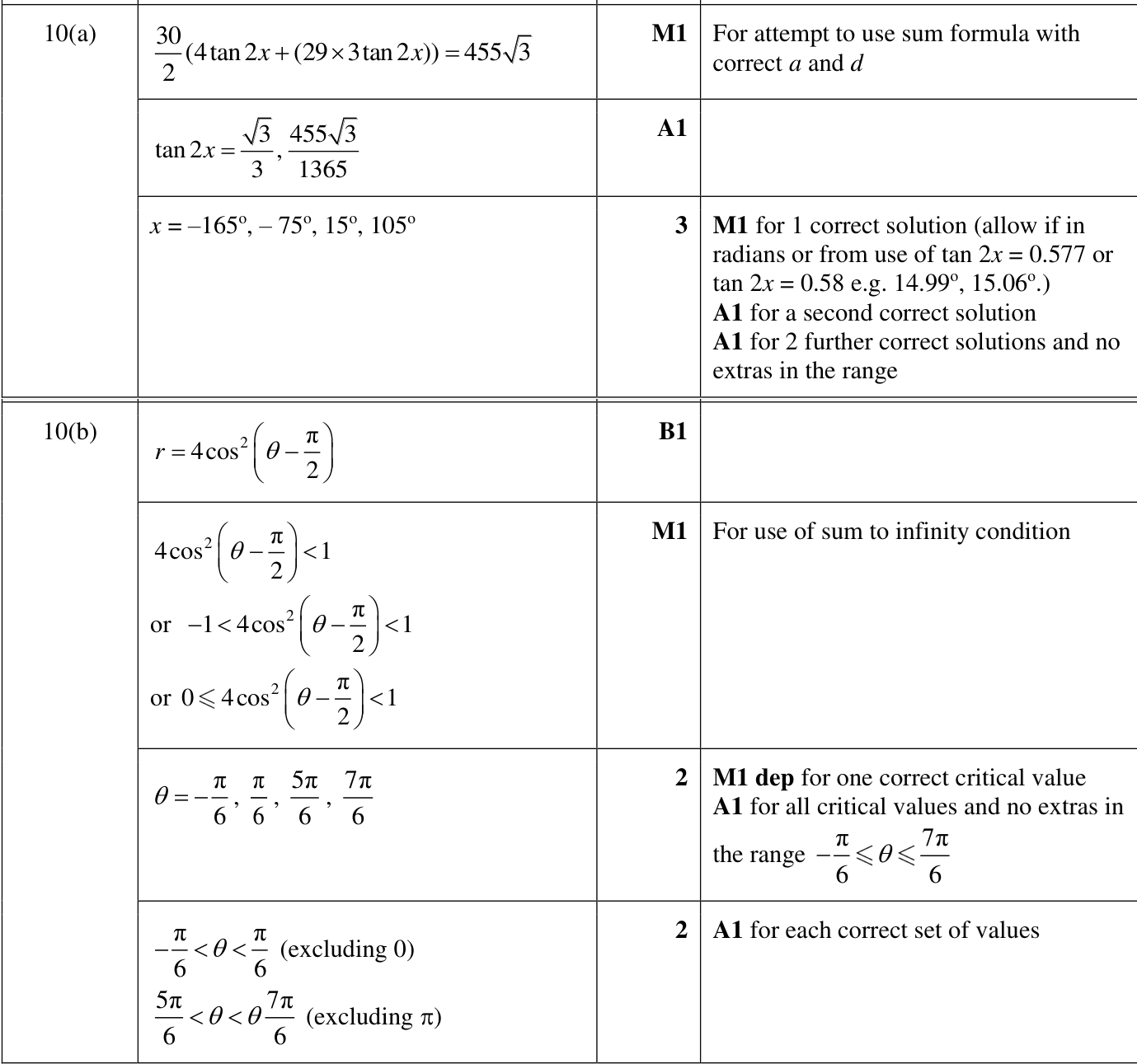
(a) The first 3 terms of an arithmetic progression are \(2 \tan 2 x, 5 \tan 2 x, 8 \tan 2 x\). Find the values of \(x\), where \(-180^{\circ} \leqslant x \leqslant 180^{\circ}\), for which the sum to 30 terms is \(455 \sqrt{3}\).
(b) The first 3 terms of a geometric progression are \(5 \cos ^{2}\left(\theta-\frac{\pi}{2}\right), \quad 20 \cos ^{4}\left(\theta-\frac{\pi}{2}\right), \quad 80 \cos ^{6}\left(\theta-\frac{\pi}{2}\right), \quad \text { where }-\frac{\pi}{6} \leqslant \theta \leqslant \frac{7 \pi}{6} .\)
Find the values of \(\theta\) for which this geometric progression has a sum to infinity.
0606 P13 - Nov 2024 - Q11 - 7 marks
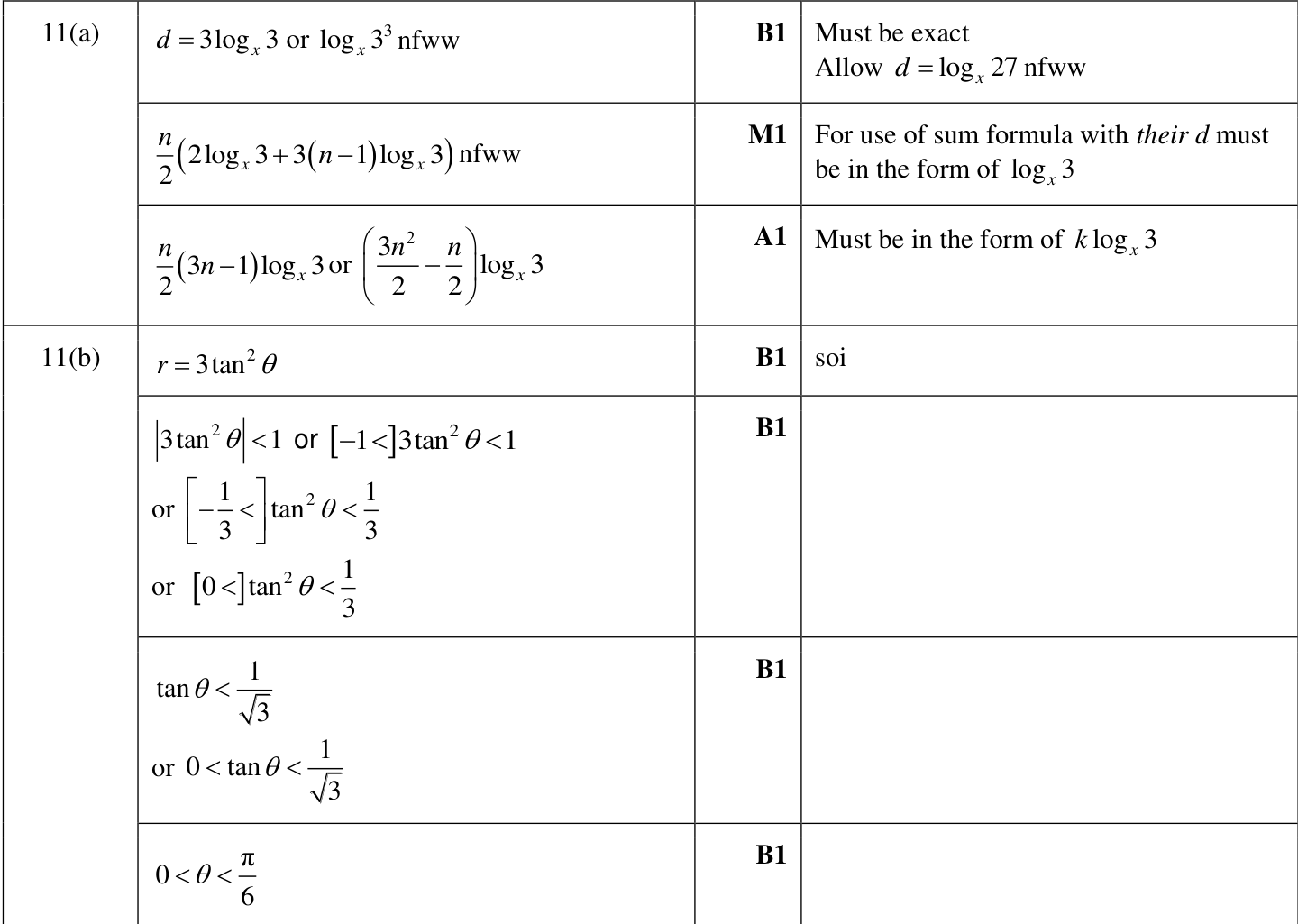
(a) The first 3 terms of an arithmetic progression are \(\log _{x} 3, \log _{x} 81, \log _{x} 2187\). Find the sum to \(n\) terms, giving your answer in the form \(k \log _{x} 3\), where \(k\) is in terms of \(n\).
(b) The first 3 terms of a geometric progression are \(1,3 \tan ^{2} \theta, 9 \tan ^{4} \theta\), for \(0\lt \theta\lt \frac{\pi}{2}\). Find the values of \(\theta\) for which this geometric progression has a sum to infinity.
0606 P12 - Mar 2024 - Q9 - 12 marks
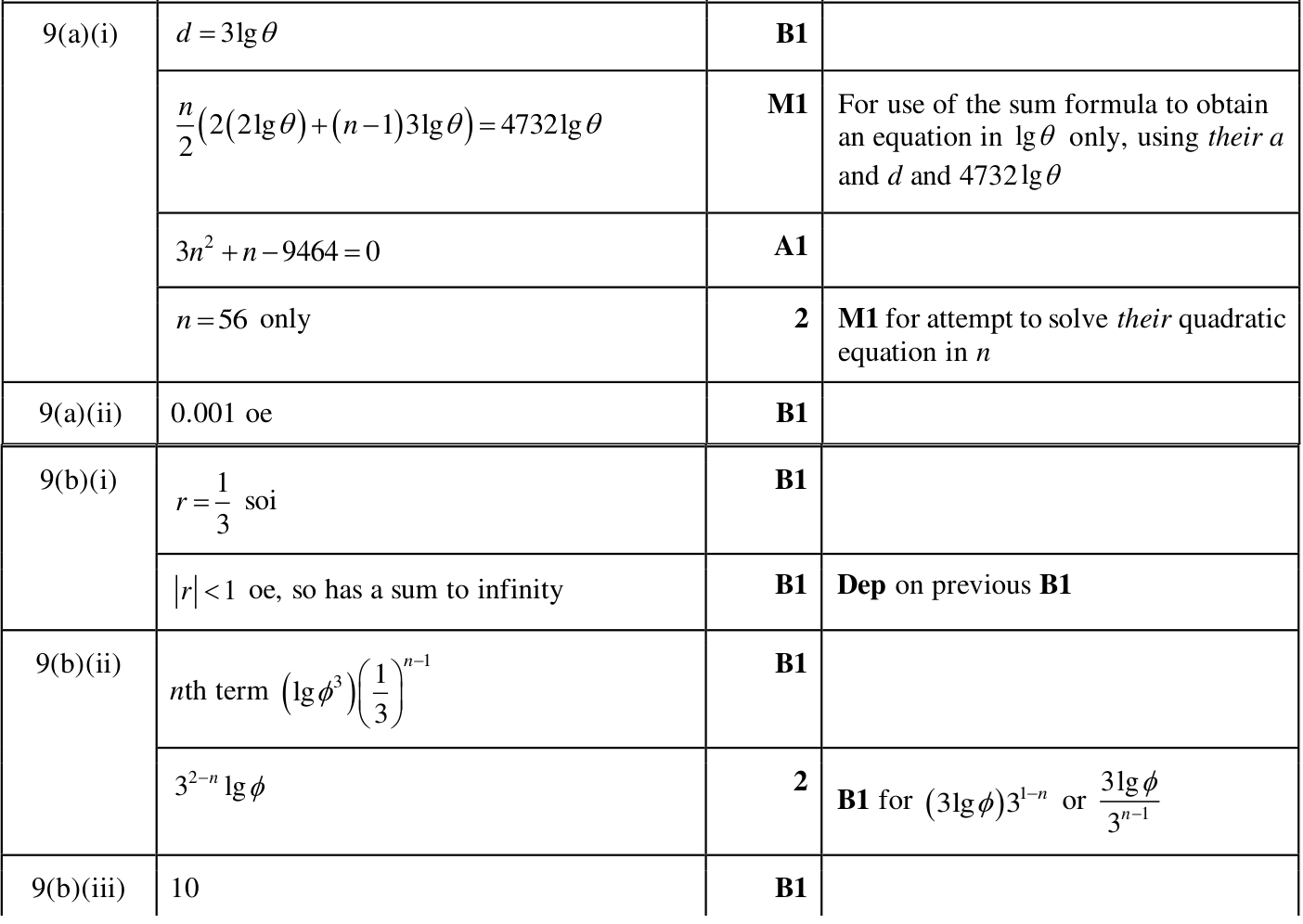
(a) The first three terms of an arithmetic progression are \(\lg \theta^{2}, \lg \theta^{5}\) and \(\lg \theta^{8}\). (i) Given that the sum to \(n\) terms of this progression is \(4732 \lg \theta\), find the value of \(n\).
(ii) This sum is equal to -14196 . Find the exact value of \(\theta\).
(b) The first three terms of a geometric progression are \(\lg \phi^{3}, \lg \phi\) and \(\lg \phi^{\frac{1}{3}}\). (i) Determine whether this geometric progression has a sum to infinity.
(ii) Find the \(n\)th term of this geometric progression, giving your answer in the form \(3^{A} \lg \phi\), where \(A\) is a function of \(n\). (iii) Find the value of \(\phi\), given that the 20th term is \(3^{-18}\).
0606 P12 - Jun 2024 - Q10 - 12 marks
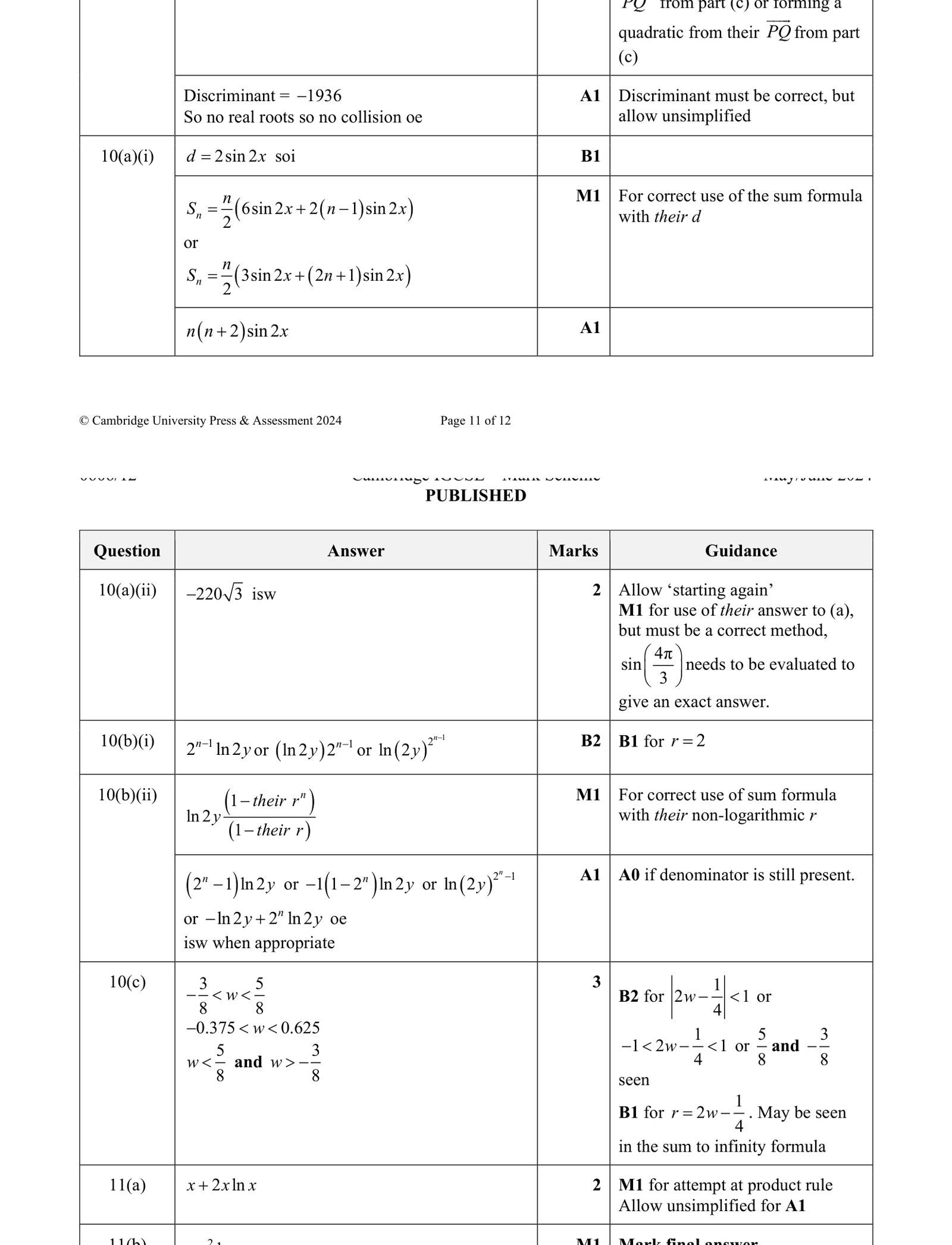
(a) The first 3 terms of an arithmetic progression are \(3 \sin 2 x, 5 \sin 2 x, 7 \sin 2 x\). (i) Show that the sum to \(n\) terms of this arithmetic progression can be written in the form \(n(n+a) \sin 2 x\), where \(a\) is a constant. (ii) Given that \(x=\frac{2 \pi}{3}\), find the exact sum of the first 20 terms.
(b) The first 3 terms of a geometric progression are \(\ln 2 y, \quad \ln 4 y^{2}, \quad \ln 16 y^{4}\). (i) Find the \(n\)th term of this geometric progression.
(ii) Find the sum to \(n\) terms of this geometric progression, giving your answer in its simplest form.
(c) The first 3 terms of a different geometric progression are \(\left(2 w-\frac{1}{4}\right),\left(2 w-\frac{1}{4}\right)^{2},\left(2 w-\frac{1}{4}\right)^{3}\). Find the values of \(w\) for which this geometric progression has a sum to infinity.
0606 P13 - Jun 2024 - Q10 - 12 marks
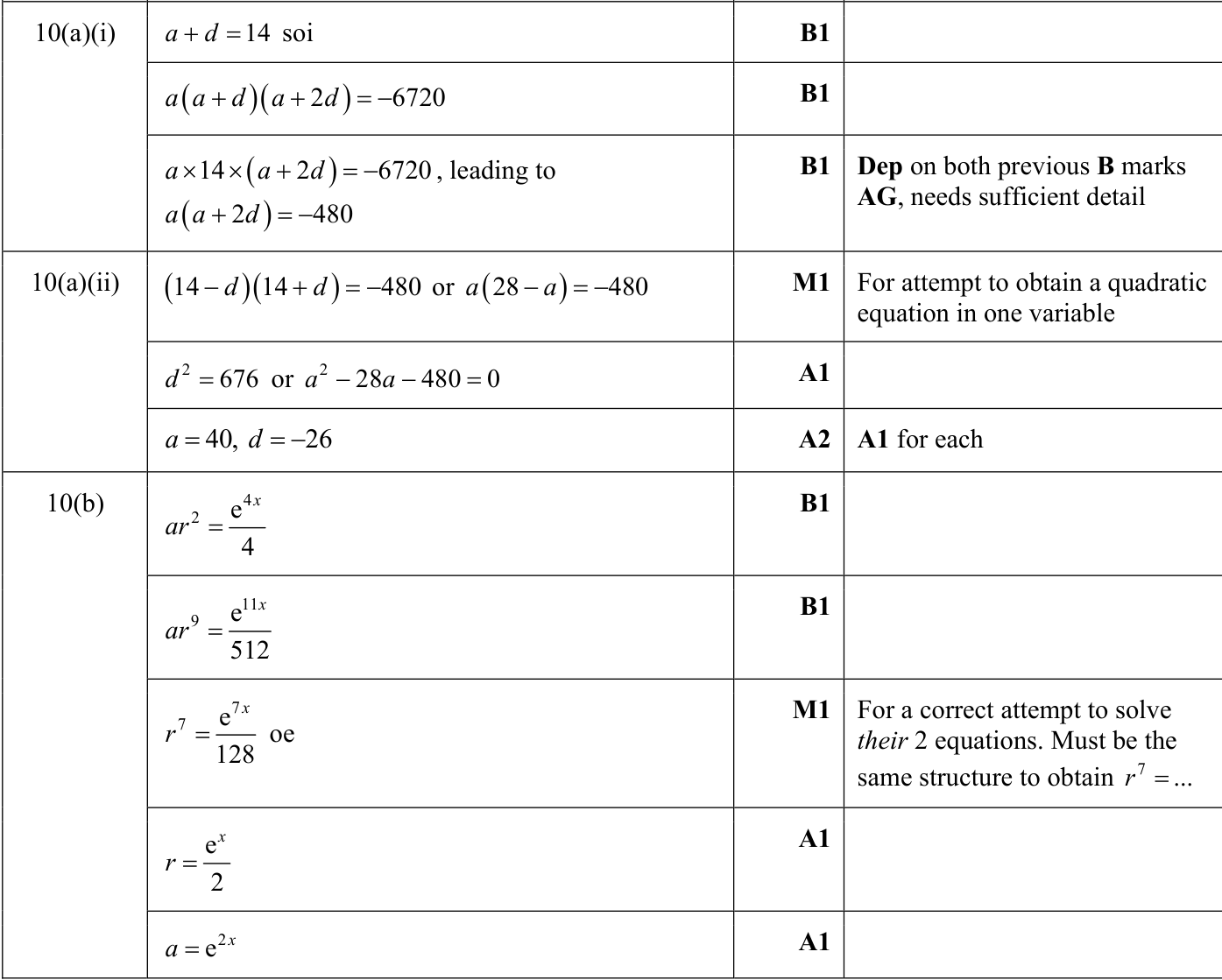
(a) In an arithmetic progression, the first term is \(a\) and the common difference is \(d\). The sum of the first three terms of this arithmetic progression is 42 . The product of the first three terms of this arithmetic progression is -6720 . (i) Show that \(a(a+2 d)=-480\).
(ii) Hence, given that \(a\) is positive, find the values of \(a\) and \(d\).
(b) In a geometric progression, the 3 rd term is \(\frac{\mathrm{e}^{4 x}}{4}\) and the 10 th term is \(\frac{\mathrm{e}^{11 x}}{512}\). Find the first term and the common ratio.
0606 P21 - Jun 2024 - Q8 - 10 marks
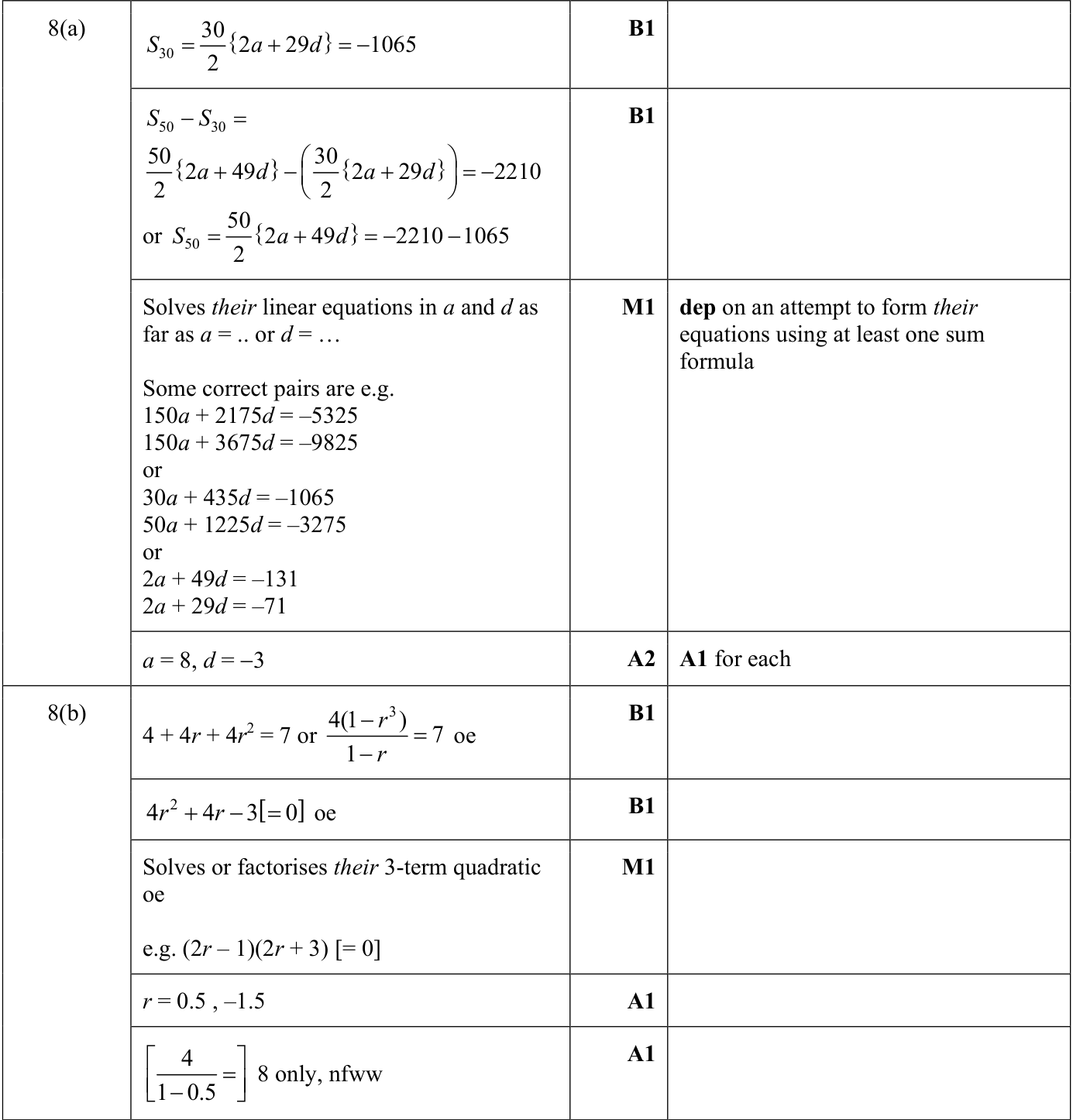
(a) In an arithmetic progression, the sum of the first 30 terms is -1065 . The sum of the next 20 terms is -2210 . Find the first term and the common difference.
(b) A geometric progression is such that the first term is 4 and the sum of the first three terms is 7 . Find the two possible values of the common ratio and find the sum to infinity for the convergent progression.
0606 P23 - Nov 2023 - Q10 - 10 marks
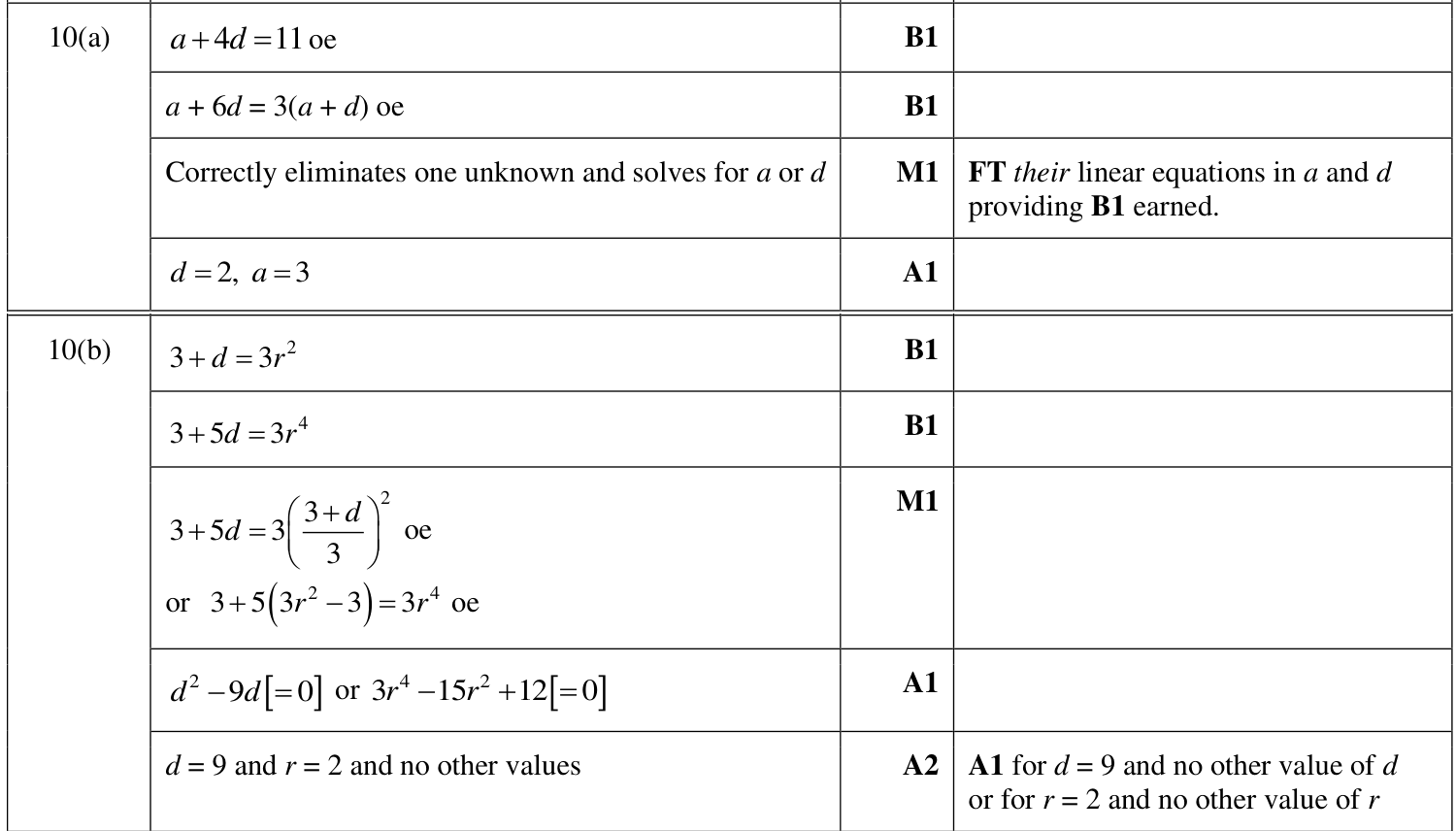
(a) In an arithmetic progression the 5th term is \(11\). The 7th term is three times the 2nd term. Find the 1st term and the common difference.
(b) An arithmetic progression and a geometric progression both have first term \(3\). The 2nd term of the arithmetic progression is equal to the 3rd term of the geometric progression. The 6th term of the arithmetic progression is equal to the 5th term of the geometric progression. Given that the common ratio of the geometric progression is greater than \(1\), find the common difference of the arithmetic progression and the common ratio of the geometric progression.
0606 P22 - Nov 2023 - Q9 - 10 marks
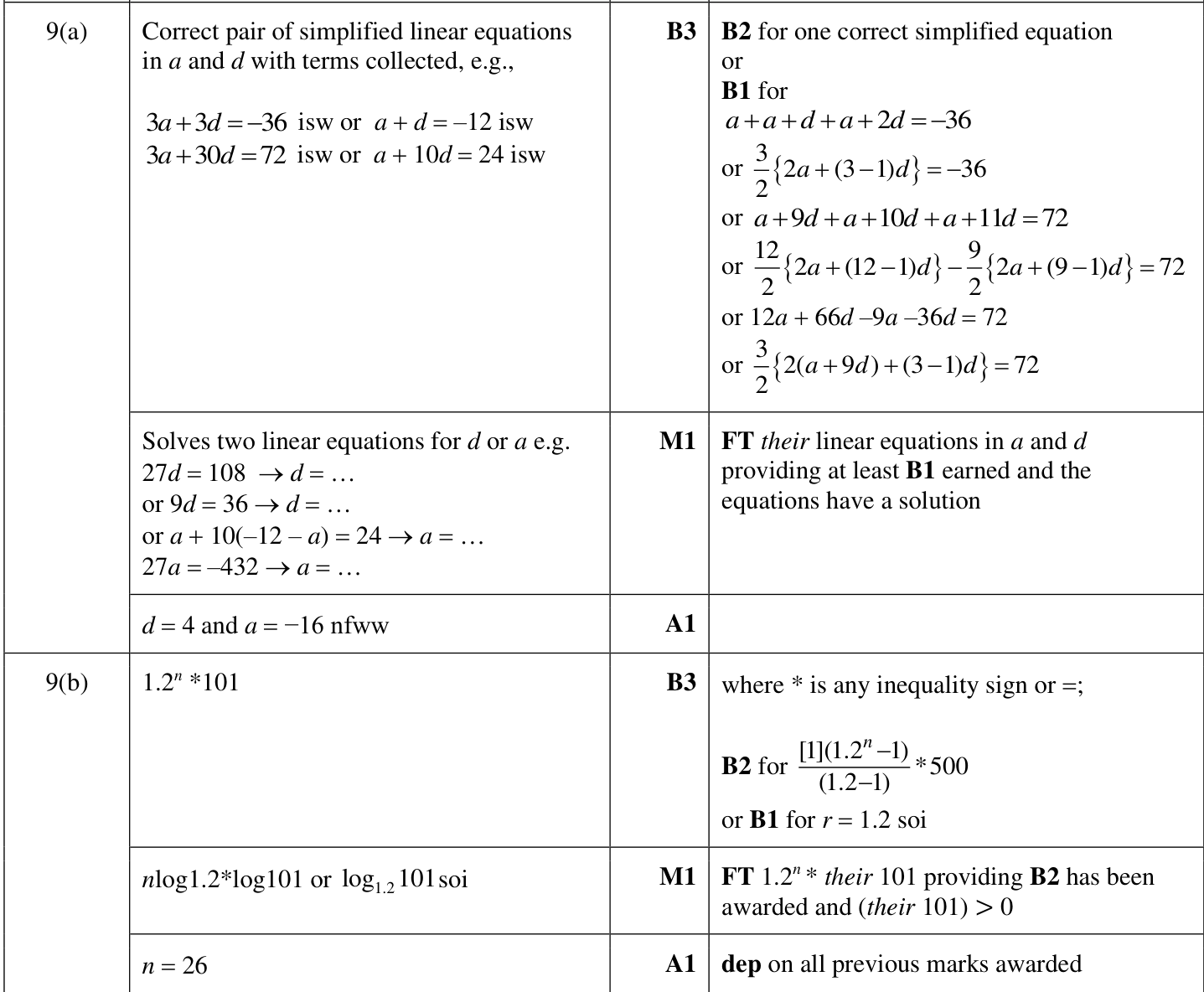
(a) An arithmetic progression has twelve terms. The sum of the first three terms is \(-36\) and the sum of the last three terms is \(72\). Find the first term and the common difference.
(b) The first three terms of a geometric progression are \(1\), \(1.2\) and \(1.44\). Find the smallest value of \(n\) such that the sum of the first \(n\) terms is greater than \(500\).
0606 P11 - Jun 2023 - Q9 - 11 marks
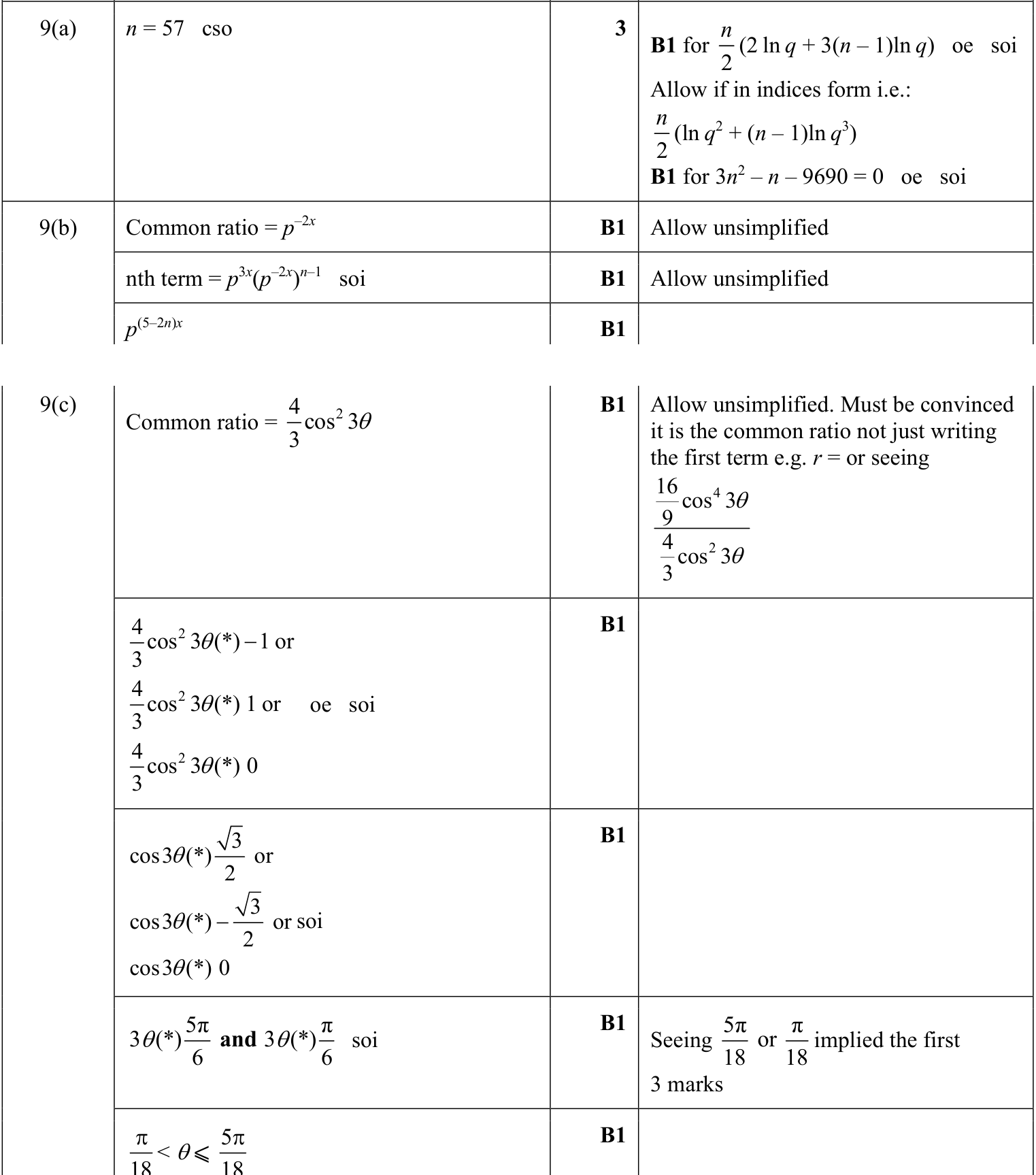
(a) The terms \(\ln q\), \(\ln q^4\), \(\ln q^7\), where \(q\) is positive, are the first three terms of an arithmetic progression. The sum of the first \(n\) terms of this progression is \(4845\ln q\). Find the value of \(n\).
(b) The terms \(p^{3x}\), \(p^x\), \(p^{-x}\), where \(p\) is positive, are the first three terms of a geometric progression. Find the \(n\)th term of this progression in the form \(p^{(a+bn)x}\), where \(a\) and \(b\) are integers.
(c) The first three terms of a geometric progression are
\(\displaystyle \frac43\cos^2 3\theta,\quad \frac{16}{9}\cos^4 3\theta,\quad \frac{64}{27}\cos^6 3\theta,\)
where \(0\lt\theta\lt\frac{\pi}{3}\). Find the set of values of \(\theta\) for which this progression has a sum to infinity.
0606 P12 - Jun 2023 - Q10 - 13 marks
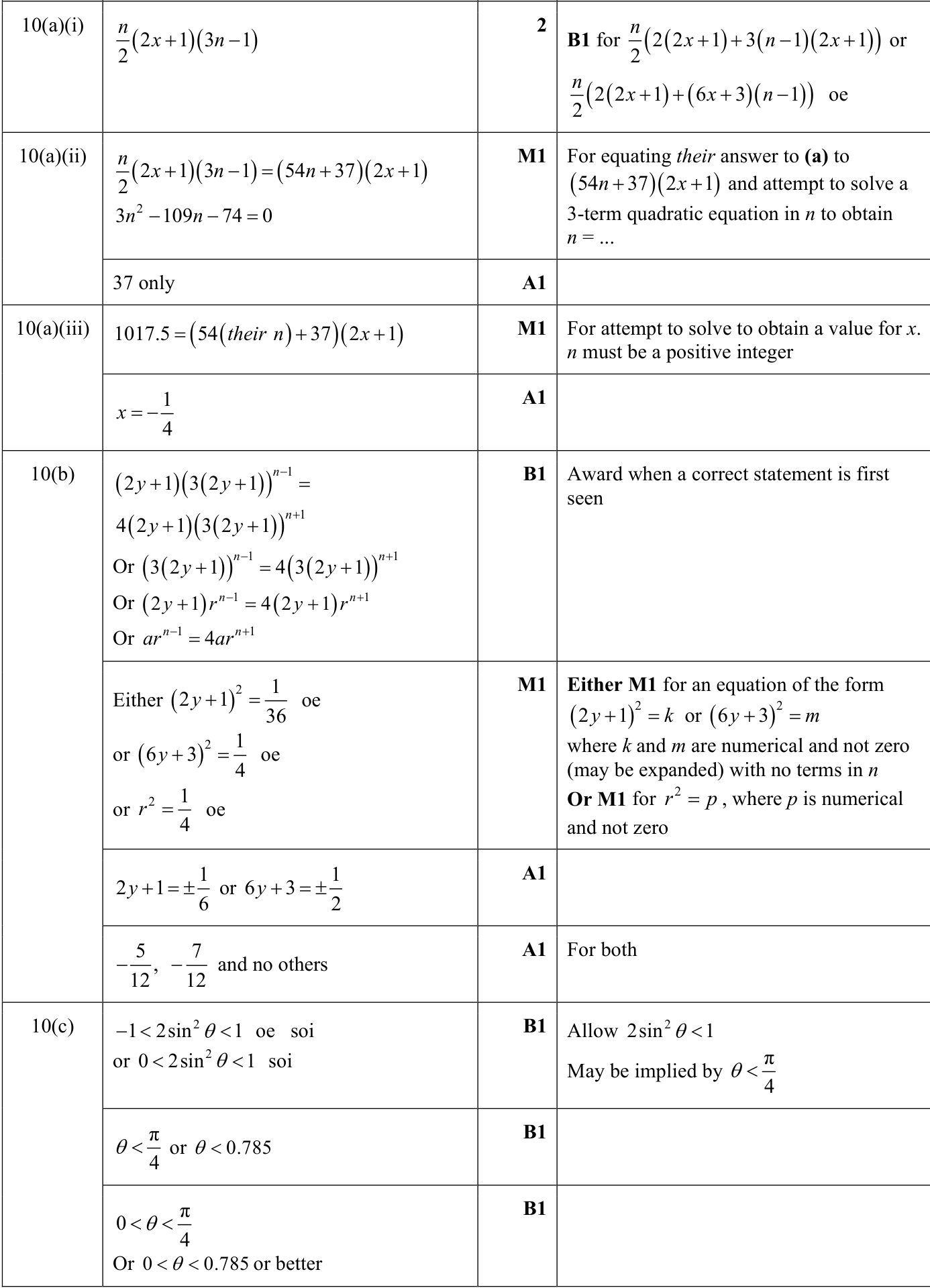
(a) The first three terms of an arithmetic progression are \((2x+1)\), \(4(2x+1)\) and \(7(2x+1)\), where \(x\ne-\frac12\).
(i) Show that the sum to \(n\) terms can be written in the form \(\frac n2(2x+1)(An+B)\), where \(A\) and \(B\) are integers to be found.
(ii) Given that the sum to \(n\) terms is \((54n+37)(2x+1)\), find the value of \(n\).
(iii) Given also that the sum to \(n\) terms in part (ii) is equal to \(1017.5\), find the value of \(x\).
(b) The first three terms of a geometric progression are \((2y+1)\), \(3(2y+1)^2\) and \(9(2y+1)^3\), where \(y\ne-\frac12\). Given that the \(n\)th term of the progression is equal to 4 times the \((n+2)\)th term, find the possible values of \(y\), giving your answers as fractions.
(c) The first three terms of a different geometric progression are \(\sin\theta\), \(2\sin^3\theta\) and \(4\sin^5\theta\), for \(0\lt\theta\lt\frac{\pi}{2}\). Find the values of \(\theta\) for which the progression has a sum to infinity.
0606 P23 - Jun 2023 - Q10 - 15 marks
An arithmetic progression \(A\) has first term \(a\) and common difference \(d\). The second, fourteenth and seventeenth terms of \(A\) form the first three terms of a convergent geometric progression \(G\) with common ratio \(r\).
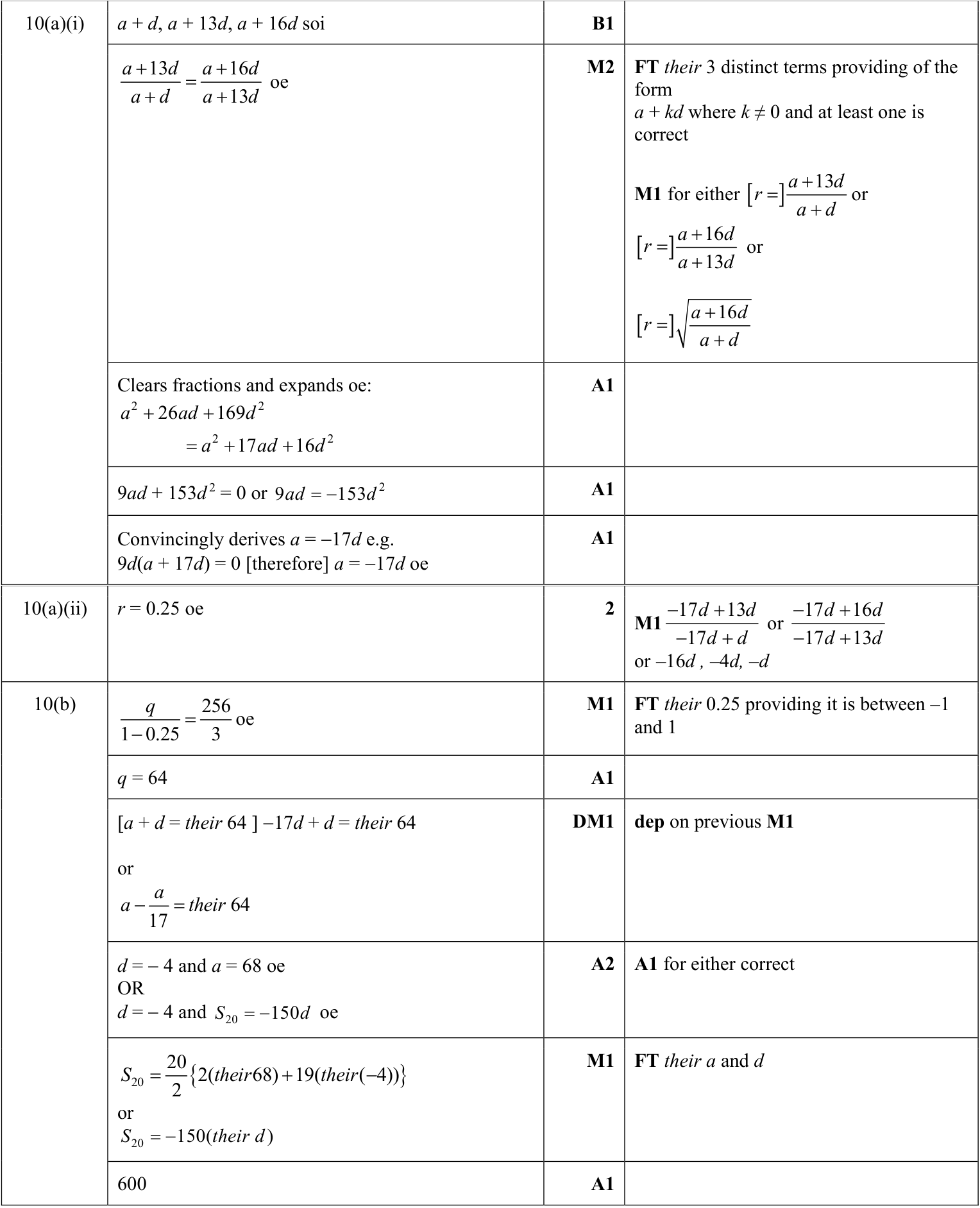
(a)(i) Given that \(d\ne0\), find two expressions for \(r\) in terms of \(a\) and \(d\), and hence show that \(a=-17d\).
(a)(ii) Find \(r\).
(b) The first term of \(G\) is \(q\), and the sum to infinity of \(G\) is \(\frac{256}{3}\). Find the sum of the first 20 terms of \(A\).