Past Exam Questions
← Back0606 P12 - Jun 2020 - Q3 - 6 marks
(a) Find the first three terms in the expansion of
\(\left(4-\frac{x}{16}\right)^6\)
in ascending powers of \(x\), giving each term in its simplest form.
(b) Hence find the term independent of \(x\) in the expansion of
\(\left(4-\frac{x}{16}\right)^6\left(x-\frac1x\right)^2.\)

0606 P21 - Jun 2020 - Q8 - 7 marks
(a) Expand \((2-x)^5\), simplifying each coefficient.
(b) Hence solve
\(\frac{e^{(2-x)^5}\times e^{80x}}{e^{10x^4+32}}=e^{-x^5}.\)

0606 P23 - Jun 2020 - Q9 - 8 marks
Do not use a calculator in this question.
(a) Find the term independent of \(x\) in the binomial expansion of
\(\left(3x-\frac1x\right)^6.\)
(b) In the expansion of
\(\left(1+\frac{x}{2}\right)^n,\)
the coefficient of \(x^4\) is half the coefficient of \(x^6\). Find the value of the positive constant \(n\).

0606 P12 - Nov 2020 - Q5 - 5 marks
Find the coefficient of \(x^2\) in the expansion of
\(\left(x-\frac{3}{x}\right)\left(x+\frac{2}{x}\right)^5.\)

0606 P13 - Nov 2020 - Q5 - 5 marks
Given that the coefficient of \(x^2\) in the expansion of
\((1+x)\left(1-\frac{x}{2}\right)^n\)
is \(\dfrac{25}{4}\), find the value of the positive integer \(n\).

0606 P21 - Nov 2020 - Q5 - 7 marks
The first three terms in the expansion of
\((a+bx)^5(1+x)\)
are
\(32-208x+cx^2.\)
Find the value of each of the integers \(a\), \(b\) and \(c\).

0606 P12 - Mar 2019 - Q3 - 6 marks
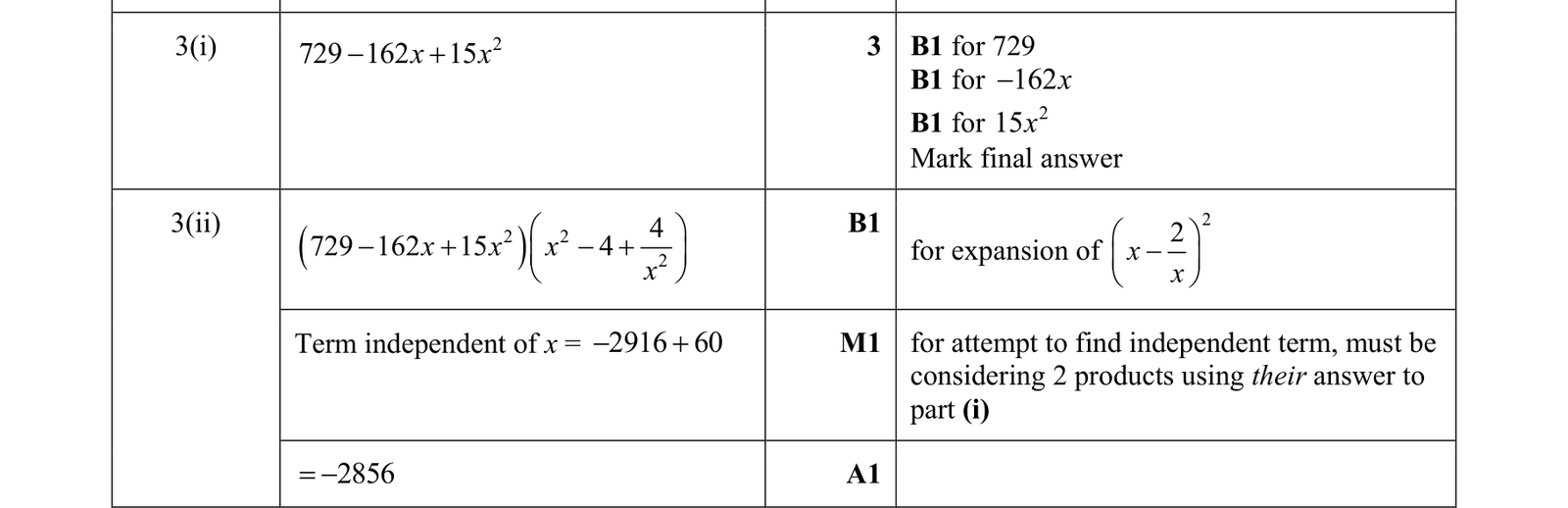
(i) Find the first three terms, in ascending powers of \(x\), in the expansion of \(\left(3-\dfrac{x}{9}\right)^6\).
(ii) Hence find the term independent of \(x\) in the expansion of \(\left(3-\dfrac{x}{9}\right)^6\left(x-\dfrac2x\right)^2\).
0606 P11 - Jun 2019 - Q4 - 7 marks
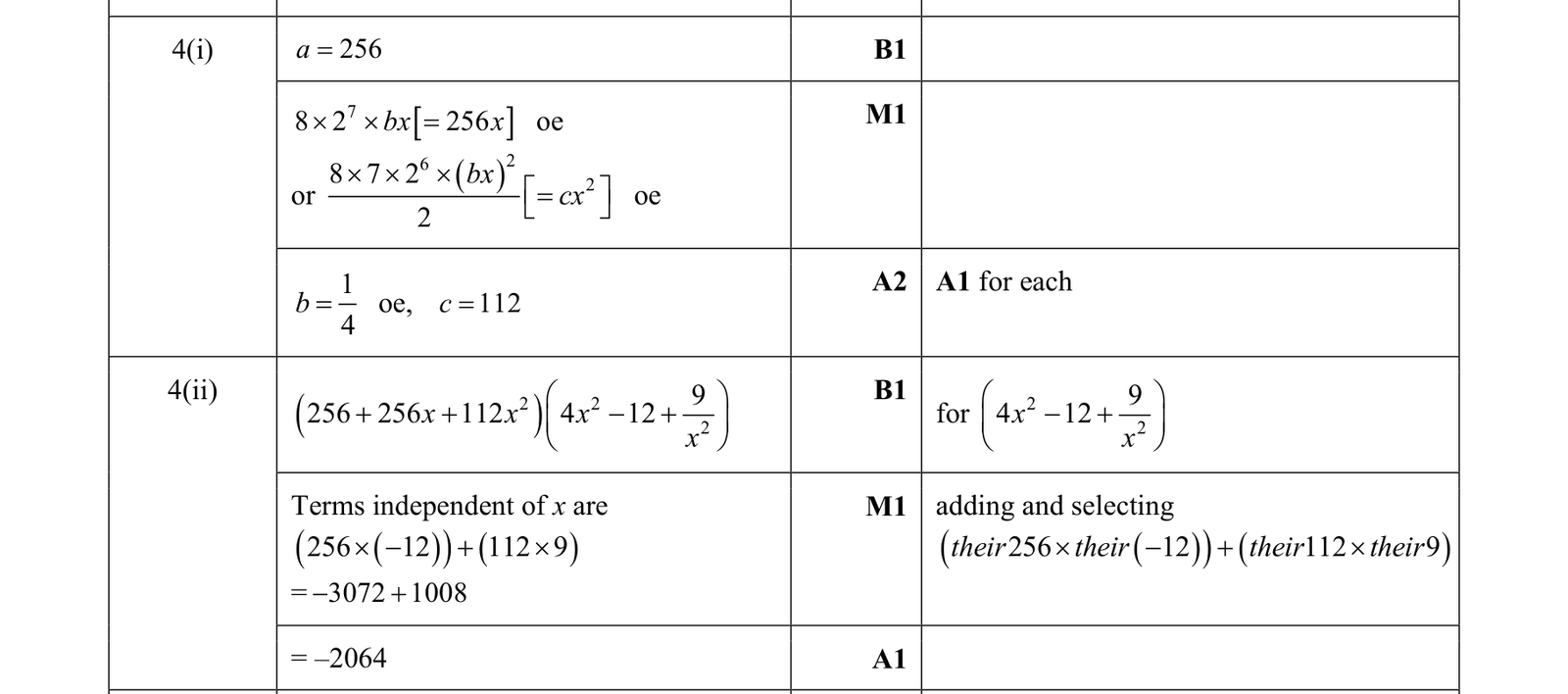
(i) The first 3 terms, in ascending powers of \(x\), in the expansion of \((2+bx)^8\) can be written as
\(a+256x+cx^2.\)
Find \(a\), \(b\) and \(c\).
(ii) Using the values found in part (i), find the term independent of \(x\) in the expansion of
\((2+bx)^8\left(2x-\frac3x\right)^2.\)
0606 P22 - Jun 2019 - Q8 - 8 marks
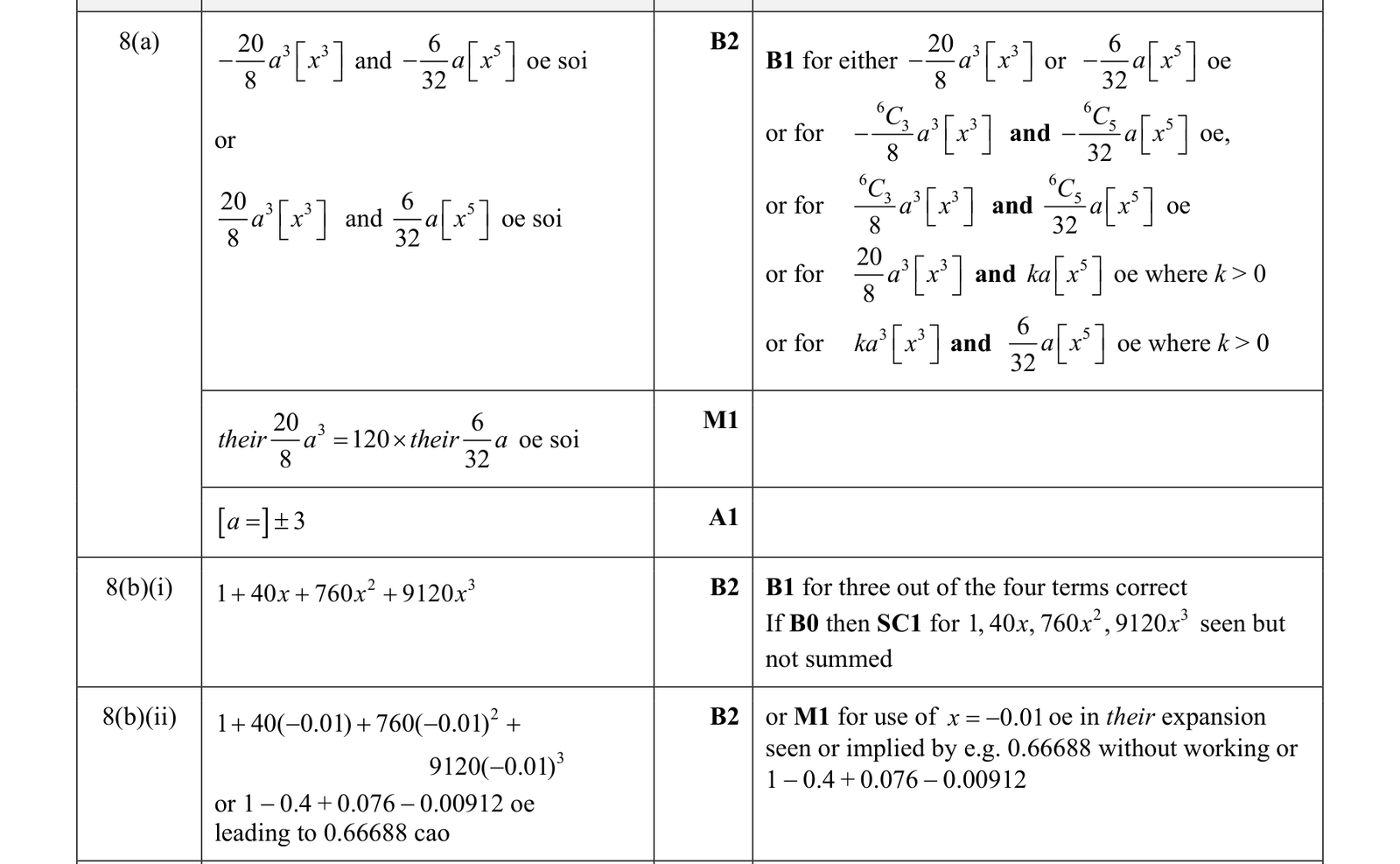
(a) In the binomial expansion of \(\left(a-\dfrac{x}{2}\right)^6\), the coefficient of \(x^3\) is 120 times the coefficient of \(x^5\). Find the possible values of the constant \(a\).
(b) (i) Expand \((1+2x)^{20}\) in ascending powers of \(x\), as far as the term in \(x^3\). Simplify each term.
(ii) Use your expansion to show that the value of \(0.98^{20}\) is \(0.67\) to 2 decimal places.
0606 P23 - Jun 2019 - Q8 - 8 marks
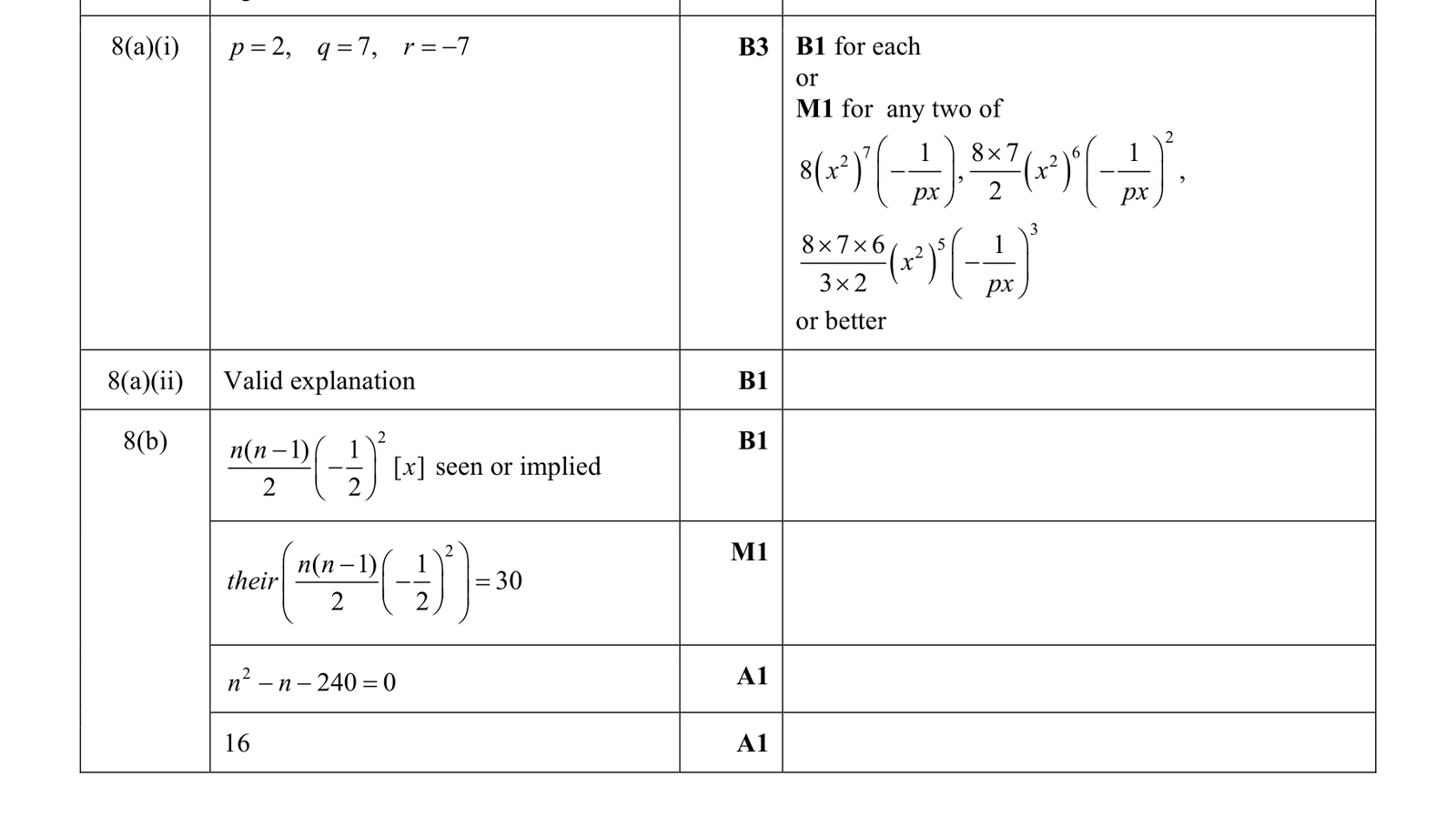
(a) (i) Given that \(\left(x^2-\dfrac1{px}\right)^8=x^{16}-4x^{13}+qx^{10}+rx^7+\cdots\), find the value of each of the constants \(p\), \(q\) and \(r\).
(ii) Explain why there is no term independent of \(x\) in the binomial expansion of \(\left(x^2-\dfrac1{px}\right)^8\).
(b) In the binomial expansion of \(\left(1-\dfrac{\sqrt{x}}2\right)^n\), where \(n\) is a positive integer, the coefficient of \(x\) is 30. Form an equation in \(n\) and hence find the value of \(n\).
0606 P12 - Nov 2019 - Q3 - 6 marks
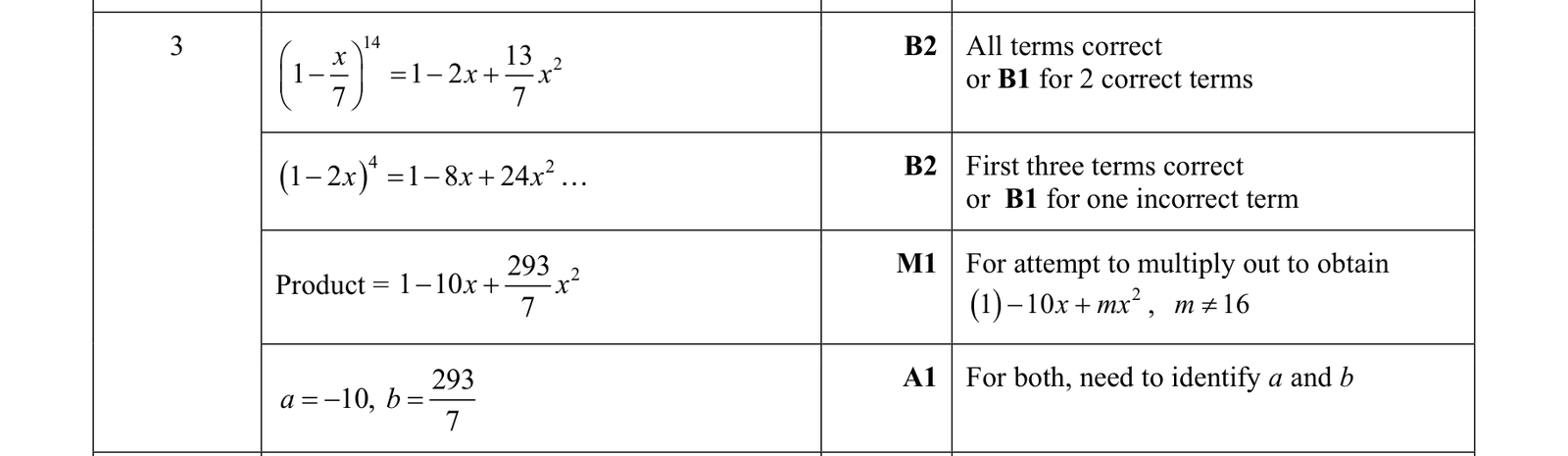
The first three terms in the expansion of
\(\left(1-\frac{x}{7}\right)^{14}(1-2x)^4\)
can be written as \(1+ax+bx^2\). Find the value of each of the constants \(a\) and \(b\).
0606 P21 - Nov 2019 - Q10 - 8 marks
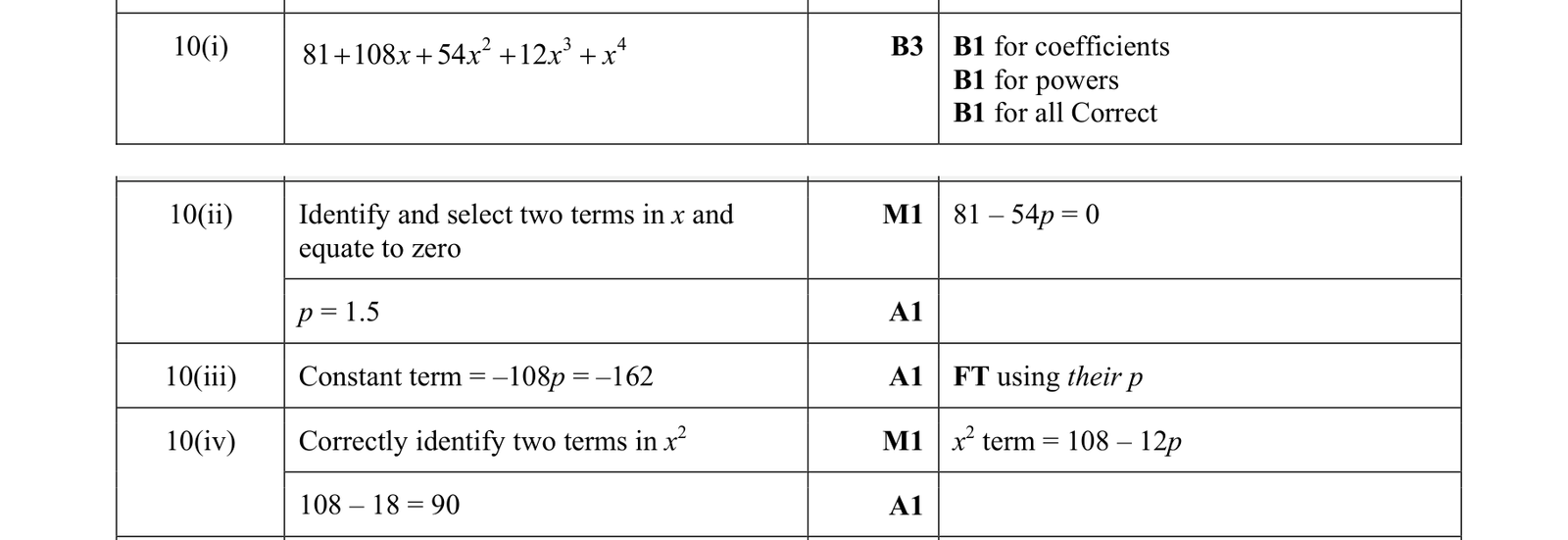
(i) Expand \((3+x)^4\), evaluating each coefficient.
In the expansion of
\(\left(x-\frac{p}{x}\right)(3+x)^4\)
the coefficient of \(x\) is zero.
(ii) Find the value of the constant \(p\).
(iii) Hence find the term independent of \(x\).
(iv) Show that the coefficient of \(x^2\) is \(90\).
0606 P23 - Nov 2019 - Q3 - 8 marks
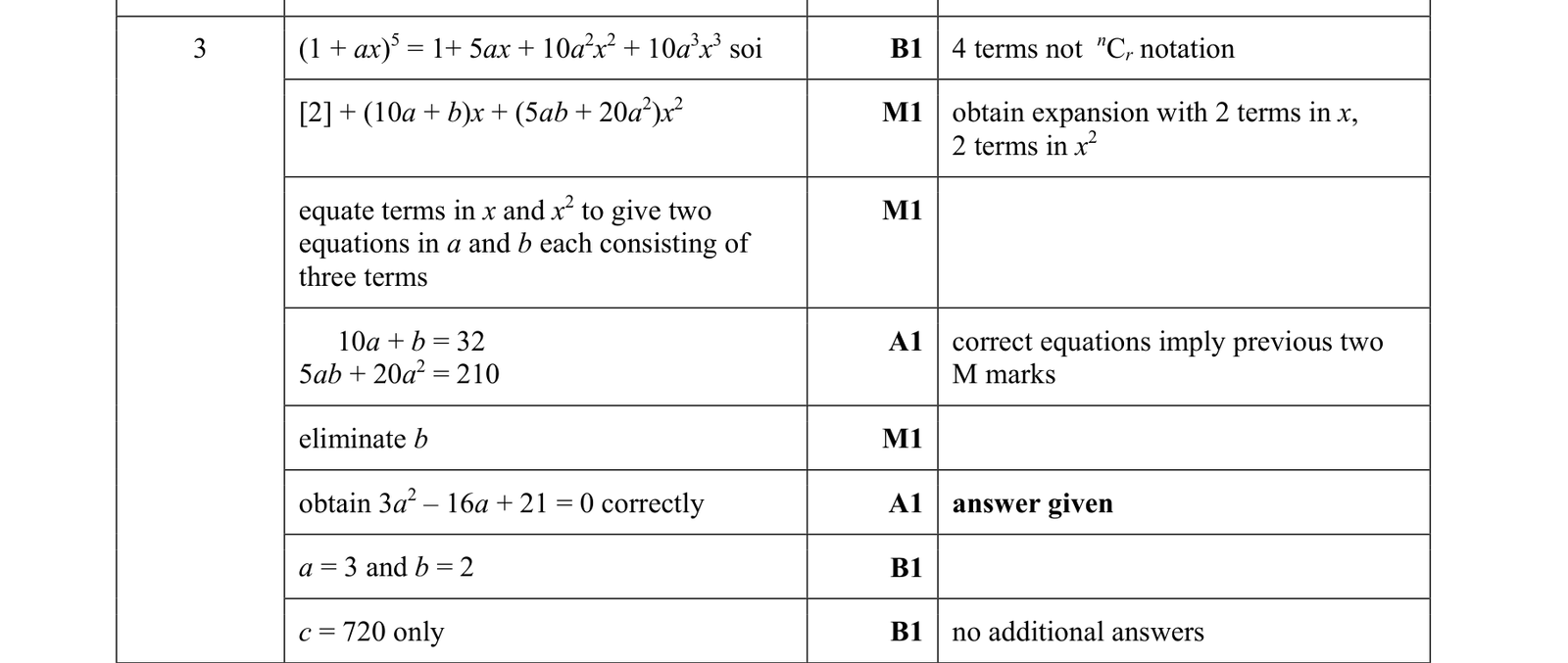
The first four terms in the expansion of \((1+ax)^5(2+bx)\) are
\(2+32x+210x^2+cx^3,\)
where \(a\), \(b\) and \(c\) are integers. Show that
\(3a^2-16a+21=0\)
and hence find the values of \(a\), \(b\) and \(c\).
0606 P12 - Mar 2018 - Q5 - 8 marks
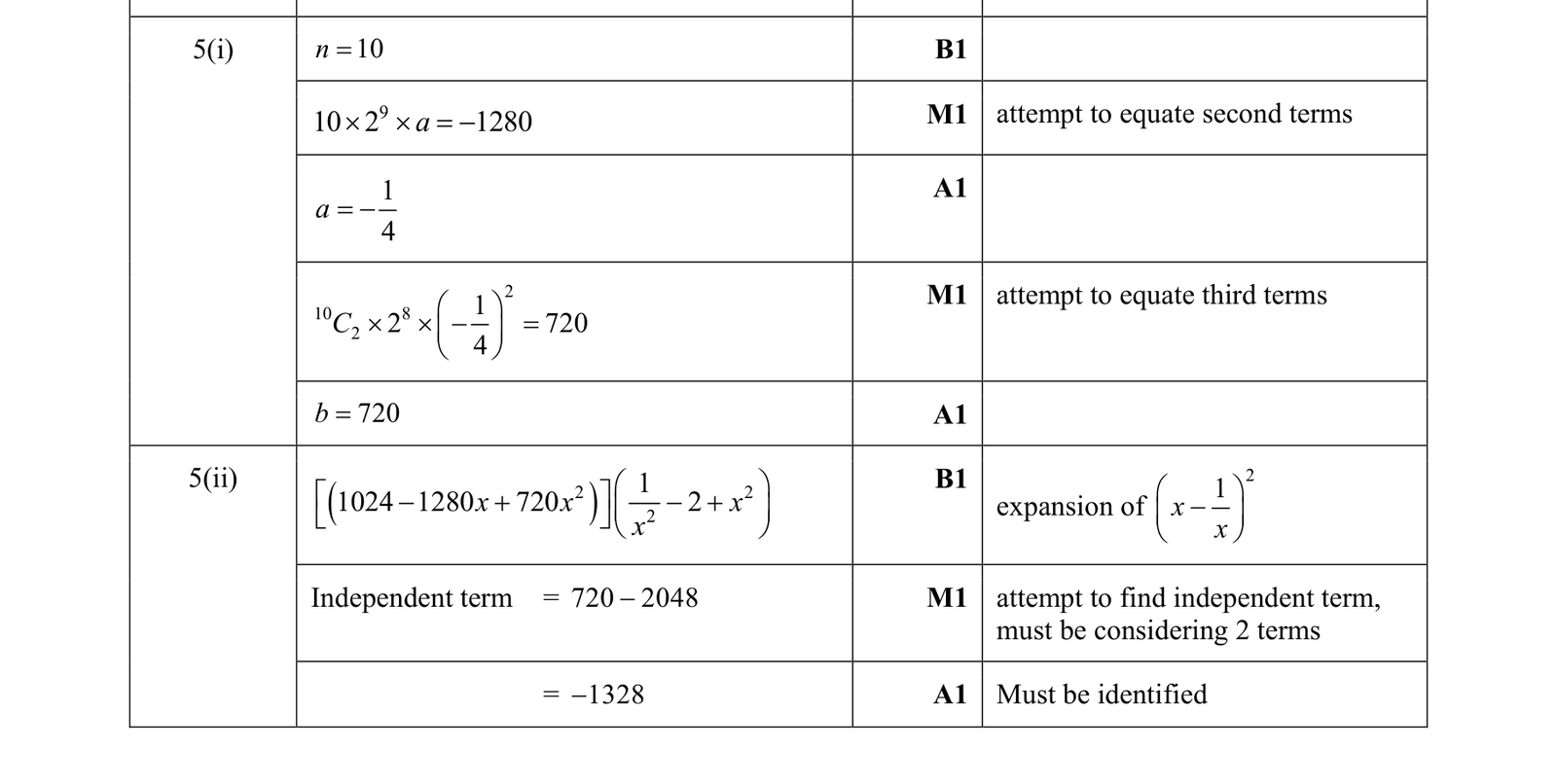
The first three terms, in ascending powers of \(x\), in the expansion of \((2+ax)^n\) are \(1024-1280x+bx^2\). Find the values of \(n\), \(a\), and \(b\).
Hence find the term independent of \(x\) in the expansion of \((2+ax)^n\left(x-\dfrac1x\right)^2\).
0606 P11 - Jun 2018 - Q9 - 6 marks
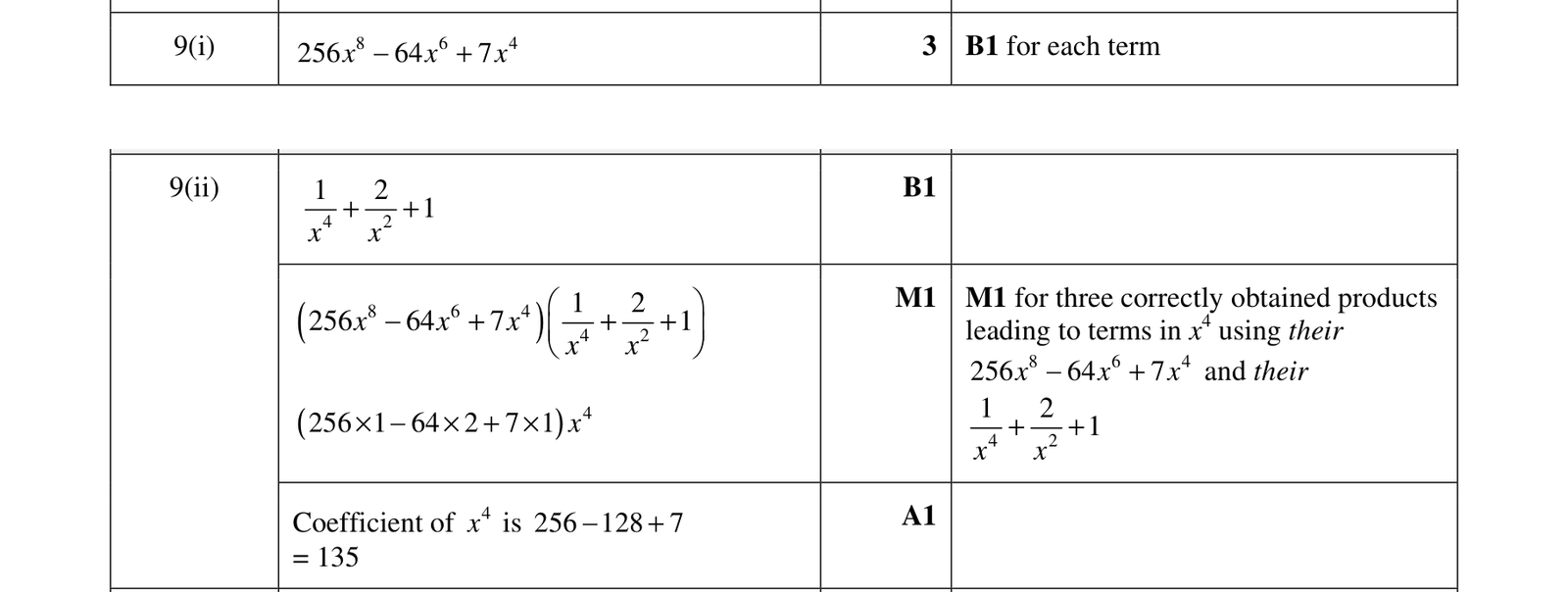
(i) Find the first \(3\) terms in the expansion of
\(\left(2x-\frac{1}{16x}\right)^8\)
in descending powers of \(x\).
(ii) Hence find the coefficient of \(x^4\) in the expansion of
\(\left(2x-\frac{1}{16x}\right)^8 \left(\frac{1}{x^2}+1\right)^2.\)
0606 P12 - Jun 2018 - Q5 - 6 marks
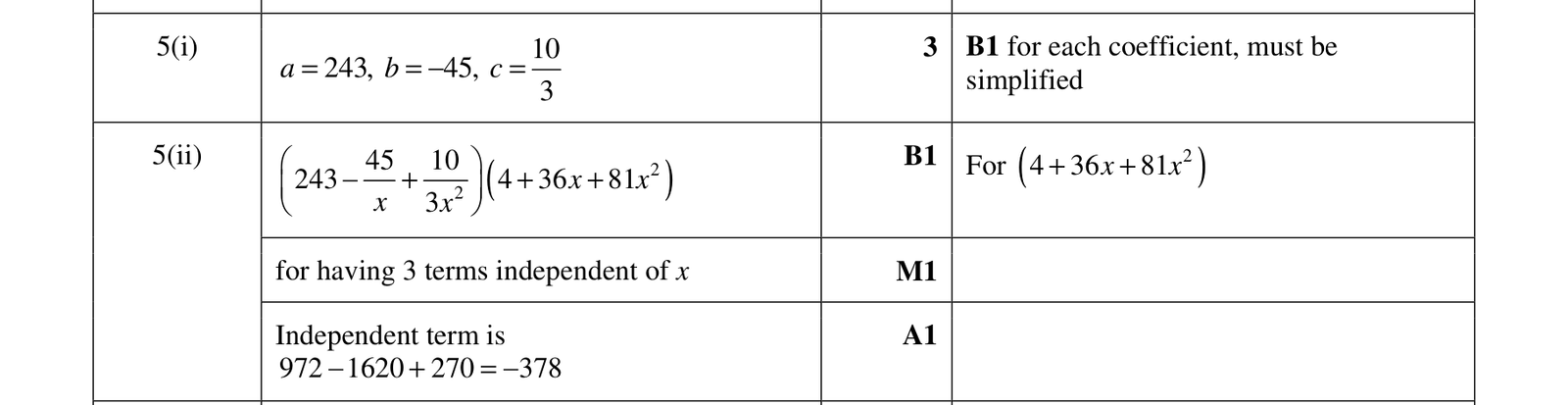
(i) The first three terms in the expansion of
\(\left(3-\frac1{9x}\right)^5\)
can be written as \(a+\dfrac bx+\dfrac c{x^2}\). Find the value of each of the constants \(a\), \(b\) and \(c\).
(ii) Use your values of \(a\), \(b\) and \(c\) to find the term independent of \(x\) in the expansion of
\(\left(3-\frac1{9x}\right)^5(2+9x)^2.\)
0606 P13 - Jun 2018 - Q9 - 6 marks
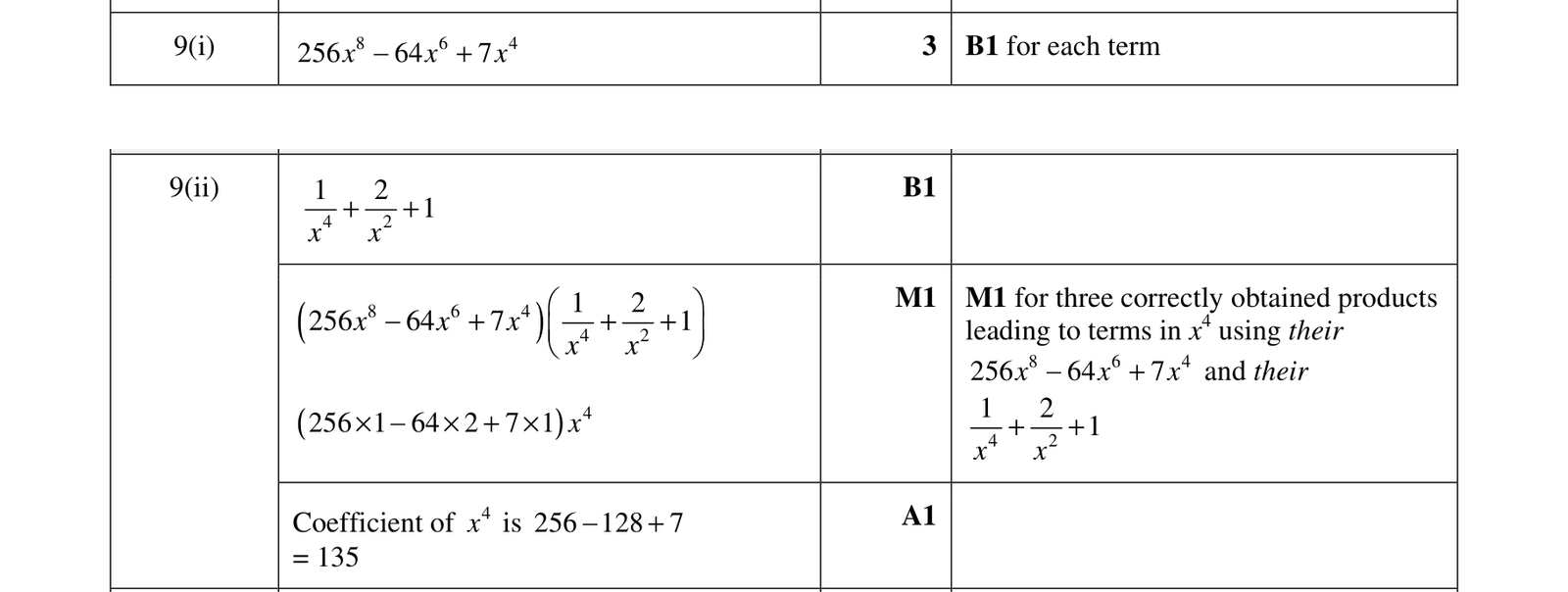
(i) Find the first \(3\) terms in the expansion of
\(\left(2x-\frac{1}{16x}\right)^8\)
in descending powers of \(x\).
(ii) Hence find the coefficient of \(x^4\) in the expansion of
\(\left(2x-\frac{1}{16x}\right)^8 \left(\frac{1}{x^2}+1\right)^2.\)
0606 P11 - Nov 2018 - Q3 - 6 marks
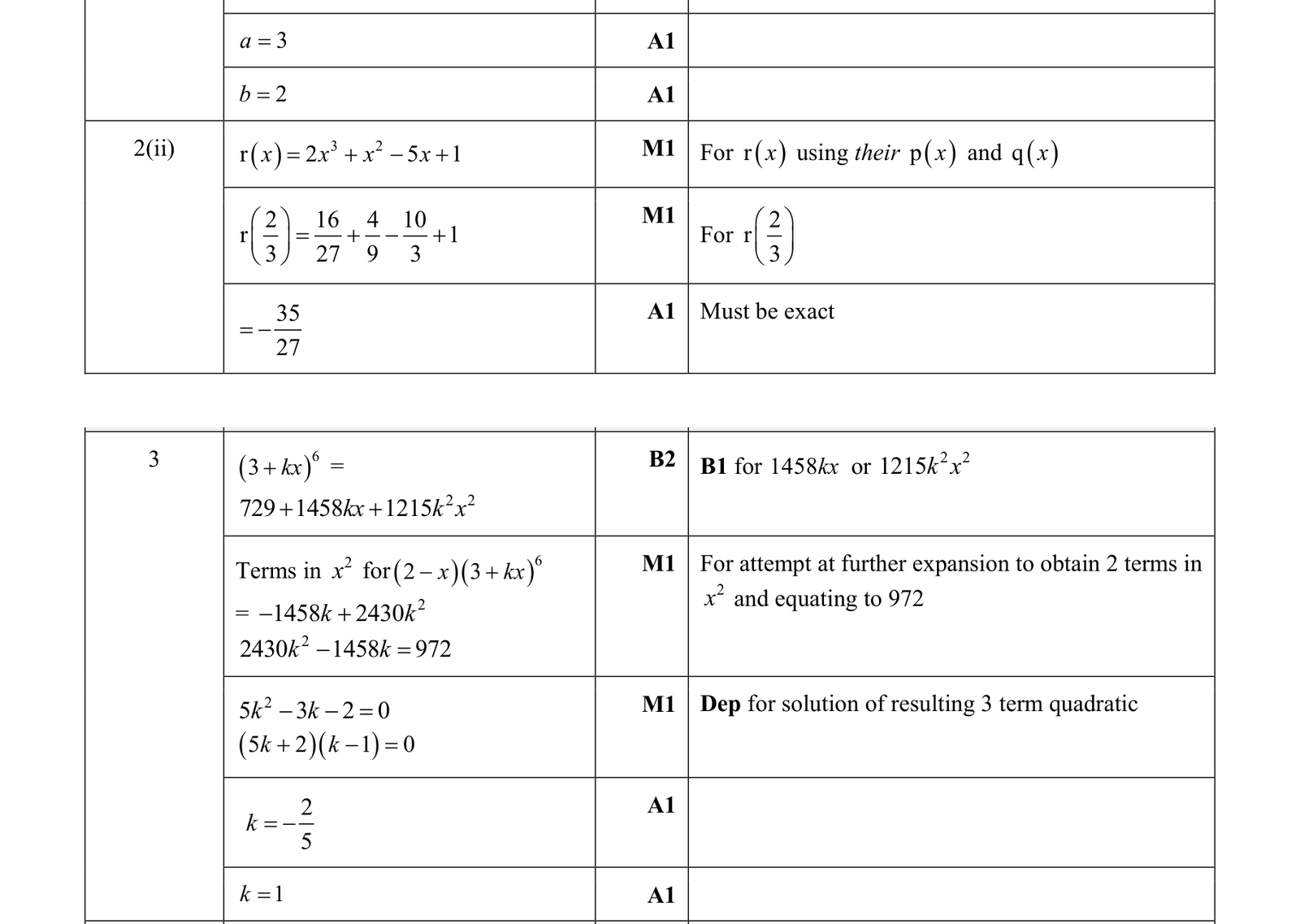
The coefficient of \(x^2\) in the expansion of \((2-x)(3+kx)^6\) is equal to \(972\). Find the possible values of the constant \(k\).
0606 P12 - Nov 2018 - Q5 - 6 marks
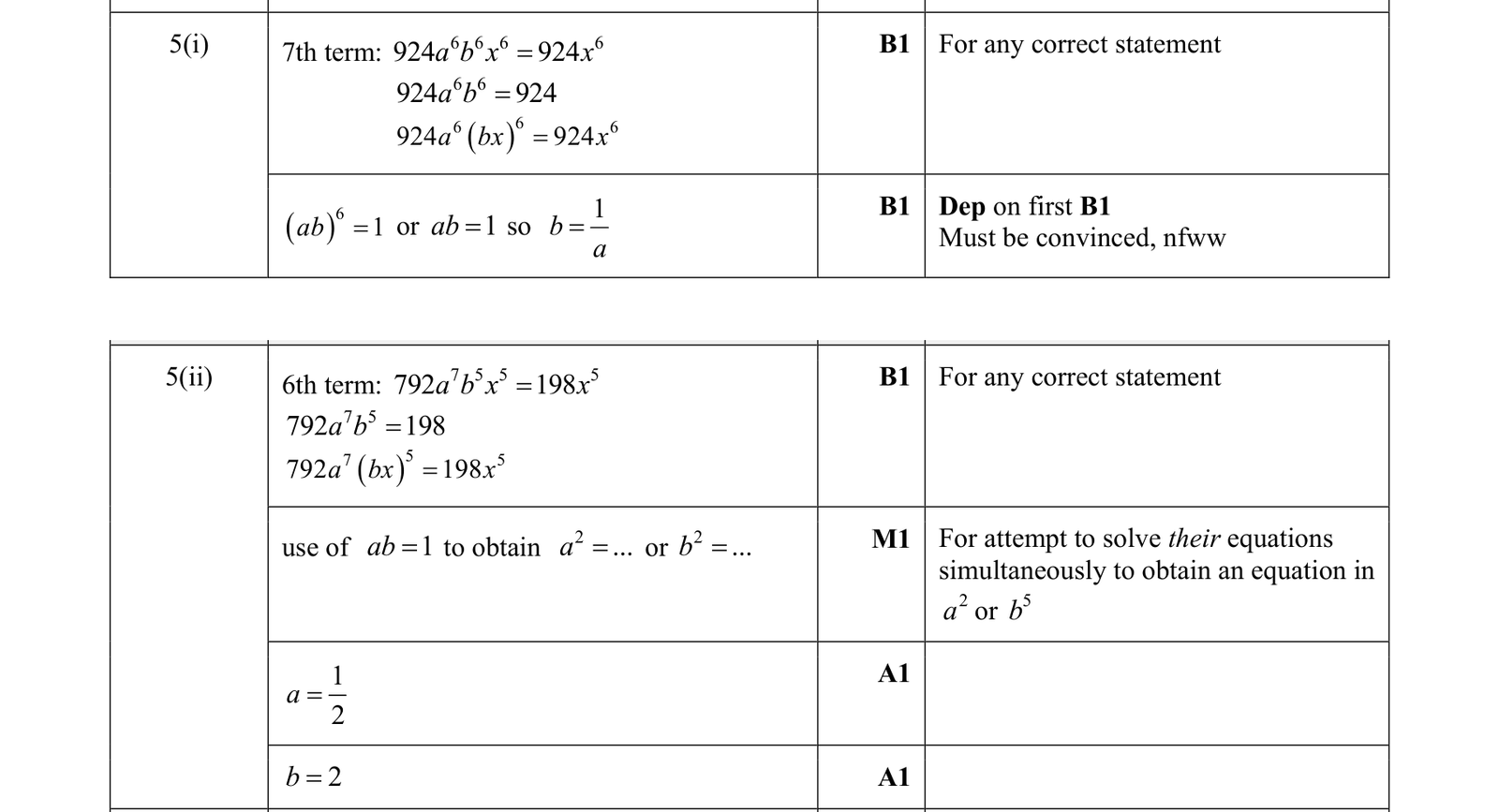
The 7th term in the expansion of \((a+bx)^{12}\) in ascending powers of \(x\) is \(924x^6\). It is given that \(a\) and \(b\) are positive constants.
(i) Show that \(b=\dfrac1a\).
The 6th term in the expansion of \((a+bx)^{12}\) in ascending powers of \(x\) is \(198x^5\).
(ii) Find the value of \(a\) and of \(b\).

0606 P13 - Nov 2018 - Q1 - 6 marks
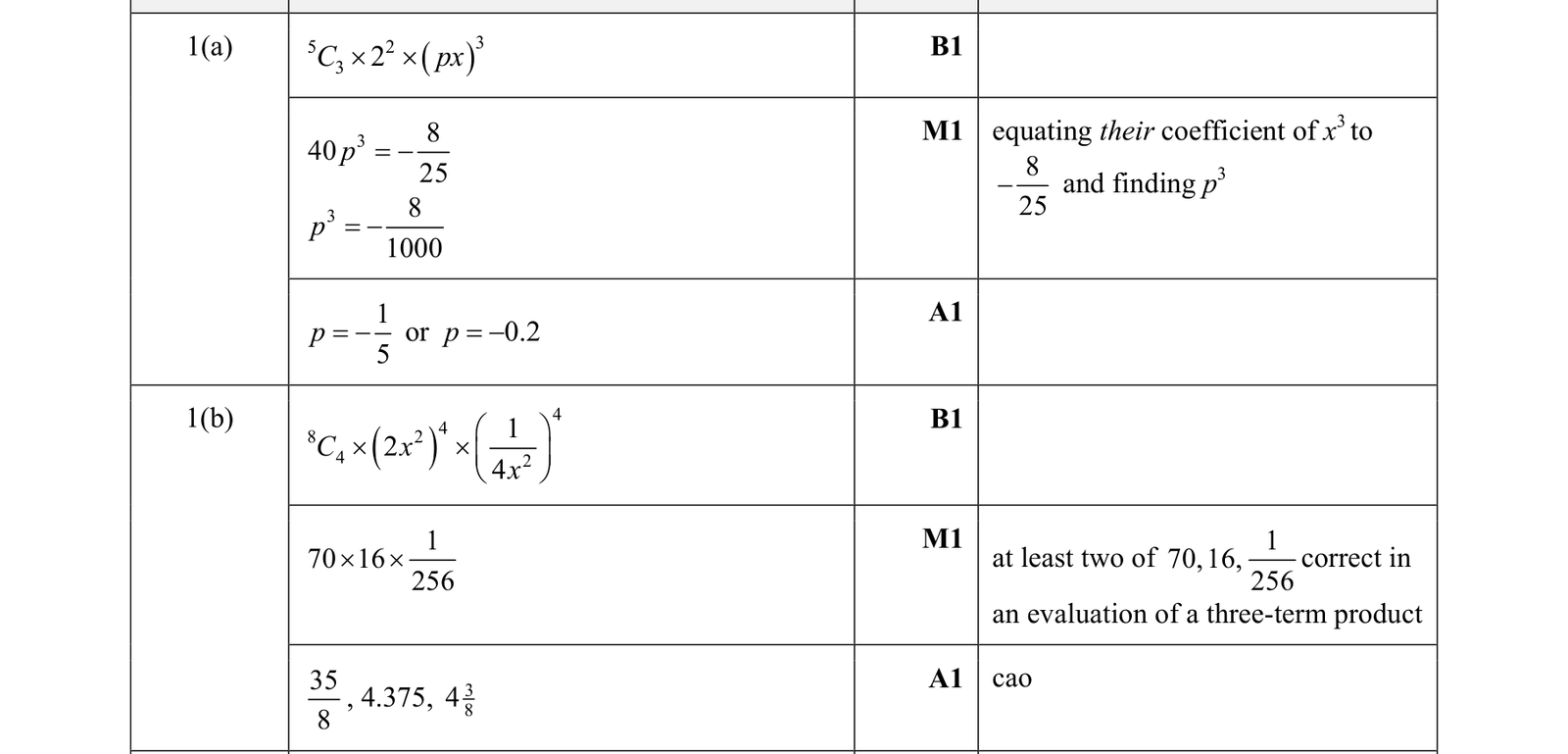
(a) In the expansion of \((2+px)^5\), the coefficient of \(x^3\) is equal to \(-\dfrac{8}{25}\). Find the value of the constant \(p\).
(b) Find the term independent of \(x\) in the expansion of \(\left(2x^2+\dfrac{1}{4x^2}\right)^8\).