Past Exam Questions
← Back0606 P13 - Jun 2023 - Q5 - 6 marks
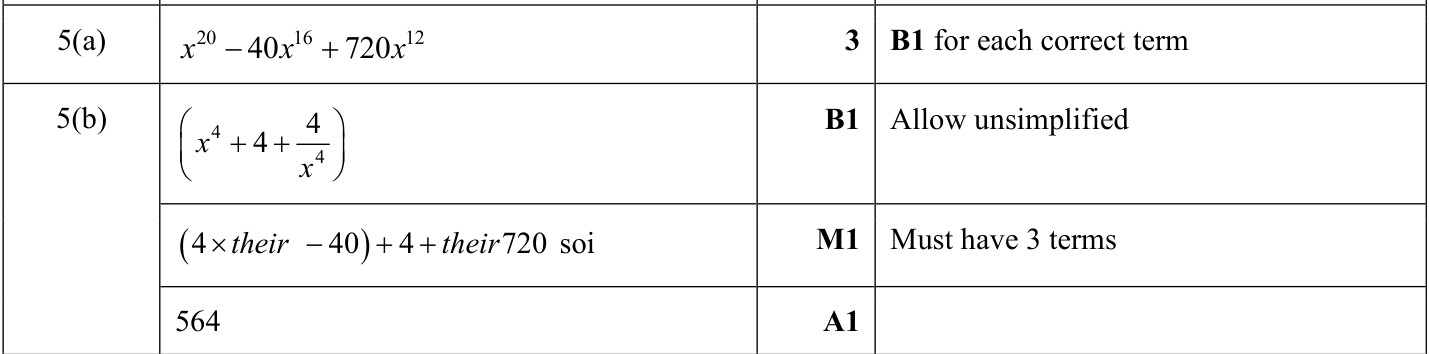
(a) Find the first three terms in the expansion of
\(\left(x^2-\frac4{x^2}\right)^{10}\)
in descending powers of \(x\). Give each term in its simplest form.
(b) Hence find the coefficient of \(x^{16}\) in the expansion of
\(\left(x^2-\frac4{x^2}\right)^{10}\left(x^2+\frac2{x^2}\right)^2.\)
0606 P21 - Jun 2023 - Q10 - 7 marks
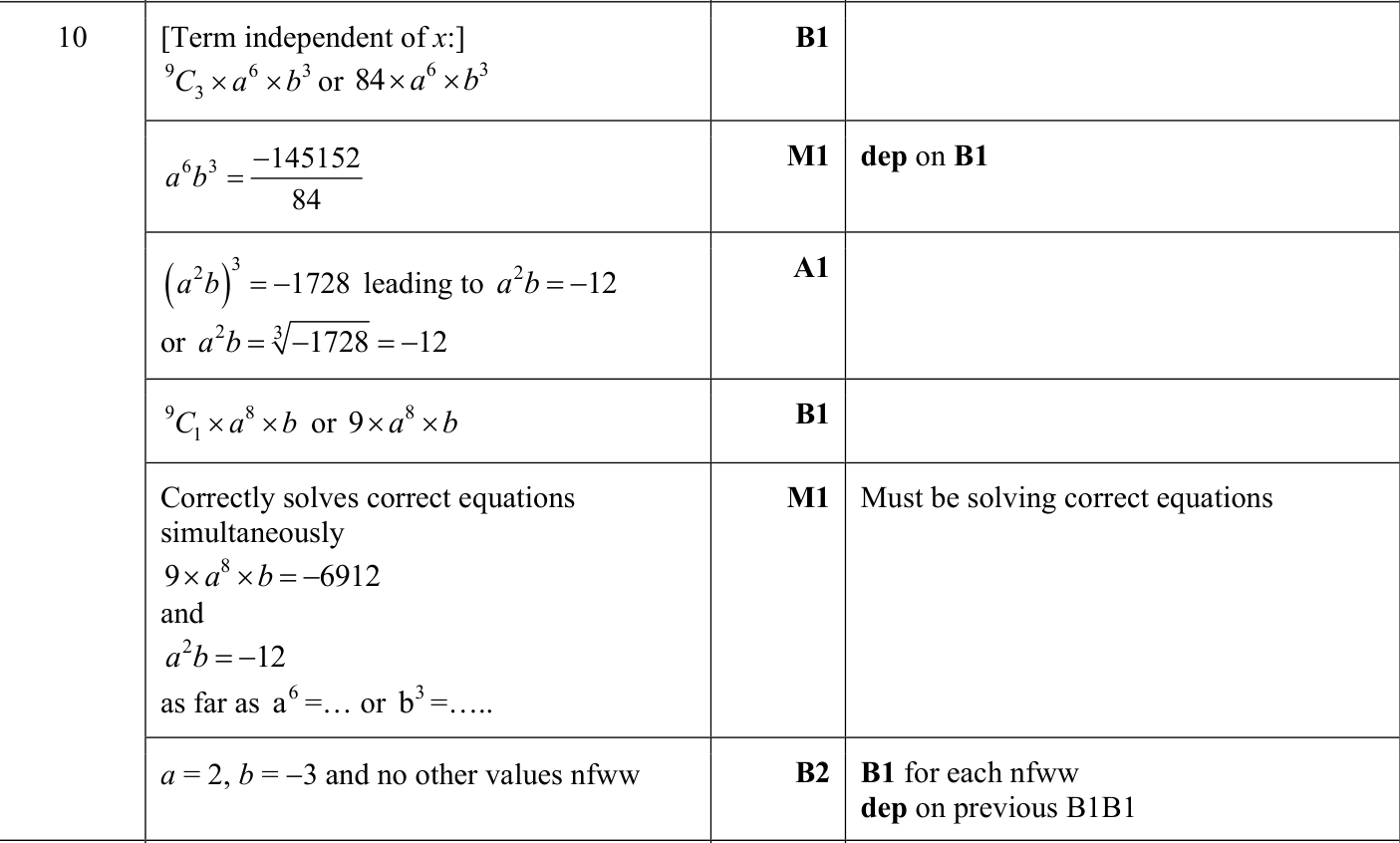
In the expansion of
\(\left(ax+\frac{b}{x^2}\right)^9,\)
where \(a\) and \(b\) are constants with \(a\gt 0\), the term independent of \(x\) is \(-145\,152\) and the coefficient of \(x^6\) is \(-6912\). Show that \(a^2b=-12\) and find the value of \(a\) and the value of \(b\).
0606 P22 - Jun 2023 - Q6 - 9 marks
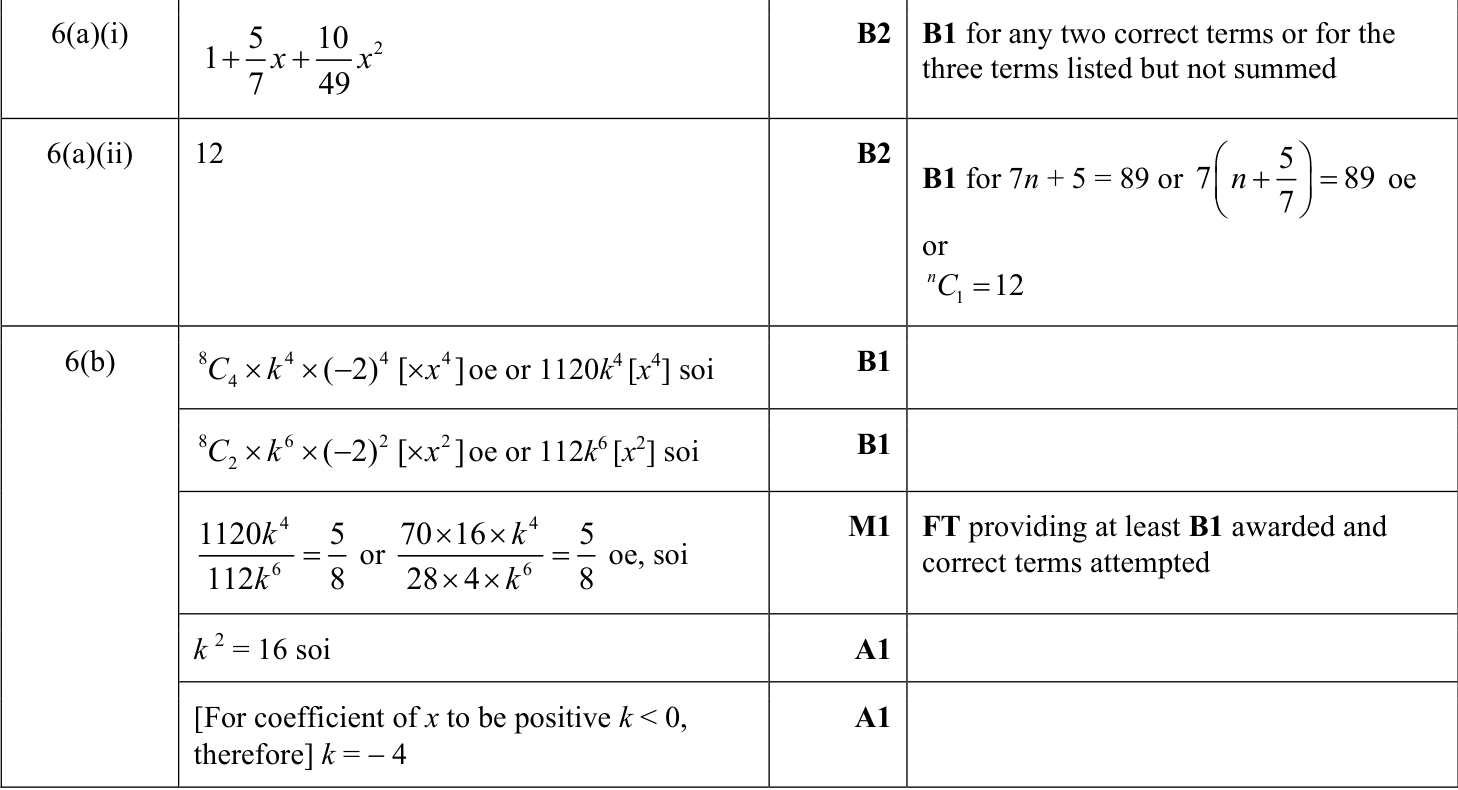
(a)(i) Find the first three terms in the expansion of
\(\left(1+\frac{x}{7}\right)^5\)
in ascending powers of \(x\). Simplify the coefficient of each term.
(a)(ii) The expansion of
\(7(1+x)^n\left(1+\frac{x}{7}\right)^5,\)
where \(n\) is a positive integer, is written in ascending powers of \(x\). The first two terms in the expansion are \(7+89x\). Find the value of \(n\).
(b) In the expansion of \((k-2x)^8\), where \(k\) is a constant, the coefficient of \(x^4\) divided by the coefficient of \(x^2\) is \(\frac58\). The coefficient of \(x\) is positive. Form an equation and hence find the value of \(k\).
0606 P12 - Nov 2023 - Q4 - 7 marks
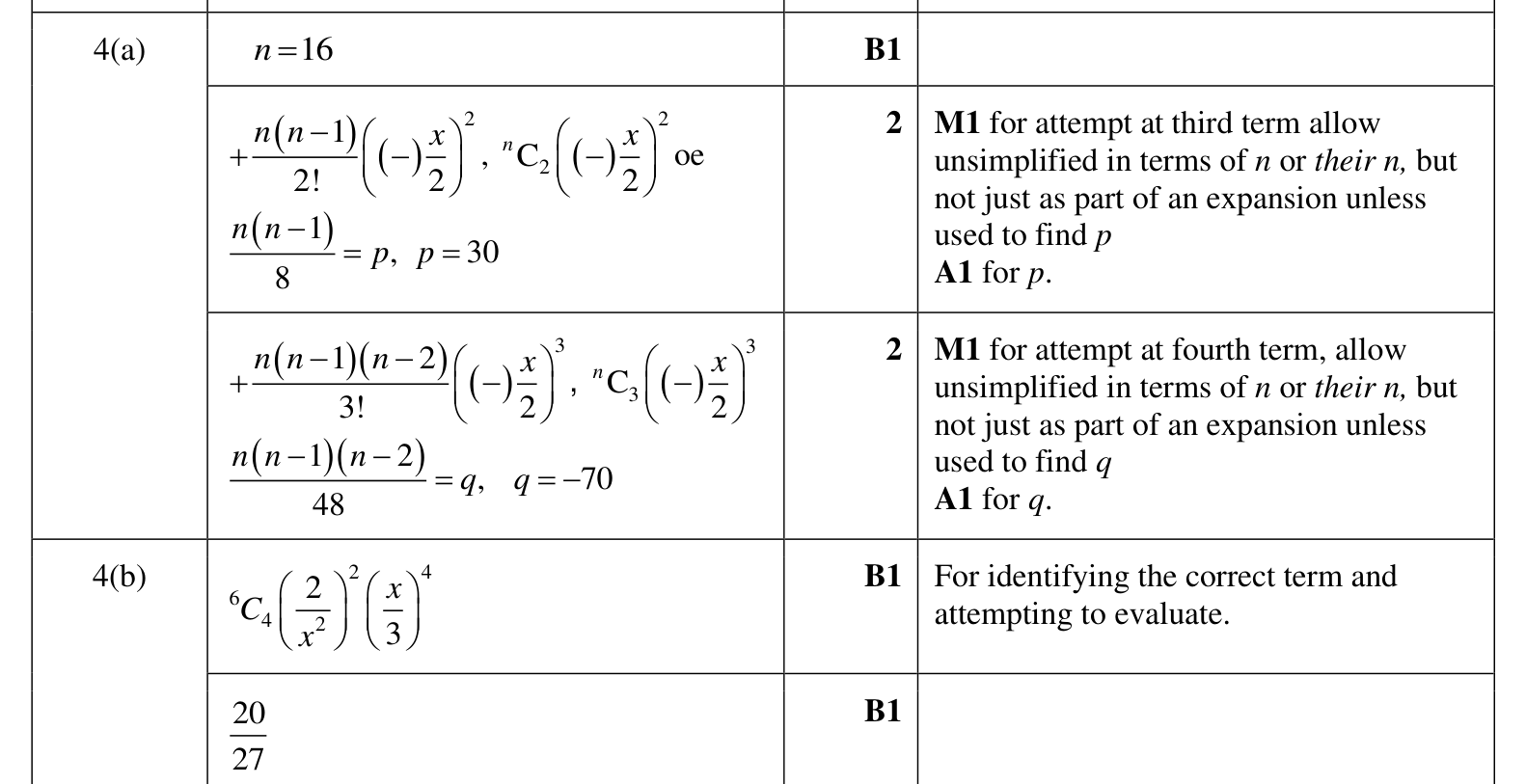
(a) It is given that the first four terms, in ascending powers of \(x\), in the expansion of \(\left(1-\frac{x}{2}\right)^n\) can be written in the form
\(1-8x+px^2+qx^3\),
where \(n\), \(p\) and \(q\) are integers. Find the values of \(n\), \(p\) and \(q\).
(b) Find the term independent of \(x\) in the expansion of \(\left(\frac{2}{x^2}+\frac{x}{3}\right)^6\), giving your answer as a rational number.
0606 P13 - Nov 2023 - Q8 - 6 marks
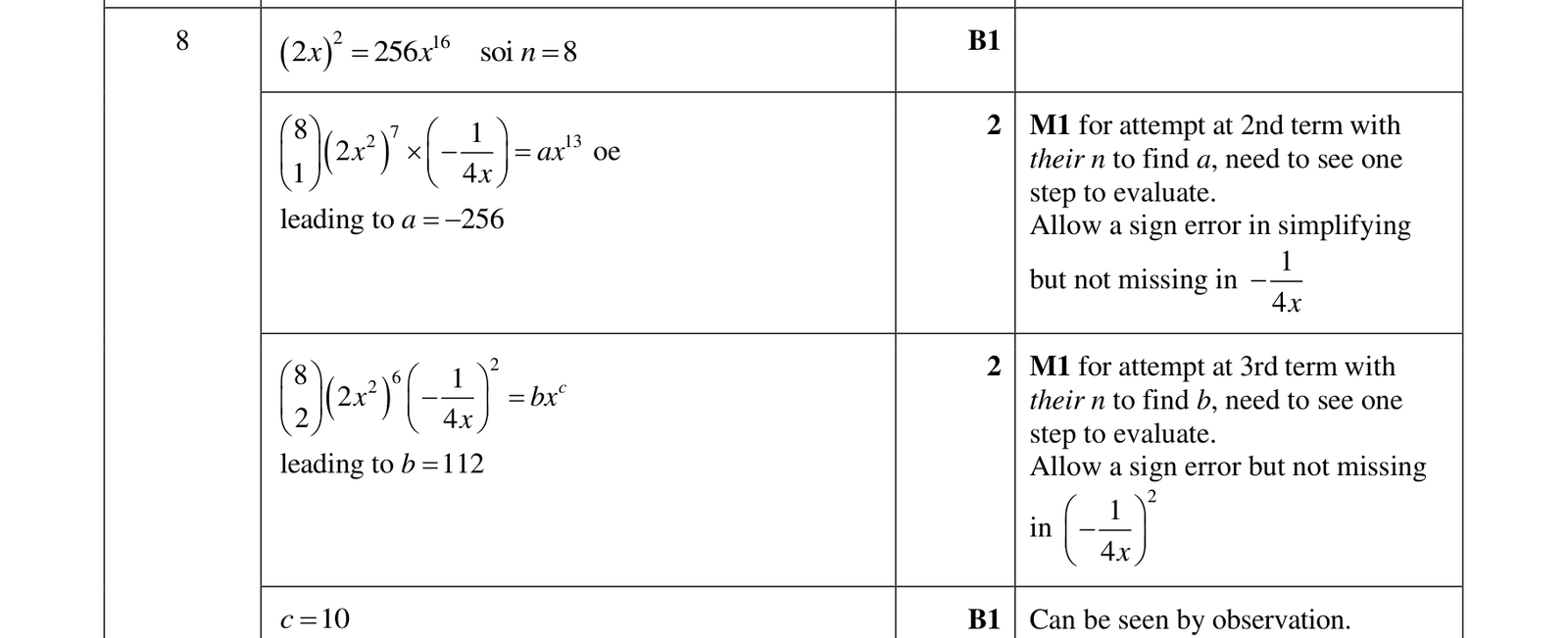
The first three terms, in descending powers of \(x\), in the expansion of
\(\displaystyle \left(2x^2-\frac1{4x}\right)^n\)
can be written in the form
\(256x^{16}+ax^{13}+bx^c\),
where \(n\), \(a\), \(b\) and \(c\) are integers. Find the values of \(n\), \(a\), \(b\) and \(c\).
0606 P22 - Mar 2022 - Q6 - 6 marks
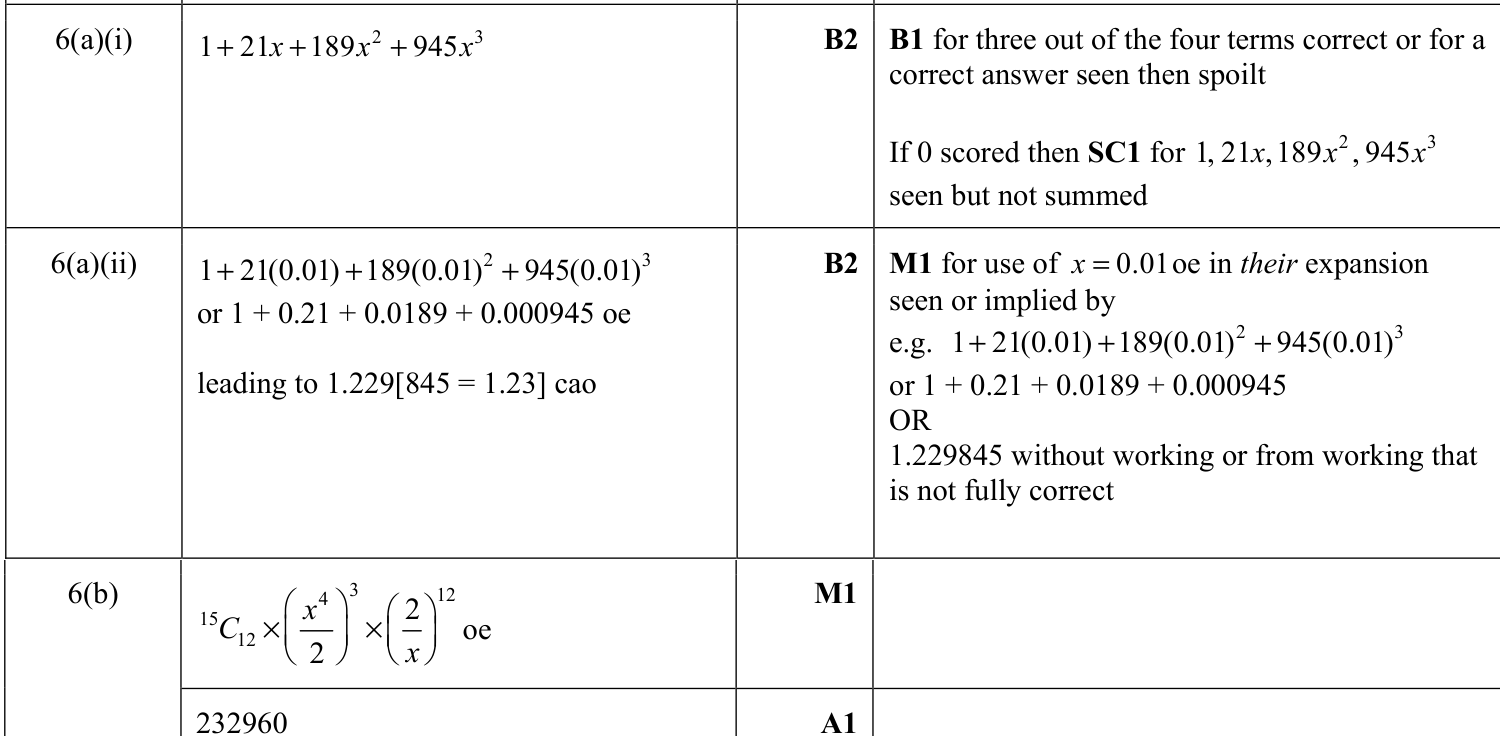
(a)(i) Use the binomial theorem to expand \((1+3x)^7\) in ascending powers of \(x\), as far as the term in \(x^3\). Simplify each term.
(a)(ii) Show that your expansion from part (a)(i) gives the value of \(1.03^7\) as \(1.23\) to \(2\) decimal places.
(b) Find the term independent of \(x\) in the expansion of
\(\left(\frac{x^4}{2}+\frac{2}{x}\right)^{15}.\)
0606 P12 - Jun 2022 - Q5 - 8 marks
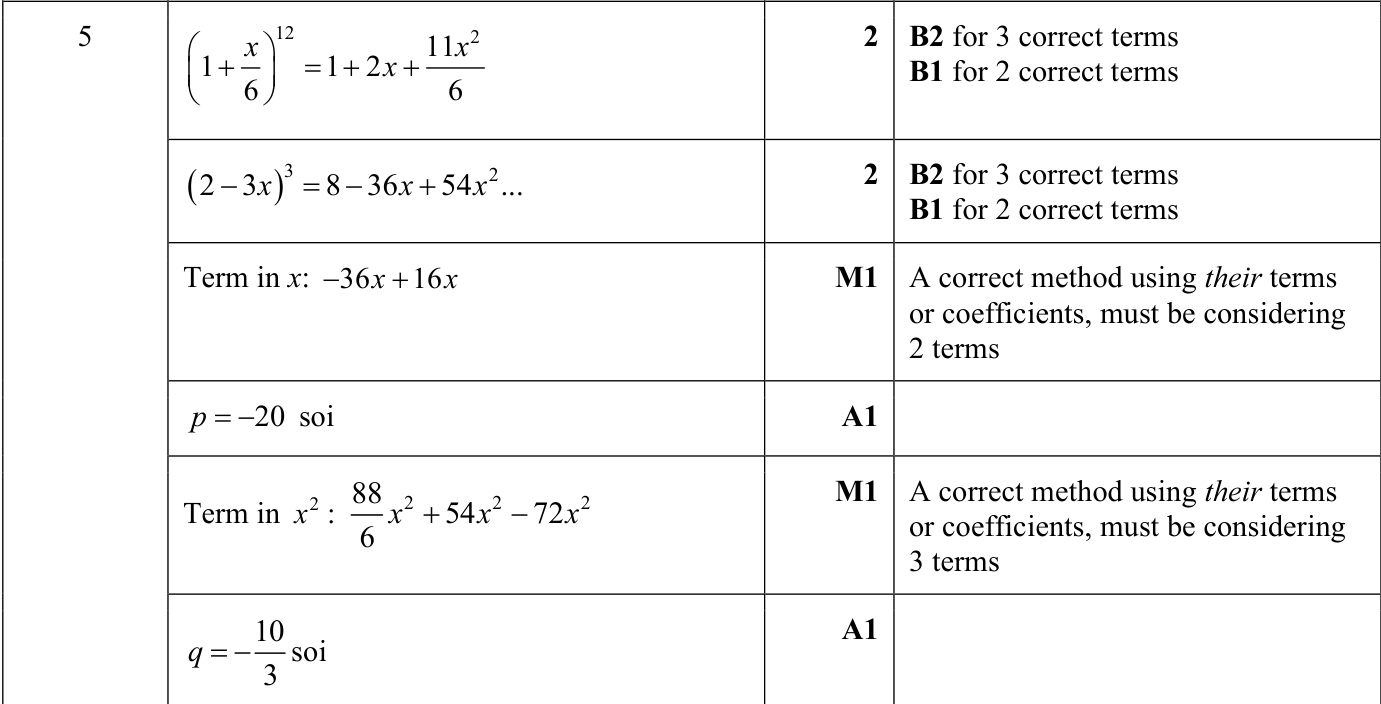
The first three terms, in ascending powers of \(x\), in the expansion of
\(\left(1+\frac{x}{6}\right)^{12}(2-3x)^3\)
can be written in the form \(8+px+qx^2\), where \(p\) and \(q\) are constants. Find the values of \(p\) and \(q\).
0606 P13 - Jun 2022 - Q1 - 6 marks
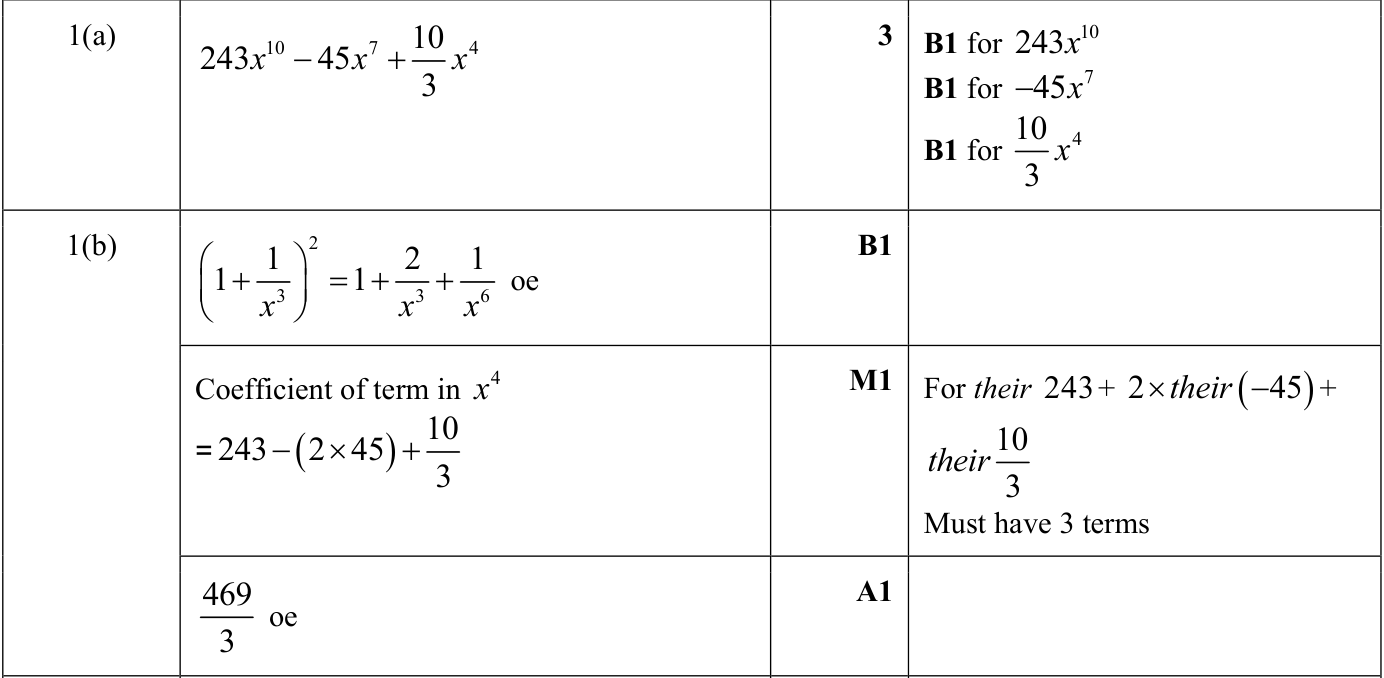
(a) Find the rational numbers \(a\), \(b\) and \(c\), such that the first three terms, in descending powers of \(x\), in the expansion of
\(\left(3x^2-\frac{1}{9x}\right)^5\)
can be written in the form \(ax^{10}+bx^7+cx^4\).
(b) Hence find the coefficient of \(x^4\) in the expansion of
\(\left(3x^2-\frac{1}{9x}\right)^5\left(1+\frac{1}{x^3}\right)^2.\)
0606 P21 - Jun 2022 - Q5 - 7 marks
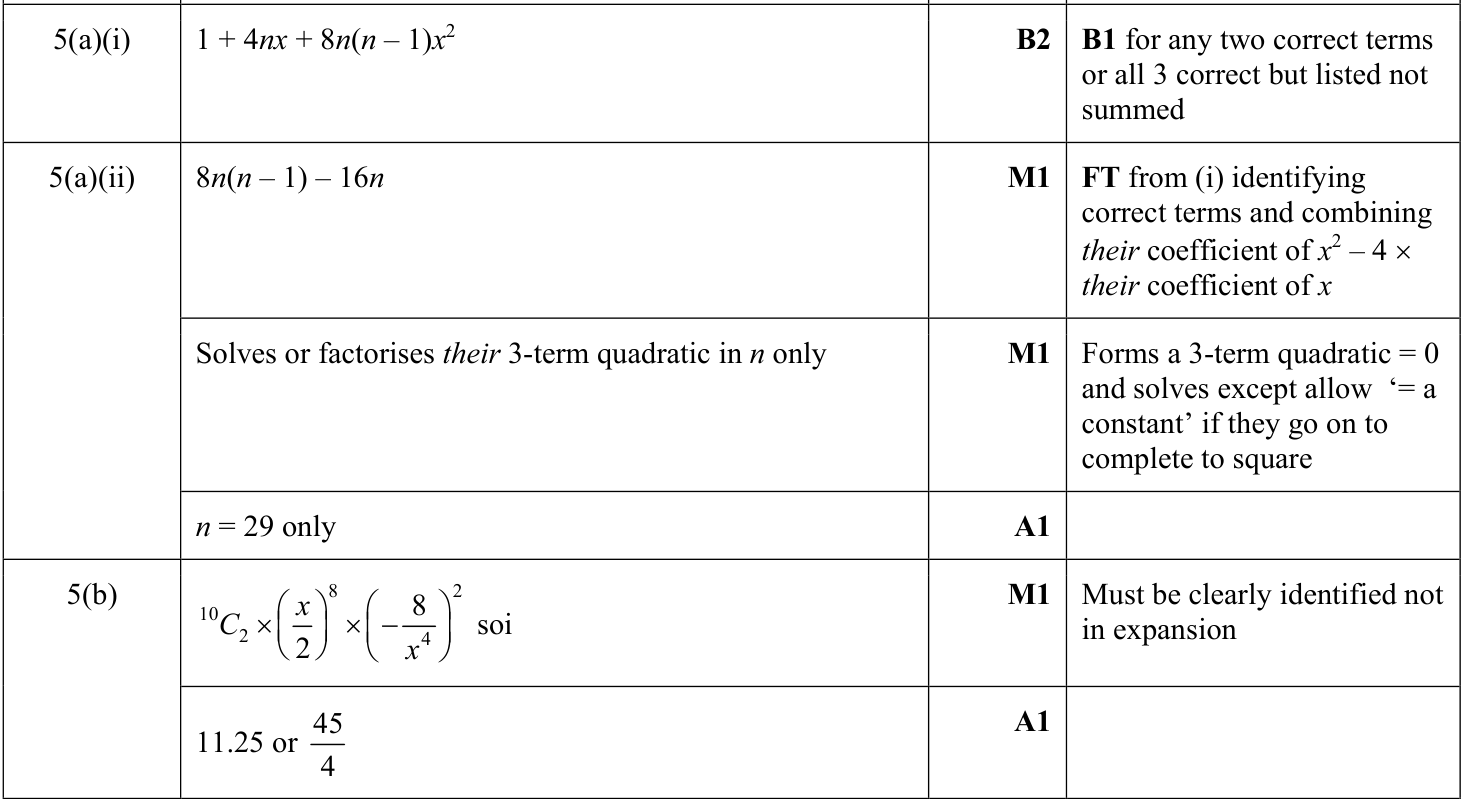
(a) (i) Write down the first three terms, in ascending powers of \(x\), in the expansion of \((1+4x)^n\), where \(n\) is a positive integer.
(ii) In the expansion of \((1+4x)^n(1-4x)\), the coefficient of \(x^2\) is 6032. Find the value of \(n\).
(b) Find the term independent of \(x\) in the expansion of \(\left(\frac{x}{2}-\frac{8}{x^4}\right)^{10}\).
0606 P11 - Nov 2022 - Q6 - 7 marks
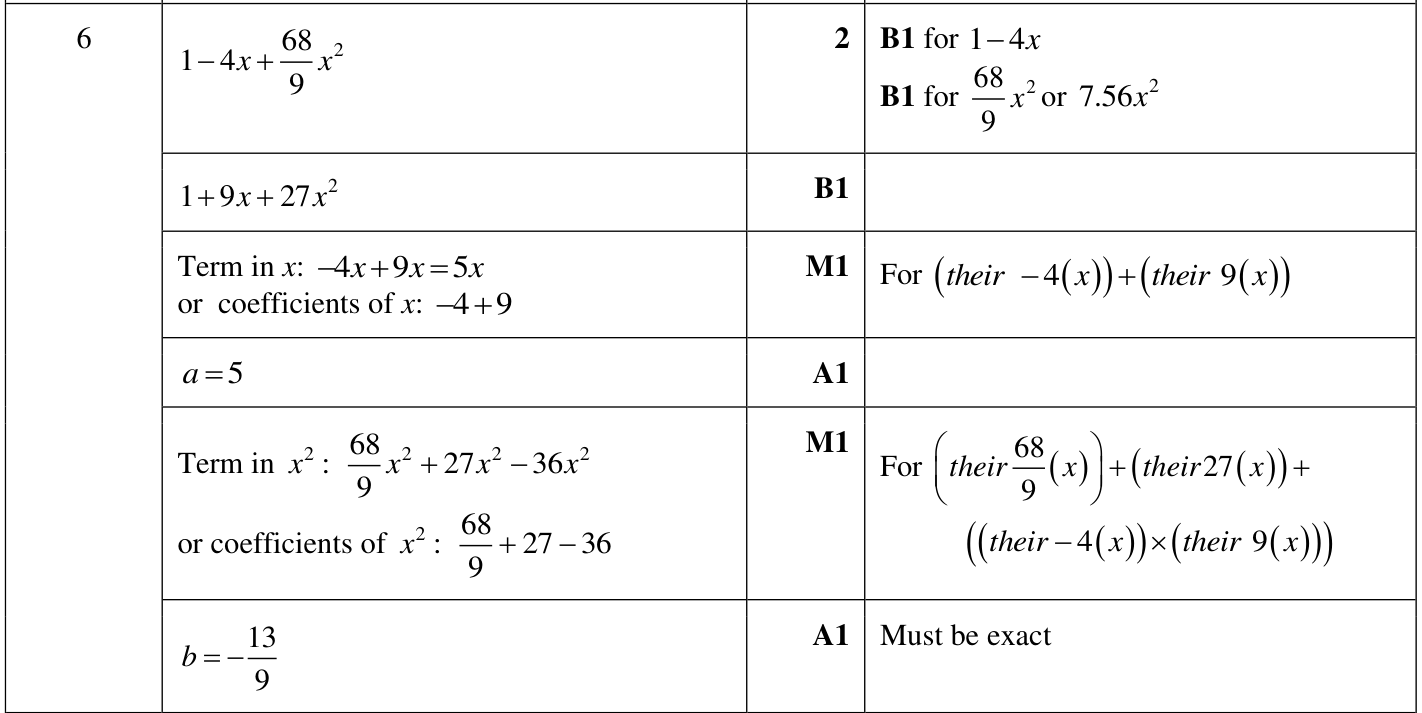
The first three terms, in ascending powers of \(x\), in the expansion of
\(\left(1-\frac{2x}{9}\right)^{18}(1+3x)^3\)
are written in the form
\(1+ax+bx^2,\)
where \(a\) and \(b\) are constants. Find the exact values of \(a\) and \(b\).
0606 P12 - Nov 2022 - Q12 - 9 marks
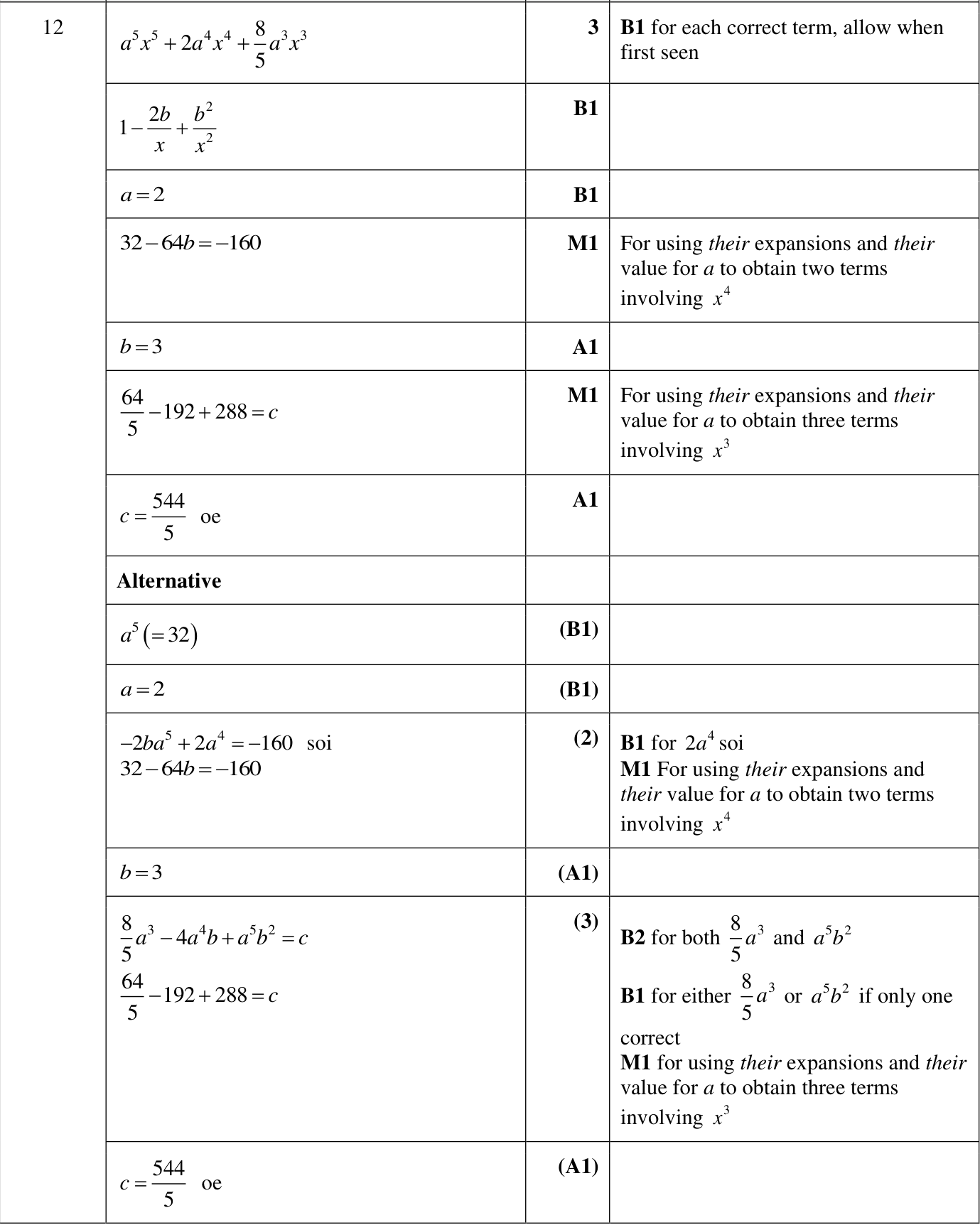
The first three terms, in descending powers of \(x\), of the expansion of
\(\left(ax+\frac25\right)^5\left(1-\frac{b}{x}\right)^2\)
can be written as
\(32x^5-160x^4+cx^3,\)
where \(a\), \(b\) and \(c\) are constants. Find the exact values of \(a\), \(b\) and \(c\).
0606 P23 - Nov 2022 - Q6 - 6 marks
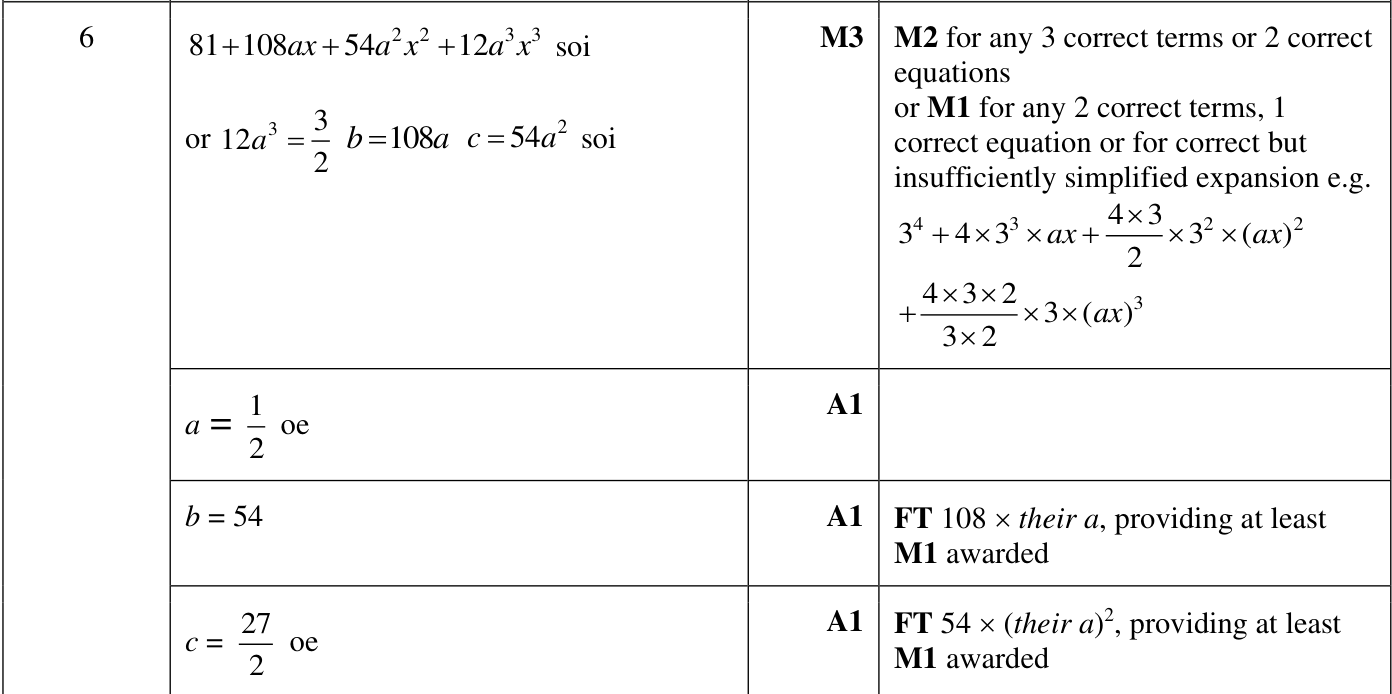
The first four terms in the expansion of \((3+ax)^4\), in ascending powers of \(x\), are
\(81+bx+cx^2+\frac32x^3.\)
Find the values of \(a\), \(b\) and \(c\).
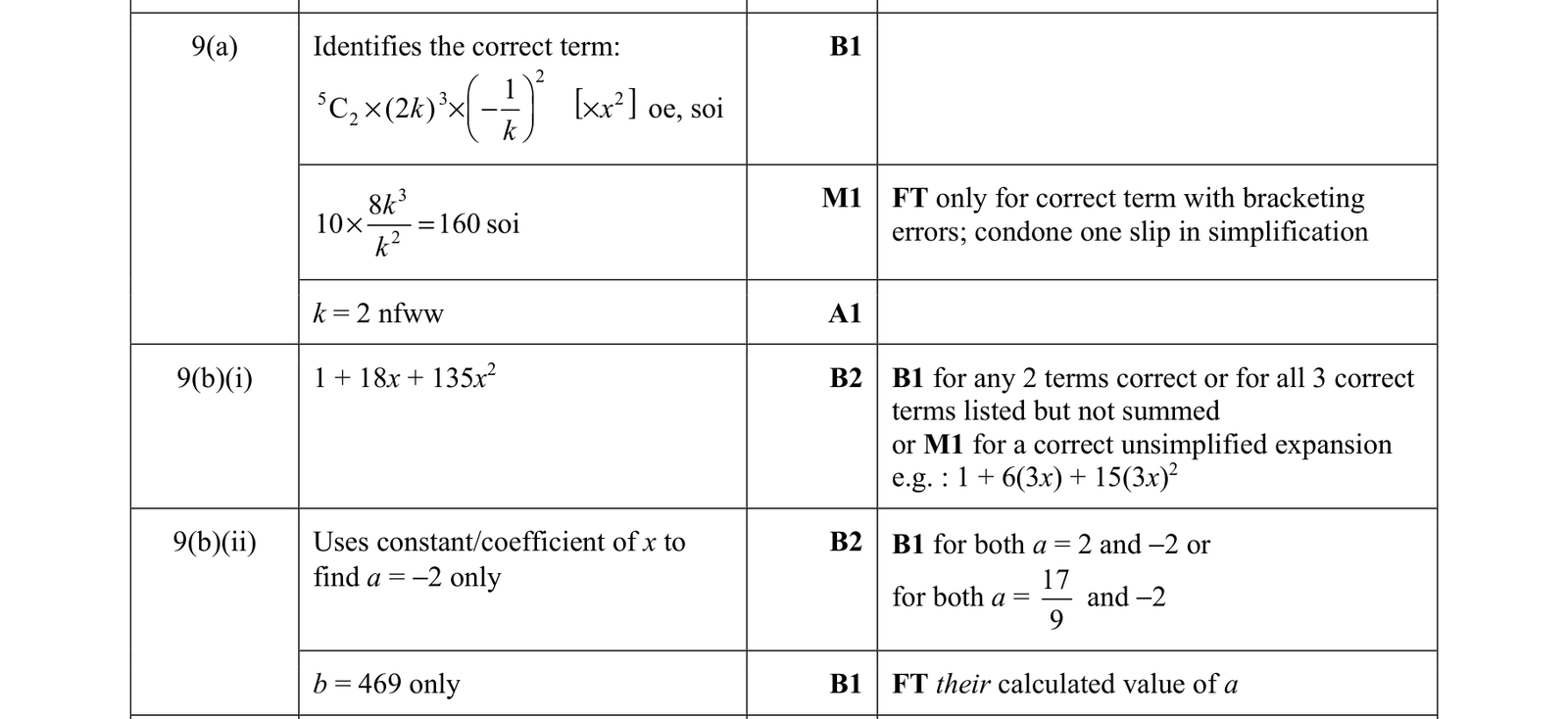
0606 P22 - Mar 2021 - Q9 - 8 marks
(a) In the expansion of
\(\left(2k-\frac{x}{k}\right)^5,\)
where \(k\) is a constant, the coefficient of \(x^2\) is \(160\). Find the value of \(k\).
(b)
(i) Find, in ascending powers of \(x\), the first 3 terms in the expansion of \((1+3x)^6\), simplifying the coefficient of each term.
(ii) When \((1+3x)^6(a+x)^2\) is written in ascending powers of \(x\), the first three terms are \(4+68x+bx^2\), where \(a\) and \(b\) are constants. Find the value of \(a\) and of \(b\).
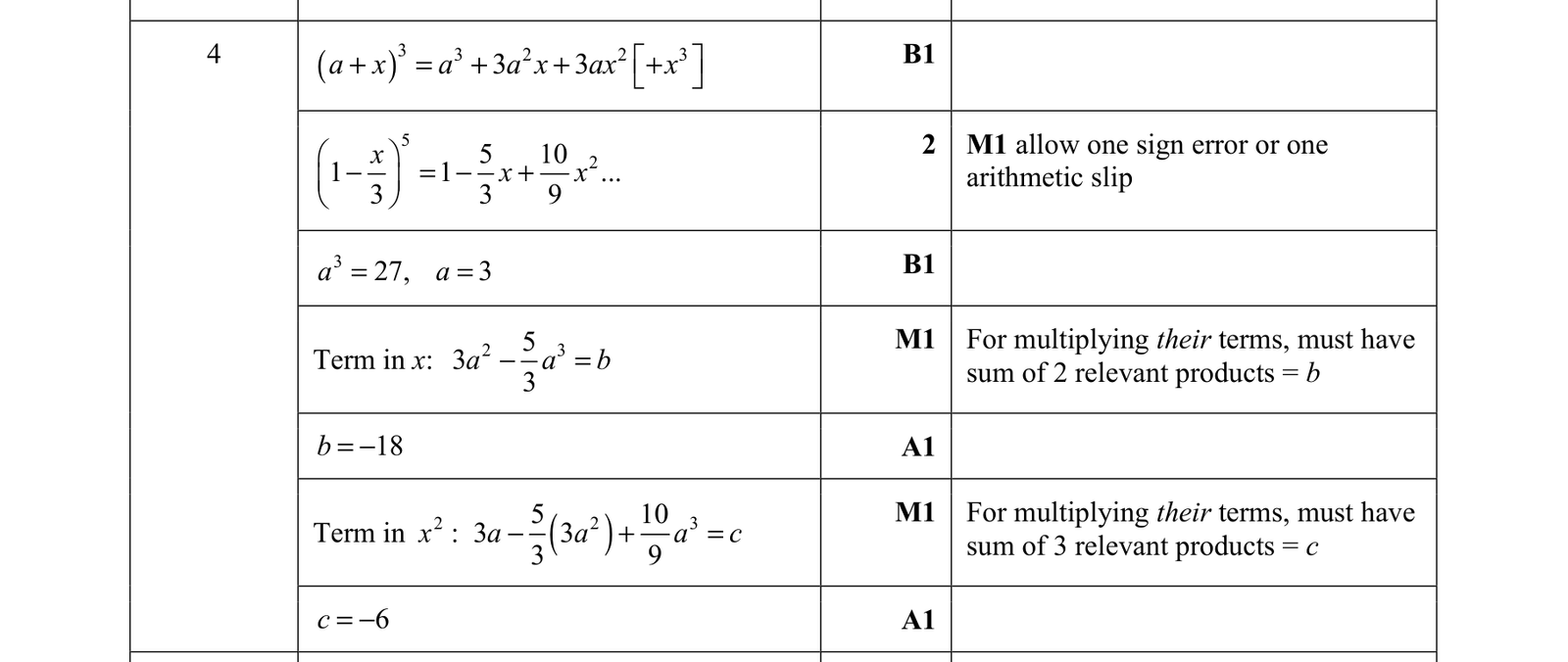
0606 P11 - Jun 2021 - Q4 - 8 marks
The first 3 terms in the expansion of
\((a+x)^3\left(1-\frac{x}{3}\right)^5\)
in ascending powers of \(x\), can be written in the form
\(27+bx+cx^2,\)
where \(a\), \(b\) and \(c\) are integers. Find the values of \(a\), \(b\) and \(c\).
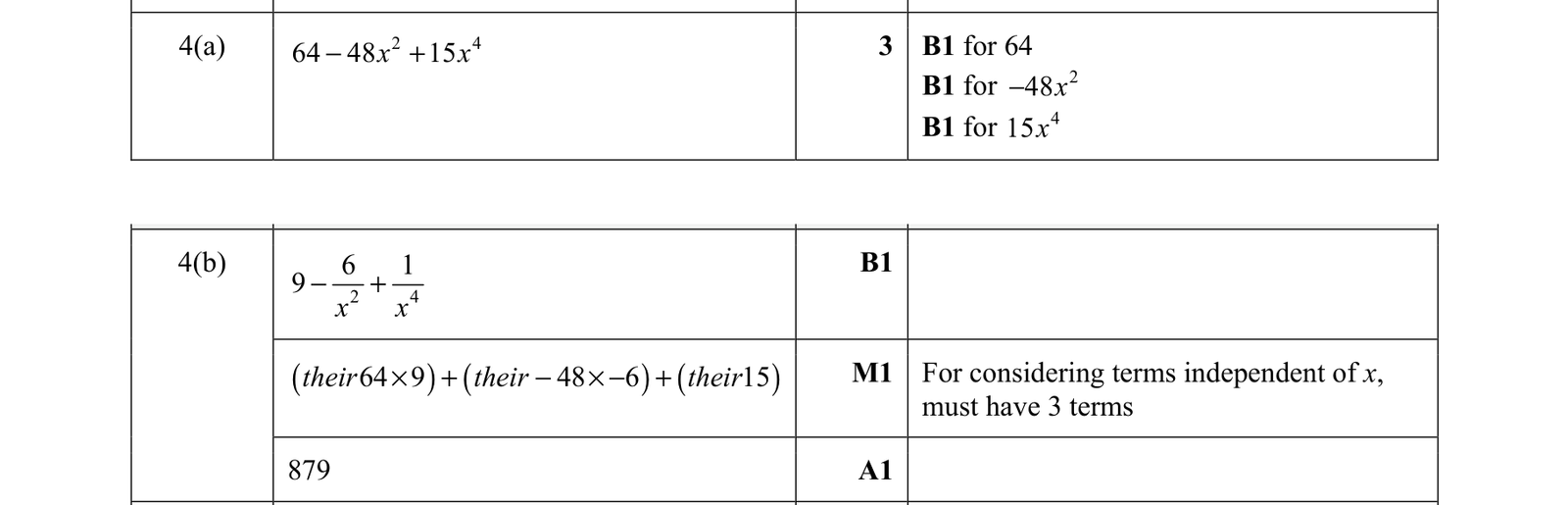
0606 P13 - Jun 2021 - Q4 - 6 marks
(a) Find the first three non-zero terms in the expansion of
\(\left(2-\frac{x^2}{4}\right)^6\)
in ascending powers of \(x\). Simplify each term.
(b) Hence find the term independent of \(x\) in the expansion of
\(\left(2-\frac{x^2}{4}\right)^6\left(3-\frac1{x^2}\right)^2.\)
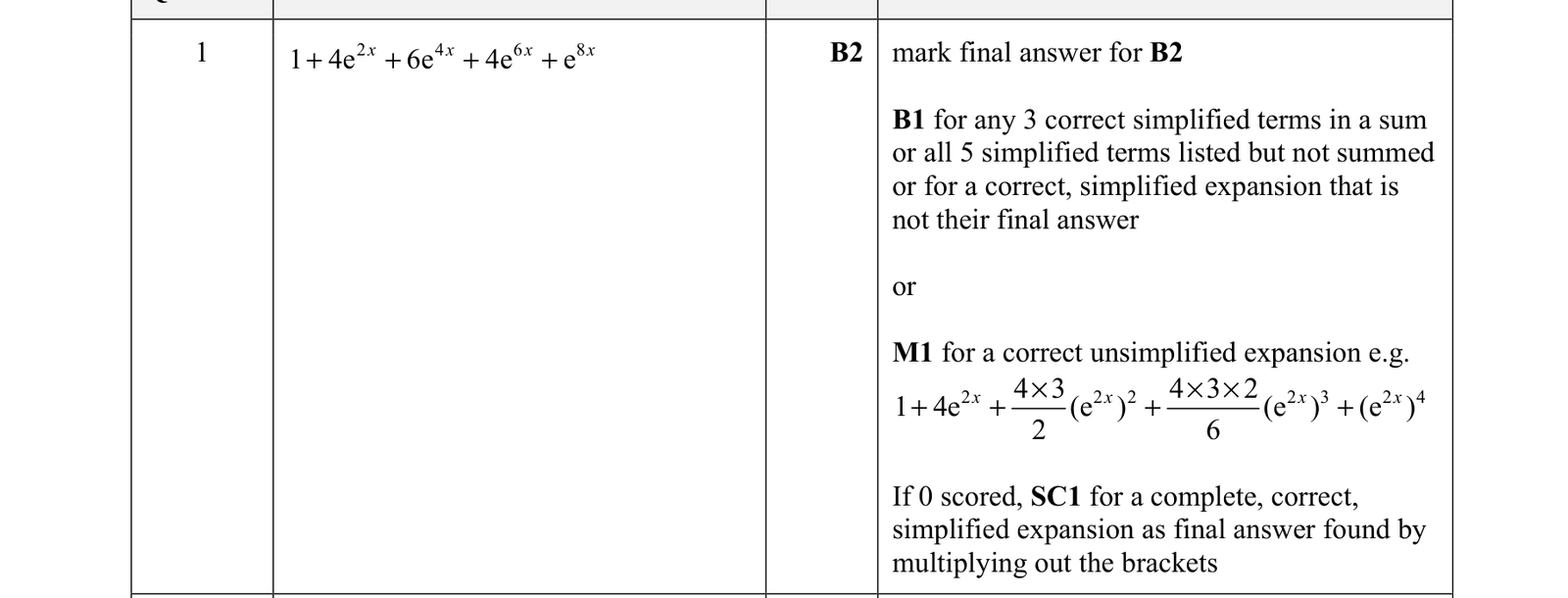
0606 P22 - Jun 2021 - Q1 - 2 marks
Using the binomial theorem, expand
\((1+e^{2x})^4,\)
simplifying each term.
0606 P11 - Nov 2021 - Q7 - 7 marks
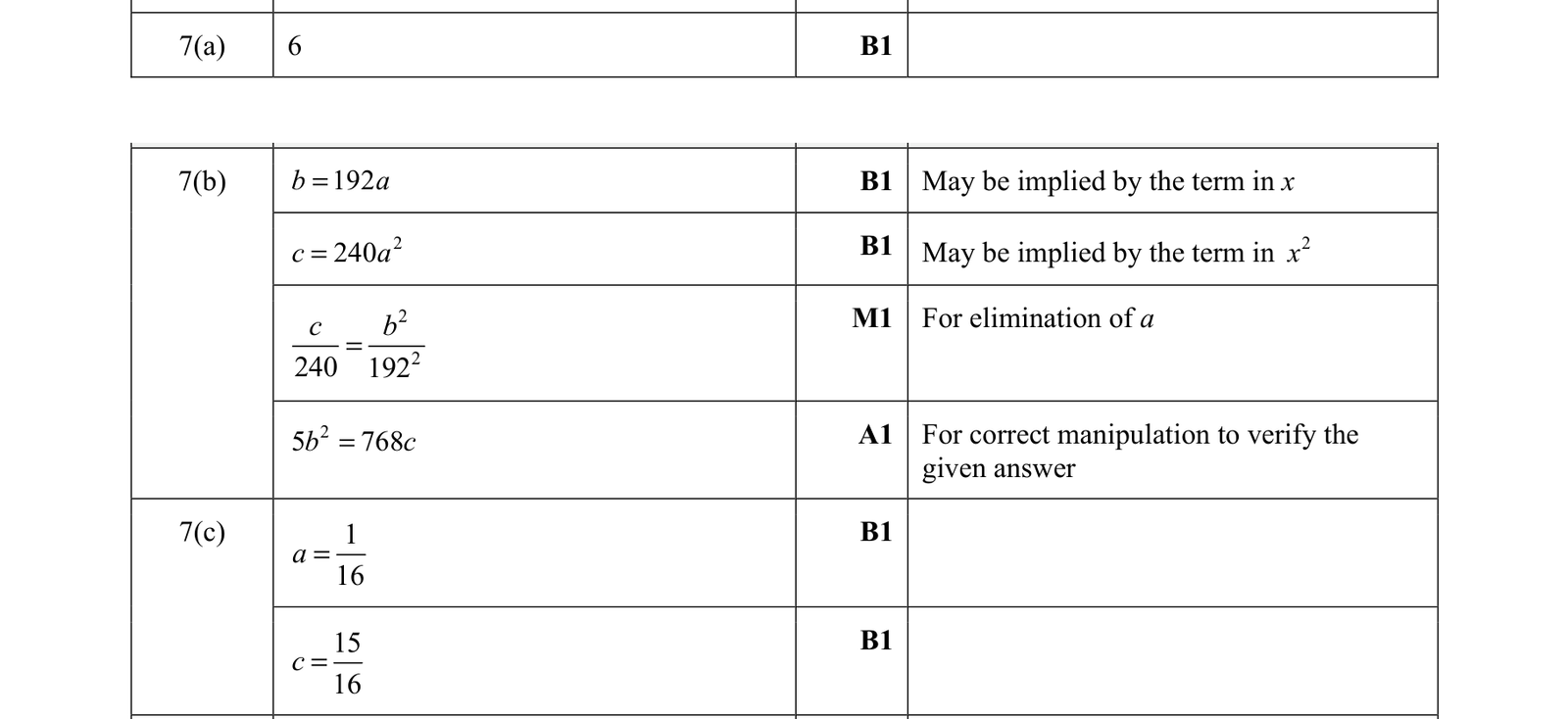
The first three terms, in ascending powers of \(x\), in the expansion of \((2+ax)^n\) can be written as \(64+bx+cx^2\), where \(n\), \(a\), \(b\) and \(c\) are constants.
(a) Find the value of \(n\).
(b) Show that \(5b^2=768c\).
(c) Given that \(b=12\), find the exact value of \(a\) and of \(c\).
0606 P13 - Nov 2021 - Q4 - 6 marks
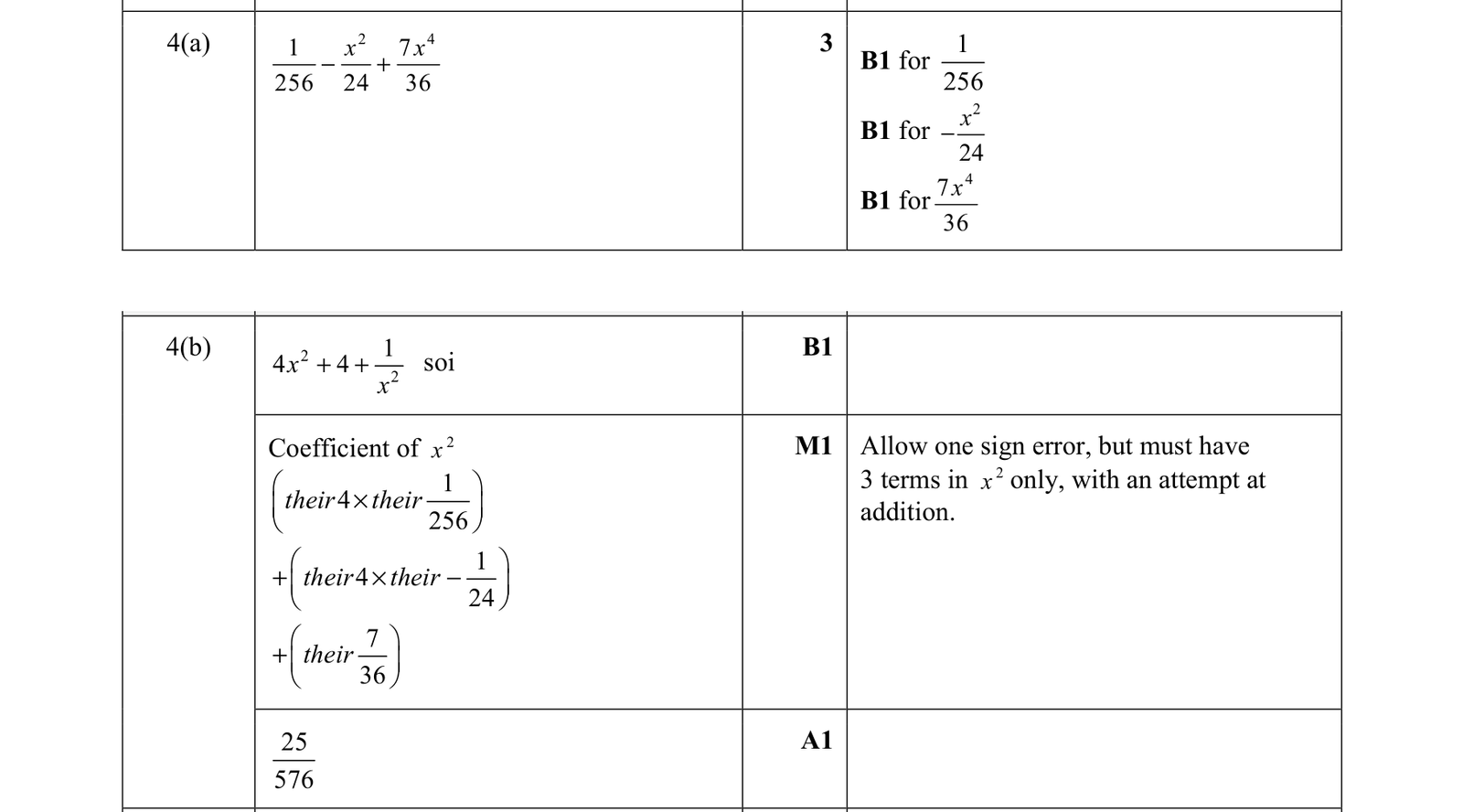
(a) Find the first three terms, in ascending powers of \(x^2\), in the expansion of
\(\left(\frac12-\frac23x^2\right)^8.\)
Write your coefficients as rational numbers.
(b) Find the coefficient of \(x^2\) in the expansion of
\(\left(\frac12-\frac23x^2\right)^8\left(2x+\frac1x\right)^2.\)
0606 P22 - Nov 2021 - Q2 - 8 marks
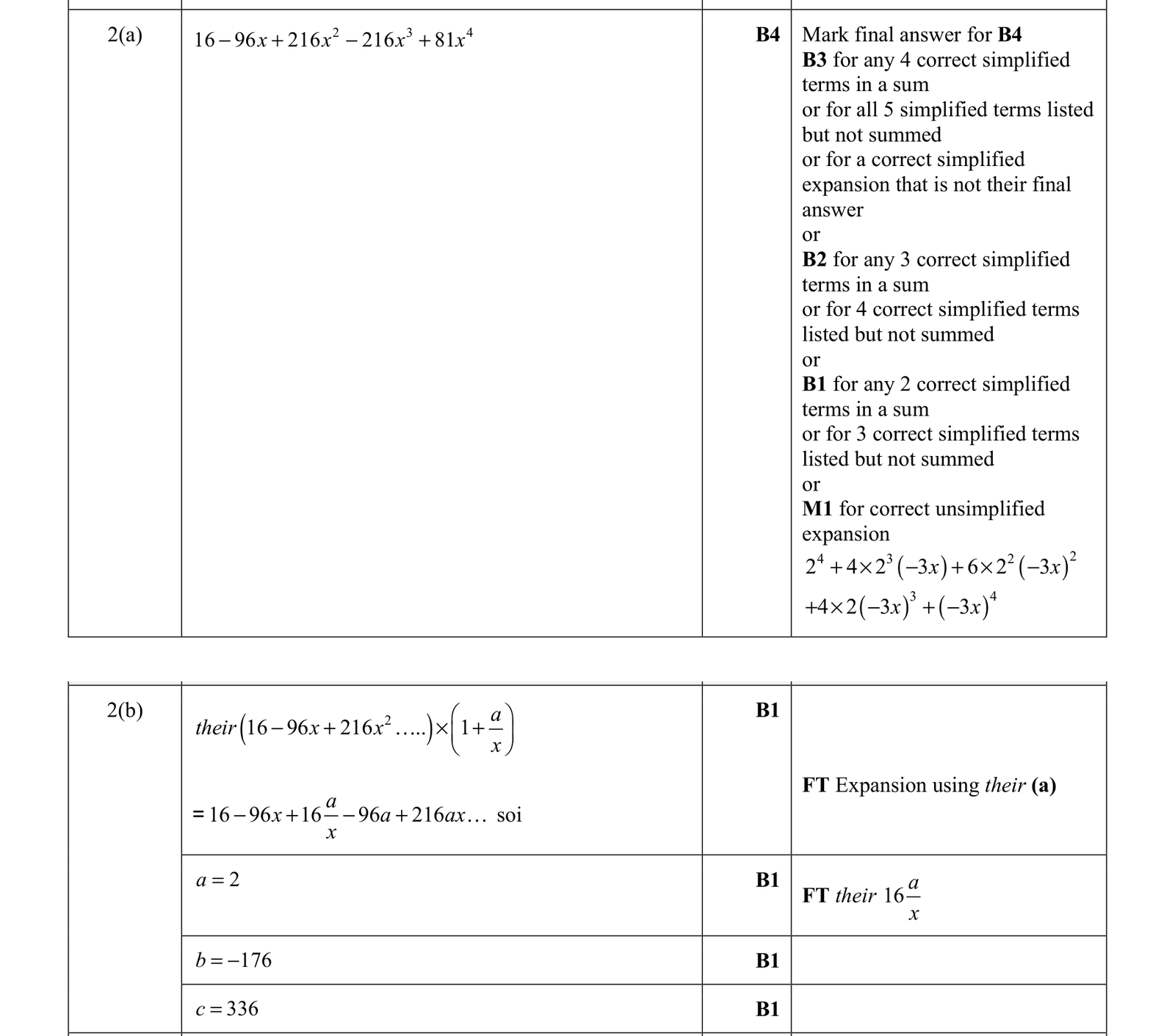
(a) Expand \((2-3x)^4\), evaluating all of the coefficients.
(b) The sum of the first three terms in ascending powers of \(x\) in the expansion of
\((2-3x)^4\left(1+\frac ax\right)\)
is
\(\frac{32}{x}+b+cx,\)
where \(a\), \(b\) and \(c\) are integers. Find the values of \(a\), \(b\) and \(c\).
0606 P12 - Mar 2020 - Q3 - 5 marks
The first 3 terms in the expansion of \((3-ax)^5\), in ascending powers of \(x\), can be written in the form
\(b-81x+cx^2.\)
Find the value of each of \(a\), \(b\) and \(c\).
