0606 P12 - Jun 2023 - Q10 - 13 marks
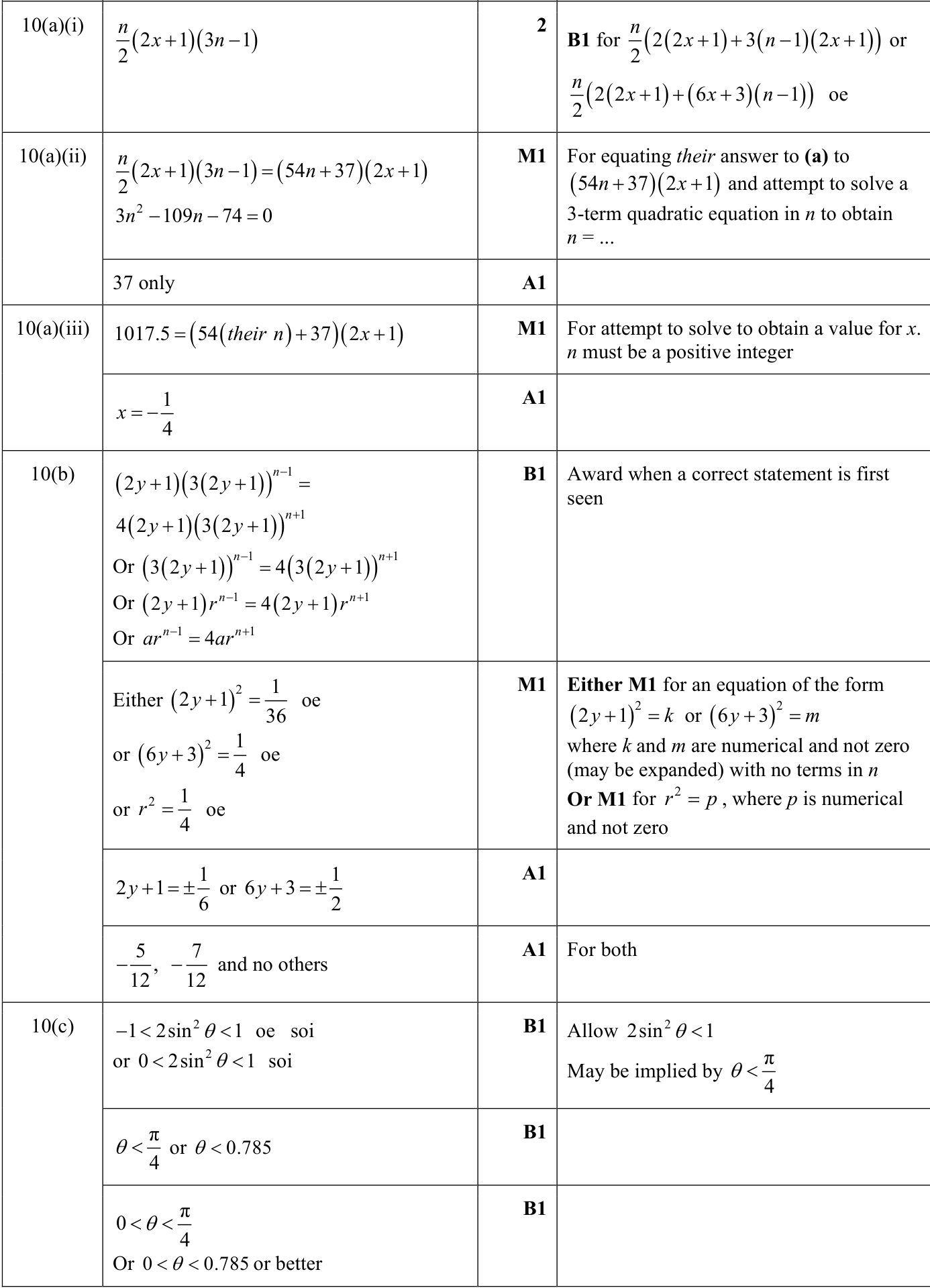
(a) The first three terms of an arithmetic progression are \((2x+1)\), \(4(2x+1)\) and \(7(2x+1)\), where \(x\ne-\frac12\).
(i) Show that the sum to \(n\) terms can be written in the form \(\frac n2(2x+1)(An+B)\), where \(A\) and \(B\) are integers to be found.
(ii) Given that the sum to \(n\) terms is \((54n+37)(2x+1)\), find the value of \(n\).
(iii) Given also that the sum to \(n\) terms in part (ii) is equal to \(1017.5\), find the value of \(x\).
(b) The first three terms of a geometric progression are \((2y+1)\), \(3(2y+1)^2\) and \(9(2y+1)^3\), where \(y\ne-\frac12\). Given that the \(n\)th term of the progression is equal to 4 times the \((n+2)\)th term, find the possible values of \(y\), giving your answers as fractions.
(c) The first three terms of a different geometric progression are \(\sin\theta\), \(2\sin^3\theta\) and \(4\sin^5\theta\), for \(0\lt\theta\lt\frac{\pi}{2}\). Find the values of \(\theta\) for which the progression has a sum to infinity.