Past Exam Questions
← Back9231 P42 - Nov 2022 - Q6 - 10 marks
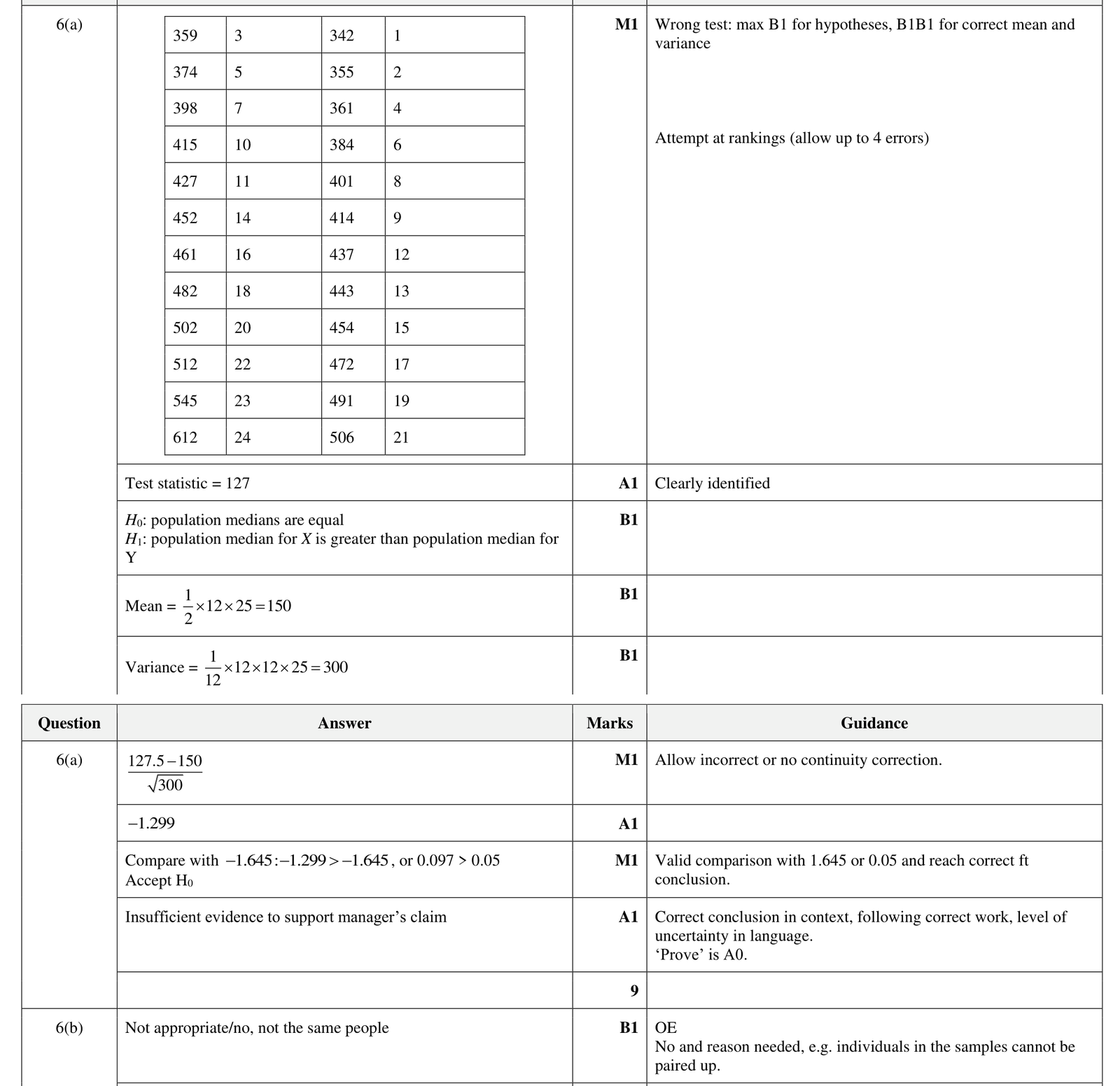
The manager of a technology company \(A\) claims that his employees earn more per year than the employees at technology company \(B\). The amounts earned per year, in hundreds of dollars, by a random sample of 12 employees from company \(A\) and an independent random sample of 12 employees from company \(B\) are shown below.
| Company A | 461 | 482 | 374 | 512 | 415 | 452 | 502 | 427 | 398 | 545 | 612 | 359 |
|---|---|---|---|---|---|---|---|---|---|---|---|---|
| Company B | 454 | 506 | 491 | 384 | 361 | 443 | 401 | 472 | 414 | 342 | 355 | 437 |
(a) Carry out a Wilcoxon rank-sum test at the 5% significance level to test whether the manager's claim is supported by the data.
(b) Explain whether a paired sample \(t\)-test would be appropriate to test the manager's claim if earnings are normally distributed.
9231 P41 - Nov 2021 - Q6 - 9 marks
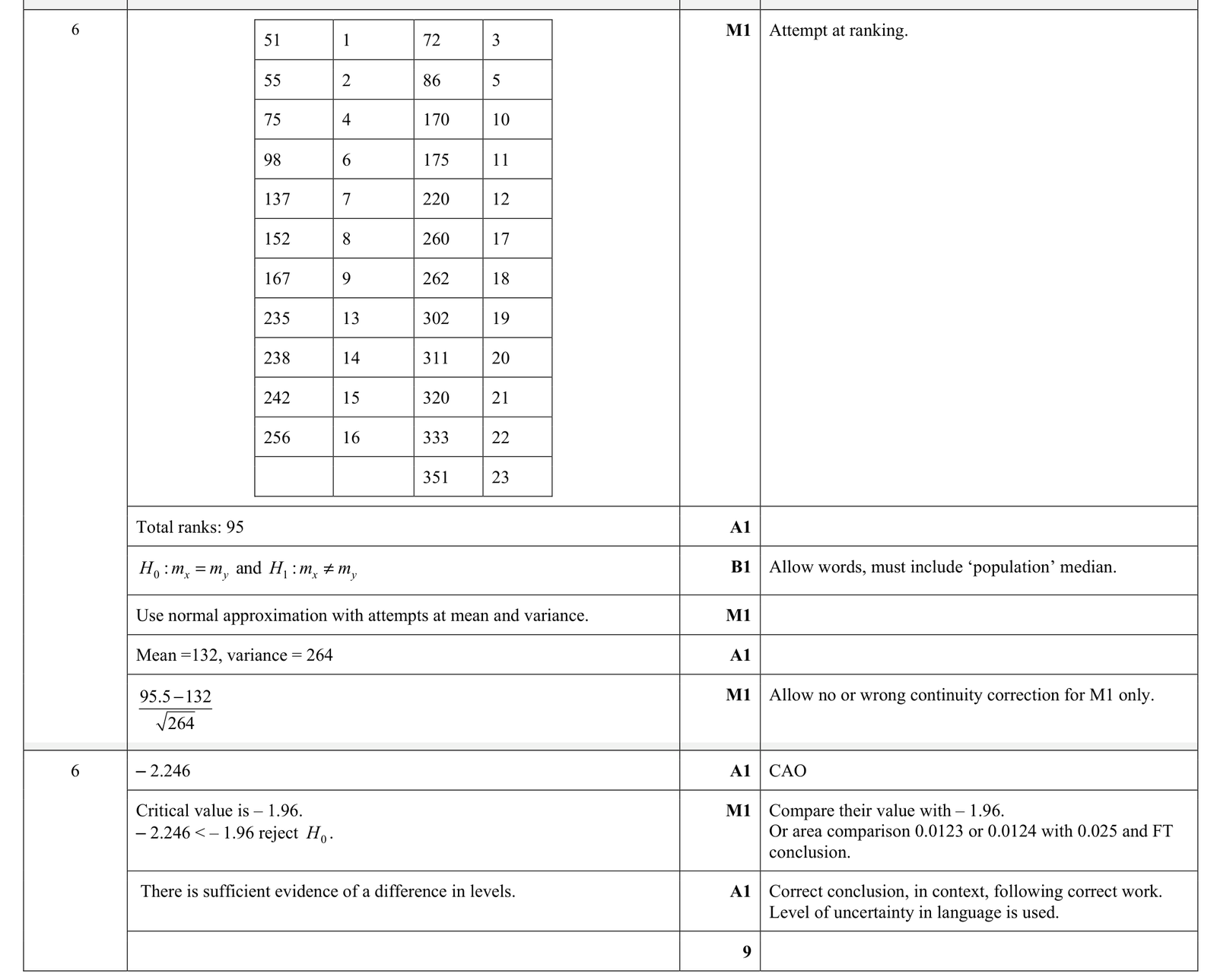
The blood cholesterol levels, measured in suitable units, of a random sample of 11 women and a random sample of 12 men are shown below.
Women | 51 | 55 | 242 | 167 | 152 | 256 | 75 | 137 | 98 | 238 | 235 |
|---|---|---|---|---|---|---|---|---|---|---|---|
Men | 311 | 262 | 170 | 302 | 175 | 320 | 220 | 260 | 72 | 351 | 86 |
Carry out a Wilcoxon rank-sum test, at the \(5 \%\) significance level, to test whether, on average, there is a difference in cholesterol levels between women and men.
9231 P42 - Nov 2021 - Q4 - 8 marks
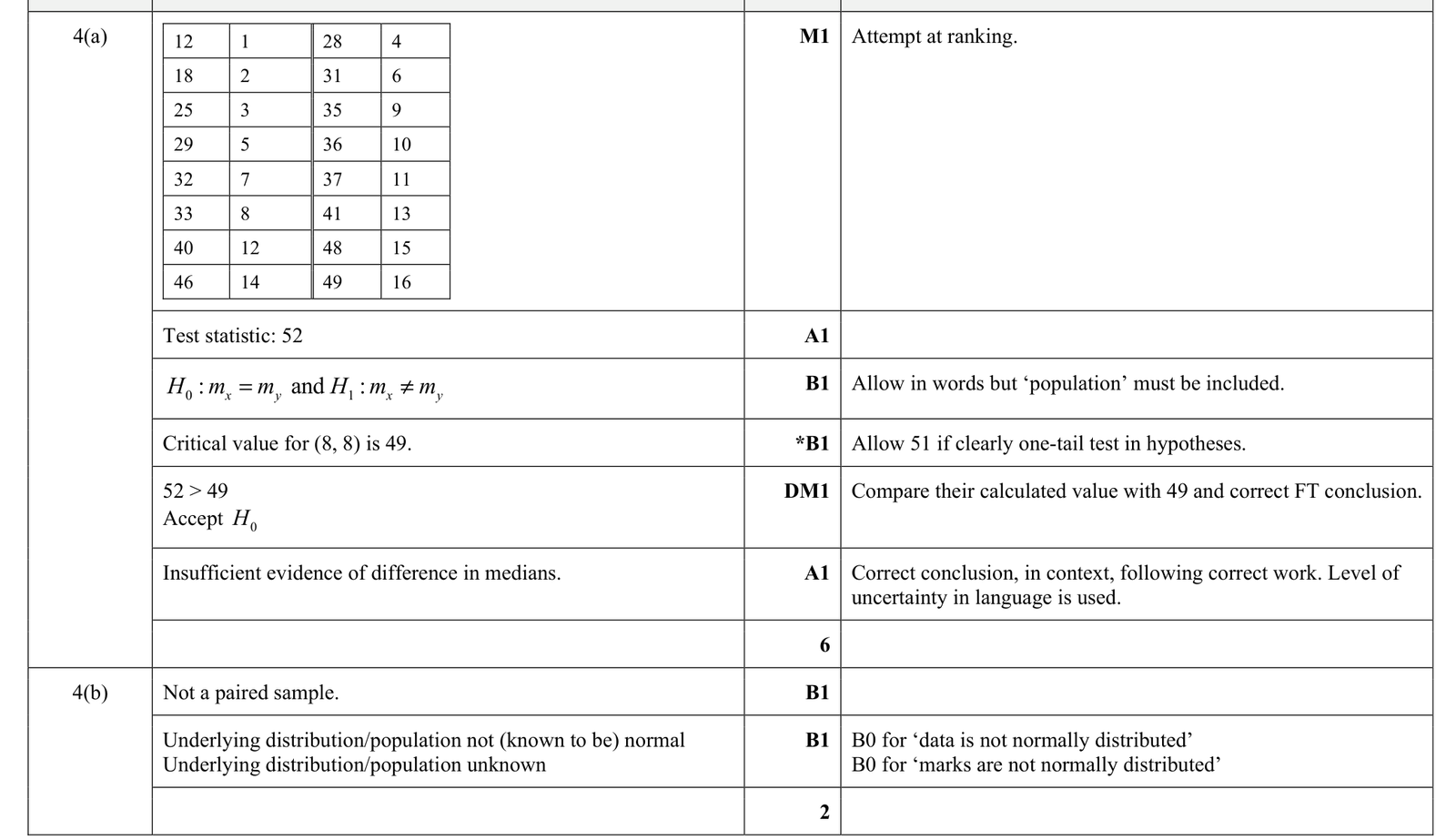
Applicants for a particular college take a written test when they attend for interview. There are two different written tests, \(A\) and \(B\), and each applicant takes one or the other. The interviewer wants to determine whether the medians of the distribution of marks obtained in the two tests are equal. The marks obtained by a random sample of 8 applicants who took test \(A\) and a random sample of 8 applicants who took test \(B\) are as follows.
Test \(A\) | 46 | 32 | 29 | 12 | 33 | 18 | 25 | 40 |
|---|---|---|---|---|---|---|---|---|
Test \(B\) | 36 | 28 | 49 | 37 | 48 | 35 | 41 | 31 |
(a) Carry out a Wilcoxon rank-sum test at the \(5 \%\) significance level to determine whether there is a difference in the population median marks obtained in the two tests.
The interviewer considers using the given information to carry out a paired sample \(t\)-test to determine whether there is a difference in the population means for the two tests.
(b) Give two reasons why it is not appropriate to use this test.
9231 P43 - Jun 2020 - Q6 - 11 marks
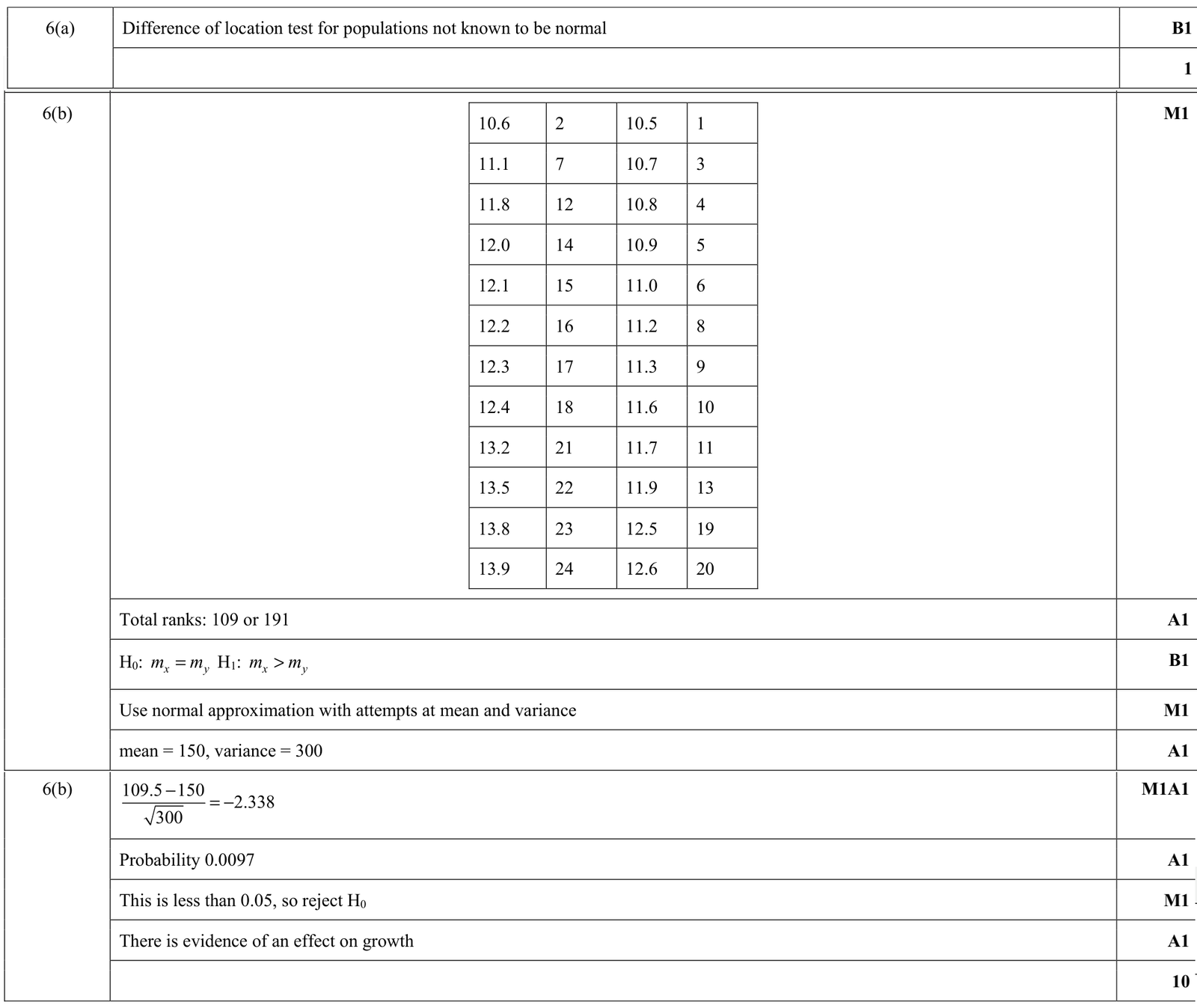
A biologist is studying the effect of nutrients on the heights to which plants grow. A random sample of 24 similar young plants is divided into two equal groups \(A\) and \(B\). The plants in group \(A\) are fed with nutrients and water and the plants in group \(B\) are given only water. After four weeks, the height, in cm, of each plant is measured and the results are as follows.
| Group \(A\) | 12.3 | 11.8 | 12.1 | 13.2 | 11.1 | 10.6 | 13.8 | 12.0 | 12.2 | 12.4 | 13.5 | 13.9 |
|---|---|---|---|---|---|---|---|---|---|---|---|---|
| Group \(B\) | 11.7 | 10.8 | 10.9 | 11.3 | 11.2 | 12.6 | 11.0 | 10.5 | 11.9 | 12.5 | 10.7 | 11.6 |
The biologist decides to carry out a test at the \(5\%\) significance level to test whether the nutrients have resulted in an increase in growth.
(a) She carries out a Wilcoxon rank-sum test. Give a reason why this is an appropriate choice of test.
(b) Carry out the Wilcoxon rank-sum test for these results.
0606 P22 - Nov 2025 - Q3 - 6 marks
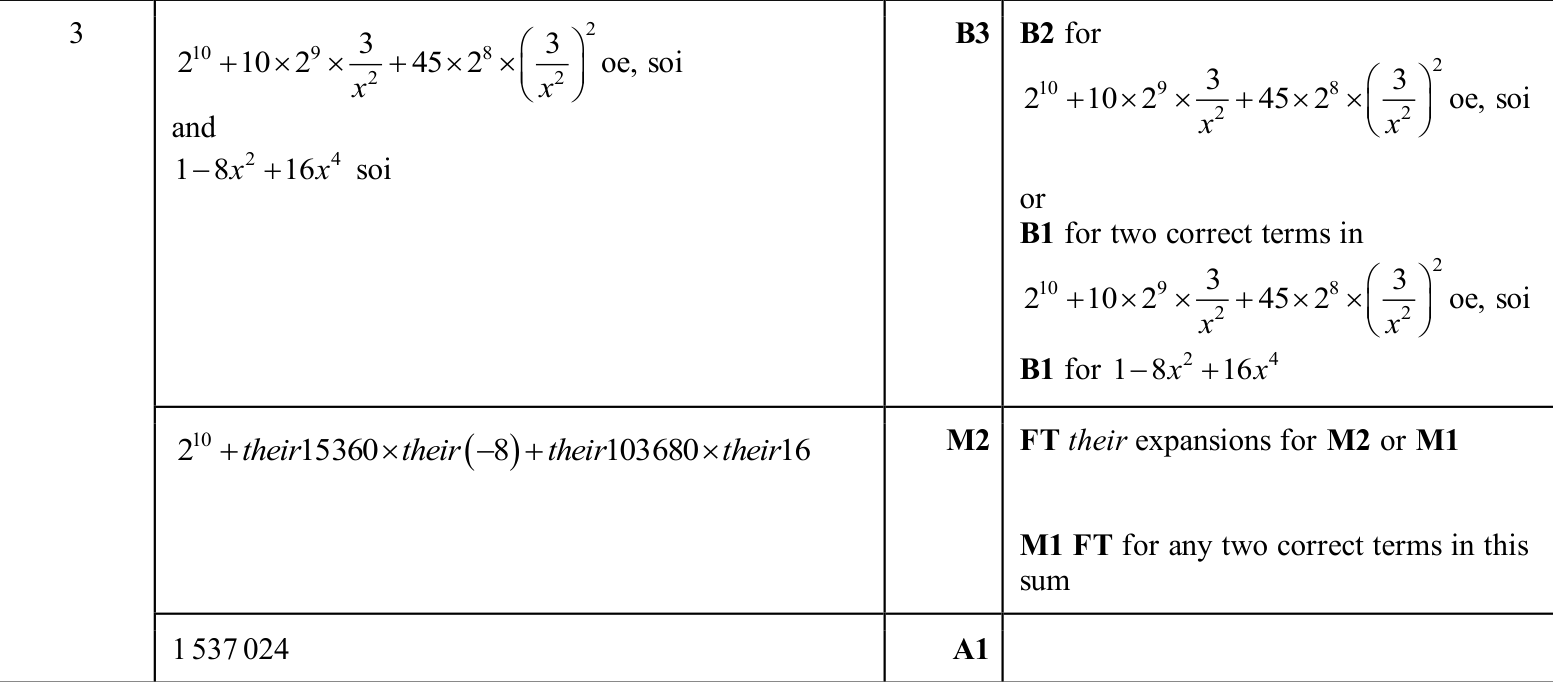
Find the exact value of the term independent of \(x\) in the expansion of
\(\left(2+\frac{3}{x^2}\right)^{10}(1-4x^2)^2.\)
0606 P21 - Nov 2025 - Q10 - 5 marks
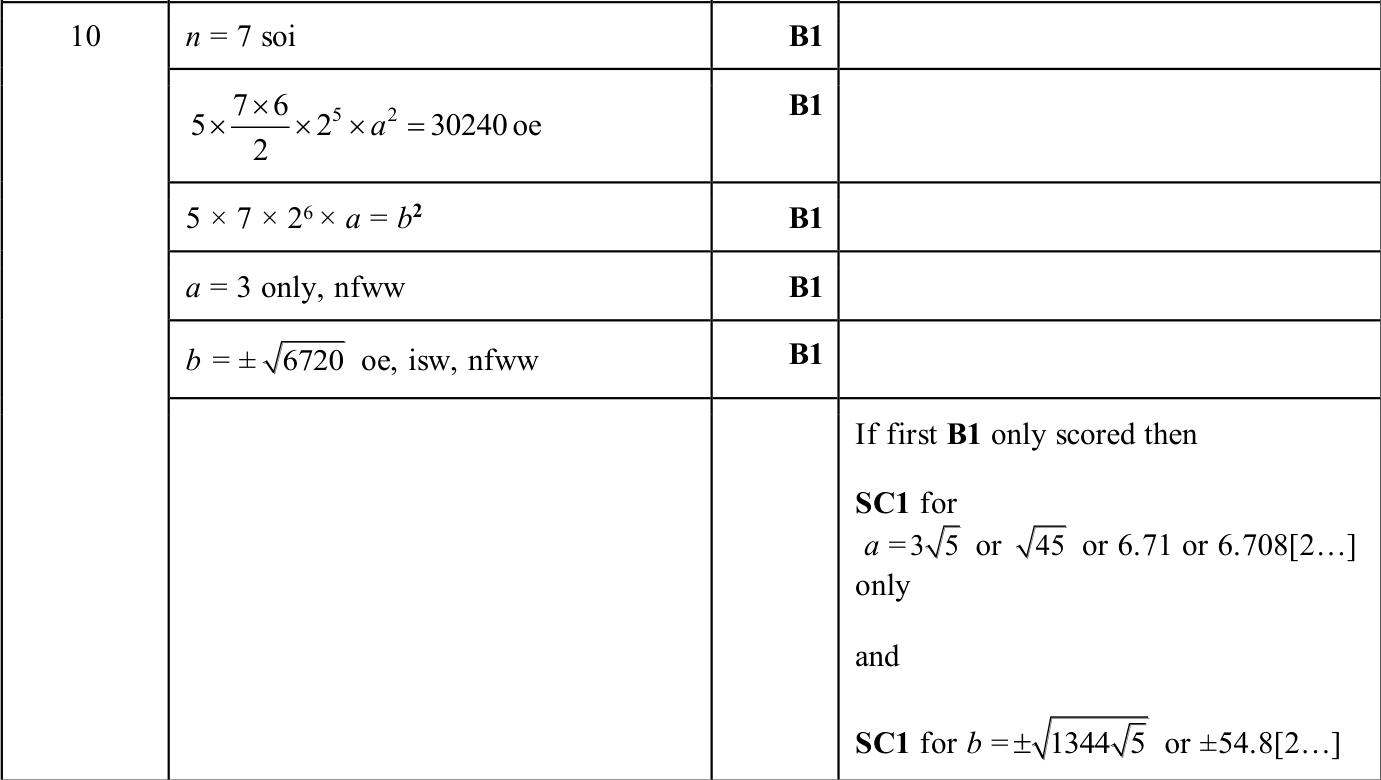
In this question \(a\), \(b\) and \(n\) are constants. When \(5(2+ax)^n\) is written in ascending powers of \(x\), the first three terms are \(640+b^2x+30240x^2\).
Find the value of \(a\) and the possible values of \(b\).
0606 P13 - Nov 2025 - Q12 - 5 marks
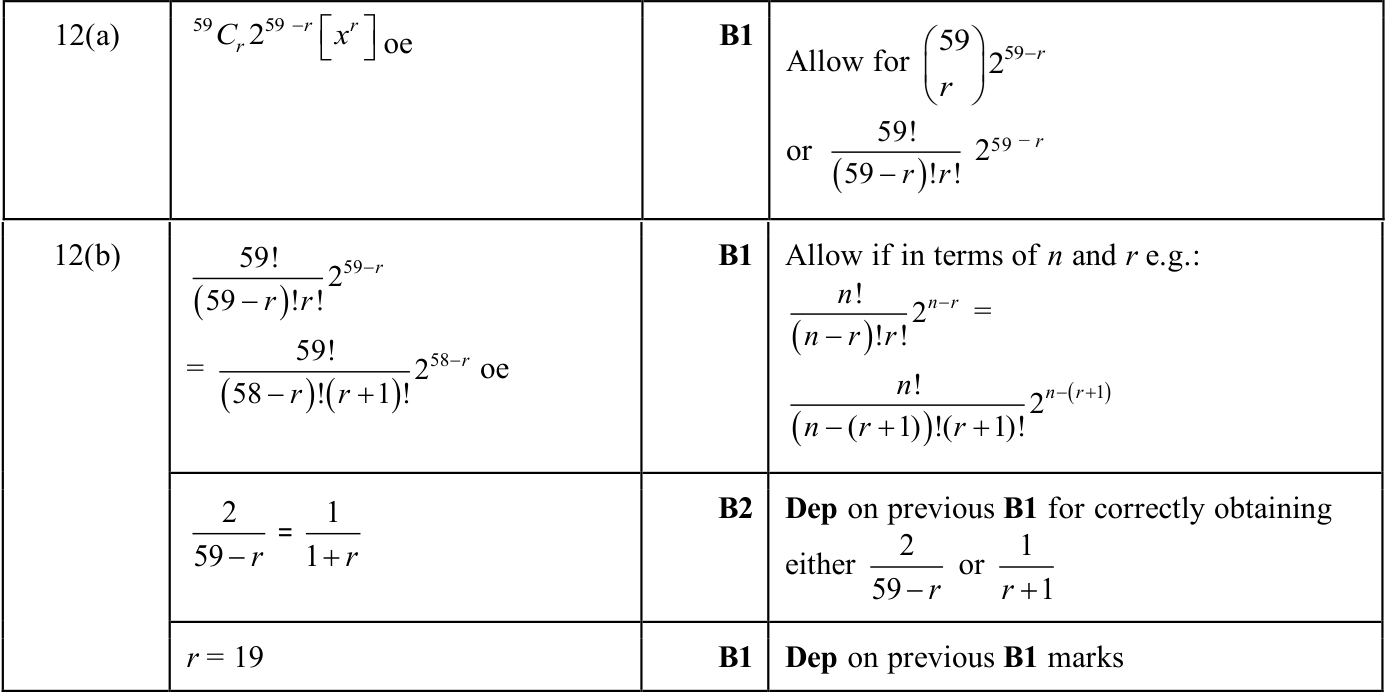
(a) Write down the coefficient of \(x^r\) in the binomial expansion of \((2+x)^{59}\).
(b) For this expansion, find the value of \(r\) for which the coefficient of \(x^r\) is equal to the coefficient of \(x^{r+1}\).
0606 P21 - Jun 2025 - Q6 - 6 marks
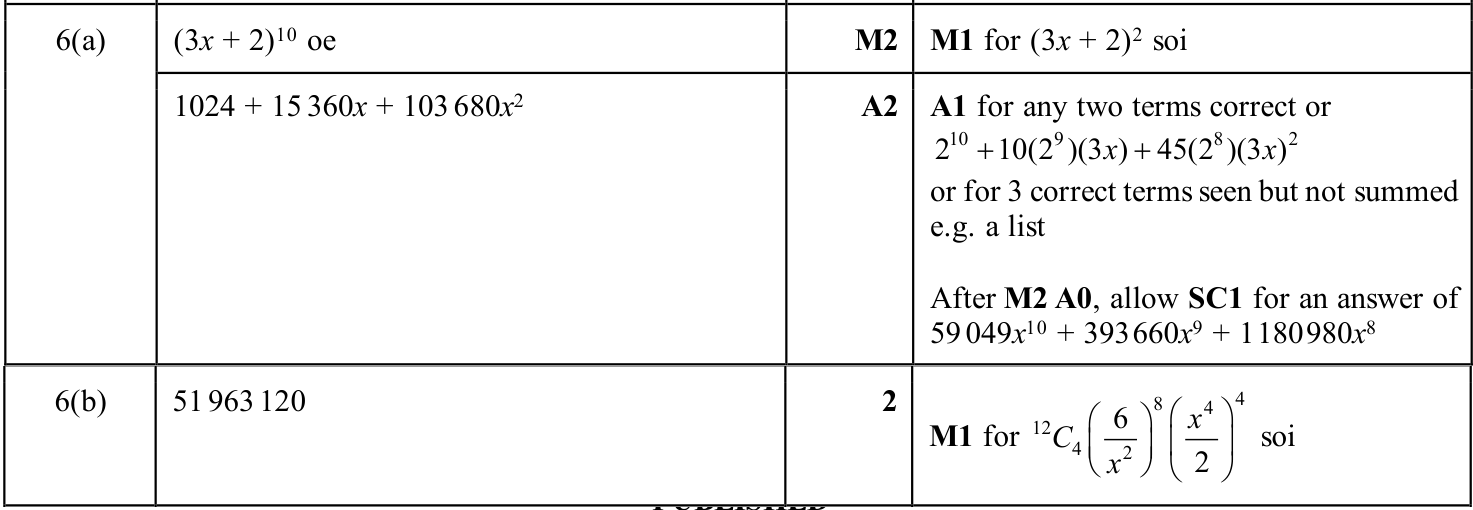
(a) Using an appropriate quadratic factorisation, find the first three terms in the binomial expansion of \(\left(9 x^{2}+12 x+4\right)^{5}, \quad\) in ascending powers of \(x\). You must simplify your coefficients.
(b) Find the term independent of \(x\) in the expansion of \(\left(\frac{6}{x^{2}}+\frac{x^{4}}{2}\right)^{12}\).
0606 P22 - Jun 2025 - Q10 - 9 marks
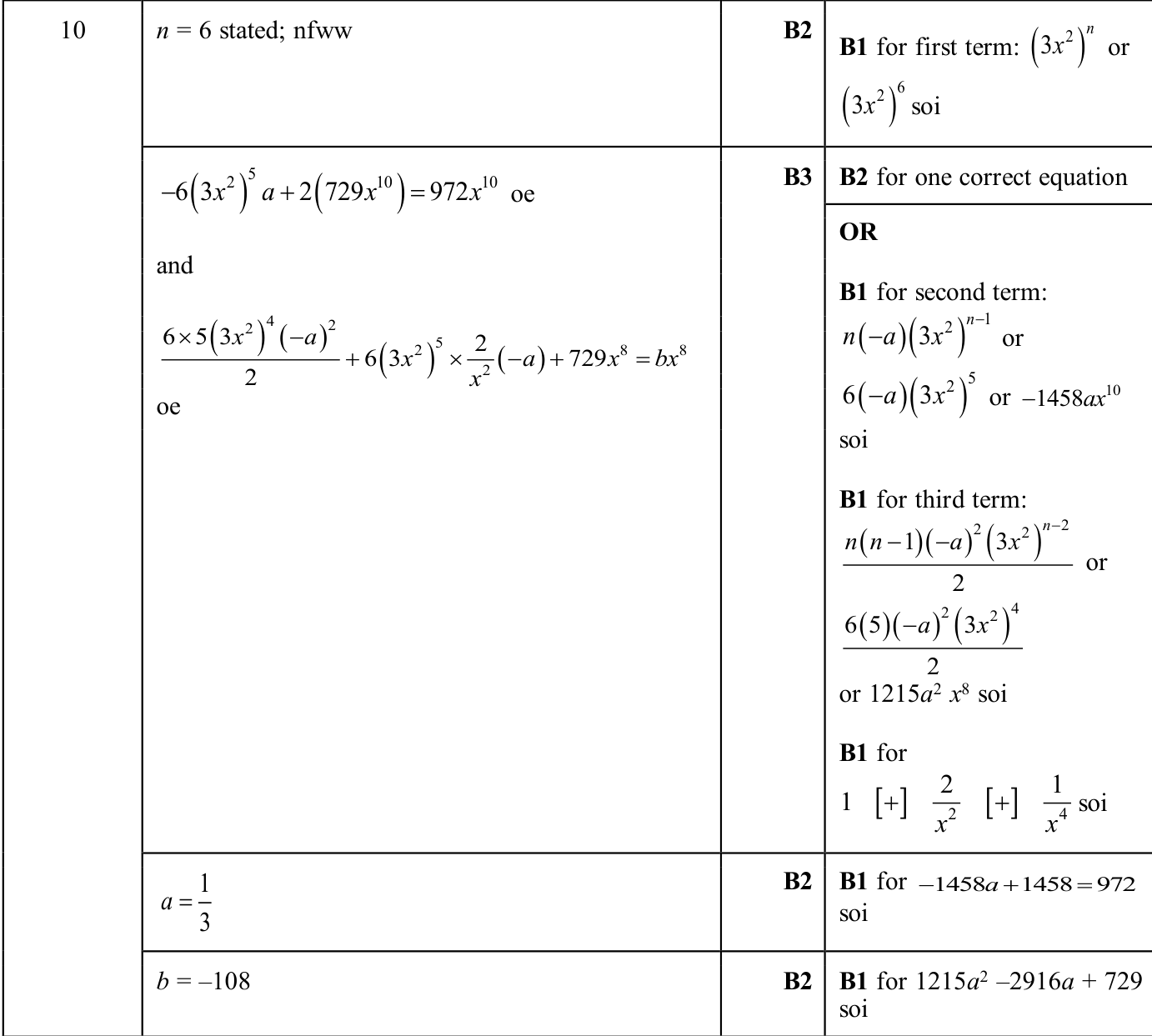
The first three terms, in descending powers of \(x\), in the expansion of \(\left(3 x^{2}-a\right)^{n}\left(1+\frac{1}{x^{2}}\right)^{2}\) can be written as \(\quad 729 x^{12}+972 x^{10}+b x^{8}, \quad\) where \(a, b\) and \(n\) are constants.
Find the values of \(a, b\) and \(n\).
0606 P23 - Jun 2025 - Q7 - 6 marks
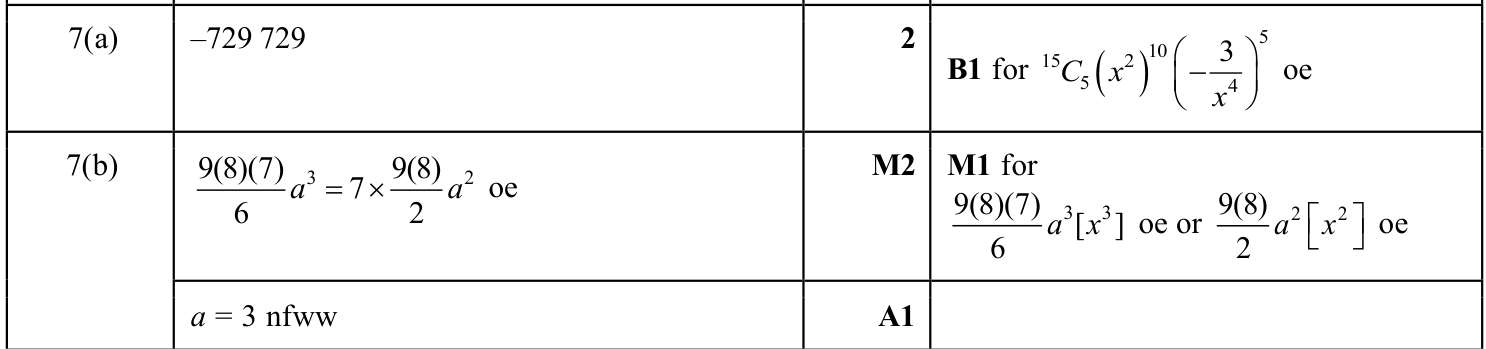
(a) Find the term independent of \(x\) in the expansion of \(\left(x^{2}-\frac{3}{x^{4}}\right)^{15}\). (b) In the expansion of \((1+a x)^{9}\) the coefficient of \(x^{3}\) is 7 times the coefficient of \(x^{2}\). Given that \(a\) is a positive constant, find the value of \(a\).
0606 P22 - Mar 2025 - Q10 - 10 marks
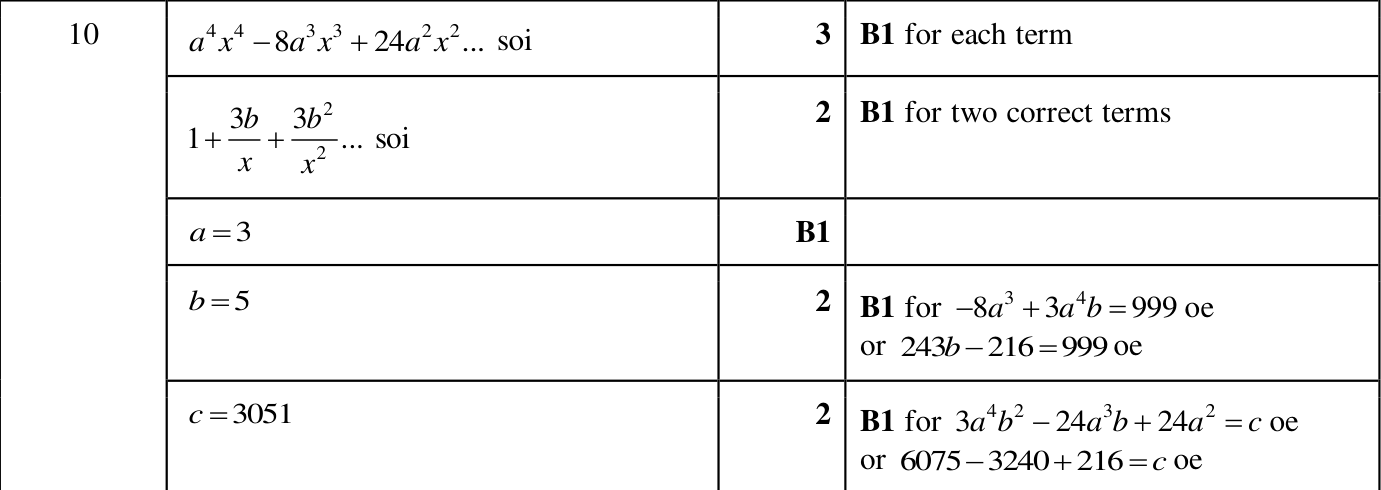
The expansion of \((ax-2)^4\left(1+\frac{b}{x}\right)^3\) is written in descending powers of \(x\).
The first 3 terms of this expansion are \(81x^4+999x^3+cx^2\).
It is given that \(a\), \(b\) and \(c\) are positive integers.
Find the values of \(a\), \(b\) and \(c\).
0606 P11 - Nov 2024 - Q5 - 4 marks
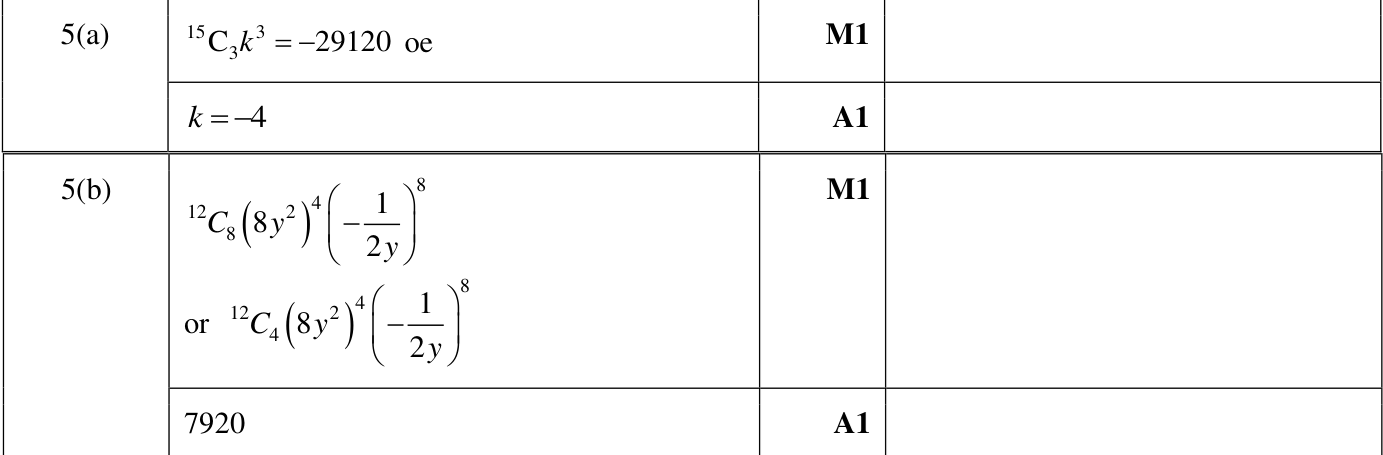
(a) In the expansion of \((1+k x)^{15}\), where \(k\) is a constant, the coefficient of \(x^{3}\) is -29120 . Find the value of \(k\). (b) Find the term independent of \(y\) in the expansion of \(\left(8 y^{2}-\frac{1}{2 y}\right)^{12}\).
0606 P12 - Nov 2024 - Q6 - 7 marks
(a) Find, in descending powers of \(x\), the first 3 terms in the expansion of \(\left(x+\frac{2}{x^{2}}\right)^{10}\). Simplify each term as far as possible. term as far as possible.
(b) Find the term independent of \(x\) in the expansion of \(\left(4 x^{2}+\frac{1}{2 x^{2}}\right)^{8}\).

0606 P23 - Nov 2024 - Q7 - 7 marks
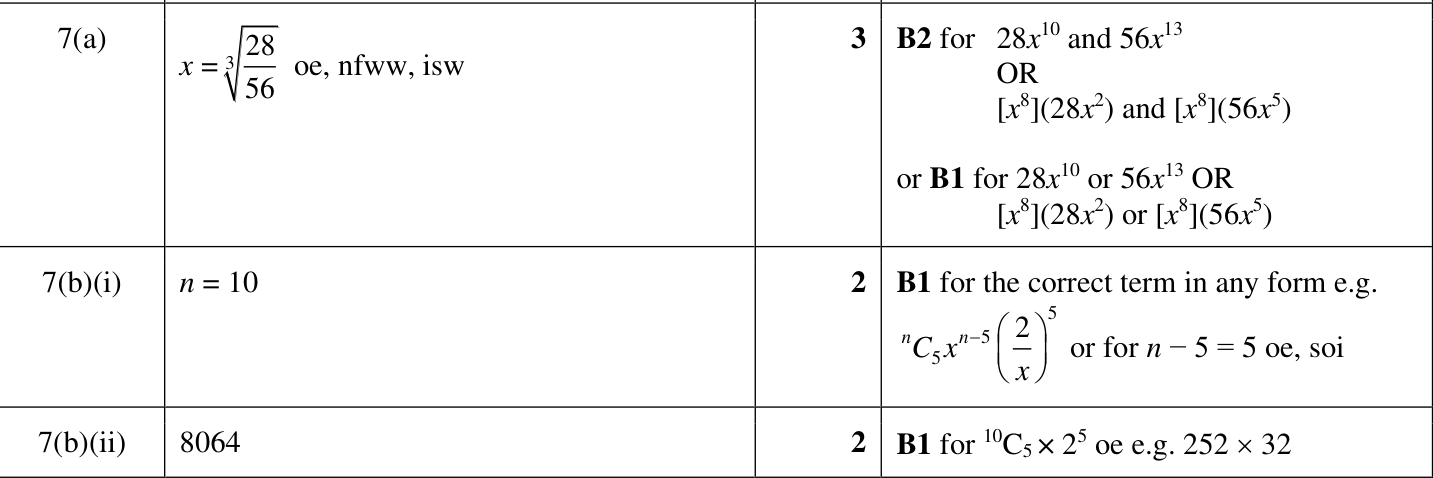
(a) In the expansion of \(\left(x+x^{2}\right)^{8}\) in ascending powers of \(x\), the 3rd and 6th terms are equal. Find the value of \(x\).
(b) In the expansion of \(\left(x+\frac{2}{x}\right)^{n}\) in decreasing powers of \(x\), the 6th term is a constant. (i) Find the value of the positive integer \(n\).
(ii) Find the value of the 6th term.
0606 P22 - Mar 2024 - Q10 - 10 marks
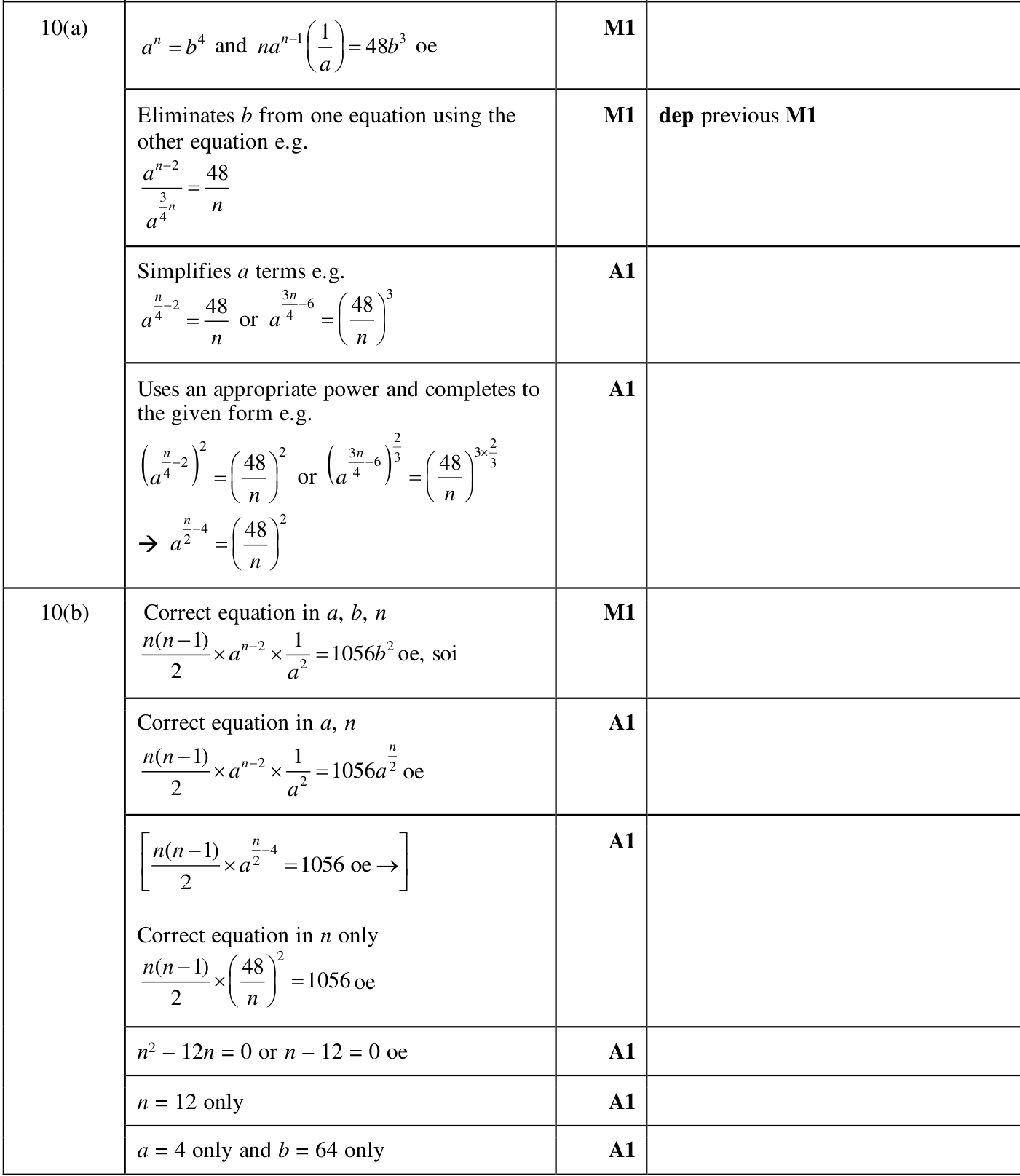
The expansion of \(\left(a+\frac{x}{a}\right)^{n}\) in ascending powers of \(x\) begins \(b^{4}+48 b^{3} x\), where \(n, a\) and \(b\) are positive integers. (a) Show that \(a^{\frac{n}{2}-4}=\left(\frac{48}{n}\right)^{2}\). (b) Given also that the third term is \(1056 b^{2} x^{2}\), find the values of \(n, a\) and \(b\).
0606 P11 - Jun 2024 - Q4 - 7 marks
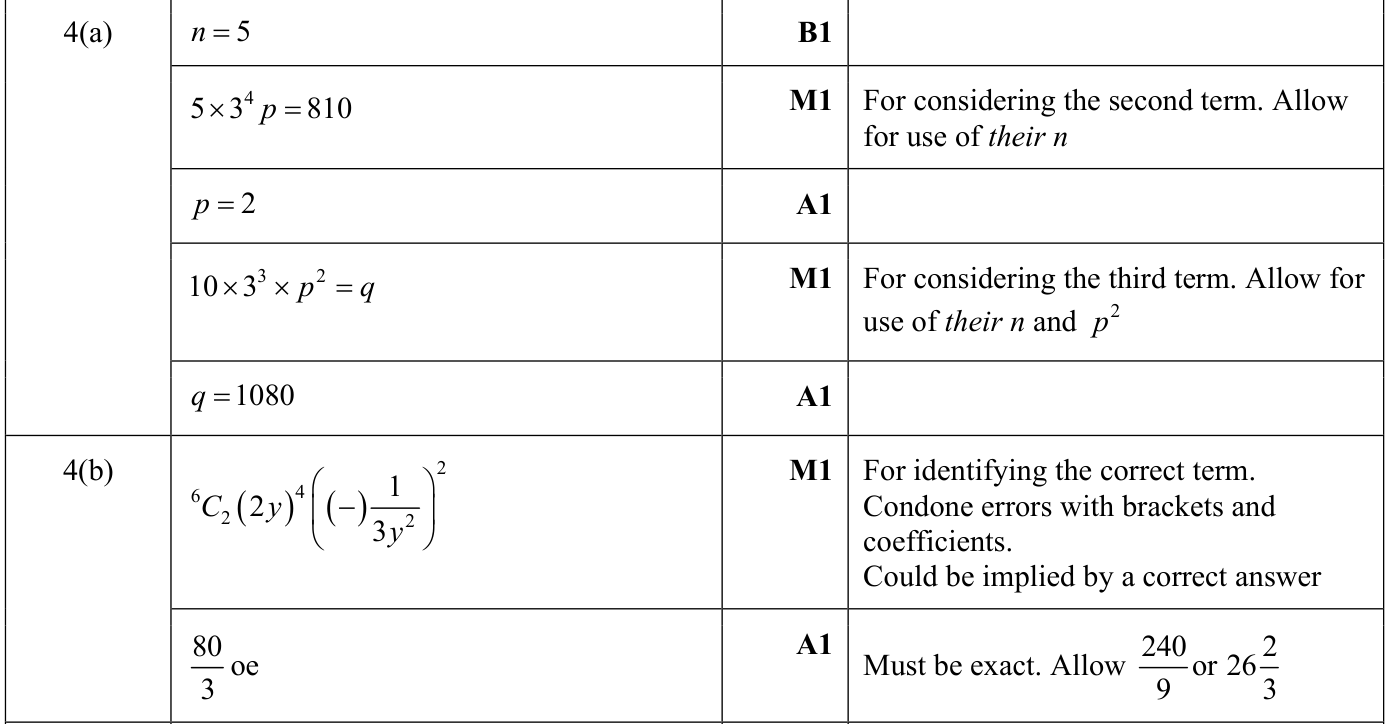
(a) The first three terms, in ascending powers of \(x\), in the expansion of \((3+p x)^{n}\) are \(243+810 x+q x^{2}, \quad\) where \(n, p\) and \(q\) are constants. Find the values of \(n, p\) and \(q\). (b) Find the term independent of \(y\) in the expansion of \(\left(2 y-\frac{1}{3 y^{2}}\right)^{6}\). Give your answer in exact form.
0606 P22 - Jun 2024 - Q11 - 8 marks
In the binomial expansion of \(\left(2+\frac{x}{2}\right)^{n}\), the first three terms in increasing powers of \(x\) are \(b+a b x+\frac{9}{8} a b x^{2}\). Find the values of the constants \(n, a\) and \(b\).
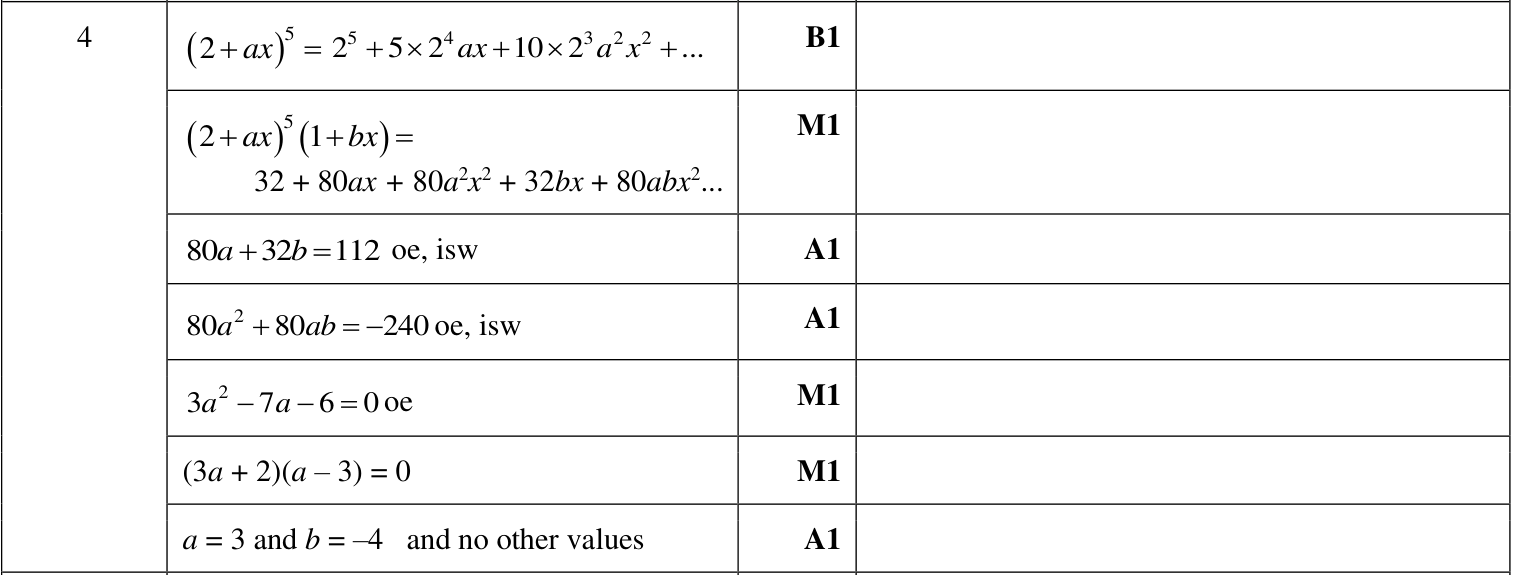
0606 P21 - Nov 2023 - Q4 - 7 marks
In this question \(a\) and \(b\) are integers.
Three terms in the expansion of \((2+ax)^5(1+bx)\) are
\(32+112x-240x^2.\)
Find the values of \(a\) and \(b\).
0606 P23 - Jun 2024 - Q4 - 8 marks
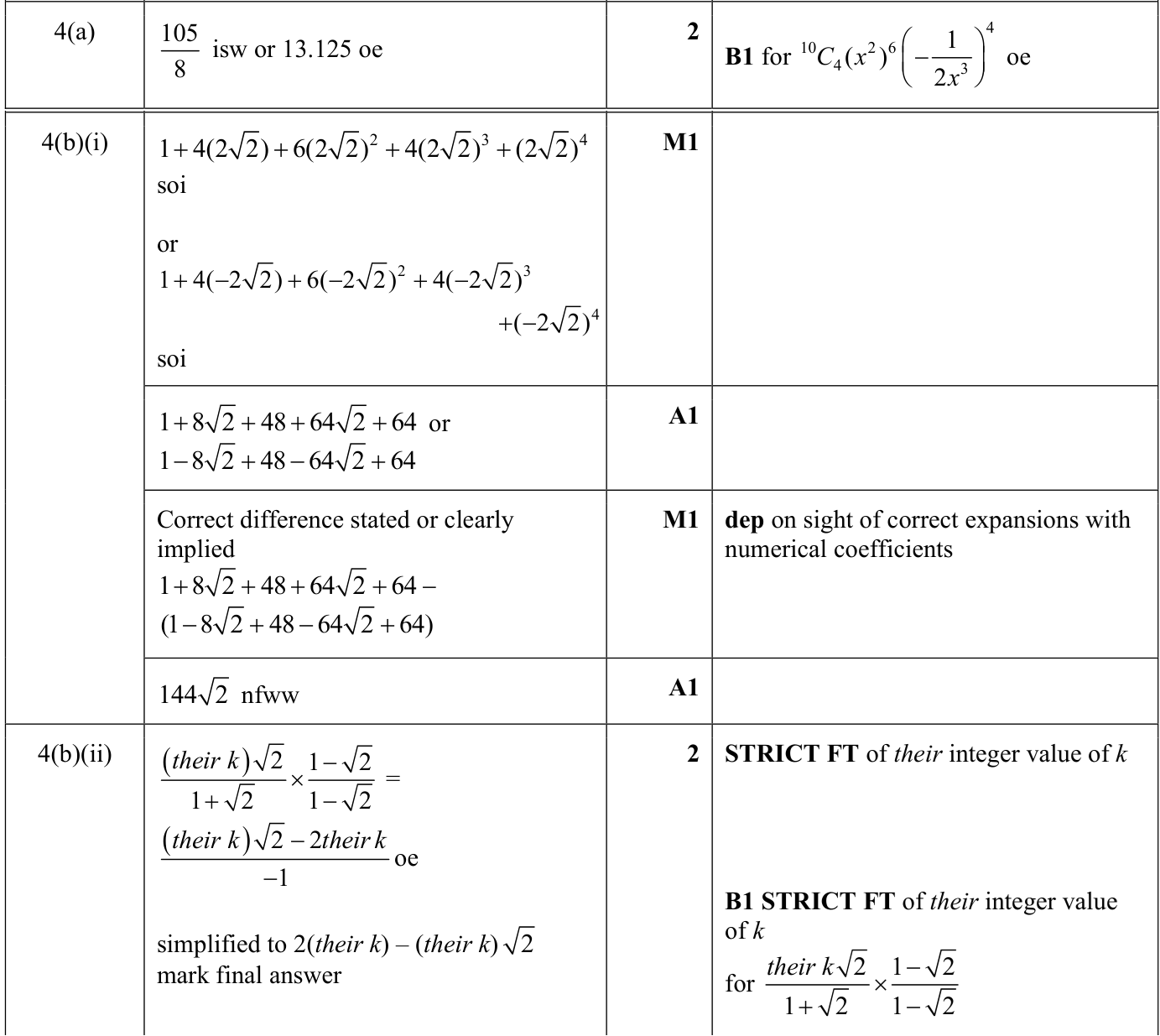
(a) Find and simplify the term independent of \(x\) in the expansion of \(\left(x^{2}-\frac{1}{2 x^{3}}\right)^{10}\). (b) DO NOT USE A CALCULATOR IN THIS PART OF THE QUESTION. (i) Use the binomial theorem to show that \((1+2 \sqrt{2})^{4}-(1-2 \sqrt{2})^{4}=k \sqrt{2}\), where \(k\) is an integer to be found. (ii) Hence write \(\frac{(1+2 \sqrt{2})^{4}-(1-2 \sqrt{2})^{4}}{1+\sqrt{2}}\) in the form \(a+b \sqrt{2}\), where \(a\) and \(b\) are integers.
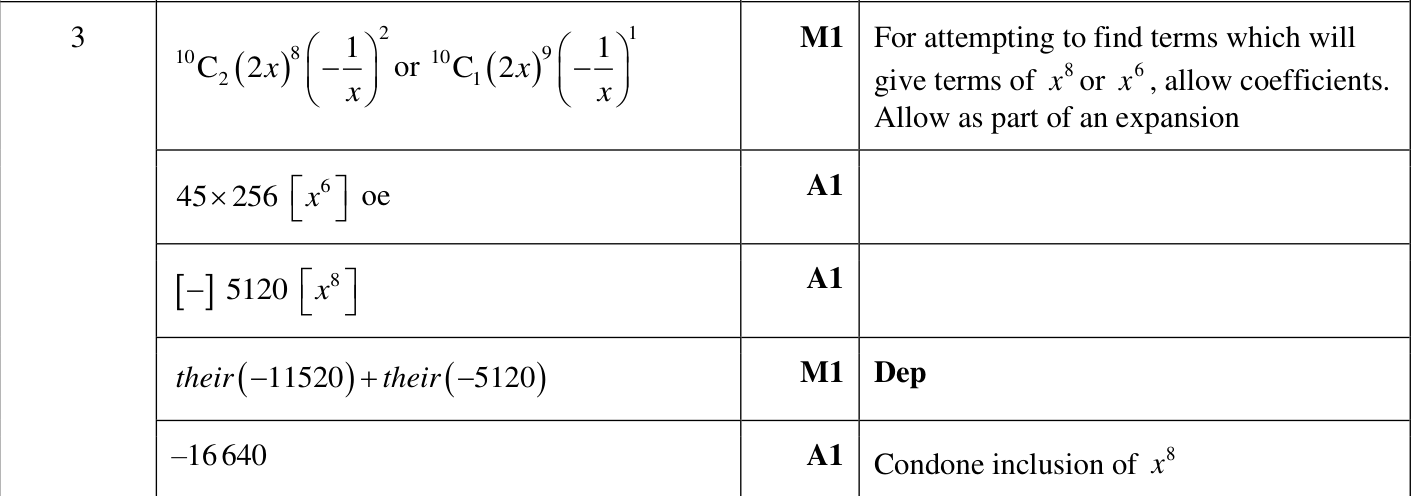
0606 P12 - Mar 2023 - Q3 - 5 marks
Find the coefficient of \(x^8\) in the expansion of
\((1-x^2)\left(2x-\frac1x\right)^{10}.\)