Past Exam Questions
← Back9709 P31 - Jun 2012 - Q4
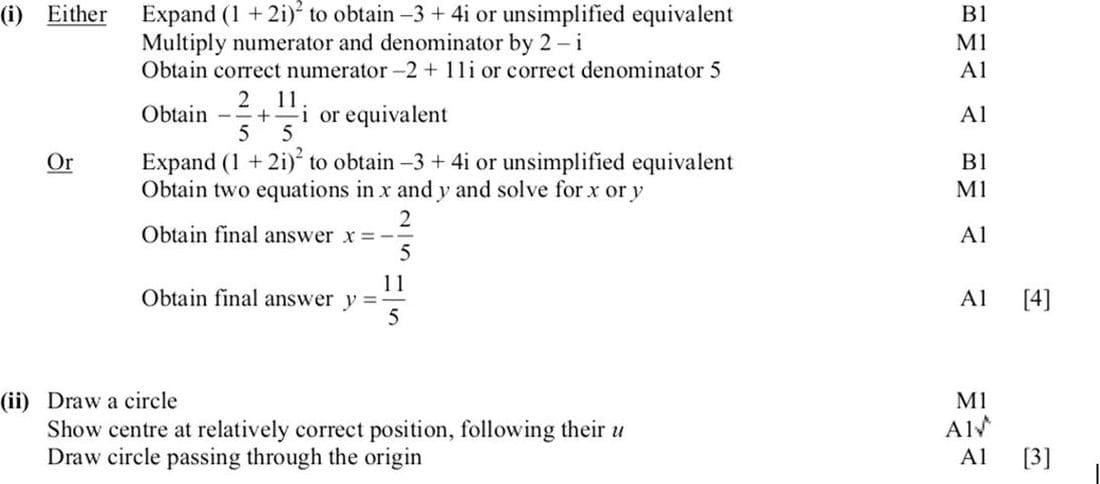
The complex number u is defined by \(u = \frac{(1 + 2i)^2}{2 + i}\).
- Without using a calculator and showing your working, express u in the form x + iy, where x and y are real.
- Sketch an Argand diagram showing the locus of the complex number z such that \(|z-u| = |u|\).
9709 P33 - Nov 2011 - Q6
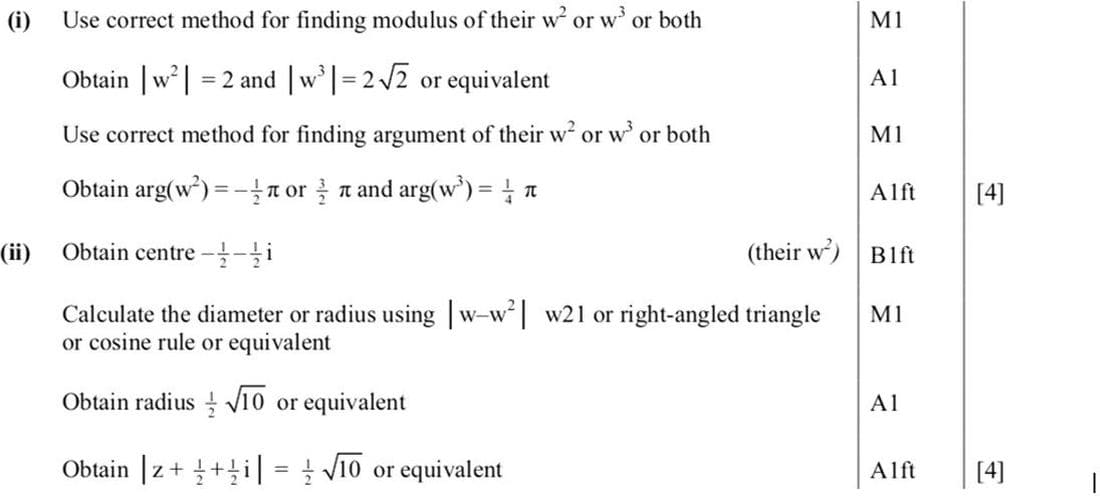
\(The complex number w is defined by w = -1 + i.\)
(i) Find the modulus and argument of w2 and w3, showing your working.
(ii) The points in an Argand diagram representing w and w2 are the ends of a diameter of a circle. Find the equation of the circle, giving your answer in the form |z - (a + bi)| = k.
9709 P31 - Nov 2011 - Q10
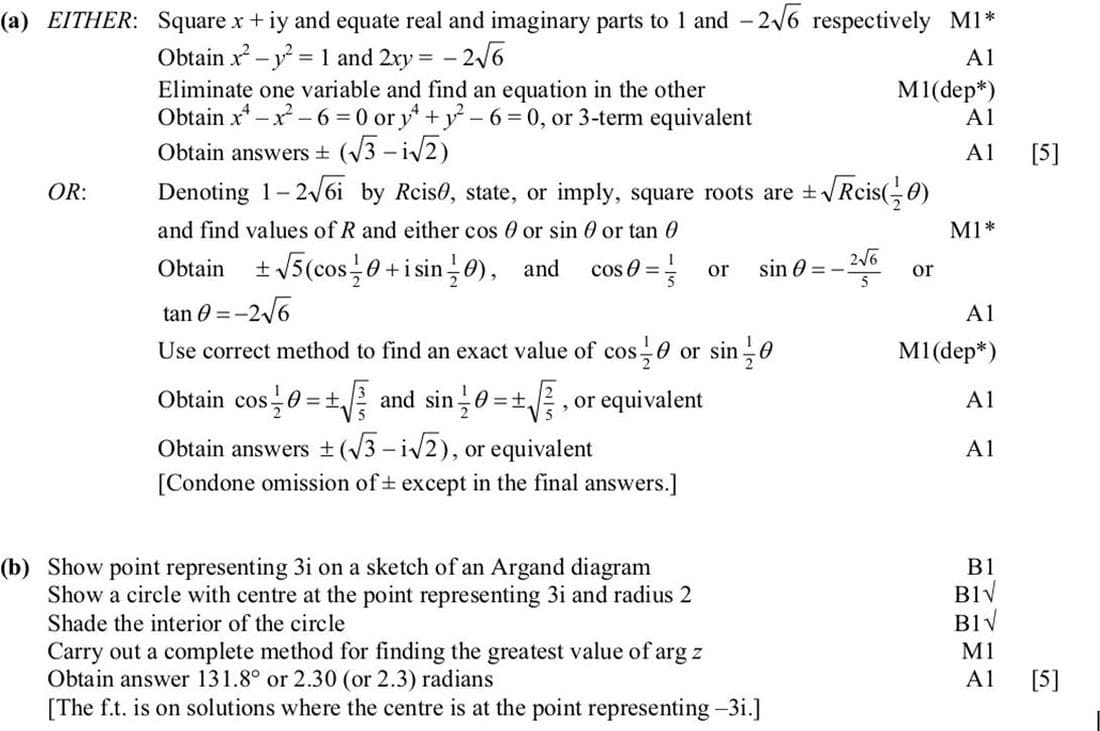
(a) Showing your working, find the two square roots of the complex number \(1 - (2\sqrt{6})i\). Give your answers in the form \(x + iy\), where \(x\) and \(y\) are exact.
(b) On a sketch of an Argand diagram, shade the region whose points represent the complex numbers \(z\) which satisfy the inequality \(|z - 3i| \leq 2\). Find the greatest value of \(\arg z\) for points in this region.
9709 P33 - Jun 2011 - Q7
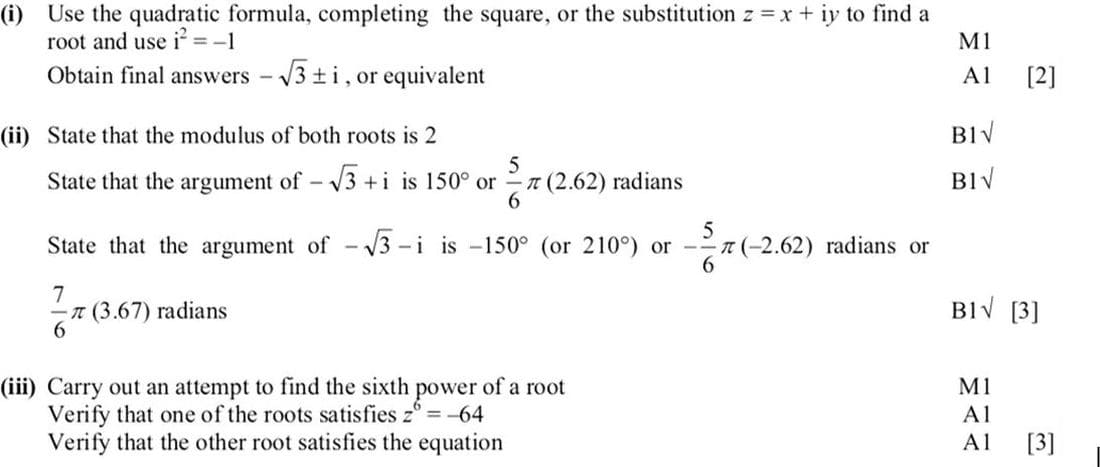
(i) Find the roots of the equation
\(z^2 + (2\sqrt{3})z + 4 = 0\),
giving your answers in the form \(x + iy\), where \(x\) and \(y\) are real.
(ii) State the modulus and argument of each root.
(iii) Showing all your working, verify that each root also satisfies the equation
\(z^6 = -64\).
9709 P32 - Jun 2011 - Q7
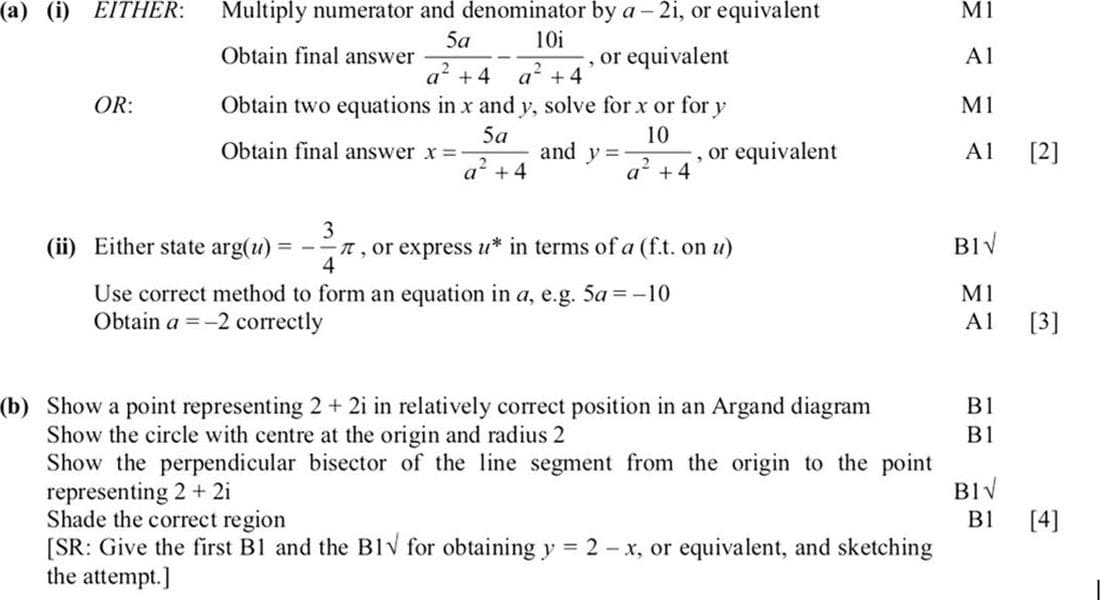
(a) The complex number u is defined by \(u = \frac{5}{a + 2i}\), where the constant a is real.
- Express u in the form x + iy, where x and y are real.
- Find the value of a for which \(\arg(u^*) = \frac{3}{4}\pi\), where u* denotes the complex conjugate of u.
(b) On a sketch of an Argand diagram, shade the region whose points represent complex numbers z which satisfy both the inequalities \(|z| < 2\) and \(|z| < |z - 2 - 2i|\).
9709 P31 - Jun 2011 - Q8
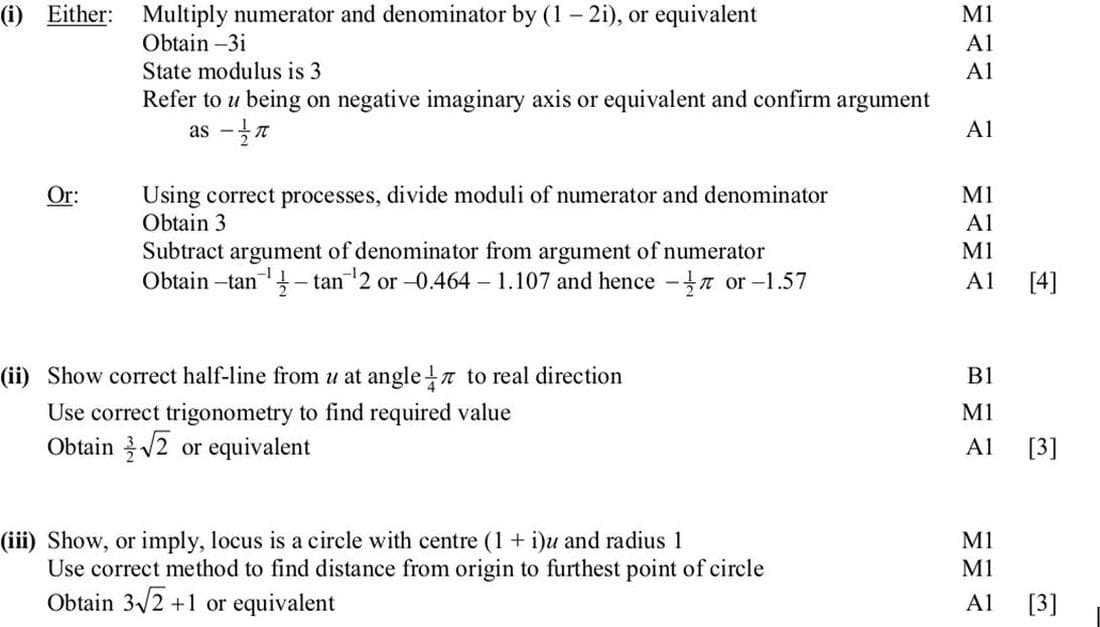
The complex number u is defined by \(u = \frac{6 - 3i}{1 + 2i}\).
- Showing all your working, find the modulus of u and show that the argument of u is \(-\frac{1}{2}\pi\).
- For complex numbers z satisfying \(\text{arg}(z - u) = \frac{1}{4}\pi\), find the least possible value of \(|z|\).
- For complex numbers z satisfying \(|z - (1 + i)u| = 1\), find the greatest possible value of \(|z|\).
9709 P32 - Jun 2023 - Q5
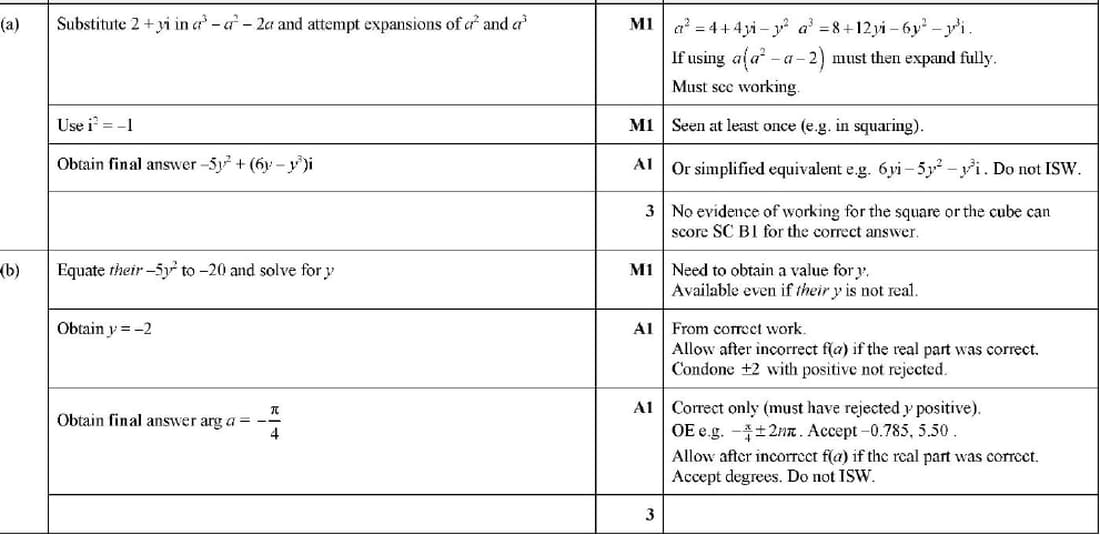
The complex number \(2 + yi\) is denoted by \(a\), where \(y\) is a real number and \(y < 0\). It is given that \(f(a) = a^3 - a^2 - 2a\).
(a) Find a simplified expression for \(f(a)\) in terms of \(y\).
(b) Given that \(\text{Re}(f(a)) = -20\), find \(\arg a\).
9709 P33 - Nov 2010 - Q3
\(The complex number w is defined by w = 2 + i.\)
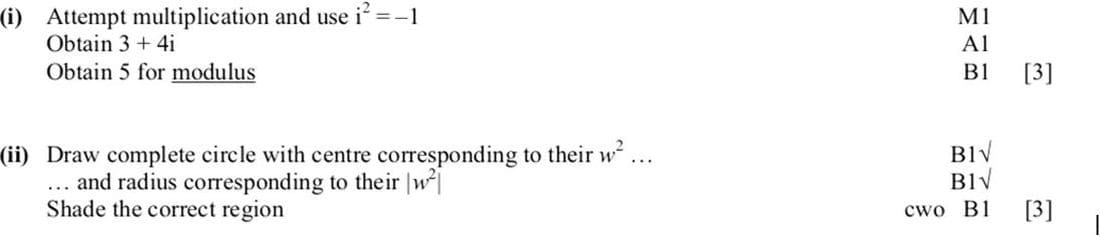
(i) Showing your working, express w2 in the form x + iy, where x and y are real. Find the modulus of w2.
(ii) Shade on an Argand diagram the region whose points represent the complex numbers z which satisfy \(|z - w^2| \leq |w^2|\).
9709 P31 - Nov 2010 - Q6
The complex number z is given by
\(z = (3) + i\).
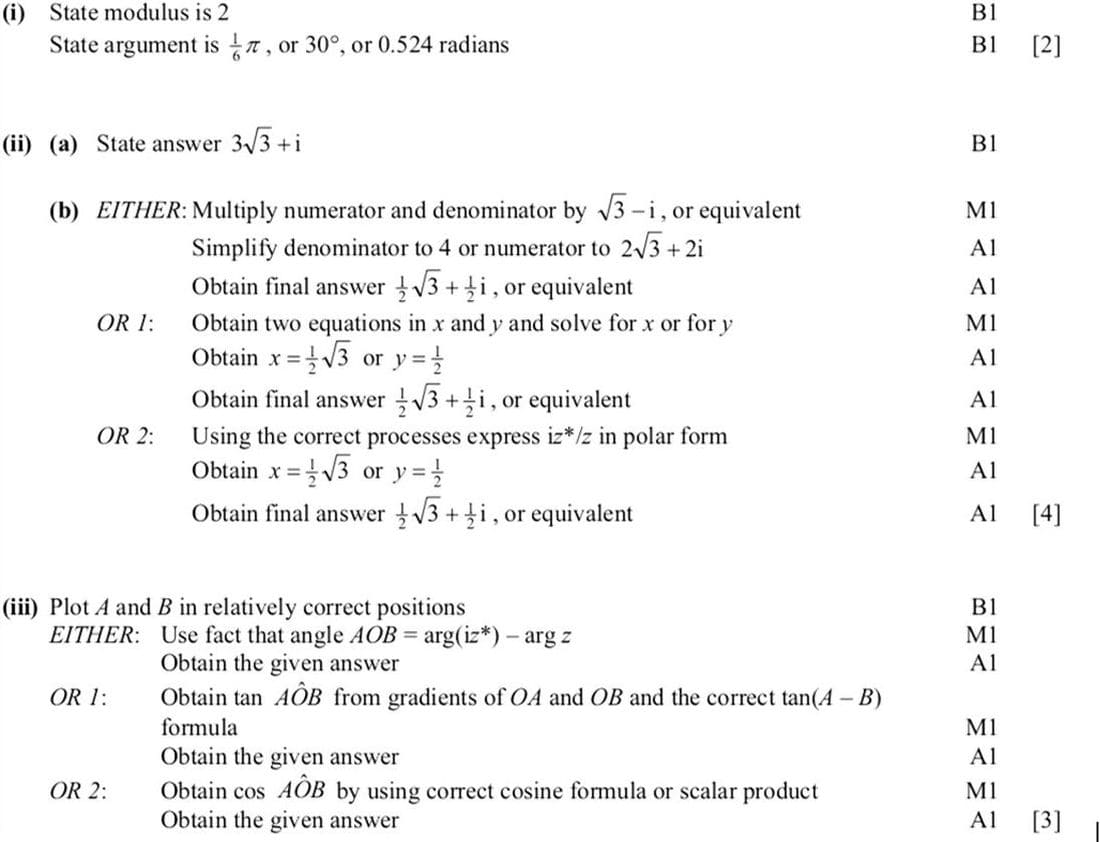
- Find the modulus and argument of z.
- The complex conjugate of z is denoted by \(z^*\). Showing your working, express in the form \(x + iy\), where x and y are real,
- \(2z + z^*\),
- \(\frac{iz^*}{z}\).
- On a sketch of an Argand diagram with origin O, show the points A and B representing the complex numbers z and \(iz^*\) respectively. Prove that angle \(AOB = \frac{1}{6}\pi\).
9709 P33 - Jun 2010 - Q8
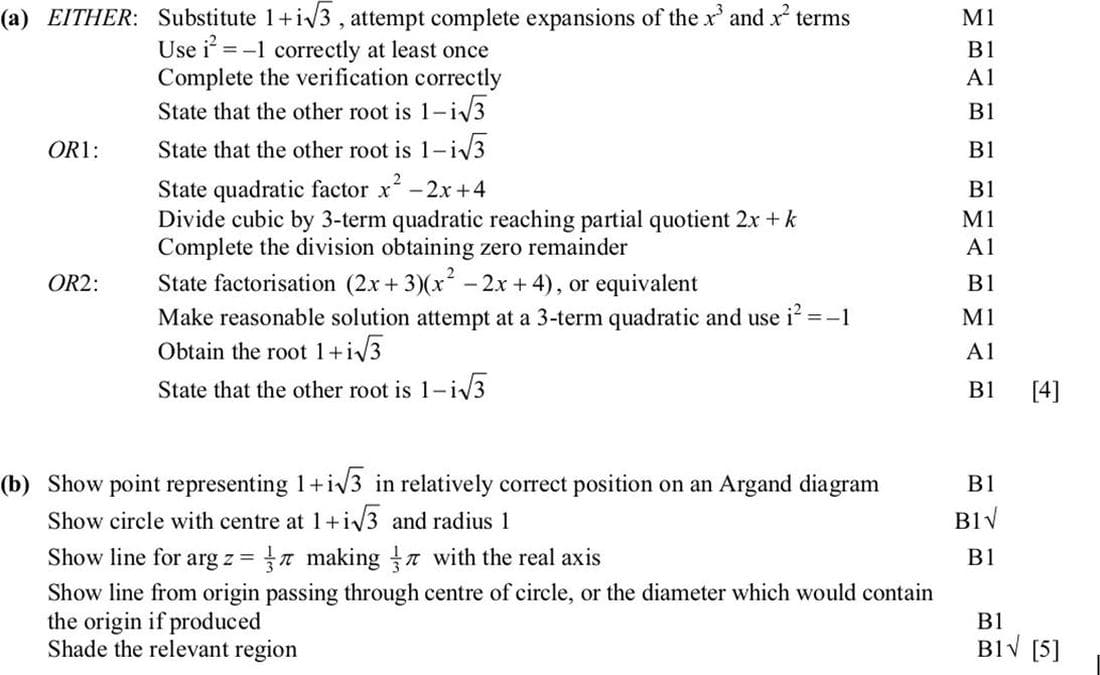
(a) The equation \(2x^3 - x^2 + 2x + 12 = 0\) has one real root and two complex roots. Showing your working, verify that \(1 + i\sqrt{3}\) is one of the complex roots. State the other complex root.
(b) On a sketch of an Argand diagram, show the point representing the complex number \(1 + i\sqrt{3}\). On the same diagram, shade the region whose points represent the complex numbers \(z\) which satisfy both the inequalities \(|z - 1 - i\sqrt{3}| \leq 1\) and \(\arg z \leq \frac{1}{3}\pi\).
9709 P32 - Jun 2010 - Q8
The variable complex number \(z\) is given by
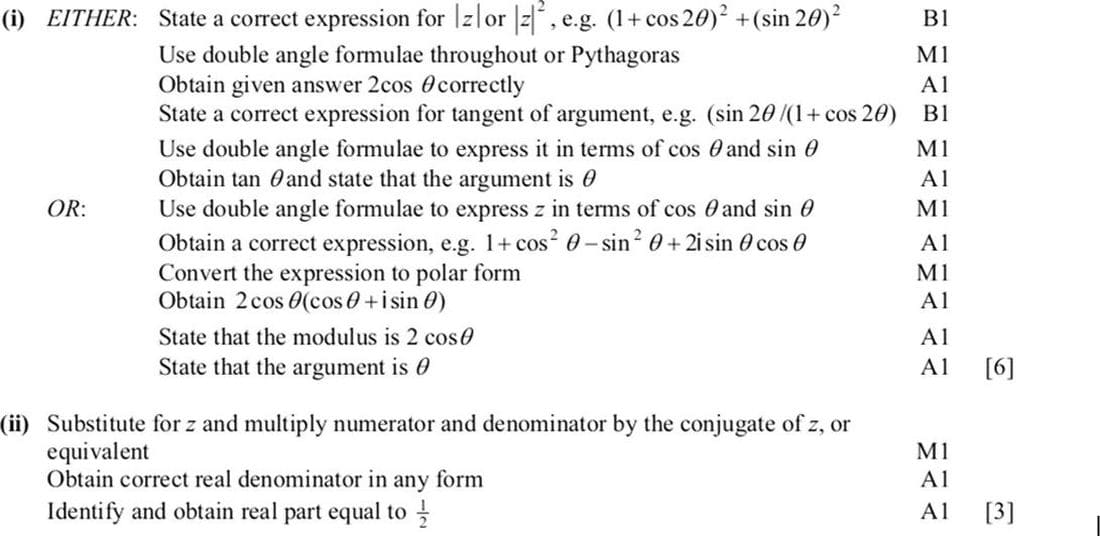
\(z = 1 + \\cos 2\theta + i \\sin 2\theta\),
where \(\theta\) takes all values in the interval \(-\frac{1}{2}\pi < \theta < \frac{1}{2}\pi\).
(i) Show that the modulus of \(z\) is \(2 \cos \theta\) and the argument of \(z\) is \(\theta\).
(ii) Prove that the real part of \(\frac{1}{z}\) is constant.
9709 P31 - Jun 2010 - Q7
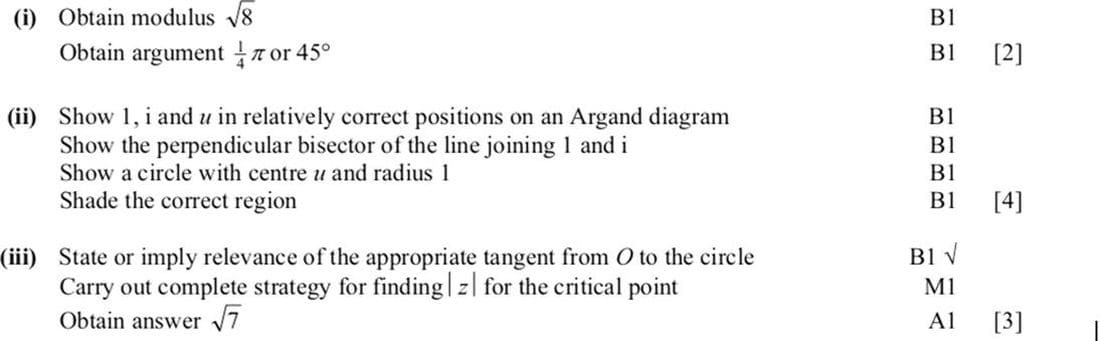
The complex number 2 + 2i is denoted by u.
(i) Find the modulus and argument of u.
(ii) Sketch an Argand diagram showing the points representing the complex numbers 1, i and u. Shade the region whose points represent the complex numbers z which satisfy both the inequalities \(|z - 1| \leq |z - i|\) and \(|z - u| \leq 1\).
(iii) Using your diagram, calculate the value of \(|z|\) for the point in this region for which \(\arg z\) is least.
9709 P32 - Nov 2009 - Q7
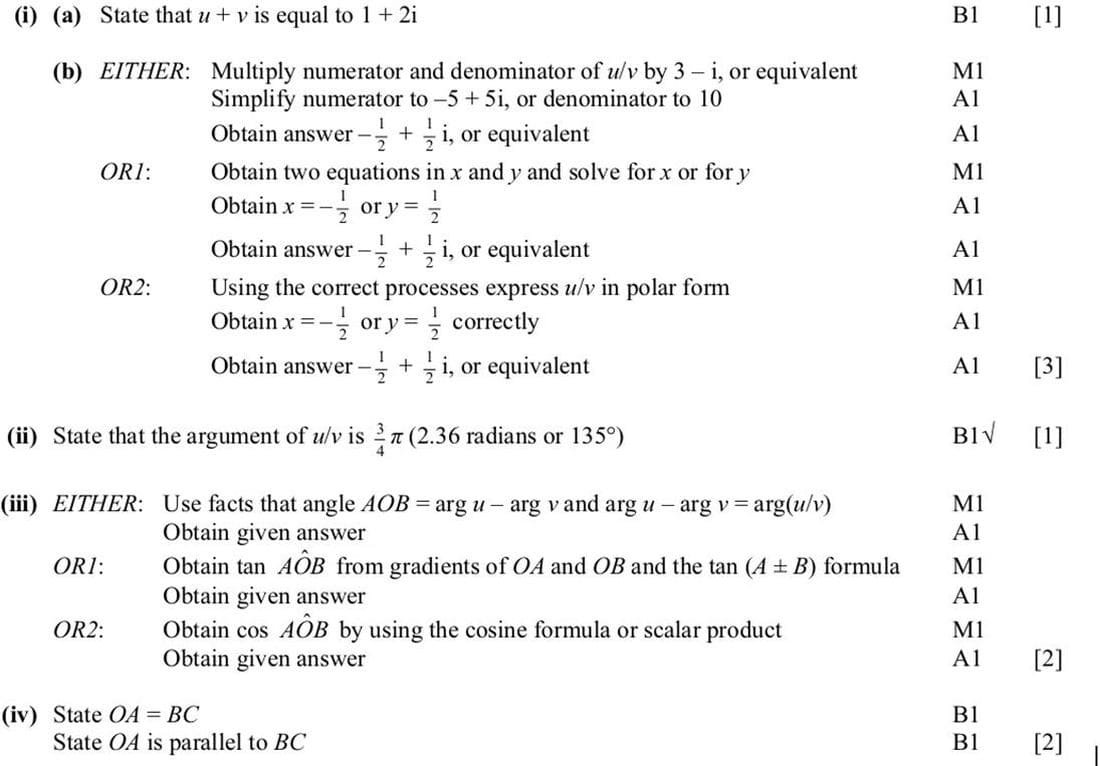
The complex numbers \(-2 + i\) and \(3 + i\) are denoted by \(u\) and \(v\) respectively.
(i) Find, in the form \(x + iy\), the complex numbers
(a) \(u + v\),
(b) \(\frac{u}{v}\), showing all your working.
(ii) State the argument of \(\frac{u}{v}\).
In an Argand diagram with origin \(O\), the points \(A, B\) and \(C\) represent the complex numbers \(u, v\) and \(u + v\) respectively.
(iii) Prove that angle \(AOB = \frac{3}{4}\pi\).
(iv) State fully the geometrical relationship between the line segments \(OA\) and \(BC\).
9709 P31 - Nov 2009 - Q7
The complex number \(-2 + i\) is denoted by \(u\).
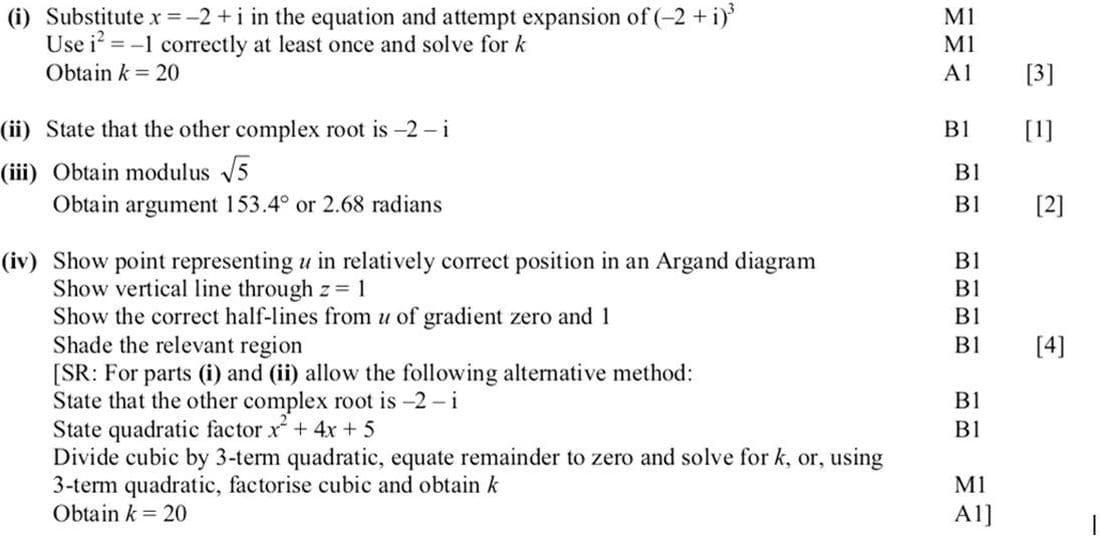
(i) Given that \(u\) is a root of the equation \(x^3 - 11x - k = 0\), where \(k\) is real, find the value of \(k\).
(ii) Write down the other complex root of this equation.
(iii) Find the modulus and argument of \(u\).
(iv) Sketch an Argand diagram showing the point representing \(u\). Shade the region whose points represent the complex numbers \(z\) satisfying both the inequalities \(|z| < |z - 2|\) and \(0 < \arg(z - u) < \frac{1}{4}\pi\).
9709 P3 - Jun 2009 - Q7
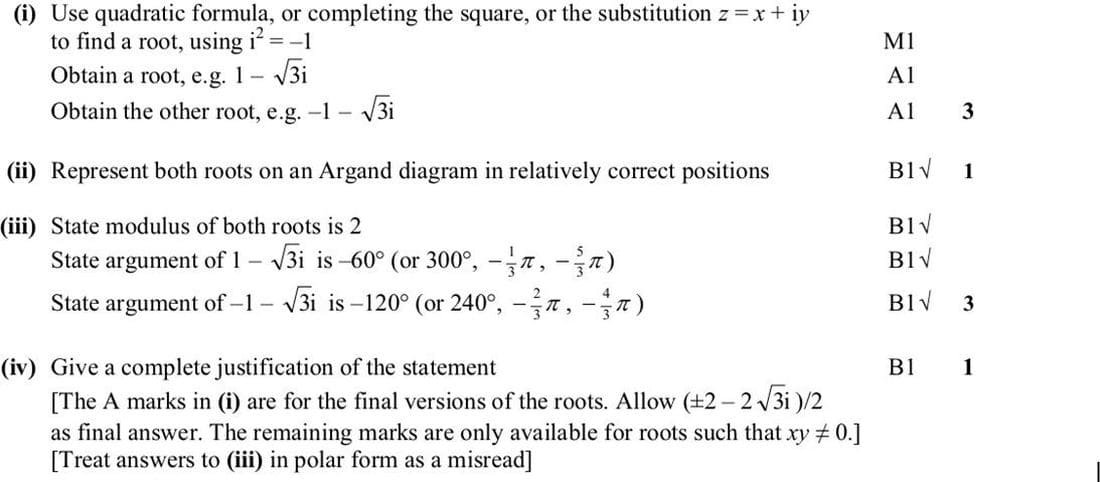
(i) Solve the equation \(z^2 + (2\sqrt{3})iz - 4 = 0\), giving your answers in the form \(x + iy\), where \(x\) and \(y\) are real.
(ii) Sketch an Argand diagram showing the points representing the roots.
(iii) Find the modulus and argument of each root.
(iv) Show that the origin and the points representing the roots are the vertices of an equilateral triangle.
9709 P3 - Nov 2008 - Q10
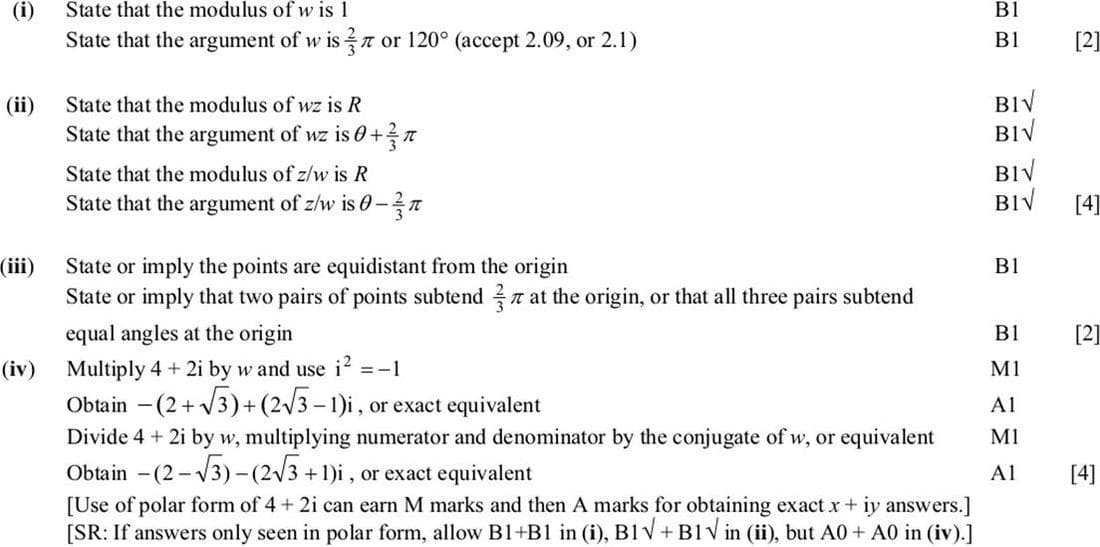
The complex number w is given by \(w = -\frac{1}{2} + i \frac{\sqrt{3}}{2}\).
- Find the modulus and argument of w. [2]
- The complex number z has modulus R and argument \(\theta\), where \(-\frac{1}{3}\pi < \theta < \frac{1}{3}\pi\). State the modulus and argument of wz and the modulus and argument of \(\frac{z}{w}\). [4]
- Hence explain why, in an Argand diagram, the points representing z, wz and \(\frac{z}{w}\) are the vertices of an equilateral triangle. [2]
- In an Argand diagram, the vertices of an equilateral triangle lie on a circle with centre at the origin. One of the vertices represents the complex number 4 + 2i. Find the complex numbers represented by the other two vertices. Give your answers in the form x + iy, where x and y are real and exact. [4]
9709 P3 - Jun 2008 - Q5
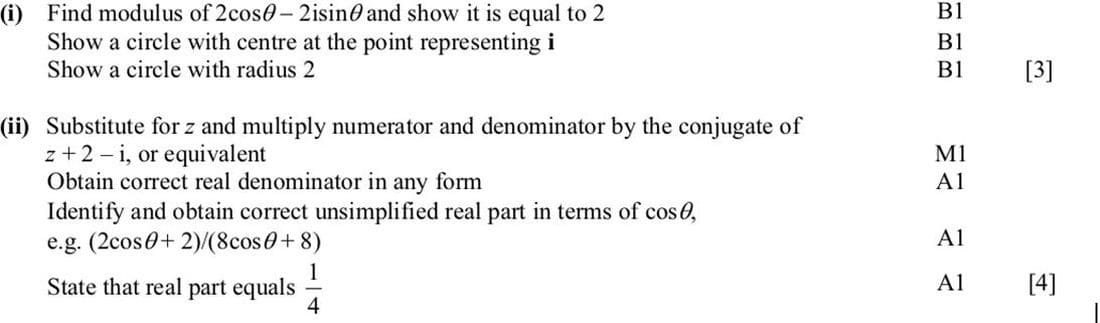
The variable complex number \(z\) is given by
\(z = 2 \cos \theta + i(1 - 2 \sin \theta)\),
where \(\theta\) takes all values in the interval \(-\pi < \theta \leq \pi\).
(i) Show that \(|z - i| = 2\), for all values of \(\theta\). Hence sketch, in an Argand diagram, the locus of the point representing \(z\).
(ii) Prove that the real part of \(\frac{1}{z + 2 - i}\) is constant for \(-\pi < \theta < \pi\).
9231 P42 - Nov 2025 - Q1 - 6 marks
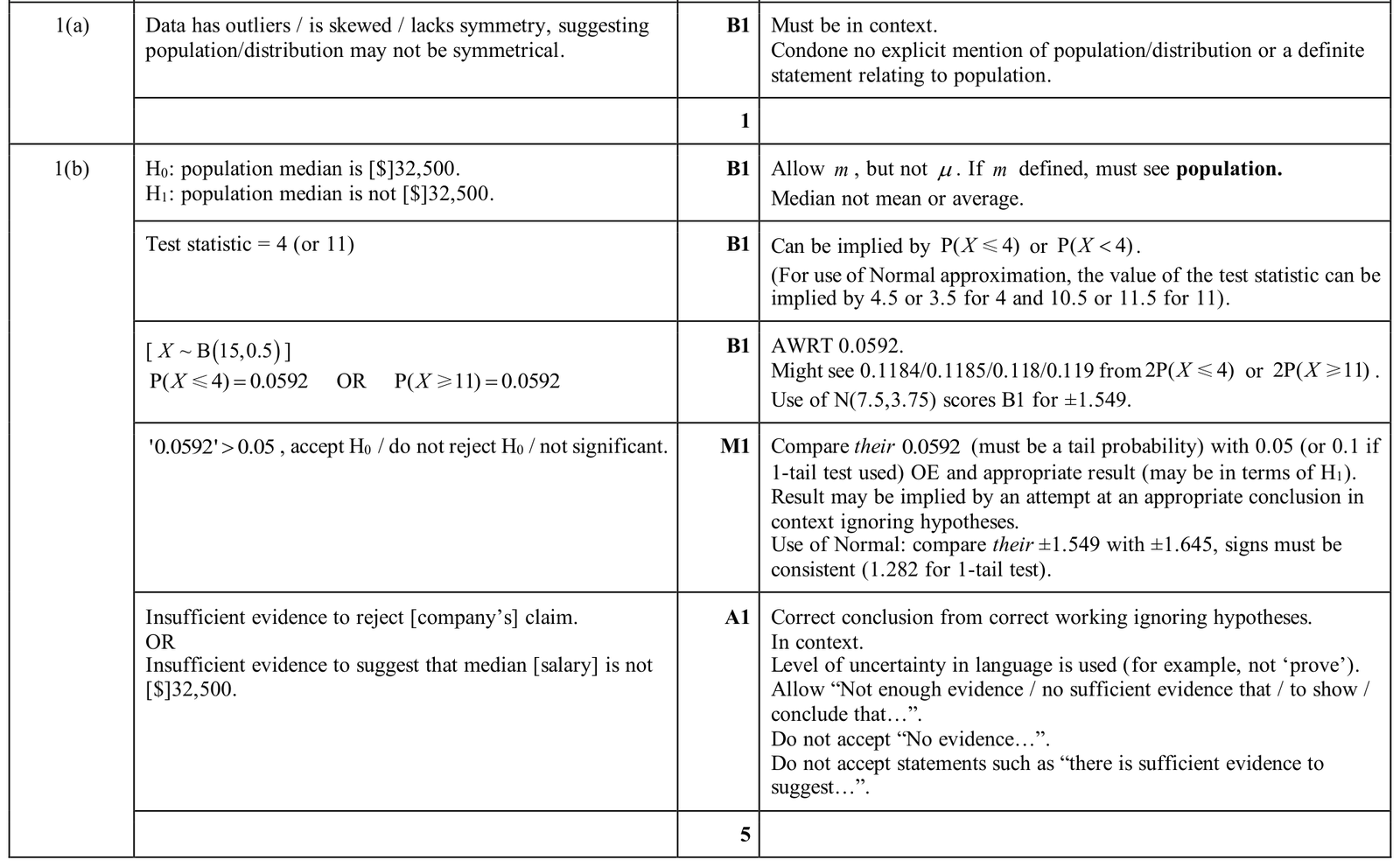
A large company claims that the median salary of its employees is \(\$32500\). The salaries, in dollars, of 15 randomly selected employees are listed below.
| \(18750\) | \(30500\) | \(125000\) | \(42500\) | \(25000\) | \(26000\) | \(52500\) | \(23000\) | \(27500\) | \(19500\) | \(25500\) | \(33000\) | \(30000\) | \(21500\) | \(29000\) |
(a) Explain why a Wilcoxon signed-rank test may not be appropriate to test the company's claim in this case.
(b) Carry out a sign test at the \(10\%\) significance level to investigate the company's claim.
9231 P41 - Jun 2024 - Q2 - 5 marks
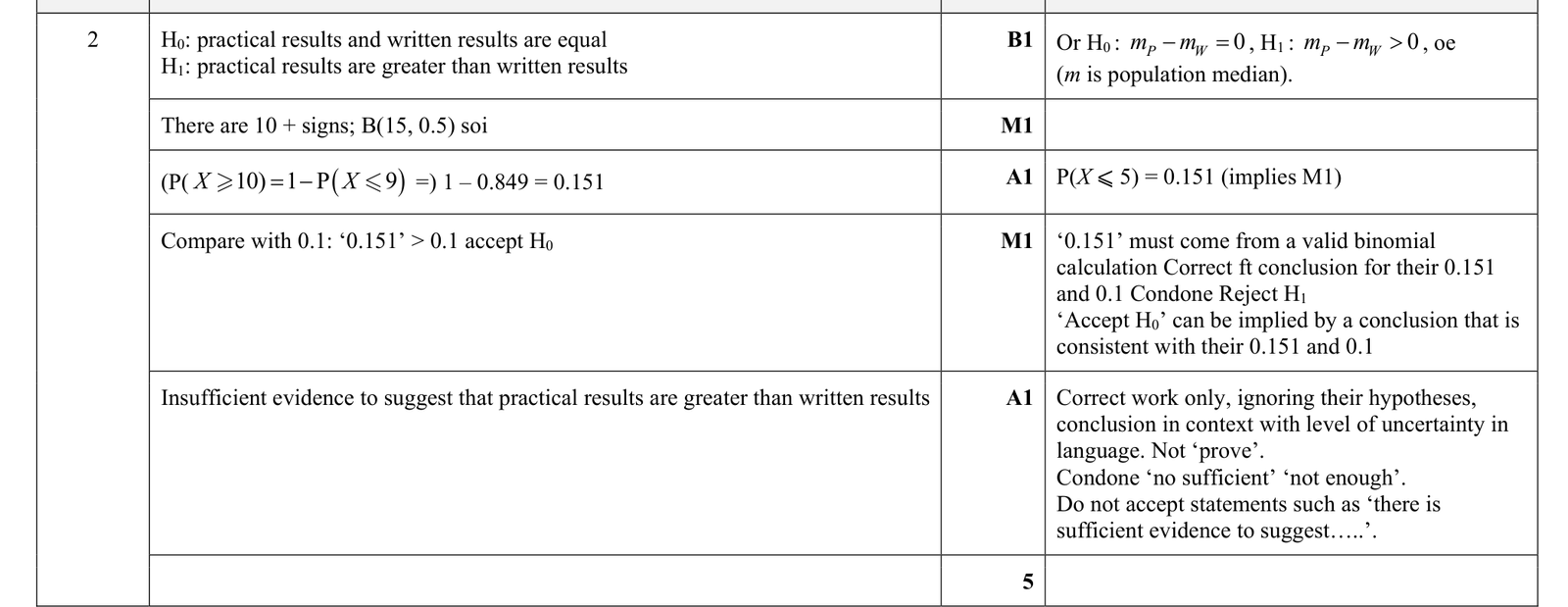
A large number of students are taking a Physics course. They are assessed by a practical examination and a written examination. The marks out of 100 obtained by a random sample of 15 students in each of the examinations are as follows.
Use a sign test, at the \(10 \%\) significance level, to test whether, on average, the practical examination marks are higher than the written examination marks.
9231 P41 - Nov 2025 - Q4 - 5 marks
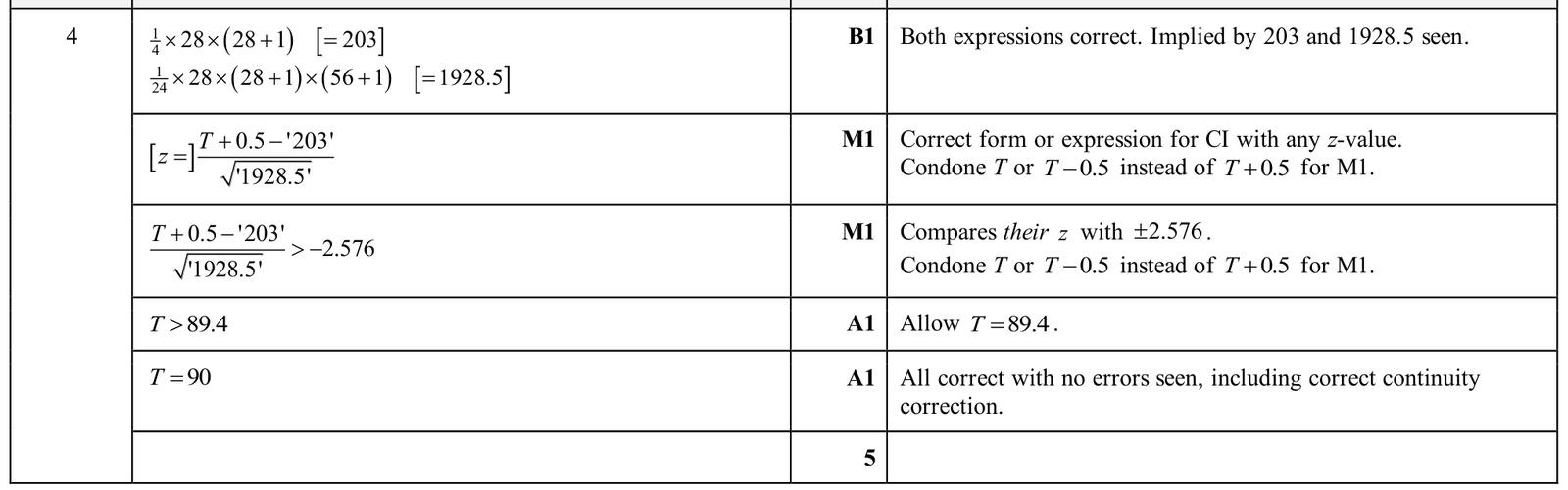
A researcher believes that the median \(m\) of a population has changed from its known previous value \(m_{0}\). The researcher collects a random sample of size 28 . She ranks the data and calculates a test statistic \(T\) using the Wilcoxon signed-rank test. The conclusion of the test carried out at a \(1 \%\) significance level is that there is not sufficient evidence to support her belief. Using a normal approximation, find the least possible value of \(T\).