Past Exam Questions
← Back9709 P31 - Nov 2018 - Q8
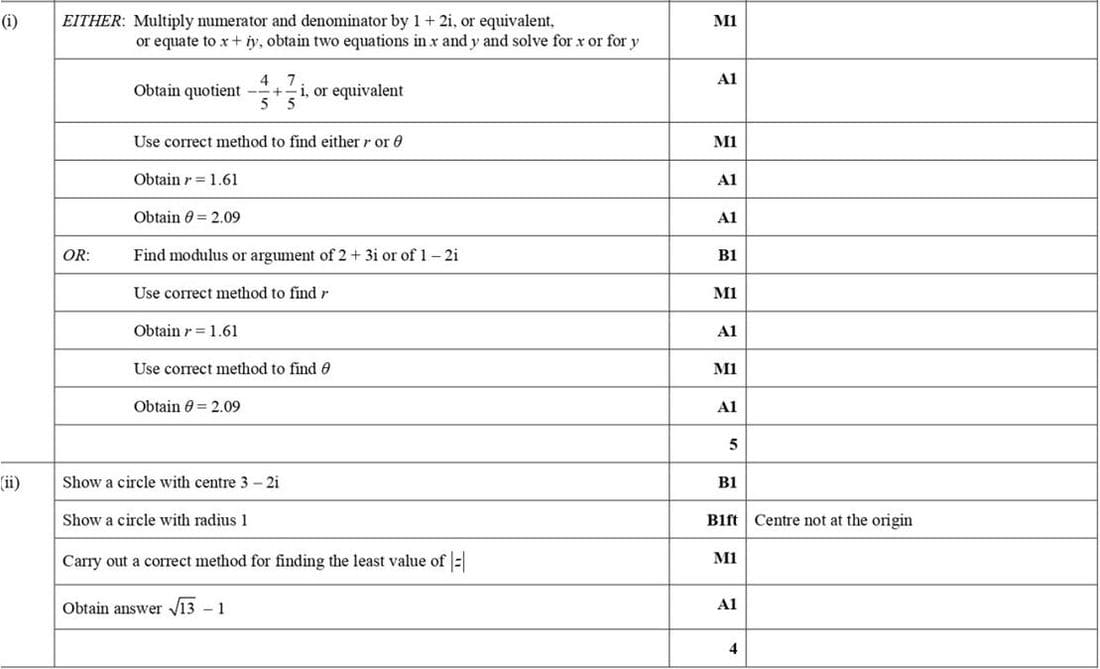
(a) Showing all necessary working, express the complex number \(\frac{2 + 3i}{1 - 2i}\) in the form \(re^{i\theta}\), where \(r > 0\) and \(-\pi < \theta \leq \pi\). Give the values of \(r\) and \(\theta\) correct to 3 significant figures.
(b) On an Argand diagram sketch the locus of points representing complex numbers \(z\) satisfying the equation \(|z - 3 + 2i| = 1\). Find the least value of \(|z|\) for points on this locus, giving your answer in an exact form.
9709 P33 - Jun 2018 - Q9
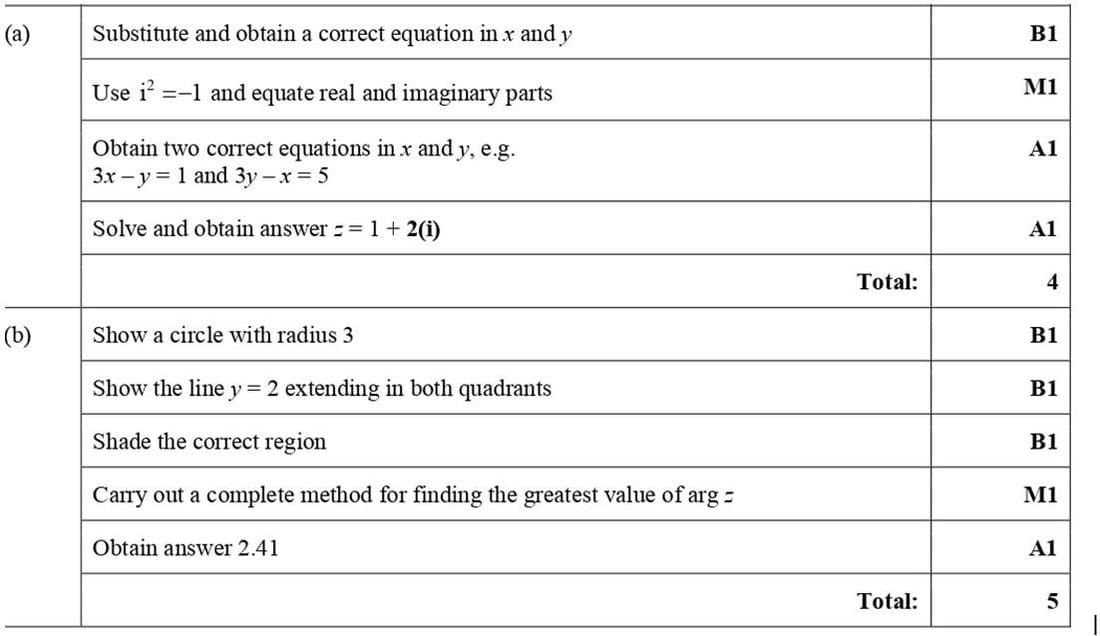
(a) Find the complex number z satisfying the equation
\(3z - iz^* = 1 + 5i\),
where \(z^*\) denotes the complex conjugate of \(z\).
(b) On a sketch of an Argand diagram, shade the region whose points represent complex numbers \(z\) which satisfy both the inequalities \(|z| \leq 3\) and \(\text{Im } z \geq 2\), where \(\text{Im } z\) denotes the imaginary part of \(z\). Calculate the greatest value of \(\arg z\) for points in this region. Give your answer in radians correct to 2 decimal places.
9709 P31 - Nov 2023 - Q4
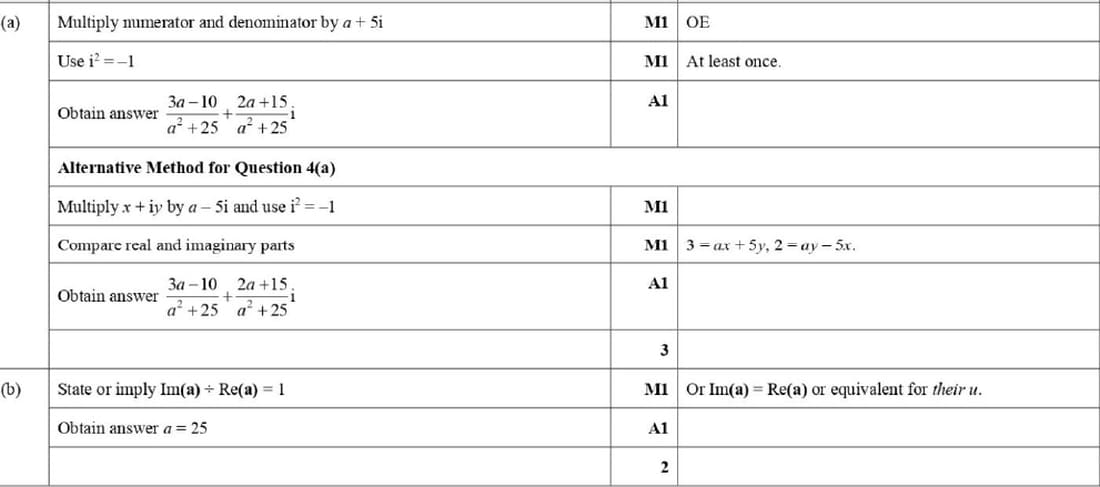
The complex number u is defined by \(u = \frac{3 + 2i}{a - 5i}\), where a is real.
(a) Express u in the Cartesian form \(x + iy\), where x and y are in terms of a.
(b) Given that \(\arg u = \frac{1}{4}\pi\), find the value of a.
9709 P32 - Jun 2018 - Q7
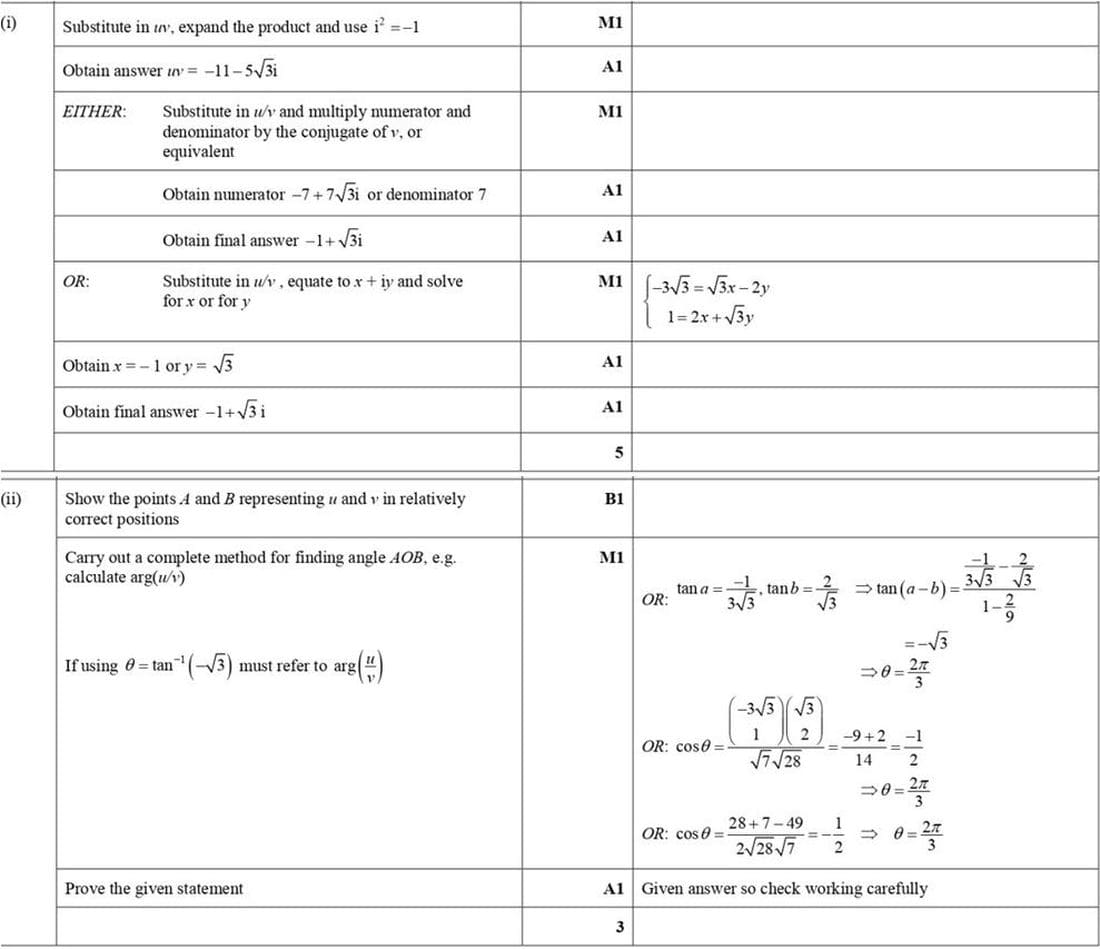
The complex numbers \(-3\sqrt{3} + i\) and \(\sqrt{3} + 2i\) are denoted by \(u\) and \(v\) respectively.
- Find, in the form \(x + iy\), where \(x\) and \(y\) are real and exact, the complex numbers \(uv\) and \(\frac{u}{v}\). [5]
- On a sketch of an Argand diagram with origin \(O\), show the points \(A\) and \(B\) representing the complex numbers \(u\) and \(v\) respectively. Prove that angle \(AOB = \frac{2}{3}\pi\). [3]
9709 P31 - Jun 2018 - Q7
(i) Showing all working and without using a calculator, solve the equation \(z^2 + (2\sqrt{6})z + 8 = 0\), giving your answers in the form \(x + iy\), where \(x\) and \(y\) are real and exact.
(ii) Sketch an Argand diagram showing the points representing the roots.
(iii) The points representing the roots are \(A\) and \(B\), and \(O\) is the origin. Find angle \(AOB\).
(iv) Prove that triangle \(AOB\) is equilateral.

9709 P32 - Mar 2018 - Q9
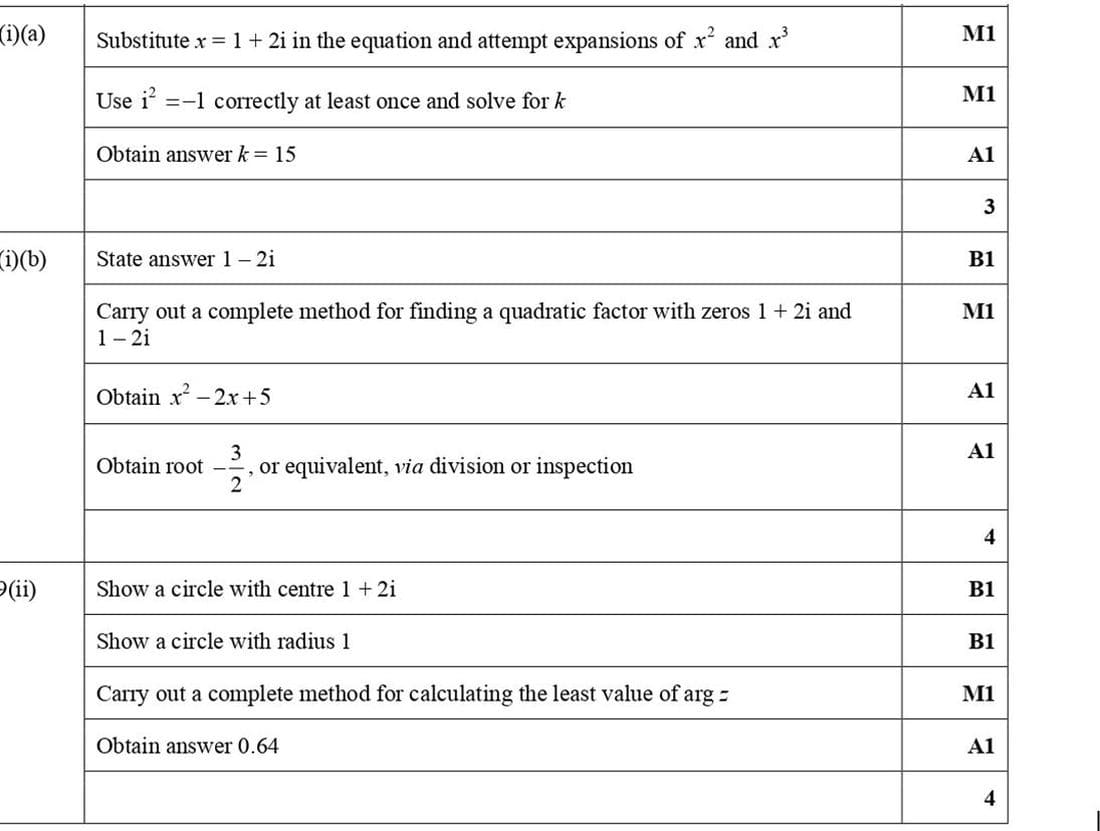
The complex number 1 + 2i is denoted by u.
\((i) It is given that u is a root of the equation 2x^3 - x^2 + 4x + k = 0, where k is a constant.\)
(a) Showing all working and without using a calculator, find the value of k.
(b) Showing all working and without using a calculator, find the other two roots of this equation.
(ii) On an Argand diagram sketch the locus of points representing complex numbers z satisfying the equation |z - u| = 1. Determine the least value of arg z for points on this locus. Give your answer in radians correct to 2 decimal places.
9709 P32 - Nov 2017 - Q7
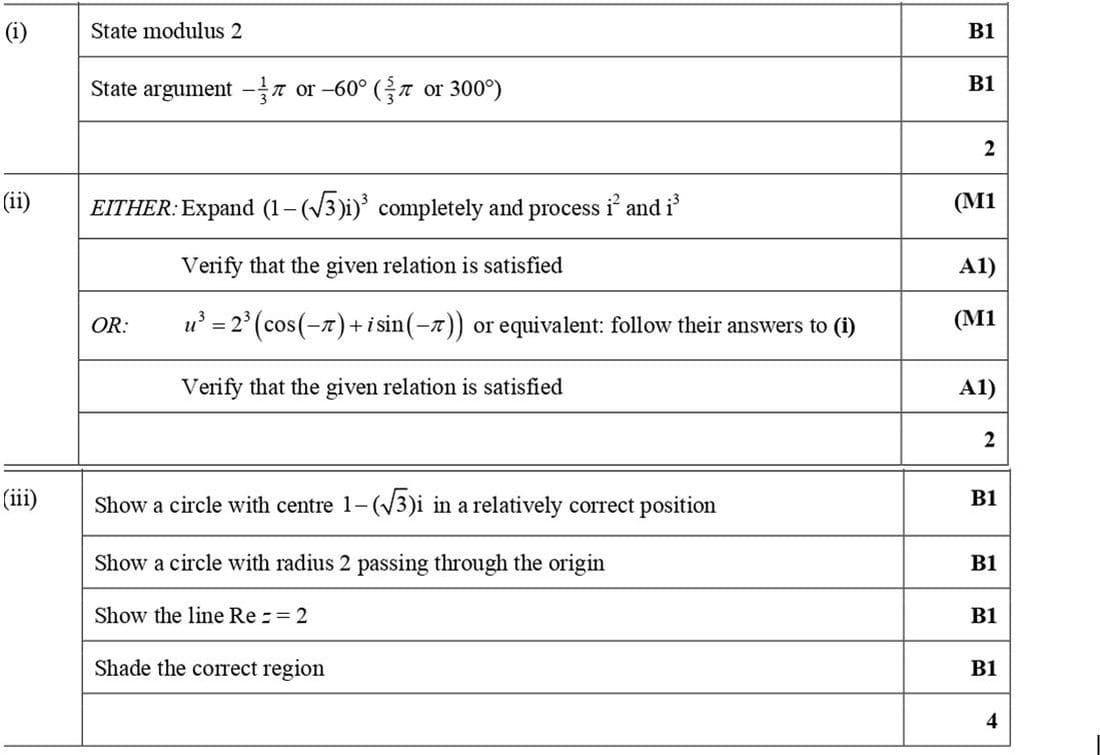
The complex number \(1 - (\sqrt{3})i\) is denoted by \(u\).
(i) Find the modulus and argument of \(u\).
(ii) Show that \(u^3 + 8 = 0\).
(iii) On a sketch of an Argand diagram, shade the region whose points represent complex numbers \(z\) satisfying both the inequalities \(|z - u| \leq 2\) and \(\text{Re } z \geq 2\), where \(\text{Re } z\) denotes the real part of \(z\).
9709 P31 - Nov 2017 - Q7
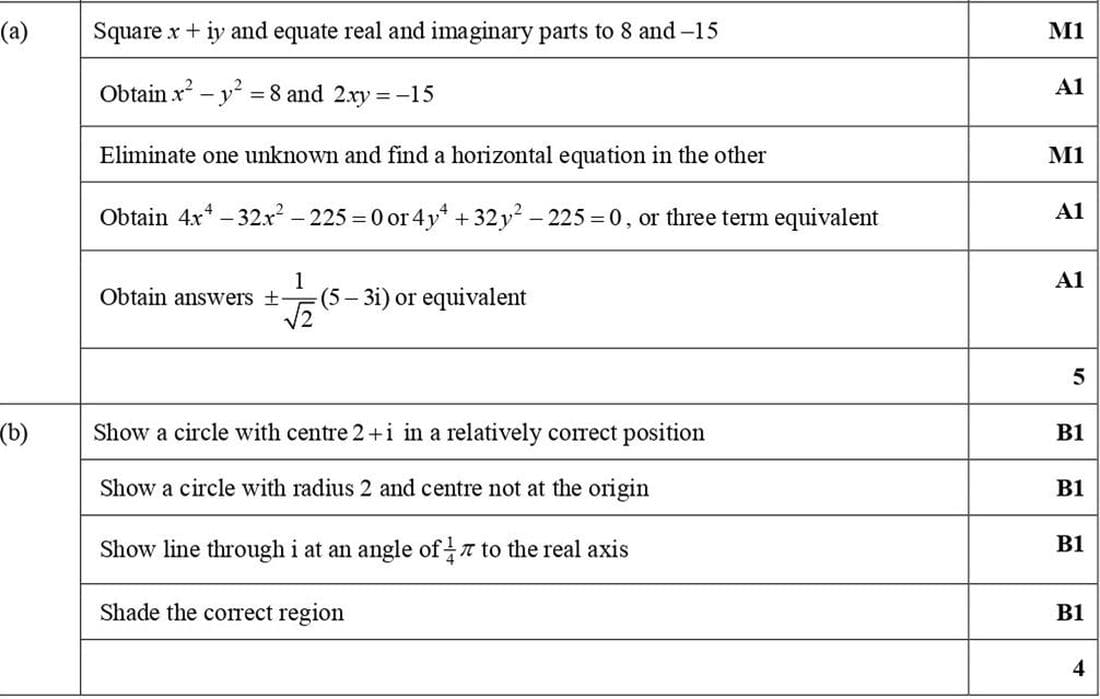
(a) The complex number u is given by u = 8 - 15i. Showing all necessary working, find the two square roots of u. Give answers in the form a + ib, where the numbers a and b are real and exact.
(b) On an Argand diagram, shade the region whose points represent complex numbers satisfying both the inequalities \\(|z - 2 - i| \leq 2\\) and \\(0 \leq \arg(z - i) \leq \frac{1}{4}\pi\\).
9709 P33 - Jun 2017 - Q11
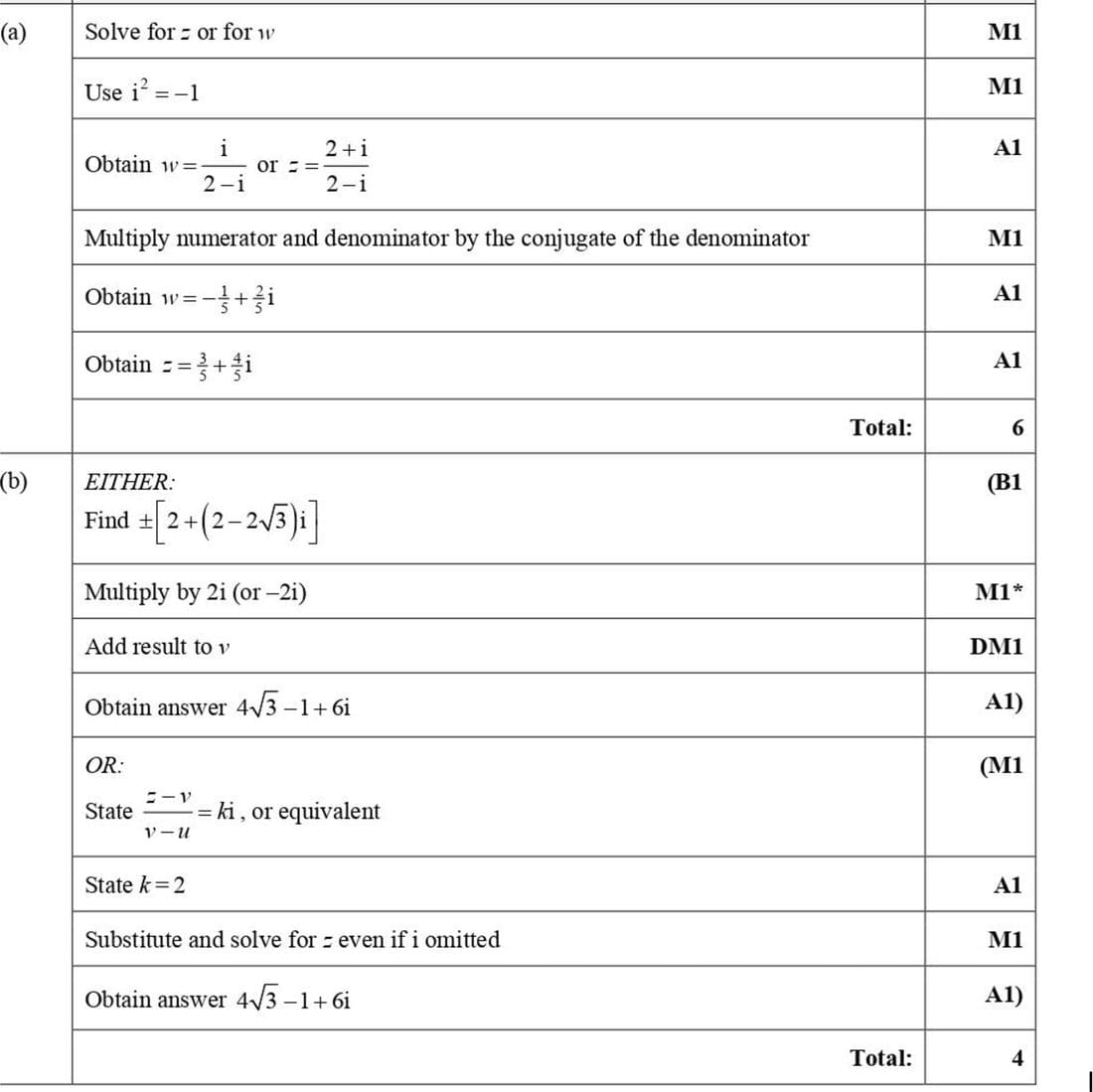
(a) The complex numbers z and w satisfy the equations
\(z + (1+i)w = i\)
and
\((1-i)z + iw = 1\).
Solve the equations for z and w, giving your answers in the form x + iy, where x and y are real.
(b) The complex numbers u and v are given by \(u = 1 + (2\sqrt{3})i\) and \(v = 3 + 2i\). In an Argand diagram, u and v are represented by the points A and B. A third point C lies in the first quadrant and is such that \(BC = 2AB\) and angle \(\angle ABC = 90^\circ\). Find the complex number z represented by C, giving your answer in the form x + iy, where x and y are real and exact.
9709 P32 - Jun 2017 - Q6
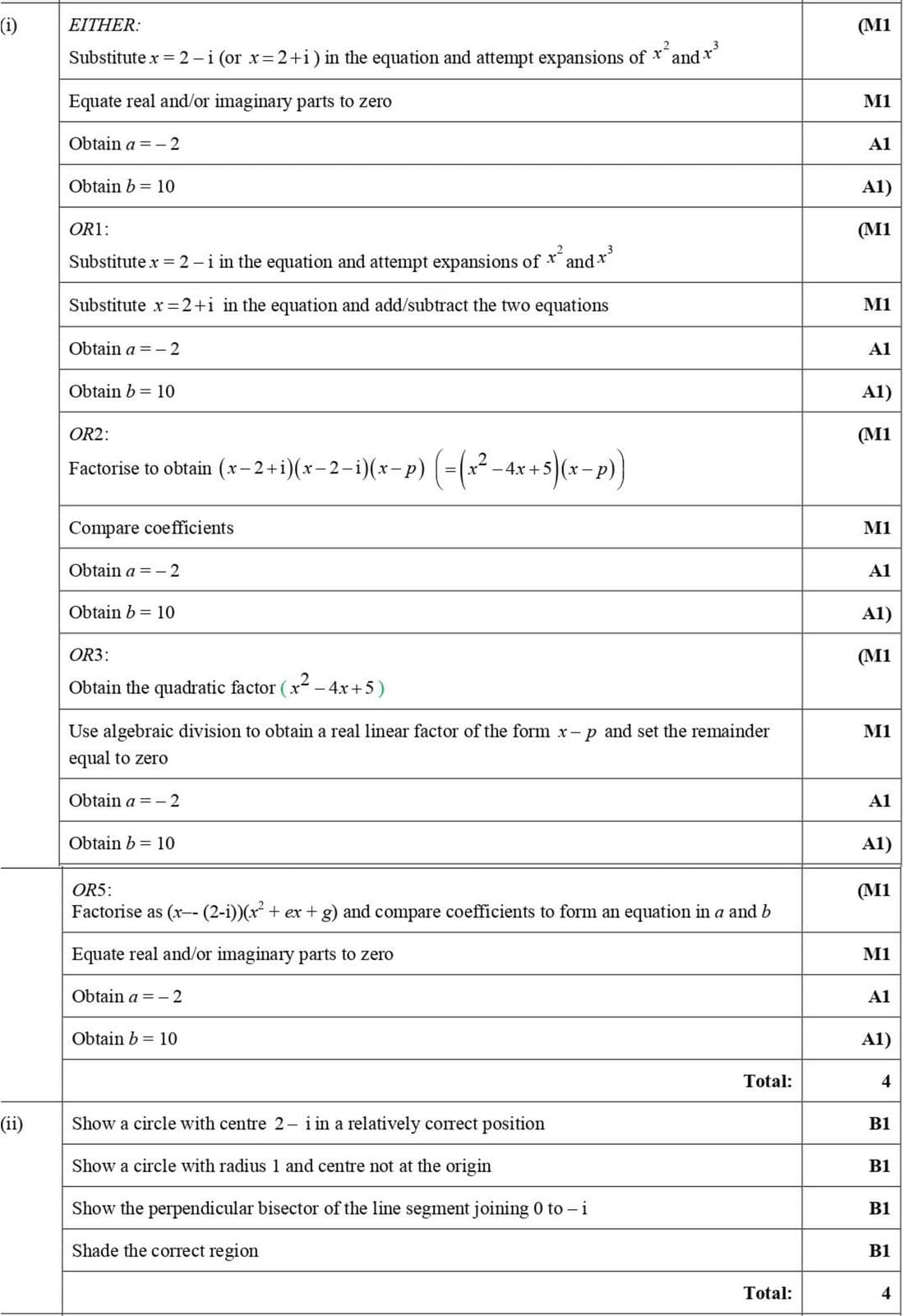
The complex number \(2 - i\) is denoted by \(u\).
(i) It is given that \(u\) is a root of the equation \(x^3 + ax^2 - 3x + b = 0\), where the constants \(a\) and \(b\) are real. Find the values of \(a\) and \(b\).
(ii) On a sketch of an Argand diagram, shade the region whose points represent complex numbers \(z\) satisfying both the inequalities \(|z - u| < 1\) and \(|z| < |z + i|\).
9709 P31 - Jun 2017 - Q7
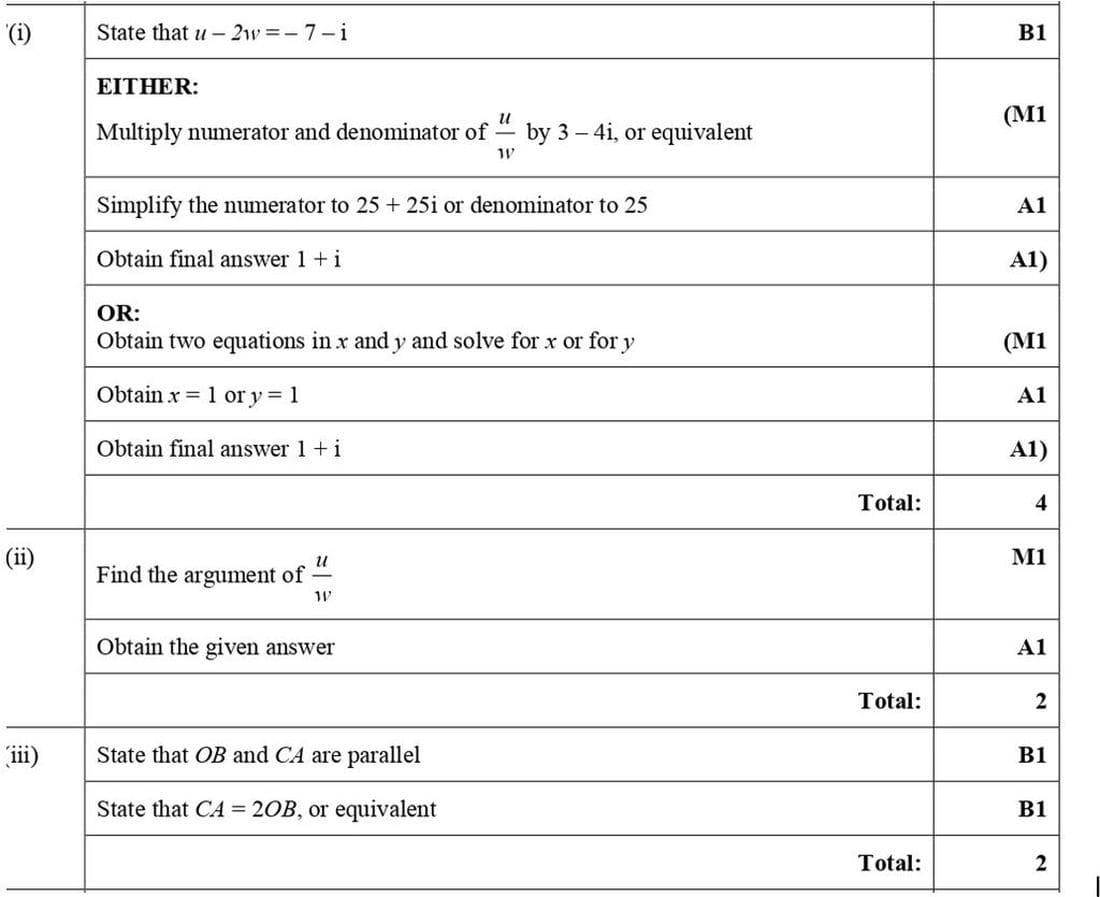
\(The complex numbers u and w are defined by u = -1 + 7i and w = 3 + 4i.\)
- Showing all your working, find in the form x + iy, where x and y are real, the complex numbers u - 2w and \(\frac{u}{w}\).
- In an Argand diagram with origin O, the points A, B and C represent the complex numbers u, w and u - 2w respectively. Prove that angle AOB = \(\frac{1}{4}\pi\).
- State fully the geometrical relation between the line segments OB and CA.
9709 P32 - Mar 2017 - Q8
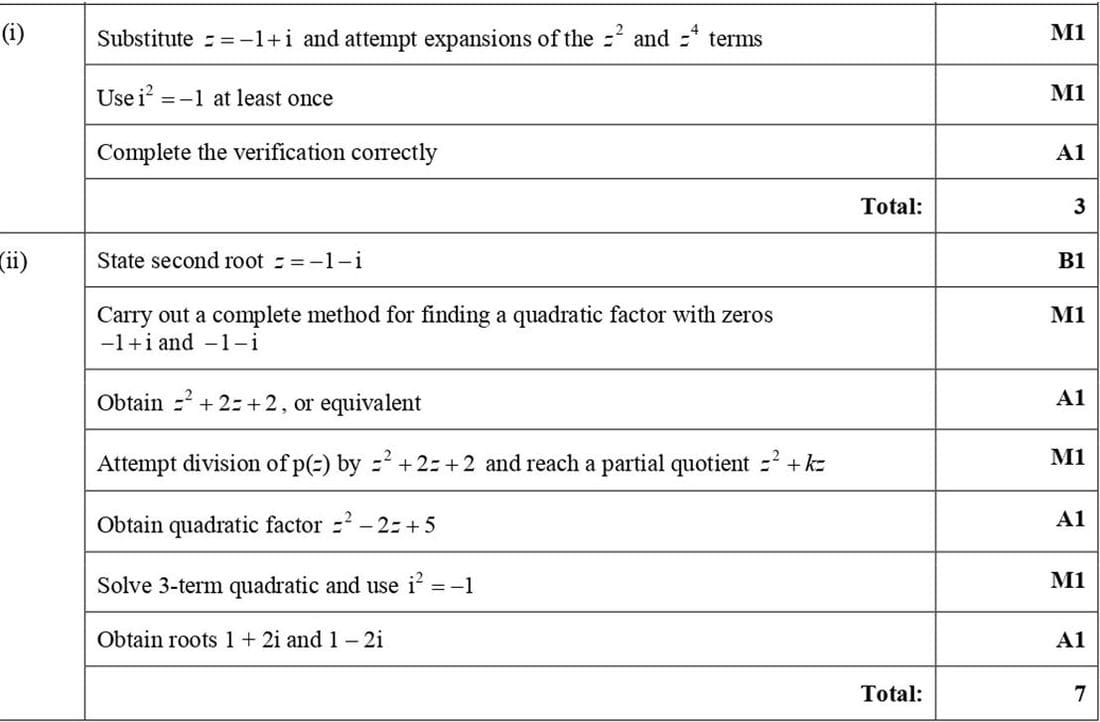
The polynomial \(z^4 + 3z^2 + 6z + 10\) is denoted by \(p(z)\). The complex number \(-1 + i\) is denoted by \(u\).
(i) Showing all your working, verify that \(u\) is a root of the equation \(p(z) = 0\).
(ii) Find the other three roots of the equation \(p(z) = 0\).
9709 P33 - Nov 2016 - Q7
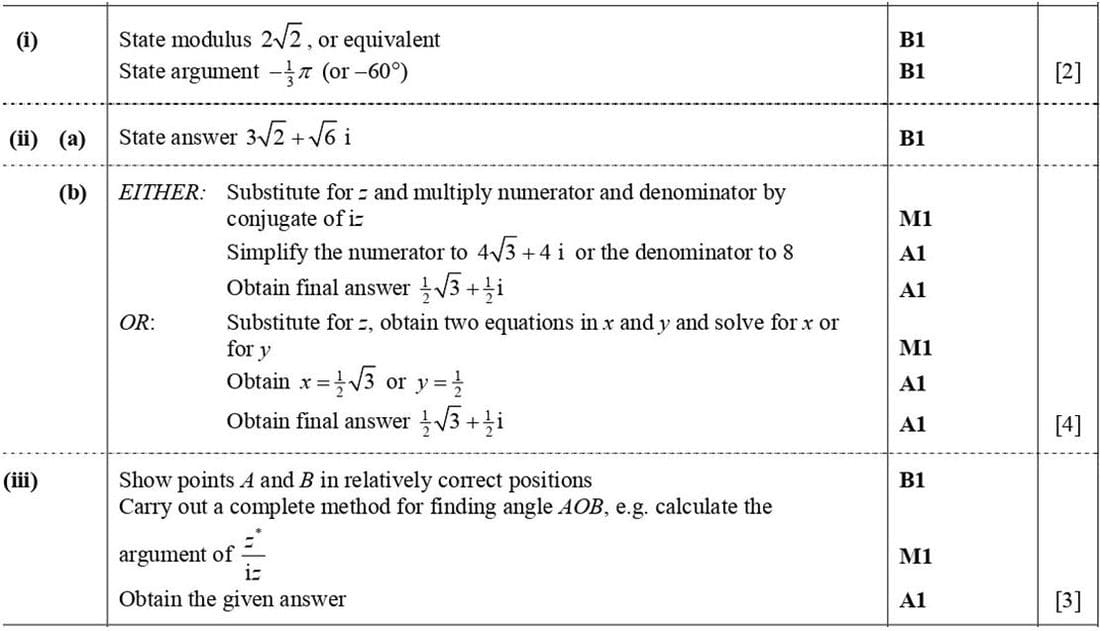
The complex number \(z\) is defined by \(z = (\sqrt{2}) - (\sqrt{6})i\). The complex conjugate of \(z\) is denoted by \(z^*\).
- Find the modulus and argument of \(z\).
- Express each of the following in the form \(x + iy\), where \(x\) and \(y\) are real and exact:
- \(z + 2z^*\);
- \(\frac{z^*}{iz}\).
- On a sketch of an Argand diagram with origin \(O\), show the points \(A\) and \(B\) representing the complex numbers \(z^*\) and \(iz\) respectively. Prove that angle \(AOB\) is equal to \(\frac{1}{6}\pi\).
9709 P31 - Nov 2023 - Q2
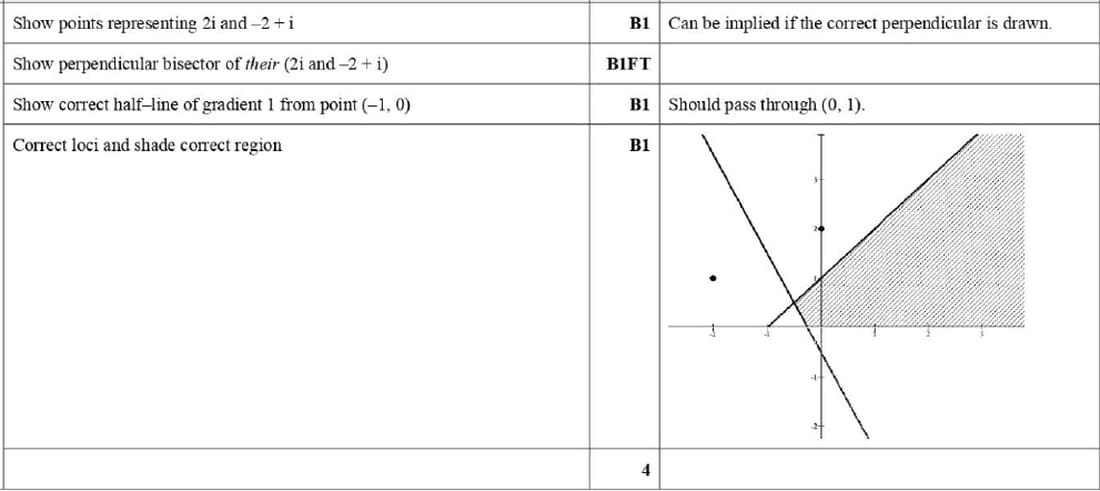
On an Argand diagram, shade the region whose points represent complex numbers \(z\) satisfying the inequalities \(|z - 2i| \leq |z + 2 - i|\) and \(0 \leq \arg(z + 1) \leq \frac{1}{4}\pi\).
9709 P31 - Nov 2016 - Q9
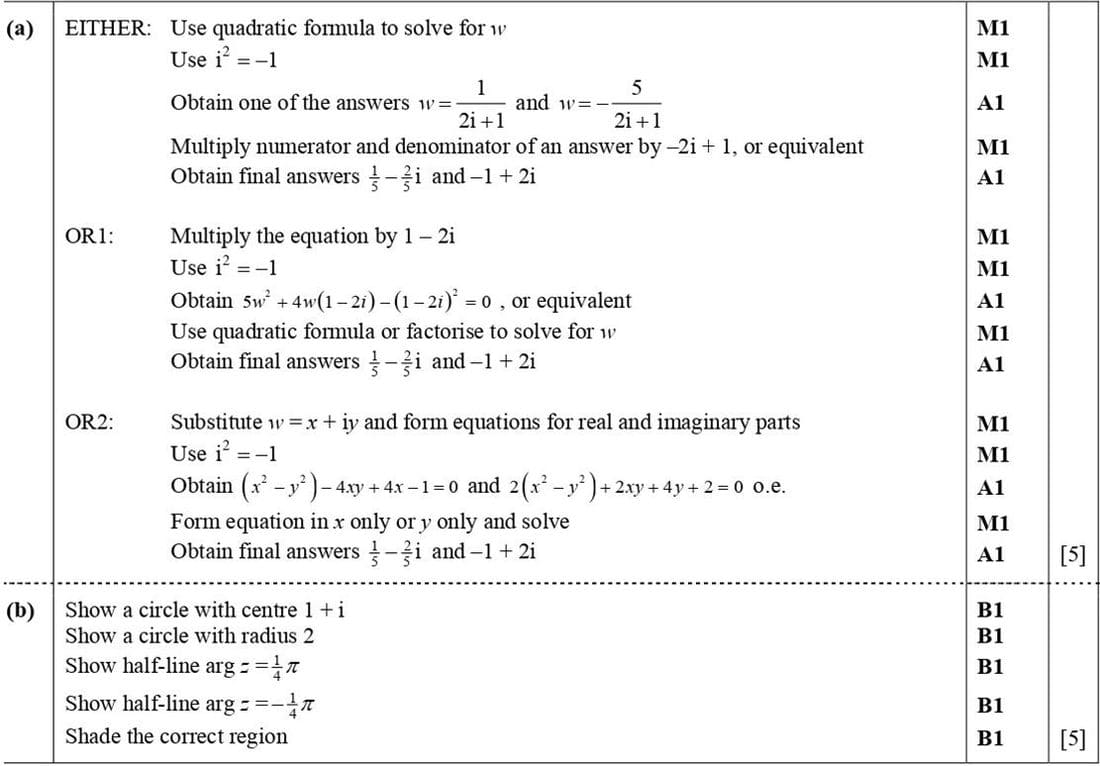
(a) Solve the equation \((1 + 2i)w^2 + 4w - (1 - 2i) = 0\), giving your answers in the form \(x + iy\), where \(x\) and \(y\) are real.
(b) On a sketch of an Argand diagram, shade the region whose points represent complex numbers satisfying the inequalities \(|z - 1 - i| \leq 2\) and \(-\frac{\pi}{4} \leq \arg z \leq \frac{\pi}{4}\).
9709 P33 - Jun 2016 - Q9
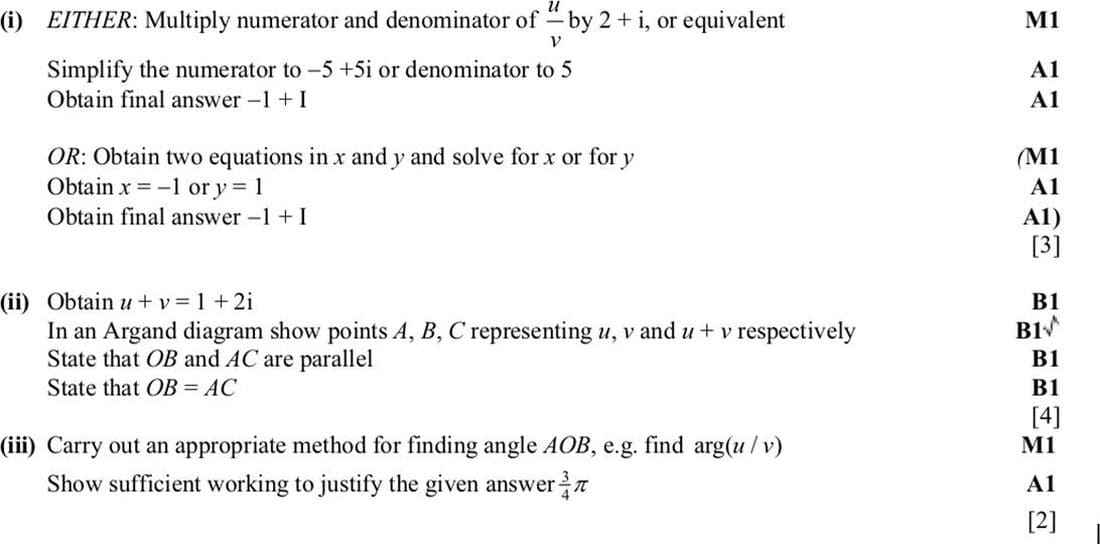
The complex numbers \(-1 + 3i\) and \(2 - i\) are denoted by \(u\) and \(v\) respectively. In an Argand diagram with origin \(O\), the points \(A, B\) and \(C\) represent the numbers \(u, v\) and \(u + v\) respectively.
- Sketch this diagram and state fully the geometrical relationship between \(OB\) and \(AC\).
- Find, in the form \(x + iy\), where \(x\) and \(y\) are real, the complex number \(\frac{u}{v}\).
- Prove that angle \(AOB = \frac{3}{4}\pi\).
9709 P32 - Jun 2016 - Q10
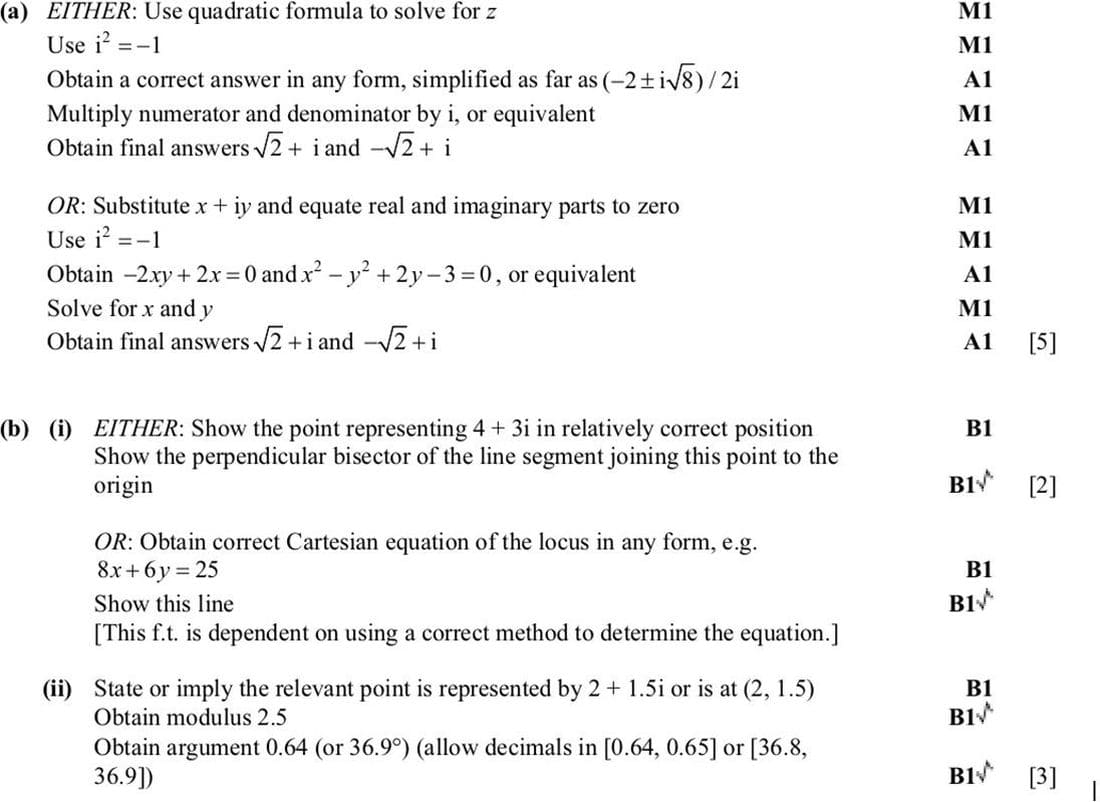
(a) Showing all necessary working, solve the equation \(iz^2 + 2z - 3i = 0\), giving your answers in the form \(x + iy\), where \(x\) and \(y\) are real and exact.
(b) (i) On a sketch of an Argand diagram, show the locus representing complex numbers satisfying the equation \(|z| = |z - 4 - 3i|\).
(ii) Find the complex number represented by the point on the locus where \(|z|\) is least. Find the modulus and argument of this complex number, giving the argument correct to 2 decimal places.
9709 P31 - Jun 2016 - Q10
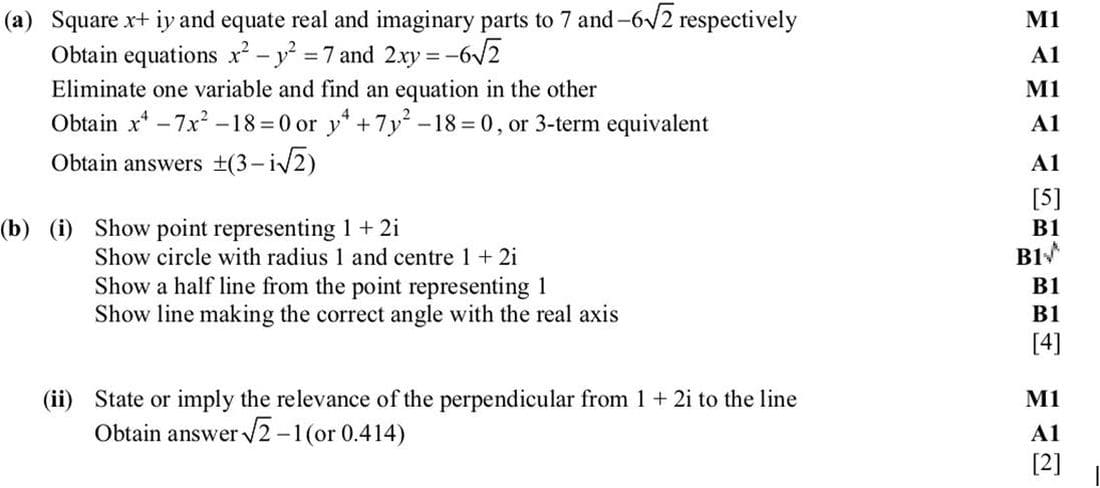
(a) Showing all your working and without the use of a calculator, find the square roots of the complex number \(7 - (6\sqrt{2})i\). Give your answers in the form \(x + iy\), where \(x\) and \(y\) are real and exact.
(b) (i) On an Argand diagram, sketch the loci of points representing complex numbers \(w\) and \(z\) such that \(|w - 1 - 2i| = 1\) and \(\text{arg}(z - 1) = \frac{3}{4}\pi\).
(ii) Calculate the least value of \(|w - z|\) for points on these loci.
9709 P32 - Mar 2016 - Q10
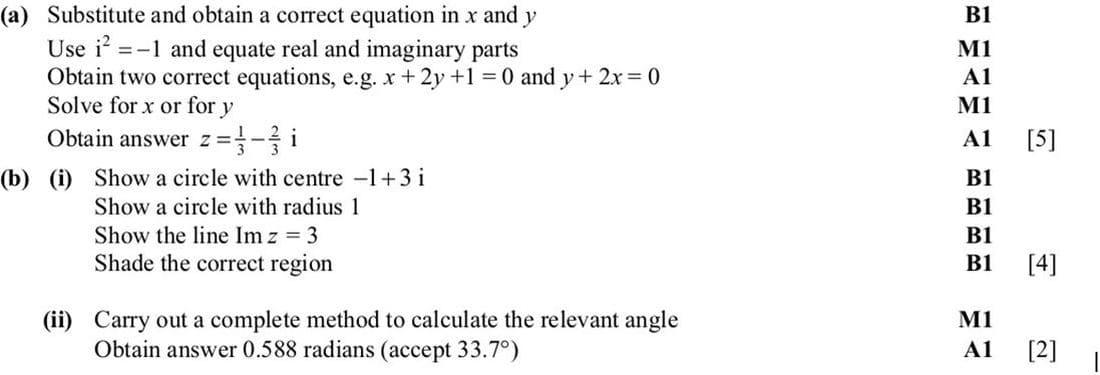
(a) Find the complex number z satisfying the equation \(z^* + 1 = 2iz\), where \(z^*\) denotes the complex conjugate of \(z\). Give your answer in the form \(x + iy\), where \(x\) and \(y\) are real.
(b) (i) On a sketch of an Argand diagram, shade the region whose points represent complex numbers satisfying the inequalities \(|z + 1 - 3i| \leq 1\) and \(\text{Im } z \geq 3\), where \(\text{Im } z\) denotes the imaginary part of \(z\).
(ii) Determine the difference between the greatest and least values of \(\arg z\) for points lying in this region.
9709 P33 - Nov 2015 - Q9
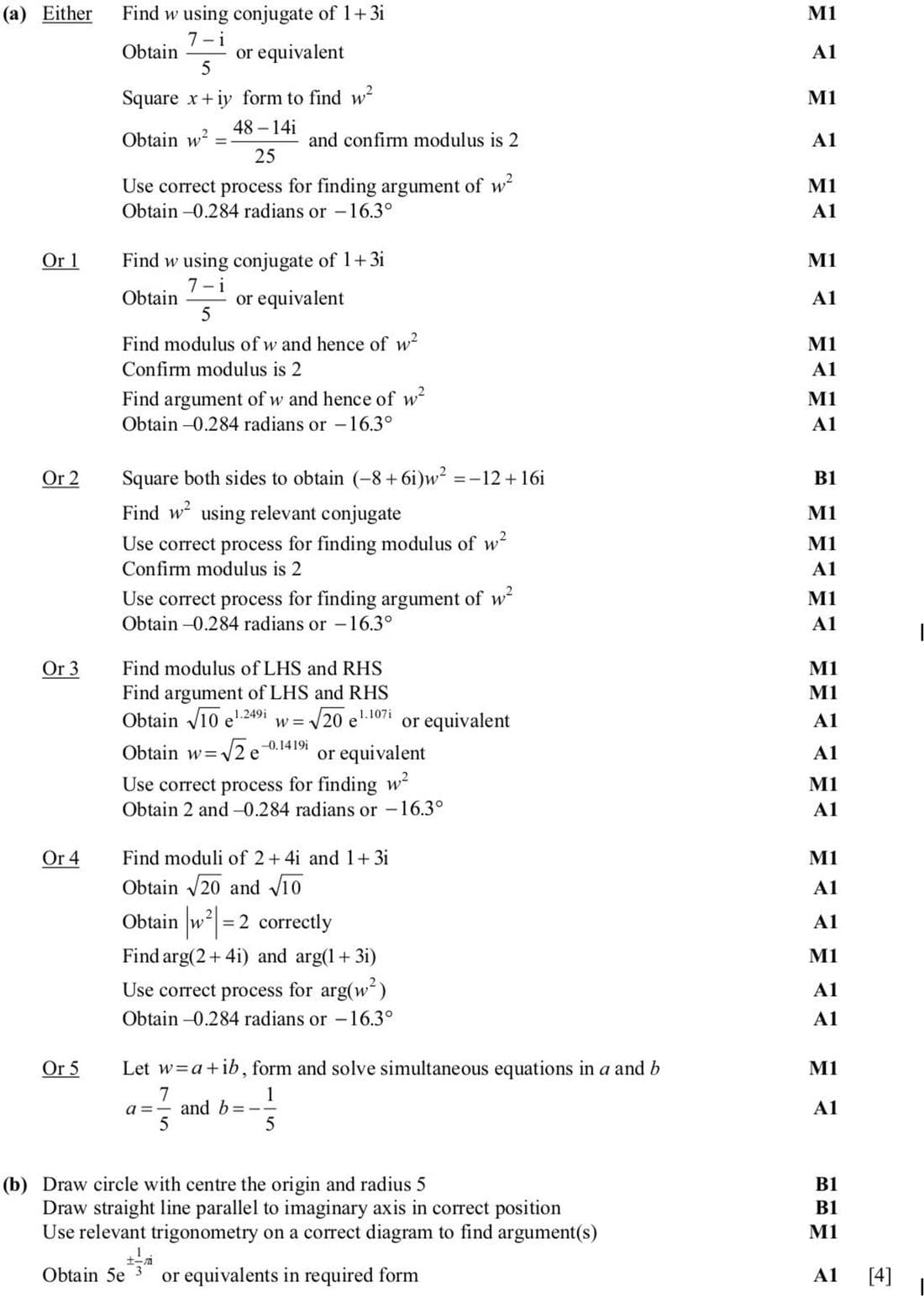
(a) It is given that \((1 + 3i)w = 2 + 4i\). Showing all necessary working, prove that the exact value of \(|w^2|\) is 2 and find \(\arg(w^2)\) correct to 3 significant figures.
(b) On a single Argand diagram sketch the loci \(|z| = 5\) and \(|z - 5| = |z|\). Hence determine the complex numbers represented by points common to both loci, giving each answer in the form \(re^{i\theta}\).