Answer:
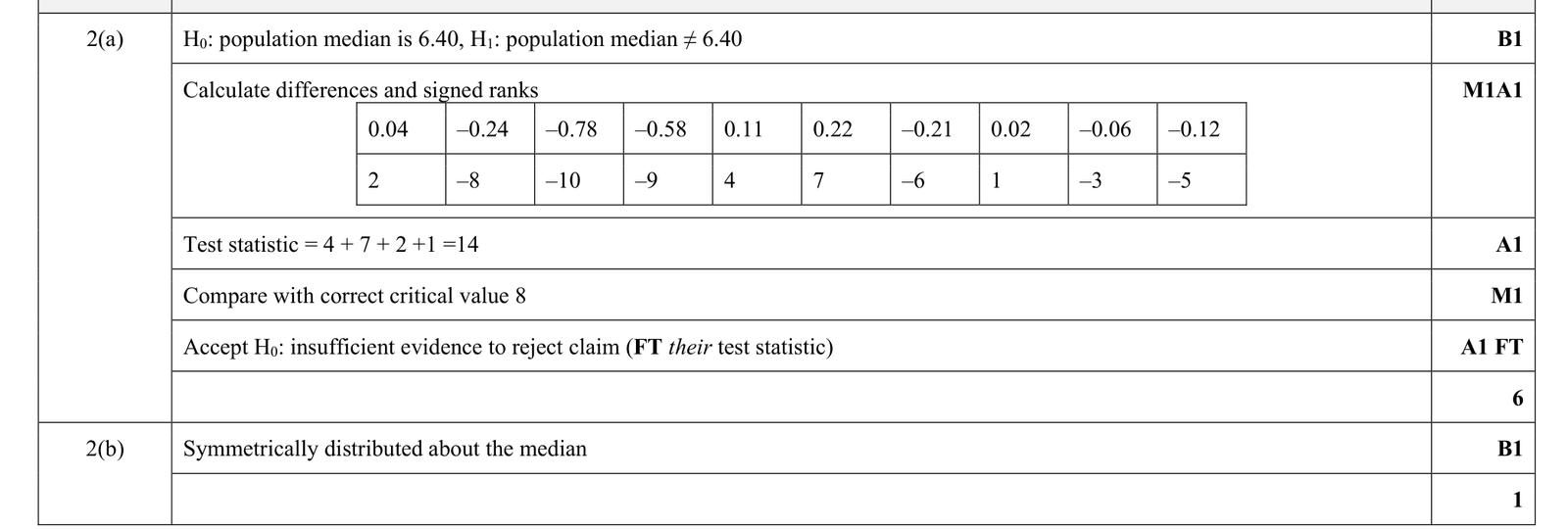
(a) Let \(d = \text{time} - 6.4\).
Using a two-tailed Wilcoxon signed-rank test:
\(H_0\): the population median time is \(6.4\text{ ms}\)
\(H_1\): the population median time is not \(6.4\text{ ms}\)
The sum of the positive ranks is \(41\) and the sum of the negative ranks is \(14\), so the test statistic is \(T=14\).
For \(n=10\) at the \(5\%\) significance level (two-tailed), the critical value is \(8\).
Since \(14 \gt 8\), we do not reject \(H_0\).
There is insufficient evidence to suggest that the median time differs from \(6.4\text{ ms}\). The claim is accepted.
(b) An underlying assumption is that the population distribution is symmetric about its median.
(a) We test whether the median time is \(6.4\text{ ms}\).
Take differences from \(6.4\):
| Time | \(d=\text{time}-6.4\) | \(|d|\) | Rank | Signed rank |
|---|
| 6.44 | \(+0.04\) | 0.04 | 1 | \(+1\) |
| 6.16 | \(-0.24\) | 0.24 | 4 | \(-4\) |
| 5.62 | \(-0.78\) | 0.78 | 10 | \(-10\) |
| 5.82 | \(-0.58\) | 0.58 | 7 | \(-7\) |
| 6.51 | \(+0.11\) | 0.11 | 3 | \(+3\) |
| 6.62 | \(+0.22\) | 0.22 | 3? | |
| 6.19 | \(-0.21\) | 0.21 | 5 | \(-5\) |
| 6.42 | \(+0.02\) | 0.02 | 2 | \(+2\) |
| 6.34 | \(-0.06\) | 0.06 | 2? | |
| 6.28 | \(-0.12\) | 0.12 | 4? | |
Now rank the absolute differences correctly from smallest to largest:
\(0.02, 0.04, 0.06, 0.11, 0.12, 0.21, 0.22, 0.24, 0.58, 0.78\)
So the signed ranks are:
| Time | \(d\) | Rank | Signed rank |
|---|
| 6.44 | \(+0.04\) | 2 | \(+2\) |
| 6.16 | \(-0.24\) | 8 | \(-8\) |
| 5.62 | \(-0.78\) | 10 | \(-10\) |
| 5.82 | \(-0.58\) | 9 | \(-9\) |
| 6.51 | \(+0.11\) | 4 | \(+4\) |
| 6.62 | \(+0.22\) | 7 | \(+7\) |
| 6.19 | \(-0.21\) | 6 | \(-6\) |
| 6.42 | \(+0.02\) | 1 | \(+1\) |
| 6.34 | \(-0.06\) | 3 | \(-3\) |
| 6.28 | \(-0.12\) | 5 | \(-5\) |
Hence
sum of positive ranks \(= 2+4+7+1 = 14\)
sum of negative ranks \(= 8+10+9+6+3+5 = 41\)
The Wilcoxon test statistic is the smaller of these two sums, so
\(T=14\).
Hypotheses:
\(H_0\): population median \(=6.4\)
\(H_1\): population median \(\neq 6.4\)
For \(n=10\) and a two-tailed test at the \(5\%\) level, the critical value is \(8\).
We reject \(H_0\) only if \(T \le 8\).
Since \(14 \gt 8\), we do not reject \(H_0\).
There is insufficient evidence that the median completion time is different from \(6.4\text{ ms}\). So the claim that the median is \(6.4\text{ ms}\) is supported.
(b) An assumption for this test is that the population distribution is symmetric about the median.