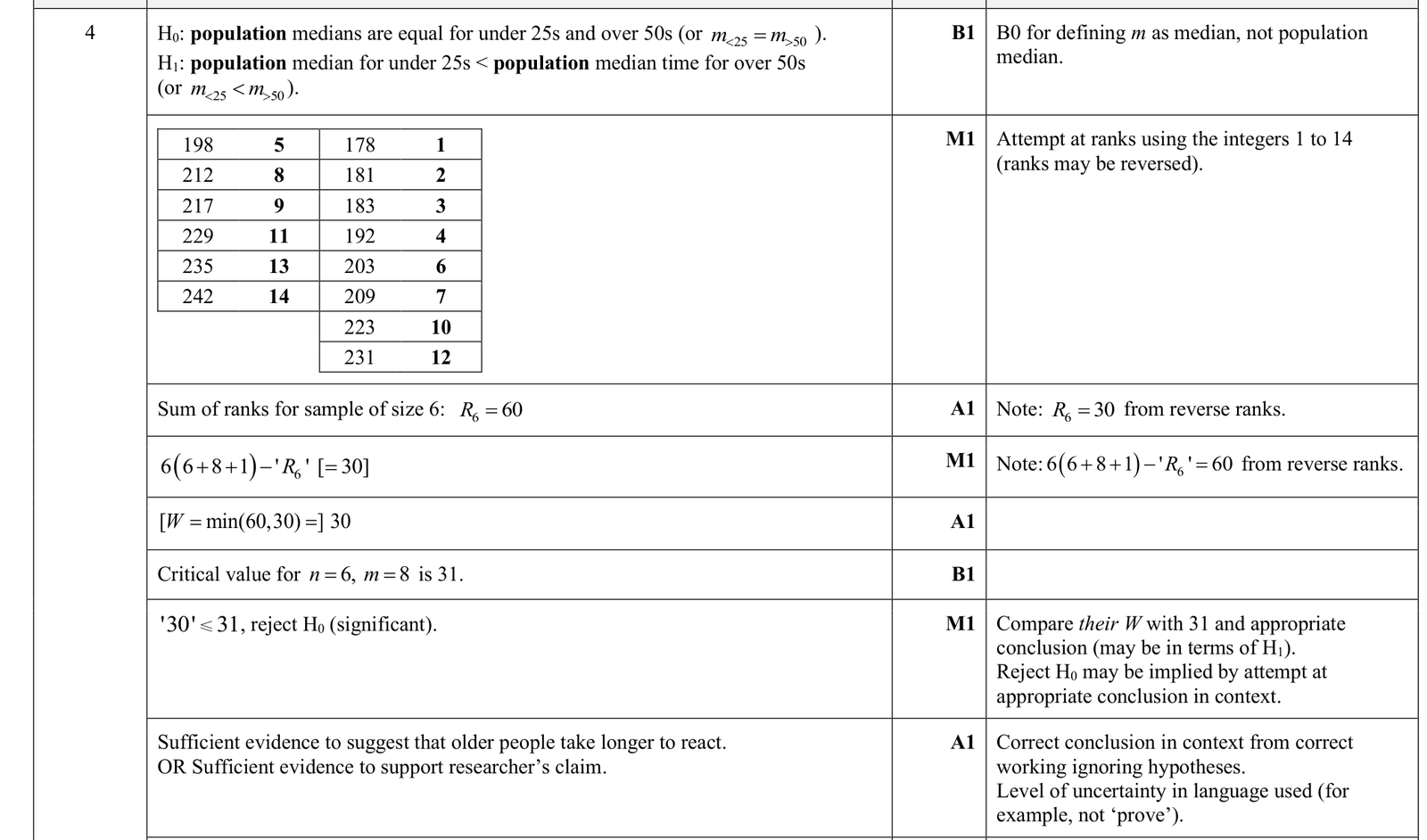
Answer: Let the population median reaction times be compared for the two age groups.
\(H_0\): the population medians are equal.
\(H_1\): the population median reaction time for under 25s is less than that for over 50s.
Ranking all 14 times from smallest to largest gives rank sums:
Over 50: ranks \(5,8,9,11,13,14\), so \(R=60\).
For the Wilcoxon rank-sum test with the sample of size 6, \(W=\min(60,\,6(6+8+1)-60)=\min(60,30)=30\).
For \(n=6\) and \(m=8\) at the \(5\%\) level (one-tailed), the critical value is \(31\).
Since \(30 \le 31\), reject \(H_0\).
There is sufficient evidence at the \(5\%\) level to support the claim that older people take longer to react than younger people.
We use a Wilcoxon rank-sum test because we are comparing two independent samples and testing whether one population tends to have larger values than the other.
Let
\(H_0\): the population median reaction times are equal for over 50s and under 25s.
\(H_1\): the population median reaction time for under 25s is less than the population median reaction time for over 50s.
This matches the researcher's claim that older people take longer to react.
Combine the data and rank from smallest to largest:
| Reaction time | Group | Rank |
|---|
| 178 | Under 25 | 1 |
| 181 | Under 25 | 2 |
| 183 | Under 25 | 3 |
| 192 | Under 25 | 4 |
| 198 | Over 50 | 5 |
| 203 | Under 25 | 6 |
| 209 | Under 25 | 7 |
| 212 | Over 50 | 8 |
| 217 | Over 50 | 9 |
| 223 | Under 25 | 10 |
| 229 | Over 50 | 11 |
| 231 | Under 25 | 12 |
| 235 | Over 50 | 13 |
| 242 | Over 50 | 14 |
There are no tied values, so no tie adjustment is needed.
Take the sample of size 6 (the over 50 group). Its rank sum is
\(R=5+8+9+11+13+14=60\).
For the Wilcoxon rank-sum statistic we use the smaller of \(R\) and its complementary value:
\(6(6+8+1)-60 = 6 \times 15 - 60 = 90-60=30\).
So
\(W=\min(60,30)=30\).
From Wilcoxon rank-sum critical values, for sample sizes \(6\) and \(8\) at the \(5\%\) significance level for a one-tailed test, the critical value is \(31\).
Since \(W=30\) and \(30 \le 31\), the result is significant, so we reject \(H_0\).
Therefore there is sufficient evidence at the \(5\%\) level to suggest that older people take longer to react to the noise than younger people.