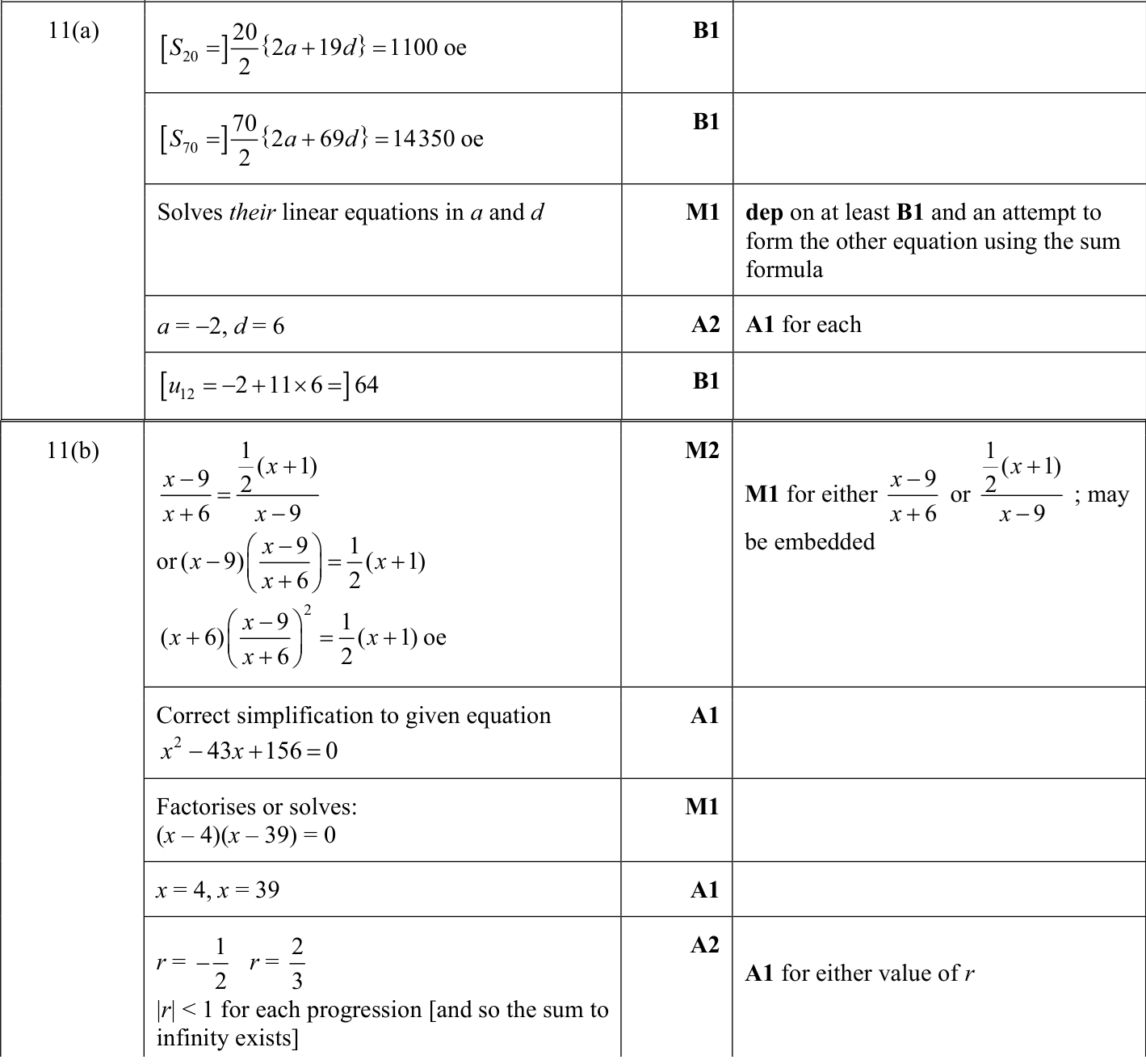
Answer: (a) \(64\). (b) \(x=4\) or \(x=39\), giving common ratios \(-\frac12\) and \(\frac23\), so the sum to infinity exists in both cases.
Answer: (a) \(64\). (b) \(x=4\) or \(x=39\), giving common ratios \(-\frac12\) and \(\frac23\), so the sum to infinity exists in both cases.
(a) The sum of the first \(n\) terms of an arithmetic progression is
\(\displaystyle S_n=\frac{n}{2}\{2a+(n-1)d\}\).
Using \(S_{20}=1100\):
\(\displaystyle \frac{20}{2}(2a+19d)=1100\),
so
\(2a+19d=110\).
Using \(S_{70}=14350\):
\(\displaystyle \frac{70}{2}(2a+69d)=14350\),
so
\(2a+69d=410\).
Subtracting the two equations gives
\(50d=300\),
so \(d=6\).
Then
\(2a+19(6)=110\),
so \(2a=-4\) and \(a=-2\).
The 12th term is
\(a+11d=-2+66=64\).
(b) Since the three terms form a geometric progression, the ratio between consecutive terms is the same:
\(\displaystyle \frac{x-9}{x+6}=\frac{\frac12(x+1)}{x-9}.\)
Cross-multiply:
\((x-9)^2=\frac12(x+1)(x+6)\).
Multiplying by 2 gives
\(2(x-9)^2=(x+1)(x+6)\).
Expand:
\(2(x^2-18x+81)=x^2+7x+6\).
So
\(2x^2-36x+162=x^2+7x+6\),
and hence
\(x^2-43x+156=0\).
Factorise:
\((x-4)(x-39)=0\).
Thus \(x=4\) or \(x=39\).
If \(x=4\), the terms are \(10,-5,\frac52\), so the common ratio is \(-\frac12\).
If \(x=39\), the terms are \(45,30,20\), so the common ratio is \(\frac23\).
In both cases \(|r|\lt 1\), so the sum to infinity exists.