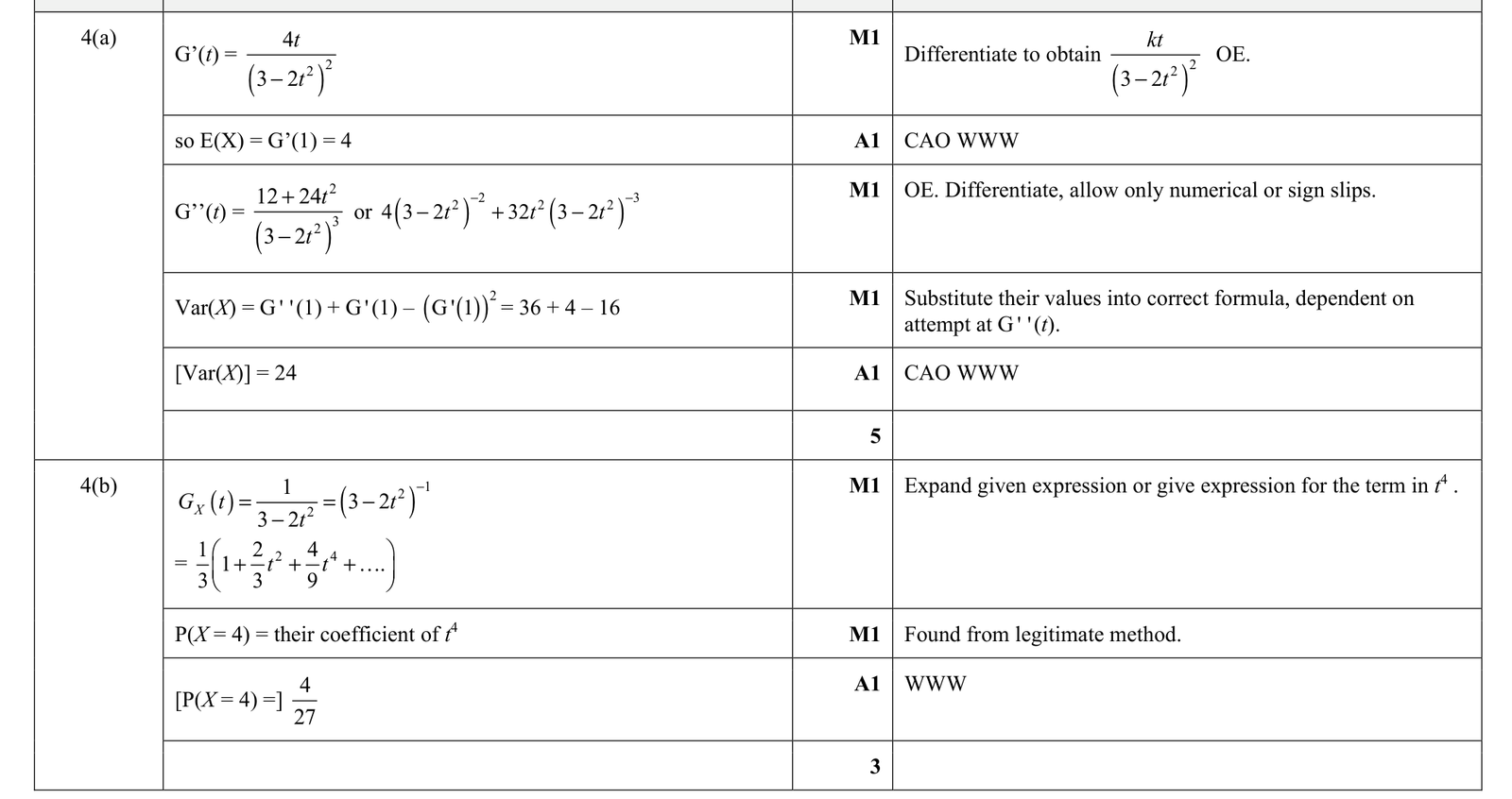
Answer: (a) \(\mathrm{E}(X)=4\) and \(\operatorname{Var}(X)=24\).
(b) \(\mathrm{P}(X=4)=\frac{4}{27}\).
(a) For a probability generating function \(G_X(t)\),
\(\mathrm{E}(X)=G_X'(1)\) and \(\operatorname{Var}(X)=G_X''(1)+G_X'(1)-\big(G_X'(1)\big)^2\).
Given
\(G_X(t)=\frac{1}{3-2t^2}=(3-2t^2)^{-1}.\)
Differentiate:
\(G_X'(t)=-(3-2t^2)^{-2}(-4t)=\frac{4t}{(3-2t^2)^2}.\)
So
\(\mathrm{E}(X)=G_X'(1)=\frac{4}{(3-2)^2}=4.\)
Differentiate again:
\(G_X''(t)=\frac{d}{dt}\left(4t(3-2t^2)^{-2}\right)\)
\(=4(3-2t^2)^{-2}+4t\cdot \left[-2(3-2t^2)^{-3}(-4t)\right]\)
\(=4(3-2t^2)^{-2}+32t^2(3-2t^2)^{-3}.\)
At \(t=1\),
\(G_X''(1)=4+32=36.\)
Hence
\(\operatorname{Var}(X)=36+4-4^2=36+4-16=24.\)
Therefore \(\mathrm{E}(X)=4\) and \(\operatorname{Var}(X)=24\).
(b) Expand the generating function as a geometric series:
\(G_X(t)=\frac{1}{3-2t^2}=\frac{1}{3}\cdot \frac{1}{1-\frac{2}{3}t^2}.\)
Using \(\frac{1}{1-r}=1+r+r^2+\cdots\),
\(G_X(t)=\frac{1}{3}\left(1+\frac{2}{3}t^2+\frac{4}{9}t^4+\cdots\right).\)
In a probability generating function, the coefficient of \(t^x\) is \(\mathrm{P}(X=x)\). So the coefficient of \(t^4\) is
\(\frac{1}{3}\cdot \frac{4}{9}=\frac{4}{27}.\)
Therefore \(\mathrm{P}(X=4)=\frac{4}{27}.\)