0606 P22 - Jun 2022 - Q7 - 4 marks
7829
Differentiate \(\displaystyle y=\frac{\mathrm{e}^{4x}\tan x}{\ln x}\) with respect to \(x\).
Solution
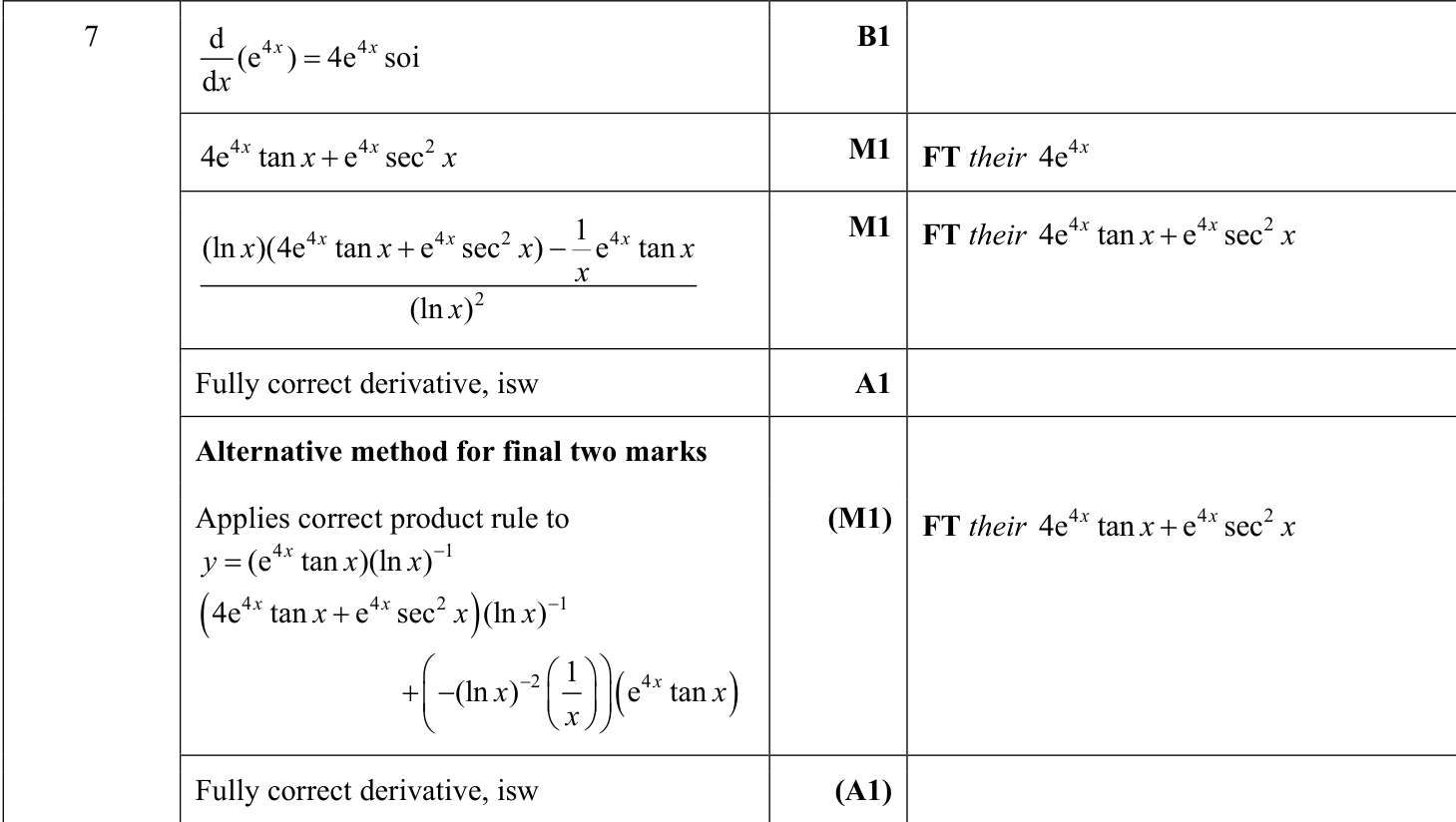
Answer: \(\displaystyle \frac{(\ln x)(4\mathrm{e}^{4x}\tan x+\mathrm{e}^{4x}\operatorname{sec}^{2}x)-\frac{1}{x}\mathrm{e}^{4x}\tan x}{(\ln x)^2}\).
Answer: \(\displaystyle \frac{(\ln x)(4\mathrm{e}^{4x}\tan x+\mathrm{e}^{4x}\operatorname{sec}^{2}x)-\frac{1}{x}\mathrm{e}^{4x}\tan x}{(\ln x)^2}\).
Use the quotient rule with numerator
\(u=\mathrm{e}^{4x}\tan x\)
and denominator
\(v=\ln x\).
First differentiate \(u\) using the product rule:
\(\displaystyle u'=4\mathrm{e}^{4x}\tan x+\mathrm{e}^{4x}\operatorname{sec}^{2}x\).
Also,
\(\displaystyle v'=\frac1x\).
Therefore
\(\displaystyle \frac{dy}{dx}=\frac{v u'-u v'}{v^2}\).
Substituting gives
\(\displaystyle \frac{dy}{dx}=\frac{(\ln x)(4\mathrm{e}^{4x}\tan x+\mathrm{e}^{4x}\operatorname{sec}^{2}x)-\frac{1}{x}\mathrm{e}^{4x}\tan x}{(\ln x)^2}.\)