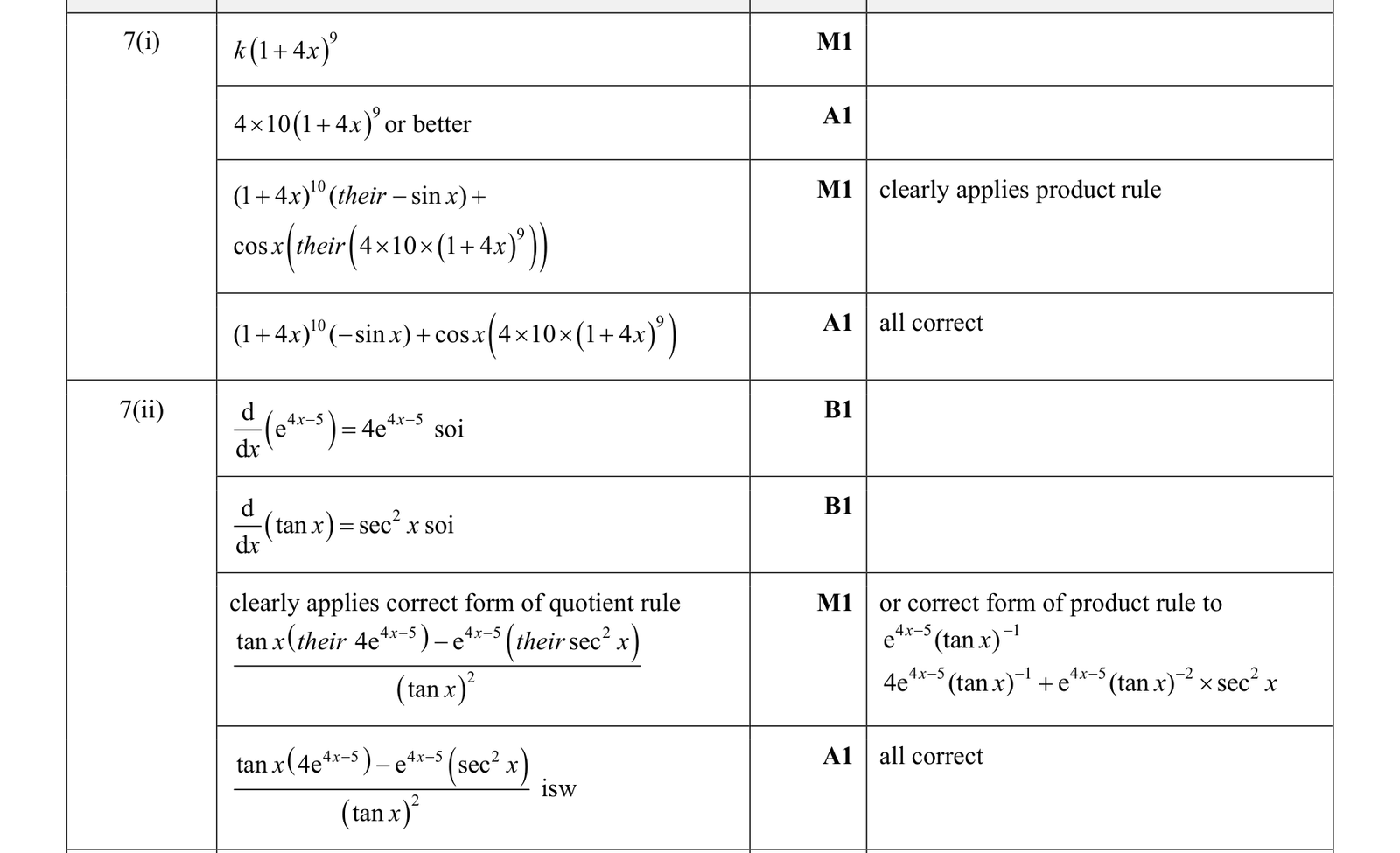
0606 P23 - Jun 2017 - Q7 - 8 marks
8611
Differentiate with respect to \(x\),
(i) \((1+4x)^{10}\cos x\),
(ii) \(\dfrac{e^{4x-5}}{\tan x}\).
Solution
Answer: (i) \(40(1+4x)^9\cos x-(1+4x)^{10}\sin x\). (ii) \(\dfrac{e^{4x-5}(4\tan x-\operatorname{sec}^2 x)}{\tan^2 x}\).
(i) Let
\(y=(1+4x)^{10}\cos x.\)
Use the product rule:
\(\frac{dy}{dx} = \frac{d}{dx}(1+4x)^{10}\cdot \cos x + (1+4x)^{10}\cdot \frac{d}{dx}(\cos x).\)
Now
\(\frac{d}{dx}(1+4x)^{10}=10(1+4x)^9\cdot 4=40(1+4x)^9,\)
and
\(\frac{d}{dx}(\cos x)=-\sin x.\)
Therefore
\(\frac{dy}{dx} = 40(1+4x)^9\cos x-(1+4x)^{10}\sin x.\)
(ii) Let
\(y=\frac{e^{4x-5}}{\tan x}.\)
Use the quotient rule:
\(\frac{dy}{dx} = \frac{\tan x\cdot \dfrac{d}{dx}(e^{4x-5})-e^{4x-5}\cdot \dfrac{d}{dx}(\tan x)}{\tan^2 x}.\)
Now
\(\frac{d}{dx}(e^{4x-5})=4e^{4x-5}, \qquad \frac{d}{dx}(\tan x)=\operatorname{sec}^2 x.\)
So
\(\frac{dy}{dx} = \frac{\tan x(4e^{4x-5})-e^{4x-5}\operatorname{sec}^2 x}{\tan^2 x}.\)
Factor out \(e^{4x-5}\):
\(\frac{dy}{dx} = \frac{e^{4x-5}(4\tan x-\operatorname{sec}^2 x)}{\tan^2 x}.\)