Past Exam Questions
← Back9709 P12 - Jun 2014 - Q7
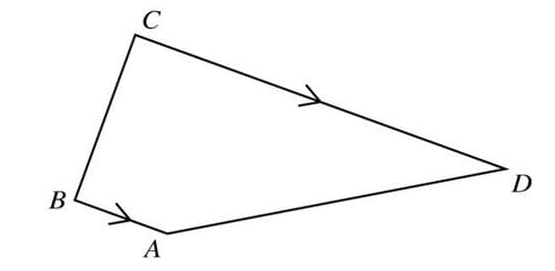
The diagram shows a trapezium ABCD in which BA is parallel to CD. The position vectors of A, B, and C relative to an origin O are given by
\(\overrightarrow{OA} = \begin{pmatrix} 3 \\ 4 \\ 0 \end{pmatrix}, \quad \overrightarrow{OB} = \begin{pmatrix} 1 \\ 3 \\ 2 \end{pmatrix}, \quad \text{and} \quad \overrightarrow{OC} = \begin{pmatrix} 4 \\ 5 \\ 6 \end{pmatrix}.\)
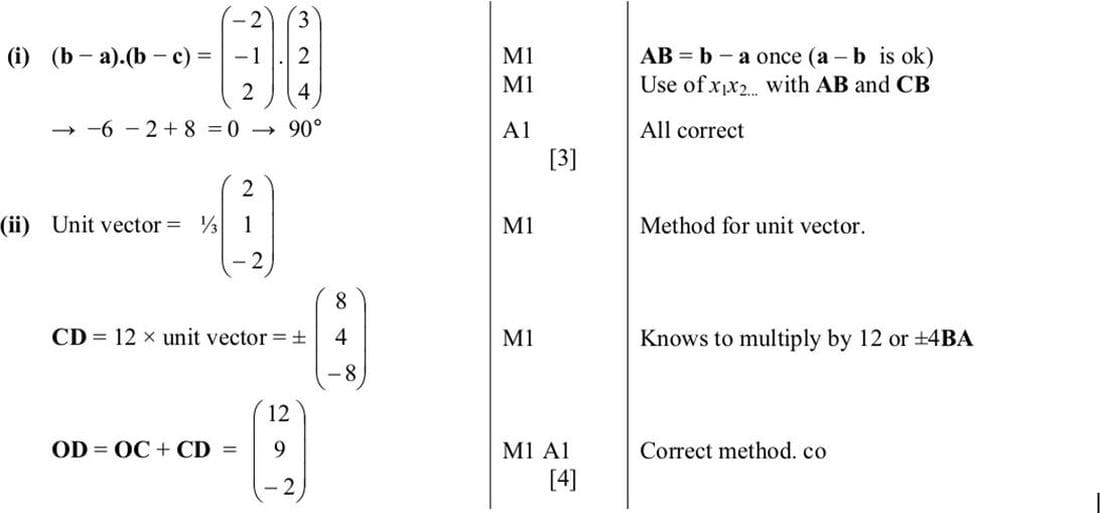
- Use a scalar product to show that AB is perpendicular to BC.
- Given that the length of CD is 12 units, find the position vector of D.
9709 P31 - Nov 2022 - Q11
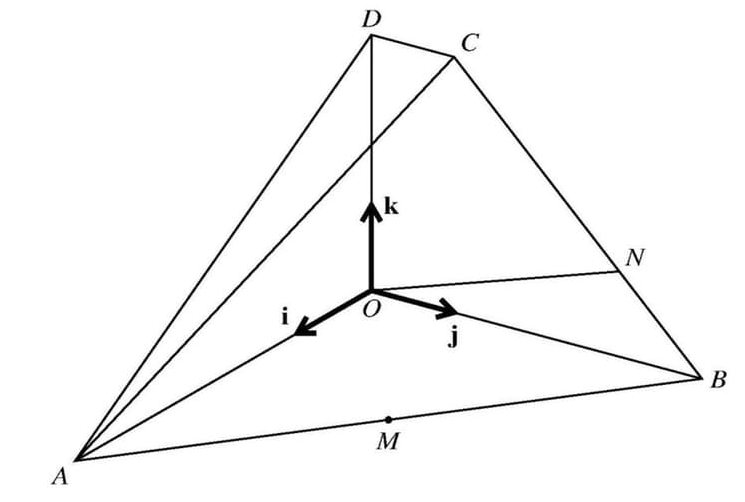
In the diagram, \(OABCD\) is a solid figure in which \(OA = OB = 4\) units and \(OD = 3\) units. The edge \(OD\) is vertical, \(DC\) is parallel to \(OB\) and \(DC = 1\) unit. The base, \(OAB\), is horizontal and angle \(AOB = 90^\circ\). Unit vectors \(\mathbf{i}, \mathbf{j}\) and \(\mathbf{k}\) are parallel to \(OA, OB\) and \(OD\) respectively. The midpoint of \(AB\) is \(M\) and the point \(N\) on \(BC\) is such that \(CN = 2NB\).
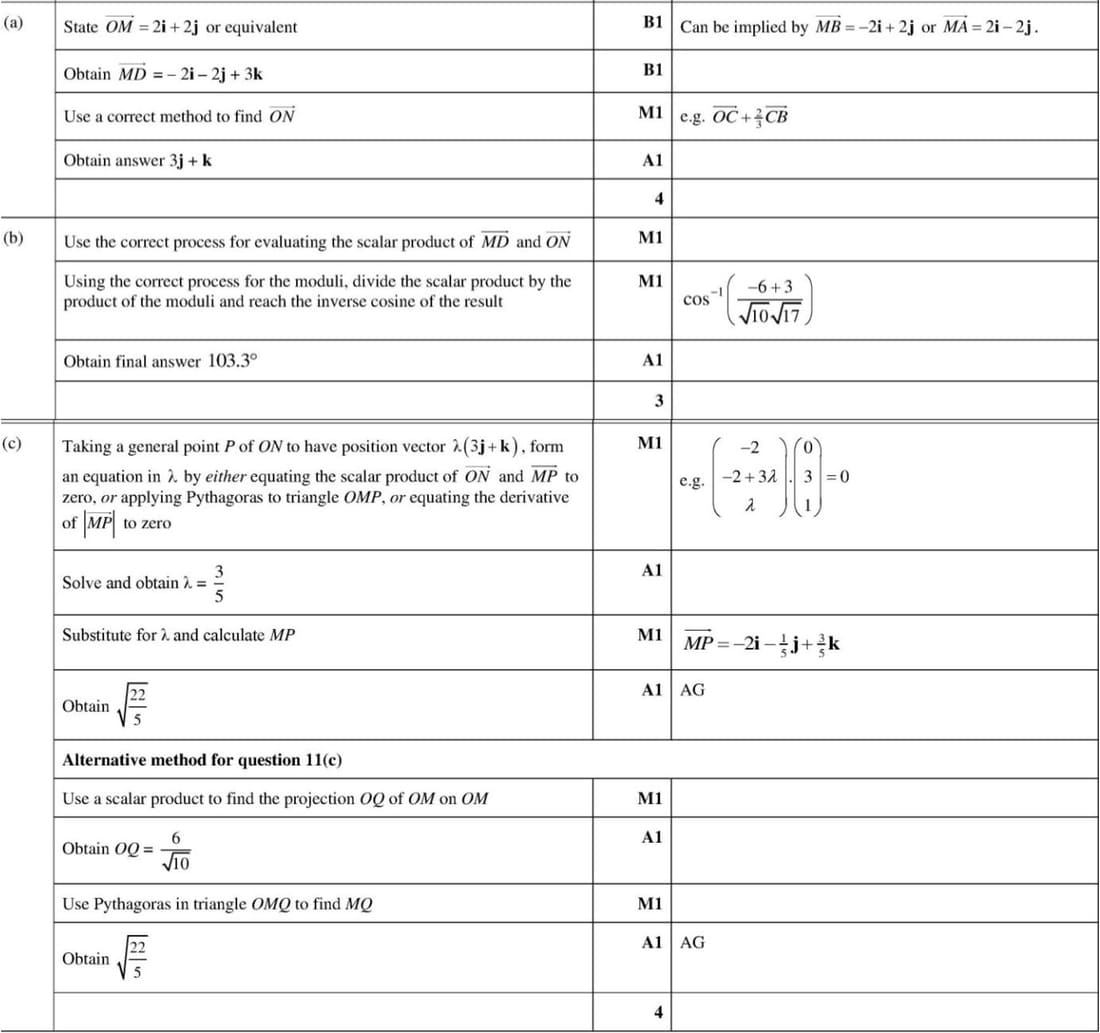
- Express vectors \(\overrightarrow{MD}\) and \(\overrightarrow{ON}\) in terms of \(\mathbf{i}, \mathbf{j}\) and \(\mathbf{k}\).
- Calculate the angle in degrees between the directions of \(\overrightarrow{MD}\) and \(\overrightarrow{ON}\).
- Show that the length of the perpendicular from \(M\) to \(ON\) is \(\sqrt{\frac{22}{5}}\).
9709 P13 - Nov 2013 - Q4
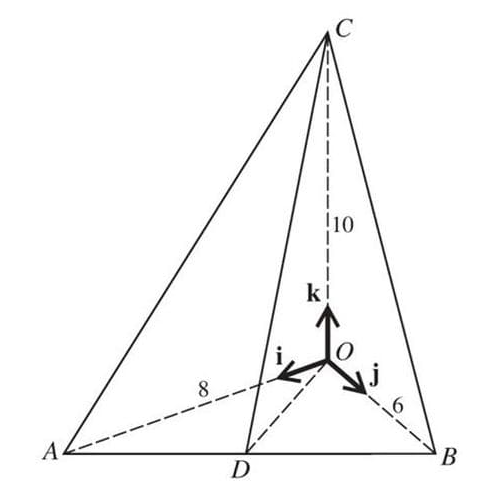
The diagram shows a pyramid OABC in which the edge OC is vertical. The horizontal base OAB is a triangle, right-angled at O, and D is the mid-point of AB. The edges OA, OB and OC have lengths of 8 units, 6 units and 10 units respectively. The unit vectors i, j and k are parallel to \(\overrightarrow{OA}\), \(\overrightarrow{OB}\) and \(\overrightarrow{OC}\) respectively.
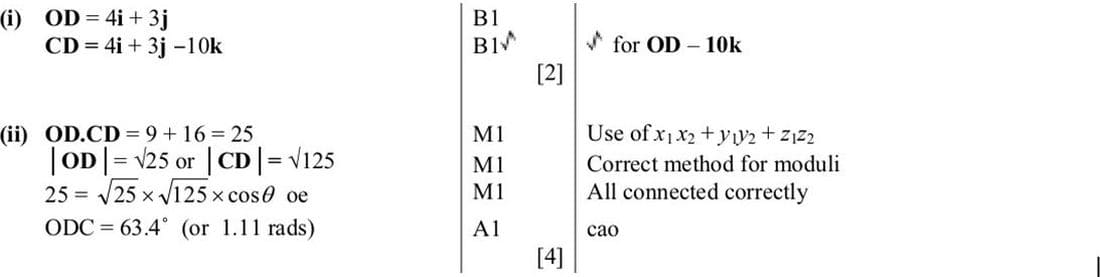
(i) Express each of the vectors \(\overrightarrow{OD}\) and \(\overrightarrow{CD}\) in terms of i, j and k.
(ii) Use a scalar product to find angle ODC.
9709 P11 - Nov 2013 - Q3
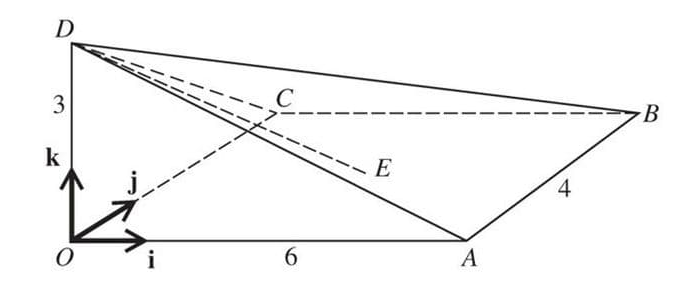
The diagram shows a pyramid OABCD in which the vertical edge OD is 3 units in length. The point E is the centre of the horizontal rectangular base OABC. The sides OA and AB have lengths of 6 units and 4 units respectively. The unit vectors i, j and k are parallel to \(\overrightarrow{OA}\), \(\overrightarrow{OC}\) and \(\overrightarrow{OD}\) respectively.
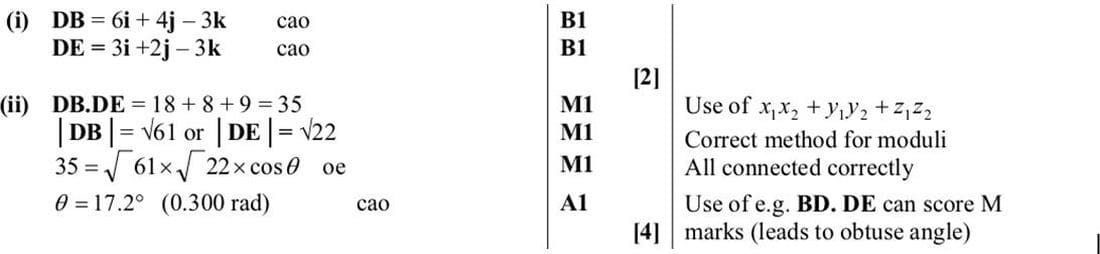
- Express each of the vectors \(\overrightarrow{DB}\) and \(\overrightarrow{DE}\) in terms of i, j and k.
- Use a scalar product to find angle BDE.
9709 P13 - Jun 2013 - Q8
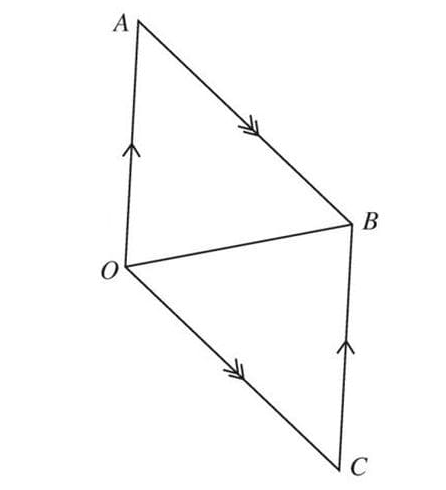
The diagram shows a parallelogram \(OABC\) in which
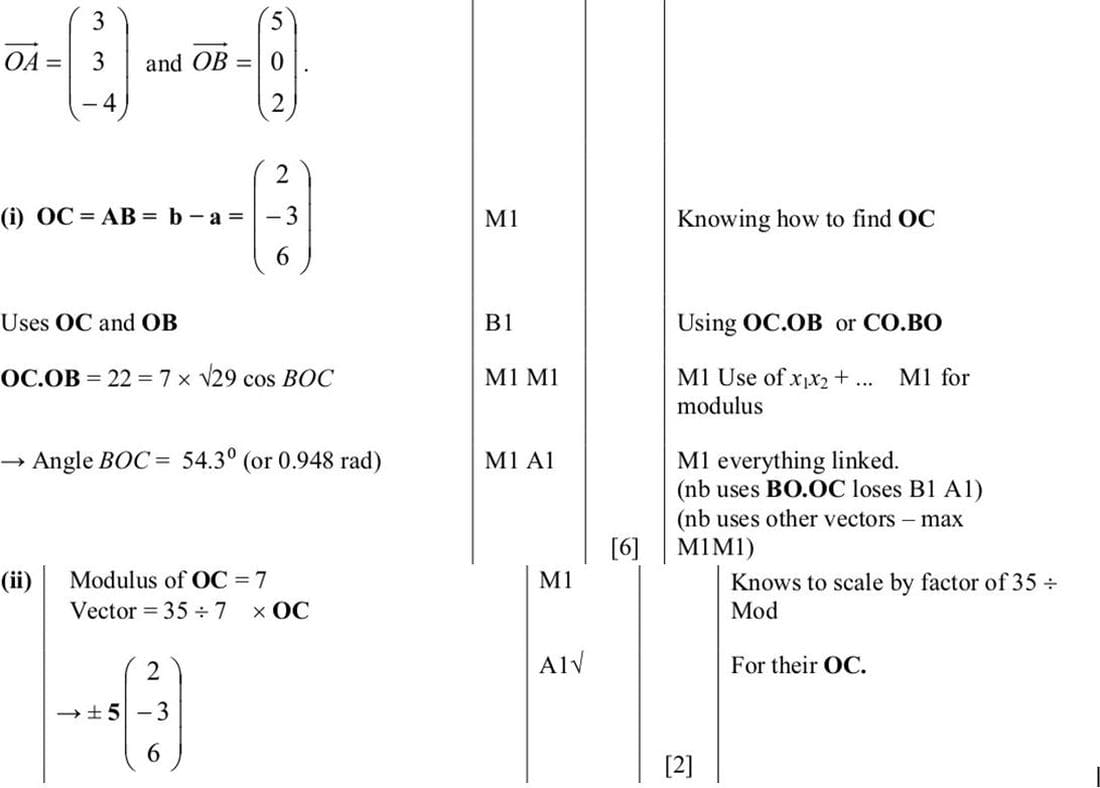
\(\overrightarrow{OA} = \begin{pmatrix} 3 \\ 3 \\ -4 \end{pmatrix}\) and \(\overrightarrow{OB} = \begin{pmatrix} 5 \\ 0 \\ 2 \end{pmatrix}\).
(i) Use a scalar product to find angle \(BOC\).
(ii) Find a vector which has magnitude 35 and is parallel to the vector \(\overrightarrow{OC}\).
9709 P13 - Jun 2011 - Q5
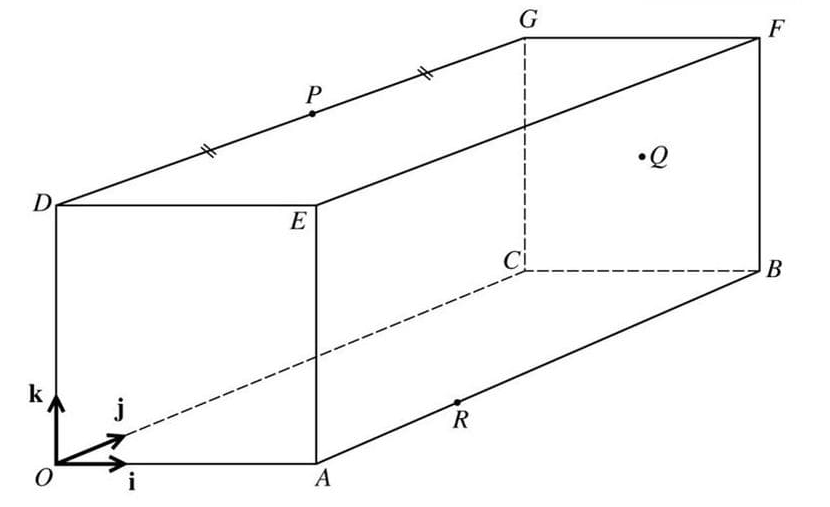
In the diagram, OABCDEFG is a rectangular block in which OA = OD = 6 cm and AB = 12 cm. The unit vectors i, j and k are parallel to \(\overrightarrow{OA}\), \(\overrightarrow{OC}\) and \(\overrightarrow{OD}\) respectively. The point P is the mid-point of DG, Q is the centre of the square face CBFG and R lies on AB such that AR = 4 cm.
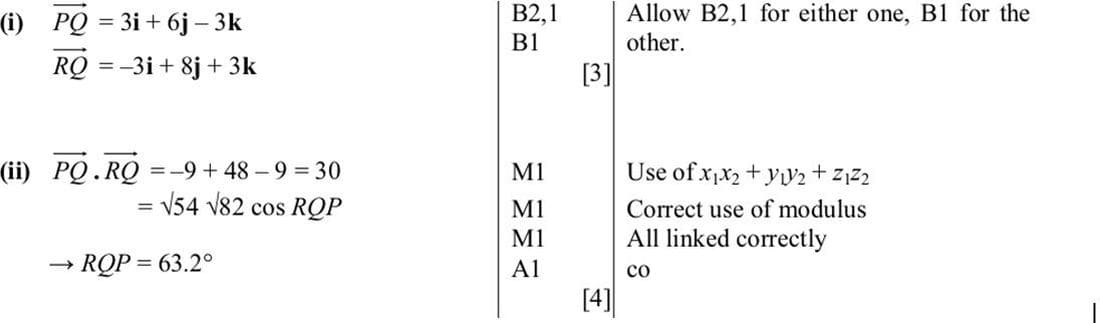
(i) Express each of the vectors \(\overrightarrow{PQ}\) and \(\overrightarrow{RQ}\) in terms of i, j and k.
(ii) Use a scalar product to find angle RQP.
9709 P11 - Jun 2011 - Q4
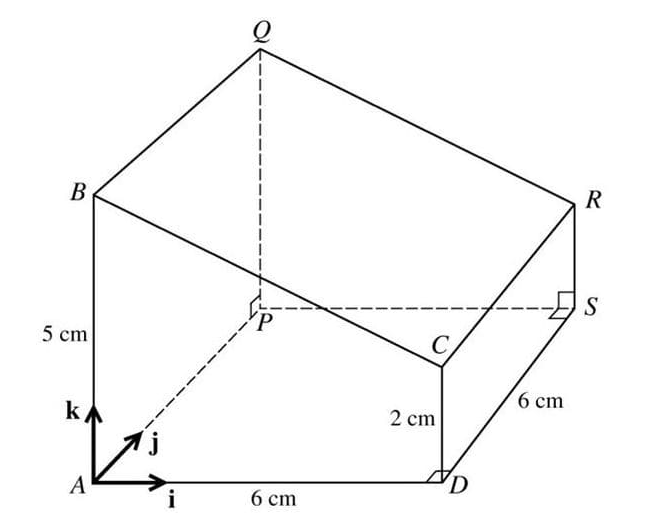
The diagram shows a prism ABCDPQRS with a horizontal square base APSD with sides of length 6 cm. The cross-section ABCD is a trapezium and is such that the vertical edges AB and DC are of lengths 5 cm and 2 cm respectively. Unit vectors i, j and k are parallel to AD, AP and AB respectively.
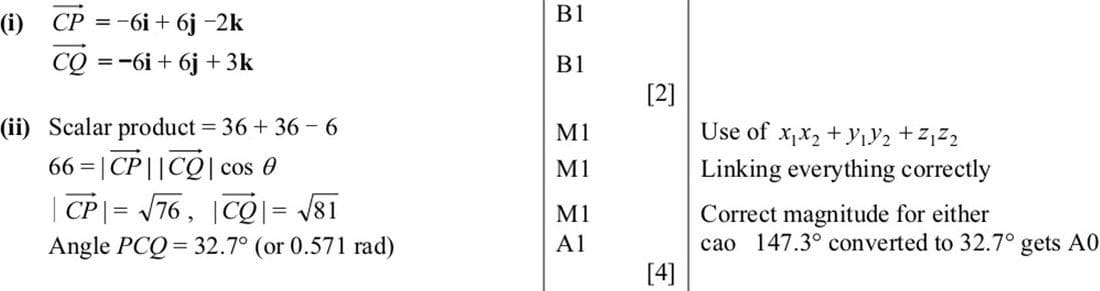
(i) Express each of the vectors \(\overrightarrow{CP}\) and \(\overrightarrow{CQ}\) in terms of i, j and k.
(ii) Use a scalar product to calculate angle PCQ.
9709 P13 - Nov 2010 - Q10
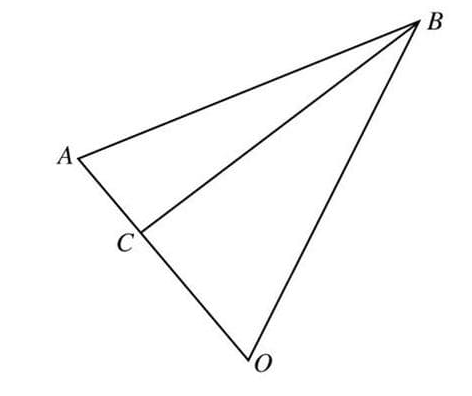
The diagram shows triangle OAB, in which the position vectors of A and B with respect to O are given by \(\overrightarrow{OA} = 2\mathbf{i} + \mathbf{j} - 3\mathbf{k}\) and \(\overrightarrow{OB} = -3\mathbf{i} + 2\mathbf{j} - 4\mathbf{k}\).
C is a point on OA such that \(\overrightarrow{OC} = p \overrightarrow{OA}\), where p is a constant.
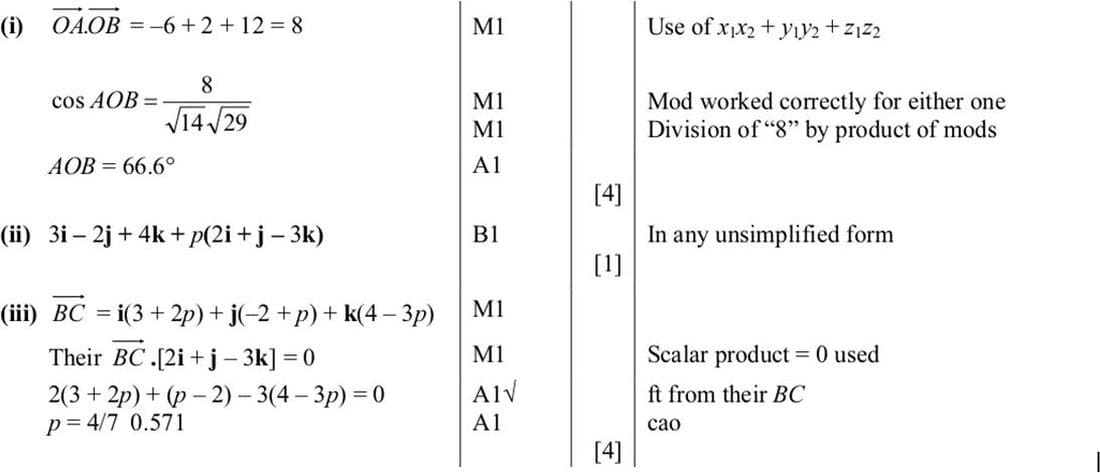
- Find angle AOB. [4]
- Find \(\overrightarrow{BC}\) in terms of p and vectors \(\mathbf{i}, \mathbf{j}\) and \(\mathbf{k}\). [1]
- Find the value of p given that BC is perpendicular to OA. [4]
9709 P12 - Nov 2010 - Q9
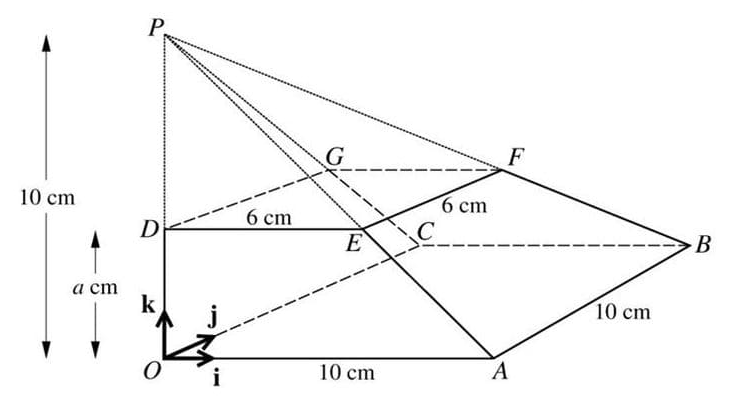
The diagram shows a pyramid OABCP in which the horizontal base OABC is a square of side 10 cm and the vertex P is 10 cm vertically above O. The points D, E, F, G lie on OP, AP, BP, CP respectively and DEFG is a horizontal square of side 6 cm. The height of DEFG above the base is a cm. Unit vectors i, j and k are parallel to OA, OC and OD respectively.
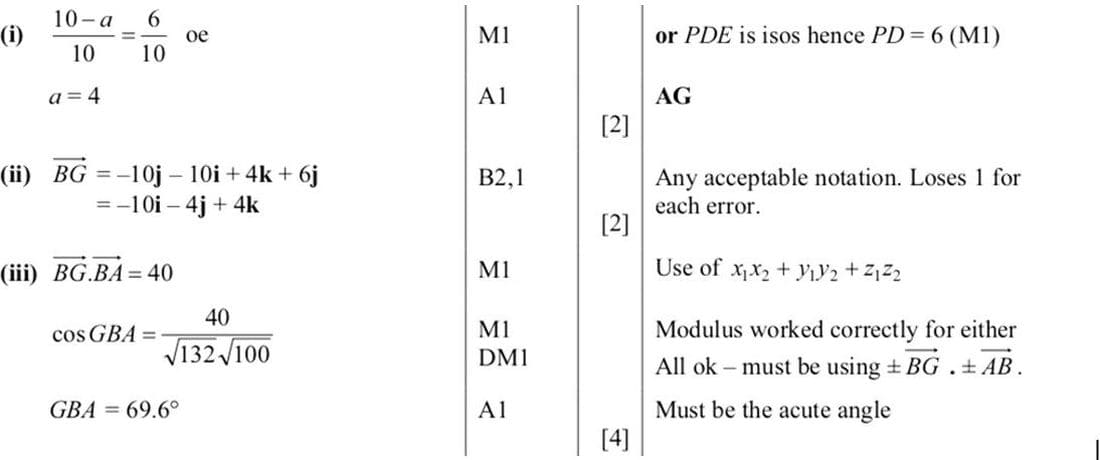
- Show that a = 4.
- Express the vector \(\overrightarrow{BG}\) in terms of i, j and k.
- Use a scalar product to find angle GBA.
9709 P11 - Nov 2010 - Q5
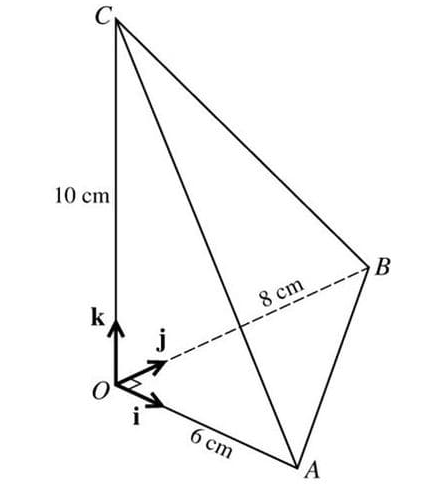
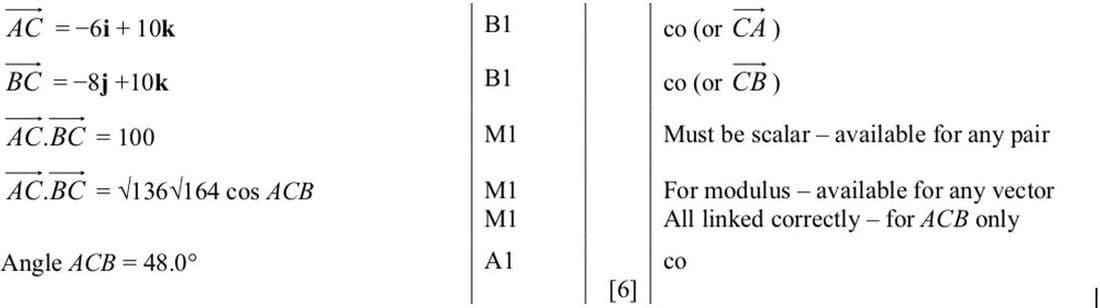
The diagram shows a pyramid OABC with a horizontal base OAB where OA = 6 cm, OB = 8 cm and angle AOB = 90°. The point C is vertically above O and OC = 10 cm. Unit vectors i, j and k are parallel to OA, OB and OC as shown. Use a scalar product to find angle ACB.
9709 P11 - Jun 2010 - Q10
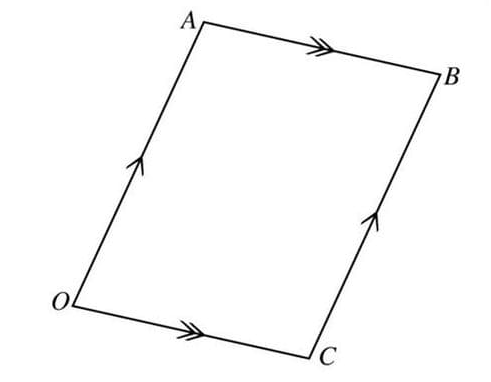
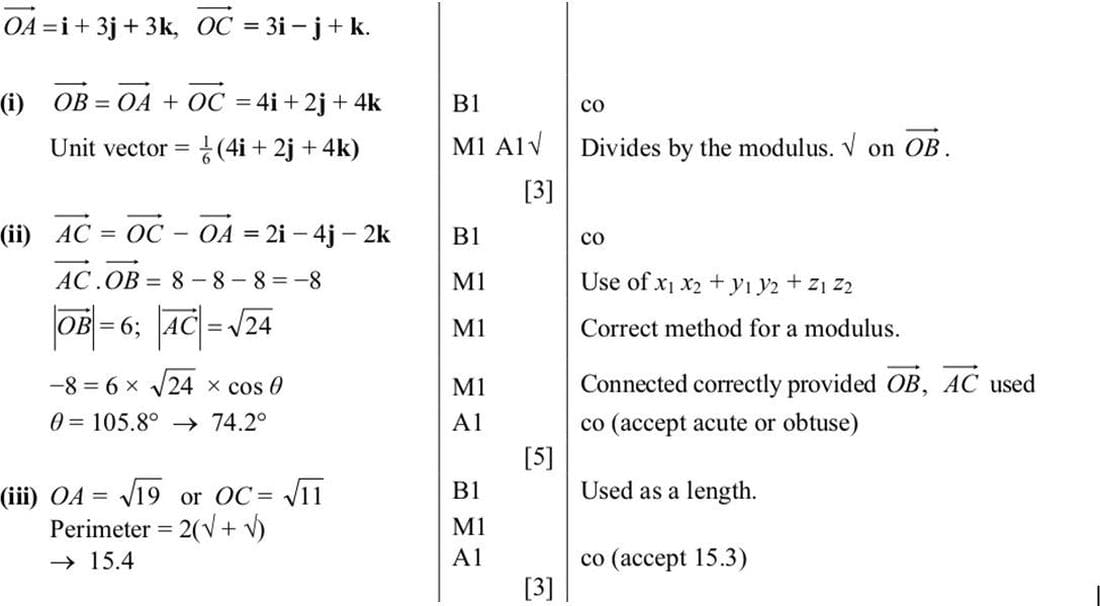
The diagram shows the parallelogram OABC. Given that \(\overrightarrow{OA} = \mathbf{i} + 3\mathbf{j} + 3\mathbf{k}\) and \(\overrightarrow{OC} = 3\mathbf{i} - \mathbf{j} + \mathbf{k}\), find
- the unit vector in the direction of \(\overrightarrow{OB}\),
- the acute angle between the diagonals of the parallelogram,
- the perimeter of the parallelogram, correct to 1 decimal place.
9709 P12 - Nov 2009 - Q6
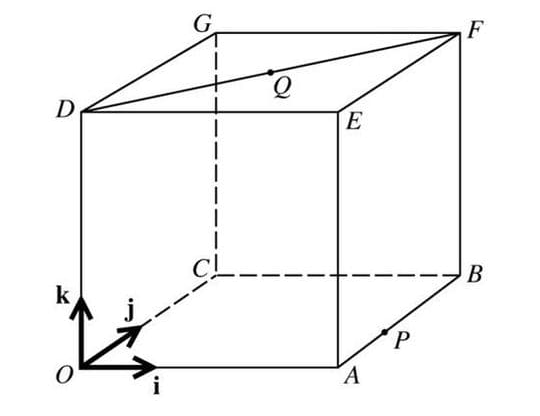
In the diagram, \(OABCDEFG\) is a cube in which each side has length 6. Unit vectors \(\mathbf{i}, \mathbf{j}\) and \(\mathbf{k}\) are parallel to \(\overrightarrow{OA}, \overrightarrow{OC}\) and \(\overrightarrow{OD}\) respectively. The point \(P\) is such that \(\overrightarrow{AP} = \frac{1}{3} \overrightarrow{AB}\) and the point \(Q\) is the mid-point of \(DF\).
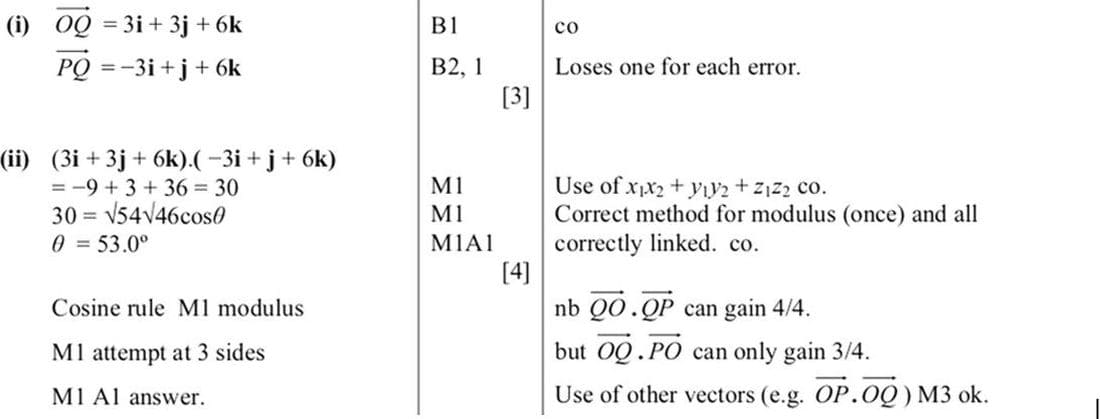
(i) Express each of the vectors \(\overrightarrow{OQ}\) and \(\overrightarrow{PQ}\) in terms of \(\mathbf{i}, \mathbf{j}\) and \(\mathbf{k}\).
(ii) Find the angle \(OQP\).
9709 P12 - Nov 2019 - Q7
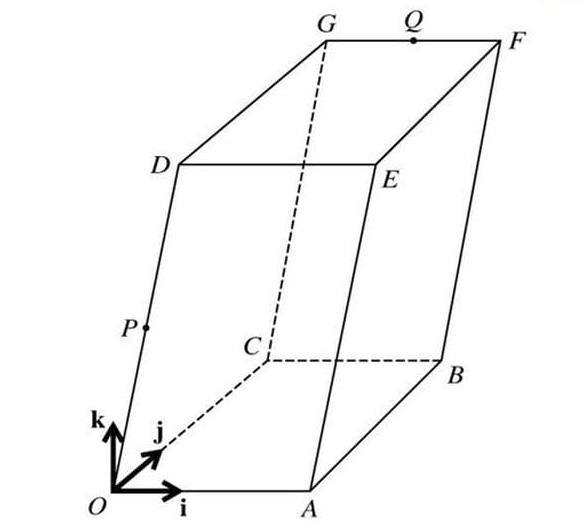
The diagram shows a three-dimensional shape OABCDEFG. The base OABC and the upper surface DEFG are identical horizontal rectangles. The parallelograms OAED and CBFG both lie in vertical planes. Points P and Q are the mid-points of OD and GF respectively. Unit vectors i and j are parallel to \(\overrightarrow{OA}\) and \(\overrightarrow{OC}\) respectively and the unit vector k is vertically upwards. The position vectors of A, C and D are given by \(\overrightarrow{OA} = 6\mathbf{i}\), \(\overrightarrow{OC} = 8\mathbf{j}\) and \(\overrightarrow{OD} = 2\mathbf{i} + 10\mathbf{k}\).
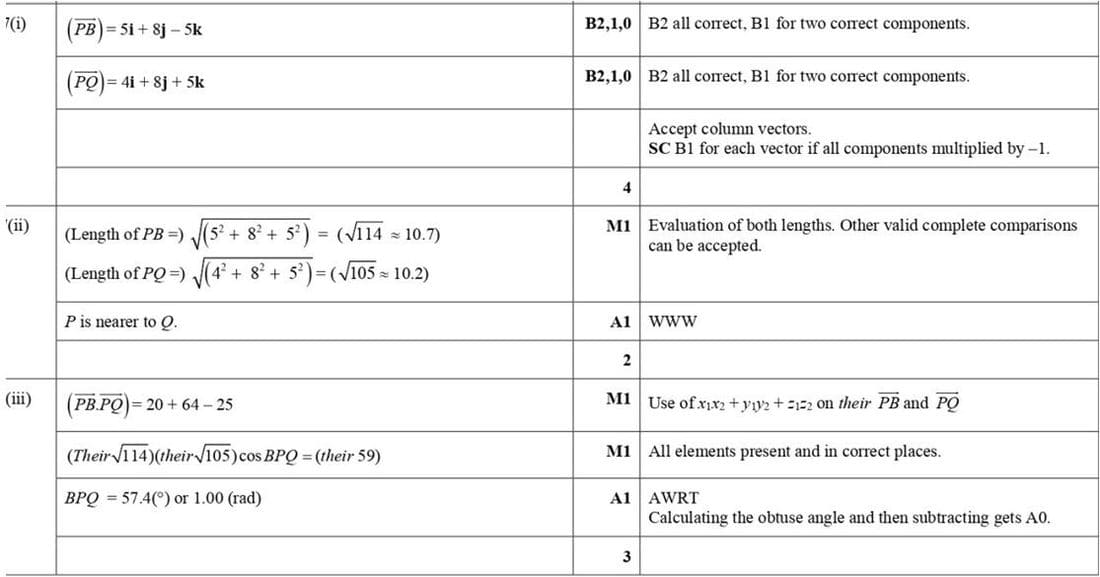
(i) Express each of the vectors \(\overrightarrow{PB}\) and \(\overrightarrow{PQ}\) in terms of i, j and k.
(ii) Determine whether P is nearer to Q or to B.
(iii) Use a scalar product to find angle BPQ.
9709 P1 - Nov 2008 - Q4
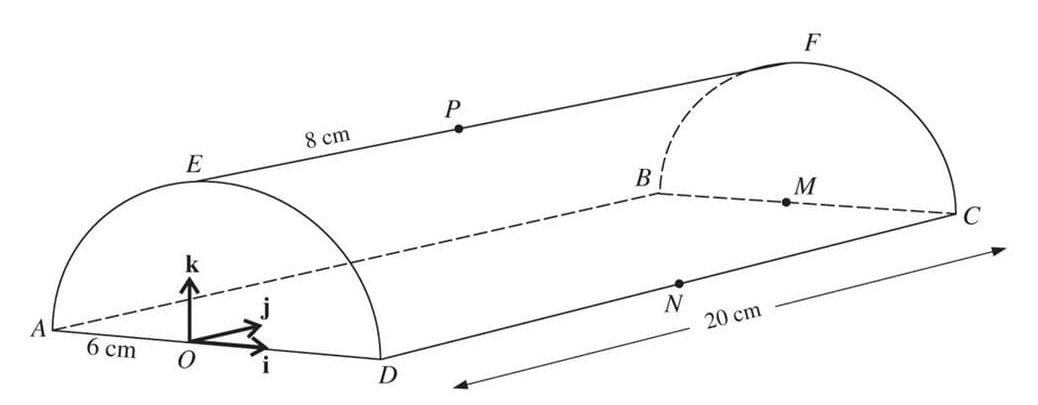
The diagram shows a semicircular prism with a horizontal rectangular base \(ABCD\). The vertical ends \(AED\) and \(BFC\) are semicircles of radius 6 cm. The length of the prism is 20 cm. The mid-point of \(AD\) is the origin \(O\), the mid-point of \(BC\) is \(M\) and the mid-point of \(DC\) is \(N\). The points \(E\) and \(F\) are the highest points of the semicircular ends of the prism. The point \(P\) lies on \(EF\) such that \(EP = 8\) cm.
Unit vectors \(\mathbf{i}, \mathbf{j}\) and \(\mathbf{k}\) are parallel to \(OD, OM\) and \(OE\) respectively.
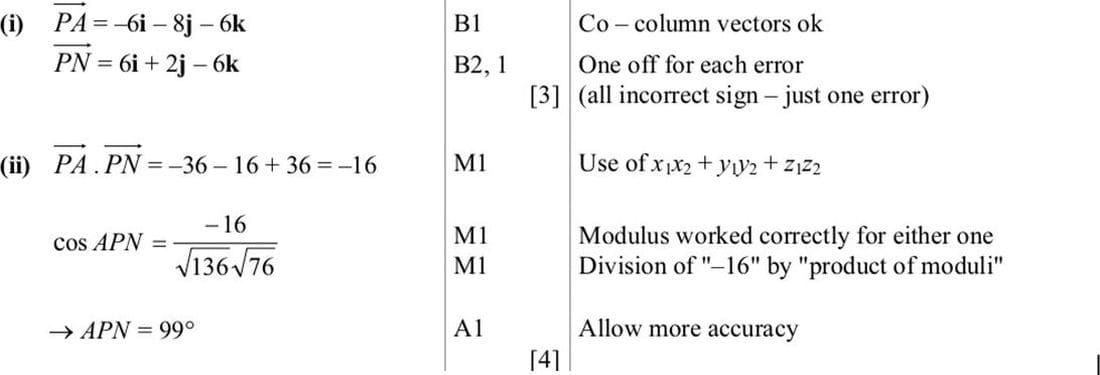
(i) Express each of the vectors \(\overrightarrow{PA}\) and \(\overrightarrow{PN}\) in terms of \(\mathbf{i}, \mathbf{j}\) and \(\mathbf{k}\).
(ii) Use a scalar product to calculate angle \(APN\).
9709 P1 - Nov 2007 - Q10
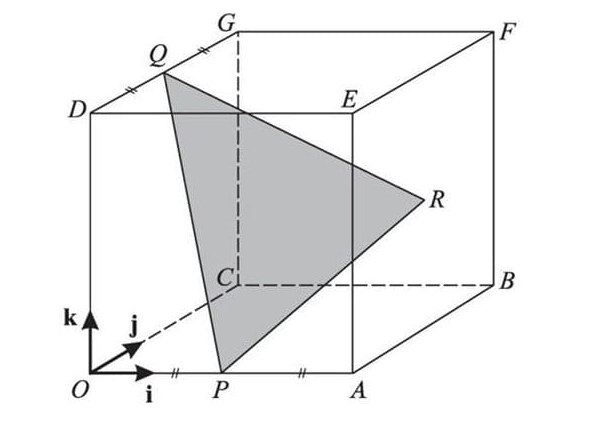
The diagram shows a cube OABCDEFG in which the length of each side is 4 units. The unit vectors i, j, and k are parallel to \(\overrightarrow{OA}\), \(\overrightarrow{OC}\), and \(\overrightarrow{OD}\) respectively. The mid-points of OA and DG are P and Q respectively and R is the centre of the square face ABFE.
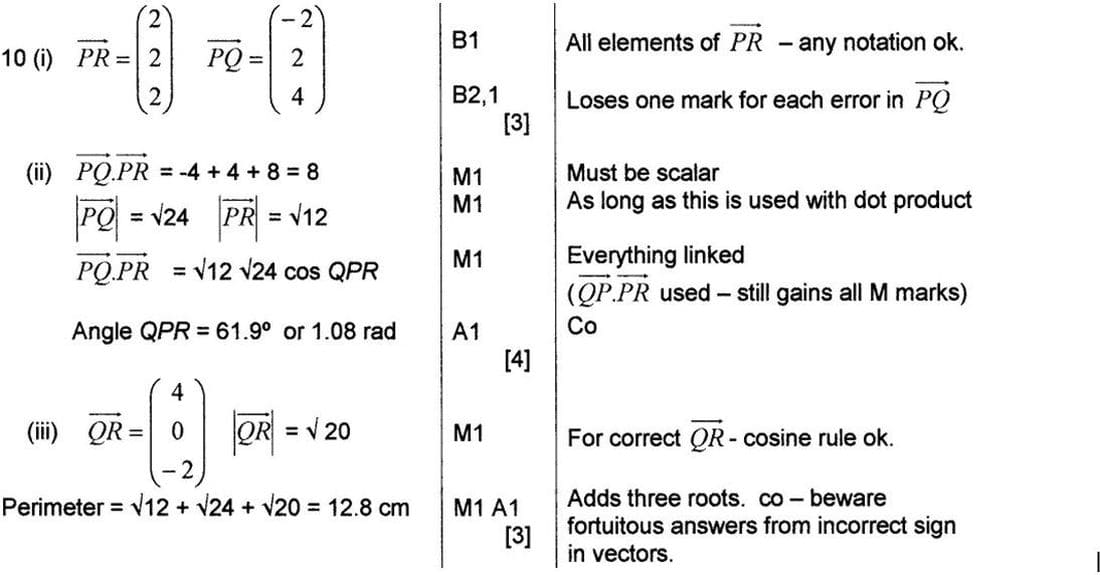
- Express each of the vectors \(\overrightarrow{PR}\) and \(\overrightarrow{PQ}\) in terms of i, j, and k.
- Use a scalar product to find angle QPR.
- Find the perimeter of triangle PQR, giving your answer correct to 1 decimal place.
9709 P1 - Jun 2006 - Q8
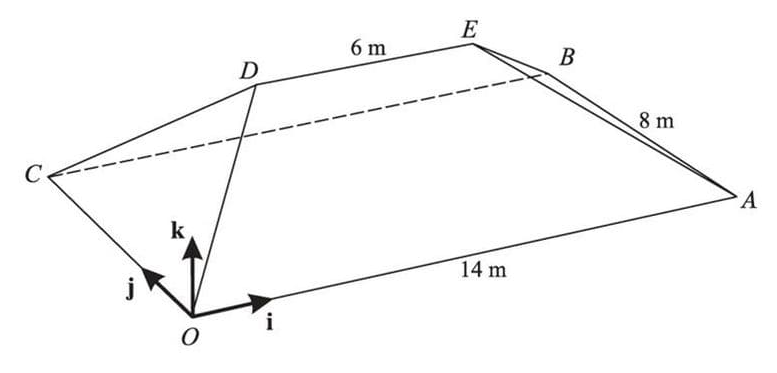
The diagram shows the roof of a house. The base of the roof, \(OABC\), is rectangular and horizontal with \(OA = CB = 14 \, \text{m}\) and \(OC = AB = 8 \, \text{m}\). The top of the roof \(DE\) is 5 m above the base and \(DE = 6 \, \text{m}\). The sloping edges \(OD, CD, AE\) and \(BE\) are all equal in length.
Unit vectors \(\mathbf{i}\) and \(\mathbf{j}\) are parallel to \(OA\) and \(OC\) respectively and the unit vector \(\mathbf{k}\) is vertically upwards.
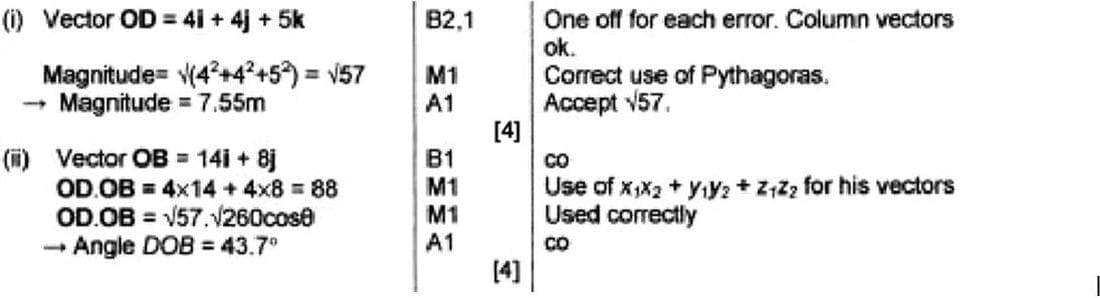
- Express the vector \(\overrightarrow{OD}\) in terms of \(\mathbf{i}, \mathbf{j}\) and \(\mathbf{k}\), and find its magnitude. [4]
- Use a scalar product to find angle \(DOB\). [4]
9709 P1 - Nov 2003 - Q7
The diagram shows a triangular prism with a horizontal rectangular base ADFC, where CF = 12 units and DF = 6 units. The vertical ends ABC and DEF are isosceles triangles with AB = BC = 5 units. The mid-points of BE and DF are M and N respectively. The origin O is at the mid-point of AC.
Unit vectors i, j and k are parallel to OC, ON and OB respectively.
- Find the length of OB.
- Express each of the vectors \(\overrightarrow{MC}\) and \(\overrightarrow{MN}\) in terms of i, j and k.
- Evaluate \(\overrightarrow{MC} \cdot \overrightarrow{MN}\) and hence find angle CMN, giving your answer correct to the nearest degree.


9709 P1 - Jun 2002 - Q5
The diagram shows a solid cylinder standing on a horizontal circular base, centre O and radius 4 units. The line BA is a diameter and the radius OC is at 90° to OA. Points O', A', B' and C' lie on the upper surface of the cylinder such that OO', AA', BB' and CC' are all vertical and of length 12 units. The mid-point of BB' is M.
Unit vectors i, j and k are parallel to OA, OC and OO' respectively.
(i) Express each of the vectors \(\overrightarrow{MO}\) and \(\overrightarrow{MC}\) in terms of i, j and k.
(ii) Hence find the angle OMC.


9709 P11 - Nov 2019 - Q10
Relative to an origin O, the position vectors of the points A, B, C and D, shown in the diagram, are given by
\(\overrightarrow{OA} = \begin{pmatrix} -1 \\ 3 \\ -4 \end{pmatrix}, \overrightarrow{OB} = \begin{pmatrix} 2 \\ -3 \\ 5 \end{pmatrix}, \overrightarrow{OC} = \begin{pmatrix} 4 \\ -2 \\ 5 \end{pmatrix} \text{ and } \overrightarrow{OD} = \begin{pmatrix} 2 \\ 2 \\ -1 \end{pmatrix}.\)
- Show that AB is perpendicular to BC.
- Show that ABCD is a trapezium.
- Find the area of ABCD, giving your answer correct to 2 decimal places.


9709 P13 - Jun 2019 - Q6
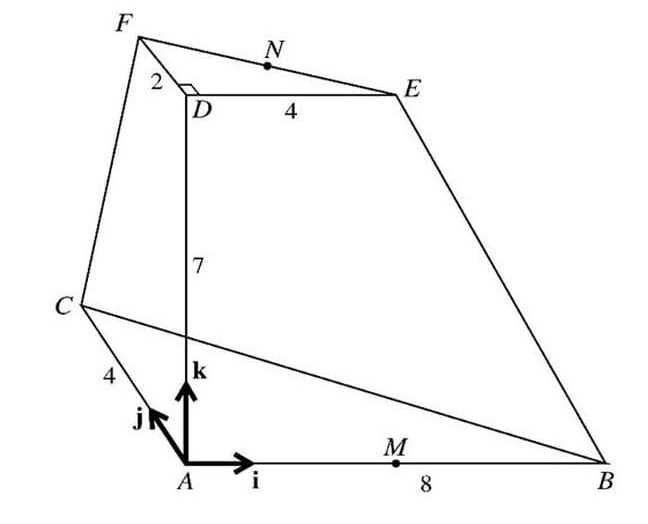
The diagram shows a solid figure ABCDEF in which the horizontal base ABC is a triangle right-angled at A. The lengths of AB and AC are 8 units and 4 units respectively and M is the mid-point of AB. The point D is 7 units vertically above A. Triangle DEF lies in a horizontal plane with DE, DF and FE parallel to AB, AC and CB respectively and N is the mid-point of FE. The lengths of DE and DF are 4 units and 2 units respectively. Unit vectors i, j and k are parallel to \overrightarrow{AB}, \overrightarrow{AC} and \overrightarrow{AD} respectively.
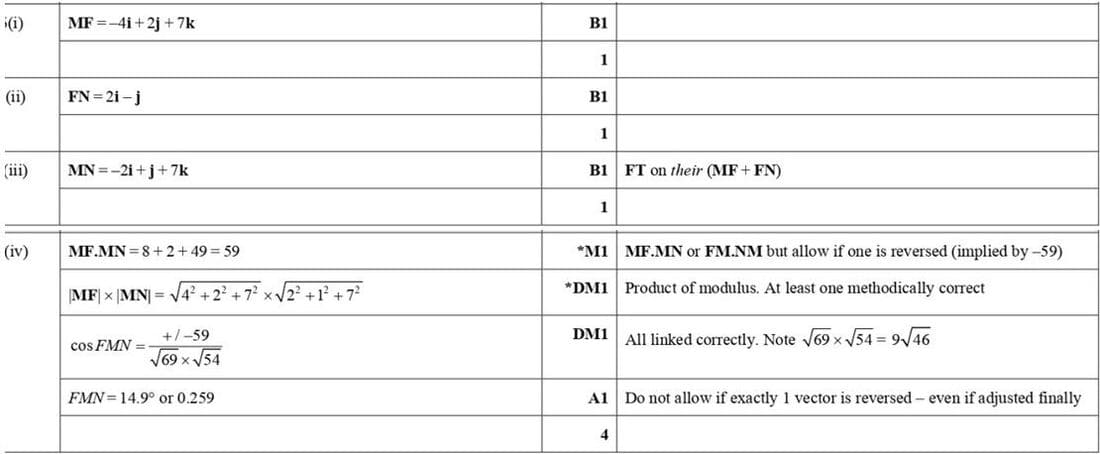
- Find \overrightarrow{MF} in terms of i, j and k.
- Find \overrightarrow{FN} in terms of i and j.
- Find \overrightarrow{MN} in terms of i, j and k.
- Use a scalar product to find angle FMN.