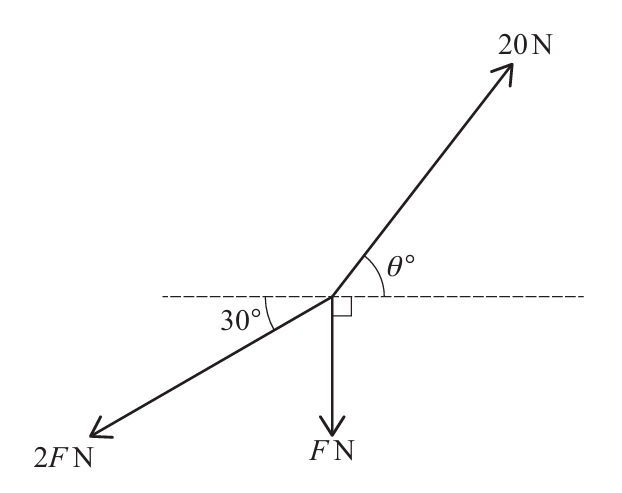
Resolve horizontally.
The horizontal component of the \(20\text{ N}\) force is \(20\cos\theta\).
The horizontal component of the \(2F\text{ N}\) force is \(2F\cos30^\circ\).
So
\[
20\cos\theta=2F\cos30^\circ.
\]
Since \(\cos30^\circ=\frac{\sqrt3}{2}\),
\[
20\cos\theta=F\sqrt3. \tag{1}
\]
Resolve vertically.
The upward component of the \(20\text{ N}\) force is \(20\sin\theta\).
The downward forces are \(F\) and \(2F\sin30^\circ\).
So
\[
20\sin\theta=F+2F\sin30^\circ.
\]
Since \(\sin30^\circ=\frac12\),
\[
20\sin\theta=F+F=2F.
\]
Therefore
\[
F=10\sin\theta. \tag{2}
\]
Substitute (2) into (1):
\[
20\cos\theta=10\sqrt3\sin\theta.
\]
So
\[
2\cos\theta=\sqrt3\sin\theta.
\]
Hence
\[
\tan\theta=\frac{2}{\sqrt3}.
\]
Therefore
\[
\theta=49.1^\circ.
\]
Using \(F=10\sin\theta\),
\[
F=10\sin49.1^\circ=7.56.
\]
Answer: \(F=7.56\), \(\theta=49.1^\circ\).