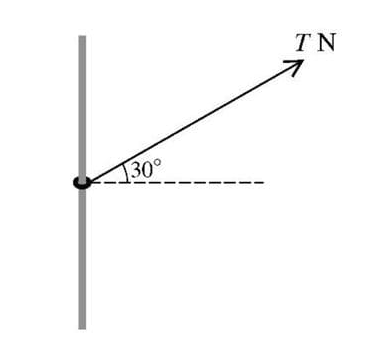
To solve this problem, we need to resolve the forces acting on the ring both horizontally and vertically.
1. **Horizontal Resolution:**
The horizontal component of the tension \(T\) is \(T \cos 30^{\circ}\). This is balanced by the normal reaction \(R\) from the rod, so:
\(R = T \cos 30^{\circ}\)
2. **Vertical Resolution:**
The vertical component of the tension \(T\) is \(T \sin 30^{\circ}\). The weight of the ring is \(2g\) N (where \(g\) is the acceleration due to gravity, approximately \(9.8 \text{ m/s}^2\)). The frictional force \(F\) can act either upwards or downwards to prevent motion, so we consider both cases:
**Case 1:** Friction prevents upwards motion:
\(F = T \sin 30^{\circ} - 2g\)
**Case 2:** Friction prevents downwards motion:
\(-F = T \sin 30^{\circ} - 2g\)
3. **Frictional Force:**
The frictional force \(F\) is given by \(F = \mu R\), where \(\mu = 0.24\). Substituting for \(R\) from the horizontal resolution:
\(F = 0.24 \times T \cos 30^{\circ}\)
4. **Solving for \(T\):**
Using the equations for \(F\) in both cases, we have:
\(T \sin 30^{\circ} - 2g = \pm 0.24 \times T \cos 30^{\circ}\)
Rearranging gives:
\(T = \frac{2g}{\sin 30^{\circ} \pm 0.24 \cos 30^{\circ}}\)
5. **Calculating Values:**
Substituting \(g = 9.8 \text{ m/s}^2\), \(\sin 30^{\circ} = 0.5\), and \(\cos 30^{\circ} = \sqrt{3}/2 \approx 0.866\):
\(T = \frac{2 \times 9.8}{0.5 \pm 0.24 \times 0.866}\)
Calculating for both cases:
**Case 1:**
\(T = \frac{19.6}{0.5 + 0.24 \times 0.866} \approx 28.3 \text{ N}\)
**Case 2:**
\(T = \frac{19.6}{0.5 - 0.24 \times 0.866} \approx 68.5 \text{ N}\)
Thus, the two values of \(T\) are \(28.3 \text{ N}\) and \(68.5 \text{ N}\).