Past Exam Questions
← Back9709 P11 - Jun 2019 - Q7
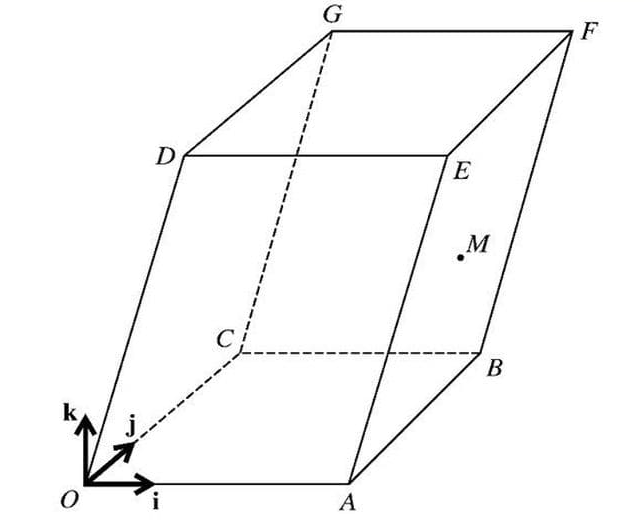
The diagram shows a three-dimensional shape in which the base OABC and the upper surface DEFG are identical horizontal squares. The parallelograms OAED and CBFG both lie in vertical planes. The point M is the mid-point of AF.
Unit vectors i and j are parallel to OA and OC respectively and the unit vector k is vertically upwards. The position vectors of A and D are given by \(\overrightarrow{OA} = 8\mathbf{i}\) and \(\overrightarrow{OD} = 3\mathbf{i} + 10\mathbf{k}\).
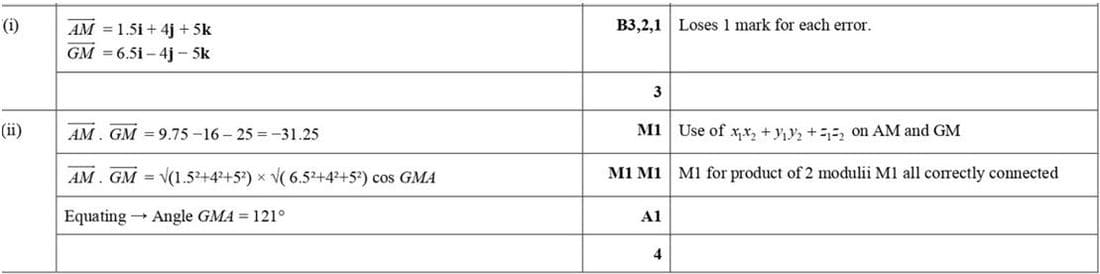
(i) Express each of the vectors \(\overrightarrow{AM}\) and \(\overrightarrow{GM}\) in terms of i, j and k. [3]
(ii) Use a scalar product to find angle GMA correct to the nearest degree. [4]
9709 P13 - Nov 2018 - Q6
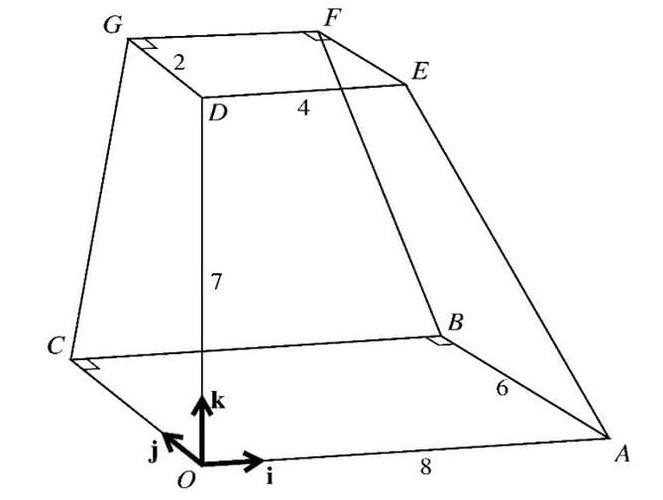
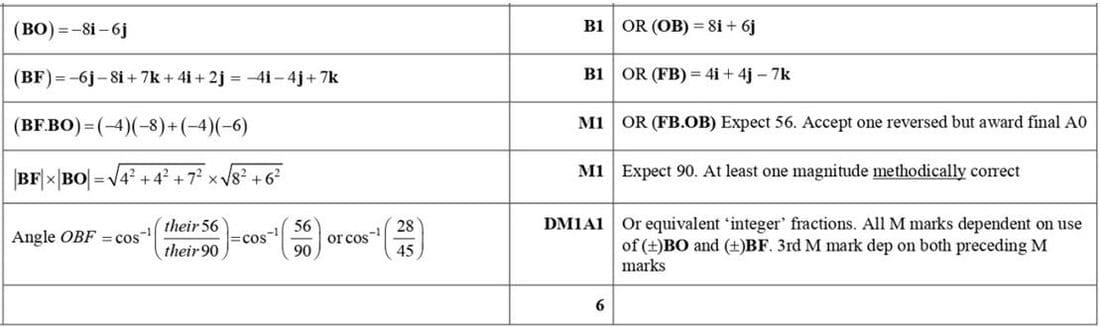
The diagram shows a solid figure OABCDEFG with a horizontal rectangular base OABC in which OA = 8 units and AB = 6 units. The rectangle DEFG lies in a horizontal plane and is such that D is 7 units vertically above O and DE is parallel to OA. The sides DE and DG have lengths 4 units and 2 units respectively. Unit vectors i, j and k are parallel to OA, OC and OD respectively. Use a scalar product to find angle OBF, giving your answer in the form cos-1(\frac{a}{b}), where a and b are integers.
9709 P12 - Nov 2018 - Q7
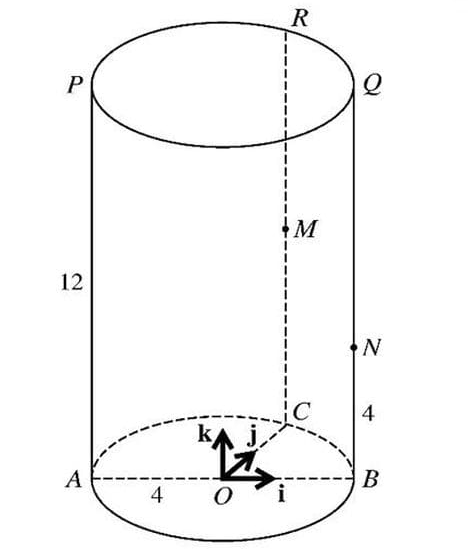
The diagram shows a solid cylinder standing on a horizontal circular base with centre O and radius 4 units. Points A, B and C lie on the circumference of the base such that AB is a diameter and angle BOC = 90°. Points P, Q and R lie on the upper surface of the cylinder vertically above A, B and C respectively. The height of the cylinder is 12 units. The mid-point of CR is M and N lies on BQ with BN = 4 units.
Unit vectors i and j are parallel to OB and OC respectively and the unit vector k is vertically upwards.
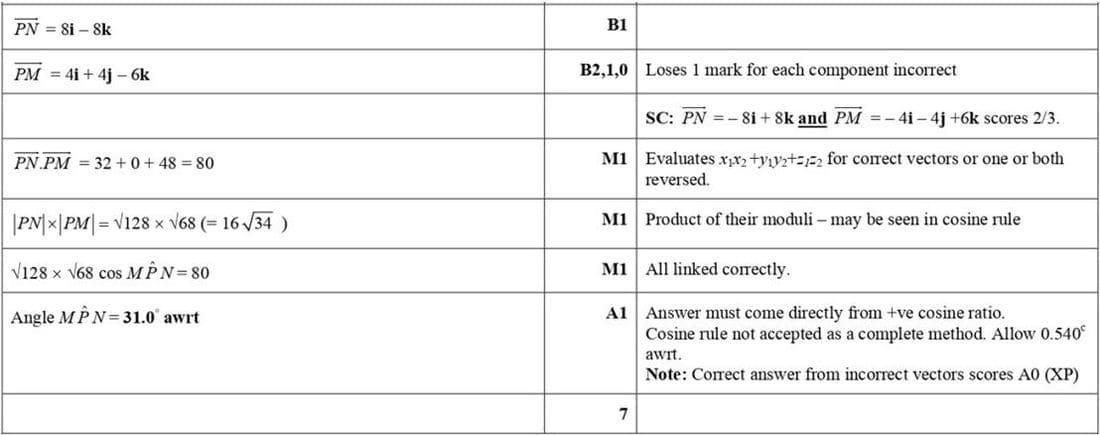
Evaluate \(\overrightarrow{PN} \cdot \overrightarrow{PM}\) and hence find angle MPN.
9709 P11 - Nov 2018 - Q8
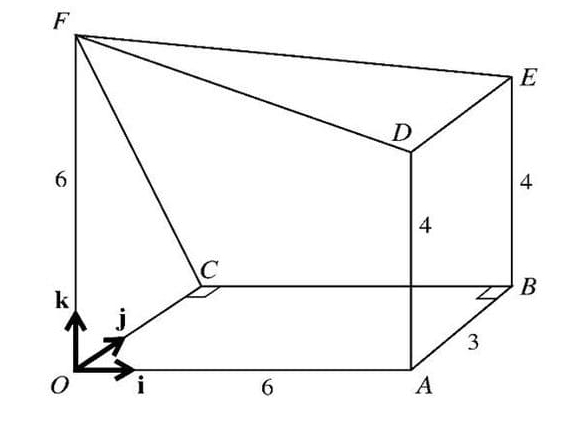
The diagram shows a solid figure OABCDEF having a horizontal rectangular base OABC with OA = 6 units and AB = 3 units. The vertical edges OF, AD and BE have lengths 6 units, 4 units and 4 units respectively. Unit vectors i, j and k are parallel to OA, OC and OF respectively.
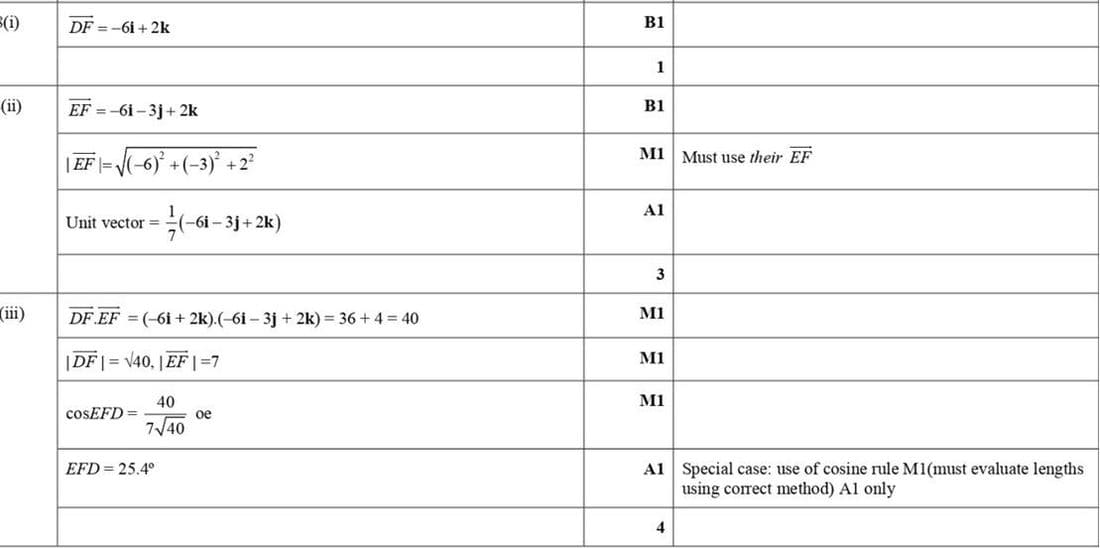
- Find \(\overrightarrow{DF}\).
- Find the unit vector in the direction of \(\overrightarrow{EF}\).
- Use a scalar product to find angle EFD.
9709 P41 - Nov 2014 - Q2
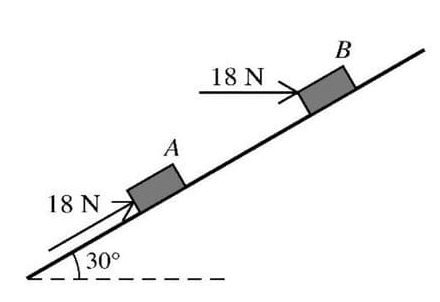
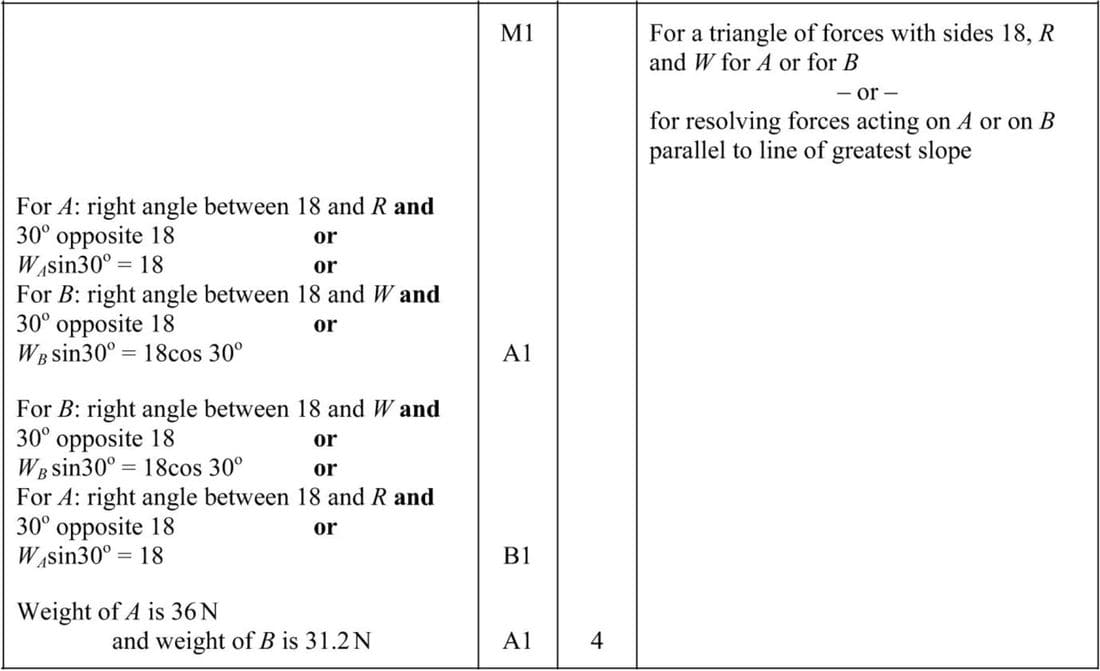
Small blocks A and B are held at rest on a smooth plane inclined at 30° to the horizontal. Each is held in equilibrium by a force of magnitude 18 N. The force on A acts upwards parallel to a line of greatest slope of the plane, and the force on B acts horizontally in the vertical plane containing a line of greatest slope (see diagram). Find the weight of A and the weight of B.
9709 P42 - Nov 2013 - Q1
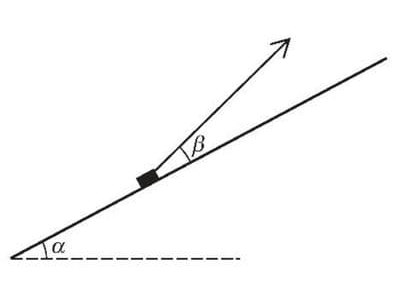
A small block of weight 5.1 N rests on a smooth plane inclined at an angle \(\alpha\) to the horizontal, where \(\sin \alpha = \frac{8}{17}\). The block is held in equilibrium by means of a light inextensible string. The string makes an angle \(\beta\) above the line of greatest slope on which the block rests, where \(\sin \beta = \frac{7}{25}\) (see diagram). Find the tension in the string.
9709 P42 - Nov 2009 - Q1
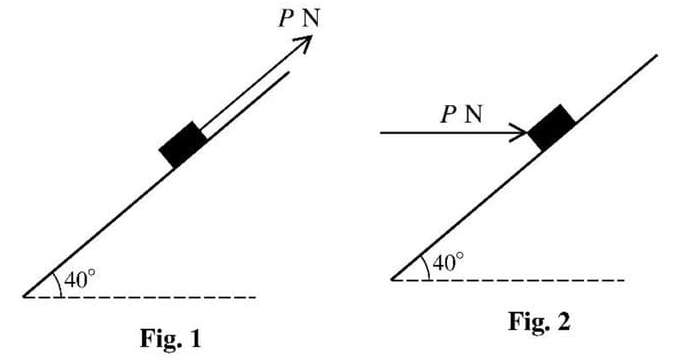
A small block of weight 12 N is at rest on a smooth plane inclined at 40° to the horizontal. The block is held in equilibrium by a force of magnitude P N. Find the value of P when
- the force is parallel to the plane as in Fig. 1,
- the force is horizontal as in Fig. 2.
9709 P4 - Nov 2004 - Q2
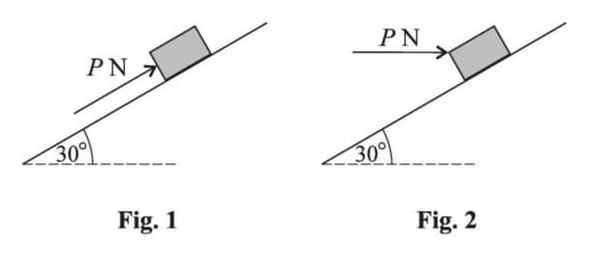
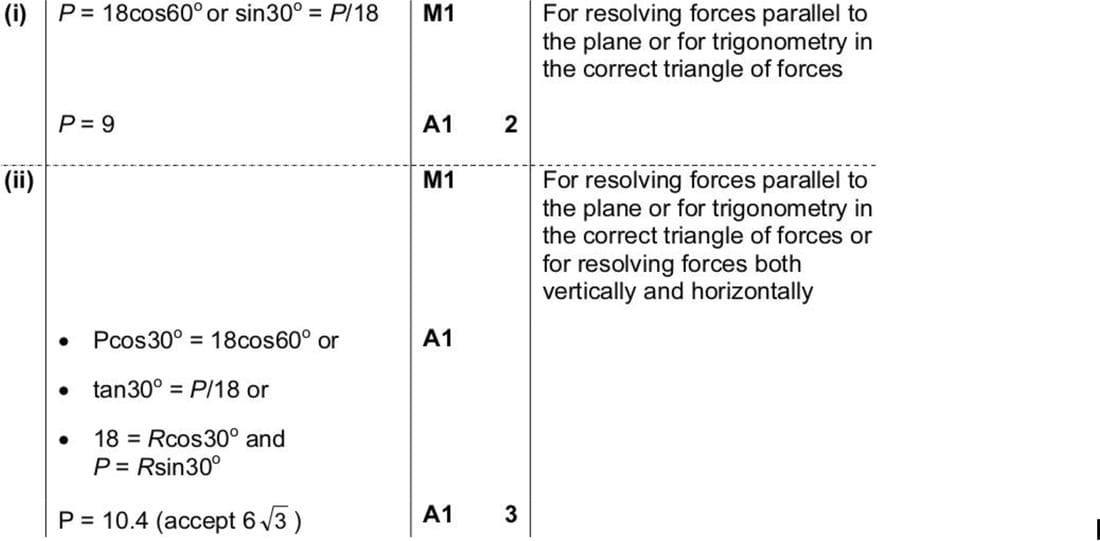
A small block of weight 18 N is held at rest on a smooth plane inclined at 30° to the horizontal, by a force of magnitude \(P\) N. Find
- the value of \(P\) when the force is parallel to the plane, as in Fig. 1,
- the value of \(P\) when the force is horizontal, as in Fig. 2.
9709 P42 - Nov 2022 - Q5
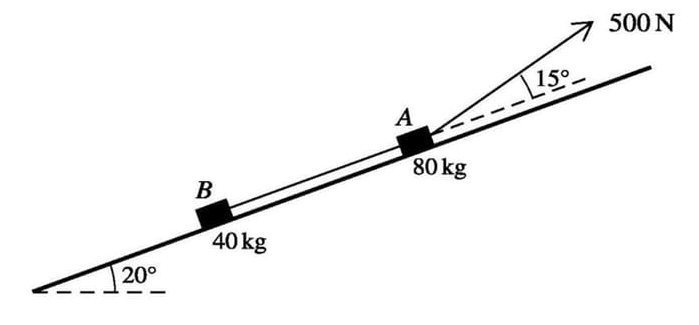
A block A of mass 80 kg is connected by a light, inextensible rope to a block B of mass 40 kg. The rope joining the two blocks is taut and is parallel to a line of greatest slope of a plane which is inclined at an angle of 20° to the horizontal. A force of magnitude 500 N inclined at an angle of 15° above the same line of greatest slope acts on A (see diagram). The blocks move up the plane and there is a resistance force of 50 N on B, but no resistance force on A.
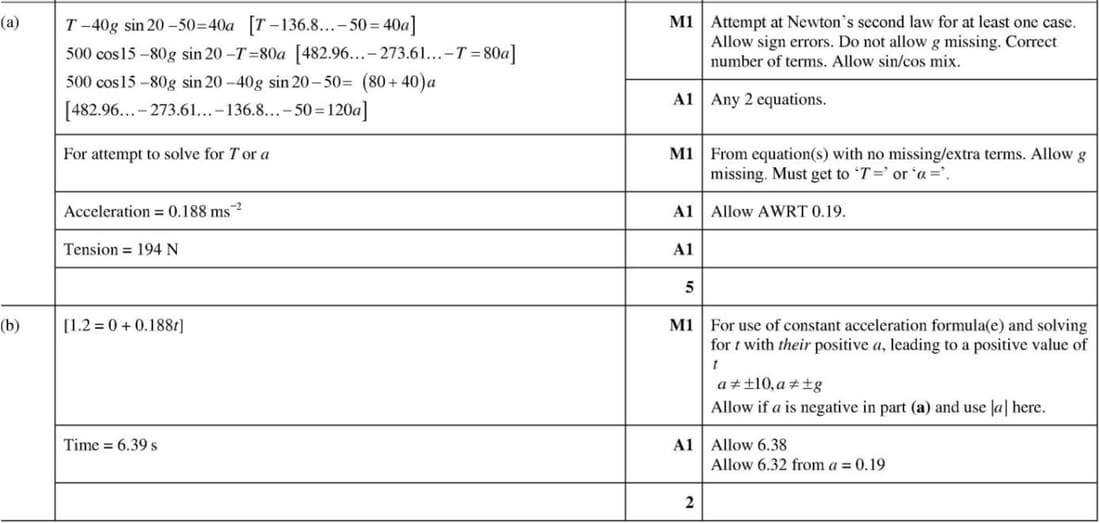
(a) Find the acceleration of the blocks and the tension in the rope. [5]
(b) Find the time that it takes for the blocks to reach a speed of 1.2 m/s-1 from rest. [2]
9709 P41 - Nov 2019 - Q4
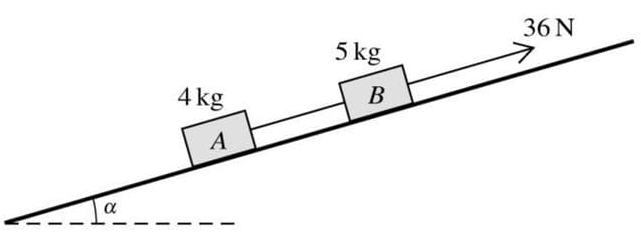
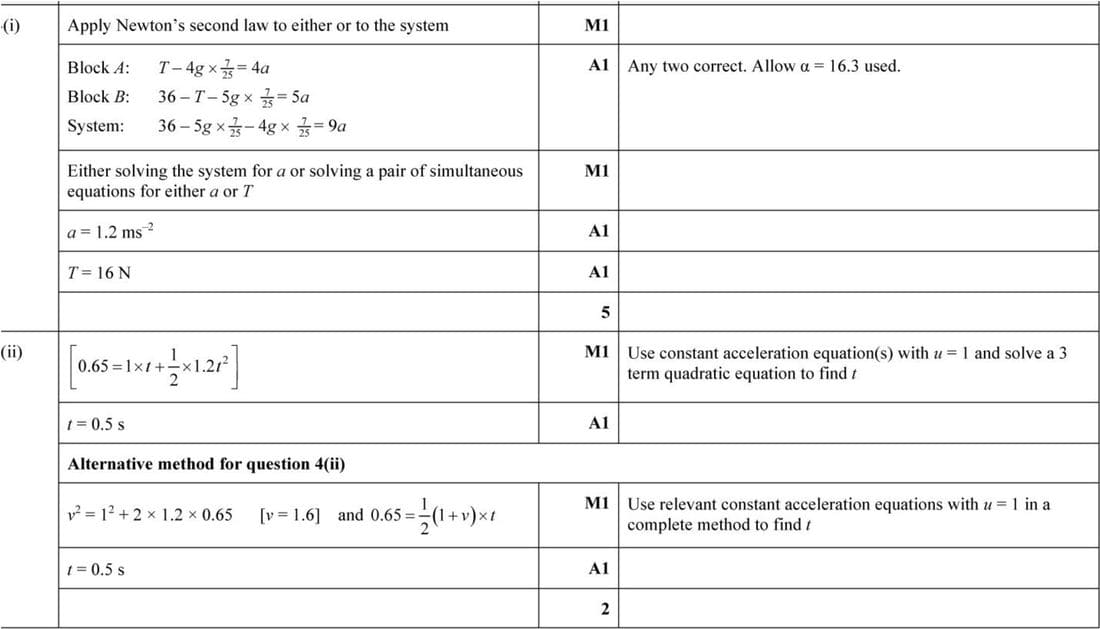
Two blocks A and B of masses 4 kg and 5 kg respectively are joined by a light inextensible string. The blocks rest on a smooth plane inclined at an angle \(\alpha\) to the horizontal, where \(\tan \alpha = \frac{7}{24}\). The string is parallel to a line of greatest slope of the plane with B above A. A force of magnitude 36 N acts on B, parallel to a line of greatest slope of the plane (see diagram).
- Find the acceleration of the blocks and the tension in the string. [5]
- At a particular instant, the speed of the blocks is 1 m s-1. Find the time, after this instant, that it takes for the blocks to travel 0.65 m. [2]
9709 P41 - Jun 2018 - Q3
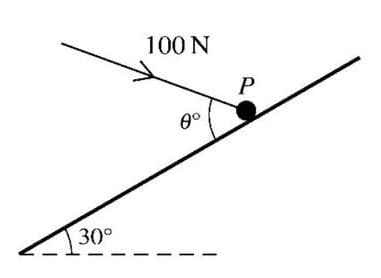
A particle P of mass 8 kg is on a smooth plane inclined at an angle of 30° to the horizontal. A force of magnitude 100 N, making an angle of θ° with a line of greatest slope and lying in the vertical plane containing the line of greatest slope, acts on P (see diagram).
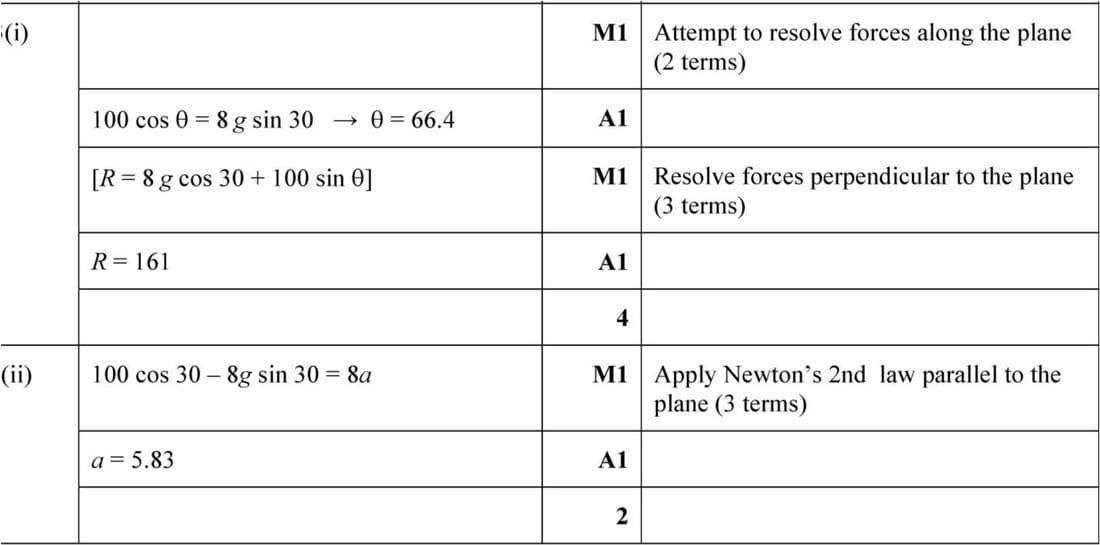
(i) Given that P is in equilibrium, show that θ = 66.4, correct to 1 decimal place, and find the normal reaction between the plane and P. [4]
\((ii) Given instead that θ = 30, find the acceleration of P. [2]\)
9709 P4 - Jun 2007 - Q1
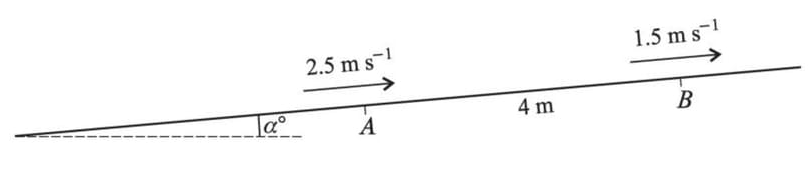
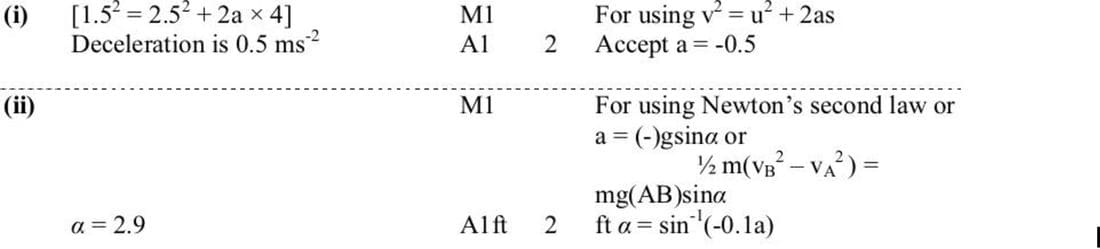
A particle slides up a line of greatest slope of a smooth plane inclined at an angle \(\alpha^\circ\) to the horizontal. The particle passes through the points \(A\) and \(B\) with speeds 2.5 m s\(^{-1}\) and 1.5 m s\(^{-1}\) respectively. The distance \(AB\) is 4 m (see diagram). Find
- the deceleration of the particle,
- the value of \(\alpha\).
9709 P4 - Jun 2006 - Q7
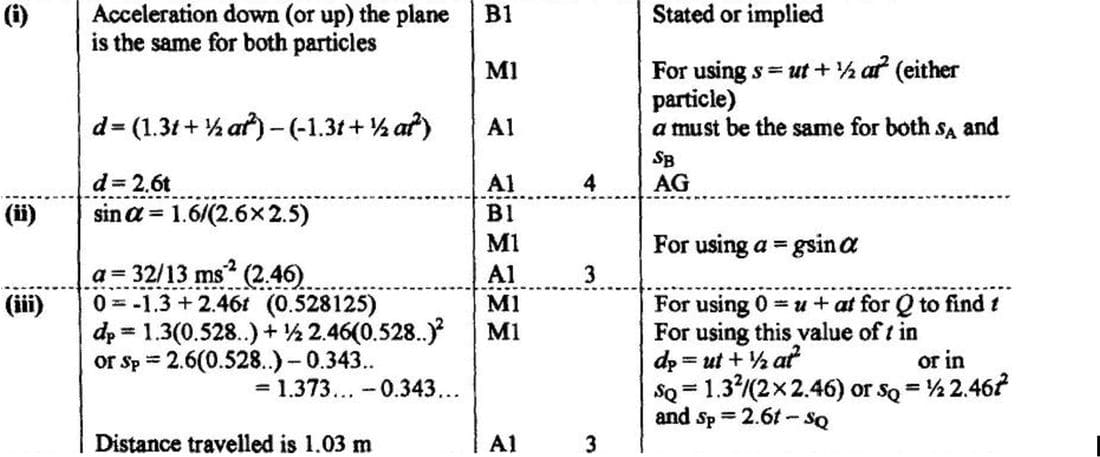
Two particles P and Q move on a line of greatest slope of a smooth inclined plane. The particles start at the same instant and from the same point, each with speed 1.3 m s-1. Initially P moves down the plane and Q moves up the plane. The distance between the particles t seconds after they start to move is d m.
- Show that d = 2.6t.
\(When t = 2.5 the difference in the vertical height of the particles is 1.6 m. Find\)
- the acceleration of the particles down the plane,
- the distance travelled by P when Q is at its highest point.
9709 P41 - Nov 2011 - Q4
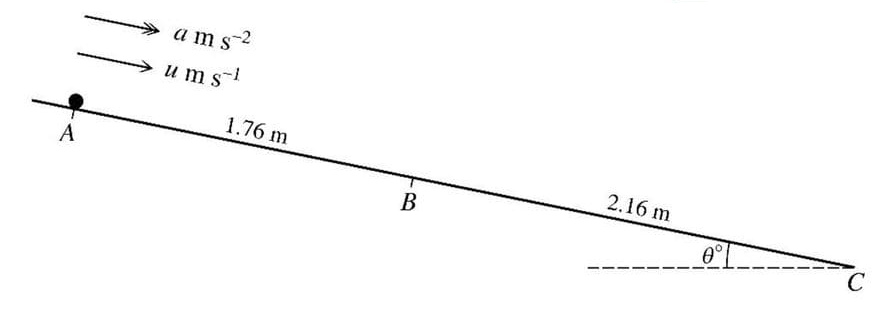
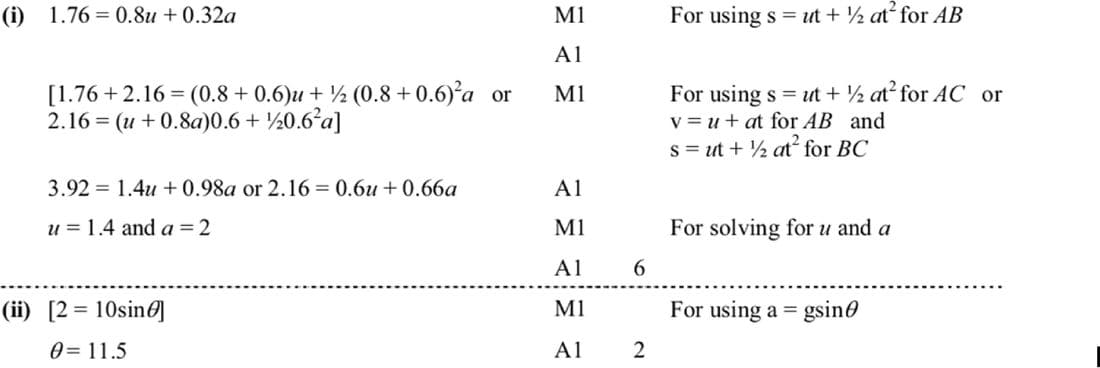
A, B, and C are three points on a line of greatest slope of a smooth plane inclined at an angle of \(\theta^\circ\) to the horizontal. A is higher than B and B is higher than C, and the distances AB and BC are 1.76 m and 2.16 m respectively. A particle slides down the plane with constant acceleration \(a \, \text{m s}^{-2}\). The speed of the particle at A is \(u \, \text{m s}^{-1}\) (see diagram). The particle takes 0.8 s to travel from A to B and takes 1.4 s to travel from A to C. Find
- the values of \(u\) and \(a\),
- the value of \(\theta\).
9709 P43 - Jun 2011 - Q3
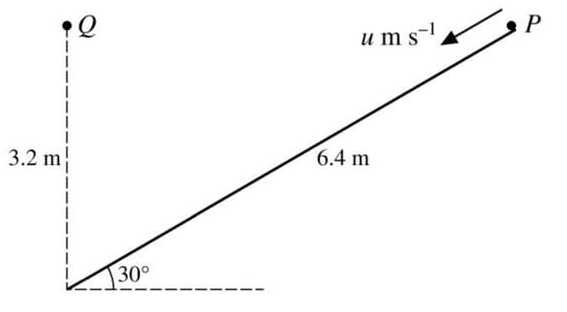
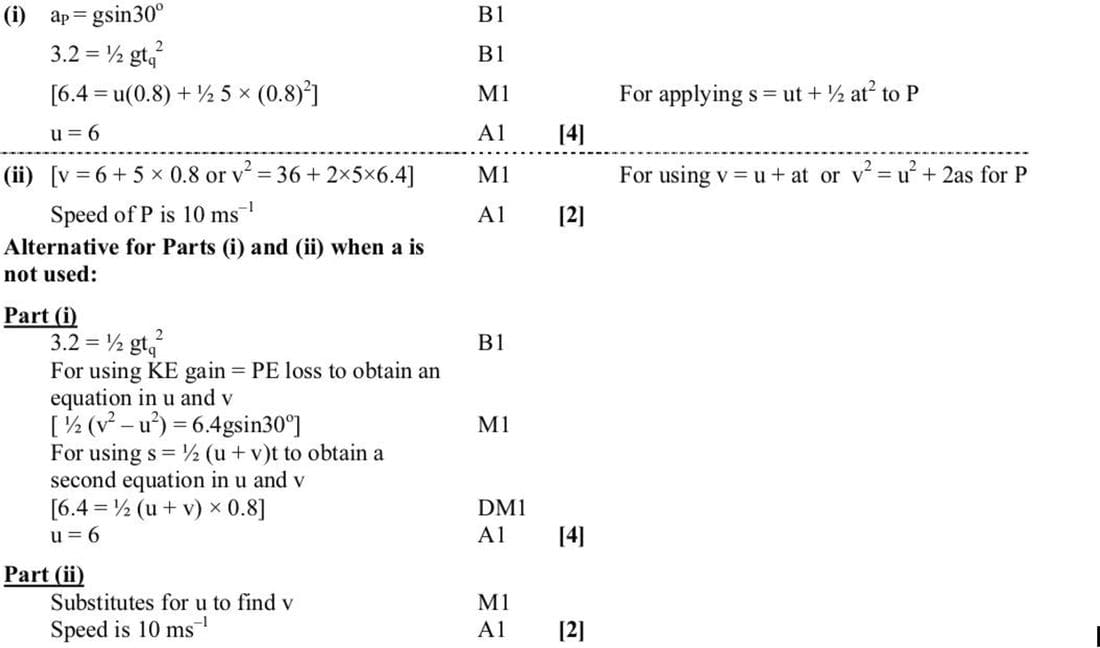
A particle P is projected from the top of a smooth ramp with speed u m s-1, and travels down a line of greatest slope. The ramp has length 6.4 m and is inclined at 30° to the horizontal. Another particle Q is released from rest at a point 3.2 m vertically above the bottom of the ramp, at the same instant that P is projected (see diagram). Given that P and Q reach the bottom of the ramp simultaneously, find
- the value of u,
- the speed with which P reaches the bottom of the ramp.
9709 P43 - Nov 2010 - Q1
A particle P is released from rest at a point on a smooth plane inclined at 30° to the horizontal. Find the speed of P
- when it has travelled 0.9 m,
- 0.8 s after it is released.

9709 P43 - Jun 2010 - Q6
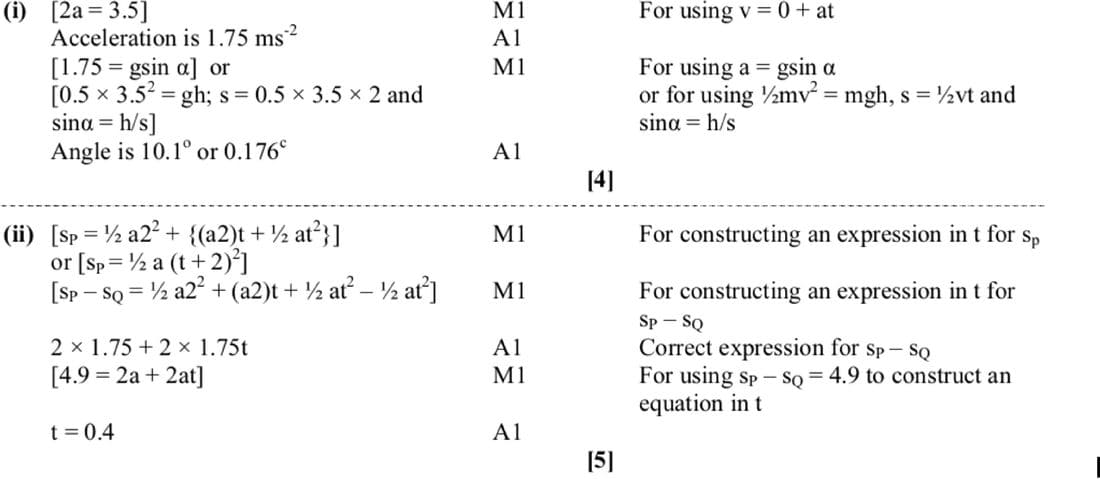
Particles P and Q move on a line of greatest slope of a smooth inclined plane. P is released from rest at a point O on the line and 2 s later passes through the point A with speed 3.5 m s-1.
(i) Find the acceleration of P and the angle of inclination of the plane.
At the instant that P passes through A the particle Q is released from rest at O. At time t s after Q is released from O, the particles P and Q are 4.9 m apart.
(ii) Find the value of t.
9709 P4 - Jun 2008 - Q1
A particle slides down a smooth plane inclined at an angle of \(\alpha^\circ\) to the horizontal. The particle passes through the point \(A\) with speed \(1.5 \text{ m s}^{-1}\), and \(1.2\) s later it passes through the point \(B\) with speed \(4.5 \text{ m s}^{-1}\). Find
- the acceleration of the particle,
- the value of \(\alpha\).

9709 P43 - Nov 2023 - Q2
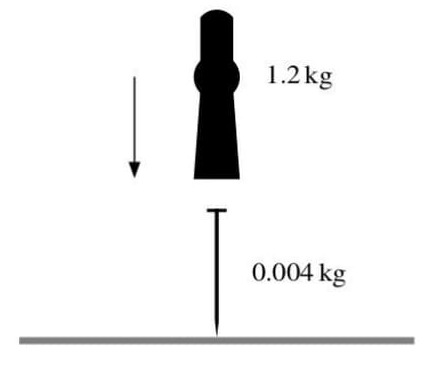
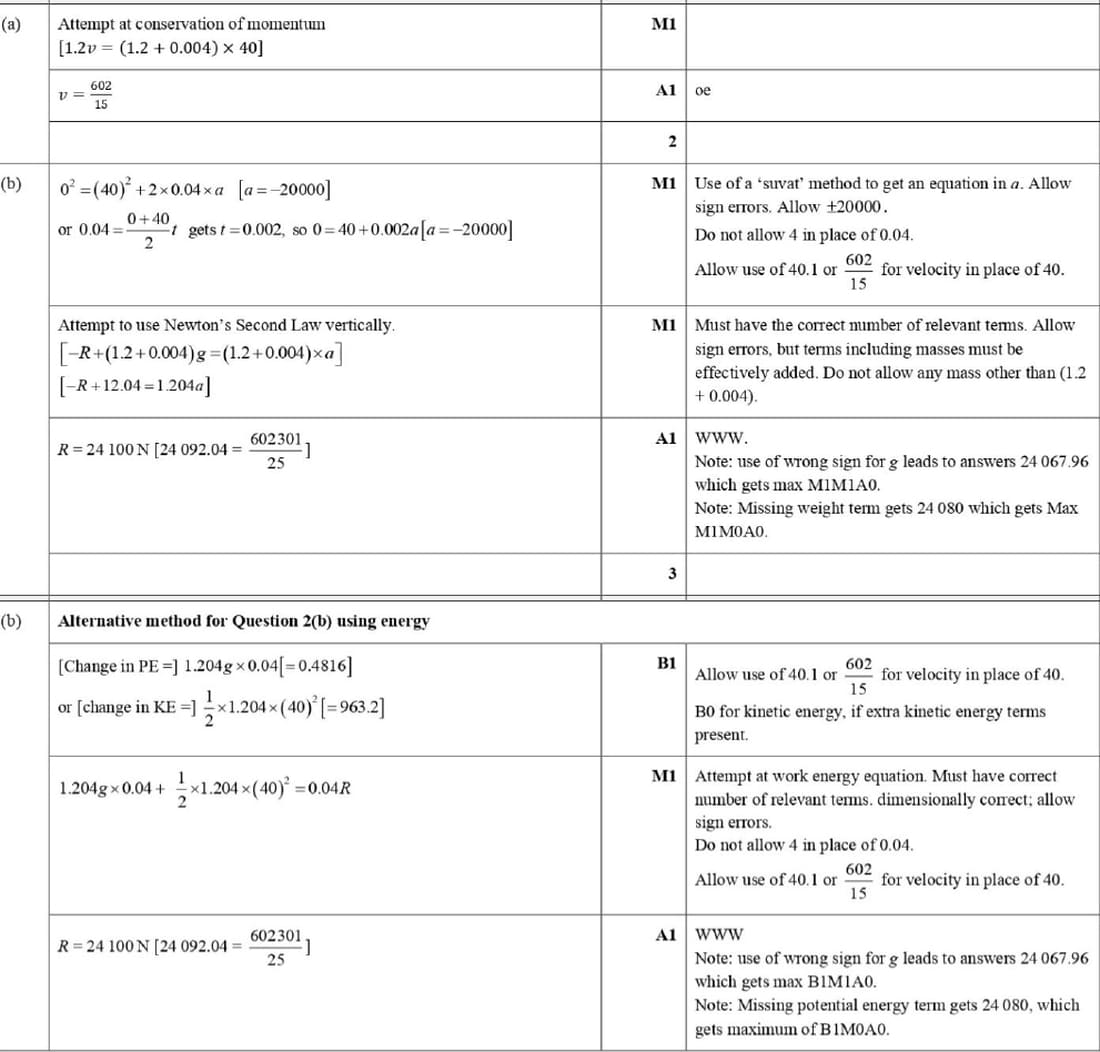
A machine for driving a nail into a block of wood causes a hammerhead to drop vertically onto the top of a nail. The mass of the hammerhead is 1.2 kg and the mass of the nail is 0.004 kg (see diagram). The hammerhead hits the nail with speed \(v \text{ m s}^{-1}\) and remains in contact with the nail after the impact. The combined hammerhead and nail move immediately after the impact with speed 40 \(\text{ m s}^{-1}\).
(a) Calculate \(v\), giving your answer as an exact fraction.
(b) The nail is driven 4 cm into the wood. Find the constant force resisting the motion.
9709 P43 - Jun 2023 - Q6
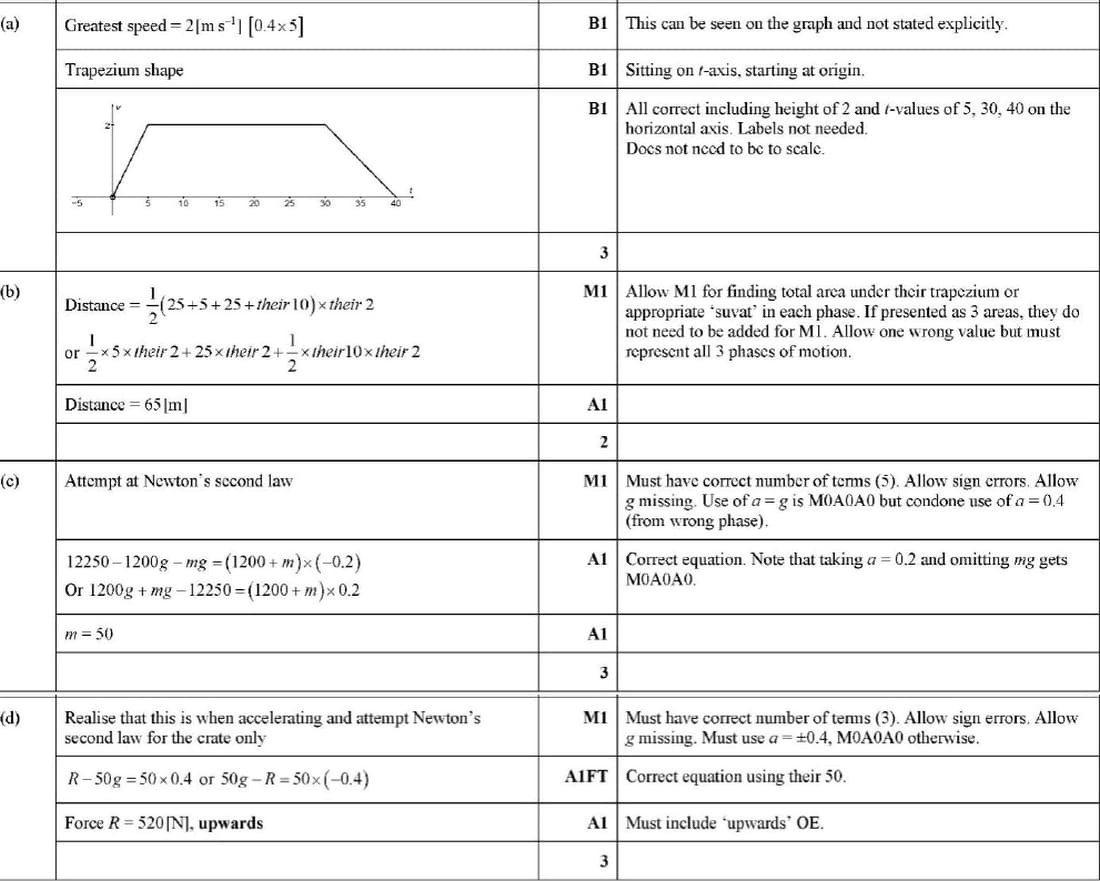
An elevator is pulled vertically upwards by a cable. The elevator accelerates at 0.4 m/s2 for 5 s, then travels at constant speed for 25 s. The elevator then decelerates at 0.2 m/s2 until it comes to rest.
(a) Find the greatest speed of the elevator and hence draw a velocity-time graph for the motion of the elevator.
(b) Find the total distance travelled by the elevator.
The mass of the elevator is 1200 kg and there is a crate of mass m kg resting on the floor of the elevator.
(c) Given that the tension in the cable when the elevator is decelerating is 12250 N, find the value of m.
(d) Find the greatest magnitude of the force exerted on the crate by the floor of the elevator, and state its direction.