Past Exam Questions
← Back9231 P12 - Jun 2025 - Q03 - 7 marks
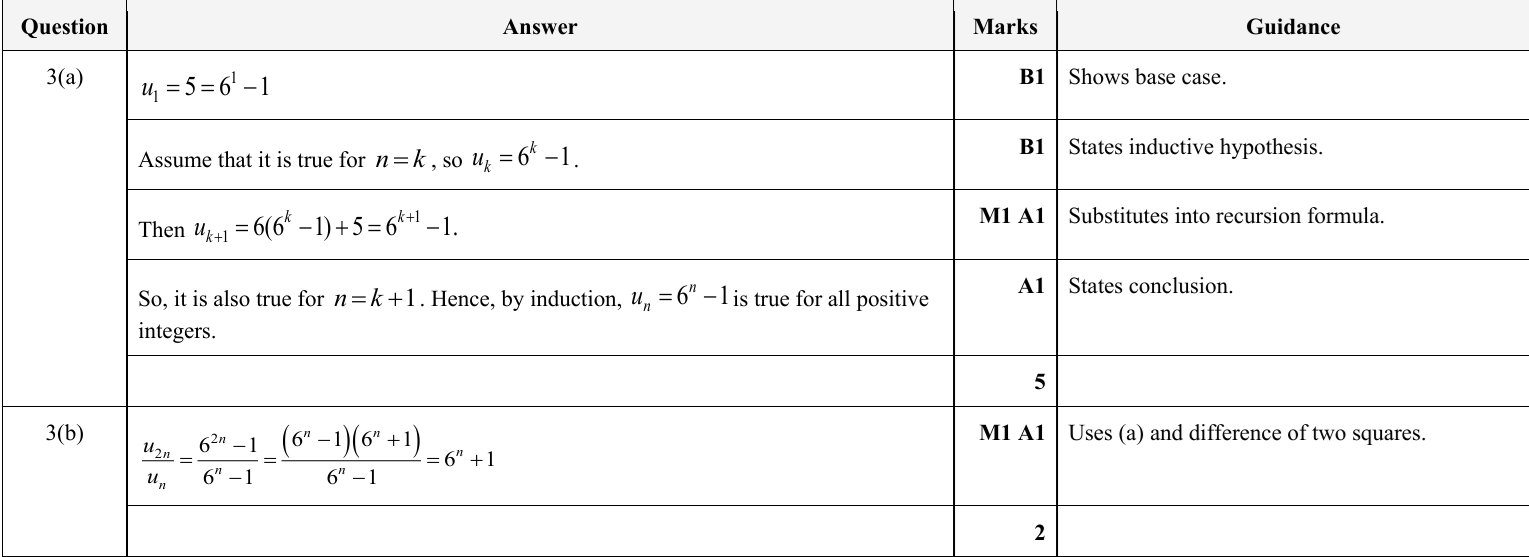
The sequence \(u_1, u_2, u_3, \ldots\) is such that \(u_1 = 5\) and \(u_{n+1} = 6u_n + 5\) for \(n \geq 1\).
(a) Prove by induction that \(u_n = 6^n - 1\) for all positive integers \(n\).
(b) Deduce that \(u_{2n}\) is divisible by \(u_n\) for \(n \geq 1\).
9231 P11 - Jun 2025 - Q03 - 7 marks
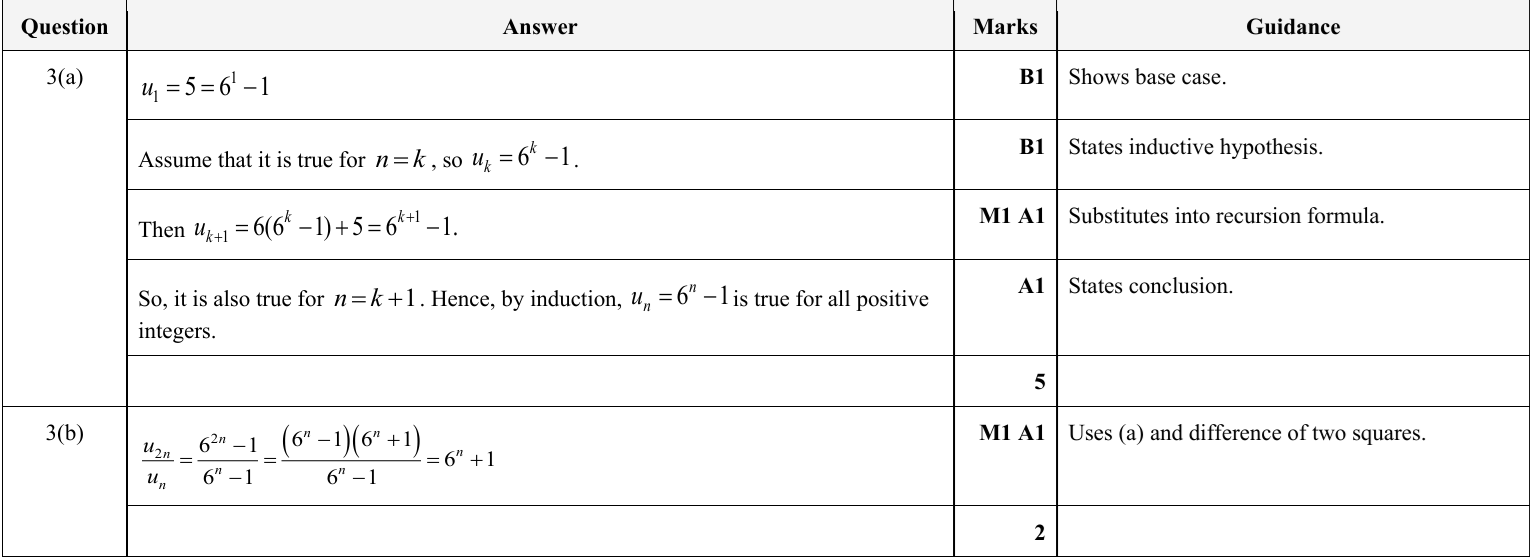
The sequence \(u_1, u_2, u_3, \ldots\) is such that \(u_1 = 5\) and \(u_{n+1} = 6u_n + 5\) for \(n \geq 1\).
(a) Prove by induction that \(u_n = 6^n - 1\) for all positive integers \(n\).
(b) Deduce that \(u_{2n}\) is divisible by \(u_n\) for \(n \geq 1\).
9231 P13 - Jun 2025 - Q02 - 6 marks
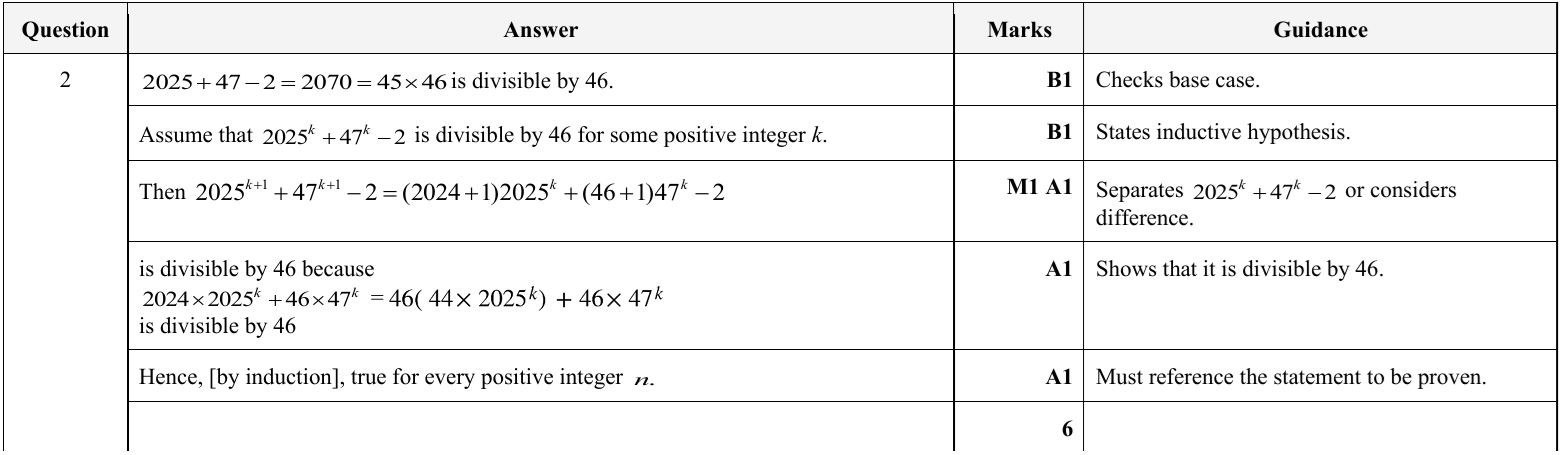
Prove by mathematical induction that \(2025^n + 47^n - 2\) is divisible by 46 for all positive integers \(n\).
9231 P11 - Jun 2024 - Q02 - 6 marks
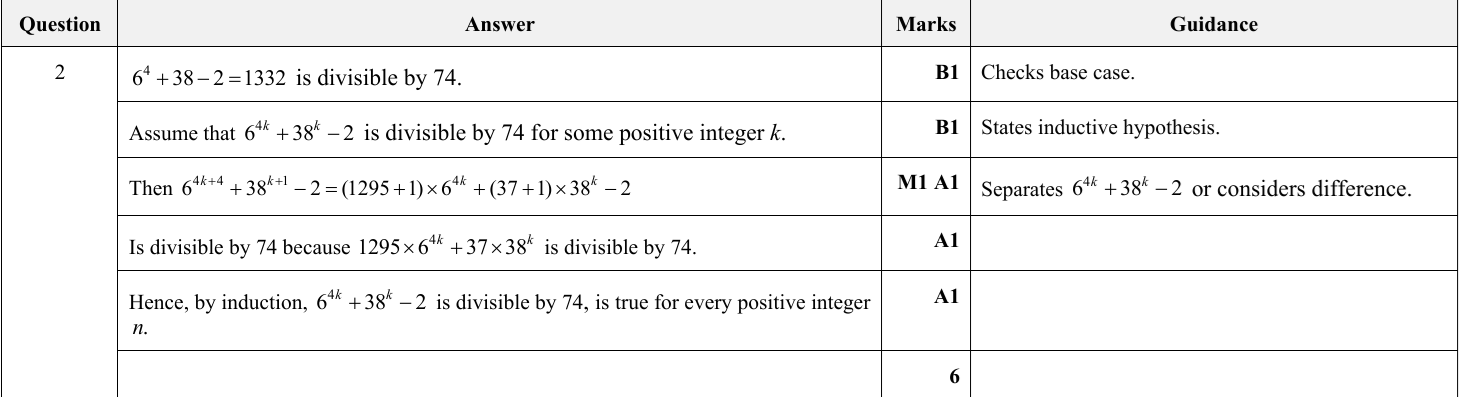
Prove by mathematical induction that \(6^{4n} + 38^n - 2\) is divisible by 74 for all positive integers \(n\). [6]
9231 P12 - Jun 2024 - Q02 - 6 marks
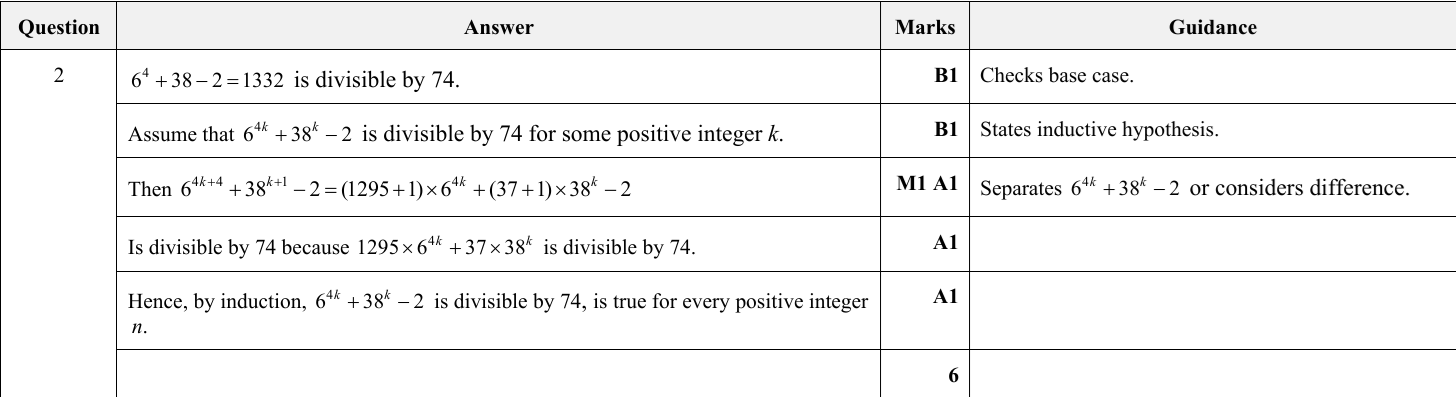
Prove by mathematical induction that \(6^{4n} + 38^n - 2\) is divisible by 74 for all positive integers \(n\).
9231 P13 - Jun 2023 - Q01 - 6 marks
Prove by mathematical induction that, for all positive integers n, \(5^{3n} + 32^n - 33\) is divisible by 31.

9231 P11 - Nov 2022 - Q02 - 6 marks
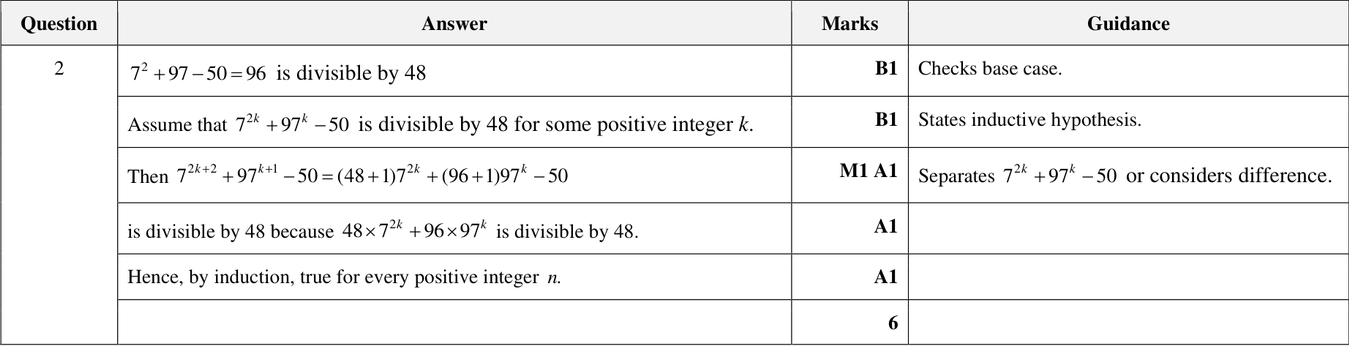
Prove by mathematical induction that, for all positive integers n, \(7^{2n} + 97^n - 50\) is divisible by 48. [6]
9231 P12 - Jun 2021 - Q01 - 6 marks
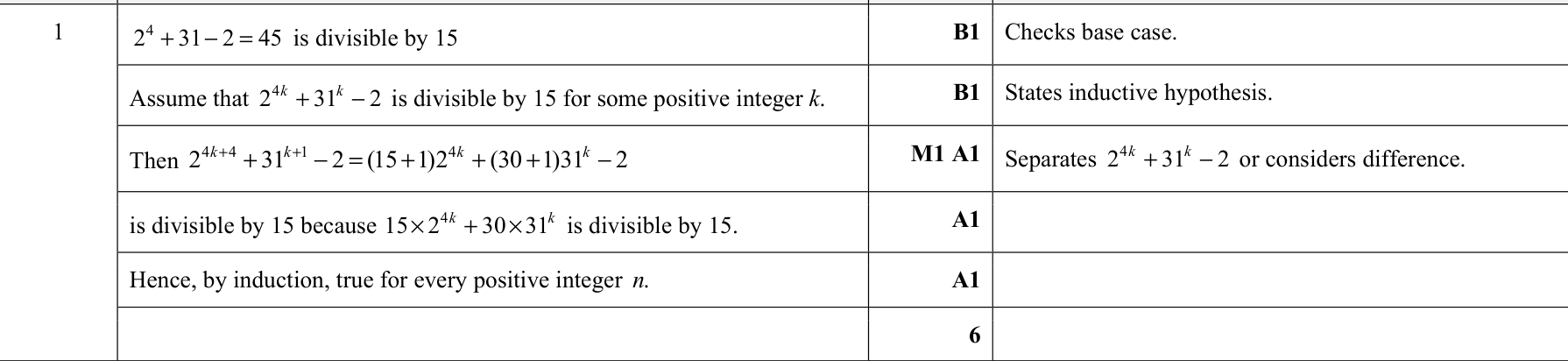
Prove by mathematical induction that \(2^{4n} + 3^{1n} - 2\) is divisible by 15 for all positive integers \(n\).
9231 P13 - Jun 2019 - Q1 - 5 marks
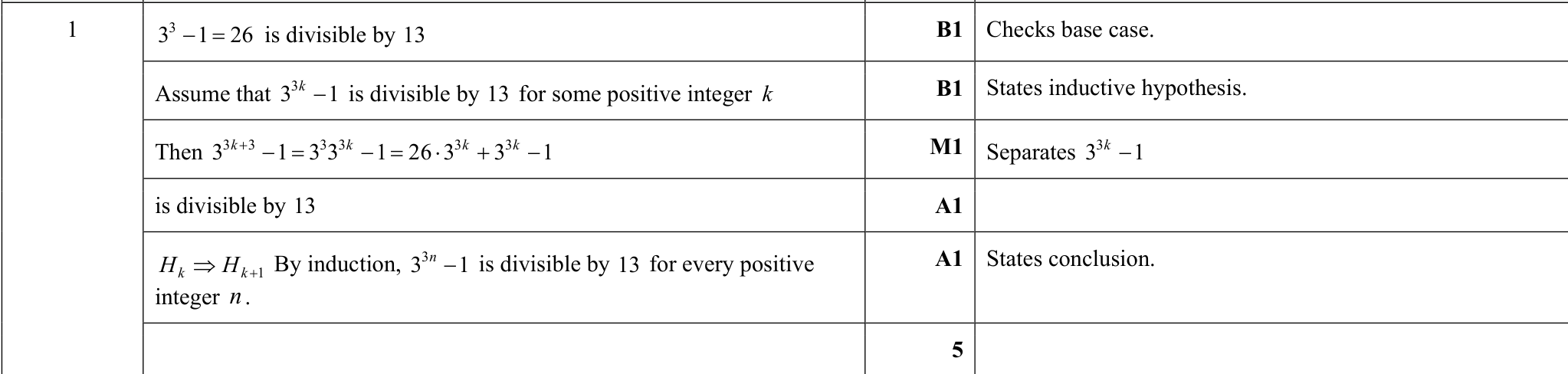
1 Prove by mathematical induction that \(3^{3 n}-1\) is divisible by 13 for every positive integer \(n\).
9231 P11 - Jun 2018 - Q2 - 6 marks
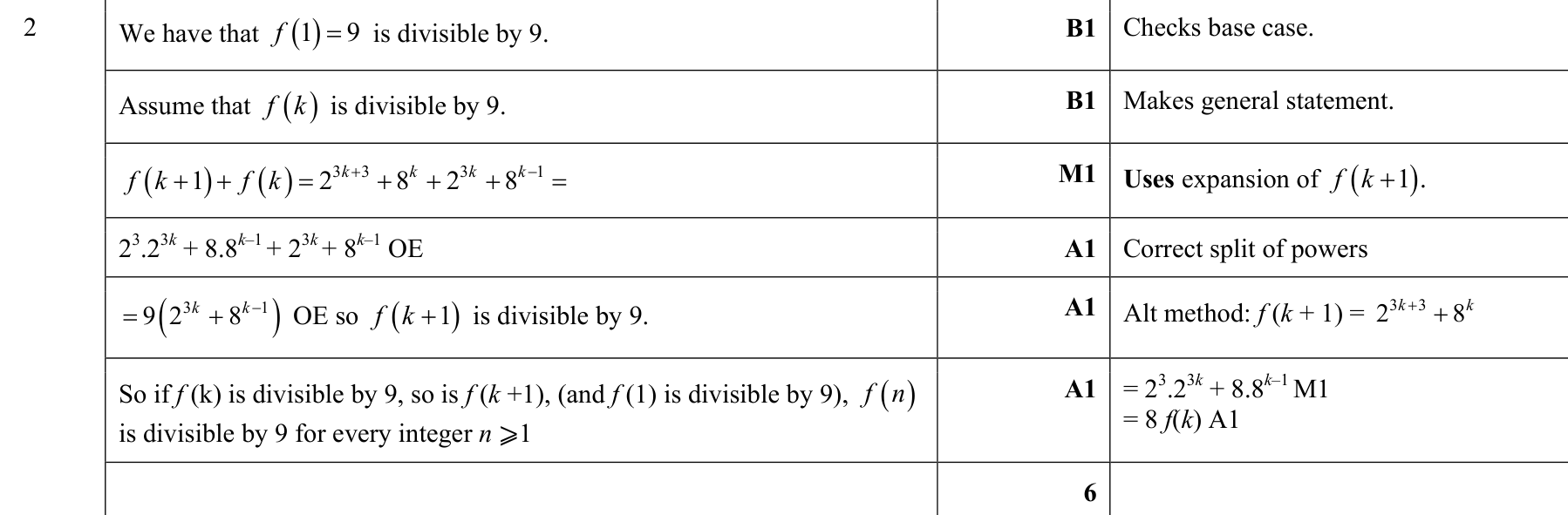
It is given that \(\mathrm{f}(n)=2^{3 n}+8^{n-1}\). By simplifying \(\mathrm{f}(k)+\mathrm{f}(k+1)\), or otherwise, prove by mathematical induction that \(\mathrm{f}(n)\) is divisible by 9 for every positive integer \(n\).
9231 P11 - Jun 2017 - Q2 - 5 marks
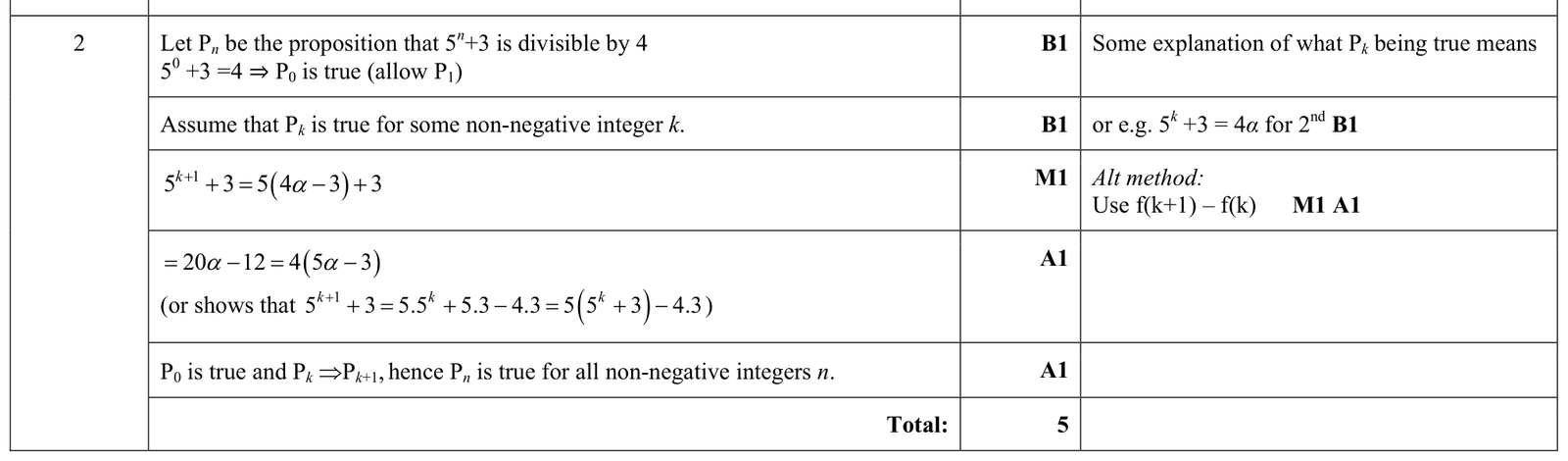
Prove, by mathematical induction, that \(5^{n}+3\) is divisible by 4 for all non-negative integers \(n\).
9231 P13 - Jun 2014 - Q3 - 7 marks
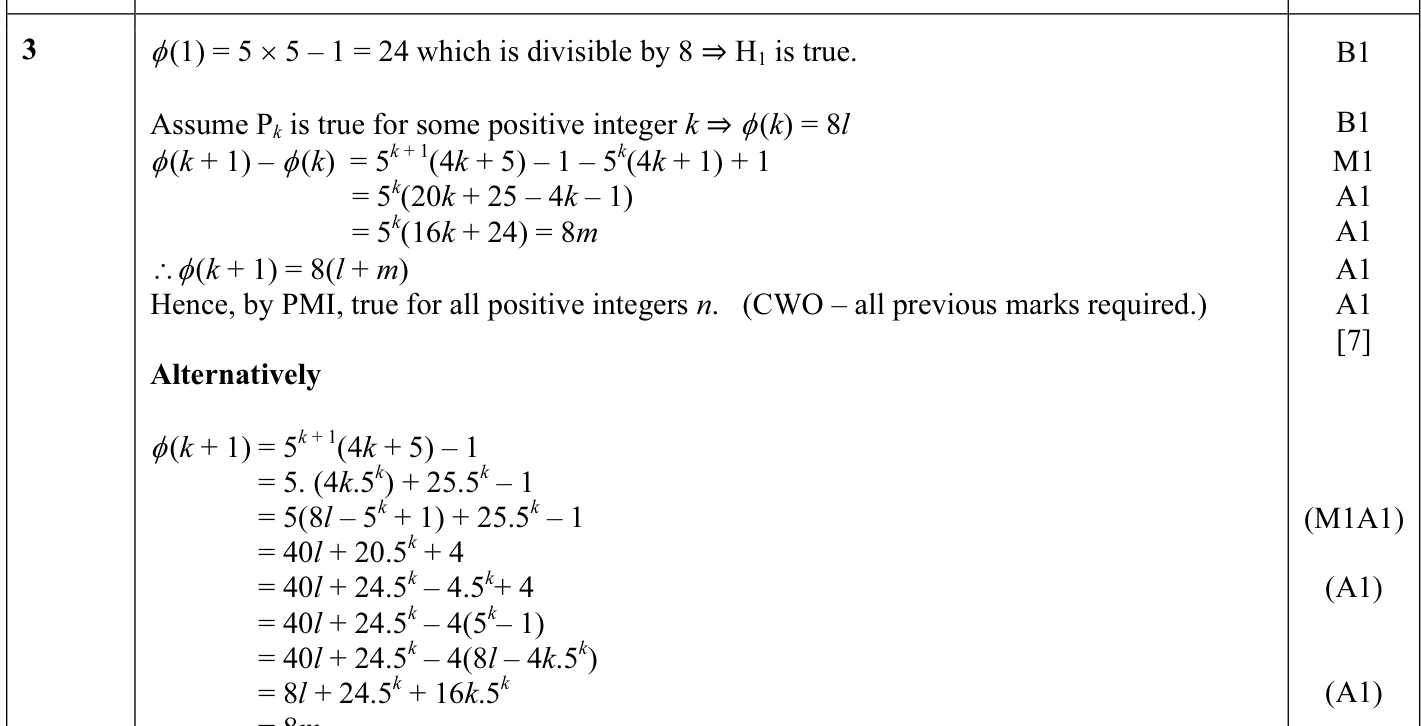
It is given that \(\phi(n)=5^{n}(4 n+1)-1\), for \(n=1,2,3, \ldots\). Prove, by mathematical induction, that \(\phi(n)\) is divisible by 8 , for every positive integer \(n\).
9231 P11 - Jun 2014 - Q3 - 6 marks
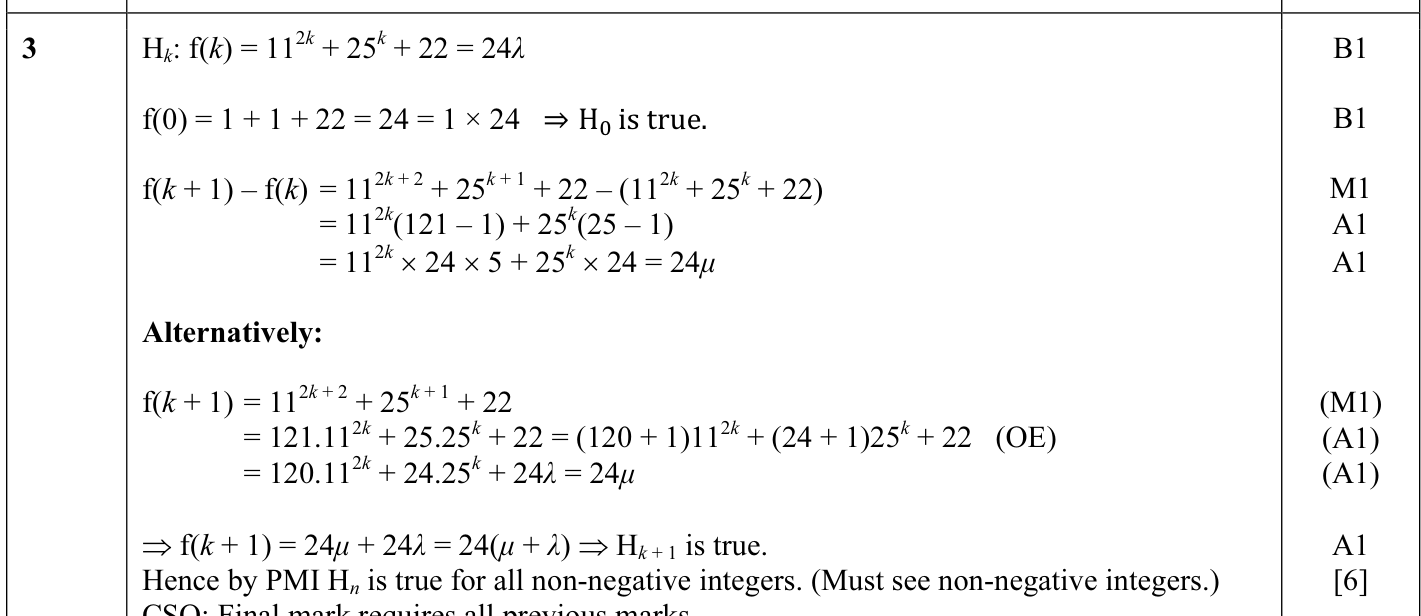
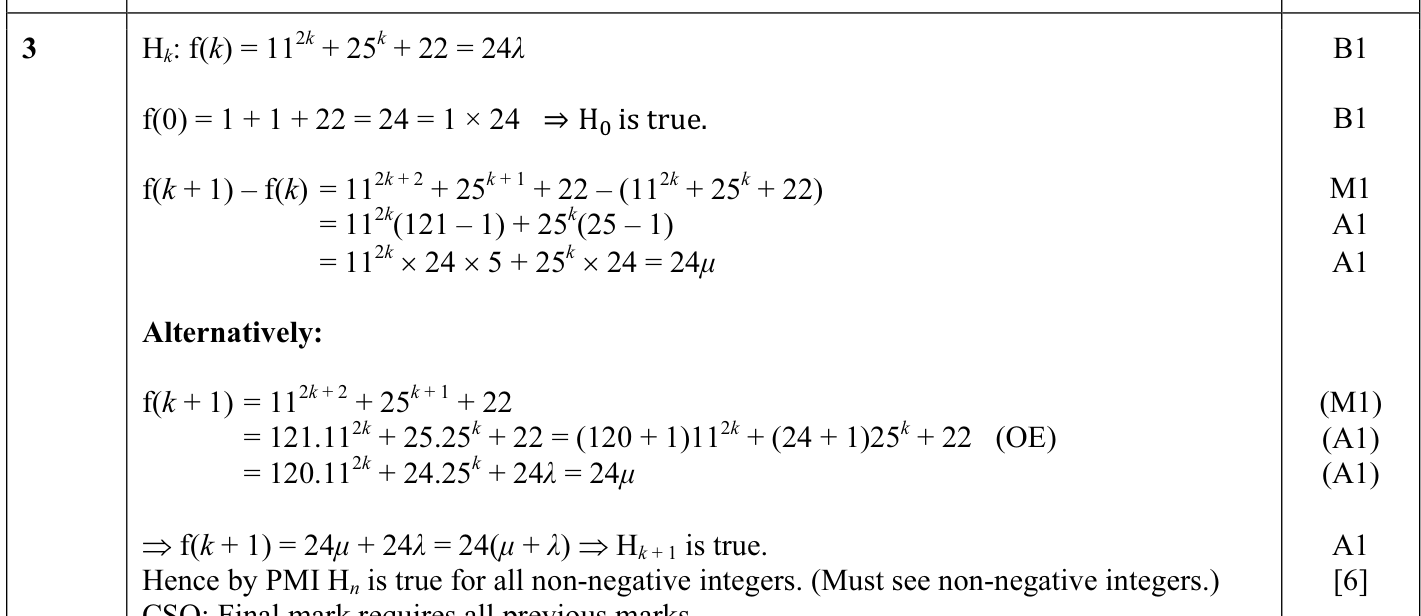
Prove by mathematical induction that, for all non-negative integers \(n\),
\(11^{2 n}+25^{n}+22\)
is divisible by 24 .
9231 P11 - Jun 2016 - Q3 - 6 marks
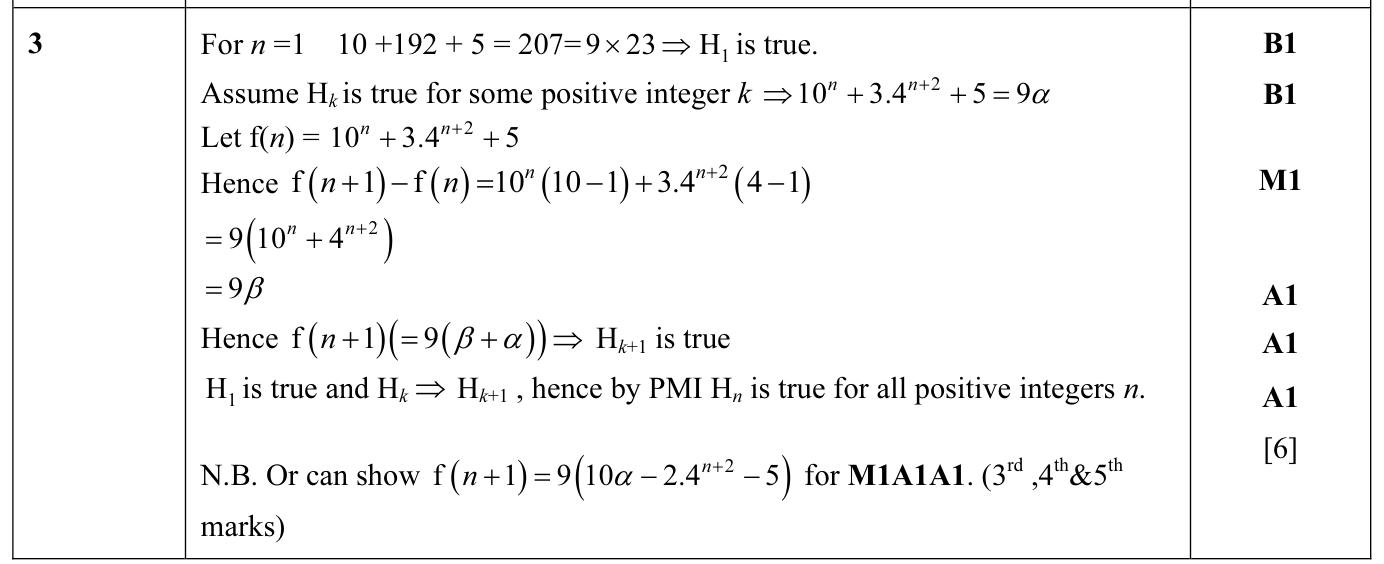
Prove by mathematical induction that, for all positive integers \(n, 10^{n}+3 \times 4^{n+2}+5\) is divisible by 9 .
9231 P11 - Jun 2013 - Q2 - 5 marks
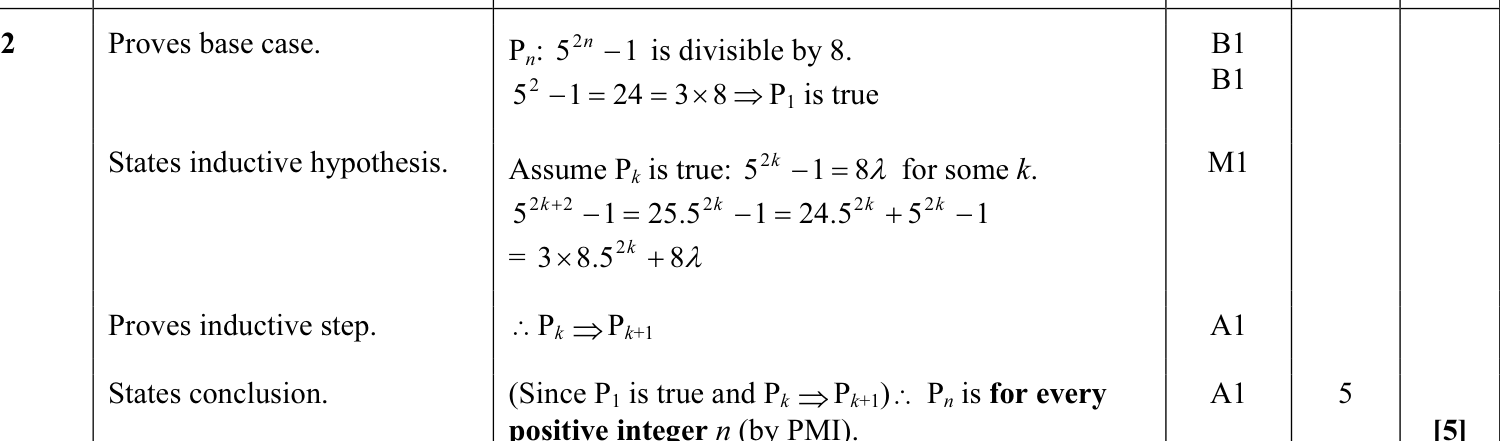
Prove by mathematical induction that \(5^{2 n}-1\) is divisible by 8 for every positive integer \(n\).
9231 P11 - Jun 2011 - Q4 - 6 marks
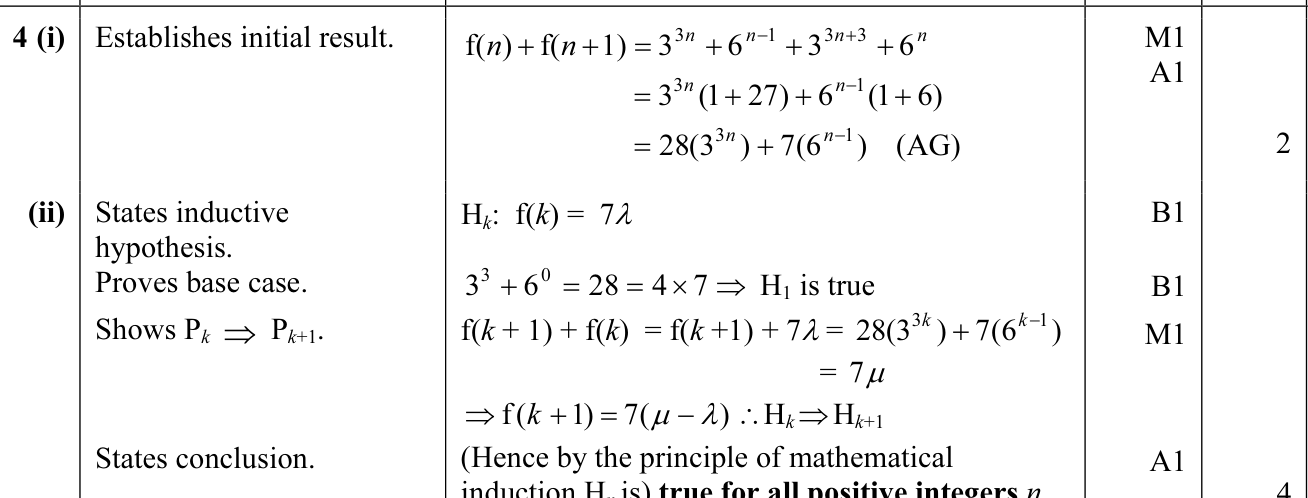
It is given that \(\mathrm{f}(n)=3^{3 n}+6^{n-1}\).
(i) Show that \(\mathrm{f}(n+1)+\mathrm{f}(n)=28\left(3^{3 n}\right)+7\left(6^{n-1}\right)\).
(ii) Hence, or otherwise, prove by mathematical induction that \(\mathrm{f}(n)\) is divisible by 7 for every positive integer \(n\).
9231 P12 - Jun 2014 - Q3 - 6 marks
Prove by mathematical induction that, for all non-negative integers \(n\),
\(11^{2 n}+25^{n}+22\)
is divisible by 24 .
9231 P11 - Nov 2018 - Q11 - 26 marks
Answer only one of the following two alternatives.
EITHER
(i) By considering \((2r+1)^2-(2r-1)^2\), use the method of differences to prove that
\(\sum_{r=1}^{n}r=\frac12n(n+1).\)
(ii) By considering \((2r+1)^4-(2r-1)^4\), use the method of differences and the result given in part (i) to prove that
\(\sum_{r=1}^{n}r^3=\frac14n^2(n+1)^2.\)
The sums \(S\) and \(T\) are defined as follows:
\(S=1^3+2^3+3^3+4^3+\cdots+(2N)^3+(2N+1)^3,\)
\(T=1^3+3^3+5^3+7^3+\cdots+(2N-1)^3+(2N+1)^3.\)
(iii) Use the result given in part (ii) to show that \(S=(2N+1)^2(N+1)^2\).
(iv) Hence, or otherwise, find an expression in terms of \(N\) for \(T\), factorising your answer as far as possible.
(v) Deduce the value of \(\dfrac ST\) as \(N\to\infty\).
OR
The curve \(C\) has equation \(x^2+2xy=y^3-2\).
(i) Show that \(A(-1,1)\) is the only point on \(C\) with \(x\)-coordinate equal to \(-1\).
For \(n\ge1\), let \(A_n\) denote the value of \(\dfrac{d^ny}{dx^n}\) at the point \(A(-1,1)\).
(ii) Show that \(A_1=0\).
(iii) Show that \(A_2=\dfrac25\).
Let \(I_n=\int_{-1}^{0}x^n\dfrac{d^ny}{dx^n}\,dx\).
(iv) Show that for \(n\ge2\),
\(I_n=(-1)^{n+1}A_{n-1}-nI_{n-1}.\)
(v) Deduce the value of \(I_3\) in terms of \(I_1\).

0606 P21 - Nov 2025 - Q5 - 5 marks
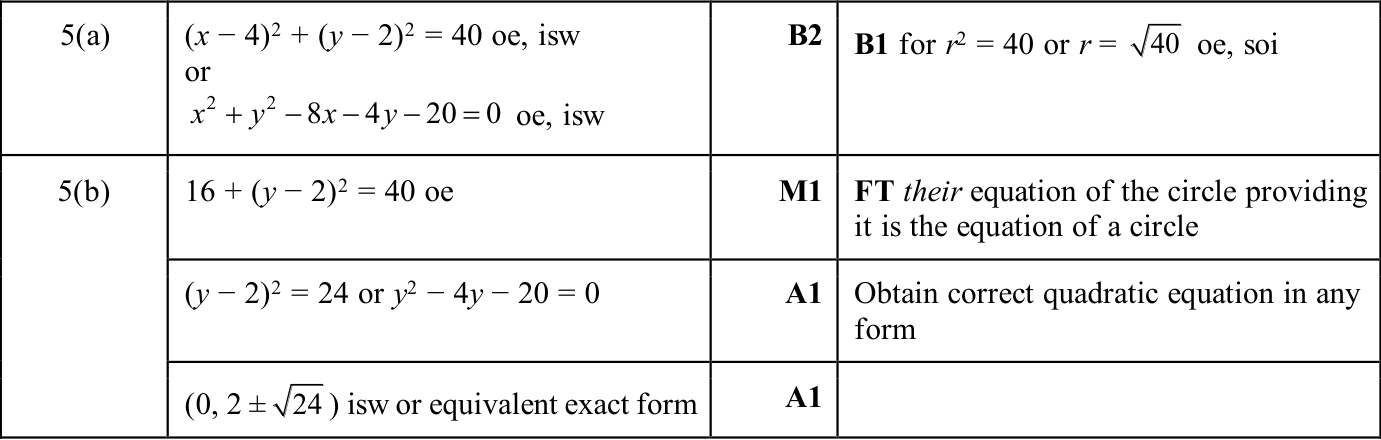
Solutions to this question by accurate drawing will not be accepted. A circle has centre \((4,2)\) and meets the \(x\)-axis at \((-2,0)\).
(a) Find the equation of the circle.
(b) Find, in exact form, the coordinates of the points where the circle meets the \(y\)-axis.
0606 P12 - Nov 2025 - Q7 - 6 marks
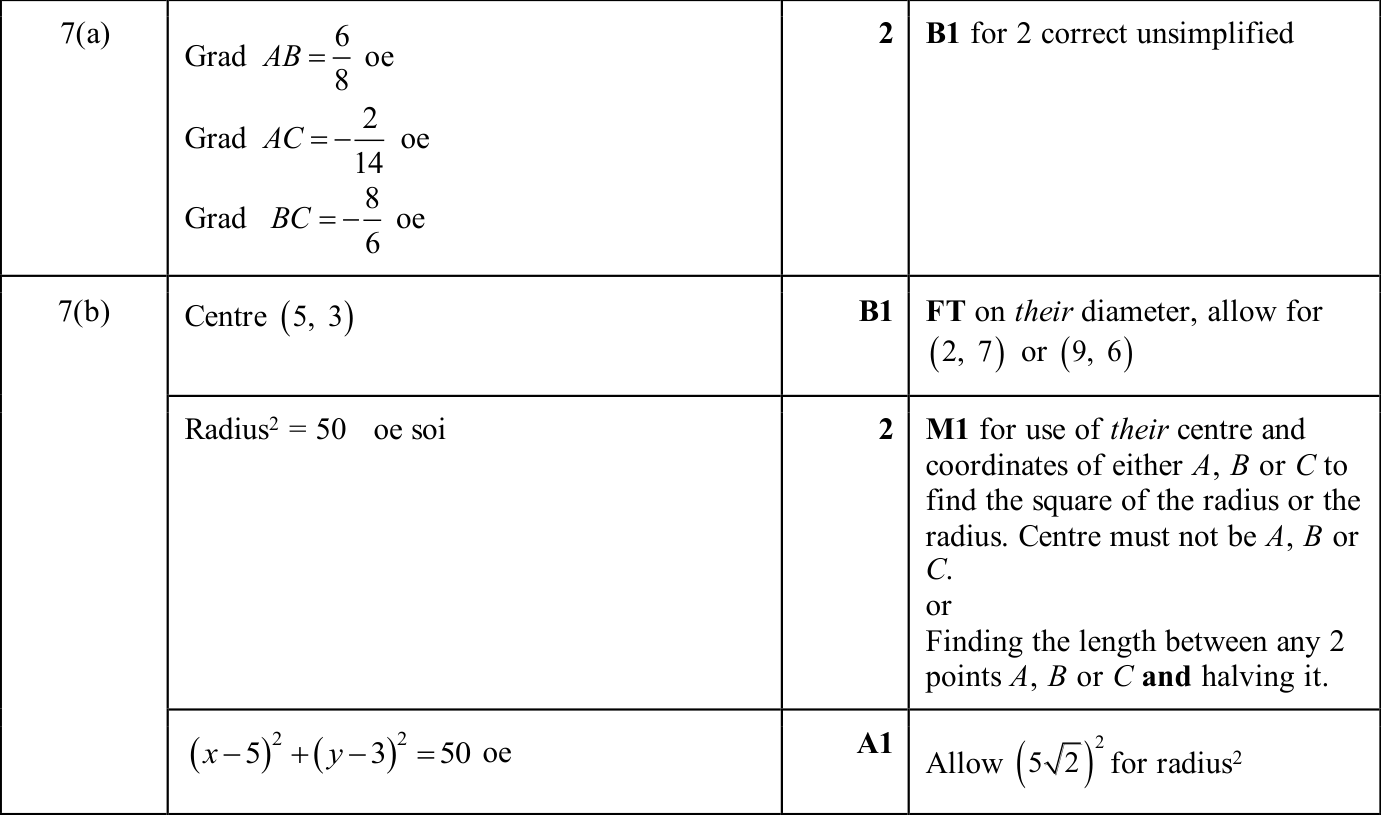
The point \(A\) has coordinates \((-2,4)\). The point \(B\) has coordinates \((6,10)\). The point \(C\) has coordinates \((12,2)\).
(a) Find the gradients of the lines \(AB\), \(AC\) and \(BC\).
(b) Hence find the equation of the circle which passes through the points \(A\), \(B\) and \(C\).