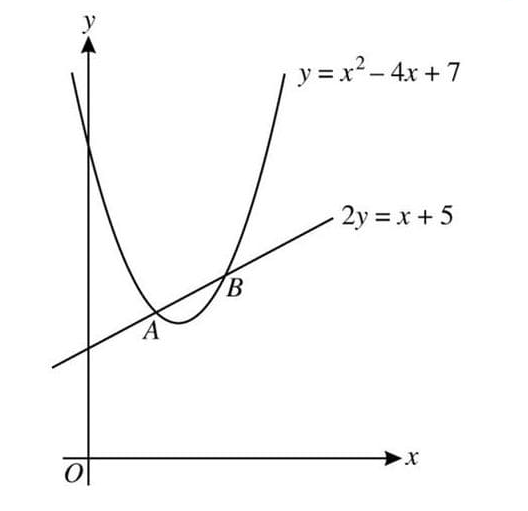
(a) To find the \(x\)-coordinates of \(A\) and \(B\), solve the simultaneous equations:
\(2y = x + 5\)
\(y = x^2 - 4x + 7\)
Substitute \(y = \frac{x + 5}{2}\) into the quadratic equation:
\(\frac{x + 5}{2} = x^2 - 4x + 7\)
Multiply through by 2 to eliminate the fraction:
\(x + 5 = 2x^2 - 8x + 14\)
Rearrange to form a quadratic equation:
\(2x^2 - 9x + 9 = 0\)
Factorize or use the quadratic formula to solve:
\(x = 3 \text{ or } x = \frac{1}{2}\)
(b) To find the equation of the tangent to the curve at \(B\), first find the derivative:
\(\frac{dy}{dx} = 2x - 4\)
At \(x = 3\), the gradient \(m\) is:
\(m = 2(3) - 4 = 2\)
The equation of the tangent at \(x = 3\) is:
\(y - 4 = 2(x - 3)\)
(c) To find the acute angle between the tangent and the line \(2y = x + 5\), first find the gradients:
The gradient of the line \(2y = x + 5\) is \(\frac{1}{2}\).
The angle \(\theta_1\) with the \(x\)-axis for the tangent is:
\(\arctan(2) \approx 63.4^\circ\)
The angle \(\theta_2\) with the \(x\)-axis for the line is:
\(\arctan\left(\frac{1}{2}\right) \approx 26.6^\circ\)
The acute angle between them is:
\(63.4^\circ - 26.6^\circ = 36.8^\circ\)
Rounded to 1 decimal place, the angle is \(37^\circ\).